2.3 Graphing functions with technology questions for IB Maths AI
33 questions on Graphing functions with technology, written by Augment in the style of IB exam papers. Six of them are below in full, to answer on paper.
- IB Mathematics: Applications and Interpretation
- Part of 2 Functions
- SL and HL
Questions by paper and level
SL and HL questions are for students at either level. HL only questions cover what only HL students study.
| Paper | SL and HL | HL only | All |
|---|---|---|---|
| Paper 1 | 17 | 0 | 17 |
| Paper 2 | 16 | 0 | 16 |
| Every paper | 33 | 0 | 33 |
Counted on
Questions to try
Written by Augment in the style of IB exams, not past papers. Answer them on paper, then check each one against its markscheme with a free account.
A museum opens a new dinosaur exhibition. The number of visitors to the exhibition, thousand per week, weeks after it opens, can be modelled by
- (a)
Sketch the graph of for , labelling the maximum point with its coordinates.
3 marks
- (b)
Write down the greatest number of visitors in one week, according to the model.
1 mark
- (c)
Find the values of for which there are visitors per week.
2 marks
After Lukas takes one dose of a painkiller, the concentration of the drug in his blood, milligrams per litre (), hours after the dose, is modelled by
- (a)
Find the concentration one hour after the dose.
1 mark
- (b)
Find the maximum concentration and the time at which it occurs.
2 marks
- (c)
Sketch the graph of for , labelling the maximum point and the endpoints with their coordinates.
3 marks
- (d)
The painkiller is effective when its concentration is at least .
Find the length of time for which one dose is effective.
3 marks
- (e)
Lukas takes a second, identical dose 4 hours after the first. For the total concentration is
Show that , correct to three significant figures.
2 marks
- (f)
Find the maximum total concentration for and the time at which it occurs.
3 marks
- (g)
The concentration should not be above . Find the length of time for which the total concentration is above this level.
3 marks
- (h)
Find the total length of time, from the first dose, for which the concentration is at least .
2 marks
Femi is investigating how bright a lamp appears at different distances. The intensity of the light, lux, at a distance of metres from the lamp is given by , for .
The following table shows some values of .
(m) | 1 | 1.5 | 2 | 3 | 4 | 5 | 6 |
|---|---|---|---|---|---|---|---|
(lux) | 36 | 9 | 2.25 | 1.44 | 1 |
- (a)
Find the value of and the value of .
2 marks
- (b)
On the following grid, draw the graph of for .
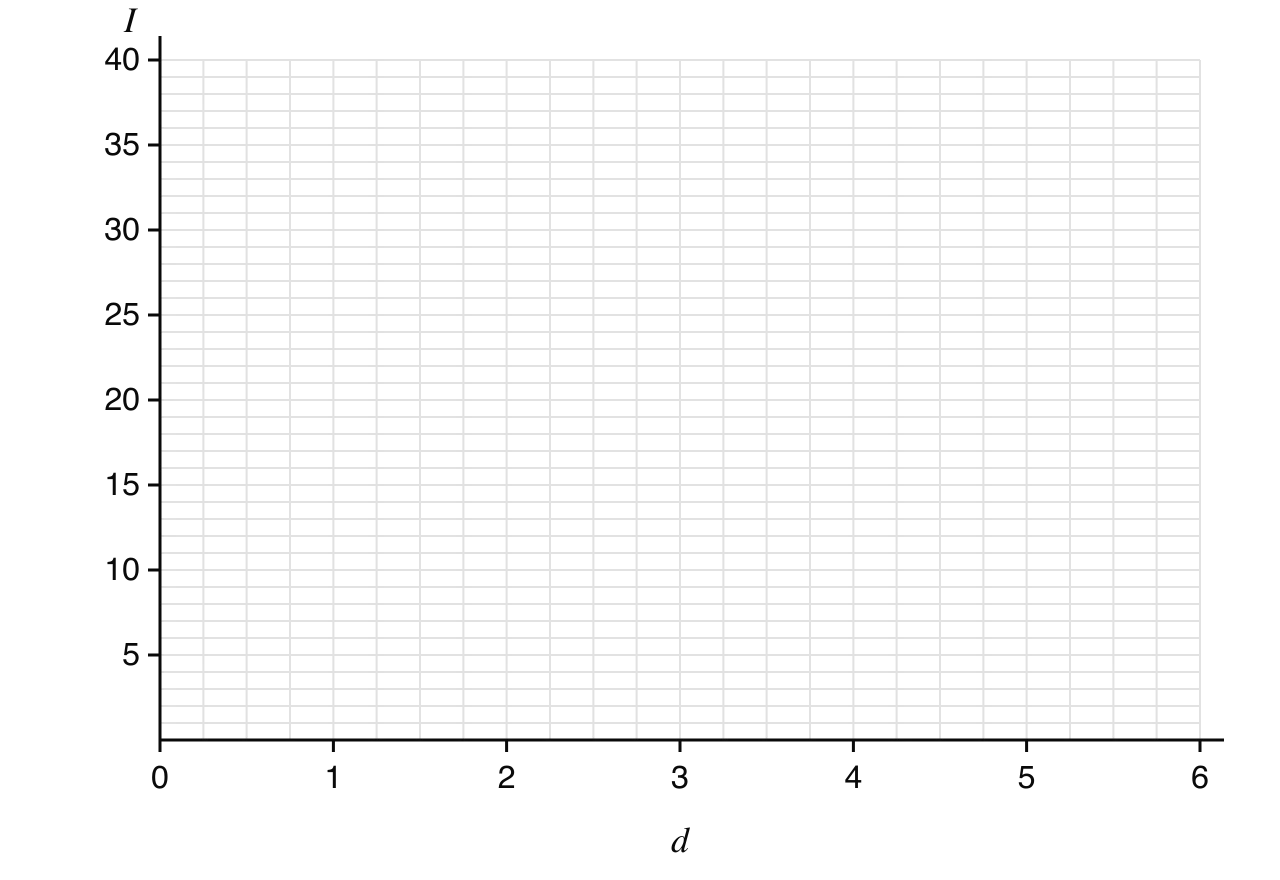
3 marks
- (c)
Use your graph to estimate the distance from the lamp at which the intensity is 6 lux.
1 mark
A swimming pool has a horizontal floor and is in the shape of a cuboid, long and wide. The pool is empty.
At 07:00, pipe A starts to fill the pool and the depth of the water increases at a constant rate of per hour. At 10:00, pipe B is also turned on, and from then the depth increases at a constant rate of per hour. When the depth reaches , both pipes are turned off.
Let be the depth of the water, in metres, hours after 07:00.
- (a)
Write down the depth of the water at 10:00.
1 mark
- (b)
Find the time of day at which the pipes are turned off.
2 marks
- (c)
Sketch the graph of against for , labelling the coordinates of the points where the rate of change of the depth changes.
3 marks
- (d)
Find an equation for in terms of for .
2 marks
- (e)
A swimming lesson can begin once the depth is at least . Find the earliest time of day at which the lesson can begin.
2 marks
- (f)
Find the volume of water in the pool when the pipes are turned off.
2 marks
- (g)
Find the rate, in per hour, at which pipe B delivers water.
3 marks
Hannah pours a cup of tea at and leaves it on her desk in a room kept at a constant . The tea cools quickly at first and then more and more slowly, getting closer and closer to the temperature of the room.
Let be the temperature of the tea, in , minutes after it was poured.
- (a)
Sketch a graph of against for . Label clearly the value where the graph meets the -axis and the equation of any asymptote.
3 marks
- (b)
The temperature of the tea can be modelled by .
Find the time it takes for the tea to cool to .
2 marks
- (c)
Hannah claims that, according to the model, the tea will eventually cool to . Explain why she is wrong.
1 mark
The temperature inside a greenhouse in Almería, , hours after 06:00, is modelled by
- (a)
Write down the temperature at 06:00.
1 mark
- (b)
Find the coordinates of
(i) the local maximum point of the graph of ;
(ii) the local minimum point of the graph of .
4 marks
- (c)
Sketch the graph of for , labelling the endpoints and the points found in part (b).
3 marks
- (d)
Write down the range of temperatures in the greenhouse during this period.
2 marks
- (e)
A fan switches on whenever the temperature is above . Find the times of day at which the fan switches on and off. Give your answers to the nearest minute.
4 marks
- (f)
Ines wants to use the model to predict the temperature at 20:00. Find and comment on her plan.
2 marks
Practice all 33 in Augment
Free with an account. Every question has its markscheme, and Augment keeps the ones you got wrong so you can come back to them.
More questions in Functions
- 2.1Equations of straight lines
- 2.2Functions, domain and range
- 2.3Graphing functions with technologyThis page
- 2.4Key features of graphs
- 2.5Modelling with functions
- 2.6The modelling process
- 2.7Composite and inverse functionsHL only
- 2.8Transformations of graphsHL only
- 2.9Further modellingHL only
- 2.10Scaling very large and small numbers using logarithmsHL only
Check your answers in Augment
A free account opens all 33 questions on Graphing functions with technology with their markschemes, and keeps a record of what you have marked.