2.1 Equations of straight lines questions for IB Maths AI
60 questions on Equations of straight lines, written by Augment in the style of IB exam papers. Six of them are below in full, to answer on paper.
- IB Mathematics: Applications and Interpretation
- Part of 2 Functions
- SL and HL
Questions by paper and level
SL and HL questions are for students at either level. HL only questions cover what only HL students study.
| Paper | SL and HL | HL only | All |
|---|---|---|---|
| Paper 1 | 24 | 3 | 27 |
| Paper 2 | 31 | 0 | 31 |
| Paper 3HL only | 0 | 2 | 2 |
| Every paper | 55 | 5 | 60 |
Counted on
Questions to try
Written by Augment in the style of IB exams, not past papers. Answer them on paper, then check each one against its markscheme with a free account.
A taxi company in Lisbon charges a fixed fee of 3.20 euros (EUR) plus 1.85 EUR per kilometre travelled. The cost, in EUR, of a journey of kilometres is given by
- (a)
Find an expression for .
2 marks
- (b)
Find and interpret your answer in context.
2 marks
A public swimming pool is 25 metres long and 10 metres wide. The graph shows the depth of water, metres, at a horizontal distance metres from the shallow end of the pool.
- 0 ≤ x ≤ 5
- 5 < x ≤ 15
- 15 < x ≤ 25
The depth of water is constant for the first 5 metres. It then increases at a constant rate until , and is constant again from to .
- (a)
Find the gradient of the graph for .
2 marks
- (b)
Write down a piecewise function for in terms of , for .
3 marks
- (c)
A swimming coach marks the point along the pool where the depth of water is 2 metres. Find the distance of this point from the shallow end.
2 marks
- (d)
Show that the volume of water in the pool is m³.
4 marks
- (e)
The time, hours, taken to fill the empty pool is inversely proportional to the number of pumps, , that are used. Using 3 pumps, the pool is filled in 25 hours.
(i) Find an equation for in terms of .
(ii) Find the least number of pumps needed to fill the pool in less than 10 hours.
4 marks
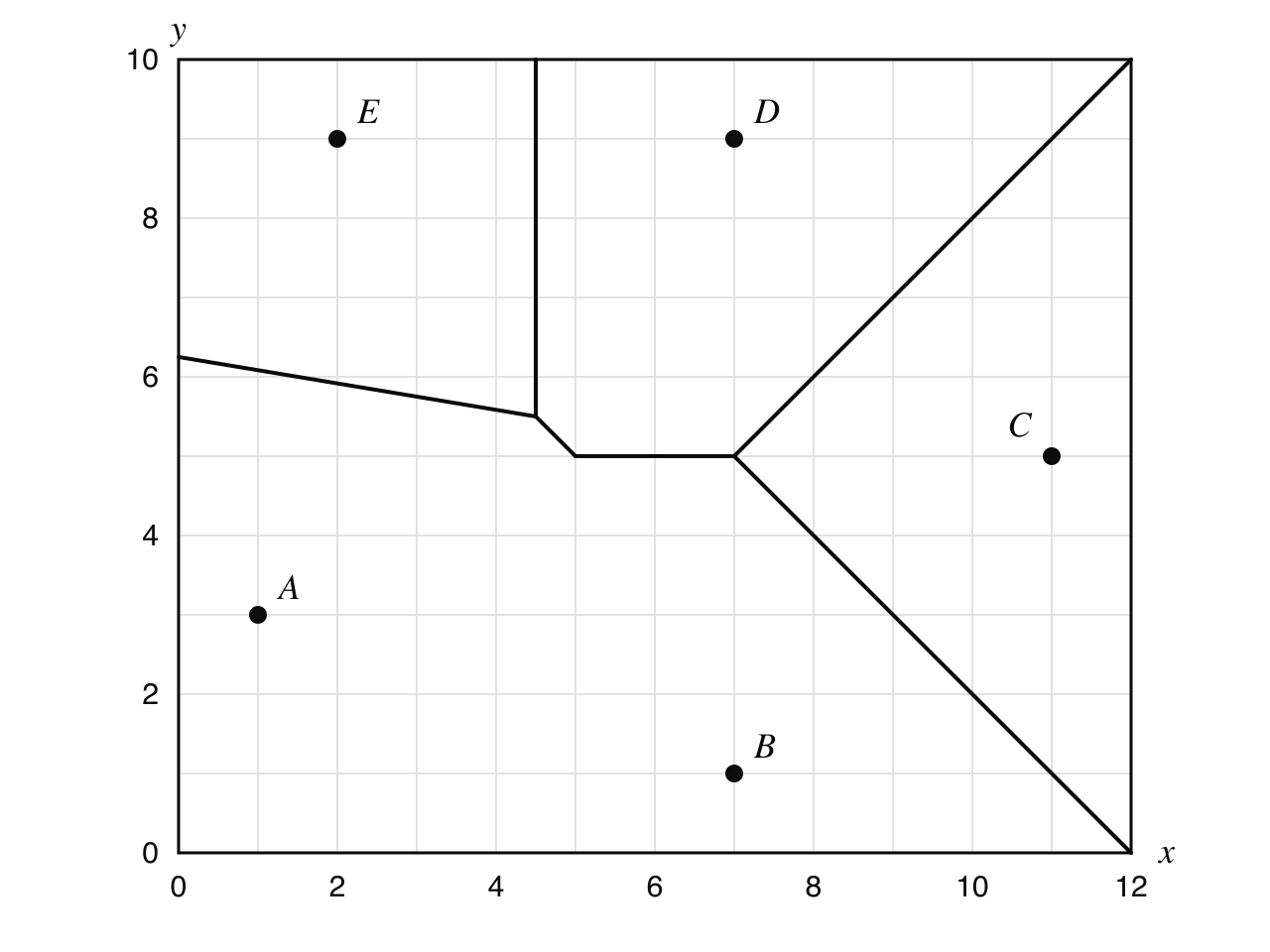
The purpose of this question is to use Voronoi diagrams to help a city council decide where to build a new public library.
Mehmet is a planner for a city whose boundary is modelled by the rectangle , , where one unit represents 1 km. The city has five libraries, at , , , and . Residents are assumed to use the library nearest to their home.
The following diagram shows the libraries and part of the Voronoi diagram for the five libraries. The edge between the cells of and is missing.
- (a)
Find the equation of the perpendicular bisector of . Give your answer in the form .
4 marks
- (b)
Show that the point is equidistant from , and .
3 marks
- (c)
Hence find the coordinates of the end points of the missing edge.
2 marks
- (d)
The council wants to build a new library at the point in the city that is furthest from its nearest existing library. A councillor claims that this point must be a vertex of the Voronoi diagram.
The vertices of the Voronoi diagram are , and .
For each vertex, find the distance to its nearest library. Hence state which vertex the councillor would choose.
3 marks
- (e)
By considering the corner of the city, show that the councillor's claim is incorrect.
2 marks
- (f)
Suggest one reason why the council might still prefer to build the new library at .
1 mark
- (g)
The council builds library at .
(i) Write down the equation of the perpendicular bisector of .
(ii) Find the equation of the perpendicular bisector of .
3 marks
- (h)
In the new Voronoi diagram, the cell of is a pentagon with vertices , , , and . The point is the intersection of the perpendicular bisectors of and , which have equations and .
Find the coordinates of .
2 marks
- (i)
The area of a polygon with vertices , listed in order around the polygon, is
Use this formula to find the area of the cell of .
4 marks
- (j)
The population density of the city is approximately 1800 people per km².
Estimate the number of residents who will use library .
2 marks
- (k)
State one reason why the actual number of people using library may be different from this estimate.
1 mark
On a map of the Kestrel Valley nature reserve, distances are measured in kilometres. A straight footpath passes through the points A and B.
- (a)
Find the gradient of the footpath.
2 marks
- (b)
Find the equation of the line through A and B. Give your answer in the form .
2 marks
- (c)
A bird hide is located at the point C. Determine whether the bird hide lies on the footpath.
2 marks
Two secondary schools, Palmer High at P(2, 9) and Quayside Academy at Q(12, 3), are shown on a map with a coordinate grid. One unit represents one kilometre.
- (a)
Find the coordinates of the midpoint of [PQ].
2 marks
- (b)
Find the equation of the perpendicular bisector of [PQ]. Give your answer in the form , where .
4 marks
- (c)
A straight road runs from the town hall at T(0, 1) along the line . A bus stop S is to be built on this road so that it is equidistant from the two schools.
Find the coordinates of S.
3 marks
- (d)
Find the distance from S to Palmer High.
2 marks
- (e)
Students go to the school nearer to their home. Determine which school a student living at H(10, 8) attends.
2 marks
- (f)
A school bus travels from T to S along the road at an average speed of 36 km h−1. Find the time taken, in minutes.
3 marks
This question explores how logarithms and matrices can be used to locate an animal from the strength of a radio signal.
Batbayar is an ecologist studying snow leopards in the Altai mountains of Mongolia. One leopard wears a collar that sends out a radio signal. Three receiving towers, , and , are at the points , and on a map, where units are kilometres.
The strength of the signal received by a tower, decibel-milliwatts (dBm), is modelled by
where km is the distance from the collar to the tower. At one moment the three towers receive the following signal strengths.
Tower | |||
|---|---|---|---|
(dBm) | −56.5 | −54.0 | −54.6 |
- (a)
Show that , and hence find the distance from the collar to .
3 marks
- (b)
Find the distance from the collar to and the distance from the collar to .
2 marks
- (c)
Using the signals at and only, the collar lies on both of the circles
Use technology to find the two possible positions of the collar.
3 marks
- (d)
Explain how the signal at shows which of these positions is correct.
1 mark
- (e)
To avoid solving non-linear equations, Batbayar uses the third circle, , as well.
By subtracting equations, show that
2 marks
- (f)
The equations in part (e) can be written as .
Write down the matrix and find the vector .
2 marks
- (g)
Use to find the position of the collar.
3 marks
- (h)
Show that . Explain why this method would fail if the three towers were in a straight line.
2 marks
- (i)
Batbayar notices that if , the first equation in part (e) becomes .
State the geometrical meaning of the line in relation to the towers and , and explain why the collar must lie on it in this case.
2 marks
- (j)
Each tower measures signal strength to within 0.5 dBm of the true value.
Find the largest percentage error in the distance from the collar to that this could cause.
3 marks
- (k)
A GPS reading later shows that the leopard was at at that moment.
Find the distance between this position and the position found in part (g), giving your answer in metres.
2 marks
- (l)
Suggest one reason why the model for the signal strength may be less reliable in the mountains.
1 mark
Practice all 60 in Augment
Free with an account. Every question has its markscheme, and Augment keeps the ones you got wrong so you can come back to them.
More questions in Functions
- 2.1Equations of straight linesThis page
- 2.2Functions, domain and range
- 2.3Graphing functions with technology
- 2.4Key features of graphs
- 2.5Modelling with functions
- 2.6The modelling process
- 2.7Composite and inverse functionsHL only
- 2.8Transformations of graphsHL only
- 2.9Further modellingHL only
- 2.10Scaling very large and small numbers using logarithmsHL only
Check your answers in Augment
A free account opens all 60 questions on Equations of straight lines with their markschemes, and keeps a record of what you have marked.