2.1 Equations of straight lines · IB Maths AI | Augment Education
2.1 Equations of straight lines
Find gradients and intercepts, write the equation of a straight line in gradient-intercept, point-gradient and general form, use parallel and perpendicular gradients, and describe the steepness of real inclines.
IB Mathematics: Applications and Interpretation
Part of 2 Functions
SL and HL
Key terms introduced here
Each is in the Maths AI glossary, with every other term in the subject.
The equation of a straight line written as ax+by+d=0
Notes on 2.1 Equations of straight lines
37 min readLast reviewed
Learning objectives
Calculate the gradient of a straight line from two points, from a graph or from its equation.
Calculate the gradient of a real incline, such as a road, railway or ramp, as a ratio, a percentage grade and an angle.
Find the x-intercept and y-intercept of a straight line.
Write down the equation of a line in gradient-intercept form y=mx+c, point-gradient form y−y1=m(x−x1)
Questions on 2.1
60 exam-style questions on this subtopic, written in the style of the IB papers. The first has its markscheme open. Counted on
Question 1 · AI-00019HL only · 4 marks
A taxi company in Lisbon charges a fixed fee of 3.20 euros (EUR) plus 1.85 EUR per kilometre travelled. The cost, in EUR, of a journey of d kilometres is given by
F(d)=3.20+1.85d,d≥0.
From the formula booklet
The entries of the mathematics: applications and interpretation formula booklet that 2.1 uses. Each opens in the explained booklet.
For a non-zero number m, the number −m1, found by turning m upside down and changing its sign; it is the gradient of any line perpendicular to a line of gradient m.
The point where a graph crosses the y-axis, found by substituting x=0; its y-coordinate is often called the y-intercept as well.
and general form
ax+by+d=0
, and convert between them.
Find the equation of a line through a given point with a given gradient, or through two given points.
Determine whether two lines are parallel, perpendicular or neither, using m1=m2 and m1×m2=−1.
Find the equation of a line parallel or perpendicular to a given line, including the perpendicular bisector of a line segment.
Interpret the gradient and the y-intercept of a straight line in a real context.
Introduction
A straight line is the simplest relationship between two quantities: every time one quantity increases by a fixed amount, the other changes by a fixed amount too. Taxi fares that grow by the same sum for every kilometre, a temperature scale converted into another, and the steady climb of a ramp all follow straight lines. Two numbers describe such a line completely: how steep it is (its gradient) and where it crosses the vertical axis (its y-intercept).
The same line can be written in several equivalent ways, and each form suits a different job: reading the gradient at a glance, building an equation from one known point, or recording an answer with whole-number coefficients. Straight lines reappear in many later subtopics: as linear models in subtopic 2.5, as regression lines in subtopic 4.4, as tangents and normals in subtopic 5.4, and as the boundaries between regions of a Voronoi diagram in subtopic 3.6.
Gradient
Rise over run
The gradient of a line measures its steepness: how far the line goes up (or down) for each unit it moves to the right. Moving from one point on a line to another involves a horizontal change, called the run, and a vertical change, called the rise. Dividing the rise by the run gives the vertical change for every one unit of horizontal change.
For two points (x1,y1) and (x2,y2) the rise is y2−y1 and the run is x2−x1. Dividing one by the other gives the gradient formula.
m=x2−x1y2−y1
The letter m for gradient is a standard convention. The order of subtraction does not matter, as long as it is the same on the top and the bottom: x1−x2y1−y2 gives the same value, because both the numerator and the denominator change sign.
Why the gradient is the same everywhere on a line
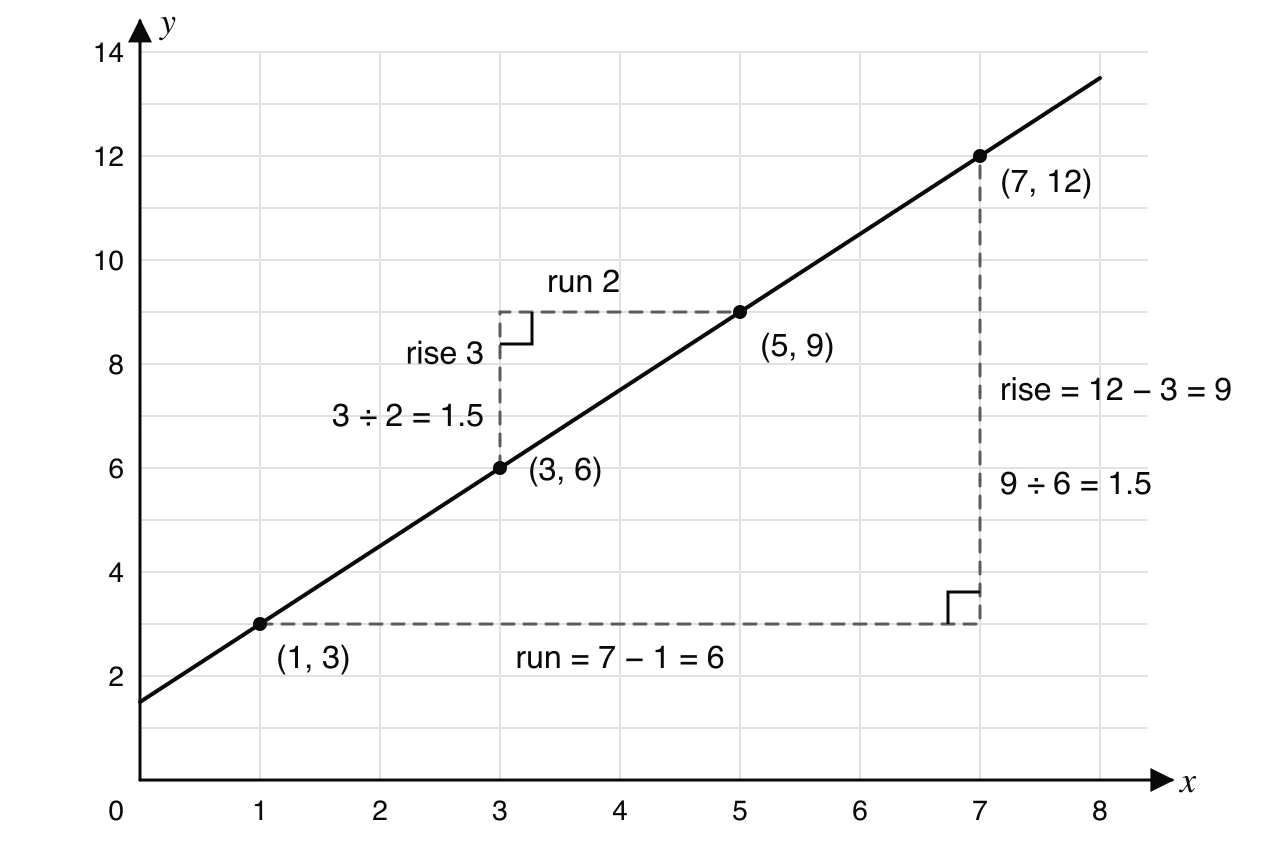
A straight line has one gradient, wherever on it the two points are chosen. Any two gradient triangles drawn on the same line are similar: they have the same angles, because their horizontal sides are parallel, their vertical sides are parallel and their sloping sides lie on the same line. In similar triangles the ratio of corresponding sides is fixed, so rise ÷ run is the same for every triangle. This property is what makes a line straight, and it is why a single number can describe its steepness.
A large and a small gradient triangle on the same line give the same ratio: 9 ÷ 6 = 3 ÷ 2 = 1.5.
The two triangles on the line through (1,3) and (7,12) have very different sizes, but the rise is always one and a half times the run. A curve has no such property: its steepness changes from point to point, and measuring the steepness of a curve at a single point is the subject of calculus (subtopic 5.1).
Positive, negative, zero and undefined gradients
The sign of the gradient shows the direction of the line. A line that rises from left to right has a positive gradient; one that falls from left to right has a negative gradient. A horizontal line has rise 0 for every run, so its gradient is 0. A vertical line has run 0, and division by zero is not defined, so a vertical line has no defined gradient. The larger the size of the gradient (ignoring its sign), the steeper the line: a line with gradient −5 is steeper than one with gradient 2.
y = 2x + 1 (gradient 2)
y = −0.5x + 4 (gradient −0.5)
y = −2 (gradient 0)
A rising line has a positive gradient, a falling line a negative one, a horizontal line gradient 0, and a vertical line has no defined gradient.
Line
Rise for a run of 1
Gradient
rises from left to right
positive
m>0
falls from left to right
negative
m<0
horizontal, y=k
0
m=0
vertical, x=k
run is always 0
undefined
Gradient as a rate of change
When the axes measure real quantities, the gradient has units: the units of the vertical quantity per unit of the horizontal quantity. A line of distance in kilometres against time in hours has a gradient in km per hour, a speed. A line of cost in dollars against the number of items bought has a gradient in dollars per item, a price. The gradient of a straight line is a constant rate of change: the vertical quantity changes by m units every time the horizontal quantity increases by 1. Subtopic 2.5 builds linear models on exactly this interpretation.
Gradients of real inclines
Ratios and percentage grades
Roads, railways, ramps and roofs are inclines, and their steepness is a gradient: vertical rise divided by horizontal run. Road signs and building regulations usually express it in one of two ways. A ratio such as 1:12 means one unit of rise for every 12 units of horizontal run, a gradient of 121. A percentage expresses the gradient out of 100: a rise of 8 m over 100 m of horizontal distance is a gradient of 0.08, written 8%.
Converting between the three descriptions is a matter of division and multiplication.
ratio 1:n⟹m=n1⟹percentage grade=n100%
A ratio of 1:5 is a gradient of 0.2 and a grade of 20%. A grade of 25% is a gradient of 0.25, a ratio of 1:4. A grade of 100% is a gradient of 1, where the rise equals the run; that is a slope of 45°, far short of a vertical wall.
The angle of inclination
The steepness of an incline can also be given as the angle it makes with the horizontal. In the right-angled triangle formed by the rise, the run and the sloping surface, the rise is opposite the angle and the run is adjacent to it, so the tangent ratio from right-angled trigonometry (subtopic 3.2, Trigonometry in triangles) links the angle to the gradient.
tanθ=runrise=m⟹θ=tan−1m
The relationship between angle and gradient is not proportional. Doubling the angle does not double the gradient: a 10° slope has gradient tan10°≈0.176 (a grade of about 17.6%), but a 45° slope has gradient 1 (100%), and the gradient grows without limit as the angle approaches 90°. On a GDC in degree mode, tan−1 gives the angle from the gradient and tan gives the gradient from the angle.
Case study: Baldwin Street, Dunedin
Guinness World Records lists Baldwin Street in Dunedin, New Zealand, as the steepest street in the world, judged by the greatest gain in height over 10 horizontal metres measured along the street's centreline. The whole street is about 350 m long and climbs from 30 m to 100 m above sea level, an average gradient of about 35070=0.2, roughly 1:5. Most of the climb is concentrated in the concrete-surfaced top section, which is 161.2 m long and rises 47.2 m.
The same steepness three ways: a gradient of 0.293, a ratio of 1 : 3.42 and a grade of 29.3%, which is an angle of only 16.3°. Data: Wikipedia, “Baldwin Street”, 2025.
The top section's gradient, ratio, grade and angle all come from the rise and the run.
The steepest part of the street, about 70 m from the top, is steeper still: about 1:2.86. That is a gradient of 2.861≈0.350, a grade of 35.0% and an angle of tan−10.350≈19.3°. A grade of 35% describes an angle of under 20°, so the two numbers for the same slope differ widely.
The street's record also shows how much a gradient depends on where it is measured. In July 2019 Guinness World Records transferred the title to Ffordd Pen Llech in Harlech, Wales, after a measurement of 37.45%. Residents of Dunedin appealed, and in April 2020 Guinness ruled that steepness must be measured along the central axis of the road. Measured that way, Ffordd Pen Llech's grade was 28.6% against Baldwin Street's 34.8%, and the title returned to New Zealand. A road is not a perfect straight line: its gradient varies along its length and across its width, so any single figure depends on the run over which it is measured.
Description
Ratio
Gradient
Grade
Angle
Baldwin Street, whole street
about 1 : 5
0.2
20%
11.3°
Baldwin Street, top section
1 : 3.42
0.293
29.3%
16.3°
Baldwin Street, steepest part
1 : 2.86
0.350
35.0%
19.3°
Ffordd Pen Llech, central axis (2020)
1 : 3.50
0.286
28.6%
16.0°
Source: Wikipedia, "Baldwin Street", accessed 2025; angles and ratios calculated from the published figures.
Confusion between grade and angle also appears in real records. The Côte St-Ange in Chicoutimi, Quebec, has been claimed to have a 33% gradient, yet the street is signed as having an 18% grade. The figure of 18 appears to have been read as 18°, and tan18°≈0.325, about 33%.
Ramps and access
Wheelchair ramps are a practical case where a maximum gradient is set in law. In the United States the Americans with Disabilities Act sets a maximum slope of 1:12 for ramps in public and business buildings, and UK guidance under the Equality Act 2010 also gives a maximum of 1:12. A gradient of 121 is about 0.0833: a grade of 8.33% and an angle of tan−1121≈4.76°. Baldwin Street's top section, with gradient 0.293, is about three and a half times as steep as a ramp at this limit (0.293÷0.0833≈3.5).
Intercepts
A line crosses the axes at its intercepts. Every point on the y-axis has x-coordinate 0, and every point on the x-axis has y-coordinate 0, which gives a simple way to find both intercepts from an equation.
The y-intercept of a real-world line is usually the starting value of the quantity on the vertical axis: the fixed charge before any kilometres are driven, or the temperature reading at time zero.
A non-horizontal straight line has exactly one x-intercept, and a non-vertical line has exactly one y-intercept. The x-intercept of a line is also the solution of the equation "y=0", which links intercepts to solving equations in subtopic 1.8 and to the zeros of functions in subtopic 2.4.
YouTube
Revision Village, “Gradients & Intercepts of Linear Lines [IB Math AI SL/HL]”: watch how the gradient and both intercepts of a line are found from its equation.
The Revision Village video works through the gradient and both intercepts for several lines. Its lines are given in the standard forms of the equation of a straight line.
Forms of the equation of a straight line
An equation of a line is a rule that every point on the line satisfies and no other point does. Because a line is fixed by its gradient and one point, every form of the equation records those two pieces of information in a different arrangement.
Every non-vertical straight line is the graph of a linear function. Vertical lines, x=k, are not: one value of x corresponds to every value of y, so the line does not give a single output for each input (the idea of a function is defined in subtopic 2.2).
Gradient-intercept form
Start at the y-intercept (0,c). Moving x units to the right along a line of gradient m changes y by m for each unit, a total of mx. So the point reached has y-coordinate c+mx, and every point on the line satisfies the same equation.
y=mx+c
The form shows both features at a glance. The line y=−3x+7 has gradient −3 and crosses the y-axis at (0,7); the line y=0.4x has gradient 0.4 and passes through the origin, because c=0. Lines through the origin describe direct proportion: doubling x doubles y.
To put an equation into this form, rearrange it to make y the subject. A coefficient on y must be divided out: 2y=6x−5 becomes y=3x−2.5, so the gradient is 3, not 6.
Point-gradient form
Often the y-intercept is not known, but one point (x1,y1) on the line and the gradient m are. Any other point (x,y) on the line, together with (x1,y1), must give gradient m in the gradient formula.
x−x1y−y1=m⟹y−y1=m(x−x1)
This form is the quickest route to an equation, because the given information goes straight in without any solving. It is the form used for tangents and normals to curves in subtopic 5.4, where the point and the gradient are found first.
An alternative to point-gradient form is to substitute the point into y=mx+c and solve for c: −1=−32(4)+c gives c=35. Both methods give the same equation; they are the same algebra in a different order.
General form
The third form collects every term on one side of the equation, equal to zero.
ax+by+d=0
The letter d is used for the constant so that it is not confused with the c of gradient-intercept form, which has a different value. General form has two advantages. It includes vertical lines (b=0, such as x−5=0), which gradient-intercept form cannot describe, and with integer coefficients it records a line exactly, with no rounded decimals. Equations from the real world often come in this form: if adult tickets cost $12 and child tickets $8, the combinations that total $480 lie on 12x+8y−480=0.
The gradient and intercepts of a general-form line come from rearranging into gradient-intercept form (when b=0).
by=−ax−d⟹y=−bax−bd
So the gradient is −ba and the y-intercept is (0,−bd). Rearranging each time is just as quick as remembering this shortcut, and avoids sign slips.
Converting to general form with integer coefficients
To write an equation in the form ax+by+d=0 with a,b,d∈Z:
Multiply both sides by the lowest common denominator of any fractions (or by a power of 10 to clear decimals).
Move every term to one side, leaving 0 on the other.
Optionally, divide by any common factor, or multiply by −1 to make a positive. Any integer multiple describes the same line.
One line, three equations
The three forms are equivalent: each can be rearranged into the others, and all describe exactly the same set of points. The table shows the line through (4,−1) with gradient −32 in each form.
Form
Equation
Shows directly
Gradient-intercept
y=−32x+35
gradient −32, y-intercept (0,35)
Point-gradient
y+1=−32(x−4)
gradient −32
General
2x+3y−5=0
exact integer coefficients; both intercepts by setting x=0 or y=0
Vertical and horizontal lines
Two families of lines have very simple equations. Every point on a horizontal line has the same y-coordinate, so the line through (3,−2) parallel to the x-axis is y=−2: gradient 0, y-intercept (0,−2) and no x-intercept. Every point on a vertical line has the same x-coordinate, so the line through (3,−2) parallel to the y-axis is x=3: no defined gradient, x-intercept (3,0) and no y-intercept. The x-axis itself is the line y=0, and the y-axis is x=0.
The line through two points
A line through two given points needs two steps: the gradient formula, then point-gradient form with either point. Using the other point at the end is a free check.
The graph of the conversion is a straight line with gradient 1.8 crossing the vertical axis at 32. Every point on it pairs a Celsius temperature with its Fahrenheit equivalent, so the graph itself works as a conversion chart.
F = 1.8C + 32
Two fixed points of water define the Celsius–Fahrenheit line: gradient 1.8 °F per °C and y-intercept 32 °F. Source: definitions of the two scales.
Graphing a line on the GDC
A GDC draws a line once it is entered in gradient-intercept form, so an equation in general form must first be rearranged to make y the subject. The graph is useful for checking: the line should pass through the given points, and the calculator's analysis tools give the intercepts (TI-84 Plus CE: 2ndTRACE (CALC), then zero for an x-intercept or value at x=0 for the y-intercept; Casio fx-CG50: SHIFTF5 (G-SOLVE), then ROOT or Y-ICEPT). A table of values (TI-84 Plus CE: 2ndGRAPH) shows the rise for every unit of run, which is the gradient. On paper, write down the equation that was graphed and the intercepts found, as coordinates.
Parallel and perpendicular lines
Parallel lines
Lines that are parallel run in the same direction, so they rise by the same amount for the same run. Equal gradients are therefore the condition for two lines to be parallel.
Parallel lines differ only in their intercepts. The lines y=2x+1, y=2x−3 and 4x−2y+7=0 (which rearranges to y=2x+3.5) are all parallel, with gradient 2. Two lines with equal gradients and equal intercepts are the same line written twice. All vertical lines are parallel to each other, as are all horizontal lines.
Perpendicular lines
Two lines are perpendicular when they meet at a right angle. Their gradients are linked in a less obvious way than for parallel lines.
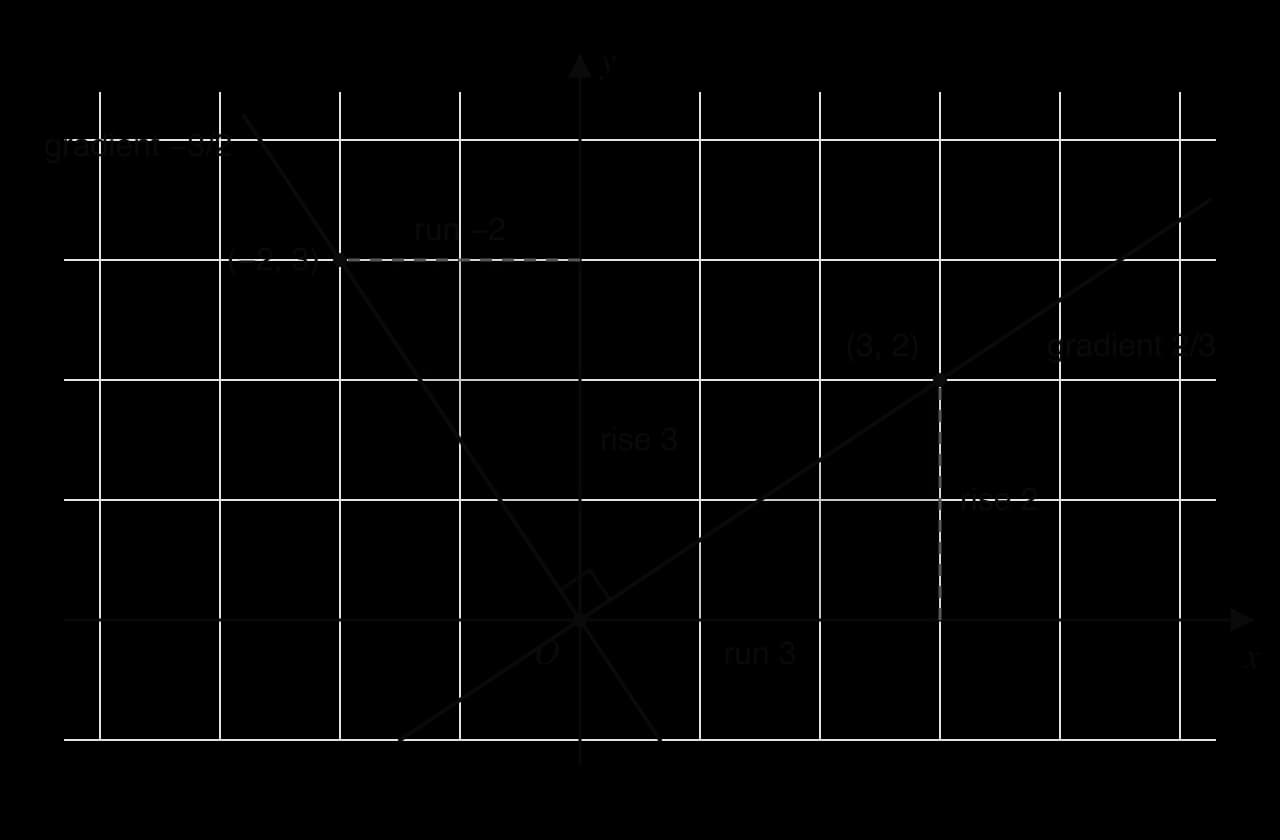
The rule comes from rotating a gradient triangle. A line with gradient 32 has a gradient triangle with run 3 and rise 2. Turning the whole line through 90° about the origin turns the triangle with it: the run of 3 to the right becomes a rise of 3 upwards, and the rise of 2 upwards becomes a run of 2 to the left, that is, a run of −2. The rotated line therefore has gradient −23=−23.
Rotating a gradient triangle through 90° swaps the rise and the run and reverses one direction, so gradient 2/3 becomes −3/2.
The same argument works for any gradient qp: rotation gives run −p and rise q, a gradient of −pq. The product of the two gradients is always −1.
m1×m2=qp×(−pq)=−1⟺m2=−m11
The rule has one exception. A horizontal line (gradient 0) is perpendicular to a vertical line (no gradient), and the product rule cannot be applied because the vertical line has no gradient to multiply. These pairs are recognised from their equations: y=k is always perpendicular to x=h.
y = 0.5x + 1
y = −2x + 6
y = 0.5x − 3
The two lines with gradient 0.5 are parallel; the line with gradient −2 crosses both at right angles, since 0.5 × (−2) = −1. Equal scales on both axes make the right angles visible.
The right angles in a graph appear as right angles only when both axes use the same scale. On a GDC's standard window the screen is wider than it is tall, so perpendicular lines can look as if they cross at another angle; a square window (TI-84 Plus CE: ZOOM → ZSquare) fixes this.
To decide whether two lines are parallel, perpendicular or neither, find both gradients (rearranging any general-form equation) and compare them.
YouTube
Khan Academy, “Equations of parallel and perpendicular lines”: watch how a line's gradient is read from its equation and how the parallel or perpendicular gradient is then used with a given point.
Application: the perpendicular bisector of a line segment
The line that cuts a line segment in half at right angles is its perpendicular bisector. Every point on it is the same distance from both ends of the segment, which is why it separates the regions of a Voronoi diagram (subtopics 3.5 and 3.6). Its equation combines the midpoint formula from prior learning with three ideas about gradients:
the midpoint of the segment from (x1,y1) to (x2,y2), (2x1+x2,2y1+y2) which is the point the bisector passes through;
the gradient of the segment, from the gradient formula;
the negative reciprocal of that gradient, the gradient of the bisector;
point-gradient form with the midpoint and the perpendicular gradient.
Where two lines meet
Two lines that are not parallel meet at exactly one point, whose coordinates satisfy both equations at once. Finding it means solving the two equations as a system of linear equations. By hand, substitution works well when one equation already gives y in terms of x; with technology, the intersection tool on a graph or the GDC's simultaneous equation solver gives the point directly (both methods are developed in subtopic 1.8, Equations and systems using technology).
Two parallel lines never meet, so their equations have no common solution; two equations of the same line have infinitely many. These cases are recognised from the gradients before any solving.
Exam focus
Straight lines are examined on Paper 1 as short questions of 4–7 marks, and as the opening parts of Paper 2 questions on geometry, Voronoi diagrams or calculus. Common command terms are find (show the working), write down (little or no working, such as a perpendicular gradient once the gradient is known), determine and "give your answer in the form …". The recurring shapes are: the gradient of a line through two points, then the perpendicular gradient, then the equation of a line in a stated form, then an intercept; the perpendicular bisector of two sites or towns, followed by where it meets another line; intercepts of a line with a geometric condition; and gradients of real inclines.
Method marks are given for a correct substitution into the gradient formula and for a correct point and gradient substituted into an equation of a line; the answer mark needs the equation in the requested form. Follow-through applies when a wrong gradient from an earlier part is used correctly later.
Parts (c) and (e) are where marks are most often lost: the perpendicular gradient written where the path's own gradient was asked (or the reverse), and the intersection found from a rounded gradient such as −1.3. Keep fractions exact, or store full values in the GDC, until the final answer.
Questions on inclines use calculate and expect the gradient, percentage or angle to 3 significant figures, with the GDC in degree mode for tan−1.
Practice questions
Write down the gradient and the y-intercept of the line y=7−2x. [2]
Find the gradient of the line through (−3,8) and (5,−4). [2]
A road rises 42 m over a horizontal distance of 600 m. Calculate (a) its percentage grade and (b) its angle of inclination. [3]
Find the coordinates of the x-intercept and the y-intercept of 5x−2y−20=0. [2]
Find the equation of the line through (2,9) and (6,−3), giving your answer in the form y=mx+c. [3]
Find the equation of the line through (−4,1) that is perpendicular to 3x+5y−2=0. Give your answer in the form ax+by+d=0
The lines y=kx+3 and 2x−6y+1=0 are perpendicular. Find the value of k
A wheelchair ramp must rise 0.6 m with a gradient no steeper than 1:12. Calculate the minimum horizontal length of the ramp, and its length along the slope, to 3 significant figures. [3]
The points A(1,7) and B(7,3) are two sites on a map. Find the equation of the perpendicular bisector of [AB] in the form y=mx+c
Line L has a negative gradient and passes through (3,4). It meets the x-axis at A and the y-axis at B, where OB=2×OA
Answers
Gradient −2; y-intercept (0,7).
m=5−(−3)−4−8=8−12=−1.5.
(a) 60042=0.07, so 7%. (b) tan−10.07=4.00° (4.004…°).
y=0: x=4, so (4,0); x=0: y=−10
m=6−2−3−9=−3; y−9=−3(x−2)
Gradient of given line −53; perpendicular gradient 35; y−1=35(x+4)
2x−6y+1=0 has gradient 31; k×31=−1
Run =12×0.6=7.2 m; slope length =7.22+0.62=52.2=7.22
Midpoint (4,5); mAB=7−13−7=−32
If OA=a then OB=2a, so the gradient is −a2a=−2
Summary
The gradient of a line is rise ÷ run, the same between any two of its points: m=x2−x1y2−y1. Positive lines rise, negative lines fall, horizontal lines have m=0 and vertical lines have no gradient.
With real units, the gradient is a constant rate of change (units of y per unit of x).
An incline's steepness can be a ratio 1:n (gradient n1), a percentage grade (gradient × 100%) or an angle θ with tanθ=m
The y-intercept is found with x=0 and the x-intercept with y=0.
Three equivalent forms: gradient-intercept y=mx+c, point-gradient y−y1=m(x−x1)
A line through two points: gradient formula, then point-gradient form, then rearrange into the form asked for.
Parallel lines have equal gradients, m1=m2; perpendicular lines have m1×m2=−1
A perpendicular bisector passes through the midpoint of a segment with the negative reciprocal of its gradient.
Two non-parallel lines meet at one point, found by solving their equations together, by hand or with the GDC.
Self-check
To do:
I can find the gradient of a line through two points, keeping the same order of subtraction.
To do:
I can explain why a straight line has the same gradient everywhere, using similar triangles.
To do:
I can state the units of a gradient in context and interpret it as a rate of change.
To do:
I can convert between a ratio 1:n, a gradient, a percentage grade and an angle of inclination.
To do:
I can find both intercepts of a line from any form of its equation.
To do:
I can write the equation of a line from its gradient and one point, or from two points.
To do:
I can rearrange an equation into y=mx+c or into ax+by+d=0 with integer coefficients.
To do:
I can find the gradient of a line given in general form.
To do:
I can write the equations of horizontal and vertical lines through a given point.
To do:
I can find the equation of a line parallel or perpendicular to a given line through a given point.
To do:
I can decide whether two lines are parallel, perpendicular or neither, and justify my answer.
To do:
I can find the equation of the perpendicular bisector of a line segment.
To do:
I can find where two lines meet, by substitution or with my GDC, and write the point as coordinates.
To do:
I can tell from a question's wording whether it wants a gradient, an equation, a single coordinate or a point.
(a)
Find an expression for F−1(x).
[2]2 marks
Markscheme (a)
x=3.20+1.85yORd=1.85F−3.20(M1)
F−1(x)=1.85x−3.20A1
Note: Accept F−1(x)=0.541x−1.73.
[2 marks]
(b)
Find F−1(25.40) and interpret your answer in context.
[2]2 marks
Markscheme (b)
F−1(25.40)=12A1
Question 2 · AI-001046 marks
On a map of the Kestrel Valley nature reserve, distances are measured in kilometres. A straight footpath passes through the points A(−2,5) and B(4,−7).
(a)
Find the gradient of the footpath.
[2]2 marks
(b)
Find the equation of the line through A and B. Give your answer in the form y=mx+c.
[2]2 marks
(c)
A bird hide is located at the point C(7,−12). Determine whether the bird hide lies on the footpath.
Amara is designing a wheelchair ramp for the entrance of a community library. The ramp rises a vertical height of 0.42 m over a horizontal distance of 5.6 m.
(a)
Find the gradient of the ramp.
[2]2 marks
(b)
Local building regulations state that the gradient of a wheelchair ramp must not be greater than 121.
Show that Amara's ramp satisfies the regulations.
[2]2 marks
(c)
Find the angle that the ramp makes with the horizontal.
[2]2 marks
(d)
A second entrance to the library is 0.6 m above the ground. Find the minimum horizontal distance needed for a ramp to this entrance that satisfies the regulations.
On the y-axis x=0: −4y+24=0, so y=6. The y-intercept is (0,6).
(b) The line passes through (−8,0) and (0,6).
m=0−(−8)6−0=86=43
The gradient is 43, or 0.75.
y1=−1
into the point-gradient form.
y−(−1)y+1y=−32(x−4)=−32x+38=−32x+35
The equation is y=−32x+35 (or y=−0.667x+1.67 to 3 significant figures). Check: at x=4, y=−38+35=−1. ✓
,
b=3
,
d=−5
. Any integer multiple, such as
−4x−6y+10=0
, describes the same line.
, point
(4,−1)
The parallel line has the same gradient. Use point-gradient form with (−5,3).
y−35y−152x+5y−5=−52(x+5)=−2x−10=0
The equation is 2x+5y−5=0. It differs from the original only in the constant term, as parallel lines in general form always do once their x and y coefficients are made the same.
is
51
.
.
y−34y−12x+4y−20=−41(x−8)=−x+8=0
Check: the gradient of x+4y−20=0 is −41, and 4×(−41)=−1. ✓ The point (8,3) gives 8+12−20=0. ✓
The gradients are not equal, so the lines are not parallel. Their product is 23×(−32)=−1, so the lines are perpendicular.
Gradient of [AB]:
mAB=5−(−1)6−2=64=32
The perpendicular gradient is −23. Point-gradient form through (2,4):
y−42y−83x+2y−14=−23(x−2)=−3x+6=0
Check: A and B should be the same distance from any point on the line, such as (0,7): 12+52=26 and 52+12=26. ✓
and use the intersect tool, or enter the system
2x−y=3
,
x+3y=12
in the simultaneous equation solver. Either gives
x=3
,
y=3
. Write down the two equations solved and the point, in brackets.
(0.75)
A1
[2 marks]
(b) y−1=43(x−2) or 1=43(2)+c(M1)
y=0.75x−0.5A1
Note: Award (M1) for their gradient from (a) and a correct point substituted. Follow through from (a).
[2 marks]
(c) −34 (−1.33) A1
Note: Follow through from (a).
[1 mark]
(d) y+1=−34(x−9)(M1)
4x+3y−33=0 (or any integer multiple) A1
Note: Award (M1) for their gradient from (c) with R substituted. The A1 requires integer coefficients and the form =0.
[2 marks]
(e) solving y=0.75x−0.5 and 4x+3y−33=0 (by substitution or with the GDC) (M1)
F(5.52,3.64)A1
[2 marks]
(f) RF=(9−5.52)2+(−1−3.64)2=5.8 units (M1)
58 m A1
Note: Award (M1) for a correct substitution of their F into the distance formula. The A1 needs the conversion to metres.
[2 marks]
Total [11 marks]
, where
a,b,d∈Z
. [3]
. [2]
, and the point where it meets the line
x=10
. [5]
and
O
is the origin.
Find
the equation of
L
and the coordinates of
A
. [5]
, so
(0,−10)
.
, so
y=−3x+15
.
, so
3y−3=5x+20
, giving
5x−3y+23=0
.
, so
k=−3
.
m (7.224…).
; perpendicular gradient
23
;
y−5=23(x−4)
, so
y=1.5x−1
. At
x=10
:
y=14
, the point
(10,14)
.
.
y−4=−2(x−3)
, so
y=−2x+10
. At
y=0
,
x=5
:
A(5,0)
.
; grade and angle are different numbers.
and general
ax+by+d=0
, usually with integer coefficients.
, so a perpendicular gradient is the negative reciprocal

 YouTube
 YouTube