1.2 How are we affected by literary texts in various ways?
How literary texts act on readers and audiences: kinds of effect, suspense and surprise, dramatic irony and catharsis, empathy, laughter, the uncanny, reader-response criticism, and how to write about effect precisely.
- IB English A: Literature
- Part of 1 Readers, writers and texts
- SL and HL
Notes on 1.2 How are we affected by literary texts in various ways?
Literary texts act on their readers: they frighten, amuse, move, puzzle and sometimes shame them. Those effects are made by particular choices of the writer, and the same choices land differently on different readers, so both the making and the landing can be analyzed. The Brazilian writer Joaquim Maria Machado de Assis published “The Fortune-Teller” in 1884; its opening, in Isaac Goldberg’s English translation of 1921, introduces two lovers and a secret.
Five kinds of effect
The opening of “The Fortune-Teller” works in several ways at once. It amuses: the narrator compares Rita’s defense of fortune-telling to Hamlet’s famous line, then admits that “she made her explanation in other words” (paragraph 1). It makes for anxiety: Camillo warns that her husband “Villela might learn of it, and then . . .” (paragraph 5), and the sentence stops before the danger is named. It also invites a judgment, since the two people the story asks its audience to like are deceiving Camillo’s oldest friend. A single page can be funny, tense and morally awkward at the same time.
Readers and critics usually sort effects into five broad kinds. An emotional effect is a feeling such as grief, fear or joy. An intellectual effect is a puzzle to solve or the pleasure of recognizing an idea. An ethical effect asks for a judgment, approval or a sense of being implicated. An aesthetic effect is pleasure in the making itself: a pattern of sound, a perfect sentence. A physical effect happens in the body: a held breath, a laugh, tears, a shiver. The table gives one short example of each, from four different forms.
Kind of effect | Example | The choice that produces it |
|---|---|---|
Emotional: grief and anger | Wilfred Owen, “Futility” (1918), on a soldier who will not wake | The question “Was it for this the clay grew tall?” (line 12), addressed to no one who can answer |
Intellectual: a puzzle | Machado, “The Fortune-Teller”, paragraph 12 | The narrator’s correction of himself, “to deny is in a sense to affirm” |
Ethical: complicity | Machado, “The Fortune-Teller”, paragraphs 2–10 | Lovers presented warmly, with the betrayed husband kept offstage as a name |
Aesthetic: pleasure in pattern | Shakespeare, Sonnet 64 (1609) | A line that turns back on itself: “Increasing store with loss and loss with store” |
Physical: a start of fear | Macbeth, Act 2, scenes 2–3 (about 1606) | Knocking at the castle gate just after the king has been murdered |
The categories overlap, and the point of naming them is to ask a sharper question. “The opening is effective” says nothing. “The opening makes the reader laugh at Camillo’s certainty and then fear for him” names two effects and their order, and an essay can then ask which choices produce each.
An effect is made
The central claim of this question is that an effect is built, and that the building can be traced. Camillo’s unfinished sentence shows how small the means can be.
Then he reproved her, saying that it was imprudent to visit such houses. Villela might learn of it, and then . . .
Machado de Assis, “The Fortune-Teller”, tr. Isaac Goldberg, paragraph 5
The narrator reports Camillo’s warning in his own words until the last moment, and then breaks off with the spaced dots of the 1921 printing. The missing words are worse than any the narrator could supply, because the reader supplies them: discovery, scandal, a duel, a death. The sentence also slips from reported speech toward Camillo’s own anxious thought, so that the fear seems to come from inside him rather than from the narrator. Three choices (a broken sentence, an unnamed consequence, a voice that sounds like the character’s) produce one effect: unease that the story will not explain.
The same means can produce different effects in different hands. In Rita’s speech, three paragraphs earlier, the same printed dots follow “The lady likes a certain person . . .” (paragraph 2), and there the gap is coy, not frightening. Rita is quoting a fortune-teller who is too tactful to name a lover. The punctuation is identical; the effect is decided by who is speaking and what is left unsaid.
Suspense and surprise
Most of the tension in a story comes from what it holds back. Camillo’s “and then . . .” produces suspense, anxious uncertainty about what will happen, because the reader knows the danger (a husband, a secret, a visit that could be seen) and does not know when or whether it will arrive.
The film director Alfred Hitchcock explained the difference between suspense and surprise with a well-known illustration, in the long interview with François Truffaut that was published as a book in 1966. Two people talk at a table, and a bomb under it suddenly explodes: the audience gets a few seconds of surprise. Show the audience the bomb first, with its timer, and the same dull conversation becomes unbearable for many minutes, because the audience knows what the characters do not. Surprise comes from information withheld until it bursts out; suspense comes from information shared early and then made to wait.
Machado uses both. Within the extract the story builds suspense, since the affair and the danger arrive together and the rest of the story waits for the husband to find out. At the end it produces surprise. Camillo receives a letter from Villela, “Come immediately to our house”, is terrified, visits the same fortune-teller and is told that nothing will happen. He arrives cheerful, and the last two sentences undo everything:
As he entered, Camillo could not repress a cry of horror:--there upon the sofa lay Rita, dead in a pool of blood. Villela seized the lover by the throat and, with two bullets, stretched him dead upon the floor.
Machado de Assis, “The Fortune-Teller”, tr. Isaac Goldberg (1921), last sentences
The shock is made by speed. After pages of slow inner debate, the catastrophe takes two sentences, and Camillo, who has done nothing but think, is killed without speaking a word. The surprise also turns back on the whole story. The fortune-teller told Camillo what he wanted to hear, and his superstition, which the narrator had mocked in the opening, returned just in time to lead him home to die. Read again after the ending, the first paragraph makes the Hamlet line, about more things in heaven and earth than philosophy dreams of, sound much darker than it did.
Mapping the effects
The diagram follows three of the story’s choices from the choice itself to its first effect and then to what that effect does to the story’s meaning. The middle column is what a reader feels; the right-hand column is what an essay argues. Writing about effect is the work of getting from the first column to the third.


The second row needs a word of explanation. In paragraph 12 the narration has moved close to Camillo’s thoughts, using free indirect discourse in “Camillo believed in nothing. Why? He could not have answered”. Then the narrator interrupts in the first person with “But I express myself ill, for to deny is in a sense to affirm”. The narration leaves Camillo’s head and stands beside a narrator who finds him slightly absurd. Distance of this kind lowers the fear for Camillo and raises the irony, which is why the ending lands as a shock rather than as a tragedy long foreseen.
Try it
Read paragraph 11 again. How does the phrase “she translated Hamlet into every-day speech” shape the reader’s attitude to Rita?
The phrase is comic: it imagines Rita’s nervous “there was many a true, mysterious thing in this world” as a plain-language version of Shakespeare. It makes her a little ridiculous and a little charming, and it links her to the story’s opening line. On a second reading it is also ironic in a darker way, because Rita’s belief in mystery turns out to be closer to the truth of the ending than Camillo’s cleverness.
Case study: dread in Oedipus the King
Sophocles’ Oedipus the King, first performed in Athens in the 420s BCE, is the classic case of an effect built on knowledge the audience already has. Its first audience knew the myth. An oracle said that the son of King Laius of Thebes would kill his father, so the infant was abandoned to die; he survived, killed Laius without knowing him, and married the widow, Jocasta, his own mother. The play does not surprise them with any of this. It shows Oedipus, now king, swearing to find the man whose crime has brought a plague on Thebes, and lets them watch him hunt himself down.
The effect is dread, and it is built scene by scene through dramatic irony, the gap between what the audience knows and what a character knows. The page on drama defines the device; here the question is what it does to the people watching. In the first episode Oedipus curses the unknown murderer before the whole city, and then, to show his good faith, extends the curse to himself:
And for myself, if with my privity
He gain admittance to my hearth, I pray
The curse I laid on others fall on me.Sophocles, Oedipus the King, tr. F. Storr (1912), first episode
Every word means one thing to Oedipus and another to the audience. He imagines a stranger hiding in his house; the audience knows the murderer already shares his hearth, his bed and his name. The speech sounds like the vow of a just ruler and is heard as a man sentencing himself. Nothing has happened yet, and the audience is already afraid, which is the reverse of how suspense usually works.
Each scene tightens the gap
The prophet Teiresias, summoned to help, refuses to speak and is goaded until he says it plainly: “I say thou art the murderer of the man / Whose murderer thou pursuest.” Oedipus hears an insult and accuses him of plotting with Creon. Jocasta, trying to calm her husband, proves that prophets are unreliable by telling him how Laius died, at a place where three roads meet, and in doing so gives him the first real clue. A messenger arrives from Corinth with good news, that the man Oedipus believed was his father has died of old age, and the good news turns out to be the proof that he was adopted. Each character who tries to help him brings him nearer to the truth.
Jocasta understands before Oedipus does, and her final plea is that he stop: “Ah mayst thou ne’er discover who thou art!” A moment later she leaves the stage, saying she will be silent from now on. The audience watches her understand, and watches him misread her leaving as a queen’s shame at his possibly humble birth. When an old herdsman is finally forced to speak, Oedipus’s knowledge reaches the audience’s at last:
Ah me! ah me! all brought to pass, all true!
O light, may I behold thee nevermore!Sophocles, Oedipus the King, tr. F. Storr (1912), fourth episode
This is the moment of recognition: the hero learns who he is. For the audience it is not a revelation but a release. The gap they have held open for the whole play closes, and the tension it carried turns at once into pity. The line about light also prepares the next thing he does offstage, blinding himself with Jocasta’s brooches, so that the man who could not see the truth cannot see anything else.
The graph shows the two kinds of knowledge across the play. The audience’s line is flat and high from the opening, since they know the story; Oedipus’s rises in jumps as each witness speaks, until it meets theirs at the herdsman’s confession. The shaded area between the lines is the dramatic irony, and it is widest in the scenes the audience finds hardest to watch.


Pity, fear and catharsis
The first critic to explain why audiences want to watch such a play was Aristotle, whose Poetics (about 335 BCE) uses Oedipus the King as its model tragedy. Aristotle says tragedy arouses pity, which is felt for someone who suffers more than he deserves, and fear, which is felt for someone like ourselves. He praises the Corinthian messenger’s scene, in which news meant to free Oedipus from fear produces the opposite, as the best kind of reversal. He even says the plot alone, told without staging, should make a listener shudder and pity, as the story of Oedipus does.
Aristotle says that tragedy brings about the catharsis of such emotions, and he never explains the word, whose meaning has been disputed ever since. Three readings dominate. In the first, catharsis is purgation, a medical metaphor. The play draws off pity and fear as a doctor draws off a harmful excess, and the audience leaves lighter (the German scholar Jacob Bernays argued this in 1857). In the second, it is purification: the emotions are refined rather than removed, so that the audience learns to feel pity and fear at the right things. In the third, it is clarification: the audience comes to understand the action, and the pleasure of tragedy is partly the pleasure of learning (the view of the American classicist Leon Golden, in the 1960s).
The three readings are not just a quarrel about a Greek word; they lead to different questions about any work. A purgation reading asks what feeling the work exhausts. A purification reading asks what it teaches its audience to feel. A clarification reading asks what the audience understands at the end that it did not at the beginning. For Oedipus the third has the strongest support in the text, since the whole play is a search for knowledge and its climax is a recognition. The audience’s release comes at the moment the hero finally knows what they know.
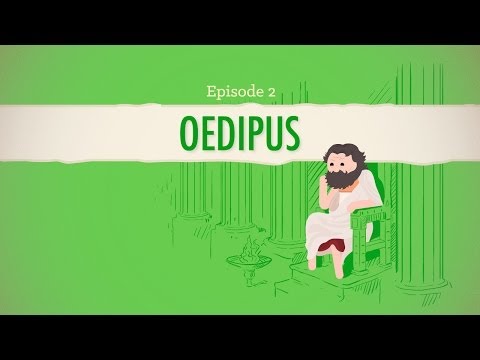 YouTube
Feeling with and feeling for
Some of the strongest effects of literature come from being placed inside another person’s experience. Machado gives his reader a brief taste of this in paragraph 12, where the narration moves from describing Camillo to following his thoughts:
He was about to speak, but he restrained himself. He did not wish to destroy her illusions.
Machado de Assis, “The Fortune-Teller”, tr. Isaac Goldberg, paragraph 12
For the length of these two sentences the narration stays with Camillo, sharing his amused restraint as he decides not to argue with Rita. This is empathy: feeling a character’s feelings from inside, as if they were one’s own. It differs from sympathy, which is feeling for a character from outside, as pity or concern. Rita, anxious and laughed at, can win sympathy without the story ever entering her mind; only Camillo’s mind is opened.
Empathy is close to identification, the imaginative taking-on of a character’s position, so that the character’s wants and fears are borrowed for a while. Identification is built by point of view. A story told through one character’s perceptions, in the first person or in free indirect discourse, supplies that character’s view of everyone else, and only a strong signal breaks the hold. Machado supplies the signal at once, when his narrator breaks in to say that he expresses himself ill. The narration steps out of Camillo, and Camillo is now seen from beside the narrator, with some irony.
The movement in and out of Camillo’s mind decides how the ending feels. Full identification with Camillo would make the last sentence a tragedy, the death of someone whose hopes had been shared. Machado keeps the story close enough to Camillo to care and far enough to judge, so the death arrives as a cruel joke at the expense of a clever man’s certainty.
Empathy engineered, then questioned
Kazuo Ishiguro’s novel Never Let Me Go (2005) builds empathy with unusual care and then makes it uncomfortable. The narrator, who introduces herself only as Kathy H., looks back on her childhood at Hailsham, a boarding school in the English countryside, and on her work as a “carer” for “donors”. She uses these words as if everyone already knew what they meant. Slowly, through hints she does not stop to explain, the novel lets its reader work out what she has always known. The children of Hailsham were raised to give their organs, one operation after another, until they die young.
Because Kathy is calm, the horror belongs to the person reading and not to her. Her restrained, ordinary voice, full of school friendships and small jealousies, invites identification, and the closer the narration draws its audience to her, the more disturbing her acceptance becomes. Many who read the novel ask why the characters never try to escape. The novel lets that question turn back on its readers, who also live inside systems they rarely question. Here the effect is ethical as much as emotional: empathy leads to the edge of a judgment the narrator never makes.
Identification is therefore not approval. A first-person narrator can draw anyone into a mind they would reject in life, and some of the most uncomfortable effects in literature come from realizing too late how far one has gone along with a voice. The page on narrative voice discusses the unreliable narrator, whose charm or confidence leads readers to trust what they should question. The two ideas meet whenever a story invites feeling with someone and then shows what that feeling has cost.
Laughter and deflation
Laughter is the most physical of literary effects, and it can serve a serious work as well as a comic one. In Macbeth, Macbeth has just murdered King Duncan in his sleep when a knocking begins at the castle gate. Macbeth and his wife hurry away to wash the blood off their hands, and a drunken porter stumbles on stage to answer the door:
Here’s a knocking indeed! If a man were porter of hell gate, he should have old turning the key.
William Shakespeare, Macbeth, Act 2, scene 3 (Porter)
The scene is a classic case of comic relief in tragedy. The Porter jokes about drink and about the sinners he pretends to admit to hell, and an audience that has held its breath through the murder laughs. The joke is exact as well. The Porter imagines himself the gatekeeper of hell without knowing that he is, in a sense, exactly that, since the castle now holds a murderer and a dead king. The laughter sharpens the dread it seems to release.
The essayist Thomas De Quincey made the knocking the subject of a famous short essay, “On the Knocking at the Gate in Macbeth” (1823). He described how the knocking had always filled him with an awe he could not explain. He then argued that it marks the return of the ordinary world after the murder: the business of the day begins again, and its normality makes the crime that has just happened feel more terrible. De Quincey’s essay is an early example of a reader trying to explain an effect he first felt and only later understood, which is the method of this whole question.
Bathos
Laughter can come from a fall as well, a sudden drop from the grand to the trivial that critics call bathos. The fall can be intended or not. Alexander Pope used it deliberately in The Rape of the Lock (1714), a mock-heroic poem about a quarrel over a stolen lock of hair, where the spirit guarding a young woman fears disaster of every size at once:
Or stain her honour or her new brocade;
Forget her pray’rs, or miss a masquerade;Alexander Pope, The Rape of the Lock, Canto II
Each line sets something grave beside something trivial, joined by a calm or: honor and a dress, prayers and a party. The effect is comic, and it is also a judgment. A society that ranks a stained dress beside lost honor has confused its values, and Pope’s syntax makes the confusion audible without stating it. Unintended bathos works the other way: a writer aiming at grandeur reaches for an image that falls flat, and the reader laughs at the text instead of with it. Pope mocked exactly that failure in a satirical treatise of 1728 whose English subtitle is The Art of Sinking in Poetry.
Try it
In Canto III, the young woman screams when her lock is cut, louder than people scream “When husbands, or when lapdogs breathe their last”. What is the effect of the order of the two nouns?
Husbands come first, so the line begins as if it were about real grief. Lapdogs arrive in the same rhythm and grammar, as if their deaths mattered equally. The line deflates the scream, and it suggests something sharper about the society it describes: that a lady’s grief for her dog might be as loud as for her husband, or louder.
The familiar made strange
Some effects are harder to name than fear or laughter. Lafcadio Hearn’s retelling of the Japanese ghost story “Yuki-Onna” (1904) produces one in a single sentence, when the young woodcutter Minokichi wakes in a snowbound hut to find a woman bending over him:
The white woman bent down over him, lower and lower, until her face almost touched him; and he saw that she was very beautiful,—though her eyes made him afraid.
Lafcadio Hearn, “Yuki-Onna”, Kwaidan (1904), paragraph 4
The sentence holds beauty and fear in the same moment, joined by a dash and though. Nothing in it is horrible: a woman, a face, eyes. The disturbance comes from the familiar turning slightly wrong. Later in the story Minokichi marries a gentle young woman named O-Yuki, and years afterward, in the most domestic of scenes, he notices that her face reminds him of the woman in the snow, so that a wife becomes a stranger without changing at all.
Sigmund Freud gave this effect a name in his essay “The Uncanny” (1919), whose German title, “Das Unheimliche”, means literally the un-homely. For Freud the uncanny is the familiar made strange, the feeling that arises when something known and homely, a face, a house, a doll, a person, shows itself as alien. His main example was E. T. A. Hoffmann’s story “The Sandman” (1816), with its figure who steals children’s eyes and its lifelike mechanical doll. Hearn’s story fits the definition closely, since its horror lives inside a marriage and a home.
Effects across forms
The same effect works differently in each form, because each form reaches its audience differently. In drama the audience shares a room and a time, so laughter is collective and a silence is felt by hundreds at once. The Porter’s jokes depend on a crowd that laughs together after holding its breath together. In poetry, sound and rhythm act on the body, as when Owen’s questions in “Futility” break the regular movement of the lines. In prose, pace controls suspense: Machado spends pages on Camillo’s doubts and two sentences on his death. A reading of effect always asks what this form allows that another would not.
Readers in the text
A formalist reading treats the text as the place where meaning lives. Reader-response criticism moves the question to the other side of the page: it studies what happens during reading, and treats a work’s effects as part of its meaning. Its critics differ in how much freedom they allow, but they share the view that a text is not complete until someone reads it.
The American educator Louise Rosenblatt made the case early, in Literature as Exploration (1938), arguing that a literary work is lived through, not mined for facts. She later called the meeting of reader and text a “transaction”, in The Reader, the Text, the Poem (1978): neither side makes the poem alone. The German critic Wolfgang Iser gave a name to the audience a text’s choices assume: its implied reader, the subject of a book first published in 1972 and translated as The Implied Reader in 1974. Iser argued as well that every text leaves gaps, places where something is not said, and that reading is the work of filling them.
Machado’s “and then . . .” is a gap in exactly Iser’s sense, and so is the space between Camillo’s visit to the fortune-teller and his arrival at Villela’s door. The implied reader of “The Fortune-Teller” knows Hamlet, finds fortune-telling slightly comic, and is ready to smile with the narrator at Rita. The story invites that smile, and then the ending punishes it. To describe the implied reader is to describe the position a text builds for its audience, and the effect often lies in what the text then does to anyone standing there.
Hamlet observes to Horatio that there are more things in heaven and earth than are dreamt of in our philosophy.
Machado de Assis, “The Fortune-Teller”, tr. Isaac Goldberg, paragraph 1
The American critic Stanley Fish added time. In an essay of 1970, “Literature in the Reader: Affective Stylistics”, he argued that meaning is an event in time. A sentence read word by word forms expectations in its reader and then confirms or overturns them. Read in that way, Machado’s first sentence sets a trap. It opens with a famous line about mystery, seems to promise a story that will take mystery seriously, and two sentences later the line turns out to be a lover’s excuse for visiting a card reader. The expectation is overturned into comedy. Only at the end does the story reverse the reversal, and the opening line regains its weight.
Writing about “the reader”
The difference matters most in writing. “The reader feels sorry for Camillo” makes a claim about everyone who opens the story, and many will not feel it. “The narrator invites the reader to smile at Camillo’s certainty” makes a claim about the text’s design, and it can be proved from the words. Phrases such as the reader is invited to, the text positions its audience to, or a reader who knows the myth keep a claim about effect anchored in the text. A strong essay uses them, and saves statements about its own feelings for moments when a personal response is genuinely the point.
Whose response?
Real people bring their lives to a text. A student who has lost a parent may read Owen’s “Futility”, with its soldier who will not wake however gently the sun touches him, quite differently from a student who has not. Someone from a culture in which fortune-telling is an ordinary part of life may find Machado’s narrator less wise and his mockery of Rita less charming. A student who has never heard of Oedipus will feel surprise where Sophocles’ first audience felt dread. These differences are real, and an honest essay can name them.
They also have limits. A response that cannot be traced to the text is a fact about a person, not about the work. The bereaved student’s grief at “Futility” becomes part of an interpretation only when it is joined to the poem’s choices: the question addressed to the sun, the word “fatuous”, the broken rhythm of the last lines. Experience can open a reading; the words still have to support it.
Earned and unearned emotion
Not every effect is welcome. Some texts ask for more emotion than they have earned, with a death made so pure, a child so good or a scene so lingering that it pushes rather than moves. The charge against such writing is sentimentality. The most famous case in English is the death of Little Nell in Charles Dickens’s The Old Curiosity Shop, published in weekly parts in 1840 and 1841, which moved many of its first readers to tears:
She was dead. No sleep so beautiful and calm, so free from trace of pain, so fair to look upon.
Charles Dickens, The Old Curiosity Shop (1841), chapter 71
The sentence after the first three words is a set of comparisons in which death becomes beautiful sleep, and the next paragraphs repeat “She was dead” and add her little bird, her winter berries, her gentleness. Later generations found the scene excessive. A remark attributed to Oscar Wilde, that one would need a heart of stone to read the death of Little Nell without laughing, became the standard verdict on Victorian sentimentality. Its source is a friend’s later report, not anything Wilde published. The charge behind the joke is manipulation: the scene seems to have decided how much its readers should cry, and to work on them until they do.
The test is whether the emotion serves the meaning or replaces it. Owen’s “Futility” is about the death of one soldier and could easily have been sentimental. It is not, because it refuses to describe the body beautifully and turns grief into a hard question about why life exists at all: “—O what made fatuous sunbeams toil / To break earth’s sleep at all?” (lines 13–14). The emotion is earned by the argument. Tears for Nell respond to Dickens’s rhetoric, while grief at “Futility” responds to an argument. Both are real effects, and whether the difference between them matters is a judgment an essay can make and defend.
Writing about effect
The commonest sentence in student writing about effect is the least useful: “this creates tension for the reader”. It names a feeling, attaches it to nobody in particular, and says nothing about how the feeling was made. The pair that follows rewrites it on Camillo’s unfinished warning.
Weak: Machado uses an ellipsis at the end of paragraph 5, which creates tension for the reader.note 1
Strong: Camillo’s warning that “Villela might learn of it, and then . . .” stops at the point where the danger would be named, so the reader must supply the consequence, and the affair’s risk hangs unspoken over every later scene.note 2
A label and a cliché. The sentence names the punctuation and attaches an effect that could follow any ellipsis in any story. “The reader” is asserted, not placed.
Choice, effect, meaning. The rewrite quotes the words, explains how the gap works on the reader (it must be filled), and says what the effect does for the story as a whole.
The strong sentence is built in three steps: the choice, the immediate effect, and the effect on meaning, the same three columns as the diagram of the story. A paragraph extends the same order across several choices and ends with a judgment. The paragraph that follows answers a question about Oedipus the King: how does Sophocles make his audience fear for Oedipus before anything has happened?
Sophocles makes his audience afraid for Oedipus in the very scene where Oedipus is most confident.note 1 Cursing the unknown murderer before the city, he adds that if the man should share his hearth, “The curse I laid on others fall on me.” To Oedipus this is a gesture of fairness; to an audience that knows the myth, it is a man pronouncing his own sentence.note 2 The fear does not come from uncertainty about what will happen, since every spectator knows the ending, but from watching each confident word close a trap he cannot see.note 3 Sophocles turns the audience into helpless witnesses, which is why the recognition, when it comes, feels less like a shock than like a breath released.note 4
A precise claim. The opening names the effect (fear), its object (Oedipus) and the paradox that makes it worth explaining (confidence).
Two readings of one line. The sentence sets the character’s meaning against the audience’s, which is dramatic irony shown rather than named.
Effect distinguished. The writer separates this fear from ordinary suspense, which shows exactly how it is made.
From effect to meaning. The last sentence links the effect to the play’s structure and to catharsis without using either word as a label.
The paragraph never says “the reader feels”. It places the audience precisely, as people who know the myth, and every claim about their fear is tied to a line. A strong essay on effect places its audience in this way: it says who is affected, by what words, and to what end.
Applying it in Paper 2
Paper 2 often asks how two works shape the responses of their readers or audiences: their sympathy for a character, their judgment of an action, their sense of dread or relief. A question of this kind is about method. It asks how the writers produce an effect, and a comparison earns its marks by setting the two methods against each other, not by reporting that both works are sad.
Writers often make an audience fear for a character who cannot yet see what is happening. Compare the methods by which two works produce this fear, and its effect.
An invented Paper 2 question of the reader-and-audience kind
Oedipus the King and Never Let Me Go make a strong pair for such a question, because they produce a similar dread by opposite means. Sophocles gives his audience everything at the start and makes them watch a hero learn it; Ishiguro gives almost nothing away and lets the novel’s audience learn it faster than the narrator says it. A comparative sentence can set the methods side by side:
Both works make their audiences fear for a person who cannot see his or her own fate, but Sophocles builds the fear from knowledge the audience already holds, while Ishiguro builds it from knowledge the reader has to infer from Kathy’s calm euphemisms, so that the play’s dread is shared and public and the novel’s is private and slow.
A model comparative topic sentence
The sentence compares methods (knowledge given against knowledge inferred) and their different effects, and it makes a claim that only the comparison could produce. The essay that follows would test it in each work through one or two precise moments: the curse in the first episode, Kathy’s use of “carer” and “donor” as ordinary words.
The commonest way marks are lost on this skill is the asserted reader. An essay that says “the reader feels pity for Oedipus” and moves on has stated an effect without showing how it is made. Examiners look for the words, the structure or the point of view that place an audience, and for an honest sense of which audience is meant.
Planning a paragraph on effect follows the same order as the strong sentence earlier: effect, choice, meaning, then the comparison. The worked plan applies it to Machado’s narrator.
How a text affects its readers leads straight to the harder question of what it means, and who decides: whether the meaning lies in the writer’s intention, the words on the page or the reader’s response. That argument belongs to the question of how meaning is constructed, negotiated and interpreted.
Self-check
- To do:
I can name five kinds of effect and give an example of each from a real text.
- To do:
I can explain the difference between suspense and surprise, and trace each to what a text withholds or shares.
- To do:
I can show how dramatic irony builds dread in a tragedy, and explain three readings of catharsis.
- To do:
I can distinguish empathy, sympathy and identification, and say how point of view produces them.
- To do:
I can explain comic relief, bathos and the uncanny on short passages.
- To do:
I can describe reader-response criticism and write about the implied reader without asserting what every reader feels.
- To do:
I can judge whether a text’s emotion is earned or sentimental, with evidence.
- To do:
I can compare how two works produce an effect by different methods.
Key terms
Each is also in the Readers, writers and texts glossary for IB English A Lit, beside the other terms of its topic.
- Bathos
A sudden fall from the elevated to the trivial. Used deliberately it produces comedy or satire; produced by accident, it makes a text that aims at grandeur unintentionally absurd.
- Catharsis
The release or working-through of pity and fear that, according to Aristotle, an audience experiences through tragedy. Its exact sense is disputed: purgation of the emotions, their purification, or the clarification that understanding brings.
- Comic relief
A comic episode in a serious work that releases the audience’s tension for a moment. It often sharpens the seriousness around it rather than lessening it.
- Empathy
Feeling with a character, sharing their emotions as if from inside. It differs from sympathy, which is feeling for a character from outside, and it depends largely on point of view.
- Identification
A reader’s imaginative taking-on of a character’s position, so that the character’s wishes and fears become, for a while, the reader’s own. It is built by point of view and does not mean approval.
- Implied reader
The reader that a text’s choices assume and invite: someone with the knowledge, expectations and position the text builds for its audience. It is distinct from any actual reader, who may accept or refuse that position.
- Reader-response criticism
Criticism that studies what happens in readers as they read and treats a work’s effects as part of its meaning. It holds that a text is completed only in the experience of reading it.
- Sentimentality
Emotion asked of a reader in excess of what a text has earned through its situation and characters. To call a work sentimental is to charge it with manipulating its audience’s feelings.
- Suspense
Anxious uncertainty about what will happen, produced when a reader knows enough to fear an outcome but not whether or when it will come. It differs from surprise, which comes from information withheld until it is suddenly revealed.
- The uncanny
The unsettling feeling that arises when something familiar and homely shows itself as strange. Sigmund Freud named and analyzed it in an essay of 1919.
Practice questions on 1.2 How are we affected by literary texts in various ways?
Augment’s own questions, written in the style of IB exam papers. Here is how a few of them start.
Practice all 17 questions on 1.2 How are we affected by literary texts in various ways?
Free with an account. Write your answer, open the markscheme beside it and mark yourself. Augment keeps the ones you got wrong for another go.
1.2 How are we affected by literary texts in various ways? questions by paper, with 6 in full
More in 1 Readers, writers and texts
The whole topic is on its own page.
- 1.1Why and how do we study literature?
- 1.2How are we affected by literary texts in various ways?This page
- 1.3In what ways is meaning constructed, negotiated, expressed and interpreted?
- 1.4How does language use vary among literary forms?
- 1.5How does the structure or style of a literary text affect meaning?
- 1.6How do literary texts offer insights and challenges?
Carry on with 1.2 How are we affected by literary texts in various ways? in Augment
With a free account, Augment remembers where you stopped in the notes and which questions you have marked.