Augment Education
    • Question bank
    • Quick fire
    • Worksheets
    • Flashcards
    • Notes
    • Try a quick-fire round
    • All features
    • Business
    • Digital Society
    • Economics
    • Geography
    • Global Politics
    • History
    • Philosophy
    • Psychology
    • Anthropology
    • World Religions
    • Biology
    • Chemistry
    • Physics
    • Computer Science
    • Design Technology
    • ESS
    • SEHS
    • Language and literature
    • Language acquisition
    • Maths AA
    • Maths AI
    • Dance
    • Film
    • Music
    • Theatre
    • Visual Arts
    • Grade calculator
    • Grade boundaries
    • Subject checker
    • Focus timer
    • Exam countdown
    • All free tools
    • IB guide
    • All subjects
  • Blog

Search

Search subjects, the syllabus, glossary terms, the booklets, the IB guide, help and the blog

Log inStart free
augment

Augment Education

IB Diploma revision built around the syllabus.

contact@augment-education.com

Product

  • Features
  • Question bank
  • Quick fire
  • Worksheets
  • Flashcards
  • Notes
  • Subjects
  • What's new

Learn

  • IB guide
  • Booklets, explained
  • Glossary
  • Blog
  • Free tools
  • Grade calculator
  • Subject checker

Company

  • About
  • Help
  • For parents
  • For teachers
  • Comparisons

Subjects

  • English A Lit
  • English A Lang & Lit
  • Chinese A Lit
  • Chinese A Lang & Lit
  • Spanish A Lit
  • Spanish A Lang & Lit
  • English Lit & Perf
  • Spanish Lit & Perf
  • English B
  • Mandarin B
  • Spanish B
  • English ab initio
  • Mandarin ab initio
  • Spanish ab initio
  • Business
  • Digital Society
  • Economics
  • Geography
  • Global Politics
  • History
  • Philosophy
  • Psychology
  • Anthropology
  • World Religions
  • Biology
  • Chemistry
  • Physics
  • Computer Science
  • Design Technology
  • ESS
  • SEHS
  • Maths AA
  • Maths AI
  • Dance
  • Film
  • Music
  • Theatre
  • Visual Arts

Augment Education is developed independently of the International Baccalaureate Organization and is not endorsed by it. “IB” and “International Baccalaureate” are its trademarks.

© 2026 Augment Education. All rights reserved.

  • Privacy
  • Terms
  1. Subjects
  2. SEHS
  3. Paper 2: short-answer and extended-response questions

Paper 2: short-answer and extended-response questions

Answer structured Paper 2 questions on data and stimuli, plan and write extended responses with mechanism, application, evidence, evaluation and a justified conclusion, and learn from three full model answers.

  • IB Sports, Exercise and Health Science
  • Exam skills
  • SL and HL

24 min readLast reviewed 15 Oct 2026

What Paper 2 contains

Paper 2 is the written paper. At SL it is worth 50 marks in 1 hour 30 minutes, on SL material only. It contains two kinds of question: structured short-answer questions, divided into parts (a), (b), (c) and so on, often built around a stimulus such as a graph, table, diagram or short description of an athlete; and extended-response questions, which ask for a longer, connected answer to a single command term such as discuss, evaluate or explain. A calculator and a clean copy of the data booklet are allowed.

Definition

Extended response: a longer written answer worth several marks, usually to a discuss, evaluate or explain question, in which linked points, evidence and a reasoned judgment are developed in continuous prose.

Paper 2 tests all three written assessment objectives, with about half of the marks for AO3. In practice this means that most structured questions end with an explain, suggest or evaluate part, and the extended responses are almost entirely AO3. Recall alone earns only part of the marks; recall that is precise, linked and applied to the context scores highly.

Time is the main constraint. With 50 marks in 90 minutes, the paper allows a little under two minutes per mark. A 3-mark part should take about five minutes and an 8-mark extended response about fifteen, including planning.

Exam tip

Spend the first two or three minutes reading the whole paper. Decide where the extended responses are and how many marks they carry, and note the topics you are strongest on. Starting with a question you can answer well builds confidence and banks marks early.

Short-answer technique

Structured questions are designed to build in demand. The first parts usually ask you to state or identify something from the stimulus; the middle parts ask you to describe, calculate or outline; the last parts ask you to explain, suggest or evaluate. Each part may depend on the one before, so read all the parts before you start: a later part often shows what an earlier part was getting at.

Reading the stimulus

Before answering, spend a minute on the stimulus:

  1. Read the title or description: who was studied, what was done, and under what conditions.

  2. Read the axes or column headings: the variables and their units.

  3. Identify the main pattern: the trend, the difference between groups, the point where something changes.

  4. Note one or two key values with units that you could quote.

A worked structured question: physiology

The graph is a hypothetical stimulus of the kind used in Paper 2. Work through the parts before opening the model answers.
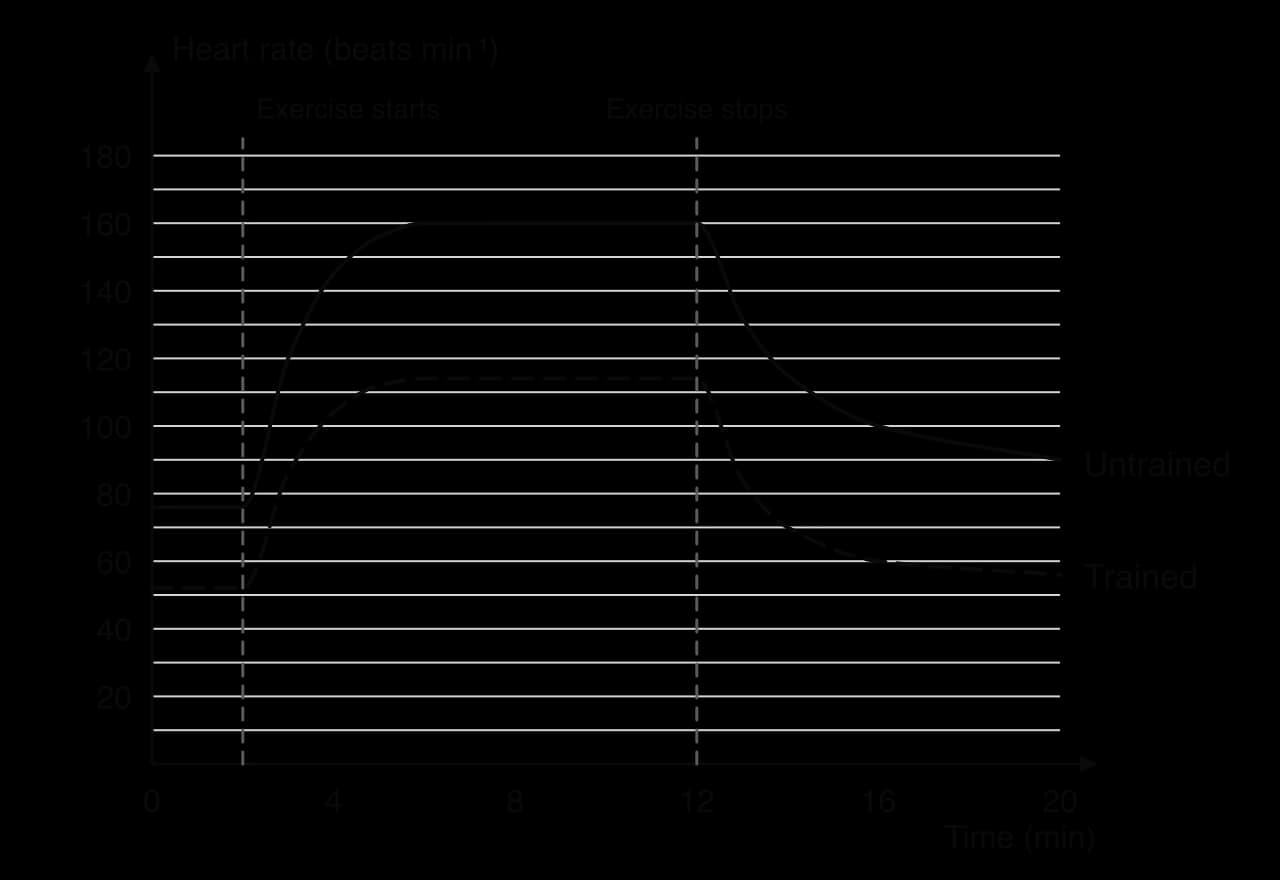
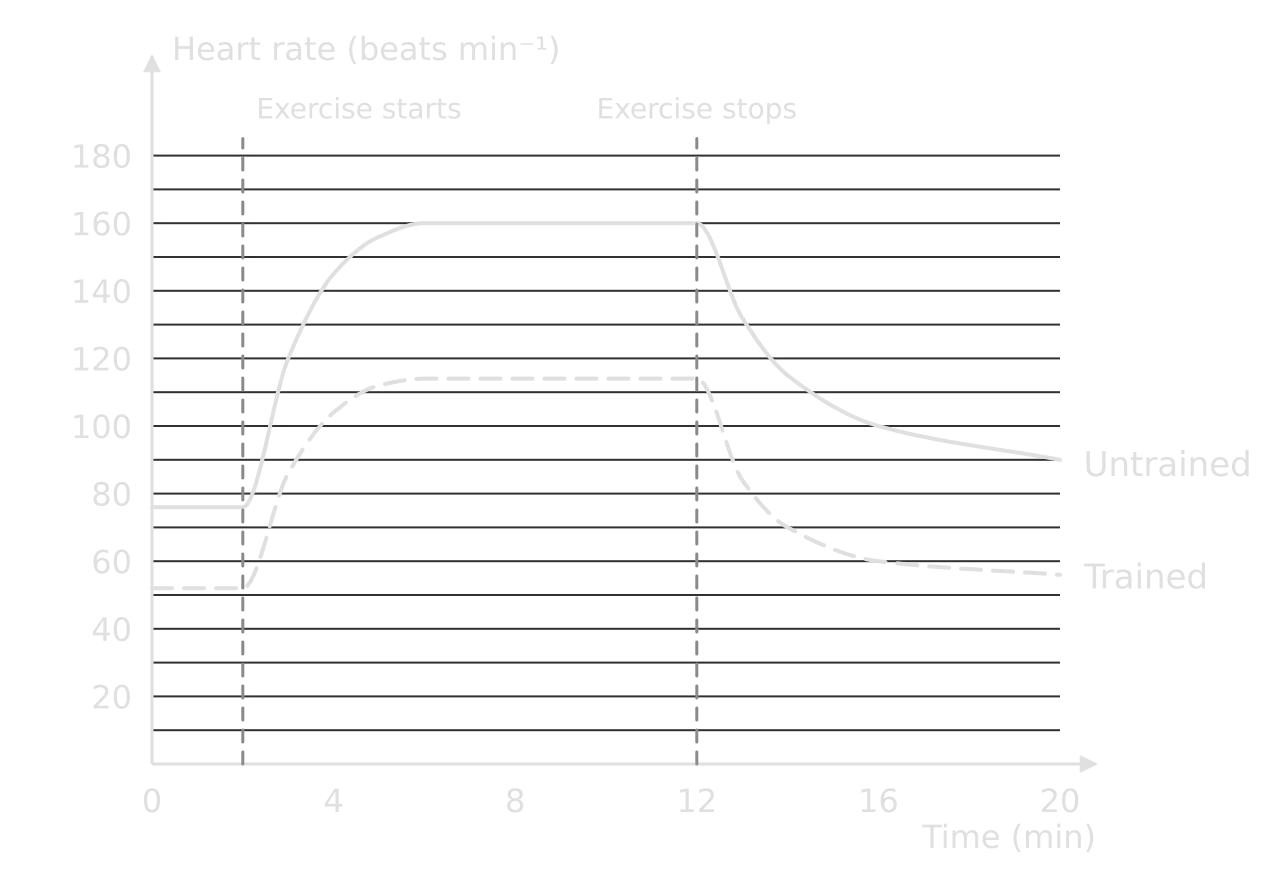
Hypothetical heart rate against time (0 to 20 min) for two students. Untrained: resting 76, exercise from 2 to 12 min, rises to a steady 160, falls to 100 at 16 min and 90 at 20 min. Trained: resting 52, steady 114, falls to 60 at 16 min and 56 at 20 min.Hypothetical heart rate against time (0 to 20 min) for two students. Untrained: resting 76, exercise from 2 to 12 min, rises to a steady 160, falls to 100 at 16 min and 90 at 20 min. Trained: resting 52, steady 114, falls to 60 at 16 min and 56 at 20 min.
Hypothetical data: heart rate of a trained and an untrained student of the same age during 10 minutes of cycling at the same workload and 8 minutes of recovery. Compare resting, steady-state and recovery values.

Worked example

The graph shows the heart rate of two students during 10 minutes of cycling at the same workload, followed by 8 minutes of seated recovery (hypothetical data).

(a) State the resting heart rate of the trained student. [1]

(b) Calculate the percentage by which the trained student’s steady-state heart rate is lower than the untrained student’s. [2]

(c) Describe the heart rate response of the untrained student from the start of exercise to the end of the recovery period. [3]

(d) Both students had a cardiac output of 16 L min⁻¹ during steady-state exercise. Calculate the stroke volume of each student. [2]

(e) Explain why the trained student’s steady-state heart rate is lower than the untrained student’s. [3]

(f) Suggest one reason, other than training, that could explain a difference in heart rate between two students. [1]

Show the model answers

(a) 52 beats min⁻¹ ✓ (the unit is needed).

(b)

percentage by which it is lower=160−114160×100=28.75%≈29%percentage by which it is lower=160160−114​×100=28.75%≈29%

Correct substitution ✓; answer of 29% (accept 28.8%) ✓. The question asks how much lower than the untrained value, so the untrained value goes in the denominator.

(c) Heart rate rises rapidly from 76 beats min⁻¹ at the start of exercise ✓, then levels off at a steady state of about 160 beats min⁻¹ from about minute 6 to minute 12 ✓; after exercise it falls rapidly to about 100 beats min⁻¹ by minute 16, then more slowly, to about 90 beats min⁻¹ at minute 20, still above the resting value ✓.

(d)

SV=Q˙HRSV=HRQ˙​​
untrained: 16,000 mL min−1160 beats min−1=100 mLtrained: 16,000 mL min−1114 beats min−1=140 mLuntrained: 160 beats min−116,000 mL min−1​=100 mLtrained: 114 beats min−116,000 mL min−1​=140 mL

Correct method with the conversion from L to mL ✓; both answers with units ✓.

(e) Endurance training causes cardiac hypertrophy, increasing the size and contractility of the left ventricle ✓ (the athlete’s heart), so the trained student has a larger stroke volume ✓; since cardiac output = HR × SV, the same cardiac output for the same workload is achieved with a lower heart rate ✓. Increased parasympathetic (vagal) tone at rest is also creditworthy.

(f) Any one of: different age, sex, body size, genetic factors, hydration, temperature, anxiety, caffeine or medication ✓.

The parts follow the typical pattern: read a value, calculate, describe with data, calculate again, explain, suggest. Part (d) feeds directly into part (e): the stroke volumes calculated in (d) are the evidence for the explanation in (e), and a strong answer to (e) could quote them.

Common mistake

Dividing by the wrong value in part (b). The question asks how much lower the trained value is than the untrained value, so 160 beats min⁻¹ is the reference. Dividing by 114 gives 40%, which answers a different question: how much higher the untrained value is than the trained one.

A worked structured question: biomechanics

Worked example

A 70 kg long jumper’s take-off foot is in contact with the board for 0.12 s, during which the average net vertical force on the jumper is 1,400 N.

(a) State Newton’s second law of motion. [1]

(b) Calculate the vertical impulse on the jumper. [2]

(c) Determine the jumper’s change in vertical velocity during take-off. [2]

(d) Explain how the jumper could increase the vertical velocity at take-off. [2]

Show the model answers

(a) The acceleration of a body is proportional to the net force acting on it and inversely proportional to its mass / F = ma / force equals rate of change of momentum ✓.

(b)

J=FΔt=1400 N×0.12 s=168 N sJ=FΔt=1400 N×0.12 s=168 N s

Substitution ✓; 168 N s ✓ (unit required).

(c) Impulse equals the change in momentum, so

Δv=Jm=168 N s70 kg=2.4 m s−1Δv=mJ​=70 kg168 N s​=2.4 m s−1

Use of J = Δp = mΔv ✓; 2.4 m s⁻¹ ✓.

(d) Increase the vertical impulse ✓, by applying a greater vertical force to the board (for example through stronger leg extensors or a lower centre of mass on the penultimate stride) or by applying the force for longer ✓; since impulse = change in momentum, a greater impulse gives a greater change in vertical velocity.

Biomechanics parts reward the law or equation, the substitution with units and the link back to the movement. Part (d) needs both the principle (impulse) and a practical way to change it; either alone earns one mark.

A worked structured question: psychology

Worked example

A youth football coach ranks players publicly after every session, praises only the players who score and gives most playing time to the most able.

(a) State the type of motivational climate the coach creates. [1]

(b) Explain two likely effects of this climate on a player of below-average ability. [4]

(c) Suggest two changes the coach could make to create a mastery climate. [2]

Show the model answers

(a) An ego (performance) climate ✓.

(b) The player’s success is judged by comparison with others ✓, so a less able player experiences repeated failure and low perceived competence ✓; this is likely to reduce intrinsic motivation and increase anxiety or dropout ✓; the player may also avoid challenging tasks, or self-handicap, to protect self-esteem ✓.

(c) Any two of: define success as personal improvement and effort ✓; give recognition privately and for effort ✓; group players in mixed-ability teams ✓; give players choices in tasks ✓; evaluate progress against each player’s own previous performance ✓.

The explain part in (b) has four marks for two effects, so each effect needs a reason: what happens, and why. Two bare effects ("low motivation; drops out") earn two marks at most.

Exam tip

In a two-effect explain question, structure the answer as two short paragraphs, each with the effect and its cause. This makes it easy for the examiner to award both marks for each effect, and avoids spending the reasons on one effect only.

Extended responses

Extended responses carry the largest single blocks of marks in Paper 2. They reward depth, accuracy and structure: a clear line of reasoning from the science to the question, supported by examples and evidence, and, for judgment terms, a conclusion that weighs up the argument.

Planning

Spend one or two minutes planning before you write. The plan is for you, not the examiner: a few words per point, in the order you will write them. Planning prevents the two biggest problems in extended answers: running out of points halfway through and forgetting the conclusion.

  1. Underline the command term and the context (the named sport, group or condition).

  2. Write the key term(s) to define in the opening sentence.

  3. List the mechanism points as a chain (cause → effect → outcome).

  4. Note one or two applications and at least one piece of evidence (a named study, a real example or typical values).

  5. For discuss or evaluate: two columns, strengths or arguments for, and limitations or arguments against.

  6. Write the conclusion in note form first, so the answer is written towards it.

A structure that fits most questions

A strong extended response moves through the same stages in most questions. Not every stage is needed for every command term, but the order keeps the answer logical.
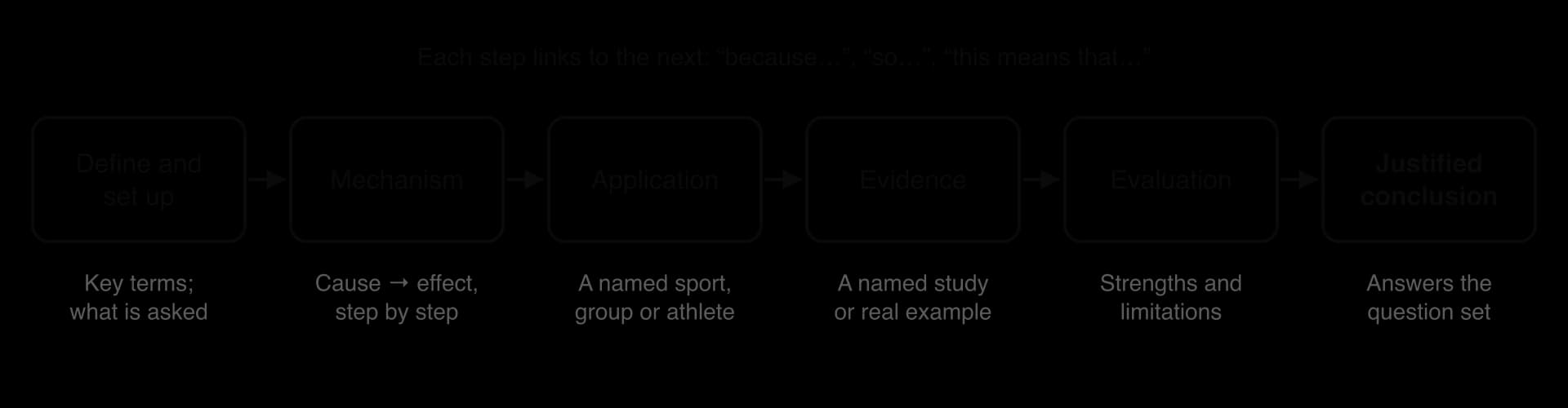
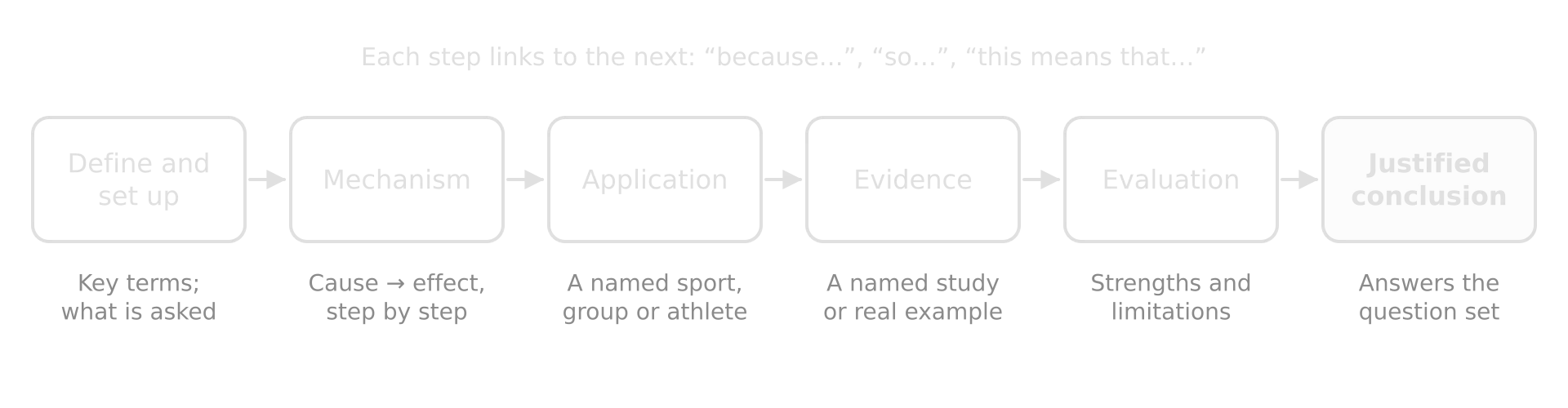
Flow chart of an extended response: Define and set up (key terms, what is asked), Mechanism (cause and effect), Application (named sport, group or athlete), Evidence (named study or real example), Evaluation (strengths and limitations), Justified conclusion (answers the question).Flow chart of an extended response: Define and set up (key terms, what is asked), Mechanism (cause and effect), Application (named sport, group or athlete), Evidence (named study or real example), Evaluation (strengths and limitations), Justified conclusion (answers the question).
An extended response moves from definitions through the mechanism and its application to evidence and evaluation, and ends with a conclusion that answers the question. Each stage builds on the one before.

Stage

What it contains

Why it earns marks

Define and set up

One or two sentences defining the key terms and stating what the answer will address

Shows precise knowledge (AO1) and keeps the answer focused

Mechanism

How or why it works, step by step

Explanations of cause and effect are AO3

Application

The mechanism applied to the named sport, group or athlete

Shows the knowledge used in context (AO2)

Evidence

A named study, a real example, typical values

Supports the argument; required for discuss

Evaluation

Strengths and limitations, conditions, who it suits

Weighing up is the core of evaluate and discuss (AO3)

Justified conclusion

A judgment that follows from the points made

Answers the question set; needed for full marks in judgment terms

The depth each command term needs

Command term

What the answer must do

What is not needed

Explain

A full chain of reasons or causes, each step linked, applied to the context

A judgment or a list of limitations, unless asked

Describe (in a longer question)

A detailed, ordered account of what happens, with data or examples

Reasons, although brief ones do no harm

Evaluate

Strengths and limitations of one thing, each explained, then a judgment of its value

Unrelated alternatives, except as a brief comparison

Discuss

A range of arguments or factors, more than one viewpoint, supported by evidence, then a conclusion

A one-sided case

To what extent

Arguments for and against the statement, ending with a judgment of degree (largely, partly, only when…)

A simple yes or no

Compare and contrast

Similarities and differences, each one about both items

Separate accounts of each item

The conclusion of a discuss, evaluate or to-what-extent answer must make a judgment, not a summary. A judgment takes a position and says what it depends on: for whom, in what conditions, and how strong the evidence is.

Writing in linked paragraphs

Extended responses are marked for the creditworthy points they contain, so each paragraph should make one point fully: the claim, the reason and the link to the question. Short paragraphs of three or four sentences make it easy for the examiner to see each point. Connectives that show reasoning, such as "because", "therefore", "this means that", "however" and "this depends on", are the visible signs of AO3 thinking.

Evidence does not need full references. "A 1960s muscle biopsy study by Bergström and colleagues showed that…" is enough, and so is a well-known real example with its key fact. Avoid invented statistics, because a wrong number undermines an otherwise good argument.

Common mistake

Writing everything you know about a topic. An 8-mark answer on carbohydrate loading does not need the whole of carbohydrate digestion. Content that does not serve the command term and the context earns nothing and uses time needed for evaluation and the conclusion.

Model extended response 1: physiology and nutrition

Worked example

Discuss the use of carbohydrate loading by endurance athletes. [8]

Show the plan, model answer and commentary

Plan (90 seconds)

  • Define: increasing muscle glycogen above normal before competition; high-carbohydrate diet + reduced training (taper) for 1–3 days.

  • Mechanism: glycogen is the main fuel at high aerobic intensities; depletion → fatigue; more glycogen → fatigue delayed.

  • Evidence: Bergström et al. 1967 (biopsies, diet → glycogen → time to exhaustion); Hawley et al. 1997 review (≈20% longer before fatigue in events > 90 min, 2–3% faster over a set distance; no benefit < 90 min).

  • Against: no benefit in short events; weight gain (water stored with glycogen); GI discomfort; old depletion phase unpleasant; needs planning and enough total energy.

  • Conclusion: worthwhile for events > 90 min (marathon, road cycling, triathlon); not for short events; use modern protocol, practise in training.

Model answer

Carbohydrate loading is a nutritional strategy in which an athlete increases muscle and liver glycogen stores above their normal level before competition, usually by eating a high-carbohydrate diet (around 10–12 g per kg of body mass per day) for 36–48 hours while reducing training.

The strategy works because glycogen is the main fuel for the oxidative system at the moderate-to-high intensities of endurance racing. As muscle glycogen falls during a long event, the athlete has to rely more on fat, which is oxidised more slowly, so the pace that can be sustained drops. Starting with larger glycogen stores therefore delays the point at which glycogen runs low, delaying fatigue.

There is strong evidence for this mechanism. Classic muscle biopsy studies by Bergström and colleagues in 1967 showed that a high-carbohydrate diet raised muscle glycogen and greatly extended the time cyclists could exercise before exhaustion. A 1997 review by Hawley and colleagues concluded that loading postpones fatigue by about 20% in events lasting longer than 90 minutes and improves performance over a set distance by about 2–3%, which is a large margin in elite endurance sport.

The same review found little or no benefit in events lasting under about 90 minutes, because normal glycogen stores are enough for them. A 10 km runner or a games player therefore gains little from loading. There are also costs: each gram of glycogen is stored with water, so body mass rises, which may be a disadvantage in weight-bearing or weight-category sports, and eating large amounts of carbohydrate can cause gastrointestinal discomfort. Older protocols included a depletion phase of hard training and low carbohydrate intake, which was unpleasant and could leave athletes tired, but modern protocols without it achieve similar glycogen stores.

The strategy’s success also depends on the individual. Athletes need to eat enough total energy for the extra carbohydrate to be stored, which can be difficult for athletes who restrict their intake, and the plan should be practised in training rather than tried for the first time before a race.

Carbohydrate loading is therefore a well-supported strategy for endurance events lasting longer than about 90 minutes, such as the marathon, road cycling and long-distance triathlon, where glycogen depletion limits performance. For shorter events its costs outweigh its benefits. Athletes who use it should follow a modern protocol without a depletion phase and rehearse it in training.

Examiner-style commentary

  • The opening defines the strategy precisely and gives a realistic intake, which establishes accurate knowledge at once.

  • The mechanism is a clear causal chain (glycogen as fuel → depletion → slower pace → delayed fatigue), not a description.

  • Evidence is named and specific without invented numbers; the review’s findings are used to support the argument and to set its limits.

  • The discussion is balanced: duration of event, body mass, gut comfort, protocol and individual factors are all weighed.

  • The conclusion makes a conditional judgment (for whom and when) that follows from the arguments. This answer would be in the top band.

The answer is about 450 words, which is realistic for 15 minutes of writing. Every paragraph makes a different point, and each point is tied to endurance performance.

Sources: Bergström, Hermansen, Hultman and Saltin, Acta Physiologica Scandinavica, 1967; Hawley, Schabort, Noakes and Dennis, Sports Medicine, 1997.

Model extended response 2: biomechanics

Worked example

Explain, using Newton’s laws of motion, how a sprinter accelerates out of the starting blocks. [6]

Show the plan, model answer and commentary

Plan (60 seconds)

  • First law: at rest in the set position; needs an unbalanced force to start moving.

  • Third law: pushes back and down on blocks → blocks push forward and up on sprinter (ground reaction force).

  • Second law: a = F/m; large net horizontal force → large acceleration; mass fixed so force is key.

  • Direction: forward lean → force directed more horizontally → more horizontal acceleration.

  • Impulse: force × time; long push from both legs → large change in momentum.

Model answer

In the set position the sprinter is at rest. According to Newton’s first law, a body stays at rest unless an unbalanced (net) external force acts on it, so the sprinter must create an unbalanced horizontal force to start moving.

The sprinter generates this force by extending the hips, knees and ankles forcefully and pushing backwards and downwards against the blocks. By Newton’s third law, the blocks exert an equal and opposite force on the sprinter, forwards and upwards. This ground reaction force is the external force that accelerates the sprinter.

Newton’s second law states that acceleration is proportional to the net force and inversely proportional to mass (F = ma). The sprinter’s mass cannot change during the start, so the larger the net horizontal force applied, the greater the forward acceleration. Powerful leg extensors, developed through strength and plyometrics training, therefore improve the start.

The direction of the force also matters. Sprinters lean forward at a low angle out of the blocks, so that the line of the push passes more horizontally through the body and a greater proportion of the ground reaction force accelerates the body forwards rather than upwards. Because force applied over time is the impulse, pushing against the blocks with both legs for an effective period produces a large change in momentum, giving the sprinter a high velocity within the first few steps.

Examiner-style commentary

  • All three laws are stated correctly and each is applied to the start, which is what "using Newton’s laws" requires.

  • The answer explains causes (why the sprinter accelerates), with the direction of each force given; vague phrases such as "pushes hard" are avoided.

  • It goes beyond the three laws to the direction of force and impulse, which are creditworthy extensions that show depth.

  • There is no evaluation or conclusion, and none is needed: the command term is explain. Time is better spent on accurate mechanism.

An explain question in biomechanics rewards laws stated precisely and applied with a direction. A free-body diagram of the sprinter in the blocks, with the weight and the ground reaction force labelled, would strengthen the answer if time allowed.

Tip

In biomechanics answers, state each law in one sentence, then write "In the sprint start, this means…" before applying it. The phrase forces the application that markschemes look for.

Model extended response 3: psychology and motor learning

Worked example

Evaluate the inverted U theory as an explanation of the relationship between arousal and performance. [8]

Show the plan, model answer and commentary

Plan (90 seconds)

  • Define arousal; describe the theory (moderate = optimal, low and high = poorer); sketch.

  • Strengths: matches experience; better than drive theory (explains over-arousal); optimal varies with skill (fine vs gross) and experience → practical use; Yerkes and Dodson 1908 origin.

  • Limitations: arousal treated as one dimension (no cognitive vs somatic: multidimensional anxiety theory); predicts gradual decline, not the sudden drop (catastrophe theory); single optimal point (IZOF suggests individual zones); hard to test (optimal identified after the event).

  • Conclusion: useful general model for coaches; too simple for elite, anxious performers.

Model answer

Arousal is a state of physiological and psychological activation, ranging from deep sleep to intense excitement. The inverted U theory proposes that performance improves as arousal rises up to an optimal, moderate level, and then deteriorates as arousal increases further, so that the relationship forms an inverted U.

A strength of the theory is that it matches the experience of many athletes and coaches. A player who is too relaxed lacks focus and effort, while one who is over-aroused becomes tense and makes errors, for example a basketball player missing free throws in a final. It also improves on drive theory, which predicts that higher arousal always improves well-learned skills, because it explains why over-aroused athletes perform poorly. The idea goes back to Yerkes and Dodson’s 1908 work, in which the best performance occurred at an intermediate level of stimulation.

The theory is also practically useful because the optimal level can be adjusted for the task and the performer. Fine, complex skills such as a snooker shot or a golf putt have a lower optimal arousal than gross, simple skills such as a rugby tackle or a weightlift, and experienced athletes tolerate higher arousal than beginners. Coaches can use this to decide whether an athlete needs psyching up or calming down.

However, the theory treats arousal as a single dimension. Multidimensional anxiety theory separates cognitive anxiety (worry) from somatic anxiety (physical tension) and shows that they affect performance differently, which the inverted U cannot explain. The theory also predicts a gradual, symmetrical decline in performance when arousal is too high. Catastrophe theory, proposed by Hardy and Fazey, argues that when cognitive anxiety is high, a further rise in physiological arousal can cause a sudden, dramatic drop in performance, which matches collapses such as a golfer losing a large lead in the final round.

A further limitation is that the theory proposes a single optimal point. Hanin’s individual zone of optimal functioning suggests that each athlete has their own range of optimal arousal, which may be high for some performers. The theory is also difficult to test, because the optimal level is usually identified after the performance, which makes it hard to show that the theory is wrong.

On balance, the inverted U theory is a useful general model that helps coaches understand why both under-arousal and over-arousal harm performance, and it correctly predicts that the optimal level depends on the skill and the performer. However, it is too simple to explain how elite athletes respond under pressure, because it ignores the separate effects of cognitive anxiety and cannot explain sudden collapses. Multidimensional and catastrophe models therefore give a more valid explanation of high-pressure competition.

Examiner-style commentary

  • The theory is defined and described accurately in the opening; a quick labelled sketch beside the first paragraph would also earn credit.

  • Strengths and limitations are both explained, not just listed, and each is applied to a sporting example.

  • Other theories are used as evidence against the inverted U, not described for their own sake, which keeps the answer an evaluation of the named theory.

  • Theorists are named correctly (Yerkes and Dodson, Hardy and Fazey, Hanin) without invented detail.

  • The conclusion weighs the strengths against the limitations and states for which situations the theory is and is not adequate.

A frequent weakness in psychology answers is to describe four theories of arousal side by side. The evaluate command term asks about one theory, so alternatives should appear only as criticisms of it, as in the model.

Add to your notes: three extended-response plans of your own, one per theme, on topics not covered in the models (for example, "Evaluate the use of sports drinks during endurance events", "Discuss the use of protective equipment to reduce injury", "To what extent does goal setting improve performance?"). Use the six stages of the structure and time yourself at two minutes per plan.

Common weaknesses in extended responses

Weakness

What it looks like

How to fix it

Description instead of explanation

"Heart rate increases, stroke volume increases, cardiac output increases."

Add the causes: because…, which causes…, so…

One-sided evaluation

Four strengths and no limitations

Plan two columns; aim for a balance

No context

A general answer when the question names a group or sport

Mention the context in every paragraph

No evidence

Claims with no study or example

Learn two pieces of evidence for each main strategy, theory or intervention

Summary instead of judgment

"There are strengths and weaknesses."

Take a position and say what it depends on

Running out of time

Last paragraph unfinished, no conclusion

Plan the conclusion first; watch the clock

Common mistake

Using "overall it is good" as a conclusion. A conclusion earns credit when it is specific: good for whom, for which kind of event or skill, under which conditions, and with how much confidence given the evidence.

HL Paper 2 (HL only)

HL only

At HL, Paper 2 is longer (80 marks in 2 hours 30 minutes) and covers both SL and additional higher level material, so HL candidates face more questions, including questions on AHL topics such as EPOC, the sliding filament theory, work, energy and power, fluid mechanics, attribution theory and the six mini-theories of self-determination.

The techniques are the same at HL, and the time per mark is almost the same (just under two minutes). What changes is the range of content and the stamina needed. AHL topics often lend themselves to sketch-and-annotate and calculation parts (EPOC curves, coefficient of restitution, power, lift and the Magnus effect) and to evaluate questions on strategies such as recovery techniques and altitude training.

Worked example

HL: (a) Sketch a graph of oxygen consumption before, during and after a period of steady submaximal exercise. Annotate your graph to show the oxygen deficit, the steady state and excess post-exercise oxygen consumption (EPOC). [4]

(b) Outline two processes that account for the slow component of EPOC. [2]

Show the model answer
Annotated sketch of oxygen consumption against time. From resting level a curved rise to steady state (supply equals demand); shaded oxygen deficit between the dashed demand line and the curve. After exercise stops a curved fall; shaded EPOC is the oxygen consumed above resting level.Annotated sketch of oxygen consumption against time. From resting level a curved rise to steady state (supply equals demand); shaded oxygen deficit between the dashed demand line and the curve. After exercise stops a curved fall; shaded EPOC is the oxygen consumed above resting level.
Model sketch: labelled axes, a curved rise to a plateau, a curved fall to resting level, and each area named with a brief note on what it shows.

(a) Axes labelled oxygen consumption and time, with the start and end of exercise marked ✓; a curve rising from resting to a plateau, then falling to resting after exercise ✓; oxygen deficit shown as the area between the demand line and the curve at the start, annotated as the period when part of the energy is supplied anaerobically ✓; EPOC shown as the area under the recovery curve above resting level, and steady state annotated where supply meets demand ✓.

(b) Any two of: removal and oxidation of lactate ✓; energy cost of the elevated heart rate and breathing rate ✓; elevated body temperature raising metabolic rate ✓; hormone-driven metabolism, such as the effects of epinephrine ✓.

HL extended responses often ask for evaluation of an intervention, for which recent reviews give both sides of the argument. The following plan is for a typical HL question.

Worked example

HL: Evaluate the use of cold-water immersion as a recovery strategy for athletes. [8] (Plan only.)

Show the plan
  • Define: immersing the body, usually to the waist or neck, in water at about 10–15 °C for several minutes after exercise.

  • Mechanism: vasoconstriction and hydrostatic pressure reduce swelling and inflammation; cooling reduces nerve conduction and perceived soreness; lowers core temperature after exercise in the heat.

  • Strengths (with evidence): reviews conclude it speeds the recovery of strength and reduces muscle soreness and perceived fatigue; useful in tournaments with matches on consecutive days (rugby sevens, tennis); cheap with an ice bath.

  • Limitations (with evidence): repeated use after resistance training can blunt gains in strength and hypertrophy, apparently by reducing anabolic signalling, while the evidence on endurance adaptations is mixed; some benefit may be placebo (it is hard to blind participants to cold water); discomfort; risk in people with cardiovascular conditions.

  • Conclusion: valuable when fast recovery between competitions matters more than long-term adaptation; avoid routine use after strength training in the development phase of a season.

The plan shows how evidence supports both sides, and how the conclusion depends on the timing within the training year, which links recovery to periodisation.

Sources: Petersen and Fyfe, Frontiers in Sports and Active Living, 2021.

Exam tip

HL candidates should expect AHL content in both short-answer and extended-response questions. Revise AHL topics to the same AO3 depth as SL topics: each AHL strategy, model or intervention needs strengths, limitations, evidence and a judgment ready.

Managing the paper

A well-managed paper protects the marks you have prepared for. The checklist sets out the routine from the first minute to the last.

  • To do:

    Read the whole paper first and note where the extended responses are.

  • To do:

    Budget about 1.8 minutes per mark; write the finishing time for each question in the margin.

  • To do:

    Read every part of a structured question before answering part (a).

  • To do:

    Use the stimulus: quote values with units.

  • To do:

    Show working, equations and units for every calculation.

  • To do:

    Plan each extended response for one or two minutes, including the conclusion.

  • To do:

    Write one point per paragraph, linked to the context, with evidence.

  • To do:

    End every discuss, evaluate or to-what-extent answer with a justified judgment.

  • To do:

    Leave a few minutes to check units, labels and that every part has been attempted.

If time runs out in an extended response, write the remaining points as a brief list and add a one-sentence conclusion. Points in note form can still earn credit if they are clear and relevant; a blank space cannot.

Summary

  • Paper 2 contains structured short-answer questions, often on a stimulus, and extended-response questions; it is 50 marks in 90 minutes at SL and 80 marks in 2 hours 30 minutes at HL.

  • Structured parts build from state and calculate to explain and suggest; read all the parts and the stimulus first.

  • Quote the stimulus with values and units; show equations and units in calculations.

  • Plan every extended response: define, mechanism, application, evidence, evaluation, justified conclusion.

  • Match the depth to the command term: explain needs causes, evaluate needs strengths, limitations and a judgment, discuss needs a range of arguments and evidence.

  • A conclusion is a judgment that says for whom and under which conditions, not a summary.

  • HL candidates face more questions and AHL content, revised to the same AO3 depth.

Keep your place

In Augment the notes remember where you stopped and which pages you have finished.

Open in Augment

More IB SEHS notes

  • Paper 1B: data-based questionsThe page before this.
  • Data analysis, statistics and the data bookletThe next page.
  • SEHS assessmentEach SEHS paper, the internal assessment and grade boundaries.
  • IB SEHSThe SEHS syllabus, how it is assessed and every notes page.

Carry on with SEHS in Augment

With a free account, Augment remembers where you stopped in the notes and which questions you have marked.

Start free