Notes on C.5.2 Imagery
Learning objectives
Define imagery and outline how it uses several senses and emotions in the absence of actual perception.
Distinguish between internal and external imagery perspectives and between visual and kinaesthetic imagery.
Explain functional equivalence and outline the psychoneuromuscular, symbolic learning and bioinformational explanations of how imagery works.
Describe the cognitive and motivational, specific and general purposes of imagery using Paivio’s framework and its five functions.
Apply Paivio’s framework and the applied model of imagery use to choose the right function of imagery for an athlete’s needs.
Describe the seven elements of the PETTLEP model and apply them to design an imagery script.
Outline how imagery ability and imagery use are measured.
Evaluate the effectiveness of imagery for performance, rehabilitation and the control of anxiety, using research evidence.
Introduction
Imagery is the use of the mind to create or recreate an experience, such as a skill, a race or a pressure moment, without actually performing it. Athletes in almost every sport use it to learn skills, rehearse tactics, prepare for competition, control nerves and stay connected to their sport during injury.
Imagery serves both lenses of the course. For performance, it allows extra high-quality practice without physical fatigue or injury risk. For health, the same mental rehearsal helps patients relearn movements after injury or illness, supports adherence to exercise by helping people picture themselves succeeding, and can be used to manage stress and anxiety.
What imagery is
Three parts of the definition matter. First, imagery mimics real experience: the aim is for the image to feel as close as possible to doing the real thing. Second, it is multisensory: it can involve any of the senses, not just vision. Third, it happens in the absence of actual perception: the athlete is not seeing, hearing or feeling the real event, so the brain has to generate these sensations from memory.
Imagery can recreate an experience that has already happened, such as a personal best, or create a new one, such as a skill not yet performed in competition or a final in an unfamiliar stadium. In both cases the raw material is memory: the more an athlete has experienced the real situation, the richer and more accurate the image can be.
Several terms are used for the same or overlapping ideas. Mental rehearsal or mental practice refers to imagining a skill in order to improve it. Visualisation is a popular term, but it suggests that imagery is only visual, so sport psychologists prefer “imagery”. Mental simulation is used in some research. Observation of a model, as in observational learning, is different: the athlete actually sees the movement, whereas in imagery nothing is perceived.
The senses in imagery
Effective imagery uses as many relevant senses as possible, together with the emotions the athlete would feel. The table uses a single skill, a 100 m freestyle race start, to show how each sense can contribute.
Modality | What is imaged | Example: a 100 m freestyle start |
|---|---|---|
Visual | What the athlete would see | The lane rope, the black line on the bottom, the far wall, the starter on the side |
Kinaesthetic | The feel of the movement: muscle tension, body position, force, rhythm | The toes curled over the block, the tension in the thighs, the stretch into the dive, the streamline |
Auditory | What the athlete would hear | The crowd, the starter’s command, the beep, the splash of entry |
Tactile | Touch and pressure on the skin | The rough surface of the block, the water rushing past the cap and goggles |
Olfactory (and taste) | Smell and taste | The chlorine in the air, the taste of the water |
Emotion | The feelings that go with the situation | Controlled excitement on the block, the confidence of a good start |
Kinaesthetic imagery is particularly important in sport because skilled movement depends on feel. Information about body position and muscle tension normally comes from proprioceptors in the muscles, tendons and joints. In kinaesthetic imagery the athlete recalls these sensations from memory. Gymnasts, divers and golfers often report that the feel of a skill is the most useful part of their imagery, because that is what they use to control the movement.
Imagery perspectives
Imagery can be experienced from two viewpoints, as if through one’s own eyes or as if watching oneself from outside.
A basketball player using internal imagery sees the hoop, the backboard and the ball in her own hands, exactly as at the free-throw line.
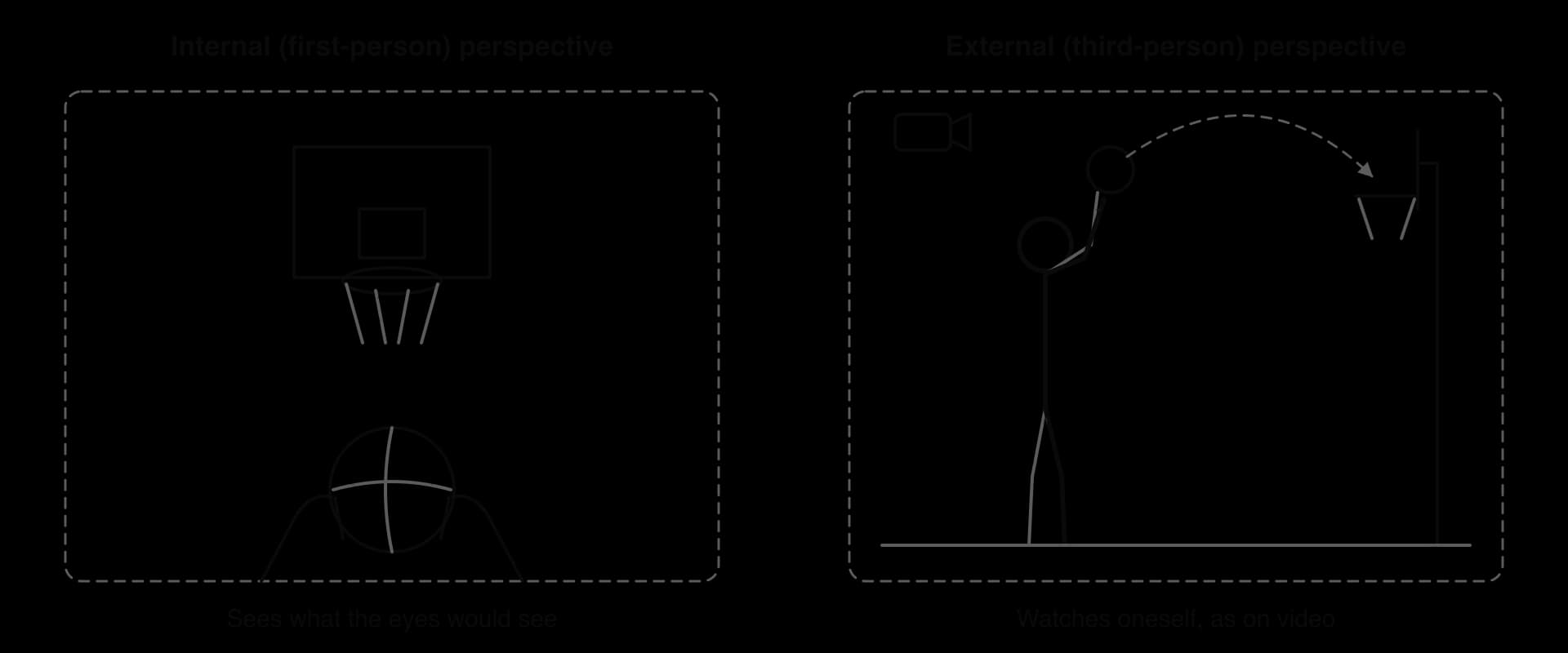
A player using external imagery sees her whole body from the side or from behind, as a coach filming her would. Each perspective gives different information. Internal imagery shows the environment as it will appear in competition, including the cues the athlete must respond to, such as the position of a defender or the line of a putt. External imagery shows the whole body, so it is useful for checking shape, posture and the relationship between body parts.
Research on form-based skills, such as gymnastics floor routines and karate kata, where the shape of the body is judged, has found external visual imagery more effective than internal visual imagery. For slalom tasks (a driving simulation, downhill running and ski slalom), in which the performer must judge a line through the environment, internal visual imagery was more effective. Internal imagery may therefore suit open skills in which the athlete must read and react to the environment, such as a footballer imagining the view as she receives the ball under pressure. Many elite athletes switch between perspectives within one session.
Sources: Hardy and Callow, Journal of Sport and Exercise Psychology, 1999; Callow et al., Frontiers in Human Neuroscience, 2013.
Perspective | Viewpoint | Best suited to | Sporting example |
|---|---|---|---|
Internal (first-person) | Through one’s own eyes | Open skills, timing and reading cues; rehearsing what will be seen in competition | A goalkeeper images the striker’s run-up as she will see it from the line |
External (third-person) | Watching oneself from outside | Form-based skills where body shape matters; checking technique | A diver watches herself in the tuck position from the side |
How imagery works
Functional equivalence
The main modern explanation of why imagery improves performance is that imagining an action and performing it share many of the same processes in the brain.
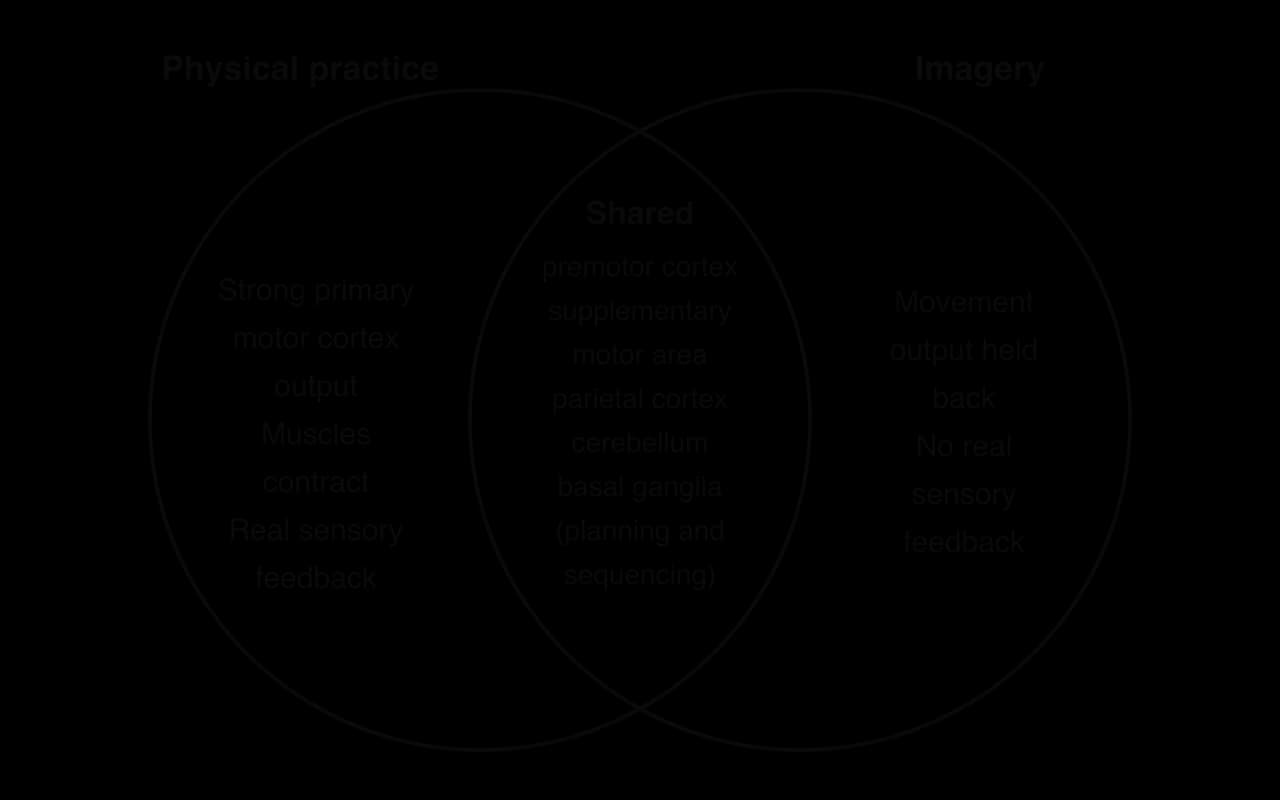
Brain-imaging studies support functional equivalence. A meta-analysis that combined data from 75 neuroimaging papers found that motor imagery consistently activates a large network in the frontal and parietal lobes, as well as subcortical regions and the cerebellum, many of which are also active during real movement. The primary motor cortex, which sends the final commands to the muscles, was not consistently activated. Imagery therefore rehearses the planning and sequencing of a movement without fully executing it.
Sources: Hétu et al., Neuroscience and Biobehavioral Reviews, 2013.
Behavioural evidence points the same way. Imagined movements usually take about the same time as real ones (mental chronometry), and imagining effortful movement can raise heart rate and breathing rate slightly. In practice, the more an image resembles the real experience, in its senses, timing, environment and emotions, the more the brain treats it like real practice. This idea is the basis of the PETTLEP model.
Three classic explanations
Before brain imaging was possible, psychologists proposed three theories of how imagery works. Each explains some findings and not others, and each is a forerunner of functional equivalence.
Psychoneuromuscular theory
Edmund Jacobson reported in the 1930s that imagining bending the arm produced small amounts of electrical activity in the biceps, measured by electromyography (EMG). The psychoneuromuscular theory proposes that this “muscle memory” activity gives a weak form of practice. Later studies confirmed that imagery can produce low-level EMG activity, but the pattern of activity is often not specific to the imagined movement, so the theory cannot fully explain how imagery improves skill.
Symbolic learning theory
According to symbolic learning theory, imagery lets the athlete think through the sequence, timing and spatial pattern of a skill, rehearsing the “plan” of the movement. The theory predicts that imagery should help most with skills that involve decisions and sequences, such as a gymnastics routine or a set play, and least with purely strength-based tasks. Research has broadly supported this pattern, but symbolic learning theory cannot explain the motivational and emotional effects of imagery or the strength gains found in some studies.
Bioinformational theory
Peter Lang’s bioinformational theory (1979) divides an image into two kinds of information. Stimulus propositions describe the scene: the stadium, the crowd, the opponent. Response propositions describe the person’s reactions: a racing heart, tense shoulders, a powerful push from the blocks, a feeling of confidence. Lang argued that imagery changes behaviour most when response propositions are included, because these are what the athlete wants to change or rehearse.
Theory | How imagery helps | Strength | Limitation |
|---|---|---|---|
Psychoneuromuscular | Small muscle activity during imagery rehearses the movement | EMG activity during imagery has been measured | Activity is often not specific to the movement; does not explain motivational effects |
Symbolic learning | Codes the movement as a mental blueprint | Explains larger effects for skills with more cognitive elements | Does not explain emotional effects or strength gains |
Bioinformational | Rehearses stimulus and response propositions | Explains why emotions and physiological responses should be imaged; supports PETTLEP | Hard to test which propositions an athlete actually includes |
Functional equivalence | Imagery and movement share brain networks | Supported by brain imaging and timing studies; guides practice (PETTLEP) | Equivalence is partial: the motor output and real feedback are missing |
 YouTube
The purposes of imagery
Athletes use imagery for different reasons: to learn a skill, to plan a game, to raise motivation, to calm down or to feel confident. In 1985 the Canadian psychologist Allan Paivio proposed that these purposes can be organised along two dimensions.
Cognitive or motivational. Cognitive imagery deals with the information needed to perform: skills and strategies. Motivational imagery deals with the drive and emotions behind performance: goals, arousal and confidence.
Specific or general. Specific imagery focuses on one particular skill or goal. General imagery focuses on broader plans, routines or states.
Cognitive imagery is closest to physical practice. A javelin thrower rehearsing the last three strides of her run-up and a rugby fly-half rehearsing a backline move are both using imagery to improve the “how” of performance.
Motivational imagery works on the “why” and the “how it feels”. A cyclist who images crossing the finish line first to keep training through winter, and the same cyclist imaging herself staying calm on the start line, are both using motivational imagery.
Paivio’s framework and the five functions of imagery
Crossing the two dimensions of Paivio’s framework gives a 2 × 2 grid. Later research by Craig Hall and colleagues (1998), while developing a questionnaire on imagery use, found that the motivational general cell contains two distinct functions, one about arousal and one about mastery. The framework therefore describes five functions of imagery.
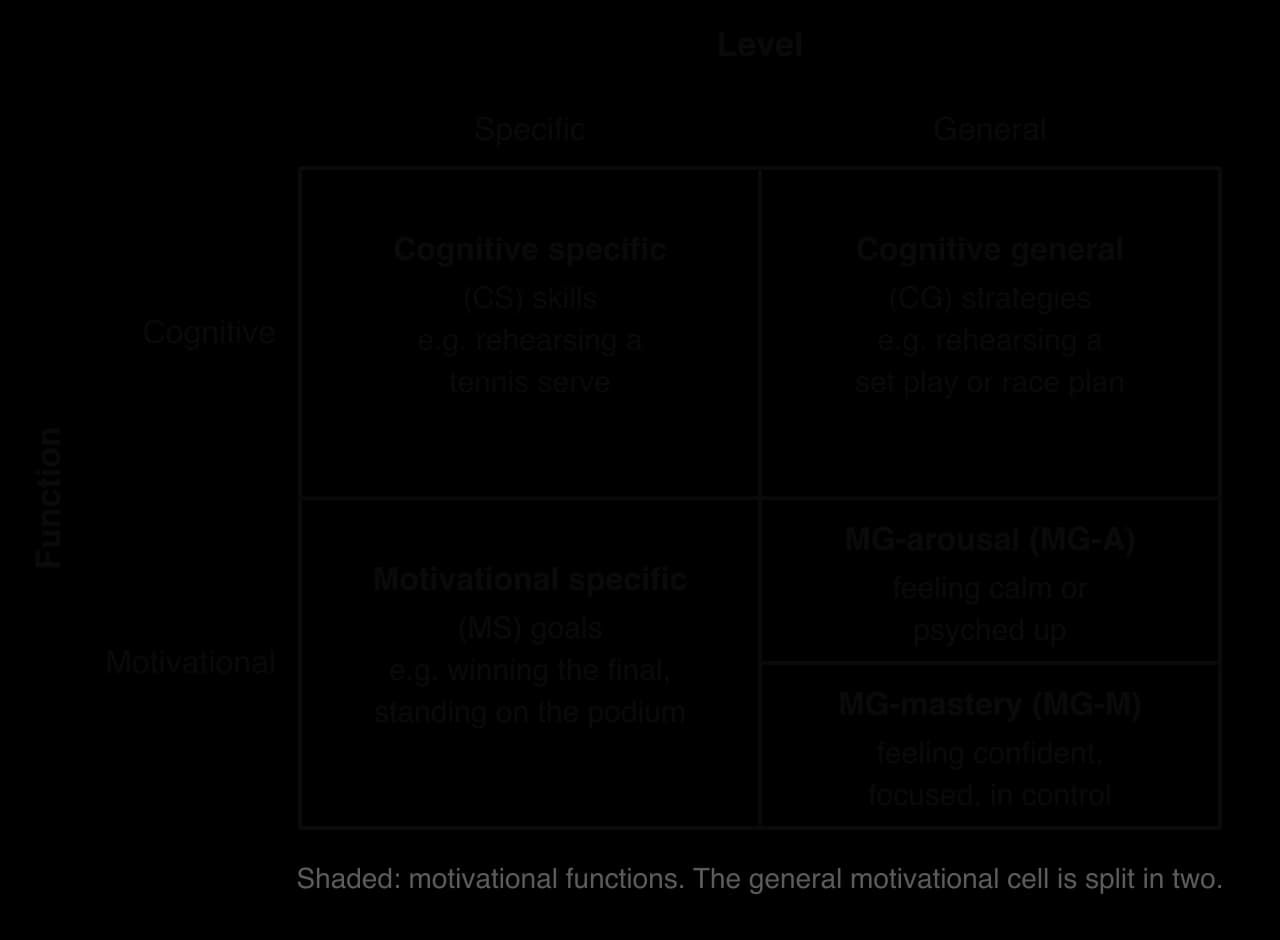
Cognitive specific (CS)
Cognitive specific imagery is the classic form of mental practice. A high jumper rehearses the curve of the approach and the take-off; a darts player rehearses the release. It is used most when learning or correcting a skill, and during injury to maintain the skill without loading the body.
Cognitive general (CG)
Cognitive general imagery rehearses the plan, not a single movement. A 1,500 m runner images the race plan lap by lap, including where she will move to the outside; a netball team images a centre-pass set play; a golfer images her whole pre-shot routine.
Motivational specific (MS)
Motivational specific imagery links imagery with goal setting. An athlete repeatedly images achieving a target, such as seeing a time on the scoreboard, to strengthen commitment to the goal and effort in training. For an exerciser in a health programme, it might mean imaging completing a 5 km event or playing with grandchildren without breathlessness.
Motivational general-arousal (MG-A)
Motivational general-arousal imagery is used to manage activation. A weightlifter may image the explosive energy of a lift to “psych up”; an archer may image a calm, slow-breathing state to “psych down”. It links imagery with inverted U theory and with relaxation as an emotion-focused coping strategy: the athlete uses the image to move arousal towards the optimal zone.
Motivational general-mastery (MG-M)
Motivational general-mastery imagery rehearses coping well. A tennis player images losing the first set and then staying composed, focused and positive; a footballer images a hostile away crowd and feeling unaffected. It is linked to confidence, self-efficacy and mental toughness, and athletes who use more mastery imagery tend to report higher confidence.
Function | Purpose | Elite example | Health or recreational example |
|---|---|---|---|
Cognitive specific (CS) | Learn and rehearse skills | A diver rehearses a 3.5-somersault entry | A patient recovering from a stroke images reaching for a cup |
Cognitive general (CG) | Rehearse strategies and routines | A rowing crew images its race plan | A beginner images the circuit of exercises in a gym session |
Motivational specific (MS) | Strengthen goals | A marathon runner images the finish clock showing a target time | A new runner images finishing a first 5 km parkrun |
Motivational general-arousal (MG-A) | Raise or lower arousal | A sprinter images controlled power in the blocks | An anxious exerciser images feeling calm in a group class |
Motivational general-mastery (MG-M) | Build confidence and control | A goalkeeper images staying calm after conceding | An older adult images walking confidently on an icy path |
Choosing the right function of imagery
Paivio’s framework is useful because it makes the choice of imagery deliberate. The useful question for a coach is which function of imagery an athlete needs at a given time. Kathleen Martin, Sandra Moritz and Craig Hall (1999) turned this idea into the applied model of imagery use.

The model has three parts. The sport situation (training, competition or injury rehabilitation) shapes which function is most useful. The type of imagery chosen (CS, CG, MS, MG-A or MG-M) should match the outcome wanted: cognitive imagery for learning and performing skills and strategies, MG-A for regulating arousal and anxiety, MG-M for confidence and self-efficacy, MS for motivation towards goals. Imagery ability influences how much benefit the athlete gets, so athletes with weak imagery may need training before the intervention works. The central principle is that the content of the imagery should match the outcome the athlete wants.
Athlete’s need | Best function | Why |
|---|---|---|
Learning a new skill or correcting a fault | Cognitive specific | Rehearses the movement pattern; functional equivalence with physical practice |
Preparing a game plan or routine | Cognitive general | Rehearses decisions and sequences in advance |
Low commitment to training | Motivational specific | Makes the goal vivid and strengthens effort and persistence |
Over-aroused or under-aroused before competition | Motivational general-arousal | Moves arousal towards the optimal level |
Low confidence or fear of failing under pressure | Motivational general-mastery | Rehearses coping successfully, building self-efficacy |
The PETTLEP model
If imagery works because it is functionally equivalent to real movement, then imagery should be designed to resemble real performance as closely as possible. Paul Holmes and David Collins (2001) set out how to do this in the PETTLEP model.
Each letter stands for one way of making the imagery more like the real thing. The PETTLEP model does not replace Paivio’s framework: Paivio’s framework decides what the imagery is for, and PETTLEP decides how to make the imagery realistic.
Element | Meaning | Practical instruction | Example: a hockey penalty flick |
|---|---|---|---|
Physical | Match the body’s physical state and position | Adopt the stance, hold the equipment and wear the kit used in competition | Stand in the flick position holding the stick, in match clothing |
Environment | Match the setting | Do the imagery in the venue, or use photos, video or sounds of it | Do the imagery on the pitch at the penalty spot, or watch a video of the stadium first |
Task | Match the task and the performer’s skill level | Image the exact skill at the level it is actually performed; experts focus on feel, beginners on visual detail | Image the specific flick into the top corner, not a generic shot |
Timing | Match the real speed of the movement | Image in real time; slow motion only to analyse a difficult part, then return to real time | Image the flick at match speed, timing it against a real one |
Learning | Update the image as skill develops | Review and change the script as the skill or tactics change | Revise the image after learning a new disguise in the flick |
Emotion | Include the emotions of real performance | Image the feelings of competition: pressure, nerves, excitement, confidence | Feel the tension of a shoot-out and the controlled confidence before striking |
Perspective | Use the viewpoint that matches the task | Internal for open skills and cues; external for form; switch if useful |
PETTLEP has good practical support. Studies of hockey players and gymnasts reported larger performance improvements when more PETTLEP elements were included in the imagery, and a 4-week study of PETTLEP imagery in netball shooting found that the amount of improvement depended on how often the imagery was done. Most of these studies are small and short (a few weeks), and many use students instead of elite athletes, so the size of the effect in elite competition is less certain.
Sources: Smith, Wright, Allsopp and Westhead, Journal of Applied Sport Psychology, 2007; Wakefield and Smith, Journal of Imagery Research in Sport and Physical Activity, 2009.
Evaluation of the PETTLEP model
Strengths | Limitations |
|---|---|
Based on functional equivalence, which is supported by brain-imaging evidence | Most studies are small, short and use non-elite participants |
Gives practical, concrete instructions that coaches can use | Some elements are hard to apply: the competition venue may not be available for practice |
Studies show larger benefits when more elements are included | Studies rarely isolate each element, so it is unclear which matter most |
Can be adapted to any sport, level and setting, including rehabilitation | Including competition emotions may increase anxiety in athletes prone to it unless it is combined with mastery imagery |
PETTLEP is the best-supported practical guide to doing imagery well, and its logic follows directly from functional equivalence. Its value depends on the athlete’s imagery ability, the time available and access to the environment, and on matching the content to the right function. It is most useful for cognitive specific and cognitive general imagery of closed skills, where the physical position, timing and environment can be reproduced closely.
Designing an imagery script
An imagery script turns Paivio’s framework and PETTLEP into a concrete session. Scripts are usually written with the athlete, in the athlete’s own words, and recorded so that the athlete can listen with eyes closed. A good script follows five steps.
Identify the need and the function. Decide what the imagery is for (for example CS to rehearse a skill, MG-M to build confidence) using Paivio’s framework.
Gather the details. Ask the athlete to describe the real situation with all the senses: what they see, hear, feel and smell, and the emotions they feel.
Write the script using PETTLEP. Write in the present tense, addressing the athlete directly, and include stimulus details (the scene) and response details (heart rate, muscle feel, emotions), and set the timing to real time.
Start with relaxation. Begin with a minute of slow breathing, because a relaxed state helps attention and vividness.
Practise, review and update. Use the script regularly (several short sessions a week), rate vividness and control after each session, and revise the script as skill develops (the Learning element).
Measuring imagery ability and imagery use
Two different things can be measured: how well an athlete can image (imagery ability) and how often and for what purposes they use imagery (imagery use). Both matter, because an athlete who images often but poorly may gain little, and an athlete with excellent ability who rarely uses it gains nothing.
Imagery ability: questionnaires and mental chronometry
The most widely used measure of imagery ability is the Movement Imagery Questionnaire-3 (MIQ-3). The athlete physically performs a simple movement, such as a knee raise or a jump, then images it, and rates how easy the image was to create on a 7-point scale. Each movement is imaged three ways: internal visual, external visual and kinaesthetic, giving a score for each type of imagery.
Imagery ability can also be measured objectively by mental chronometry: the time taken to image a movement is compared with the time taken to perform it. Because of functional equivalence, a good imager produces imagined times close to real times. In a study of 198 participants, self-report scores on the MIQ-3 did not correlate significantly with chronometry scores for any type of imagery. The two methods appear to measure different aspects of imagery quality, so researchers recommend using both.
Sources: Williams, Guillot, Di Rienzo and Cumming, European Journal of Sport Science, 2015.
Imagery use: the Sport Imagery Questionnaire
The Sport Imagery Questionnaire contains short statements describing imagery use, for example imaging being in control in difficult situations (MG-M) or imaging and refining a particular skill (CS), and the athlete rates how often each applies. It gives a profile across CS, CG, MS, MG-A and MG-M, which shows which functions an athlete already uses and which could be developed. The SIQ has been translated and checked in other languages; a Brazilian version tested with 260 athletes reproduced the same five-factor structure and showed high reliability.
Method | What it measures | Strengths | Limitations |
|---|---|---|---|
MIQ-3 (self-report) | Ease of internal visual, external visual and kinaesthetic imagery | Quick; separates three imagery types; widely used, so results can be compared | Self-report: depends on honesty and insight; ratings of “ease” are subjective |
Mental chronometry | Match between imagined and real movement time | Objective; directly tests functional equivalence of timing | Measures timing only, not vividness or emotion; needs simple timed movements |
SIQ (self-report) | Frequency of the five functions of imagery | Linked directly to Paivio’s framework; gives a profile to plan interventions | Measures frequency, not quality; recall of how often imagery is used may be inaccurate |
Imagery logs and interviews | Content, context and perceived effect of imagery sessions | Rich, individual detail; useful for revising scripts | Time-consuming; qualitative; hard to compare between athletes |
Uses of imagery beyond skill learning
Injury rehabilitation
Injured athletes lose physical practice, contact with their team and often confidence. Imagery can address all three. In interviews with 10 injured athletes receiving physiotherapy, the athletes described using imagery for three purposes: cognitive (learning and correctly performing their rehabilitation exercises), motivational (imaging themselves fully recovered, staying focused and positive) and healing (imaging the injured tissue repairing). They also used imagery to manage pain, for example by rehearsing coping with expected pain, by distracting themselves with images, or by imaging the pain dispersing.
In terms of Paivio’s framework, CS imagery maintains the sport skill while the athlete cannot train it, MS imagery keeps the goal of returning to sport vivid, and MG-M imagery rebuilds confidence before the first return to contact or competition. Because imagery places no load on healing tissue, it can be used from the earliest stage of rehabilitation, alongside physiotherapy and a graduated return to sport.
Sources: Driediger, Hall and Callow, Journal of Sports Sciences, 2006.
Controlling anxiety and building confidence
Imagery links closely with coping and with the control of arousal and anxiety. As an emotion-focused coping strategy, MG-A imagery combined with slow breathing can lower heart rate and muscle tension before competition. As a form of rehearsal, MG-M imagery allows an athlete to experience a stressor (a false start, a missed penalty, a hostile crowd) and a successful response to it before it happens, so that the real situation is more likely to be appraised as a challenge than as a threat.
This is why imagery appears in the list of effective coping strategies for athletes. It also explains how imagery can help regulate heart rate: imaging a calm, controlled state activates some of the same responses as being in that state, so rehearsing calm makes calm easier to reach. The physiological effect depends on the content. Imaging a frightening situation without a successful response can raise heart rate and anxiety, so mastery and relaxation should be built into the image.
Managing training load
Imagery can be used to keep practising skills when physical training must be limited: during a taper before competition, when fatigued, when ill or travelling, or when training volume is being reduced to lower the risk of overtraining syndrome. A diver can rehearse a dive twenty times in imagery without twenty impacts with the water. A swimmer during a taper can maintain the feel of race pace while swimming less. Imagery adds practice without adding physical load, although it cannot replace the physical adaptations of training.
Health and exercise settings
Outside elite sport, imagery is used in physiotherapy and neurological rehabilitation (for example, patients imaging movements of a weak limb after a stroke), in exercise programmes to help beginners picture themselves succeeding, and in stress management. The mental strength-training study of the elbow flexors, muscles used constantly in daily living, illustrates why imagery is of interest to health professionals working with people who cannot yet train physically.
Use | Health lens | Performance lens |
|---|---|---|
Maintaining movement when physical practice is not possible | Imaging arm movements after a stroke or surgery | Rehearsing skills while injured or during a taper |
Motivation and goals (MS) | Imaging completing a first fun run or walking without pain | Imaging a podium finish or a target time |
Arousal and anxiety control (MG-A) | Calming imagery for people anxious about exercise classes | Lowering pre-competition arousal in shooting or golf |
Confidence (MG-M) | Older adults imaging walking confidently to reduce fear of falling | Imaging staying composed after an early mistake |
Evaluating imagery
Research on imagery has been carried out for nearly a century, and several meta-analyses have pooled the results. The most recent large meta-analysis found that imagery interventions in sport had an overall medium effect (d ≈ 0.43). Imagery significantly improved motor performance and also motivational and affective outcomes. Imagery combined with physical practice was more effective than physical practice alone, and the effect increased with the amount (intensity) of imagery training.
Sources: Simonsmeier, Andronie, Buecker and Frank, International Review of Sport and Exercise Psychology, 2021.
Imagery on its own is generally less effective than physical practice, as the mental strength-training study shows. Its strongest use is therefore in addition to physical practice, or as a substitute when physical practice is impossible. Effectiveness also depends on the individual: athletes with better imagery ability benefit more, and imagery ability can itself be trained.
Strengths | Limitations |
|---|---|
Meta-analyses show a medium positive effect on performance, motivation and emotions | Imagery is private, so its content and adherence cannot be observed directly |
Adds practice without fatigue, physical load or injury risk | Less effective than physical practice on its own |
Can be used anywhere, at any time and at any level, including rehabilitation | Depends on imagery ability, which varies widely between people |
Flexible: Paivio’s framework covers skills, strategies, goals, arousal and confidence | Poorly controlled or negative imagery (imaging errors) can rehearse mistakes and raise anxiety |
Has a plausible mechanism (functional equivalence) supported by brain imaging | Many studies are small, short, use novices or laboratory tasks, and cannot rule out expectancy effects |
The evidence supports imagery as one of the most useful psychological skills, especially as a supplement to physical practice and when practice is limited by injury or load. The size of the benefit depends on matching the function to the athlete’s need (Paivio’s framework), making the imagery realistic (PETTLEP), the athlete’s imagery ability and the amount of regular practice. Imagery is weakest when it is vague, occasional or used to replace training that the athlete could do physically.
Case study: gaining strength with imagery alone
Imagery is usually linked with skill learning, but it may also affect strength. A study at the Cleveland Clinic in the United States tested this with 30 healthy young volunteers.
One group (n = 8) trained by performing “mental contractions” of the little finger abductor, the muscle that moves the little finger away from the others. A second group (n = 8) performed mental contractions of the elbow flexors. A control group (n = 8) did no training but took part in every measurement. A fourth group (n = 6) trained the little finger abductor physically with real maximal contractions. Training lasted 12 weeks, 15 minutes a day, 5 days a week.
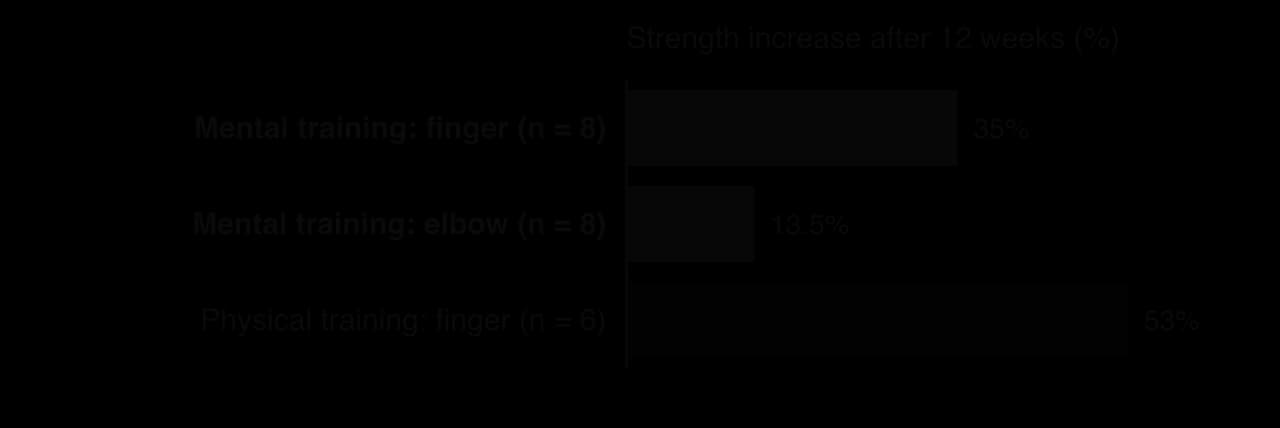
Results. Strength in the little finger abduction group increased by 35%, and in the elbow flexion group by 13.5%. The physical training group increased finger abduction strength by 53%. The control group showed no significant changes. The strength gains in the mental training groups were accompanied by significant increases in a cortical potential measured by electroencephalography (EEG), a signal associated with the brain’s control of voluntary muscle contractions.
Explanation. The muscles of the mental training groups did not contract during training, so their gains cannot be explained by changes in the muscle itself, such as hypertrophy. The researchers concluded that mental training increased the strength of the signal sent from the brain to the muscles, so the motor units were driven to a higher level of activation. This is strong support for functional equivalence: rehearsing the brain’s command for a maximal contraction improved that command. It is consistent with the large early strength gains in physical training, which are also mainly neural.
Limits of the study. The samples were very small (6–8 per group), so a few unusual participants could have a large effect on the results. The participants were healthy young volunteers, not athletes.
The little finger abductor is a small muscle that is rarely trained, so it may respond unusually well to any training; the smaller gain in the much more frequently used elbow flexors supports this. The task (one simple, maximal contraction) is far from a complex sporting skill. Participants could not be blinded to whether they were doing mental training, so expectancy effects cannot be ruled out, and it is impossible to check how intensely each person imaged each contraction.
What the case shows. The study shows that imagery can produce real physical changes through the nervous system, which supports functional equivalence and the use of imagery when physical training is not possible, for example after injury or surgery. It also shows that imagery is not a replacement for physical training. Linking to other themes, it raises a question about motor unit recruitment: if the brain can learn to recruit motor units more fully, imagery might help maintain strength during immobilisation, a question with clear importance for rehabilitation and for older adults.
Sources: Ranganathan, Siemionow, Liu, Sahgal and Yue, Neuropsychologia, 2004.
Explain why the strength gains in the mental training groups are evidence for functional equivalence.
Suggest why the gain from mental training was larger for the little finger abductor than for the elbow flexors.
Evaluate the extent to which these results could be applied to an elite weightlifter recovering from a wrist injury.
Exam practice
Imagery questions appear at HL in Paper 1A multiple-choice questions, in Paper 1B data-based questions on imagery interventions, and in Paper 2, where structured questions often ask you to outline functional equivalence, describe PETTLEP or apply Paivio’s framework, and extended responses ask you to evaluate or discuss imagery as a psychological skill.
For PETTLEP questions, name each element accurately and give a practical instruction, not just the word. “Timing: image the skill in real time, at the same speed as performance” earns credit; “Timing: think about time” does not.
Multiple-choice questions
PETTLEP questions often test the meaning of one letter.
Questions on mechanisms usually test functional equivalence.
Data-based question
This question uses real data from a published study.
Paper 1B: Researchers investigated how often PETTLEP imagery should be performed to improve netball shooting. Thirty-two female university students who had not competed in netball were randomly allocated to four groups of eight.
Three groups performed PETTLEP imagery of 20 shots once, twice or three times a week for 4 weeks; the imagery was done on a netball court, holding a ball, from an internal perspective, in real time and including the emotions felt in the pre-test. The control group did netball-related stretching twice a week. Before and after the 4 weeks, each participant took 20 shots from five positions, scored 0 (miss), 2 (hit the ring) or 5 (scored), giving a performance score out of 100.
Group | Effect size (d) for change in performance score, pre-test to post-test | Significant improvement (p < 0.05)? |
|---|---|---|
Imagery once a week (n = 8) | 0.84 | No |
Imagery twice a week (n = 8) | 0.71 | No |
Imagery three times a week (n = 8) | 1.82 | Yes (p < 0.01) |
Control: stretching (n = 8) | −0.03 | No |
Sources: Wakefield and Smith, Journal of Imagery Research in Sport and Physical Activity, 2009.
Structured questions
Paivio’s framework is often tested with a diagram.
PETTLEP questions reward practical detail.
Questions on applications combine imagery with other topics.
Extended-response question
Summary
Imagery is the creation or recreation of an experience in the mind using several senses (visual, kinaesthetic, auditory, tactile, olfactory) and emotions, in the absence of actual perception.
Internal imagery is first-person; external imagery is third-person; kinaesthetic imagery is the feel of the movement and can be combined with either perspective.
Functional equivalence (shared brain networks for imagined and real movement) is the main explanation of how imagery works; psychoneuromuscular, symbolic learning and bioinformational theories are earlier explanations.
Paivio’s framework classifies imagery as cognitive or motivational and specific or general, giving five functions: CS, CG, MS, MG-A and MG-M.
The function of imagery should be matched to the athlete’s need and situation (the applied model of imagery use).
The PETTLEP model (physical, environment, task, timing, learning, emotion, perspective) makes imagery as functionally equivalent to real performance as possible.
An imagery script puts the chosen function and PETTLEP into a written, recorded session that is practised and updated.
Imagery ability is measured with the MIQ-3 and mental chronometry; imagery use with the Sport Imagery Questionnaire.
Meta-analyses show a medium positive effect of imagery, larger when it is combined with physical practice; imagery also helps rehabilitation, anxiety control and confidence.
Self-check
- To do:
I can define imagery and describe the senses and emotions it can include.
- To do:
I can distinguish between internal and external imagery and explain when each is useful.
- To do:
I can explain functional equivalence and outline three earlier theories of how imagery works.
- To do:
I can sketch Paivio’s framework and describe the five functions of imagery with examples.
- To do:
I can apply Paivio’s framework to choose the right function of imagery for an athlete.
- To do:
I can describe each element of the PETTLEP model and use it to write an imagery script.
- To do:
I can outline how imagery ability and imagery use are measured.
- To do:
I can evaluate imagery using research evidence, including its uses in rehabilitation and anxiety control.