Paper 1A: multiple choice
How Paper 1A multiple-choice questions are built, the strategies that answer them quickly and reliably, the traps hidden in the wrong options, and ten worked questions.
- IB Physics
- Exam skills
- SL and HL
Paper 1A is the multiple-choice part of Paper 1. Every question has four options, labelled A to D, and exactly one of them is correct. Each question earns one mark, and there is no penalty for a wrong answer, so no question should ever be left blank. A calculator and a clean copy of the data booklet are available, but the numbers are chosen so that the arithmetic takes seconds: most questions test whether you can choose the right physics, not whether you can push buttons.
The skill being tested is different from that of a written paper. In Paper 2 a sound method earns marks even when the final answer slips; in Paper 1A only the letter counts. That makes two habits essential: a fast, reliable route to the answer, and a check that the answer is not one of the carefully designed wrong options.
How the questions are built
A typical stem is three or four lines long: a short physical situation, sometimes a diagram, and one question. Most stems end with a direct question ("What is the tension in the cable?"). Some end mid-sentence, and the options complete it ("The internal energy of an ideal gas is"); those options start with a lower-case word and end with a full stop.
Format | What it looks like | How to approach it |
|---|---|---|
Numbers with units | Four values, almost always in ascending order | Calculate or estimate first; the order lets you spot factor-of-2 and power-of-ten neighbours |
Expressions or ratios | , , , "What is ?" | Work with symbols and ratios; check units of each expression |
Words or phrases | Four short statements or sentence endings | Decide what you would write before reading them |
Two-quantity table | Four rows, each giving a pair of values ("What are the radius and the period?") | Decide each column separately, then find the row that matches both |
Graph or diagram options | Four sketches: "Which graph shows the variation of … with …?" | Check intercept, gradient, curvature and asymptotes one at a time |
Statement combinations | Statements I, II, III, then A "I and II only", B "I and III only", C "II and III only", D "I, II and III" | Judge each statement true or false independently |
The options are not random. Each distractor is built by applying one plausible mistake to the correct method: forgetting the ½ in kinetic energy, using a diameter as a radius, leaving a temperature in degrees Celsius, not squaring a ratio. A student who makes that slip finds their answer waiting among the options, which is why "my answer is there, so it must be right" is not a safe check.
Stems also contain cue words that carry physics. "Negligible internal resistance" means the terminal pd equals the emf. "Released from rest" sets . "Frictionless" or "in a vacuum" removes energy losses. "Ideal gas" allows and means there are no intermolecular forces, so the internal energy is all kinetic. A question that seems to lack information often has the missing piece in one of these phrases.
A routine for every question
Read the whole stem, including the last line. Mark the quantity asked for and any cue words. Many marks are lost by answering a slightly different question, such as giving the distance when the displacement was asked for.
Cover the options and predict. Decide the physics and, for a calculation, get a value or at least a rough size. For a conceptual question, say in a few words what the answer should be.
Match and check. Find your prediction among the options. Then ask which slip each neighbouring option represents. If you can explain every distractor, you can be confident in the key.
If stuck, eliminate. Remove options with the wrong unit, the wrong direction, the wrong order of magnitude or an impossible limiting case. Guessing between two options is far better than guessing between four.
Mark and move on. If a question resists you for more than a couple of minutes, choose the best remaining option, mark the question, and return to it at the end.
Strategies that save time
Proportional reasoning
Many questions ask how a quantity changes when others are scaled: "The distance is doubled and the current halved. What is the new force?" There is no need to find any actual value. Write the relationship as a proportionality, then replace each variable with its scale factor.
For example, the power dissipated in a resistor connected to a fixed pd is , and . A wire of the same material with twice the length and twice the diameter has and (area goes as diameter squared), so and .
Units as a check and an eliminator
Every correct physics equation is homogeneous: both sides have the same units. When the options are algebraic expressions, working out the units of each one often leaves only one candidate. When the options are numbers, the unit of the quantity asked for confirms that the right equation has been used: an answer in is a momentum, not an energy.
The SI base units used for this are kg, m, s, A, K and mol. A newton is , a joule is and a pascal is .
Estimation and orders of magnitude
When the options differ by factors of ten or more, a rough calculation with one-significant-figure numbers is enough. Estimation questions ("What is the order of magnitude of …?") expect you to know rough values of everyday quantities: a person has a mass of about 70 kg, a storey of a building is about 3 m high, the density of air is about 1 kg m⁻³ and of water 1000 kg m⁻³, a car on a motorway travels at about 30 m s⁻¹.
Limiting cases
An expression that is correct must behave sensibly at the extremes. If one option for the acceleration of a block on a frictionless slope at angle is , setting gives an acceleration of on a horizontal surface, which is impossible: that option is wrong. The correct gives 0 on the flat and for a vertical drop. Testing an option at , at , at zero mass or at infinite resistance takes seconds.
Reading graphs
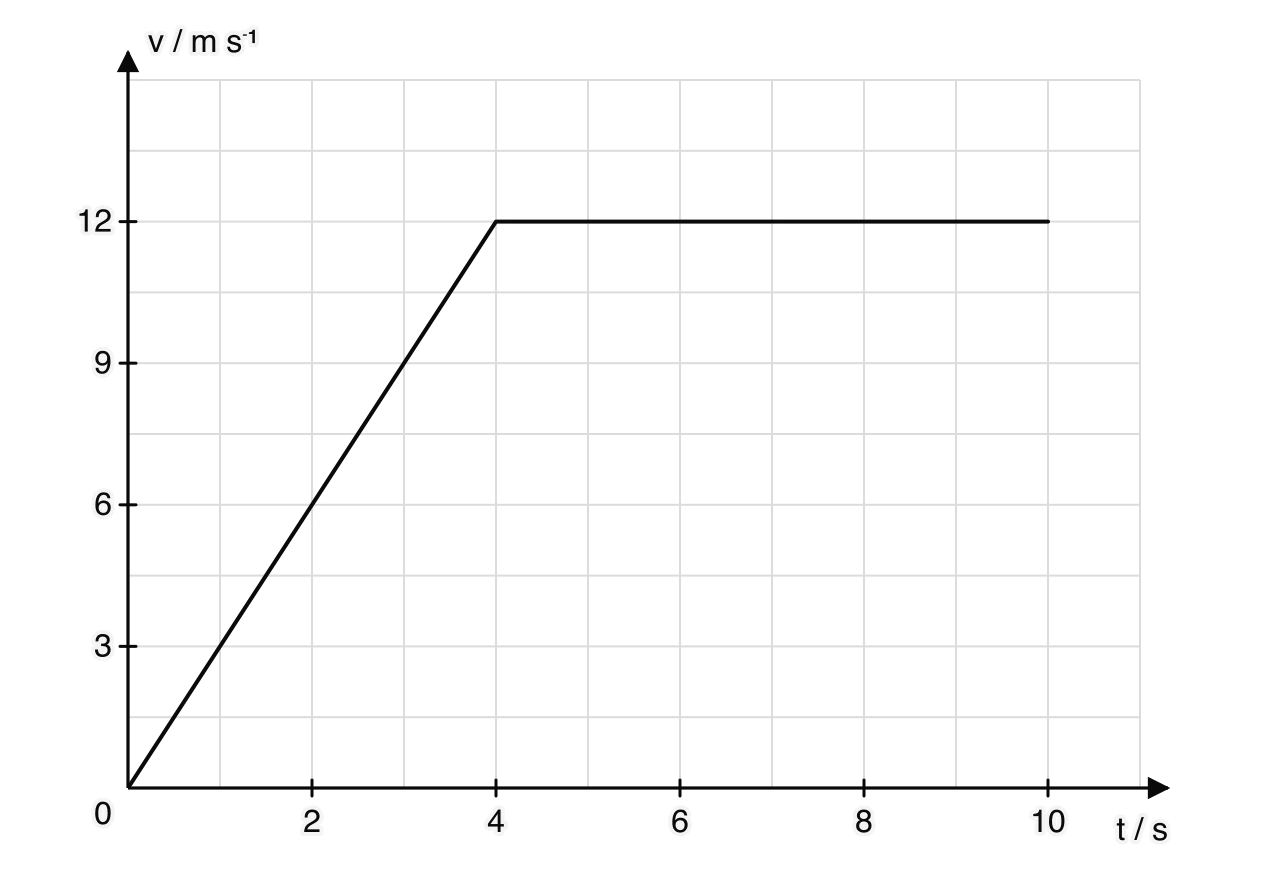
Graph questions test a small set of skills. For any graph, identify what the gradient represents and what the area under the line represents, and read the values from the axes with their units and prefixes.
Graph | Gradient | Area under the line |
|---|---|---|
Displacement–time | Velocity | (no useful meaning) |
Velocity–time | Acceleration | Displacement |
Acceleration–time | (rate of change of acceleration) | Change in velocity |
Force–time | (rate of change of force) | Impulse (change in momentum) |
Force–extension | Spring constant | Elastic potential energy stored (work done) |
Power–time | (rate of change of power) | Energy transferred |
Potential difference–current | Resistance only for a straight line through the origin | (no useful meaning) |
For "Which graph shows …?" questions with four sketches, use the features in turn. Does the line pass through the origin? Is it straight or curved, and which way does it curve? Does it approach an asymptote? Is there a maximum, and where? Usually two of these features eliminate three options.
Statement questions
In a question with statements I, II and III, judge each statement on its own and write T or F beside it. Only then look at the options. Because the options are always the same four combinations, deciding that one statement is false removes two or three options at once. If statement II is false, only B ("I and III only") can be correct, as long as I and III are true.
Traps hidden in the distractors
The same slips appear in every theme. Learning to recognise them makes most distractors easy to reject.
Trap | Example of the distractor |
|---|---|
A missing factor of 2 | Forgetting the ½ in or in ; using the final speed where the average speed is needed |
A wrong power | Not squaring in , or ; using a square root where a cube root is needed |
An inverted ratio | Giving when was asked |
Celsius for kelvin | Doubling 27 °C to 54 °C instead of 300 K to 600 K in the gas laws or in |
Radius from the wrong point | Using the height above a planet’s surface instead of the distance from its centre |
Diameter for radius | Using the full diameter of a wire, planet or circular path |
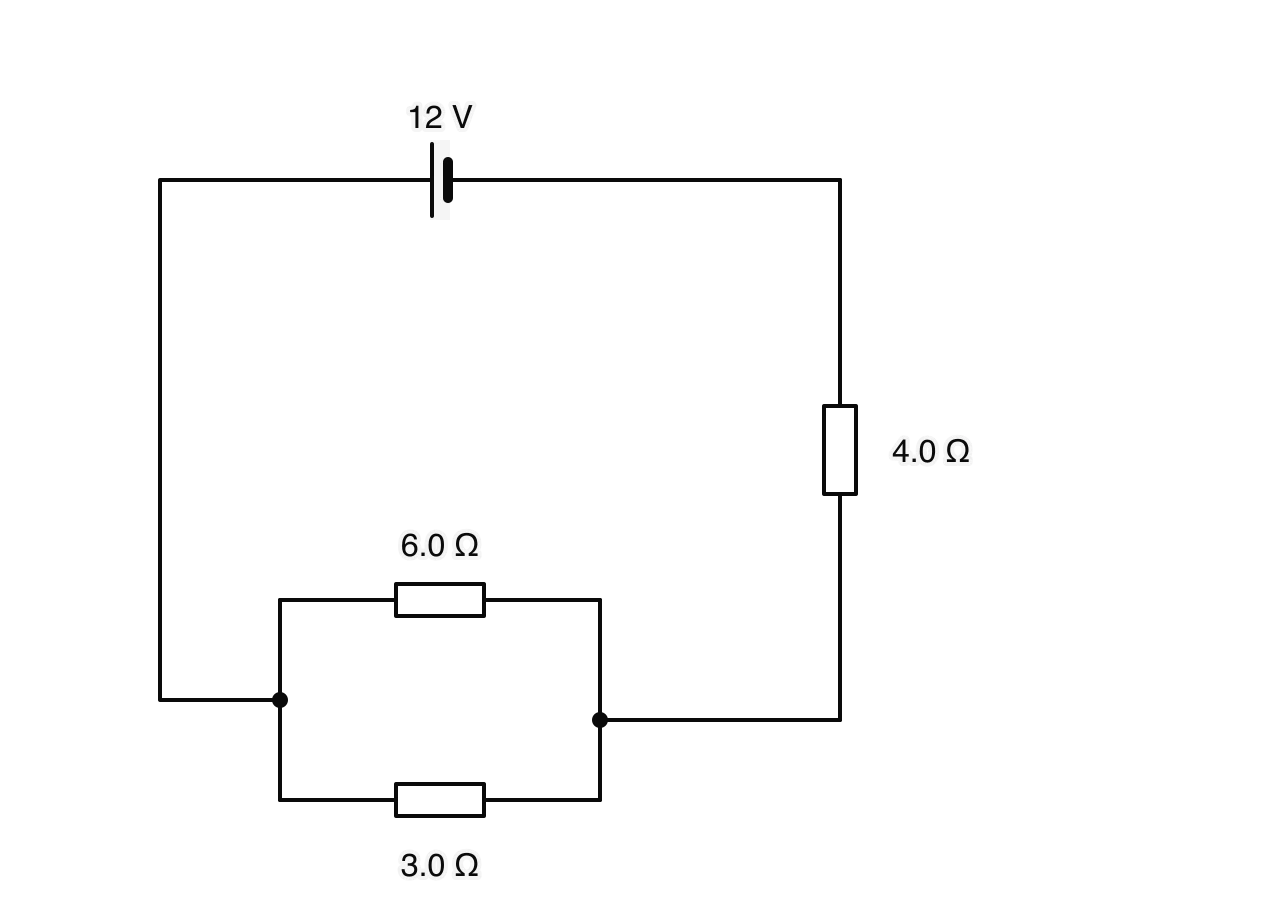
One component instead of the combination | Giving the current in one branch, or one resistor’s value, instead of the total |
Linear thinking for exponential decay | Assuming two half-lives remove the whole sample |
Direction errors | A force on the wrong body in a Newton’s third law pair; a field drawn the wrong way |
Unit and prefix slips | mm taken as m, MeV taken as J, taken as mC |
A missed detail in the stem | "From rest", "the other end is closed", "a neutron is absorbed", "the background count is 20 counts per minute" |
Worked multiple-choice questions
Each question is followed by its answer, the reasoning, and the slip behind each distractor. Try each one before opening the solution.
Question 1: reading a velocity–time graph
Question 2: a collision
Question 3: an ideal gas and temperature
Question 4: a series and parallel circuit
Question 5: choosing an expression by its units
Question 6: field strength on another planet
Question 7: half-life
Question 8: a standing wave on a string
Question 9: an order-of-magnitude estimate
Question 10: statements about a pendulum
Using the whole paper well
Paper 1A rewards steady accuracy across all the questions more than brilliance on a few. The questions follow the order of the course, so the difficulty does not rise steadily: a hard question may be followed by an easy one. A question that takes far longer than the rest is still worth only one mark.
Answer every question on the first pass, even with a provisional guess, so nothing is left blank if time runs short.
Mark questions you are unsure of and return to them at the end with fresh eyes.
Change an answer only when you find a definite error in your reasoning; a vague doubt is not a reason.
Keep the data booklet open at the right page for each theme; checking a symbol or a constant is quicker than recalling it.
For negative stems (questions with NOT in capitals), circle the word before answering.
Self-check
- To do:
I can recognise the six formats of multiple-choice question and approach each one.
- To do:
I can predict an answer before reading the options and explain the slip behind each distractor.
- To do:
I can use proportional reasoning to find how a quantity changes when others are scaled.
- To do:
I can use units to check an expression and eliminate options.
- To do:
I can make a quick order-of-magnitude estimate using everyday values.
- To do:
I can test an expression with a limiting case.
- To do:
I can state what the gradient and the area represent for the common physics graphs.
- To do:
I can judge I/II/III statements independently and use one false statement to eliminate options.
- To do:
I can name the common distractor traps: factors of 2, wrong powers, inverted ratios, Celsius for kelvin, radius errors and missed details.
Carry on with Physics in Augment
With a free account, Augment remembers where you stopped in the notes and which questions you have marked.