Augment Education
    • Question bank
    • Quick fire
    • Worksheets
    • Flashcards
    • Notes
    • Try a quick-fire round
    • All features
    • Business
    • Digital Society
    • Economics
    • Geography
    • Global Politics
    • History
    • Philosophy
    • Psychology
    • Anthropology
    • World Religions
    • Biology
    • Chemistry
    • Physics
    • Computer Science
    • Design Technology
    • ESS
    • SEHS
    • Language and literature
    • Language acquisition
    • Maths AA
    • Maths AI
    • Dance
    • Film
    • Music
    • Theatre
    • Visual Arts
    • Grade calculator
    • Grade boundaries
    • Subject checker
    • Focus timer
    • Exam countdown
    • All free tools
    • IB guide
    • All subjects
  • Blog

Search

Search subjects, the syllabus, glossary terms, the booklets, the IB guide, help and the blog

Log inStart free
augment

Augment Education

IB Diploma revision built around the syllabus.

contact@augment-education.com

Product

  • Features
  • Question bank
  • Quick fire
  • Worksheets
  • Flashcards
  • Notes
  • Subjects
  • What's new

Learn

  • IB guide
  • Booklets, explained
  • Glossary
  • Blog
  • Free tools
  • Grade calculator
  • Subject checker

Company

  • About
  • Help
  • For parents
  • For teachers
  • Comparisons

Subjects

  • English A Lit
  • English A Lang & Lit
  • Chinese A Lit
  • Chinese A Lang & Lit
  • Spanish A Lit
  • Spanish A Lang & Lit
  • English Lit & Perf
  • Spanish Lit & Perf
  • English B
  • Mandarin B
  • Spanish B
  • English ab initio
  • Mandarin ab initio
  • Spanish ab initio
  • Business
  • Digital Society
  • Economics
  • Geography
  • Global Politics
  • History
  • Philosophy
  • Psychology
  • Anthropology
  • World Religions
  • Biology
  • Chemistry
  • Physics
  • Computer Science
  • Design Technology
  • ESS
  • SEHS
  • Maths AA
  • Maths AI
  • Dance
  • Film
  • Music
  • Theatre
  • Visual Arts

Augment Education is developed independently of the International Baccalaureate Organization and is not endorsed by it. “IB” and “International Baccalaureate” are its trademarks.

© 2026 Augment Education. All rights reserved.

  • Privacy
  • Terms
  1. Subjects
  2. History
  3. Section 3: synthesis and evaluation

Section 3: synthesis and evaluation

How to write Section 3 of the historical investigation: a sustained argument that combines evidence from your sources, weighs their perspectives as it goes and reaches a reasoned conclusion, with annotated weak and strong paragraphs.

  • IB History
  • Internal assessment
  • SL and HL

12 min readLast reviewed 16 Oct 2026

Section 3 is the investigation itself. Here you answer your inquiry question with an argument built from the evidence of your sources. The IB says this section assesses how you synthesise evidence from the sources to produce a response; it is reported to carry 12 of the 24 marks and about 1,400 of the 2,200 words. Sections 1 and 2 prepare for it, but this is where most marks are won or lost.

Key points

  • Synthesis means combining evidence from several sources in the same paragraph to make one point, not summarising each source in turn.

  • Organise Section 3 by argument: each paragraph makes a point that answers the question.

  • Evaluate as you go: say how far each piece of evidence can be trusted for the point it supports, using what you established in Section 2.

  • Weigh the factors or claims against each other, including a counter-argument, and reach a judgement that answers the question as worded.

  • The conclusion follows from the argument, states its limits, and introduces no new evidence.

What synthesis and evaluation mean

Definition

Synthesis in the investigation is the combination of evidence from different sources and perspectives into one argument, showing how the sources support, qualify or contradict each other on each point. Evaluation is the judgement of how much weight that evidence can bear, and of how far the competing explanations are convincing.

The difference between summary and synthesis is the difference between a list and an argument. A summary tells the reader what Source 1 says and then what Source 2 says. Synthesis starts with a claim about the past and brings in Sources 1, 4 and 6 to support it, notes that Source 4 is the strongest because of its origin, and uses Source 3 to show where the claim needs qualifying. The diagram of the two structures shows the contrast.
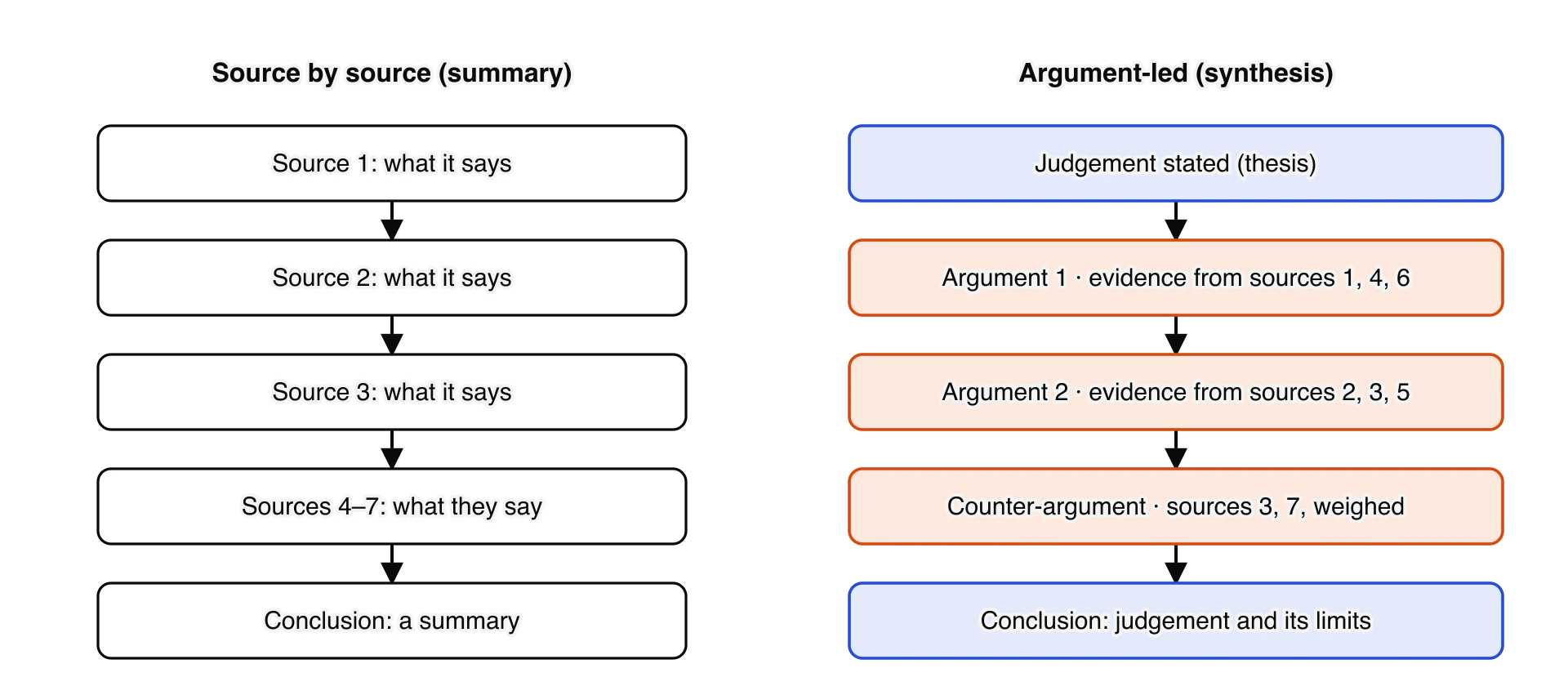
Two columns of boxes. Left, source by source: source 1, source 2, source 3, sources 4 to 7, each saying what the source says, then a conclusion that summarises.Two columns of boxes. Left, source by source: source 1, source 2, source 3, sources 4 to 7, each saying what the source says, then a conclusion that summarises.
Two ways to organise Section 3. On the left each paragraph is about a source, so the answer to the question appears only at the end, if at all. On the right each paragraph is about a point in the argument, and evidence from several sources is combined and weighed within it. Only the second is synthesis.

Common mistake

Repeating Section 2 in Section 3. Section 2 analysed each source's perspective, value and limitations; Section 3 uses that analysis briefly, in a phrase or a sentence, at the point where the evidence is used. Repeating whole evaluations wastes the words the argument needs.

Planning Section 3

Plan Section 3 before writing it, and plan it from the question, not from the sources. A reliable method has four steps:

  1. Decide your answer. Write a one-sentence judgement on the question. It can be qualified ("largely", "only in the short term", "for the government but not for the strikers"), but it must be an answer.

  2. Identify the three or four points that support or test that judgement: usually the factor or claim in the question, the main alternatives, and a counter-argument.

  3. Map the evidence. Under each point, list which sources provide evidence for and against it. A point supported by one source only is weak; a source that appears under no point should perhaps not be one of your seven.

  4. Order the points so that the argument builds: often the claim in the question first, then the alternatives, then the weighing that leads to your judgement.

Tip

A planning grid helps: points down the side, your sources across the top, and a tick, cross or note in each cell. Gaps in the grid show where the argument needs more evidence, or where the question needs adjusting.

Writing an argued paragraph

Each paragraph of Section 3 makes one point that answers the question. The opening sentence states the point; the middle brings in evidence from more than one source, with the source's perspective or reliability noted where it affects the point; and the end says what the paragraph shows about the question. The worked example compares a source-led paragraph with an argument-led one on the same material.

Worked example

Compare two paragraphs. The question is To what extent was the mistaken announcement at Günter Schabowski's press conference of 9 November 1989 the main reason that the Berlin Wall opened that night? Both paragraphs use the same sources: a transcript of the televised press conference; interviews given later by Harald Jäger, the Stasi officer in charge of passport control at the Bornholmer Straße crossing that night; Mary Elise Sarotte's The Collapse: The Accidental Opening of the Berlin Wall (2014); and Hans-Hermann Hertle's chronicle of the night, Chronik des Mauerfalls (1996).

Show the worked example

Paragraph A (source by source). The transcript of the press conference shows that Schabowski, a member of the East German Politburo, read out new travel regulations and, when a journalist asked when they took effect, said that as far as he knew it was immediately. Sarotte's book explains that the regulations were meant to start the next day and that Schabowski had not been briefed. Harald Jäger said in interviews that he opened the crossing at Bornholmer Straße late that night because of the size of the crowd. Hertle's chronicle describes the crowds that gathered at the crossings after the news was broadcast.

Why it is weak. Every sentence is accurate, and four sources are used, but the paragraph never states a point or answers the question. Each source is reported in turn; none is weighed. A reader cannot tell whether the student thinks the announcement was the main reason or not.

Paragraph B (argument-led). The announcement was the trigger for the opening, but it opened the Wall only because East Berliners acted on it. The transcript shows that Schabowski, unbriefed, told the press that the new rules applied immediately, a slip that Sarotte, drawing on East German records and interviews, shows went far beyond what the Politburo intended. Yet the regulations still required a visa, and the guards had no orders to open the gates. What changed the situation was the crowd: Hertle's chronicle and Jäger's later account agree that thousands gathered at Bornholmer Straße as the news spread through West German television, and that late in the evening Jäger let them through because he feared bloodshed and could get no clear orders from his superiors. Jäger's account was given years later and presents his own decision in a good light, but its central claim is supported by Hertle's minute-by-minute record. The announcement was therefore a necessary cause of the opening that night, but the decisive act was the pressure of the crowd on officials who no longer knew what was expected of them.

Why it is strong. It opens with a point that answers the question. Evidence from four sources is combined to support it, and they are shown to agree. Jäger's account is evaluated in one sentence, using its origin and purpose, and then corroborated. The final sentence makes a judgement and uses a precise causal term ("necessary cause"). It is about 180 words, longer than Paragraph A, but every sentence works for the argument.

Evaluation inside the argument

Evaluation in Section 3 is brief and placed where it matters: when a piece of evidence carries a lot of weight, when two sources disagree, or when the only evidence for a point comes from an interested party. Phrases that do this work include:

  • "… although, as a memoir written after the outcome was known, it may exaggerate …"

  • "Two sources from opposite perspectives agree that …, which makes this the most secure point in the argument."

  • "The only evidence for this comes from the government's own report, so it shows what officials claimed, not necessarily what happened."

  • "Historians disagree here: X stresses …, using …, while Y argues …, drawing on archives opened after 1990. Y's wider evidence makes the second view more convincing."

Exam tip

The reported criteria for Section 3 reward analysis that is sustained and organised, evidence that is synthesised from the sources, and evaluation integrated into the argument. A separate "evaluation of sources" paragraph at the end of Section 3 does neither job well: move each judgement to the point where the evidence is used.

Weighing explanations and using counter-arguments

A "to what extent" question asks for a judgement about the relative importance of something, so Section 3 must compare. It is not enough to show that the factor named in the question mattered and that other factors mattered too. The argument has to say which mattered more, in what way, and why.

Three kinds of reasoning help with weighing:

  • Necessary and sufficient. Would the outcome have happened without this factor? Was this factor enough on its own? In the Berlin Wall example, the announcement was arguably necessary for an opening on that night but not sufficient, since nothing happened at the border until crowds gathered.

  • Long-term and short-term. Some factors created the conditions (Hungary opening its border to East Germans in September 1989, the mass demonstrations in Leipzig from October, the Soviet leadership's refusal to intervene); others decided the timing. A strong answer explains how they connect.

  • Different perspectives on the same factor. Officials, participants and historians may disagree about what mattered. Explaining why they disagree, and whose evidence is stronger, is part of the judgement.

A counter-argument is the strongest case against your judgement. Present it fairly, with its evidence, then explain why you still hold your view, or how it qualifies it. An investigation that ignores the obvious objection looks one-sided; one that answers it is more convincing.

Worked example

Weigh a counter-argument. A student argues that the crowds at the border, not the announcement, were the main reason the Wall opened on 9 November 1989. Write the paragraph that deals with the strongest counter-argument.

Show the worked example

Step 1: state the counter-argument fairly. The strongest objection is that the crowds would not have come to the border that night without the announcement: no crowds gathered on 8 November. On this view the announcement, not the crowd, explains the timing.

Step 2: give its evidence. The transcript shows the exact words used; Hertle's chronicle shows that crowds began to build at the crossings in the hours after the press conference was broadcast. The sequence supports the objection.

Step 3: answer it. The objection shows that the announcement was necessary for the opening that night. It does not show that it was sufficient. The announcement changed no orders, and the guards could have turned the crowds back, as they had done for 28 years. The decision to open came from officers on the spot who were facing thousands of people and could not reach their superiors.

Step 4: make the judgement. The objection is strong on timing: without the announcement, the Wall would not have opened that night. But the announcement made the opening possible, not certain; it was the scale of the crowd, and the failure of the chain of command, that turned a press conference mistake into an open border. Both were necessary, but the crowd explains why the regime lost control rather than reasserting it.

Why it works. The paragraph gives the other side its best evidence and accepts what it proves. The judgement is refined, not abandoned, using the distinction between necessary and sufficient causes.

Using historians

Historians are among your seven sources if you cite them, and they are a perspective like any other. Use their arguments as evidence to weigh, not as authorities to quote: explain what a historian argues, what evidence they rely on, and why their view is more or less convincing for your question. A historian writing after the East German archives opened in the early 1990s has evidence that one writing in 1985 did not, and that difference can be part of your evaluation. Named historians are welcome but are not the only way to show perspectives; participants, governments, journalists and witnesses are perspectives too.

Common mistake

Using a historian's opinion as the conclusion: "Sarotte says it was an accident, so it was an accident." The judgement must be yours, supported by the evidence. A historian's view is one piece of that evidence, to be weighed against the others.

The conclusion

The conclusion answers the question directly, in the question's own terms, and in a way that follows from the paragraphs before it. It should also state the limits of the answer: what the sources could not show, and how a missing perspective affects the judgement. It introduces no new evidence and no new arguments.

Worked example

Compare two conclusions for the Berlin Wall question.

Show the worked example

A weak conclusion. In conclusion, there were many reasons why the Berlin Wall opened, including Schabowski's announcement, the crowds, Gorbachev and the demonstrations. All of these were important and they all played a part.

Why it is weak. It lists factors without a judgement, does not answer "to what extent", and could have been written before the investigation.

A strong conclusion. Schabowski's announcement was the trigger that made the opening of 9 November possible, but it was not the main reason the Wall opened that night. The evidence of the transcript, Hertle's chronicle and Jäger's account together shows that the decisive cause was the pressure of thousands of East Berliners on border officials who had no orders and no means of getting them, in a state whose authority had already been weakened by the summer's exodus and the autumn's demonstrations. This judgement rests mainly on East German and Western sources produced or published after 1989; the guards' perspective comes largely from one officer's later account, and fuller records of what the guards at other crossings decided would test it further.

Why it is strong. It answers the question in its own words ("not the main reason"), names the decisive cause and the reasoning, links the short-term and long-term causes, and states the limits of the evidence honestly.

Tip

Write the first sentence of your conclusion before you draft Section 3, then check at the end that the paragraphs actually lead to it. If they lead somewhere else, change the conclusion, not the evidence.

Using about 1,400 words well

About 1,400 words allows an introduction to the argument of 100–150 words, three or four argument paragraphs of 250–300 words each, and a conclusion of 150–200 words. That is enough for a real argument, but not for narrative. Give background only when a point needs it, and in a clause rather than a paragraph ("After Hungary opened its border in September 1989, …").
YouTube
Nottingham Trent University, "How to write a history essay: Advice and tips": university historians on argument, evidence and structure, which apply directly to Section 3.

Problem

What it looks like

Fix

Narrative

Paragraphs that tell what happened in order

Start each paragraph with a point that answers the question; cut events that do not serve it.

Source by source

"Source 3 shows … Source 4 shows …"

Organise by argument and bring several sources into each paragraph.

No judgement until the end

Factors listed; the answer appears only in the conclusion

State your judgement in the opening of Section 3 and develop it in every paragraph.

Evaluation bolted on

A final paragraph evaluating the sources

Evaluate each piece of evidence where you use it.

Unsupported claims

Facts with no footnote, or from outside your seven sources

Every fact you rely on comes from one of your cited sources.

A conclusion that changes the question

The question asks "main reason"; the conclusion says "it was important"

Answer in the terms of the question.

Self-check

  • To do:

    Section 3 opens with my judgement on the question, and every paragraph develops or tests it.

  • To do:

    Each paragraph makes one point and combines evidence from more than one source.

  • To do:

    I evaluate evidence where I use it, briefly, drawing on my analysis in Section 2.

  • To do:

    I weigh the factor or claim in the question against alternatives, using reasoning such as necessary and sufficient causes.

  • To do:

    I present the strongest counter-argument fairly and explain how it affects my judgement.

  • To do:

    Historians' views are treated as evidence to weigh, not as the answer.

  • To do:

    My conclusion answers the question in its own terms, follows from the argument and states the limits of the evidence.

Keep your place

In Augment the notes remember where you stopped and which pages you have finished.

Open in Augment

More IB History notes

  • Section 2: sources and perspectivesThe page before this.
  • The historical investigationThe next page.
  • IB HistoryThe History syllabus, how it is assessed and every notes page.

Carry on with History in Augment

With a free account, Augment remembers where you stopped in the notes and which questions you have marked.

Start free