Augment Education
    • Question bank
    • Quick fire
    • Worksheets
    • Flashcards
    • Notes
    • Try a quick-fire round
    • All features
    • Business
    • Digital Society
    • Economics
    • Geography
    • Global Politics
    • History
    • Philosophy
    • Psychology
    • Anthropology
    • World Religions
    • Biology
    • Chemistry
    • Physics
    • Computer Science
    • Design Technology
    • ESS
    • SEHS
    • Language and literature
    • Language acquisition
    • Maths AA
    • Maths AI
    • Dance
    • Film
    • Music
    • Theatre
    • Visual Arts
    • Grade calculator
    • Grade boundaries
    • Subject checker
    • Focus timer
    • Exam countdown
    • All free tools
    • IB guide
    • All subjects
  • Blog

Search

Search subjects, the syllabus, glossary terms, the booklets, the IB guide, help and the blog

Log inStart free
augment

Augment Education

IB Diploma revision built around the syllabus.

contact@augment-education.com

Product

  • Features
  • Question bank
  • Quick fire
  • Worksheets
  • Flashcards
  • Notes
  • Subjects
  • What's new

Learn

  • IB guide
  • Booklets, explained
  • Glossary
  • Blog
  • Free tools
  • Grade calculator
  • Subject checker

Company

  • About
  • Help
  • For parents
  • For teachers
  • Comparisons

Subjects

  • English A Lit
  • English A Lang & Lit
  • Chinese A Lit
  • Chinese A Lang & Lit
  • Spanish A Lit
  • Spanish A Lang & Lit
  • English Lit & Perf
  • Spanish Lit & Perf
  • English B
  • Mandarin B
  • Spanish B
  • English ab initio
  • Mandarin ab initio
  • Spanish ab initio
  • Business
  • Digital Society
  • Economics
  • Geography
  • Global Politics
  • History
  • Philosophy
  • Psychology
  • Anthropology
  • World Religions
  • Biology
  • Chemistry
  • Physics
  • Computer Science
  • Design Technology
  • ESS
  • SEHS
  • Maths AA
  • Maths AI
  • Dance
  • Film
  • Music
  • Theatre
  • Visual Arts

Augment Education is developed independently of the International Baccalaureate Organization and is not endorsed by it. “IB” and “International Baccalaureate” are its trademarks.

© 2026 Augment Education. All rights reserved.

  • Privacy
  • Terms
  1. Subjects
  2. History
  3. Section 2: sources and perspectives

Section 2: sources and perspectives

How to find, choose and analyse up to seven sources for the historical investigation, grouping them by perspective and judging their value and limitations for your question, with annotated sample paragraphs.

  • IB History
  • Internal assessment
  • SL and HL

13 min readLast reviewed 16 Oct 2026

Section 2 of the historical investigation explains which sources you chose and why, and analyses what each can tell you about your question. The IB describes it as assessing your analysis of the sources you have chosen, and it has said the new investigation gives more weight to explaining the selection of sources. It is reported to carry 6 marks and to need about 400 words.

Key points

  • You may use at most seven sources in the whole investigation, and every source you cite should be analysed here.

  • Choose sources for the range of perspectives they give on your question, not for how much information they contain.

  • A perspective is the position a source sees the past from: who made it, when, for whom and why. Group your sources by perspective, not in the order you found them.

  • Judge each source's value and limitations for your question. Origin, purpose and context are tools for that judgement, not headings to fill in.

  • Missing perspectives matter: say whose voice your sources leave out and how that limits what you can conclude.

What a perspective is

Definition

A perspective is the viewpoint from which a source sees an event or issue, shaped by the position of its creator: their role, interests, beliefs, nationality, distance in time and place, and the audience they addressed. Sources from different perspectives can be accurate and still disagree, because they saw, valued or explained different things.

Sources are not simply "for" or "against" an argument. A government report, a protester's memoir, a foreign newspaper and a historian's book may all agree that an event happened, and still differ on why it happened and what it meant. Section 2 identifies those positions so that Section 3 can weigh them. The table lists the questions that most often reveal a perspective.

Lens

Question to ask

Example of the difference it makes

Position

Was the creator a ruler or ruled, insider or outsider, participant or observer?

A colonial governor's report and a nationalist pamphlet on the same strike

Time

Was it made at the time, soon after, or decades later?

A diary of 1940 and a memoir written in 1985, after the outcome was known

Purpose and audience

Was it meant to inform, persuade, justify, record or entertain? For whom?

A speech to a party congress and a private letter by the same leader

Access

What could the creator know? What could they not see?

A foreign journalist in the capital and a villager in a war zone

Interpretation

For a historian: what approach, evidence and time of writing shaped the argument?

A Cold War-era account and one written after the archives opened

Tip

Primary sources and secondary sources both have perspectives. A historian's book is a source with an origin, purpose and context of its own, and it belongs in Section 2 like any document.

Finding sources

Start with a reliable recent book or article on your topic. Its footnotes and bibliography lead to primary sources and to the main debates. Then look for primary material you can read for yourself:

  • Published collections and translations of documents (for many periods there are sourcebooks with full references).

  • Digitised archives: national archives and libraries, the Avalon Project (Yale Law School), the Internet History Sourcebooks (Fordham University), the Marxists Internet Archive, the Wilson Center Digital Archive (Cold War), Trove (Australia), Chronicling America (United States newspapers).

  • Newspapers, photographs and film from the period, many of them digitised by libraries.

  • Oral history collections, or an interview you conduct yourself with someone who lived through the events (ask your teacher about consent and how to record it).

  • Journal articles through JSTOR or your school library, which give the most recent research.

Online material needs the same scrutiny as anything else. A useful test is whether a page tells you who wrote it, when, and where its information comes from. General encyclopedias, revision websites and popular history sites without references are useful for orientation, but they are not sources to cite: follow them to the material they are based on.

Common mistake

Citing a website that quotes a document instead of the document itself. If a page quotes a speech, find the speech in a published or archival version and cite that; quotations copied from website to website are often shortened, mistranslated or misattributed.

Choosing seven sources

With a cap of seven, every source must earn its place. Shortlist ten or more, then choose the combination that gives the widest useful range of perspectives on your question, with at least one serious secondary work for context and debate. Seven is a maximum, not a target: five or six well-chosen sources can be better than seven that repeat each other.

Role in the investigation

Twentieth-century example: the Montgomery bus boycott and the civil rights movement, 1955–1960

Medieval example: Mansa Musa's pilgrimage and Mali's reputation

Participants

A leader's memoir (Martin Luther King Jr, Stride Toward Freedom, 1958); a boycott organiser's memoir (Jo Ann Robinson, The Montgomery Bus Boycott and the Women Who Started It, 1987)

No written source by Musa or his court survives

Opponents or authorities

Statements by Montgomery city officials or the bus company in the local press

Not applicable: no hostile account survives

Outsiders at the time

National newspaper reports of 1956

al-ʿUmari's account from Cairo; the Catalan Atlas

Later or retrospective

Oral history interviews recorded in the 1970s–1980s

Mande oral tradition recorded in the twentieth century

Historians

A recent history of the boycott

Nehemia Levtzion, Ancient Ghana and Mali (1973); Michael Gomez, African Dominion (2018)

The two columns show that the available perspectives depend on the period. For a twentieth-century topic, the problem is choosing among many sources; for a medieval one, it is recognising how few perspectives survive and saying so.

Analysing a source for your question

The old IA asked for the origin, purpose, value and limitations of two sources, and many students learned to write those four headings as a formula. The new Section 2 asks for analysis of all your sources, and the skill is the same one used in Paper 1: explaining how a source's origin, purpose and context affect what it can show about this question. The same source can be strong evidence for one question and weak for another.

  1. Origin. Who made it, when, where, and in what form? Was the creator in a position to know?

  2. Purpose and audience. Why was it made, and for whom? What did the creator want the audience to think or do?

  3. Context. What was happening when it was made, and how might that shape what it says or leaves out?

  4. Content. What does it actually say or show that bears on your question?

  5. Value and limitation for your question. Given all of this, what can the source reliably tell you, and what can it not?
Exam tip

Value and limitation must be specific to your question. "It is a primary source, so it is reliable" and "it may be biased" earn nothing on their own. Say what the source is valuable for and what its position stops it from showing, as in "valuable for how officials in Cairo saw the visit, limited as evidence of Musa's own aims".

YouTube
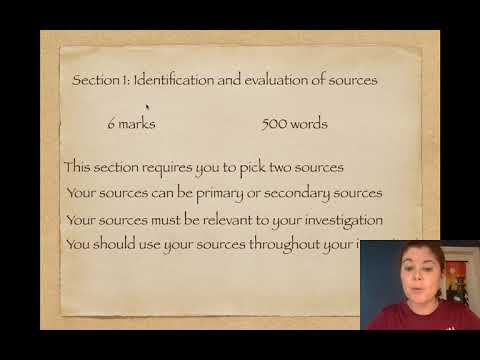
IB History – essential tips, "The IA Section 1: Identification and evaluation of sources": how to analyse a source's origin, purpose, value and limitations. Made for the previous course, where this was Section 1 and covered two sources; the analysis skills carry over to Section 2 of the new investigation.

Worked example

Analyse a source for a question. The question is How significant was Mansa Musa's pilgrimage to Mecca (1324–1325) in making Mali known in the Mediterranean world by c. 1375? The source is the account of Mali in Masalik al-absar, an encyclopaedia by Shihab al-Din al-ʿUmari, written in Cairo around 1340 (read in the English translation in Levtzion and Hopkins, Corpus of Early Arabic Sources for West African History, 1981). Write the analysis of this source for Section 2.

Show the worked example

Step 1: origin. Al-ʿUmari was a senior official in the chancery of the Mamluk sultans, which handled diplomatic correspondence. He was not in Cairo during Musa's visit, but he questioned officials who had met Musa and dealt with his large company. His account is therefore second-hand, gathered more than a decade later from Cairenes.

Step 2: purpose. The Masalik was a reference work describing the kingdoms of the known world for the use of Mamluk administrators. Al-ʿUmari wanted to record facts useful to the state: Mali's size, its ruler, its wealth and its relations with Egypt.

Step 3: context. Cairo was the leading city of the Islamic world, and the Mamluk court measured other Muslim rulers by their piety and their respect for the sultan. Musa's visit, with its gifts of gold, was still remembered.

Step 4: value for this question. It is the fullest surviving account of how the visit was seen in Cairo, and it reports its economic effects, including the claim that the gold Musa's company spent lowered the value of gold in Egypt for years. That is direct evidence that the pilgrimage made Mali known among Mamluk officials and merchants, the first link in any chain to the Mediterranean.

Step 5: limitation for this question. It shows how one Mamluk official and his informants remembered the visit, not how far knowledge of Mali spread beyond Cairo; the claim about gold prices comes from informants and may have grown in the retelling. It cannot show Musa's own aims, because no Malian account survives. For the spread of Mali's reputation to Europe, the investigation needs another source, such as the Catalan Atlas.

A model paragraph (about 110 words). Al-ʿUmari's Masalik al-absar (c. 1340) is the most detailed account of how Musa's visit was received in Cairo. As a Mamluk chancery official compiling a reference work for administrators, al-ʿUmari aimed to record Mali's wealth and standing accurately, and he drew on officials who had met Musa, which makes it valuable evidence that the pilgrimage established Mali's reputation in the Mamluk capital. However, his informants were remembering events a decade later, and their stress on Musa's lavish spending may have been shaped by Cairene interest in his gold. The source shows Mali's fame in Egypt, but not how it travelled further.

Organising Section 2 by perspective

Section 2 is clearer and shorter when sources are grouped by the perspective they represent, with one paragraph for each group. Teachers commonly suggest three or so perspectives, each supported by two sources, though the right number depends on your question and on what survives. The diagram of sources grouped by perspective shows one way of planning this for the Mansa Musa question.
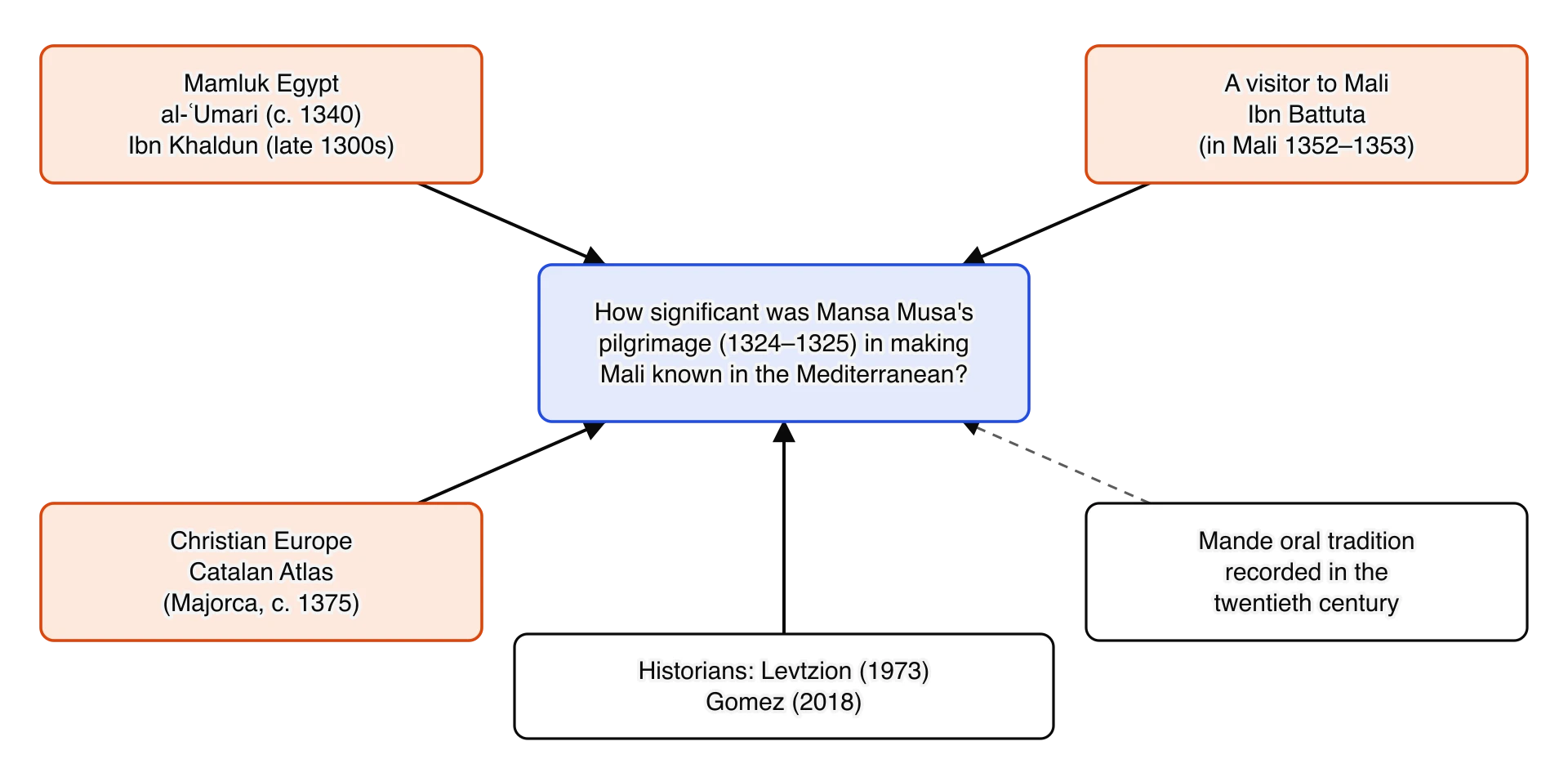
A question box in the centre: how significant was Mansa Musa's pilgrimage in making Mali known in the Mediterranean? Arrows point to it from five groups of sources: Mamluk Egypt (al-Umari, Ibn Khaldun); a visitor to Mali (Ibn Battuta); Christian Europe (the Catalan Atlas); Mande oral tradition…A question box in the centre: how significant was Mansa Musa's pilgrimage in making Mali known in the Mediterranean? Arrows point to it from five groups of sources: Mamluk Egypt (al-Umari, Ibn Khaldun); a visitor to Mali (Ibn Battuta); Christian Europe (the Catalan Atlas); Mande oral tradition…
Sources grouped by perspective for one investigation, seven sources in all. Orange groups are contemporary outsiders writing in Arabic or drawing in Catalan; the dashed arrow marks Mande oral tradition, the only insider perspective, which says little about the pilgrimage itself. Seeing the sources this way shows where the evidence is strong and where a perspective is missing.

A paragraph on a group of sources usually does four things: names the perspective and explains why it matters for the question; introduces each source briefly (author, date, type); analyses how origin, purpose and context shape what each can show; and states the value and limitation of the group as a whole. Where two sources share a perspective, analyse what they share once instead of repeating it.

Worked example

An annotated sample paragraph of Section 2. The paragraph analyses the one source that gives a European perspective on Mali's reputation and explains why it leads to the choice of the next source. Read it with the annotations.

Show the worked example

The European perspective is represented by the Catalan Atlas, a world map attributed to the Jewish cartographer Abraham Cresques of Majorca and conventionally dated 1375. It shows a crowned African ruler holding a gold nugget, with a legend naming him "Musse Melly" and calling him the richest and noblest king of the region because of the gold of his lands. As a luxury object that was in the French royal library by 1380, it records what Mediterranean mapmakers and their wealthy patrons believed about West Africa half a century after the pilgrimage, which makes it valuable evidence that Musa's name, and not only Mali's gold, had reached Christian Europe.

Annotation. The perspective is named first; the source is introduced with its origin; its purpose and audience are used to judge what it can show for this question. The link to the question ("reputation … had reached Christian Europe") is explicit.

Its limitation is that it shows a reputation but not its cause. The legend explains Musa's fame by the gold of his lands and does not mention the pilgrimage, and Majorcan mapmakers probably drew on North African merchants who knew of the gold trade regardless of Musa's journey. To test whether the pilgrimage, rather than the gold trade in general, created this image, I use Michael Gomez's African Dominion (2018), whose study of Mali's rulers combines Arabic and oral sources and gives a recent historian's judgement of the visit's effects.

Annotation. The limitation is specific to the question (the Atlas cannot show cause), and it explains why the next source was chosen. This is the "explanation of selection" that the IB has said the new investigation stresses. A student who found that an earlier chart, made in Majorca by Angelino Dulcert in 1339, already depicts a king of Mali in West Africa might swap it in for one of the later sources, because a map made fourteen years after the pilgrimage tests the link between the journey and the reputation more directly.

Common mistake

Writing Section 2 as a list of seven separate source evaluations in the order you found them. It repeats itself, uses many words and does not show how the sources relate. Group them by perspective and explain how each group helps answer the question.

Silences and missing perspectives

Every set of sources leaves some people out. Before writing Section 2, ask whose experience your question involves and which of those groups your sources speak for. Women, enslaved people, colonised peoples, the poor and people who could not write are often missing from official records, and their absence shapes any conclusion.

In the Mansa Musa example, the most important silence is Malian. No written account by Musa or his court survives, and the Mande oral traditions recorded by twentieth-century researchers centre on the founder of the empire, Sunjata, rather than on Musa. The investigation therefore sees the pilgrimage almost entirely through the eyes of outsiders. Saying this in Section 2, and returning to it in the conclusion of Section 3, is a strength, because it shows an understanding of the limits of the evidence.

Tip

If an important perspective is missing, look for indirect evidence of it: oral histories recorded later, court records in which ordinary people appear as witnesses, or a historian who has worked to recover that group's experience. If none exists, say what its absence means for your answer.

Common mistake

Choosing seven sources that all come from one side. An investigation of a strike that uses only the union's publications, or of a war that uses only one government's records, cannot weigh perspectives in Section 3. Aim for at least three distinct perspectives.

Common mistakes

Mistake

Why it loses marks

Better

"The source is biased"

Every source has a perspective; "biased" alone explains nothing

Say how the creator's position shaped the content and what that means for your question.

"Primary sources are more reliable"

A propaganda poster is primary; a careful historian is secondary

Judge each source on its origin, purpose and context, not its category.

Describing the content at length

Summary is not analysis and uses up words

Quote or paraphrase only the part relevant to the question.

Value and limitation that would fit any source

"Valuable because written at the time; limited because it is one view"

Make every judgement specific to this source and this question.

No explanation of selection

The IB stresses why sources were chosen

Say what each source adds that the others do not.

Self-check

  • To do:

    I used no more than seven sources, and I analyse every one I cite.

  • To do:

    I chose my sources for the range of perspectives they give, and I can explain what each adds.

  • To do:

    My sources are grouped by perspective, not listed one by one.

  • To do:

    For each source I explain how its origin, purpose and context affect its value and limitations for my question.

  • To do:

    I identify at least one missing perspective and explain how it limits my conclusions.

  • To do:

    Every source is in my bibliography with full details, and every quotation was copied from the source itself.

Keep your place

In Augment the notes remember where you stopped and which pages you have finished.

Open in Augment

More IB History notes

  • Section 1: the inquiry questionThe page before this.
  • Section 3: synthesis and evaluationThe next page.
  • IB HistoryThe History syllabus, how it is assessed and every notes page.

Carry on with History in Augment

With a free account, Augment remembers where you stopped in the notes and which questions you have marked.

Start free