The historical investigation
What the historical investigation is, its three sections and rules, what is official and what is reported, how it differs from the old IA, referencing and academic integrity (including AI), and a plan from first idea to submission.
- IB History
- Internal assessment
- SL and HL
The historical investigation is the internal assessment (IA) in IB History: a short piece of research on a question about the past that you choose yourself. You frame an inquiry question, select a small set of sources, analyse what each one can and cannot tell you, and combine their evidence into an argued answer. Your teacher marks it and the IB moderates a sample of each school's work. The task and the criteria are the same at SL and HL.
What is official and what is reported
The full History guide for the current course (first assessment 2028) is available only to schools. The IB has published a subject brief and a page of course updates, and teachers and publishers with access to the guide have described the rest. Most of the details agree across those descriptions, but it helps to know which facts come from the IB itself and which come from teachers.
Feature | What is known | Status |
|---|---|---|
Three sections | 1 Historical inquiry question; 2 Sources and perspectives; 3 Synthesis and evaluation | Official (IB subject brief) |
Total marks and weighting | 24 marks; 30% of the final grade at SL, 20% at HL | Official |
Teaching time | 20 hours | Official |
What each section assesses | Section 1 the formulation of an appropriate question; Section 2 the analysis of your chosen sources; Section 3 the synthesis of evidence from the sources to produce a response | Official (wording of the subject brief) |
Source limit | A maximum of seven sources | Official (IB course updates) |
Reflection section | Removed | Official |
More weight on the development of the question and the choice of sources | Stated by the IB as the main change | Official |
Marks per section | 6 / 6 / 12 | Reported by several teacher sources |
Word limit | 2,200 words; title page, headings, footnote references and bibliography not counted | Reported by several teacher sources (the same limit as the old IA) |
Link to a historical concept | Required | Reported by publishers and teachers |
Recent topics | The old ten-year rule is gone; topics from roughly the last 20 years are allowed if treated historically | Reported (one publisher source); check with your teacher |
Earliest date | One teacher site says the topic must fall after 750 CE | Uncertain: may be a teacher's own rule |
The three sections
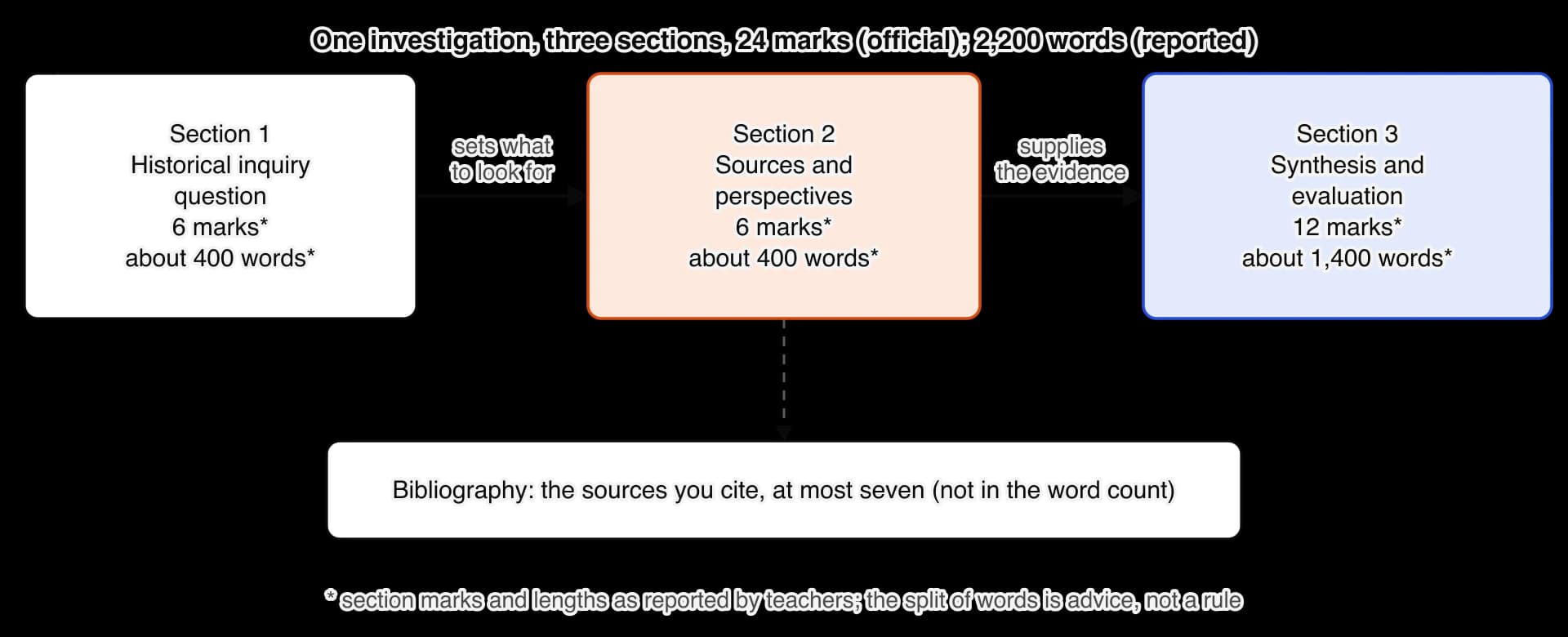
Each section has its own job, but they form one piece of work. The diagram of the three sections shows the marks and the lengths teachers suggest, and how each section leads into the next.
Section 1: the historical inquiry question
Section 1 states your question and explains how it developed: what first interested you, how reading and early source work narrowed it, and why the final wording is answerable and open to debate. It also names the historical concept your question uses and explains how that concept shapes the investigation. The IB says the new IA puts greater emphasis on explaining the development of the question, so a bare statement of the question is not enough. The page on Section 1 covers this in full.
Section 2: sources and perspectives
Section 2 explains why you chose your sources and analyses them as evidence for your question. Its central idea is perspective: each source sees the past from a particular position (a government, a protester, a victim, a journalist, a historian writing decades later), and that position shapes what it can show. A good Section 2 groups sources by perspective and weighs the value and limitations of each for this question, rather than describing them one by one.
Section 3: synthesis and evaluation
Section 3 is the investigation itself and carries half the marks. It answers the question with a sustained argument in which evidence from several sources is combined in each paragraph (synthesis), the reliability and perspective of that evidence is weighed as the argument goes (evaluation), and the conclusion follows from what has been shown. A narrative of events, or a source-by-source summary, cannot reach the higher marks however well researched it is.
The rules in detail
Word count
Teacher sources report a maximum of 2,200 words for the three sections together, with the total stated at the start of the work. Headings, the title page, footnote references and the bibliography are reported not to count. A moderator is not expected to read beyond the limit, so anything past 2,200 words may simply not be marked. Notes, appendices and long footnotes are not a way round the limit: an argument placed in a footnote is either not read or counts as part of the text.
The commonly suggested split is about 400 words for Section 1, 400 for Section 2 and 1,400 for Section 3. This is advice that follows the marks, not a rule. A Section 2 that analyses seven sources well may need 500 words; if it does, take the words from Section 1, never from Section 3.
Seven sources at most
The IB caps the investigation at seven sources so that you work closely with each one. A "source" is anything you cite: a document, a photograph, a memoir, an interview, a book, an article, a website. If a fact in your text needs a reference, the reference must be one of your seven, so the cap also limits where your background knowledge can come from. Choose sources that between them give the widest useful range of perspectives, and expect to analyse every one of them in Section 2.
A link to a historical concept
Your question is reported to need a clear link to at least one historical concept. The four concepts of the course are the safest: cause and consequence, continuity and change, perspectives, and significance. The concept usually shows in the wording of the question itself ("How significant was …", "To what extent did … change …", "What was the main cause of …"). Section 1 then explains how the concept shapes what you investigate.
Choosing a topic
Almost any period and region may be chosen, including topics you have not studied in class and local or family history, as long as the topic is historical and there are sources you can reach. Publisher sources report no formal date limits, but one teacher site gives 750 CE as the earliest date, so confirm with your teacher before choosing an earlier topic.
Recent events are allowed if they are treated historically: you can investigate the causes of a crisis in the last 20 years, but its consequences are probably still unfolding and cannot yet be judged.
The question must not be the same as your Extended Essay question; check your school's policy if both are in History.
Check sources before committing to a topic. A fascinating question with no accessible sources in a language you read cannot be investigated.
Your teacher's role
Your teacher guides the choice of topic and question, may discuss your plan, and may give feedback on one draft, either written or spoken. Teachers may not edit or correct the draft, and the version you hand in after that feedback is the final one. A complete draft therefore gets far more useful feedback than a half-finished one.
What changed from the old IA
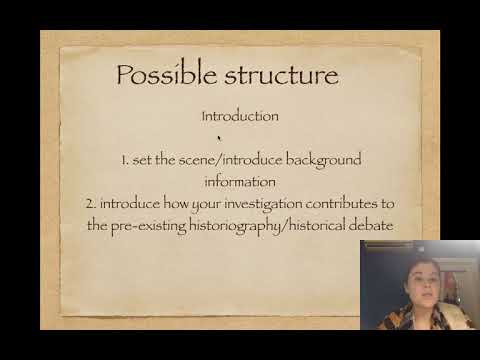
Many of the IA guides, videos and sample investigations online were written for the previous course (first assessment 2017, last exams November 2027). Much of their advice on research and writing still holds, but the structure has changed, so match any old advice to the new sections before using it.
Old IA (2017 guide) | New IA (first assessment 2028) | |
|---|---|---|
Sections and marks | A Identification and evaluation of sources (6); B Investigation (15); C Reflection (4): 25 marks | 1 Historical inquiry question; 2 Sources and perspectives; 3 Synthesis and evaluation: 24 marks (reported 6 / 6 / 12) |
Weighting | SL 25%, HL 20% | SL 30%, HL 20% |
Sources | Two sources analysed in depth (origin, purpose, value, limitation); no cap on the rest | At most seven sources in total, analysed for their perspectives |
Question | Stated at the start of Section A | Its development explained and assessed in its own section, with a link to a historical concept |
Reflection | About 400 words on the methods of historians | Removed |
Recent topics | Nothing from the last ten years | Ten-year rule removed; recent topics treated historically |
Word limit | 2,200 | 2,200 (reported) |
 YouTube
Referencing and academic integrity
The investigation must be your own work, and everything you take from someone else must be acknowledged where you use it. The IB treats a failure to do this as academic misconduct, whether it was deliberate or careless, and the penalty can be the loss of the IA mark or of the diploma.
Footnotes and the bibliography
History uses footnotes. Place a footnote number after the sentence (or the quotation) that uses a source, and give the reference at the foot of the page; the first reference to a source is full, later ones are short. The bibliography at the end lists the sources you cited, alphabetically by author's surname, and nothing else. Chicago style is the usual choice; whichever style your school uses, apply it consistently.
Type of source | First footnote (Chicago notes style) | Later footnotes |
|---|---|---|
Book | Greg Robinson, By Order of the President: FDR and the Internment of Japanese Americans (Cambridge, MA: Harvard University Press, 2001), [page]. | Robinson, By Order of the President, [page]. |
Government document | Commission on Wartime Relocation and Internment of Civilians, Personal Justice Denied (Washington, DC: Government Printing Office, 1982), [page]. | CWRIC, Personal Justice Denied, [page]. |
Document read online | Franklin D. Roosevelt, Executive Order 9066, 19 February 1942, National Archives, accessed [date], [URL]. | Executive Order 9066. |
Interview you conducted | Interview with [name], conducted by [your name], [place], [date]. | Interview with [surname]. |
AI tools
The IB does not ban AI tools, but it treats AI-generated text, ideas or images like any other source: if you use them, you must say so, in the text and in your references. Text produced by an AI and presented as your own is plagiarism. Check with your teacher how your school wants AI use recorded; many ask for a short statement at the end of the work listing the tool, the date and what it was used for.
Use of an AI tool | Acceptable? | Why |
|---|---|---|
Suggesting search terms, archives or kinds of source to look for | Usually, if acknowledged | It points you towards evidence that you then find, read and reference yourself. |
Explaining a term or background you then check in a real source | Usually, if acknowledged | The fact you use comes from the source you cite, not from the tool. |
Checking spelling and grammar | Ask your teacher | Schools differ; changes to wording beyond corrections can make the text no longer yours. |
Summarising a source you have not read | No | Summaries can be wrong or invented, and your analysis of the source must be your own. |
Writing or rewriting sentences, paragraphs or the argument | No | This is the work being assessed. |
Citing the AI tool as evidence about the past | No | An AI tool is not a historical source: it has no origin, purpose or context you can evaluate, and it can invent facts and references. |
Planning the investigation
The investigation has 20 hours of class time, usually spread over a term, plus your own reading and writing. The timeline of a model twelve-week plan sets out the order of the work.
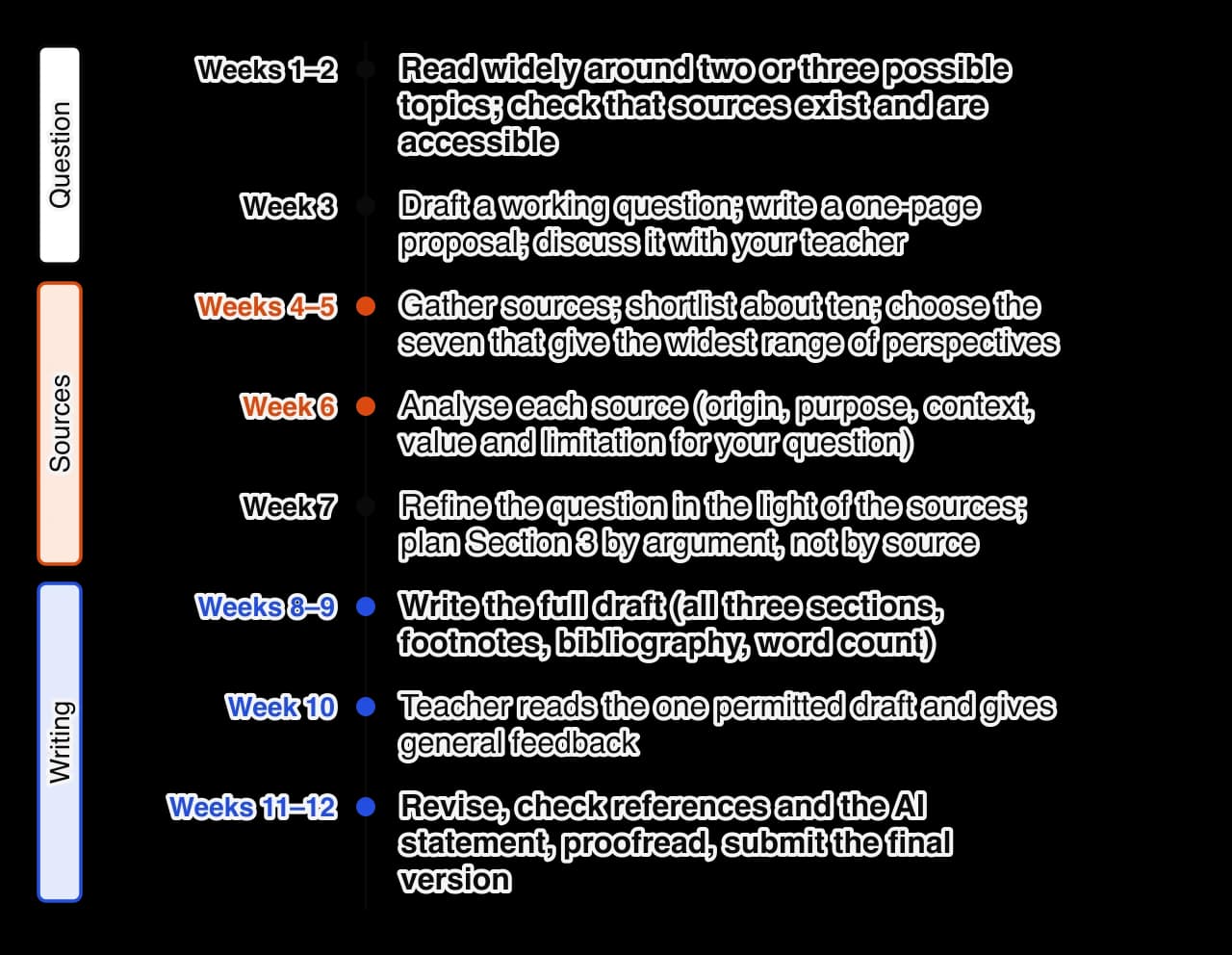
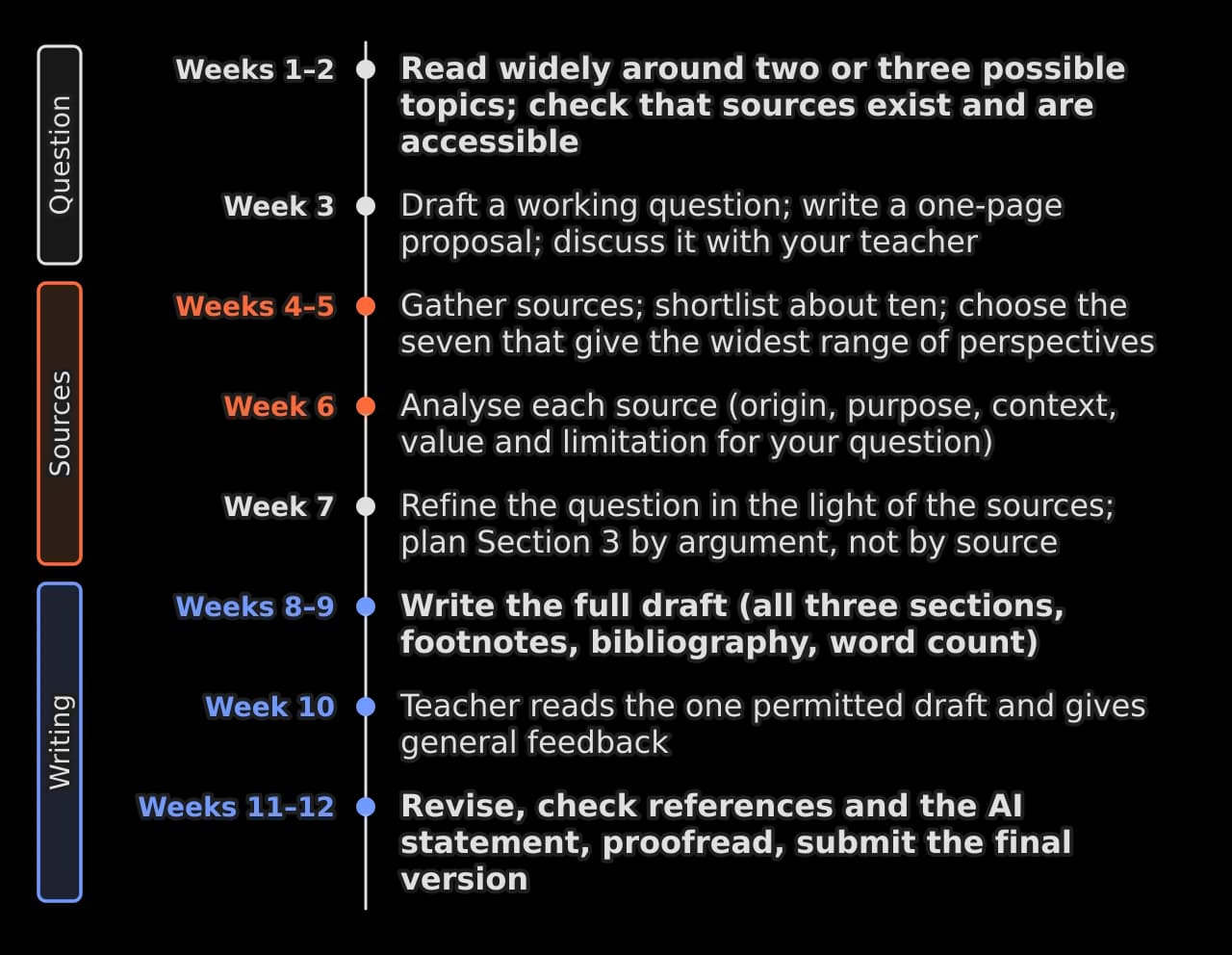
Three points in the plan matter most. The working question in week 3 is provisional: it will almost always change once you read the sources, and the story of how it changed is the material for Section 1. Source selection in weeks 4 and 5 should start from more than seven candidates, so that you choose the seven that give the best range of perspectives instead of using whatever you found first. The draft in weeks 8 and 9 should be complete, because it is the only one your teacher may comment on.
Common mistakes
Teachers and moderators of the previous IA reported the same problems year after year, and most of them apply equally to the new task.
Mistake | What it looks like | How to avoid it |
|---|---|---|
A topic, not a question | "The Cuban Missile Crisis" or "Women in the French Revolution" | Turn the topic into a debatable question with a command phrase, a focus and dates (Section 1 page). |
A question that is too broad | "What were the causes of the Second World War?" | Narrow by place, group, dates or factor until seven sources can answer it. |
A question that is already settled | "Did the Titanic sink in 1912?" | Ask about cause, change, significance or perspective, where historians and the evidence disagree. |
Narrative in Section 3 | Paragraphs that tell the story in order | Organise Section 3 by argument: each paragraph makes a point that answers the question. |
Source-by-source writing | "Source 1 says … Source 2 says …" | Group evidence by argument and combine sources in each paragraph. |
Formulaic source analysis | Origin, purpose, value, limitation listed for each source with no link to the question | Explain how each source's position makes it more or less useful for this question. |
Too few perspectives | Seven secondary works that broadly agree | Choose sources from different positions: participants, opponents, outsiders, later historians. |
Over the word limit | 2,600 words, with an argument hidden in footnotes | Cut description first; keep analysis and evaluation. |
Before you submit
- To do:
My question is a debatable "To what extent …?", "How far …?" or "How significant …?" question with clear limits of time, place and focus.
- To do:
Section 1 explains how and why my question developed and how it uses at least one historical concept.
- To do:
I use no more than seven sources, and every one of them is cited and analysed.
- To do:
Section 2 explains why I chose each source and analyses its perspective, value and limitations for my question.
- To do:
Section 3 is organised by argument, combines evidence from several sources in each paragraph and reaches a reasoned conclusion that answers the question.
- To do:
The word count (2,200 at most, as my teacher confirms) is stated at the start, and nothing essential is hidden in footnotes.
- To do:
Every quotation, fact and idea from someone else has a footnote, and the bibliography lists exactly the sources I cited.
- To do:
Any use of AI tools is acknowledged in the way my school asks.
- To do:
I have read the official criteria with my teacher and checked my work against them.
Carry on with History in Augment
With a free account, Augment remembers where you stopped in the notes and which questions you have marked.