Paper 2 Section B: short responses and essays
How to answer Paper 2 Section B: the four-mark short response (Part A) and the comparative essay with examples from two regions (Part B), with model answers, an essay plan and the rules on examples.
- IB History
- Exam skills
- SL and HL
Section B of Paper 2 is where your thematic study is tested directly. Each thematic study has two questions on the paper; you choose one and answer both of its parts. Part A is a short response asking you to explain something with one example. Part B is an essay asking “To what extent …?”, which must use examples from at least two different cases in at least two regions of the world.
How a Section B question is built
The IB’s published sample for the conflict thematic study shows the shape of every Section B question.
Part A: Explain how conflict can affect the experience of a marginalized group. Use one example from your thematic study in your response.
Part B: To what extent has the mobilization of resources been the most important factor in determining the outcome of conflict? Use examples from at least two different conflicts in at least two regions to support your response.
IB, Diploma Programme Subject Brief: History, first assessment 2028 (2025), sample Paper 2 questions. Teachers working from the guide report that Part A is worth [4] and Part B [15]. The two parts of the sample come from different guiding questions: the experiences of marginalised groups belong to “How did conflict affect people’s lives?”, and the mobilisation of resources to “What determined the outcome of the conflict?”. This is why you need to prepare the whole thematic study, not one or two favourite topics.
Part A: the short response
Part A uses the command term explain: give reasons or ways, with each one linked to the question. The bands reported by teachers working from the guide step up from identifying a relevant example (1 mark), to describing it (2), to partially explaining it (3), to explaining it effectively (4). The difference between 2 and 4 is not more detail; it is the causal links that turn detail into explanation.
Marks | What the answer does (reconstructed from reported markbands) |
|---|---|
4 | Effectively explains a relevant example: clear reasons or ways, each developed with specific evidence and linked to the question |
3 | Partially explains a relevant example: some explanation, but undeveloped or only one clear point |
2 | Describes a relevant example: accurate detail, little explanation of how or why |
1 | Identifies a relevant example, with little more |
0 | Does not reach the standard above |
Part B: the rules on examples
Part B always asks for “examples from at least two different [conflicts / authoritarian states / popular movements / innovations] in at least two regions”. The regions are the four the IB uses throughout the course: Africa and the Middle East, the Americas, Asia and Oceania, and Europe. Two well-chosen examples from two regions are enough; a third can strengthen an argument but is not needed.
Rule | What it means in practice |
|---|---|
Two different cases | Two separate conflicts, states, movements or innovations. The Second World War in Europe and in the Pacific is one war, so it cannot supply both examples; the Cold War as a whole is not “a conflict” in the military sense, though its proxy wars, such as Korea or Vietnam, are. |
Two regions | The cases must come from different IB regions. Where a conflict spans regions, say in the introduction which region your evidence comes from. |
Inside the dates | Conflict and innovation examples from 750 onwards; authoritarian rule and popular movements from 1750 onwards. Contemporary examples are allowed. |
Relevant to the line of inquiry | A case chosen for one guiding question (why a conflict began) must still have evidence on the question asked (how it ended or who it affected). |
Preparing two or three strong cases in depth, from different regions, works better than knowing six cases thinly. Your teacher chooses the cases studied in class; for each one, build a revision grid with a row for every line of inquiry in the thematic study, so that you have evidence on any question that could be set.
Part B: planning and structure
Part B uses to what extent: you weigh a claim and reach a judgement. The reconstructed markbands (official wording not public) reward an essay that is consistently analytical and focused on the question, uses relevant, specific examples from at least two regions, makes well-developed connections between the examples, and reaches a reasoned judgement consistent with the analysis.
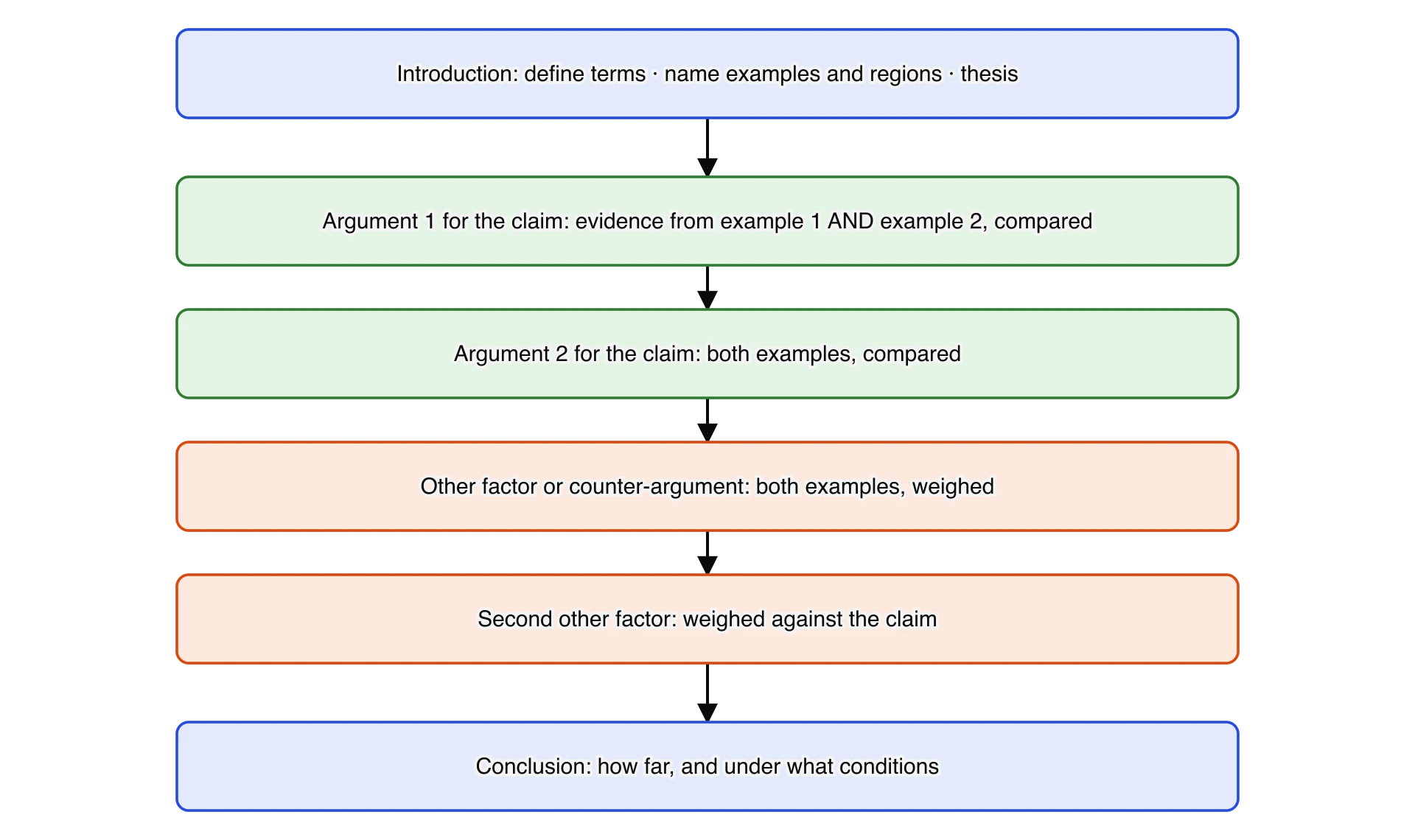
The integrated structure in the diagram is the most reliable way to produce those connections. An alternative is to group all the arguments for the claim and then all the arguments against it, but in both cases each paragraph should use both examples. The structure to avoid is two essays placed one after the other, one per example, with a comparison only in the conclusion.
Part of the essay | Length (about) | What it does |
|---|---|---|
Introduction | 100 words | Defines the key term of the question; names the examples and their regions; states a qualified thesis |
Body paragraphs (4–5) | 150–200 words each | One argument per paragraph; evidence from both examples; an explicit comparison; a sentence linking back to the claim |
Conclusion | 80–100 words | A judgement on “to what extent”, consistent with the body, saying under what conditions the claim holds |
Worked example: an essay plan with model paragraphs
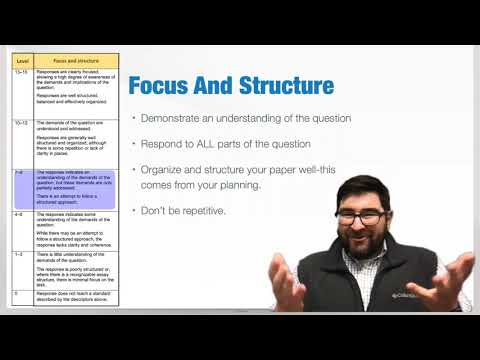 YouTube
Common mistakes in Section B
Two mini-essays. One half on each example, with no connections between them. Use both examples in every paragraph.
Narrative instead of argument. A chronological account of a war or a regime, with the question mentioned at the end. Start each paragraph with an argument that answers the question.
Ignoring the named factor. A Part B essay on resources that becomes a general essay on why the Allies won. The named factor must be the centre of the essay, weighed against others.
Invalid or out-of-range examples. The Cold War as a single “conflict”, the two theatres of the Second World War as two wars, an authoritarian state from before 1750.
A judgement that contradicts the essay. A conclusion that resources were “not the most important factor” after four paragraphs showing that they were. Plan the judgement before writing the introduction.
Repeating Part A material in Part B. You may use the same example in both parts, but the material must be adapted to the new question.
 YouTube
Self-check
- To do:
I can explain how a Section B question is built and why I need to revise the whole thematic study.
- To do:
I can write a Part A answer with two explained points, specific evidence and explicit causal links.
- To do:
I know the four IB regions and which region each of my prepared examples belongs to.
- To do:
I can check that my examples are valid, distinct and inside the thematic study’s dates.
- To do:
I can plan a Part B essay organised by argument, with both examples in every paragraph.
- To do:
I can write a qualified thesis and a conclusion consistent with it.
- To do:
I can weigh the factor named in a question against at least two others.
Carry on with History in Augment
With a free account, Augment remembers where you stopped in the notes and which questions you have marked.