Paper 2 Section A: concept questions
How to analyse a historical concept (cause and consequence, continuity and change, perspectives, significance) with one example from your thematic study, with planning frames and model answers.
- IB History
- Exam skills
- SL and HL
Section A of Paper 2 asks you to analyse one of the four historical concepts that run through the course: cause and consequence, continuity and change, perspectives and significance. Two concept questions appear on each paper and you answer one, using a single example from your thematic study. It is a short task, but an unusual one: the subject of the answer is the concept, and the example is the evidence.
What a concept question looks like
The IB’s published samples for Section A are “Analyse how historical events can have multiple causes” and “Analyse how historical events can be seen from different perspectives”, each followed by “Use one example from your thematic study to support your response.” Teachers working from the guide report that the question is worth [6] marks. The statements are generic: they do not mention any thematic study, so the same question is answered by students who studied conflict, innovation, authoritarian rule or popular movements.
The command term analyse means breaking something into its parts to show how it works. Here the “something” is the concept statement. “Historical events can have multiple causes” breaks down into the kinds of cause (long-term, short-term, trigger), how causes combine, and how their weight can be judged. The example then shows each part at work.
Breaking each concept into facets
Every concept has several facets that can each become a paragraph. The table sets out the main ones. Most questions name one facet (multiple causes, unintended consequences, different perspectives); a strong answer analyses that facet from two or three angles.
Concept | Facets to analyse | Useful vocabulary |
|---|---|---|
Cause and consequence | Long-term conditions, short-term causes and triggers; necessary and sufficient causes; how causes interact; intended and unintended consequences; short- and long-term consequences; how historians weigh causes | long-term cause, short-term cause, trigger, necessary cause, sufficient cause, multi-causality, contingency |
Continuity and change | What changed and what stayed the same; for whom; how fast (sudden or gradual); in which area of life (political, economic, social, cultural); turning points; change in law versus change in practice | continuity, turning point, transformation, reform, revolution |
Perspectives | Perspectives of different groups at the time; how position, interest and knowledge shape a view; perspectives of sources; historians’ interpretations and why they change; silenced or marginalised voices | perspective, interpretation, historiography, revisionism, hindsight |
Significance | Significance at the time and later; for different groups; criteria (scale, depth, duration, consequences, symbolism); how significance is constructed by memory and by historians | historical significance, turning point, agency |
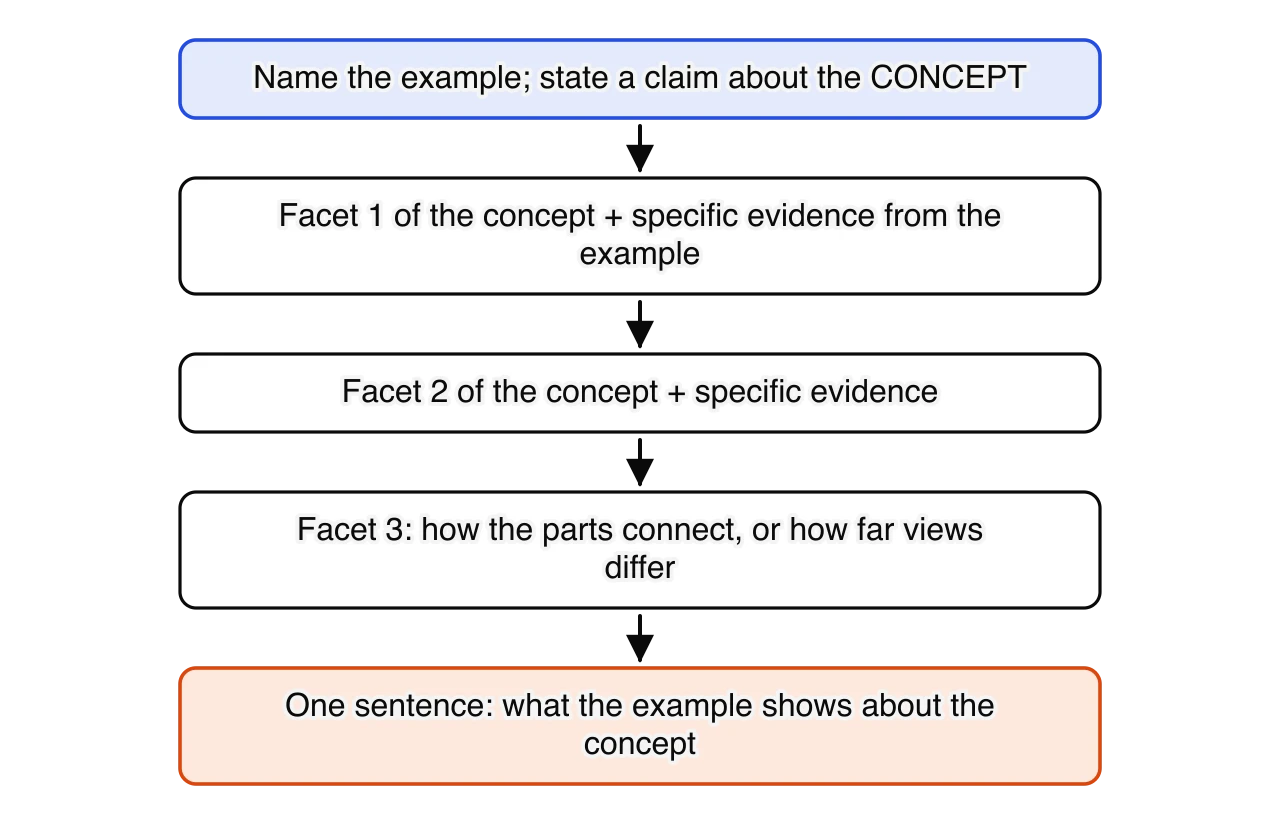
The planning frame sets out the shape of a top-band answer. The opening names the example and makes a claim about the concept; each body paragraph takes one facet and proves it with evidence from the example; the last sentence returns to the concept. With 6 marks available, two or three developed paragraphs are enough.
Choosing your example
A good Section A example is one you know in detail and that shows the concept clearly. The same example can serve several concepts, but some examples suit some concepts better. The outbreak of a war is ideal for multiple causes; a reform programme or a revolution suits continuity and change; a contested event, such as a famine or a massacre, suits perspectives.
Thematic study | Example | Strong for |
|---|---|---|
Conflict | The outbreak of the Algerian War (1954) | Multiple causes: colonial structures, the events of 1945, the closing of political routes, the example of Indochina |
Conflict | The US Civil War and its effects on enslaved people | Continuity and change: emancipation and the Thirteenth Amendment set against the Black Codes and sharecropping |
Authoritarian rule | Stalin’s collectivisation of agriculture (1929–1933) | Perspectives: the party, peasants, Ukrainians, Western observers, historians; unintended consequences |
Popular movements | The African American civil rights movement (1954–1968) | Significance: of the Montgomery bus boycott, the March on Washington or the Civil Rights Act of 1964, for different groups and over time |
Innovation and transformation | Printing with movable type in Europe from the 1450s | Significance and consequences: slow change at first, then the spread of Reformation pamphlets after 1517 |
Worked example: multiple causes
Worked example: different perspectives
Plans for the other concepts
The same approach works for continuity and change and for significance. The two plans that follow show the claim and the facets; the evidence would be developed as in the model answers.
Common mistakes
Narrating the example. The commonest weakness: a clear story of the event with the concept named once at the start. Begin each paragraph with a statement about the concept.
Using two or three examples. The question asks for one. Extra examples earn no extra credit and take time from the essay.
Vague evidence. “Many people suffered” or “the government changed things” cannot support analysis. Use dates, names, laws, numbers.
Answering the wrong concept. Read the statement closely: “multiple causes” is not “consequences”, and “different perspectives” is not “why it happened”.
Writing too much. Section A is worth only 6 of the paper’s 25 marks. A long answer here usually means a rushed essay later.
Self-check
- To do:
I can state the wording of a Section A question and what “analyse” requires.
- To do:
I can break each of the four concepts into facets and use the vocabulary of each precisely.
- To do:
I have chosen an example from my thematic study for each concept and know three facets it illustrates.
- To do:
I can plan an answer that opens with a claim about the concept, gives one facet per paragraph and closes on the concept.
- To do:
I can support each facet with specific evidence from a single example.
- To do:
I can keep a Section A answer to about 350–450 words.
Carry on with History in Augment
With a free account, Augment remembers where you stopped in the notes and which questions you have marked.