Paper 3: regional study essays
How to answer Paper 3 questions on the regional studies: unpacking the argument in the question, evaluating a range of perspectives and reaching a substantiated judgement, with a full worked plan.
- IB History
- Exam skills
- HL only
Paper 3, taken only by HL students, tests the two regional studies you have studied in depth. Every question gives you an argument, a claim, statement or perspective about the past, and asks how far you agree with it. You answer two questions, each from a different regional study, and each essay is marked out of 15. The skills are those of a historian reviewing an argument: understand it exactly, test it from several angles, and decide how much of it stands.
What a Paper 3 question looks like
The IB has published four sample questions for the new Paper 3, one from each region.
To what extent do you agree with the claim that papal patronage was the most significant factor in the development of the Italian Renaissance?
"The Mexican Revolution significantly changed the role of women." To what extent do you agree with this statement?
To what extent do you agree with the perspective that the African National Congress (ANC) adopted armed struggle because of the Sharpeville Massacre?
"The main reason for the outbreak of war in Korea in 1950 was contrasting views on free elections." To what extent do you agree with this claim?
IB, Diploma Programme Subject Brief: History, first assessment 2028 (2025), sample Paper 3 questions. Each regional study has two questions on its region’s paper, so you will normally have a choice of two for each of your studies.
Type of claim | Examples from the samples | What the essay must do |
|---|---|---|
Factor claim | Papal patronage “the most significant factor”; “the main reason … was contrasting views on free elections”; the ANC adopted armed struggle “because of” Sharpeville | Weigh the named factor against at least two others, show how they interacted, and decide whether the named one carried most weight |
Effect or characterisation claim | The revolution “significantly changed the role of women” | Test the size and nature of the change across groups, regions, areas of life and phases, against what stayed the same |
What examiners reward
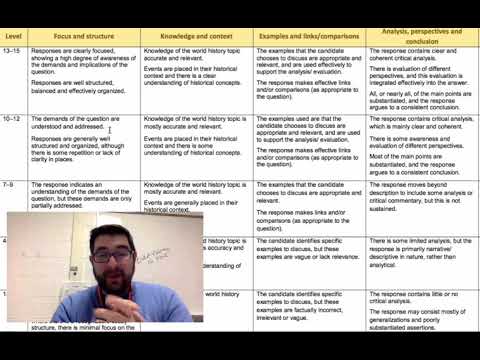
The full markbands for the new Paper 3 have not been published outside the guide. IB teachers who have reproduced them report seven levels for each 15-mark essay and a top-level descriptor with three strands: an in-depth understanding of the argument in the question; a thorough and well-balanced evaluation of a range of perspectives on that argument; and a substantiated judgement consistent with the evaluation. The top row of the table follows that reported descriptor. The lower rows are Augment’s reconstruction of how the three strands step down, so treat the table as guidance rather than the official wording.
Level (marks) | Understanding of the argument | Evaluation of perspectives | Judgement |
|---|---|---|---|
7 (14–15) | In-depth | Thorough, well balanced, a range of perspectives | Substantiated and consistent with the evaluation |
6 (12–13) | Clear | Balanced, but some perspectives less developed | Mostly substantiated |
5 (9–11) | Clear in most of the essay | Mostly balanced; evaluation sometimes slips into description | Present but only partly supported |
4 (7–8) | Some understanding | Partial or one-sided; much description | Weak or not consistent with the body |
3 and below (0–6) | Limited; may answer a different question | Mostly narrative, little evaluation | Missing or unsupported |
Compared with the essays of the previous course, the reported descriptor no longer lists structure, knowledge and historiography as separate strands. Accurate, specific knowledge is still essential, but it is rewarded through the evaluation it makes possible. Historians’ views are one kind of perspective: they strengthen an essay when used to support or test an argument, and add little when dropped in as names.
Planning: unpacking the argument
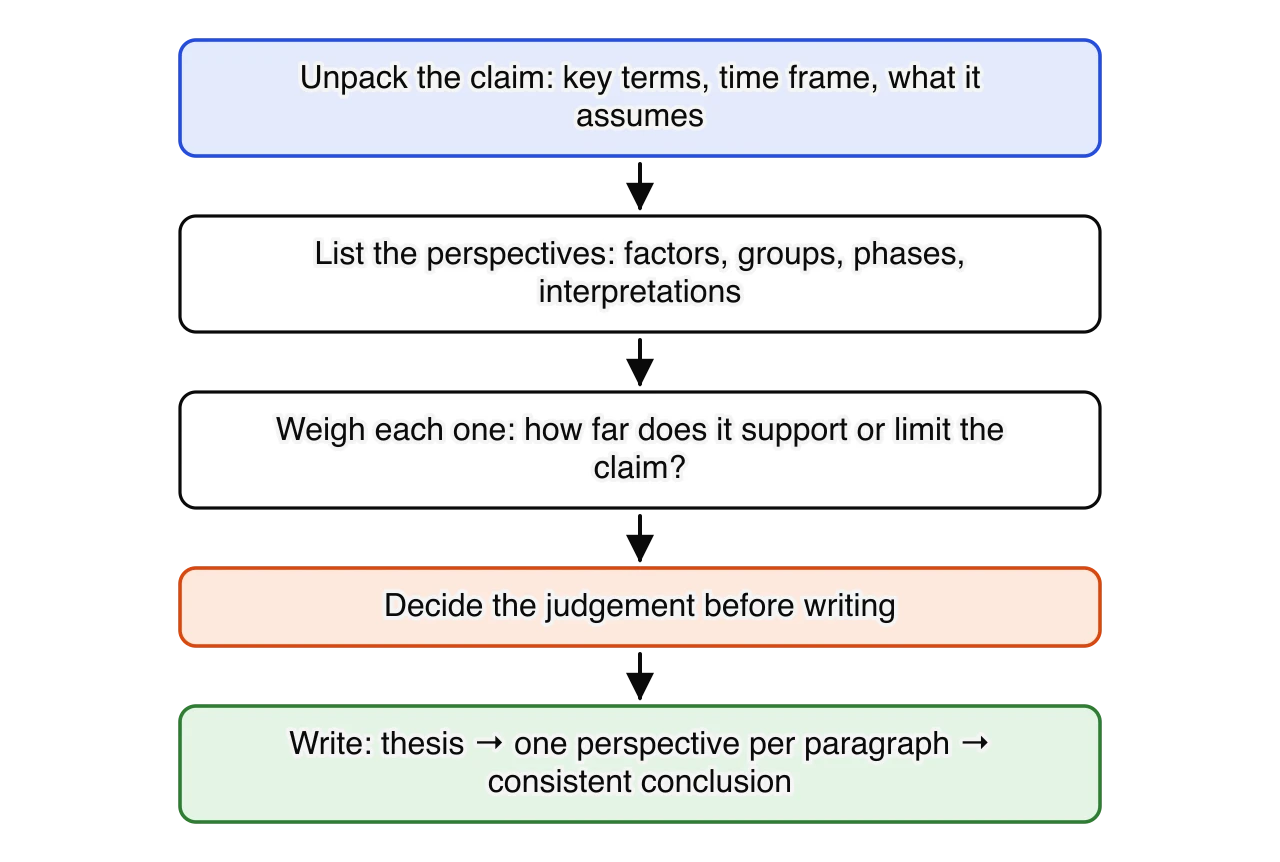
The planning steps in the diagram begin with the claim itself. Underline its key terms and ask what each one means and assumes. A factor claim assumes that one cause can be separated from others; an effect claim assumes a measure of change. The time frame of the question and of the regional study sets the limits of relevant evidence.
Worked example: a factor claim
The worked example takes one of the IB’s sample questions, from the regional study of developments in South Africa (1867–2020), through a full plan with model paragraphs.
Testing an effect claim
Effect and characterisation claims, such as “The Mexican Revolution significantly changed the role of women”, need a different kind of plan. There are no rival factors to weigh. Instead the claim is tested across the places where change might or might not be found.
Test the claim across | Questions to ask | Evidence from the Mexican Revolution (1910–1940) |
|---|---|---|
Phases | Did the change last, grow or reverse? | Women essential to the armies in 1910–1920; soldaderas excluded and romanticised after 1920; mass organisation in the 1930s |
Areas of life | Law, work, politics, culture: where did change happen? | Divorce legalised (1914–1915) and the Law of Family Relations (1917); thousands of rural teachers; no national vote |
Groups of women | Which women gained, and which did not? | Urban feminists and teachers gained most; rural women’s ejido land mostly went to male heads of household; Catholic women organised against the anticlerical state |
Measure of change | Change in law against change in practice; aims against results | The 1937 suffrage amendment was approved but never put into force; women won the national vote only in 1953 |
A strong judgement on an effect claim specifies where it holds: “the revolution significantly changed women’s public roles and legal position, but not their political rights or the lives of most rural women”. That kind of conclusion shows the in-depth understanding of the argument that the top level rewards.
Choosing questions and using the time
You answer two questions from different regional studies, so the choice is usually between the two questions set on each of your studies. Choose the question whose argument you can test from the widest range of perspectives with precise evidence, not the one whose topic you like best. Give the two essays equal time: they carry equal marks, and a strong first essay cannot make up for an unfinished second one.
Common mistakes
Narrative. The most frequent criticism in old Paper 3 reports: an account of events, accurate but not evaluating the claim. Every paragraph should begin with a point about the argument in the question.
Leaving the time frame. Evidence from after the dates in the question (the Cultural Revolution in an essay on 1949–1961) earns little credit. Brief background from before is acceptable when it explains something inside the period.
Dismissing the named factor in a line. Even if you disagree with the claim, give it a full, fair paragraph before weighing it against others.
Covering half of a two-part claim. If a question says “political and economic”, both parts need evidence, though not necessarily equal space.
Name-dropping historians. “Ellis disagrees” is not evaluation. Say what a historian argues, what evidence they stress, and how far it supports or limits the claim.
Losing the regional focus. In a question about events in one country, keep the evidence there: an essay on the Korean War that discusses only decisions in Washington and Moscow has lost Korea.
 YouTube
Self-check
- To do:
I can recognise a factor claim and an effect or characterisation claim, and plan each in the right way.
- To do:
I can unpack the key terms, time frame and assumptions of a Paper 3 question before planning.
- To do:
I can list a range of perspectives on a claim: other factors, groups, regions, phases and interpretations.
- To do:
I can write a paragraph that evaluates one perspective with precise evidence and ends with a judgement on the claim.
- To do:
I can use a historian’s or contemporary’s view as a perspective to evaluate, not as a name to drop.
- To do:
I can write a thesis and a conclusion that agree with each other and with the body of the essay.
- To do:
I can divide the time equally between two essays from different regional studies.
Carry on with History in Augment
With a free account, Augment remembers where you stopped in the notes and which questions you have marked.