Augment Education
    • Question bank
    • Quick fire
    • Worksheets
    • Flashcards
    • Notes
    • Try a quick-fire round
    • All features
    • Business
    • Digital Society
    • Economics
    • Geography
    • Global Politics
    • History
    • Philosophy
    • Psychology
    • Anthropology
    • World Religions
    • Biology
    • Chemistry
    • Physics
    • Computer Science
    • Design Technology
    • ESS
    • SEHS
    • Language and literature
    • Language acquisition
    • Maths AA
    • Maths AI
    • Dance
    • Film
    • Music
    • Theatre
    • Visual Arts
    • Grade calculator
    • Grade boundaries
    • Subject checker
    • Focus timer
    • Exam countdown
    • All free tools
    • IB guide
    • All subjects
  • Blog

Search

Search subjects, the syllabus, glossary terms, the booklets, the IB guide, help and the blog

Log inStart free
augment

Augment Education

IB Diploma revision built around the syllabus.

contact@augment-education.com

Product

  • Features
  • Question bank
  • Quick fire
  • Worksheets
  • Flashcards
  • Notes
  • Subjects
  • What's new

Learn

  • IB guide
  • Booklets, explained
  • Glossary
  • Blog
  • Free tools
  • Grade calculator
  • Subject checker

Company

  • About
  • Help
  • For parents
  • For teachers
  • Comparisons

Subjects

  • English A Lit
  • English A Lang & Lit
  • Chinese A Lit
  • Chinese A Lang & Lit
  • Spanish A Lit
  • Spanish A Lang & Lit
  • English Lit & Perf
  • Spanish Lit & Perf
  • English B
  • Mandarin B
  • Spanish B
  • English ab initio
  • Mandarin ab initio
  • Spanish ab initio
  • Business
  • Digital Society
  • Economics
  • Geography
  • Global Politics
  • History
  • Philosophy
  • Psychology
  • Anthropology
  • World Religions
  • Biology
  • Chemistry
  • Physics
  • Computer Science
  • Design Technology
  • ESS
  • SEHS
  • Maths AA
  • Maths AI
  • Dance
  • Film
  • Music
  • Theatre
  • Visual Arts

Augment Education is developed independently of the International Baccalaureate Organization and is not endorsed by it. “IB” and “International Baccalaureate” are its trademarks.

© 2026 Augment Education. All rights reserved.

  • Privacy
  • Terms
  1. Subjects
  2. History
  3. Paper 1: working with sources

Paper 1: working with sources

How to answer the three static Paper 1 questions on content, context and perspectives, with a full worked set on Kenyan independence, model answers and the mistakes that cost marks.

  • IB History
  • Exam skills
  • SL and HL

18 min readLast reviewed 16 Oct 2026

Paper 1 tests the work historians do with sources. You are given an inquiry question on your focused study and three sources, labelled A, B and C, and you answer three questions whose wording never changes. Because the questions are fixed, Paper 1 rewards practice more than any other paper: you can learn in advance exactly what each question needs and rehearse it until it is automatic.

Key points

  • The three questions are static: question 1 on the content of sources A and B, question 2 on the context of source C, question 3 on the perspectives in all three.

  • You are not asked to answer the inquiry question yourself. You explain how the sources could be used to answer it, as a historian would use evidence.

  • Every point needs a link back to the inquiry question: what the evidence suggests, and how far.

  • Your knowledge of the focused study is the tool for reading the sources: it explains what a source means, why its context matters and why perspectives differ. It is not credited as an essay in its own right.

  • Question 3 is worth as much as questions 1 and 2 together, so plan your time to give it about half the paper.

The three static questions

Every Paper 1 set is introduced by the same sentence, naming the focused study and the inquiry question, followed by the same three questions. The IB’s published sample, on post-war displacement in Europe, reads as follows.

Using the three provided sources on post-Second World War displacement in Europe and considering the overarching inquiry question of "To what extent was persecution the main reason for post-war mass displacement in Europe?", respond to the following three questions.

1. Explain how the content of both source A and source B can be used to answer the inquiry question.

2. Analyse how the context of source C influences how it can be used to answer the inquiry question.

3. Examine how the perspectives in all the sources can be used to answer the inquiry question.

IB, Diploma Programme Subject Brief: History, first assessment 2028 (2025), sample Paper 1 questions. The marks are not printed in the brief; teachers and publishers working from the guide agree that the questions are worth 6, 6 and 12 marks.
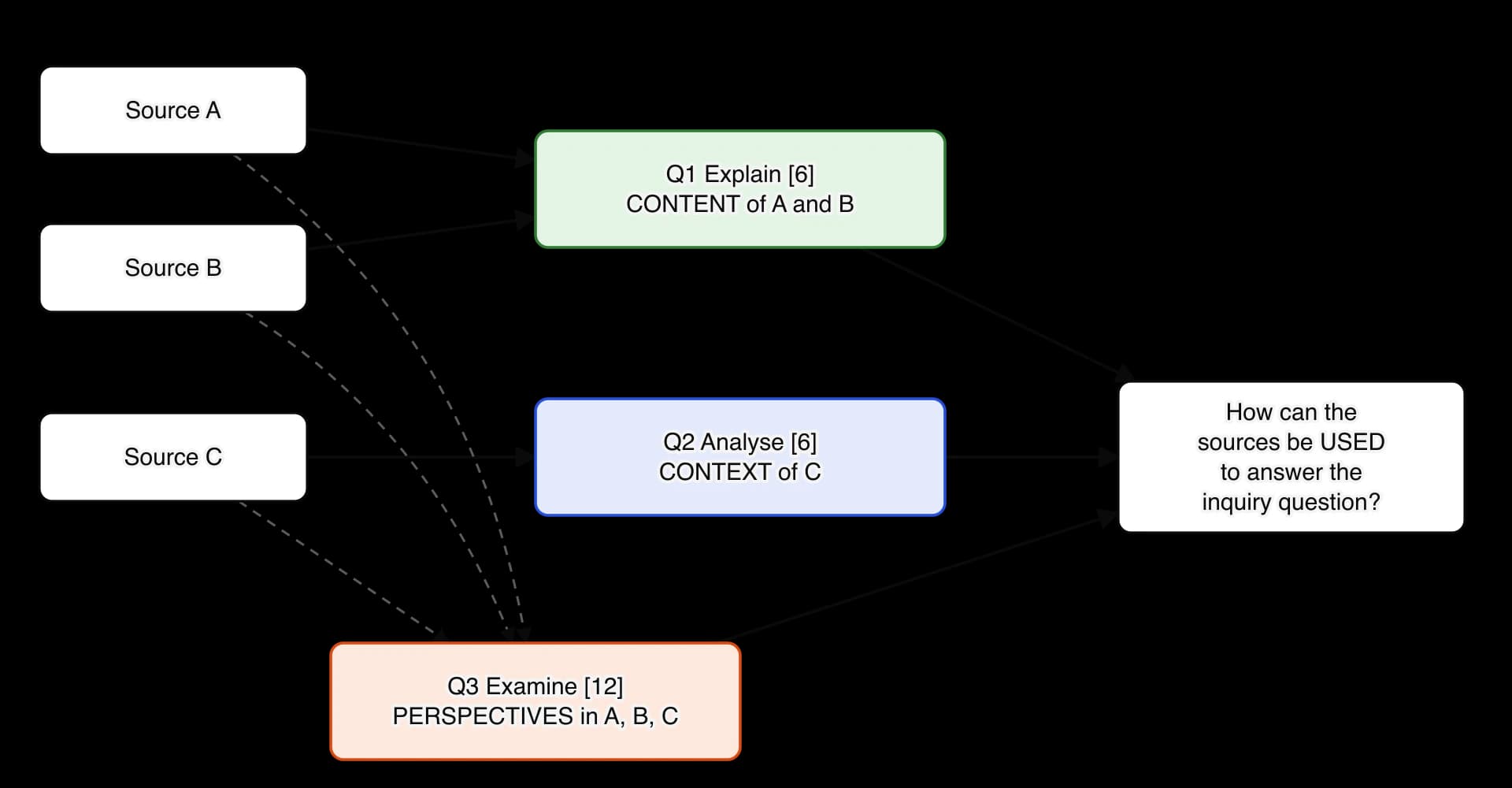
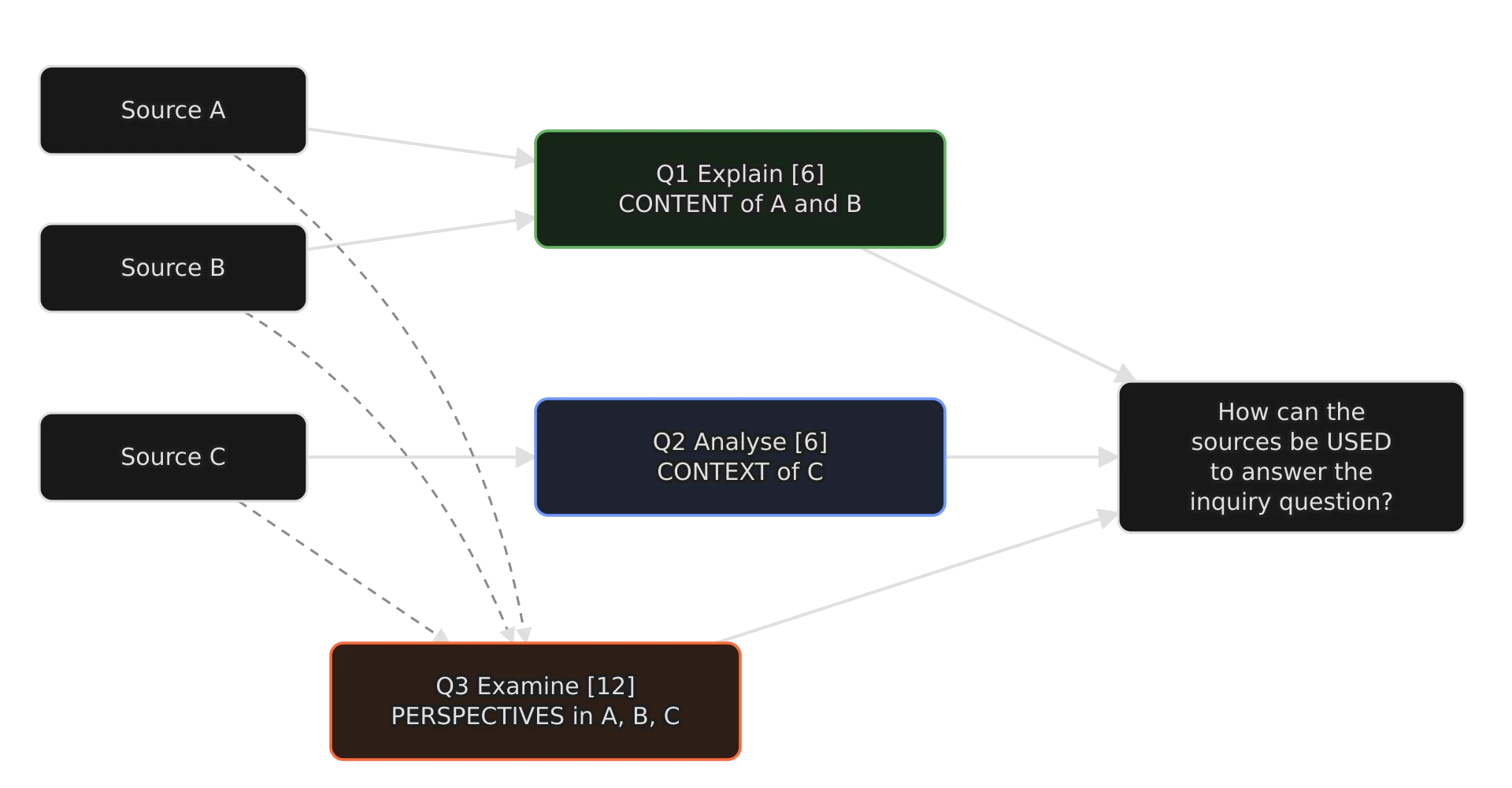
Diagram of the three Paper 1 questions. Sources A and B feed question 1, explain, 6 marks, on content. Source C feeds question 2, analyse, 6 marks, on context. Dashed arrows from all three sources feed question 3, examine, 12 marks, on perspectives.Diagram of the three Paper 1 questions. Sources A and B feed question 1, explain, 6 marks, on content. Source C feeds question 2, analyse, 6 marks, on context. Dashed arrows from all three sources feed question 3, examine, 12 marks, on perspectives.
How the three static questions divide the sources. Each question looks at the sources through a different lens (content, context, perspectives), and every answer points the same way: towards how a historian could use the sources to answer the inquiry question.

The diagram of the paper’s structure shows the logic. Question 1 asks what the sources say that bears on the inquiry question. Question 2 asks how the circumstances in which one source was made shape what it can tell a historian. Question 3 asks how the different viewpoints in the sources fit together. Old-course formats, such as the origin, purpose, value and limitation (OPVL) question, the compare-and-contrast question and the comprehension question on the “message” of a source, are no longer set.

Exam tip

Nobody outside the IB has seen the official markbands for the new Paper 1. The guidance here is the best reconstruction available, based on the IB’s own description of what each question assesses and on markbands reproduced by experienced IB teachers. Check it against any markscheme your teacher gives you.

Reading the inquiry question and the sources

The inquiry question is always framed “To what extent …?” and names a claim: that persecution, foreign pressure, a leader or an economic factor was the main reason for something. Read it first, and identify the claim and the alternatives it implies. If the question asks whether persecution was the main reason for displacement, the alternatives include the fighting itself, the Allies’ border decisions and economic need.

Then read each source twice. On the first reading, take in the provenance line (who, what, when) before the text, because the provenance tells you how to read the words. On the second, mark the text: one symbol for content that supports the claim, another for content that challenges or qualifies it, and a note in the margin on anything in the provenance that would affect its use.

Tip

Write the inquiry question’s claim at the top of your plan in your own words (“The war, not older grievances, started the movement”). Every point in every answer should say something about that sentence.

Definition

Provenance is the information about a source’s origin: its author and their position, its date, its type, its audience and the circumstances in which it was made. In Paper 1 it appears as a line above each source.

A worked set: Kenyan independence

The worked set that follows is written in the style of the IB for the focused study of Kenyan independence (1945–1978). The model answers show one way of reaching the top band; they are not the only way.

The inquiry question and the sources

Using the three provided sources on Kenyan independence and considering the overarching inquiry question of “To what extent was the Second World War the main reason for the emergence of the independence movement in Kenya?”, respond to the following three questions.

Source A: Franklin D. Roosevelt, president of the United States, and Winston Churchill, prime minister of the United Kingdom, in a joint declaration of war aims, The Atlantic Charter (1941).

Third, they respect the right of all peoples to choose the form of government under which they will live; and they wish to see sovereign rights and self government restored to those who have been forcibly deprived of them.

Source B: Timothy Parsons, a historian, in a journal article, “Mau Mau’s Army of Clerks: Colonial Military Service and the Kenya Land Freedom Army in Kenya’s National Imagination”, Journal of African History (2017). Adapted summary of the article’s argument, not a quotation.

Parsons challenges the widespread view that veterans of the Second World War, radicalised by their service in the King’s African Rifles, supplied the fighters and skills of Mau Mau’s armed wing, the Kenya Land Freedom Army. He argues that the rank and file of the King’s African Rifles, most of whom were not Kikuyu, were willing to fight against the Land Freedom Army, and that this has been largely forgotten in Kenya since independence. In his account, wartime military service explains much less of the armed movement than is often assumed.

Source C: delegates to the Fifth Pan-African Congress, held in Manchester, England, in October 1945, in a declaration, Declaration to the Colonial Workers, Farmers and Intellectuals, published in George Padmore (ed.), Colonial and Coloured Unity (1947). Jomo Kenyatta, later leader of the Kenya African Union, attended the congress.

We affirm the right of all Colonial peoples to control their own destiny. All Colonies must be free from foreign imperialist control, whether political or economic. The peoples of the Colonies must have the right to elect their own governments, without restrictions from foreign powers.

Question 1: content of sources A and B

1. Explain how the content of both source A and source B can be used to answer the inquiry question. [6]

Question 1 rewards specific content, explicitly linked to the inquiry question. The top band, as teachers working from the guide describe it, needs at least two distinct points from each source, and the strongest answers show where a source supports the claim and where it limits or complicates it. Context and provenance belong to question 2; here they appear only where a phrase needs explaining.

Plan for question 1

Source A

Source B

Supports the claim

The war produced a public promise of self-government for “all peoples”, which colonial nationalists could quote back at Britain.

It sets out the widely held view that servicemen radicalised by the war supplied the fighters of Mau Mau, which shows how strong the case for the war as a cause has seemed.

Challenges or qualifies

The clause speaks of rights “restored” to those “forcibly deprived” of them, wording aimed at countries conquered in the war, so it supplied an argument more than a cause.

Most soldiers serving in the 1950s were not Kikuyu and fought against the Land Freedom Army, so wartime service explains much less of the armed movement than is assumed.

Worked example

Write a top-band answer to question 1.

Show the model answer and comments

Model answer. Sources A and B can both be used to argue that the Second World War helped the independence movement to emerge, but each also suggests that the war was not the whole explanation.

Source A supports the inquiry question because the war produced the Allied promise to “respect the right of all peoples to choose the form of government under which they will live”. A war fought in the name of self-government gave Kenyan nationalists a principle they could hold the British government to, which suggests that the war changed the terms in which independence could be demanded. The source also shows that Britain itself had committed to the restoration of “sovereign rights and self government” to those “forcibly deprived of them”, a phrase colonised peoples could apply to their own case. However, the clause speaks of restoring rights that had been taken away, which points to the countries occupied during the war rather than to colonies; the content therefore shows that the war supplied an argument, not that it created the demand for independence.

Source B can be used to support the claim in part. It sets out the widely held view that veterans of the Second World War, radicalised by their service in the King’s African Rifles, supplied the fighters and skills of the armed wing of Mau Mau; that the view is so common shows how strongly the war has been linked to the emergence of the movement. Yet B mainly challenges the claim. It argues that most of the rank and file of the King’s African Rifles were not Kikuyu and that they fought against the Land Freedom Army, which suggests that military service did not make Kenyans into nationalists. B therefore implies that the movement’s armed wing rested on causes other than wartime service.

Taken together, the content of A and B suggests that the war gave the movement new language and arguments, but that it does not explain by itself who joined the movement or why.

Comments. The answer takes two or more points from each source, quotes or closely paraphrases them, and links each to the claim with “supports … because”, “challenges”, “suggests”. It shows both directions for each source, even though B leans one way. It does not evaluate who wrote the sources (that is question 2) and does not wander into an essay on Mau Mau. At about 330 words it is the right length for 6 marks.

Common mistake

Paraphrasing the sources in turn (“Source A says … Source B says …”) without saying what each point shows about the inquiry question. Old examiner reports repeatedly criticised this. The link to the question is what earns the marks.

Question 2: context of source C

2. Analyse how the context of source C influences how it can be used to answer the inquiry question. [6]

Context means the circumstances in which a source was produced: who made it and from what position, when and in what situation, for which audience, for what purpose, and in what form. Question 2 asks you to analyse these elements: take them one at a time and show, for each, what it allows the source to show about the inquiry question and what it prevents it from showing. Every sentence about provenance should end with its consequence for this question.

Element of context

Source C

Effect on its use for the inquiry question

Authors and position

Activists of the African diaspora and colonial students, many of them socialists, meeting in Britain

Valuable for the ideas of the movement’s future leaders; limited as evidence of what most Kenyans in Kenya thought

Date and circumstances

October 1945, weeks after the end of the war, with Labour newly in power in Britain

Shows the war’s immediate effect on nationalist demands, which moved from reform to independence

Audience and purpose

Addressed to colonial workers, farmers and intellectuals to mobilise them

A manifesto, so it states aims, not causes; it is evidence of intentions and language

Publication

Published by George Padmore, an organiser of the congress, in 1947

Presents the congress as its organisers wished it to be remembered

Link to Kenya

Kenyatta attended; he returned to Kenya in 1946 and led the Kenya African Union from 1947

Connects the post-war ideas to a Kenyan leader, but not to the land grievances of the rural majority

Worked example

Write a top-band answer to question 2.

Show the model answer and comments

Model answer. Source C was written by delegates to a Pan-African congress in Manchester in October 1945, and this context makes it valuable evidence of how the war changed nationalist demands, but limited evidence of why a mass movement emerged in Kenya.

Its date is its main value for the inquiry question. Meeting only weeks after the end of the war, the delegates demanded that “all Colonies must be free from foreign imperialist control”, where earlier Pan-African congresses had asked for reform. Because the declaration was produced at this moment, it can be used to show that the war had radicalised the aims of colonial nationalists, which supports the view that the war mattered to the emergence of the movement. Its language of the “right to elect their own governments” also echoes the wartime principle of self-determination.

The authors’ position limits its use. The delegates were mainly activists, students and trade unionists living in Britain or travelling to it, many of them socialists, which explains the attack on “economic” as well as political control. Their declaration shows the ideas of an educated, international elite, not the experience of Kikuyu squatters evicted from settler farms or of workers in Nairobi, whose grievances drove the movement inside Kenya. Kenyatta’s presence links the source to Kenya, since he returned in 1946 and became president of the Kenya African Union in 1947, but one leader’s presence does not show that Kenyans at home shared these aims in 1945.

The source’s purpose and publication also shape its use. As a manifesto addressed to colonial “workers, farmers and intellectuals”, it set out what the movement wanted, not what caused it, and it was published in 1947 by George Padmore, one of the congress’s organisers, who presented it as a turning point. It is therefore strong evidence that the war changed the aims and confidence of nationalist leaders, but it cannot by itself show that the war, rather than older grievances, was the main reason the movement emerged.

Comments. Each paragraph takes one element of context (date; authors; purpose and publication), states it briefly, and spends most of its words on the consequence for this inquiry question, with both value and limitation. There is no generic “it is biased” or “it is primary, so it is reliable”.

Common mistake

Spending most of a question 2 answer describing the provenance. “Source C was written in 1945 by the Fifth Pan-African Congress in Manchester. It was published in 1947. Its purpose was to inform colonial peoples” earns little. Old examiners repeatedly noted “lengthy descriptions of the origin, purpose and content … at the expense of actual evaluation”. One sentence of description is enough; the rest is analysis of the effect.

Question 3: perspectives in all the sources

3. Examine how the perspectives in all the sources can be used to answer the inquiry question. [12]

A perspective is the viewpoint from which a source sees the issue, shaped by its author’s position, knowledge, time of writing and purpose. Question 3 asks you to identify the perspectives in all three sources, explain why they differ, show how they relate to one another, and bring them together into a view of how far the sources, as a set, can answer the inquiry question. That final step, synthesis, is what separates the top band from a good list.

Organise the answer by perspective, not by source. Three steps work well: group the sources that share a viewpoint, set the groups against each other and explain the difference, and then say what the sources together show and what perspective is missing.

Worked example

Write a top-band answer to question 3.

Show the model answer and comments

Model answer. The three sources offer two broad perspectives on the inquiry question: that of contemporaries who saw the war as a moment of new principles (A and C), and that of a historian who, with hindsight, looks at what the war actually did to Kenyans (B). Together they suggest that the war helped to shape the language and aims of the movement, but not that it was the main reason for its emergence.

Sources A and C share a perspective centred on ideas and declarations. Source A, the Atlantic Charter, gives the view of the two Allied leaders in 1941, who promised self-government to “all peoples” as a war aim; Source C, the Manchester congress of 1945, gives the view of colonial nationalists who took that promise and made it a demand: “All Colonies must be free”. Read together, the two sources show the war producing an argument that passed from the Allies to their colonial subjects, which supports the claim. Their positions also explain their limits. Churchill told Parliament in September 1941 that the clause applied primarily to the nations of Europe under Nazi occupation, so A records a principle its British author did not mean for Kenya; C records the aims of an educated, international elite, meeting in Britain, rather than the experience of Kenyans at home. Neither was written to explain why a movement emerged.

Source B offers a different perspective: that of a historian writing more than seventy years after the war who re-examines a common explanation. Parsons tests the claim that servicemen radicalised by the war drove the armed movement, and argues that most of the rank and file in the King’s African Rifles were not Kikuyu and fought against the Land Freedom Army. His hindsight and his use of the records of the army, rather than the declarations of leaders, explain why he is more sceptical than A and C. B qualifies rather than contradicts them: it does not deny that the war mattered, but it shows that wartime service cannot be assumed to have produced nationalists.

The perspectives therefore fit together. A and C show that the war changed what nationalists could demand and how they justified it; B shows that the step from wartime service to armed resistance cannot be assumed, since many soldiers stayed on the side of the colonial state. A historian using all three would conclude that the war was a significant accelerating cause of the movement’s ideas and aims, but the sources do not support the stronger claim that it was the main reason the movement emerged. The set has an important silence: no source gives the perspective of rural Kenyans, the squatters, labourers and women whose grievances over land fed the mass movement, or of the settler-dominated government. Evidence from them would be needed before the inquiry question could be answered with confidence.

Comments. The answer opens with a judgement about the perspectives; it groups A and C and sets them against B; it explains each perspective by its author’s position, purpose and time of writing; it refers to all three sources with short quotations or close paraphrase; and it ends by synthesising them and naming a missing perspective. It uses contextual knowledge (Churchill’s statement of 1941, the land grievances of rural Kenyans) only to explain the sources.

Exam tip

A missing perspective is a strong ending for question 3, but only when it is specific to the inquiry question. “There is no source from a woman” is weak on its own; “there is no source from the Kikuyu squatters whose evictions after 1945 turned old grievances into mass protest, so the sources cannot show whether the war mattered to them” explains why the gap matters.

Using your time

The marks set the time. Question 3 carries half the marks, so it deserves about half the time; questions 1 and 2 share the rest roughly equally. A few minutes of reading and marking up the sources first make all three answers quicker to write, because the same notes serve each of them.
YouTube
Lanterna Education, “IB History Revision: How to Score a 7 in History Paper 1 – Part 1”: Paper 1 question types and timing. Made for the previous course, whose Paper 1 had four sources and four questions; the new paper has three sources and the three static questions, so use the video for technique only.

Common mistake

Running out of time on question 3, a problem old examiner reports noted in almost every session. If time is short, cut questions 1 and 2 back to the essentials and protect the 12 marks of question 3.

Common mistakes and how to avoid them

  • Answering the inquiry question instead of using the sources. Paper 1 is not an essay. A paragraph of your own knowledge on the causes of Kenyan nationalism, however good, earns nothing unless it explains what a source shows.

  • Generic comments on reliability. “It is primary, so it is reliable”, “it may be biased”, “it is only an extract” could be said of any source and earn little. Say what in this source’s context affects what it can show about this question.

  • Treating perspectives as “for” and “against”. Two sources can share a conclusion from different perspectives (a government and a historian), and one source can carry two perspectives. A perspective is a viewpoint, not a side.

  • Ignoring visual or statistical sources. A source may be a photograph, poster, cartoon, map or table. Read its creator, date and purpose exactly as for a text, and quote what it shows (a figure, a caption, a detail of the image) as content.
YouTube
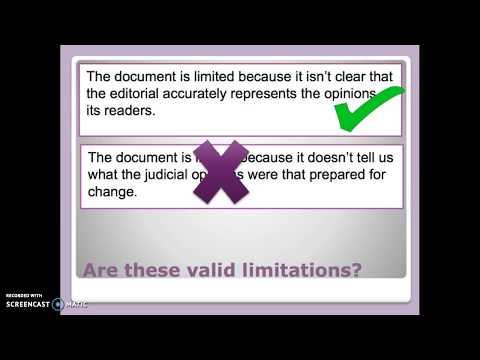
penguinhistory, “How to OPCVL DP History”: a teacher’s guide to analysing a source’s origin, purpose, content, value and limitations. Made for the previous course, which set a separate OPVL question; the same thinking now goes into question 2 (context) and question 3 (perspectives), organised around the inquiry question.

Self-check

  • To do:

    I can write out the three static Paper 1 questions from memory and say which sources each one uses.

  • To do:

    I can rewrite an inquiry question as a claim and name the alternatives it implies.

  • To do:

    I can take at least two specific points from each of sources A and B and link each to the inquiry question, in both directions.

  • To do:

    I can analyse the author, date, audience, purpose and circumstances of a source and explain the effect of each on its use for one question.

  • To do:

    I can group sources by perspective, explain why the perspectives differ and synthesise them into a view of how far the sources answer the inquiry question.

  • To do:

    I can name a missing perspective and explain why it matters for the inquiry question.

  • To do:

    I can divide my time so that question 3 gets about half of it.

Keep your place

In Augment the notes remember where you stopped and which pages you have finished.

Open in Augment

More IB History notes

  • Command terms and what they ask forThe page before this.
  • Paper 2 Section A: concept questionsThe next page.
  • History assessmentEach History paper, the internal assessment and grade boundaries.
  • IB HistoryThe History syllabus, how it is assessed and every notes page.

Carry on with History in Augment

With a free account, Augment remembers where you stopped in the notes and which questions you have marked.

Start free