Using the HL lenses in answers
Use environmental law, economics and ethics to raise HL answers, especially 9-mark essay parts: where lenses earn marks, how to add one without bolting it on, and the same answers before and after a lens.
- IB Environmental Systems and Societies
- Exam skills
- HL only
The HL lenses are three ways of looking at any environmental issue. Environmental law asks which rules govern it, at what scale, and whether they are enforced. Environmental economics asks who pays, who gains and why markets fail to protect the environment. Environmental ethics asks what is right, whose interests count and why. Each lens draws on the same ESS knowledge but adds a layer of analysis that SL answers do not need.
Used well, a lens explains something the science alone cannot: why a fishery collapsed even though scientists warned of it, why one international agreement worked and another did not, why a conservation project succeeded in numbers but was resented locally. Used badly, a lens is a sentence added at the end (“this also has legal and ethical implications”) that earns nothing. The aim is to make the lens do work in the argument.
Where the lenses earn marks
The lenses matter most in the 9-mark final part of each Section B essay. At HL, the markbands for that part look for knowledge and understanding of ESS issues and concepts and of HL lens content at every level. An answer with excellent science but no use of the lenses can still be strong, but it is harder to show the “substantial evidence” and “wide breadth of knowledge statements effectively linked to each other” of the top band.
Band | What the descriptor looks for in lens content (HL) | What that looks like in practice |
|---|---|---|
1–3 | Minimal knowledge of issues, concepts or lens content | A lens term named in passing (“a law could help”), with no specific example or link |
4–6 | Some sound knowledge of issues, concepts and lens content, linked to the context | A named law, instrument or framework that is relevant to the question, but described rather than used |
7–9 | Substantial knowledge of issues, concepts and lens content, linked to each other and to the question | Lens content used as evidence or as a reason in the argument, and helping to shape the conclusion |
The lenses also appear elsewhere. HL students take a Paper 1 twice the length of SL, in which evaluation and suggestion items about the unseen case can often be answered better with a lens: a pollution case invites the polluter-pays principle, a dispute between countries invites international law, a conflict between conservation and livelihoods invites ethics. At HL, Section A of Paper 2 may also include short questions directly on lens content, such as a definition of market failure or a distinction between intrinsic value and instrumental value.
Three questions to ask of any issue
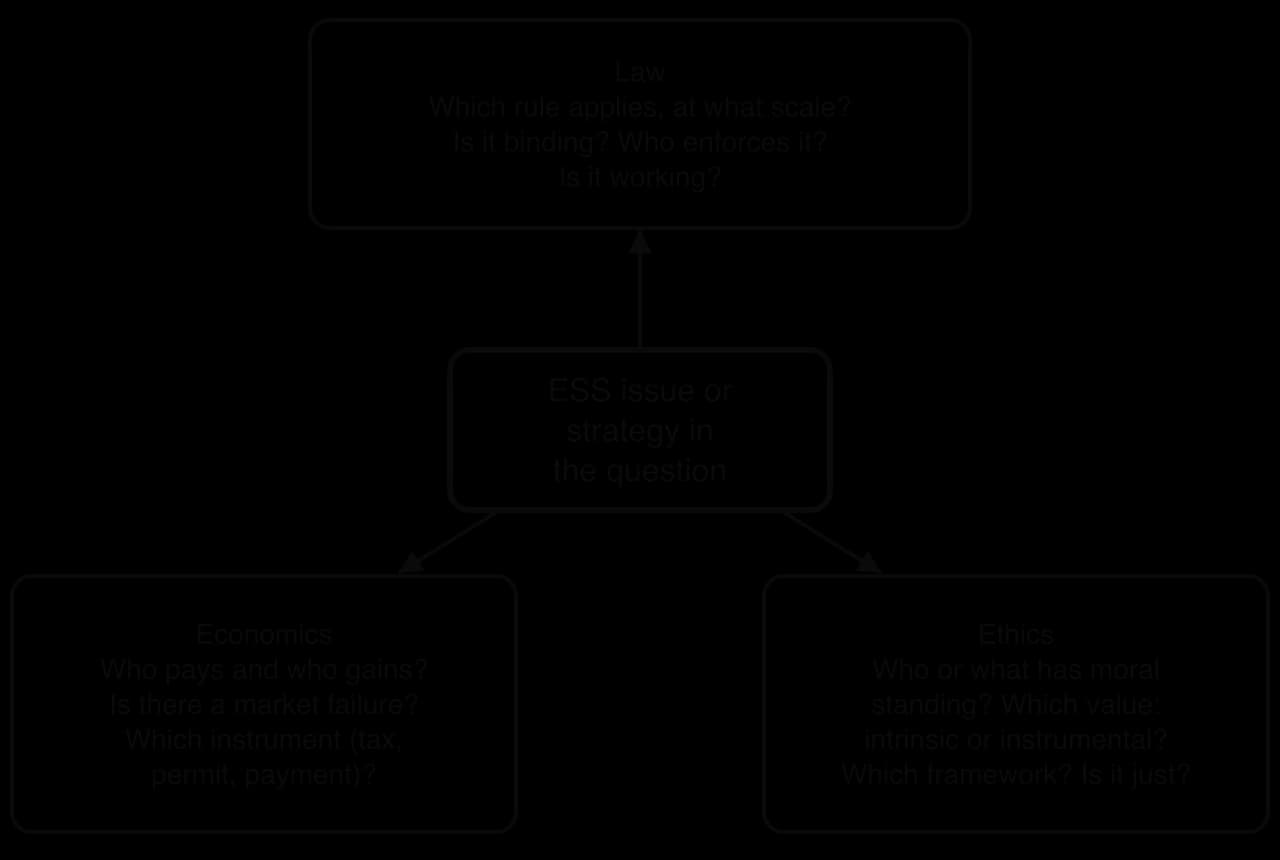
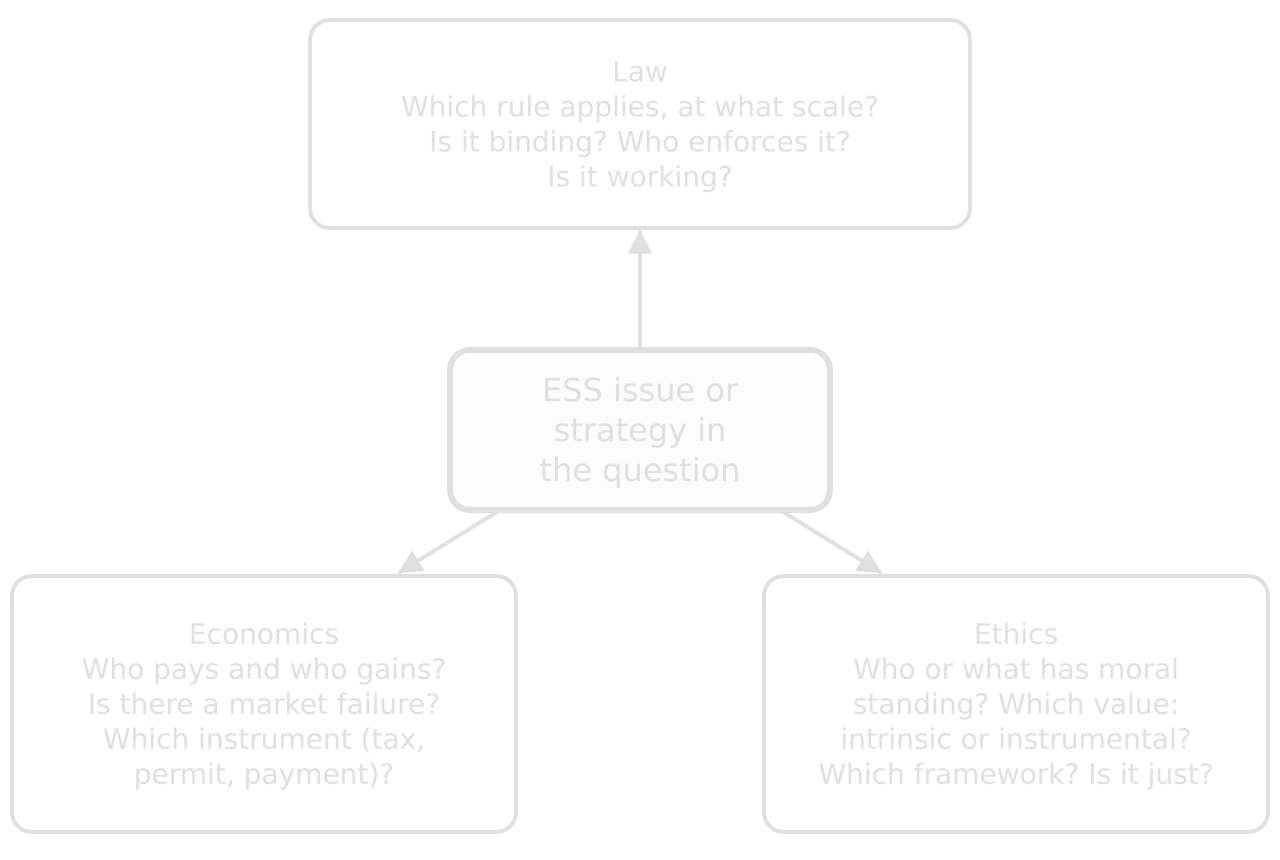
The quickest way to find a lens in a question is to ask the three questions in the figure while planning. Most ESS issues answer at least one of them clearly. A question about overfishing raises law (who owns the fish, who sets the quota), economics (the tragedy of the commons, subsidies, the value of a standing stock) and ethics (the rights of coastal communities and future generations). A question about invasive species raises ethics most sharply: whether killing one species to protect another is justified.
A toolkit for each lens
Lenses work only when backed by specific content. The table lists the concepts that do most work in answers, and examples that can be used in a sentence or two across many questions.
Lens | Concepts that do the most work | Examples to have ready |
|---|---|---|
Law | Scale of law (local, national, international); conventions and protocols; binding versus voluntary commitments; ratification; enforcement and funding; environmental constitutionalism; legal personhood; courts; lobbying | Montreal Protocol (1987), universally ratified (198 parties); Kyoto Protocol (1997), binding targets for developed countries only; Paris Agreement (2015) and its nationally determined contributions; Ecuador’s constitution (2008) and the rights of nature; the Whanganui River as a legal person (2017); Urgenda v. the Netherlands (2019); exclusive economic zones under UNCLOS |
Economics | Market failure and externalities; polluter pays; taxes, tradeable permits, quotas and fines; payments for ecosystem services; use value and non-use value; willingness to pay; tragedy of the commons and community management; decoupling; degrowth; greenwashing | EU Emissions Trading System (from 2005); Sweden’s carbon tax (from 1991); Costa Rica’s payments to landowners for forest services (from 1997); the Exxon Valdez spill (1989) and valuing lost non-use value; Swiss Alpine pastures managed by farmers since 1517, studied by Elinor Ostrom; Cape Town’s rising block tariffs |
Ethics | Intrinsic and instrumental value; moral standing (non-human beings, future generations); virtue ethics; consequentialist ethics; rights-based ethics; stewardship; the appeal to nature fallacy; environmental justice | Predator Free 2050 in New Zealand (killing introduced predators to save native birds); Minamata and Ogoniland (pollution borne by people with least power); displacement of the Twa from Volcanoes National Park; informal settlements in Cape Town during the drought |
How to add a lens without bolting it on
A lens earns credit when it does one of three jobs in the argument: it explains why something happened, it evaluates a strategy by a new criterion, or it changes the judgement. Each job follows the same three moves.
Name it precisely. A specific law, instrument, framework or concept, with a place and date where possible: “Sweden’s carbon tax, introduced in 1991”, not “taxes”.
Explain the mechanism. How it works in this case: what behaviour it changes, who it binds, whose value it recognises.
Use it to evaluate. What it shows about the strengths or limits of the strategy, and how it affects the answer to the question.
The three moves are easiest to see by comparing two versions of the same paragraph: one a strong SL candidate might write, and the same paragraph rewritten with one lens added.
The law lens: before and after
The economics lens: before and after
The ethics lens: before and after
A complete answer using all three lenses
A full 9-mark part (c) shows how the lenses can share the argument. A short plan of the same answer without the lenses is given first, for comparison.
The same answer without the lenses (an SL-style plan)
Montreal Protocol: CFCs phased out, ozone hole stopped growing, recovery projected over Antarctica by about 2066. A success.
Climate agreements: Kyoto had limited success; Paris targets are not enough; emissions are still rising. Less successful.
Reasons: ozone involved a few chemicals with substitutes; climate involves the whole energy system.
Conclusion: cooperation can solve some problems but not all.
Comment: accurate and balanced, likely band 4–6 at HL. The reasons for success and failure are stated but not analysed, and the conclusion does not say what the answer depends on.
Model answer (HL, band 7–9):
Global environmental problems such as ozone depletion and climate change affect a global commons that no single country owns, so no country can solve them alone and each has a reason to let others bear the cost. International cooperation, through binding agreements and the institutions they create, is the main response. How far it succeeds depends on whether the agreement is legally strong, whether it makes economic sense for the parties, and whether it is seen as fair.
The Montreal Protocol (1987) shows cooperation at its most effective. Legally, it is a binding protocol ratified by all 198 parties, with timetables for phasing out each ozone-depleting substance and the power to restrict trade with non-parties, and it has been strengthened by amendments such as Kigali (2016), which added HFCs. Economically, the costs of compliance were low because substitutes for CFCs were available, and a fund paid the extra costs of lower-income countries, so joining was in every country’s interest. Production of ozone-depleting substances has fallen by about 99%, and the Antarctic ozone hole has stopped growing.
Climate change has proved much harder, and the lenses help explain why. The Kyoto Protocol (1997) set binding targets, but only for developed countries, and the United States never ratified it. The Paris Agreement (2015) gained near-universal participation by letting each country set its own nationally determined contribution, but achieving these targets is not legally required, and the United States has left the agreement twice. Economically, greenhouse gases are a negative externality of the whole energy system, so cutting them is costly in the short term and every country gains from others’ cuts without making its own. Where emissions are priced, cooperation works better: emissions in the sectors covered by the EU Emissions Trading System fell by about 47% between 2005 and 2023.
The ethics of climate change are a further obstacle. The principle of common but differentiated responsibilities recognises that high-income countries emitted most of the historical carbon dioxide, while many lower-income countries face the worst impacts with the least capacity to adapt. Disagreement over who should cut first, and who should pay for adaptation, has slowed every negotiation.
Courts have begun to act where negotiations are slow: in Urgenda v. the Netherlands (2019), the Dutch Supreme Court required the government to cut emissions by 25% below 1990 levels by 2020, treating protection from dangerous climate change as a human-rights duty of the state. The moral standing of future generations, who will bear most of the impacts of today’s emissions, strengthens the case for acting now even where it is costly.
International cooperation can therefore solve global environmental problems to a large extent when the problem is narrow, substitutes are cheap and the costs are shared fairly, as with ozone. It is far less effective when, as with climate change, the problem lies at the heart of the economy and the question of fairness is unresolved; in those cases cooperation sets the direction but depends on national laws, carbon pricing and courts to deliver it. A limitation of this judgement is that the ozone layer will not have recovered for decades, so even the clearest success is still being tested.
Commentary: how the lenses lift the answer
Lens | Where it does work | Effect on the markband |
|---|---|---|
Law | Binding protocol versus nationally determined contributions; ratification; Kigali; Urgenda | Precise, accurate lens content used to explain the difference in success |
Economics | Low cost of substitutes; a fund for lower-income countries; climate as an externality; free-riding; carbon pricing evidence | Explains why parties joined or held back; data from the EU ETS as evidence |
Ethics | Common but differentiated responsibilities; historical responsibility; future generations | Adds a third reason for slow progress and supports the conditional conclusion |
The answer still rests on ESS knowledge (the ozone hole, greenhouse gases, the commons). The lenses do not replace that knowledge; they explain it, which is what moves the answer into the top band.
Lens questions in Section A and Paper 1
Short questions on lens content are point-marked like any other Section A item. They reward precise definitions and a clear mechanism.
Questions on economic instruments usually want the mechanism, not just the name.
In Paper 1, lens points usually answer “suggest” or “evaluate” items about the unseen place.
Which lens fits which topic
Every topic of the course can take all three lenses, but some fit particular topics especially well. The table suggests the strongest lens point for each topic, as a starting point for the lens grid.
Topic | A strong lens point |
|---|---|
Foundation | Ethics: environmental value systems map onto ethical frameworks (ecocentrism and intrinsic value; anthropocentrism and instrumental value). Economics: green GDP, the circular economy and doughnut economics as applications of ecological economics. |
Ecology | Economics: the value of ecosystem services that do not appear in markets, such as pollination and nutrient cycling. Law: national bans and the Stockholm Convention’s restrictions on persistent pollutants such as DDT, which biomagnify along food chains. |
Biodiversity and conservation | Law: CITES controls international trade in endangered species; the Kunming–Montreal framework (2022) sets the 30% by 2030 target. Ethics: whether killing introduced predators to save native species is justified. |
Water | Law: exclusive economic zones and transboundary water agreements. Economics: water pricing and rising block tariffs. Ethics: access to safe water as a right, and who bears the burden of restrictions. |
Land | Economics: guaranteed prices and subsidies that lock farmers into water-hungry crops, as with rice and wheat in Punjab. Ethics: food justice and the rights of smallholders. |
Atmosphere and climate change | Law: Montreal compared with Kyoto and Paris. Economics: carbon taxes and emissions trading. Ethics: climate justice and common but differentiated responsibilities. |
Natural resources | Law: environmental impact assessment before development. Economics: polluter pays and product stewardship for waste. Ethics: intergenerational equity when non-renewable resources are used up. |
Human populations and urban systems | Ethics: a rights-based critique of coercive population policies. Law: air-quality standards and low-emission zones. Economics: charges that make drivers pay for congestion and pollution. |
Common mistakes with the lenses
Mistake | Why it costs marks | Better |
|---|---|---|
Listing all three lenses in one sentence | Names without content | Develop one or two lenses in full paragraphs |
Naming a law without saying what it does | Knowledge not linked to the question | “The Kigali Amendment (2016) added HFCs to the Montreal Protocol, so…” |
Inaccurate treaty facts | Loses precision; can undermine the argument | Learn a few agreements well: date, who is bound, what they require |
Economics as “cost” only | SL-level evaluation | Externality, market failure, instrument, who pays |
Ethics as personal opinion | Unsupported judgement | Framework + reason + who or what has moral standing |
A lens that does not fit the question | Drifts from the question | Use the lens that explains the issue best; leave the others |
Carry on with ESS in Augment
With a free account, Augment remembers where you stopped in the notes and which questions you have marked.