5.3 Poetry
How to read a poem closely: the line and the line break, the stanza, the speaker and the person addressed, sound, image and the turn, set forms as choices, the prose poem and poetry in translation.
- IB English A: Language and Literature
- Part of 5 Literary forms
- SL and HL
Notes on 5.3 Poetry
A poem is language arranged in lines, and the line is what first separates poetry from every other form. Because the poet decides where each line ends, every word in a poem sits in a position that was chosen, and a short poem can hold as much as a chapter of prose. Claude McKay’s “The Tropics in New York”, first published in 1920 and collected in Harlem Shadows (1922), takes twelve lines to travel from a shop window in New York to a Jamaican speaker’s tears.
What a poem can do
The first thing a poem can do is make the line a unit of meaning. Each of McKay’s first three lines holds one portion of a list, from fruit “ripe and green” (line 1) to “Cocoa in pods and alligator pears” (line 2). The fourth gives a judgment of all of it, “Fit for the highest prize at parish fairs” (line 4). A prose writer could list the same fruit in one sentence, but the sentence would hurry past them. Set out in lines, each item gets its own moment and its own weight, and the abundance of a market at home is built up before the poem says where the fruit is.
The second power is compression. The poem has 85 words, and in them it holds a migration, a homeland, a religion of landscape and a grief. Line 4 alone carries a whole rural world: “parish fairs” brings in the island’s farming year and the pride of its prize tables. A novel would need a chapter to build that world. The poem gives one line and trusts the words to bring the rest with them.
The third power is sound used as part of the sense. McKay’s poem rhymes in alternate lines and keeps a steady beat, so the fruit of stanza 1 is set out in an orderly, almost ceremonial music. When the last stanza breaks down into weeping, the same music continues: “I turned aside and bowed my head and wept” (line 12). The steadiness of the line holds the grief in check, which makes it more moving than an outburst would be. The chapter on sound and rhythm teaches how rhyme and meter are heard.
The fourth power is a voice. Every poem has a speaker, and many speak to someone. McKay’s speaker stays hidden for eight lines and appears only in line 9, “My eyes grew dim”, when the sight of the fruit has become too much. The poem addresses no one. It is a private moment that the reader is allowed to witness. A short poem of this kind, one speaker voicing one moment of thought or feeling, is a lyric poem, the commonest kind of poem written today.
The short film from TED-Ed reaches the same answers by another route, and adds the borders where poetry meets prose.
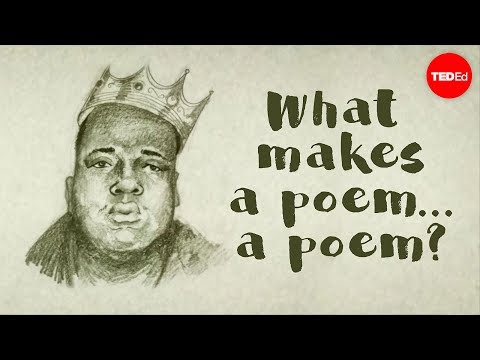 YouTube
The line and the line break
A poem is organized twice over. Its sentences follow the grammar every reader knows, and its lines follow a second order that the poet imposes. The line break is the point where these two orders meet, and its effect depends on where it falls in the sentence. In McKay’s poem the lines and the phrases mostly coincide. Most lines end at a comma, a semicolon or a full stop, so each is a complete unit of sense: one group of fruit (“Cocoa in pods and alligator pears”, line 2), one memory, one act of the body.
That agreement between line and phrase gives McKay’s poem its composure. The chapter on sound and rhythm reads its pauses closely, including the few places where a phrase runs over a line end, such as the enjambment of lines 5–6. Agreement also sets up a norm, so that a line which breaks it is felt at once. Charlotte Mew’s “The Farmer’s Bride” (1916) keeps its lines short and even until the moment its speaker’s wife runs away:
Lying awake with her wide brown stare.
So over seven-acre field and up-along across the down
We chased her, flying like a hareCharlotte Mew, “The Farmer’s Bride”, lines 13–15
Line 14 is nearly twice as long as the lines around it, and in the 1921 printing it pushes out past the left margin that every other line keeps. Its length is the length of the chase: field, slope and open down are crossed in one breathless run before the men catch sight of her. The short line that follows, “We chased her, flying like a hare”, snaps back to the poem’s usual measure. A line’s length is part of what it says, and a single line that will not fit the pattern can carry a whole event.
Breaks that hold a word in place
“Temperament”, the poem of a piano tuner’s daughter in Winnipeg, is written in free verse, verse with no regular meter or rhyme, so its line breaks are not set by a pattern. Each one is a decision, and several fall inside a phrase. The first stanza ends its third line on the speaker’s father and makes him wait for his verb:
a few cents at a time, and my father
drove around the city putting them back.“Temperament”, lines 3–4
The break after father gives him a line ending to himself, the strongest position in a line, before he does anything. When the verb arrives it is ordinary, drove, and the rest of line 4 is his whole working life: driving, and putting pianos back in tune. The break turns a sentence about a job into a portrait of a man who is introduced first and explained second.
A line break can slow a sentence down to the speed of what it describes. In the second stanza the father “leaned into the strings and listened for the beat” (line 8), and the line ends on beat before saying what the beat is. For a moment the word stands alone, with its everyday senses of a heartbeat or a blow. The next line narrows it to music, “that two strings make when they nearly agree” (line 9), but the break has let the other senses in first. Near the end, “Some nights” closes line 28 and “I strike the A” opens line 29. The break turns a habit into an action that the reader watches happen.
White space and indentation
Every poem is a shape on the page as well as a sound, and the white space around its lines is part of what it says. “Temperament” uses no quotation marks anywhere. When the father finally speaks about his trade, his words are set in from the margin:
He said it once, driving home in the dark:
Nothing’s in tune. Not really.
You set every fifth a hair narrow“Temperament”, lines 13–15
The indentation does the work of quotation marks and something more. Quotation marks would frame his words as a remark made on one evening. The indented lines stand apart as if they were a lesson the speaker has kept separate all her life. The white space also marks a change of voice that no reader can miss, and when the margin returns in line 18, “He said it to the windshield”, the daughter’s voice takes the poem back.
Indentation does not always carry meaning of this kind. McKay’s even-numbered lines are indented in Harlem Shadows because they rhyme with each other: the printer’s layout shows the pattern of rhyme, as many books of the period did. The difference is a matter of convention against choice. McKay’s indentation is the house style of rhymed verse in 1922; the indentation of “Temperament” happens once, for one voice, and could only belong to this poem.
Are the lines of free verse arbitrary?
Because free verse has no fixed meter, critics have asked whether its line breaks are anything more than prose cut into pieces. Robert Frost is reported to have said, in several versions during the 1930s, that writing free verse was like playing tennis with the net down. The Imagist poets had argued the opposite in the magazine Poetry (March 1913): a line should follow the shape of a thought or a breath, not the beat of a metronome. The two positions can be tested on a poem. If a break can be moved without changing anything, Frost’s charge holds for that poem. In “Temperament” it does not: moving father to the start of line 4, or beat to the start of line 9, removes the suspense the analysis found.
The stanza
Lines gather into stanzas, groups set apart by a space, and the stanza works in a poem much as the paragraph works in prose. Each one usually holds a single step of thought, a scene or a stage of feeling, and the gap after it asks the reader to stop and connect. McKay’s poem is built from three quatrains, stanzas of four lines, and each takes one step: the fruit in stanza 1, the remembered island in stanza 2, the speaker’s body in stanza 3.
The most interesting thing about those stanzas is where the first gap falls. It does not fall at the end of a sentence. Stanza 1 ends with a comma, and the sentence runs straight across the gap:
Fit for the highest prize at parish fairs,
Set in the window, bringing memoriesClaude McKay, “The Tropics in New York”, lines 4–5
On one side of the white space the fruit is at a parish fair in Jamaica, winning prizes. On the other side it is “Set in the window” of a shop in New York. The stanza break falls exactly between the two places, so that a reader crosses an ocean in the time it takes the eye to drop a line. The second gap is different. Line 8 ends with a full stop, and stanza 3 opens on a new sentence about the speaker: “My eyes grew dim” (line 9). The poem uses an open gap for the move between places and a closed one for the move from memory to grief.
A stanza can be any length. Two-line stanzas are couplets; three-line stanzas are tercets, the unit Dante used for the interlocking rhymes of the Divine Comedy; four-line stanzas are the commonest of all in English. What matters in analysis is less the name than the relation between the stanza’s length and what it holds. McKay gives each step the same four lines, so the three steps feel equal and inevitable, like three movements of one piece of music.
Stanzas that change shape
The stanzas of “Temperament” are uneven: four lines, then eight, seven, six and six. Each is a scene rather than a fixed measure: the city in October, the houses on Wellington Crescent, the drive home, the family kitchen, the speaker’s hallway now. The longest is the one in which the child sits and waits while her father listens, and its length lets time pass slowly. Stanzas that grow or shrink with what they contain are often called verse paragraphs.
A stanza built as an exchange
Some poems give the stanza a fixed inner design and repeat it throughout. Sarojini Naidu’s “In the Bazaars of Hyderabad”, from The Bird of Time (1912), builds every stanza out of questions to the people of the market and the answers they call back, which the book prints in italic:
What do you weigh, O ye vendors?
Saffron and lentil and rice.
What do you grind, O ye maidens?
Sandalwood, henna, and spice.Sarojini Naidu, “In the Bazaars of Hyderabad”, lines 7–10
The stanza becomes a walk through the market, stall by stall, with the italic lines giving each trade its own voice. The pattern also sets up an expectation, and the last stanza uses it. Its question goes to the flower-girls, and their answer moves from a bridegroom’s crowns and his bed to “Sheets of white blossoms new-gathered / To perfume the sleep of the dead” (lines 29–30). The fixed stanza carries the same lightness into its last two lines, which makes the arrival of death in a cheerful market song all the more striking.
Try it
Naidu’s stanzas alternate between two designs: in stanzas 1, 3 and 5 one question is answered by several lines, while in stanzas 2 and 4 each question gets one line of answer. What does the alternation do to the pace of the poem?
The stanzas with one answer per question move fast: three stalls are visited in six lines, so the reader hears the market’s quick calls and replies. The stanzas with several answer lines slow down to look at one trade in detail, the turbans and mirrors of the merchants or the bells and girdles of the goldsmiths. The alternation gives the poem the rhythm of a walk through a market, passing some stalls quickly and stopping at others, and it means the last stanza, a slow one, lingers on the flowers for the dead.
Who speaks, and to whom
McKay’s speaker talks to no one, but many poems are spoken to somebody. The person or thing a poem speaks to is its addressee, and the choice of addressee shapes everything from the poem’s tone to what it dares to say. Poem 27 of Rabindranath Tagore’s Gitanjali, which he made in English prose from his own Bengali songs and published in London in 1912, is a prayer at night in a storm. It speaks to more than one listener, beginning with a cry into the dark, “Light, oh where is the light?” (paragraph 1), and none of them answers.
The speaker addresses three listeners in six short paragraphs. The opening cry is spoken into the dark, and its command, “Kindle it”, has no named hearer: it could be meant for God, for the night or for the speaker. In paragraph 2 the speaker turns inward and speaks to “my heart”, with the old intimate pronouns “thy” and “thee”. Through the heart the poem reaches a third figure, the “lord” who “calls thee to the love-tryst” (paragraph 3), present only in a message that Misery delivers.
Speaking to someone or something that cannot reply is called apostrophe. Tagore’s address to his own heart is an apostrophe, and so is every prayer to an absent god. The figure changes what a poem can do with feeling. A statement such as my heart is unlit reports a condition; “is such thy fate, my heart!” (paragraph 2) pleads with it, as if the heart could still be persuaded to change. Apostrophe makes the poem an act of calling, and the silence that follows each call is part of its meaning.
An addressee who answers
Some addressees are present and able to reply, and the possibility shapes the poem. The chapter on communication reads Christina Rossetti’s “My Secret” (1862), spoken to a listener who keeps asking for a secret and never gets it. Naidu’s market song is a different case, and a useful test of the term.
Its “O ye merchants” (line 1) sounds like apostrophe, with its formal O and old pronoun ye, yet the merchants answer in the italic lines of every stanza. The test for apostrophe is whether the addressee can answer, whatever the grandeur of the address.
The dramatic monologue
Some poems give the whole voice to a character who is plainly not the poet. In a dramatic monologue that character speaks at a particular moment, usually to a listener, and gives away more than they intend. Mew’s “The Farmer’s Bride”, the title poem of her first collection, is spoken by a farmer about the young wife who is afraid of him:
Three Summers since I chose a maid,
Too young maybe—but more’s to do
At harvest-time than bide and woo.Charlotte Mew, “The Farmer’s Bride”, lines 1–3
The speaker’s own words build his portrait. His dialect, “When us was wed” (line 4) and “she runned away” (line 9), places him in a rural world far from the London poet who wrote him. He admits that the bride was “Too young maybe”, then dismisses the doubt because the harvest left no time for courting. When she runs, he reports the hunt across the fields and its end, with the door locked on her (line 19), without any sense of what it means.
The poem’s power lies in the distance between what the farmer says and what the reader understands. He describes his wife in the language of his farm, as a hare, a mouse and “a little frightened fay” (line 8), and lists her beauties: “Shy as a leveret, swift as he” (line 30). He seems to love her and to have no idea why she fears him. The line “I’ve hardly heard her speak at all” (line 29), with its stressed pronoun, admits without meaning to that her silence is a silence toward him. A reader who judges the farmer, pities him and pities her all at once is responding to what the form is built to produce. The chapter on narrative voice sets out the wider idea of the persona, of which the dramatic monologue is the purest case.
Sound and rhythm in a poem
Every English word of more than one syllable puts more weight on one syllable than on the others: merchants, bananas, remember. The heavier syllable is the stressed syllable, and in ordinary speech stresses fall wherever the words put them: in “the width of a hair” (“Temperament”, line 11) the weight falls on width and hair. A poem arranges its words so that the stresses form a pattern a listener can hear. The chapter on sound and rhythm teaches how to hear meter and rhyme in detail; a poem has to be read with them, because they are part of what it says.
Mew’s farmer tells his story in lines of four beats, most of them rhymed in pairs, the measure of a ballad sung by the fire. The end of the chase shows how much that steady beat can carry:
We caught her, fetched her home at last
And turned the key upon her, fast.Charlotte Mew, “The Farmer’s Bride”, lines 18–19
Read aloud, with the stressed syllables in bold, the lines go “We caught her, fetched her home at last / And turned the key upon her, fast.” The beat falls evenly, four times a line, and the last stress lands on fast with the rhyme on last. The sound locks the couplet shut at the moment the key locks the door. The farmer’s rhythm never falters as he tells it, and that steadiness is the poem’s most chilling effect: he finds nothing in the story worth changing his voice for.
Meter here becomes part of a character. In McKay’s poem, as the chapter on sound and rhythm shows, five regular beats hold a grief in check; in Mew’s, a steady four exposes a speaker who cannot hear what he is saying. The same regularity does opposite work in the two poems.
Rhyme inside the line
Rhyme usually falls at the ends of lines, where it links one line to another. Internal rhyme brings it inside the line, and the effect is denser and faster. Rossetti’s speaker describes the weather that keeps her wrapped up, and her description crowds with chiming words:
Come bounding and surrounding me,
Come buffeting, astounding me,
Nipping and clipping through my wraps and all.Christina Rossetti, “My Secret”, lines 15–17
The rhymes of “bounding and surrounding me”, “buffeting, astounding me” and “Nipping and clipping” come so close together that the lines seem blown about by their own sound, as the wind is everywhere at once. A speaker who can rhyme this freely about the cold is enjoying her excuse, which makes it harder to believe that the weather is the real reason she will not tell.
The refrain
A refrain is a line or phrase that a poem repeats at intervals, as songs repeat a chorus. Its words stay the same, but each return is heard against everything that has happened since. Tagore’s prose poem has no lines, but it has a refrain. The cry of its first paragraph comes back at the start of its last, with one change of punctuation:
Light, oh where is the light! Kindle it with the burning fire of desire!
Rabindranath Tagore, Gitanjali 27, paragraph 6
In paragraph 1 the first sentence, “Light, oh where is the light?”, ends with a question mark; in paragraph 6 it ends with an exclamation mark. Between the two the speaker has heard the lord’s call, seen lightning make the dark deeper and felt the heart grope for a path. The question has been answered by nothing, and so it becomes a cry. A refrain can measure change in this way precisely because it does not change, and the single altered mark is the measure.
Images and conceits
Poems think in pictures more than any other form, because compression leaves no room to explain. McKay’s speaker never says that he is homesick. The imagery says it for him: fruit in a window, hills that are “nun-like” under skies “In benediction” (line 8), and then eyes that grow dim. The chapter on imagery reads those pictures sense by sense; for the form, what matters is that a poem’s images often carry the statement a prose writer would make directly.
The conceit
Some poems take one comparison and develop it far beyond what seems possible. An elaborate, surprising comparison between two unlike things, worked out at length, is a conceit. The best-known conceits in English belong to John Donne, whose poems were first printed in 1633, two years after his death. In “A Valediction Forbidding Mourning” a man about to travel tells the woman he loves not to grieve, and finally compares their two souls to the two legs of a drawing compass:
If they be two, they are two so
As stiff twin compasses are two;
Thy soul, the fix’d foot, makes no show
To move, but doth, if th’ other do.John Donne, “A Valediction Forbidding Mourning”, lines 25–28
Nothing seems less like love than a piece of drawing equipment, which is exactly the point. The compass is a single instrument with two legs joined at the top, so it answers the problem the poem has set: how two souls can be apart and still be one. The woman is “the fix’d foot”, which stays at the center but turns as the other leg travels, so even her stillness is a kind of movement with him. The next stanza adds a further detail: as the traveling leg moves out, the fixed one “leans, and hearkens after it” (line 31), and “grows erect, as that comes home” (line 32).
A conceit asks for admiration of its ingenuity, and that admiration carries a risk. When a comparison seems clever rather than true, attention moves from the feeling to the poet. Donne’s conceit survives the risk because each new detail of the compass says something new about the lovers, until the last line closes the circle the instrument draws. Samuel Johnson, in his life of the poet Abraham Cowley (1779), complained that poets of Donne’s kind forced the most unlike ideas together by violence; T. S. Eliot, in his essay “The Metaphysical Poets” (1921), praised the same poets for fusing thought and feeling. The test a reader can apply is whether the strain of the comparison produces a thought that a plainer image could not.
Try it
The last stanza of Donne’s poem reads: “Such wilt thou be to me, who must, / Like th’ other foot, obliquely run; / Thy firmness makes my circle just, / And makes me end where I begun” (lines 33–36). How does the conceit of the compass answer the woman’s fear that he will not return?
The traveling leg of a compass can only draw a circle if the fixed leg holds steady, and a circle always ends where it began. The speaker says that her “firmness” is what makes his journey a true circle, so his return is built into the shape of the instrument: he cannot draw a circle and fail to come back to the start. The conceit turns her waiting into an active part of the journey and makes his return a matter of geometry rather than of a promise.
Seamus Heaney’s early poem “Scaffolding” (1966) builds a love poem on a conceit drawn from building work: the scaffolding masons put up and test before they build, and can take down once the wall stands. In the recording from his publisher, Heaney reads it in his own voice.
 YouTube
The turn
Many poems change direction once, decisively, and the point where they do is often the key to the whole. In “Temperament” it comes in the middle of the poem. Two stanzas have shown the father at work, seen from the bottom stair, and then line 13 announces that he once said something, on the drive home. The four indented lines that follow give his only teaching:
Nothing’s in tune. Not really.
You set every fifth a hair narrow
so the music can go into any key it wants.
Tune one key pure and you can’t play the rest.“Temperament”, lines 14–17
Up to this point the poem has been about a trade. From here it is about something larger: a man explaining that perfection in one place spoils everything else, and that a working life, or a family, needs every interval slightly out. The turn is then completed by the speaker in lines 18–19, “I was eleven / and thought he was talking about pianos”, which tells the reader that he was not. The poem turns twice, once in the father’s words and once in the daughter’s understanding of them years later.
The traditional name for this change of direction in a poem is the volta, Italian for “turn”. The chapter on structure describes the structural shift in any text, from a change of tense to a new speaker. A volta is the poem’s main shift, the hinge on which its argument or feeling swings. In McKay’s poem there are two candidates. Line 5, “Set in the window”, moves the fruit from Jamaica to New York, but the strongest turn is at line 9, where the speaker’s “eyes grew dim” and the poem moves from things to the self.
The turn as a rule of form
In the sonnet, a poem of fourteen lines, the turn is built into the form. The diagram sets out its two main shapes. The Petrarchan sonnet, named after the fourteenth-century Italian poet Petrarch, divides into eight lines and six, and the volta falls between them: the first part sets out a situation and the second answers it. The Shakespearean sonnet, the shape Shakespeare used in the sonnets printed in 1609, has three quatrains and a closing couplet, two rhyming lines that often turn or clinch the argument at the last moment.


Claude McKay wrote “If We Must Die” in 1919, a summer of racist attacks on Black communities in American cities, and published it in the magazine The Liberator that July. It takes the Shakespearean rhyme scheme, but it turns at line 9 in the Petrarchan way. The first eight lines are conditional, built on the repeated “If we must die” (lines 1 and 5) and on a choice between two ways of dying. Line 9 drops the condition and speaks to the people beside the speaker:
O kinsmen! we must meet the common foe!
Though far outnumbered let us show us brave,
And for their thousand blows deal one death-blow!Claude McKay, “If We Must Die”, lines 9–11
The turn moves from thinking about death to deciding how to meet it, from the conditional if to the plain obligation of must. The couplet then gives the whole poem its last image: “Like men we’ll face the murderous, cowardly pack, / Pressed to the wall, dying, but fighting back!” (lines 13–14). The hunted “hogs” of line 1 have become men who fight. By choosing the sonnet, the form of love poetry and of Shakespeare, McKay also claimed the most respected shape in English verse for a call to resistance.
Set forms as choices
A set form is a shape that poets have used so often that it carries expectations with it: a length, a pattern of rhyme or meter, a kind of subject. Choosing one is a statement before the first word is read, and a poem can fulfill the expectations, stretch them or turn them against themselves.
The elegy
An elegy is a poem of mourning, traditionally moving from grief toward some consolation: the dead live on in memory, in nature or in heaven. Wilfred Owen’s “Futility”, written in 1918 by an English officer who had fought on the Western Front, and collected in his Poems (1920) after his death in the last week of the war, begins as an elegy for one soldier:
Move him into the sun—
Gently its touch awoke him once,
At home, whispering of fields unsown.Wilfred Owen, “Futility”, lines 1–3
The first line is an order to people around the body, an addressee the poem never names. It sounds like practical care, as if warmth might still revive him. The stanza holds on to that hope with gentle details: the sun “whispering of fields unsown” (line 3) to a man who once worked the land at home. The second stanza widens the view to the sun that “Woke, once, the clays of a cold star” (line 9), the making of life on Earth. Then the poem ends on questions instead of comfort: “Was it for this the clay grew tall?” (line 12).
“Futility” keeps the elegy’s form of address and its rise from one death to a larger meaning, but it refuses the consolation the form promises. Its last line, “To break earth’s sleep at all?” (line 14), asks why life was ever woken from the earth. The poem’s rhymes are also slightly off, once against France and seeds against sides, a feature the chapter on sound and rhythm calls half-rhyme. The chimes never quite resolve, just as the grief never resolves. The elegy is fulfilled in its occasion and overturned in its ending, and that tension is what the title names.
The ode
An ode addresses and praises its subject at length, in an elevated style, as John Keats’s odes of 1819 do for a nightingale and for autumn. Toru Dutt’s “Our Casuarina Tree”, published in Ancient Ballads and Legends of Hindustan (1882) after her death at 21, is an ode to a tree in her family’s garden in Bengal. Its last stanza names its purpose: “Therefore I fain would consecrate a lay / Unto thy honour, Tree” (lines 45–46). A young Bengali poet who addressed an Indian tree in the grandest English form was claiming that form for her own home.
Blank verse and free verse
Two forms are defined by what they leave out. Blank verse is unrhymed iambic pentameter: it keeps the regular beat of McKay’s lines and drops the rhyme. Without rhyme the line can run on without a chime to stop it, so blank verse suits long works and the rhythms of serious speech. It is the verse of Shakespeare’s plays, of John Milton’s Paradise Lost (1667) and of many long poems since. Free verse drops both meter and rhyme, as “Temperament” does, and puts the weight on the line break and the shape of the phrase. Walt Whitman’s Leaves of Grass (1855) made it a major form in English; in the twentieth century it became the commonest form of all.
The table gathers the main set forms and what choosing each tends to signal. The signals are expectations, not rules.
Form | Its shape | What choosing it tends to signal | An example |
|---|---|---|---|
Sonnet | Fourteen lines, usually rhymed, with a turn | An argument or feeling compressed and resolved; love, devotion, a public cause | McKay, “If We Must Die” (1919) |
Elegy | No fixed shape; a poem of mourning | Grief worked through toward consolation, or refused it | Owen, “Futility” (1918) |
Ode | Long stanzas of address | Praise and meditation; a subject raised to importance | Dutt, “Our Casuarina Tree” (1882) |
Ballad | Quatrains, often with a refrain | A story told simply, in the voice of song and community | The traditional ballads of Britain and North America |
Blank verse | Unrhymed lines of five regular beats | Serious speech; drama and long narrative | Shakespeare’s plays; Milton, Paradise Lost (1667) |
Free verse | No fixed meter or rhyme | The rhythms of speech and thought; the line break as the main tool | “Temperament” |
The lyric across time
The lyric poem is older than any of these forms. Its name comes from the lyre, the stringed instrument to which the poets of ancient Greece sang. Sappho, who lived on the island of Lesbos around 600 BCE, wrote lyrics of love and longing that survive mostly in fragments. Anne Carson’s translation, If Not, Winter (2002), prints square brackets wherever the papyrus is torn, so that a modern reader sees the gaps as well as the words. The lyric’s basic situation, one voice caught in one moment of feeling, has hardly changed since, and McKay’s speaker at the shop window belongs to that tradition.
The prose poem and poetry in translation
Tagore’s Gitanjali 27 has no line breaks at all, yet it reads as a poem. A prose poem keeps poetry’s compression, imagery and patterns of sound while giving up the line. Its unit is the short paragraph, and Tagore’s paragraphs are built like the verses of a psalm, each a single breath of prayer, such as “Misery knocks at thy door” (paragraph 3). Repetition does the work that the line break does in verse:
The sky is overcast with clouds and the rain is ceaseless. I know not what this is that stirs in me,—I know not its meaning.
Rabindranath Tagore, Gitanjali 27, paragraph 4
The repeated “I know not” sets up a rhythm that a reader hears without any lines to mark it. The first sentence reports the weather; the second turns inward, and the dash in the middle of it is a pause the voice has to take. Without line breaks, the prayer runs on as one continuous act of speaking, which suits a speaker groping forward in the dark. In paragraph 5, “A moment’s flash of lightning drags down a deeper gloom on my sight” is a single sweep of sentence, and the light that should help makes the dark worse before the sentence can stop.
Something is lost, too. A prose poem cannot hold a word at the end of a line, as “Temperament” holds father or beat, so it makes emphasis by punctuation. Tagore’s dashes do the work of a line break: in “There is the lamp but never a flicker of a flame,—is such thy fate, my heart!” (paragraph 2) the comma and dash together force a pause before the speaker turns from the lamp to the heart. The exclamation that follows, “Ah, death were better by far for thee!”, gives the paragraph the stress that a line ending would give a verse.
A translation that changes the form
Tagore’s English Gitanjali is a self-translation, made from songs he had written in Bengali verse. The chapter on creativity shows what he built the English from: prose paragraphs in place of rhyme and meter, and the biblical thy and thee of English prayer. The book made Tagore famous in Europe, and in 1913, the year after it appeared, he received the Nobel Prize in Literature, the first given to a writer from beyond Europe.
Translators of poetry always have to decide what to keep, because sense, form and sound cannot all cross into another language at once. In 1898 the scholar Herbert A. Giles published a version of a poem by the Tang dynasty poet Du Fu, written around 759, about an officer who comes to press men into the army. Giles made it into an English ballad, with rhymed quatrains and old-fashioned diction:
There, where at eve I sought a bed,
A pressgang came, recruits to hunt;
Over the wall the goodman sped,
And left his wife to bear the brunt.Du Fu, “The Pressgang”, translated by Herbert A. Giles (1898), lines 1–4
Where Tagore dropped the verse of his songs, Giles added a verse form that the Chinese poem does not have. “Pressgang”, “goodman” and later “the cruel serjeant’s rage” (line 5) come from English history, so the poem sounds like a ballad from the age of the British navy rather than a poem from eighth-century China. The rhyme also pulls the story into tidy pairs. Both translations make choices that a reader in English cannot see without being told. For a single poem the habit is to ask which features belong to the poet and which to the translator.
Reading an unseen poem
A poem met for the first time rewards a particular order of questions: what happens, who speaks and where, how the poem moves, and what it is finally saying. The reading that follows takes McKay’s “The Tropics in New York” as if it were unseen.
First impressions
The title sets two places against each other before the poem begins. The Tropics and New York do not belong together, and the preposition in suggests that one has somehow been brought inside the other. A first reading shows how: through fruit. Twelve lines move from a list of produce to a man weeping. Why should a shop window full of bananas and mangoes bring someone to tears?
A second reading starts with the voice. For eight lines there is no speaker, only things, and the reader does not know where the fruit is until line 5. When the speaker finally appears, he speaks in the past tense of one moment: “My eyes grew dim” (line 9). The poem is a memory of a memory, a man recalling the moment when the sight of fruit made him remember home.
Following the movement
The three quatrains give the poem a clear plan, which the diagram sets out. The first stanza is pure display, and its last line adds a judgment that only someone from the island could make: this fruit is “Fit for the highest prize at parish fairs” (line 4). The speaker sees produce with a farmer’s eye and a villager’s pride. Then the sentence crosses the stanza break, and the fruit turns out to be “Set in the window” (line 5) of a city shop. The same bananas that would win prizes at home are goods behind glass, waiting to be bought.


The second stanza moves from the window into memory, and its images are of a different kind. In place of things that can be priced, it offers what no shop can sell: “low-singing rills” (line 6), “dewy dawns” and skies “In benediction over nun-like hills” (lines 7–8). The vocabulary of religion makes the island a sacred place. The full stop at the end of line 8 is the poem’s first, and after it the speaker’s body takes over in a run of verbs: eyes that “grew dim”, a longing that “swept”, a head that is bowed.
From observations to an argument
With the movement mapped, the details start to connect. The speaker is “hungry for the old, familiar ways” (line 11), and the word hungry is the hinge of the whole poem. He is standing in front of a window full of food, and the one hunger it cannot satisfy is the one it has woken. The fruit can be bought, but the parish fair, the streams and the dawns cannot. The window that shows him home is also the glass that separates him from it.
A reading now has enough to argue. McKay’s poem turns a shop display into an image of exile: the fruit of Jamaica reaches New York as goods for sale, while the life it grew from stays out of reach, and the speaker’s grief is the recognition of that difference. The poem’s form supports the argument at every level. Its eight verbless lines keep the speaker looking, its stanza break carries the fruit across an ocean, and its last line reduces grief to three plain actions. The speaker turns, bows and weeps, and then the poem stops.
An interpretation that skips the middle steps states a theme (the poem is about homesickness) without showing how the poem makes it, while one built through them can point to the stanza break, the window and the word hungry.
And, hungry for the old, familiar ways,
I turned aside and bowed my head and wept.Claude McKay, “The Tropics in New York”, lines 11–12
The last two lines test the reading. If the poem is about the distance between seeing and having, its ending should keep that distance, and it does. The speaker “turned aside”: he turns away from the window, the one thing that connects him with home, because looking has become unbearable. Nothing in the last line brings him nearer to the island.
Where poetry’s edges blur
Poetry shares borders with every other form, and some of the most interesting writing lives on them. The prose poem sits on the border with prose, as Tagore’s Gitanjali shows. Verse drama sits on the border with the stage, from Shakespeare’s blank verse to modern plays written in verse, and the chapter on drama reads it as theater. Two other borders matter to readers today: the verse novel and poetry made for performance.
The verse novel
A verse novel tells a long story, with characters and a plot, in lines and stanzas. Vikram Seth’s The Golden Gate (1986), set among young professionals in San Francisco, is written entirely in tightly rhymed fourteen-line stanzas modeled on Pushkin’s Eugene Onegin. More recently the verse novel has become a major form of fiction for young adults. Elizabeth Acevedo’s The Poet X (2018) follows a teenager in Harlem who finds her voice by writing and performing poems. Its short poems work as chapters, and the white space between them lets time pass and thoughts go unsaid. A verse novel is read with both sets of tools: who narrates and how time moves, and where the lines break and what each stanza holds.
Poetry for the voice
Poetry began as song and performance, and much of it still is. Langston Hughes’s “The Weary Blues”, published in 1925 and the title poem of his first book (1926), describes a blues musician in Harlem playing late at night, and sets the words of his song into the poem. The song’s lines follow the blues pattern of a statement repeated and then answered, and the poem around them keeps returning to the cry “O Blues!” like a listener calling back:
I got the Weary Blues
And I can’t be satisfied.
Got the Weary Blues
And can’t be satisfied—Langston Hughes, “The Weary Blues” (1926)
Hughes brought a Black musical form into the printed poem, and with it the voice of a community that the poetry of his time seldom heard.
Spoken word poetry, performed at open mics and poetry slams since the 1980s, carries that tradition into the present. A spoken word poem is written for one voice in one room, and much of its meaning lives in timing, emphasis and the audience’s response. On the page it can look plainer than a printed lyric. Read aloud, its repetitions and refrains do the work of meter, as the refrain did in Tagore’s prayer. Many printed poems keep the marks of the voice they were made for, and reading them aloud recovers some of it.
Writing about poetry
A paragraph about a poem makes a claim about meaning and proves it through form: the line, the stanza, the voice, the sound or the image, quoted exactly and explained. The paragraph that follows, as a strong student might write it, is about Tagore’s prose poem.
Tagore’s Gitanjali 27 moves its prayer from the dark outside the speaker to the life within, and its changes of address trace that movement.note 1 The first cry, “Light, oh where is the light?” (paragraph 1), is spoken to no one in particular, as if light could be fetched from somewhere else.note 2 By paragraph 2 the speaker has turned to “my heart”, and the intimate “thy” brings the plea indoors, beside a lamp with “never a flicker of a flame”. Even the lord is reached only through the heart, since Misery’s message is that he “calls thee to the love-tryst” (paragraph 3).note 3 The last sentence completes the turn inward: the light the opening asked for must be kindled “with thy life” (paragraph 6), so the prayer is answered by the one who prays.note 4
Claim first. The topic sentence names an interpretation and the feature that will prove it, so the paragraph has an argument before it has a quotation.
Evidence in order. Short quotations, cited by paragraph, follow the poem’s own sequence from the cry into the dark to the address to the heart.
Address as evidence. The student tracks who is spoken to, the apostrophe to the heart and the absent lord, and treats each change as a step in the argument.
An ending that interprets. The last sentence quotes the poem’s final words and says what they do to the opening question, instead of summarizing the paragraph.
The paragraph never names a feature without saying what it does, and its quotations sit inside its own sentences. The same habits separate a weak and a strong sentence about a single line break. The two sentences that follow are about lines 8–9 of “Temperament”, where the father “listened for the beat / that two strings make when they nearly agree”.
Weak: The poet uses enjambment between lines 8 and 9, which creates flow and makes the reader want to read on.note 1
Strong: Ending line 8 on “beat” lets the word sound first like a heartbeat or a blow, so the father’s listening seems bodily before line 9 narrows it to two strings that “nearly agree”.note 2
A label and a stock effect. The term is correct, but “creates flow” and “makes the reader want to read on” could be said of any run-on line in any poem.
The word, the break, the meaning. In 33 words the sentence names the word that ends the line, the senses the break lets in, and what the next line does to them.
The strong sentence earns its point from the exact word on which the line ends, and it does not need the term enjambment at all. A term helps only when it is followed by what the feature does in these lines.
Applying it in Paper 2
A collection of poems by one poet can be one of the literary works studied, and Paper 2 may then ask for it to be compared with a novel, a play or another collection. The four questions are general, and many leave room for form. A question about voice, for example, opens the dramatic monologue and the lyric speaker; a question about endings opens the volta and the closing couplet.
A thesis comparing a poetry collection with a play needs to show how each form does the work. A model, on McKay’s Harlem Shadows and Glaspell’s Trifles: Both works let objects carry feelings their speakers cannot state, but McKay’s lyric speaker grieves alone over fruit in a window, while Glaspell’s women read a kitchen together, so that the poem’s objects open a private memory and the play’s become shared evidence. Each later paragraph then sets a quoted line of a poem against a moment of the play, with the form named as the reason for the difference.
The commonest way to lose marks with poetry is to write about what the poems say and never about how they are made, which leaves the analysis criterion half answered. Another is to quote from memory inaccurately: poems are short enough that a misremembered line is noticed. A third is to discuss one poem in depth, so that the comparison rests on a single page of a whole book.
The line, the stanza and the turn lead to the question of how texts follow and break the conventions of their form, and of how structure and style affect meaning in any text.
Self-check
- To do:
I can explain what a poem can do with the line, compression, sound and a speaker, and what makes a poem a lyric.
- To do:
I can say what a line break does to the word that ends a line, and tell a meaningful layout from a printing convention.
- To do:
I can describe how a poem’s stanzas divide its thought, including a sentence that runs across a stanza break.
- To do:
I can tell the speaker, the addressee and apostrophe apart, and explain how a dramatic monologue exposes its speaker.
- To do:
I can hear the stressed syllables in a line and explain what internal rhyme and a refrain add to a poem.
- To do:
I can locate a poem’s volta and explain how the sonnet, the elegy, the ode, blank verse and free verse work as choices.
- To do:
I can explain what a prose poem gains and loses without the line, and which choices in a translated poem belong to the translator.
- To do:
I can read an unseen poem from first impressions to an argued interpretation and write a paragraph that proves it through form.
Key terms
Each is also in the Literary forms glossary for IB English A Lang & Lit, beside the other terms of its topic.
- Addressee
The person or thing a poem speaks to, named or implied by its “you”. The addressee may be the reader, a lover, a god, a silent listener in a scene or the speaker's own heart, and the choice shapes the poem's tone.
- Apostrophe
A speaker's direct address to someone absent or dead, or to a thing, place or idea that cannot answer. It turns a statement into a call and shows what the speaker wants from what they address.
- Blank verse
Unrhymed lines of iambic pentameter. It keeps a regular beat without the chime of rhyme, which makes it close to the rhythm of serious speech and suited to drama and long poems.
- Conceit
An elaborate, often surprising comparison between two things that seem to have little in common, developed at length through a poem. Its pleasure lies in how far the poet can make the unlikely likeness hold.
- Couplet
A pair of lines that belong together, usually rhymed and of the same length. A couplet can stand as a stanza of its own or close a longer poem, where it often sums up, answers or turns what came before.
- Dramatic monologue
A poem spoken entirely by one character, who is clearly not the poet, to a listener who is present but silent. The speaker reveals more about themselves than they intend, and the reader judges them from their own words.
- Elegy
A poem of mourning for a person who has died, or more broadly a reflective poem on loss. An elegy commonly moves through grief and questioning toward some kind of consolation, or deliberately refuses one.
- Free verse
Verse without a regular meter or rhyme scheme, whose lines are shaped by the rhythms of speech, by syntax and by the poet's placing of each line break. It still uses lines and stanzas, so its breaks carry the weight that meter carries elsewhere.
- Internal rhyme
Rhyme between words inside a line, or between a word inside a line and the word at its end. It speeds or binds a line and links ideas that end rhyme would keep at a distance.
- Line
The basic unit of a poem: a run of words that ends where the poet chooses to end it rather than where the page runs out. A line can hold a complete phrase or break one in two, and its length sets the pace at which the poem is read.
- Line break
The point where one line of a poem ends and the next begins. Where the break falls decides which word ends the line, what a reader expects next and how long the eye pauses before the sentence continues.
- Lyric poem
A short poem in which a single speaker expresses a thought, feeling or perception, usually in the first person and the present tense. It is the dominant kind of poem in modern writing and takes its name from songs once sung to the lyre.
- Ode
A long lyric poem that addresses and celebrates a person, an object or an idea in an elevated style. It speaks to its subject directly and usually builds its praise into a meditation on what the subject means.
- Prose poem
A poem written in sentences and paragraphs instead of lines. It keeps poetry's compression, imagery and patterns of sound and repetition while giving up the line break as a tool.
- Quatrain
A stanza or group of four lines, often rhymed in alternate lines or in pairs. It is the most common stanza in English verse and gives a thought room to be stated and developed before the stanza closes.
- Refrain
A line or group of lines repeated at intervals in a poem or song, often at the end of each stanza. Each return of the refrain is read against what has happened since its last appearance, so its meaning can change while its words stay the same.
- Sonnet
A poem of fourteen lines, traditionally in iambic pentameter and a fixed rhyme scheme, built so that its thought changes direction at a set point. The Petrarchan sonnet divides into eight lines and six; the Shakespearean into three quatrains and a closing couplet.
- Stanza
A group of lines set apart from the next group by a space, working in a poem as a paragraph works in prose. Stanzas may repeat one length and pattern or vary freely, and the gap between two stanzas often marks a step in thought, time or feeling.
- Stressed syllable
A syllable spoken with more force, length or pitch than those around it. The pattern of stressed and unstressed syllables makes the rhythm of English speech and verse.
- Volta
The turn in a poem: the point where its argument, feeling or direction changes. In a sonnet it falls at a set place, usually after the eighth line or before the final couplet, and in other poems wherever the poet places it.
Practice questions on 5.3 Poetry
Augment’s own questions, written in the style of IB exam papers. Here is how a few of them start.
Practice all 27 questions on 5.3 Poetry
Free with an account. Write your answer, open the markscheme beside it and mark yourself. Augment keeps the ones you got wrong for another go.
More in 5 Literary forms
The whole topic is on its own page.
- 5.1Prose: fiction
- 5.2Prose: non-fiction
- 5.3PoetryThis page
- 5.4Drama
Carry on with 5.3 Poetry in Augment
With a free account, Augment remembers where you stopped in the notes and which questions you have marked.