The portfolio and choosing articles
Know every rule of the IA portfolio (units, key concepts, article dates and sources, the word limit) and choose news articles that give each commentary room for a diagram, analysis and evaluation.
- IB Economics
- Internal assessment
- SL and HL
What the portfolio is
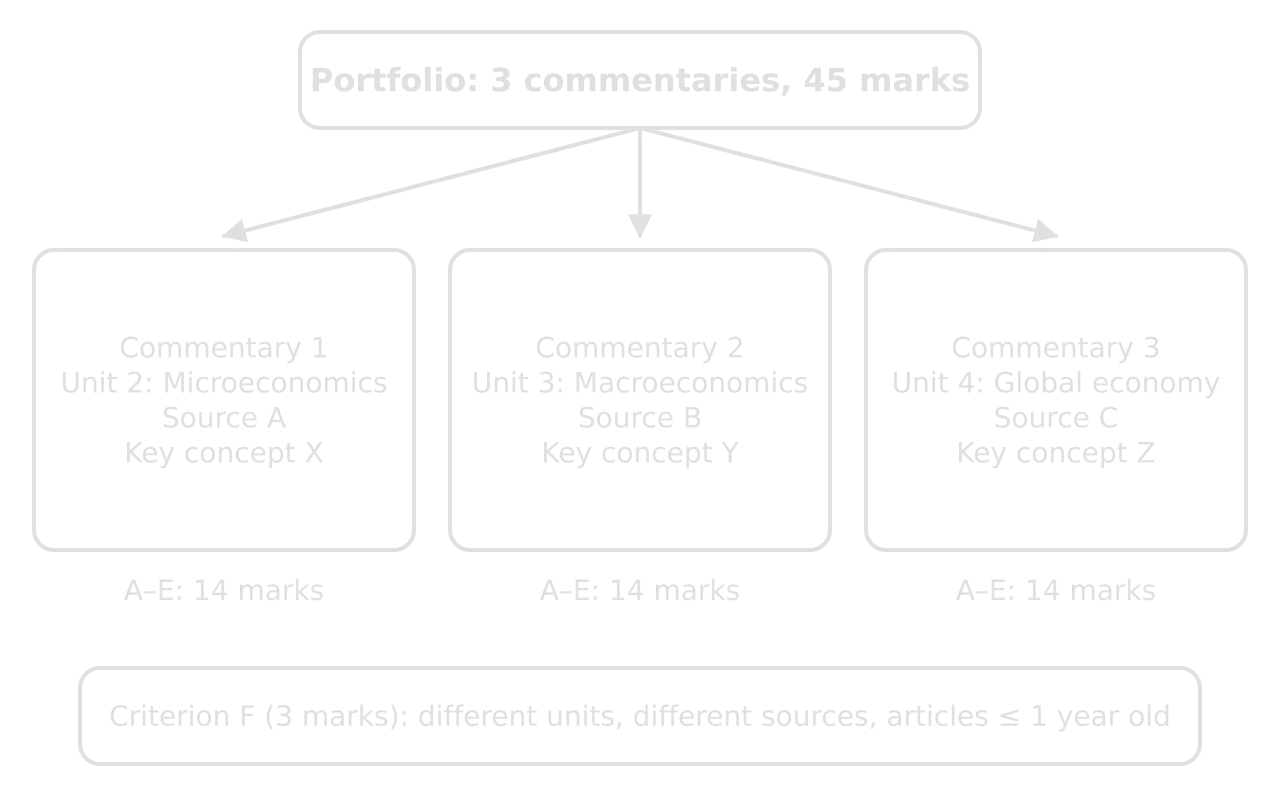
The internal assessment in IB Economics is a portfolio of three commentaries. Each commentary is a short analysis, at most 800 words, of a recent news article, using economic theory, a diagram and one of the nine key concepts to explain what is happening and to judge its implications. Your teacher marks the portfolio, and the IB checks a sample of each school’s marks through moderation.
The requirements and the assessment criteria are identical at SL and HL. Only the weighting differs, because HL students also sit Paper 3.
SL | HL | |
|---|---|---|
Share of the final grade | 30% | 20% |
Commentaries | Three | Three |
Marks | 45 (14 per commentary on criteria A–E, plus 3 for criterion F) | 45 (the same) |
Teaching time | About 20 hours | About 20 hours |
For an SL student, the portfolio is worth as much as Paper 1, and it is the one part of the assessment completed without time pressure, with a chance to research, draft and improve. It is therefore the part of the assessment most under the student’s control.
The rules, one by one
Most of the rules are simple, but breaking one costs marks that no amount of good economics can recover. Criterion F gives 1 mark for each of three formal rules, and criterion D gives 0 for a commentary that repeats a key concept already used.
One commentary for each of Units 2, 3 and 4
Each commentary must be based on a different unit: Unit 2 (Microeconomics), Unit 3 (Macroeconomics) and Unit 4 (The global economy). Unit 1 (Introduction to economics) cannot be used. Writing two commentaries on the same unit loses a mark under criterion F.
What makes a commentary belong to a unit is the theory it applies, not the subject of the article. An article about rising oil prices could support a Unit 2 commentary (supply and demand, elasticity, a tax or subsidy), a Unit 3 commentary (cost-push inflation, an SRAS shift) or a Unit 4 commentary (the terms of trade or a current account deficit for an importer). Decide the unit by the diagram and the theory used, record it on the cover sheet, and make sure the analysis stays within that unit.
A different key concept for each commentary
Each commentary must use a different one of the nine key concepts as the lens through which it analyses the article. The concepts are scarcity, choice, efficiency, equity, economic well-being, sustainability, change, interdependence and intervention.
Using the same concept twice puts 3 marks at risk, because criterion D scores 0 for a concept already used in another commentary. Using it in all three risks 6 marks. Plan all three concepts together, before the second commentary is written.
Articles published within one year
Each article must have been published no more than one year before the commentary on it is written. The date that matters is the date the commentary is written, recorded on the cover sheet, not the date the article was found or the portfolio submitted.
This rule catches students who collect articles early and write later. An article saved in September and written about the following October is out of date, even if it seemed current when it was chosen. Write each commentary soon after choosing its article.
A different and appropriate source for each
The three articles must come from three different sources. Two articles from the same publication, for example two from one newspaper’s website, lose a mark under criterion F, even if they were written by different journalists and are about different units.
An appropriate source is published news media in written form: a newspaper, a magazine, a journal or a news website. Television and radio broadcasts are not allowed. A written article on a broadcaster’s news website is an internet article and can be used; a video clip or a recording of a programme cannot.
Usually appropriate | Not appropriate |
|---|---|
National and regional newspapers, in print or online | Television or radio broadcasts, video clips, podcasts |
News magazines and business publications | Textbooks, revision sites and economics teaching blogs |
Written news articles on broadcasters’ websites | Social media posts |
Wire-agency stories carried by a news outlet | Press releases and reports by a government, firm or international organisation, unless reported in a news article |
Journals that publish current news and comment | Articles given to the whole class by the teacher |
Article length and language
Short articles are better. A long article is discouraged; if one is used, the part the commentary is based on must be highlighted, so the moderator can see which section was analysed. A news story of 400–900 words is usually enough to support an 800-word commentary.
The article should, where possible, be in the same language as the commentary. If it is not, an accurate translation of the whole article must be included, along with the original.
The word limit
Each commentary has a maximum of 800 words, and moderators do not read past the 800th word. Diagrams, labels of five words or fewer, diagram headings of ten words or fewer, tables of statistical data, equations and calculations, citations and references are not counted. Definitions and quotations are counted and must be in the body of the commentary; footnotes and endnotes are for references only.
Cover information
Each commentary records the same seven items, usually on the IB’s cover sheet:
the title of the article;
its source, with the date of access if it is online;
the date the article was published;
the date the commentary was written;
the word count of the commentary;
the unit the article relates to;
the key concept used.
These details are how the moderator checks criterion F, so they must be accurate. A missing publication date can make it impossible to confirm that an article is recent enough.
Your own work, with one round of feedback
You choose your own articles. Two students may happen to pick the same article, but a teacher may not hand articles to the class, and each commentary is written individually: no shared drafts and no collaboration on the writing. Your teacher can discuss your choice of article and the requirements with you at any stage, and reads and comments on one draft of each commentary, orally or in writing, without editing it. The next version you hand in is the final one, and once submitted it cannot be withdrawn.
What makes a good article
The choice of article limits how good the commentary can be. A well-chosen article makes every criterion easier to reach, while a poor one can put the top marks on some criteria out of reach. Before committing to an article, test it against these qualities.
Quality | Why it matters | Warning sign |
|---|---|---|
One clear economic event or decision | Gives the commentary a single question to analyse in 800 words | The article covers many topics or countries |
A change that can be drawn | Criterion A needs a relevant diagram showing the change | Nothing shifts: the article is a profile, an interview or a forecast list |
Facts and figures | Data make the application specific and support evaluation | Only opinions, no numbers or details |
Stakeholders and a debate | Evaluation needs people who gain and lose, and a judgment to make | Everyone agrees; there is nothing to weigh |
Fits one unit | The theory, diagram and evaluation stay in one unit | The main issue straddles units |
Short and recent | Easier to analyse in depth; meets the date rule | Several thousand words; older than a few months |
Reported, not already analysed | The analysis must be yours | An opinion piece by an economist that already does the analysis |
Articles about a policy decision are often the strongest choice, because they come with an aim (which gives the key concept and the evaluation a question to answer), a mechanism (which gives the diagram) and people who are affected (which gives the stakeholders). Articles about a market shock, such as a harvest failure or a strike, work well too, especially when the government is considering a response.
Where to find articles
The best articles come from regular reading over the whole course, not from a search the week before a deadline. Reading a business or economics section a few times a week makes it easy to spot an event that fits a topic just taught.
Business and economics sections of national newspapers and news websites: policy decisions, price changes, company news, labour disputes.
Business publications and news magazines: deeper reporting on markets, trade and central banks.
Regional and local news: local taxes, housing, transport, minimum wages, a factory closing. Local articles are often short, specific and rarely chosen by other students.
News outlets in other countries, in your language of instruction: a way to find articles on development and trade.
When an article looks promising, save it immediately as a PDF or printout with its URL, its publication date and the date of access. Web pages change and disappear, and the moderator needs to see the article as it was used.
Checking an article before committing to it
A few minutes of checking prevents a weak commentary. The first check is whether the article is news reporting or opinion. A news report states what happened, with facts, figures and quotations from the people involved, and leaves the analysis to the reader. An opinion column or editorial argues a case: it can be used, but its claims are the writer’s view, and the commentary must analyse them rather than repeat them.
The second check is whether the article contains enough. Underline every fact that the commentary could use: a price, a percentage, a tax rate, a date, a named firm or group of people. An article with fewer than three or four usable facts usually leads to a commentary that relies on general theory. The third check is whether the article’s own explanation is complete. Many news reports give one cause of an event; a commentary that adds a cause the article misses, or questions the one it gives, shows the economic insight the task rewards.
Check | Ask | If the answer is no |
|---|---|---|
Date | Is the publication date shown, and will the commentary be written within a year of it? | Find another article |
Source | Is it a written news source not yet used in the portfolio? | Find another article |
Focus | Can the article’s main event be stated in one sentence of economics? | Look for a narrower article |
Diagram | Can a diagram from the chosen unit show the main change? | Consider another unit, or another article |
Evidence | Are there at least three or four usable facts or figures? | Choose a richer article |
Debate | Are there gainers and losers, or a disagreement to weigh? | Evaluation will be hard: reconsider |
Copy | Is a full copy saved, with its URL and dates? | Save it now; web pages change |
Paywalled articles can be used, provided the full text is saved and submitted with the commentary. The moderator must be able to read exactly what was analysed.
Matching articles to units, diagrams and concepts
Planning the three commentaries together avoids the most common rubric problems: two articles from one unit, two from one source, or two using the same concept. The table lists the kinds of articles that usually work for each unit.
Unit | Articles that work well | Diagrams | Concepts that often fit |
|---|---|---|---|
2 Microeconomics | A tax on sugary drinks, tobacco or fuel; a subsidy; a price cap or minimum price; a minimum wage; a ban or regulation; a market shortage; a merger or a monopoly fine | Demand and supply with shifts; tax, subsidy and price control diagrams; externality diagrams; HL cost and revenue diagrams | Intervention, efficiency, equity, sustainability |
3 Macroeconomics | An interest rate decision; new inflation, unemployment or growth figures; a budget; a stimulus or austerity package; a supply-side reform | AD/AS with shifts; business cycle; Lorenz curve; Phillips curve (HL) | Change, economic well-being, intervention, equity |
4 The global economy | A tariff, quota or trade agreement; a currency movement or central bank intervention in the foreign exchange market; a trade surplus or deficit; aid, debt relief or development policy | Tariff and quota diagrams; exchange rate diagrams; J-curve (HL) | Interdependence, sustainability, equity, efficiency |
Worked example: judging three candidate articles
The three articles in this example were all published in October 2026, in the same week as the model commentary’s article. A student who has already written a Unit 2 commentary on an NPR article (about tax-free diesel, using the concept of intervention) is looking for articles for the other two units.
Sources: CNA, 14 October 2026; CNBC, 12 October 2026; CNBC, 7 October 2026; NPR, 7 October 2026.
Article C is a common type of weak choice: interesting and authoritative, but too broad. A narrower article on one of its topics, such as a central bank’s response to rising bond yields, would be a better basis for a commentary.
Planning the portfolio over the course
Most schools spread the three commentaries over the two years, writing each soon after the unit it draws on has been taught. Writing the first commentary early has an advantage: the feedback on it improves the next two.
Stage | What to do | Check |
|---|---|---|
Throughout the course | Read the news; keep an article log | Dates and sources recorded for every candidate |
After each unit is taught | Choose the article; plan the diagram and key concept | Published within the last year; a source not yet used |
First draft | Write a complete commentary of at most 800 words | All five criteria addressed; cover information complete |
After feedback | Revise into the final version | The final version is handed in as final; no more feedback |
Before submission | Check the whole portfolio | Three units, three sources, three concepts, all dates within a year |
Summary
The portfolio is three commentaries of at most 800 words each, marked out of 45; it is worth 30% at SL and 20% at HL.
One commentary each on Units 2, 3 and 4; never Unit 1.
Each commentary uses a different key concept; a repeated concept scores 0 on criterion D.
Each article comes from a different, appropriate written news source and was published no more than one year before the commentary is written.
Good articles report one clear, recent event with data, stakeholders and a debate, and support a diagram from one unit.
Keep an article log, save each article with its dates, and plan all three commentaries together.
Self-check
- To do:
I can state the rules on units, key concepts, sources, article dates and the word limit.
- To do:
I can list the seven items of cover information for each commentary.
- To do:
I can explain what counts towards the 800 words and what does not.
- To do:
I can judge whether an article is suitable for a commentary and explain why.
- To do:
I can plan three commentaries that meet every rubric requirement.
Carry on with Economics in Augment
With a free account, Augment remembers where you stopped in the notes and which questions you have marked.