The inquiry process document
Write an inquiry process document that states a precise inquiry focus and discusses three sources' claims and perspectives through origin and purpose, meaning and methods, and corroboration and use, within 1,500 words.
- IB Digital Society
- Internal assessment
- SL and HL
Introduction
The inquiry process document (IPD) is the written record of how the inquiry was set up and researched. In no more than 1,500 words it states the inquiry focus and then discusses three of the sources that shaped the investigation, showing what each claims, from which perspective, and why it was useful.
The IPD is short, so every sentence has to do work. It is assessed against two criteria: A, Inquiry focus (3 marks), and B, Claims and perspectives (6 marks). Together these are worth 9 of the project's 24 marks, which makes the IPD a substantial part of the result for a document that is shorter than many school essays.
Structure of the IPD
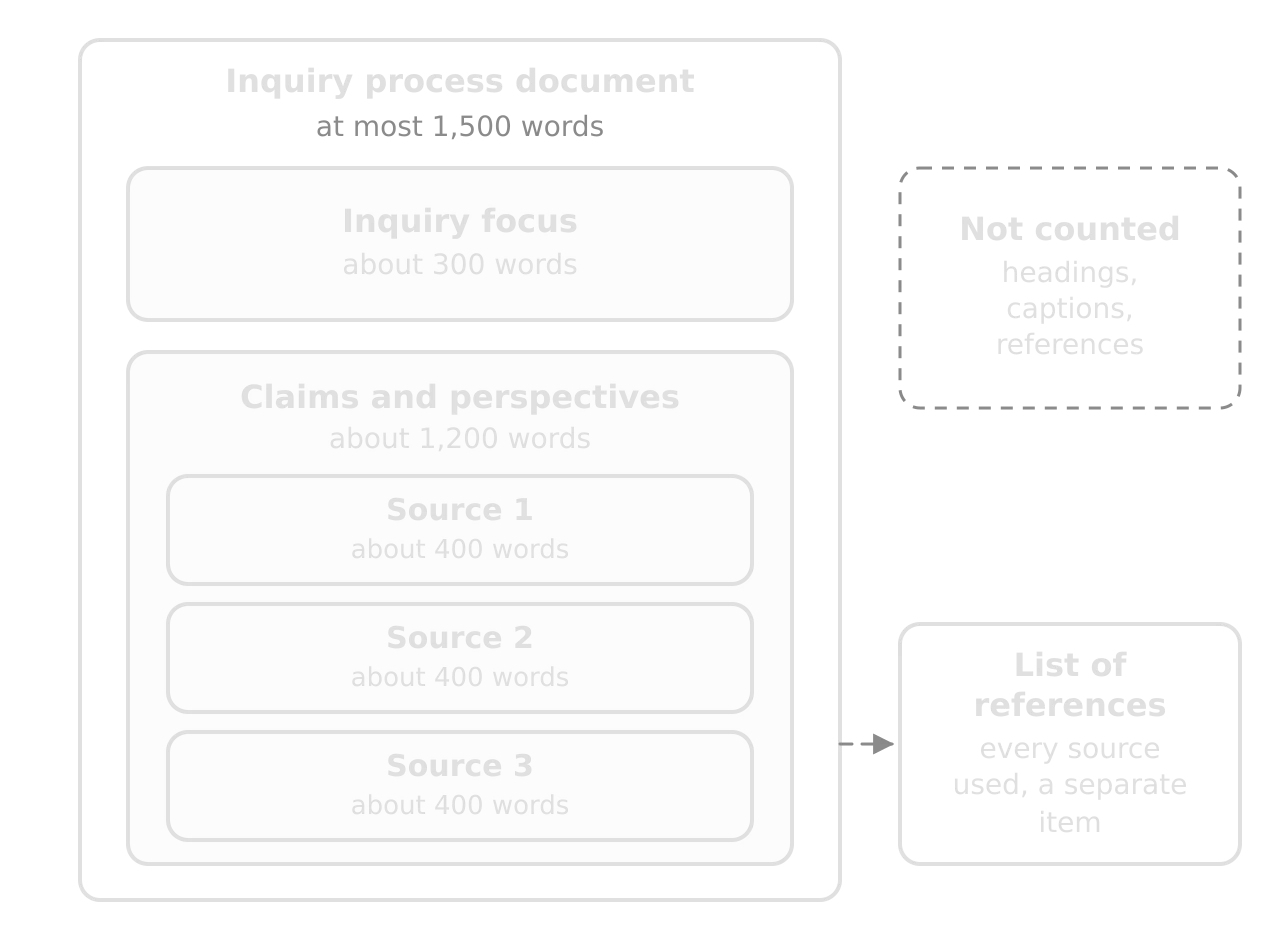
The IPD is submitted as one document with two labelled sections in a fixed order: Inquiry focus, then Claims and perspectives. Using exactly those names as headings makes each part easy to find. A word count must be included with each section, and the list of references is submitted as a separate item.
Section | Recommended maximum | Purpose | Criterion |
|---|---|---|---|
Inquiry focus | about 300 words | Explain how the inquiry question connects to a specific, relevant real-world example and to course concepts, content and contexts | A (3 marks) |
Claims and perspectives | about 1,200 words | Discuss the claims and perspectives of three sources and justify each one's usefulness | B (6 marks) |
Source: IB Digital Society guide (first assessment 2024), internal assessment details.
The recommended maximums are guidance rather than separate limits. The firm rule is the total: words beyond 1,500 are not assessed, so an over-long focus would push the third source discussion out of the assessed text.
What counts towards the word limit
Counts | Does not count |
|---|---|
All running text in both sections | Headings (including the two section labels) |
Quotations from sources | Captions |
Text in tables and footnotes (not listed as an exclusion, so safest treated as counting) | The list of references |
Headings, captions and references are the only stated exclusions, so any other text is best treated as part of the 1,500 words.
The inquiry focus section
What it contains
The inquiry focus section does three things, all of which are assessed together under criterion A:
It states the inquiry question.
It explains the specific, relevant real-world example: the named digital system, where and when it is used, and who is affected.
It explains how the question connects to course concepts, content and contexts. All three must be addressed, but they do not need equal weight.
The focus must also suit a presentation of up to ten minutes. The same focus must be used in the presentation, where the introduction restates it.
From listing to explaining
The difference between the middle and the top of criterion A lies in how fully the connections are explained. A focus that lists "Concept: power. Content: algorithms. Context: economic" gives the elements but not the reasons. A targeted focus explains why each connection matters for this question and this example.
A model structure for the focus
One workable order for a focus of about 250 to 300 words is the following (a suggestion, not a required structure).
The inquiry question, stated once and exactly.
Two or three sentences on the digital system: what it is, how it works in outline, where and since when.
One or two sentences on the people and communities affected and why the question matters to them.
Concept: which one, and why it is the right lens for this question.
Content: which area of digital systems, and which technical detail matters most.
Context: which one (or two), and how it situates the inquiry.
The claims and perspectives section
The second section shows how the research was carried out. It discusses three sources, and for each one it explains the source's claims and perspectives and justifies its usefulness to the inquiry. The project will normally use more than three sources; all of them go in the list of references, but only three are discussed here.
Selecting three sources
Since only three sources are discussed, the choice matters. Strong selections usually:
are clearly relevant to the inquiry question and real-world example, not to the general topic
represent different perspectives, so that their claims can be compared (for example, an official report, an industry source and a community or user voice)
include at least one source of high reliability, such as an official investigation, peer-reviewed research or a well-documented dataset
differ in type or method, which gives more to say about meaning and methods (a statistical report, an interview-based article, a video documentary)
each made a visible difference to the inquiry: changed the question, supplied key evidence, or raised a counter-claim.
What to discuss for each source
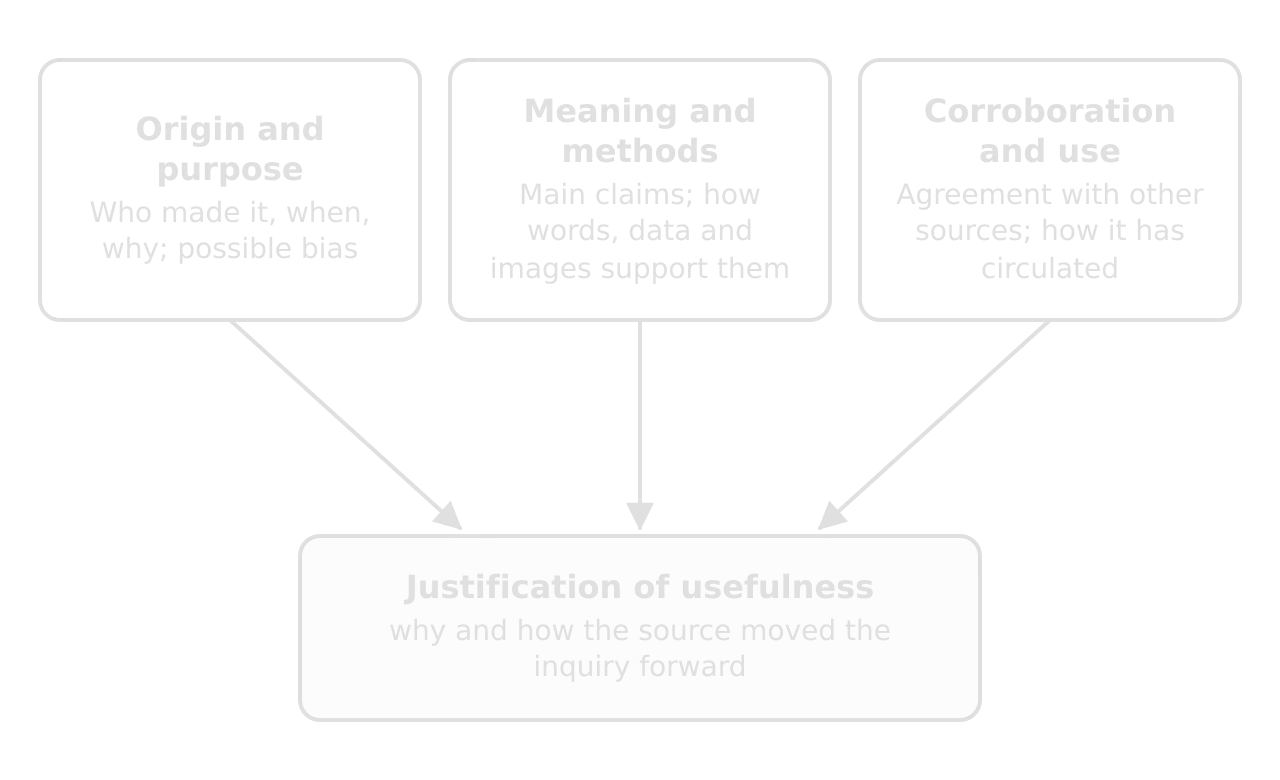
Each source discussion addresses three overlapping facets, then justifies the source's usefulness. The facets come from the course toolkit and apply to any source, from a government report to a TikTok video.
Origin and purpose
Origin is the source's provenance: who created it, when, where and for whom, including cases where the author is hidden or unclear. Purpose is why it was made: to inform, persuade, sell, defend a decision, hold someone to account. Together they help identify possible bias and the source's value and limitations for different groups.
Questions to ask:
Who made it, and what is their relationship to the digital system (operator, regulator, critic, user, independent researcher)?
When was it made, and has anything important changed since?
Who was the intended audience?
What might the creator gain from the claims being accepted?
Meaning and methods
Meaning is what the source claims: its main ideas and conclusions. Methods are the techniques it uses to support those claims: the words chosen, the data and how it was collected, images, graphics and overall design.
Questions to ask:
What are the source's main claims about the digital system and its impacts?
What evidence supports them: statistics, case studies, interviews, expert opinion, personal experience?
How was the evidence gathered, and how large was the sample?
How do language, images or layout shape the reader's response?
Corroboration and use
Corroboration means comparing the source with others that address the same issue: do independent sources agree, disagree or add nuance? Use means how the source has been circulated and used by different people, communities and platforms (cited by researchers, quoted by campaigners, shared on social media, challenged by the company concerned). Corroboration and use help judge a source's reliability, verifiability and validity.
Questions to ask:
Do other independent sources support or contradict its claims?
Can its evidence be checked?
Who has cited, shared or disputed it, and why?
Justifying usefulness
The justification explains why and how the source supported the inquiry and the student's understanding. This is where many discussions fall short. A strong justification is specific: it says what the source made possible (key evidence for a claim, a perspective that would otherwise be missing, a reason to narrow the question) and is honest about the limits of that usefulness.
Weak justification | Strong justification |
|---|---|
"This source was useful because it had a lot of information." | "This report gave the only independent figures on how often alerts led to evidence of a crime, which became the central evidence for my claim about effectiveness." |
"This source was reliable because it was from the government." | "As an audit by the city's own inspector general, it had access to police records unavailable to journalists, but it measured only what police recorded, so it cannot show deterrent effects." |
"This source gave a different perspective." | "This article was the only source to include residents' own accounts, which led me to add trust between residents and police as a second impact to investigate." |
Worked examples of source evaluation
The two discussions that follow evaluate the same source, first weakly and then strongly.
The source is the Chicago Office of Inspector General's report on the Chicago Police Department's use of ShotSpotter, published in August 2021. It analysed alerts from January 2020 to May 2021 and found that of about 50,000 alerts confirmed as probable gunshots, about 9% led to documented evidence of a gun-related criminal offence, and about 2% could be linked to an investigatory stop. It also noted that the quality of police and dispatch records limited the analysis. It concluded that police responses to ShotSpotter alerts rarely produced documented evidence of a gun-related crime.
The strong version spends its words on evaluation and justification rather than summary.
A second short illustration
The same approach works with a very different source. Suppose an inquiry into food-delivery riders in one city uses a Fairwork ratings report. Fairwork, a project based at the Oxford Internet Institute with the WZB Berlin Social Science Center, scores digital labour platforms out of 10 against five principles: fair pay, fair conditions, fair contracts, fair management and fair representation. A good discussion would note its origin (university researchers with an explicit aim of improving platform work, which is a perspective, not a neutral stance), its method (desk research, interviews with workers and evidence supplied by the platforms themselves), and its corroboration (whether its scores match riders' own accounts or local news). The justification might explain that the report allowed one platform to be compared with others in the same city, which a single interview could not do.
Referencing
Throughout the project, the student's own words and ideas must be clearly separated from those of others. Two things achieve this.
Citations at the point of use
A citation is a brief acknowledgement at the place where a source is used. In the IPD it is usually written in brackets after the relevant sentence. It should include, where known, the author's or creator's surname (or the organisation's name) and the date of publication, for example "(Chicago OIG, 2021)".
The list of references
The list of references is submitted as its own item and includes every source used in the IPD and in making the presentation, including images, video clips, music and data. For each source it gives, where known and appropriate:
the surname of the author or creator (or the organisation)
the title
the date of publication
the format (report, video, article, podcast, dataset)
page numbers or time codes where relevant
the URL and the date of access for online sources.
A reference in this style might read: City of Chicago Office of Inspector General. The Chicago Police Department's Use of ShotSpotter Technology. August 2021. Report. Accessed 12 March 2026. Any consistent, recognised referencing style is acceptable; the school may specify one.
Common mistakes in the IPD
The level descriptors for criteria A and B describe what separates weaker from stronger work. The most frequent problems follow directly from them.
Mistake | Why it matters | Better approach |
|---|---|---|
Focus missing one element (no clear question, no specific example, or one of the three Cs absent) | An incomplete focus matches the lowest level descriptor of criterion A | Check that the question, the example and all three Cs are present and labelled in the text |
Example too general ("social media", "AI") | The example is not specific or relevant | Name the system, place, time and people |
Connections listed, not explained | Only a partial explanation | Say why each concept, content area and context matters for this question |
Fewer than three sources discussed | Matches the 1–2 band descriptor of criterion B | Discuss exactly three, each in its own paragraph or subsection |
Summary instead of discussion | Primarily descriptive | Address origin and purpose, meaning and methods, corroboration and use |
No justification, or a vague one | Justification is missing or underdeveloped | State what each source made possible in the inquiry |
No word count per section | A word count with each section is a stated requirement | Give the word count under each section heading |
Over 1,500 words | Excess text is not assessed | Cut repetition and general statements first |
Appendices | They are not read | Keep supporting material in the research journal |
Checklist
- To do:
My IPD has two sections labelled "Inquiry focus" and "Claims and perspectives", in that order, each with its word count.
- To do:
The total is 1,500 words or fewer, not counting headings, captions and references.
- To do:
My inquiry focus states the question once, exactly as it will appear in the presentation.
- To do:
I explain a specific, relevant real-world example: the named system, setting, time and people affected.
- To do:
I explain, not just name, the connection to a concept, to the content and to a context.
- To do:
I discuss exactly three sources that represent different perspectives.
- To do:
For each source I address origin and purpose, meaning and methods, and corroboration and use.
- To do:
I distinguish each source's claims from the perspective it is written from.
- To do:
Each source has a specific justification of how it supported the inquiry and my understanding.
- To do:
Every source is cited at the point of use and listed in the separate list of references with full details.
- To do:
There are no appendices and no discussion hidden in captions.
Carry on with Digital Society in Augment
With a free account, Augment remembers where you stopped in the notes and which questions you have marked.