The presentation and the assessment criteria
Build a recorded multimedia presentation of up to ten minutes that analyses and evaluates impacts and implications, concludes with insight and future trends, and meets each of the criteria A to E.
- IB Digital Society
- Internal assessment
- SL and HL
Introduction
The recorded multimedia presentation is where the inquiry reaches its conclusions. In up to ten minutes, narrated in the student's own voice, it restates the inquiry focus, analyses and evaluates the impacts and implications of the digital system for people and communities, and ends with new insight and a discussion of where things are heading.
The presentation is assessed against three criteria worth 15 of the project's 24 marks: C, Analysis and evaluation (6), D, Conclusion (6), and E, Communication (3). The inquiry process document (IPD) carries the other 9 marks through criteria A and B. Understanding what each criterion rewards makes it much easier to plan the presentation and to judge a draft honestly.
The recorded multimedia presentation
Format and limits
The presentation is a single recorded file of no more than ten minutes. Anything after the tenth minute is not assessed. It may combine text, still images, moving images and sound, and it must contain an audible recorded commentary in the student's own voice throughout. Text-to-speech tools may produce the commentary as long as the script is the student's own work. Subtitles are allowed and can help understanding.
Common formats include narrated slides exported as video, a screen recording with voice-over, or an edited video combining footage, images and narration. Any software can be used, provided the visuals, text and sound are combined to support understanding.
The three labelled sections
The presentation contains three sections, each of which must be included and labelled, in this order. How the labels appear is not specified; on-screen titles, spoken signposts or both are common choices.
Section | What it does | Criterion |
|---|---|---|
Introduction | Restates the inquiry focus from the IPD, unchanged, and briefly outlines its significance for digital society | No criterion of its own; it contributes to the organisation assessed under E (the focus itself is assessed in the IPD under A) |
Analysis and evaluation | The bulk of the presentation: the student's own sustained, evidence-based analysis and evaluation of impacts and implications for people and communities | C |
Conclusion | Further insight showing new understanding of the inquiry focus after the analysis, and a discussion of emerging trends and future developments | D |
Source: IB Digital Society guide (first assessment 2024), internal assessment details.
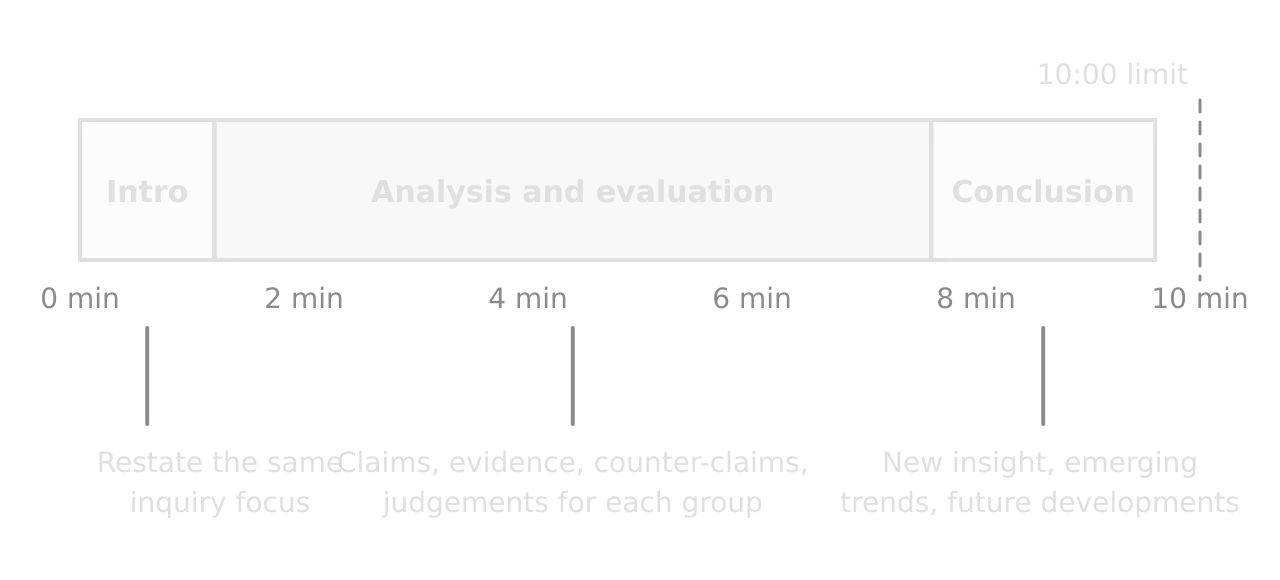
Every section must be addressed, but the sections do not need equal time. The analysis and evaluation section makes up the balance (the bulk) of the presentation, so it takes the largest share, as the suggested timeline shows.
The introduction
The introduction is short; about a minute is usually enough. It restates the same inquiry focus as the IPD (the question and real-world example), so that the IPD and the presentation are visibly the same inquiry. It then outlines why the inquiry matters for digital society: who is affected, how widely the system is used, or what larger debate it belongs to. It may also preview the structure of the analysis, which helps organisation.
Analysis and evaluation
The analysis and evaluation is the heart of the project. Analysis breaks the impacts and implications into parts and explains how they arise and how they relate to each other. Evaluation weighs them: how significant, for whom, under what conditions, compared with what. The section integrates the student's own thinking with evidence from sources and, where available, primary research.
Supporting questions from the investigate stage of inquiry help structure the analysis:
What are the positive and negative impacts for different people and communities?
Which impacts were intended, and which were unintended?
Over what timescale do the impacts and implications play out?
What are the ethical, policy, legal or governance implications?
Who is affected directly, and who indirectly?
What claims do different groups make, and what are their roles, responsibilities and relationships?
How do the chosen concept and context shape the investigation?
A practical way to organise the section (a suggestion, not a requirement) is by group or by impact rather than by source. Each part makes a claim, supports it with evidence (cited on screen or aloud), considers a counter-claim or another group's perspective, and reaches a judgement.
The conclusion
The conclusion has two jobs, and both are assessed under criterion D.
Further insight. The conclusion shows what the student now understands that they did not at the start. It is not a summary. A useful prompt is: "Having analysed the impacts, what do I now see differently about the inquiry question?" The insight should follow from, and be supported by, the analysis that came before.
Emerging trends and future developments. The conclusion discusses where the system and its impacts are heading: new versions of the technology, changing laws, wider adoption or abandonment, new groups who will be affected. The discussion should be substantiated (based on evidence of an actual trend) and connected to the inquiry, not a general prediction about technology.
Communicating with media
Criterion E rewards organisation and a coherent use of media. Organisation means ideas and evidence are arranged logically, with clear signposting (on-screen section labels, spoken transitions such as "The second group affected is…"). Coherent media means that what is seen and what is heard support each other: a chart appears while the narration explains it, a short clip illustrates a point and is then discussed.
Practical rules follow from the communication requirements:
The narration must be audible throughout. Background music or clip audio should be lowered under the commentary, or the commentary paused while a clip plays.
All on-screen text must be legible: large fonts, high contrast, few words per slide.
Visuals should be appropriate to the topic and the audience, and sourced.
Sources are cited at the point of use, on screen (author or creator and date) or aloud.
Weak use of media | Coherent use of media |
|---|---|
Dense slides of text read aloud word for word | Short on-screen claims; the narration explains and adds evidence |
Stock images that decorate but say nothing | A map of station locations shown while explaining access |
Long video clips that do the analysis for the student | A 10-second clip, cited on screen, then analysed in the student's voice |
Loud background music over the commentary | No music, or music only between sections |
Charts copied without labels or source | A simplified chart with a clear title and on-screen citation |
The assessment criteria
Each criterion has a short set of level descriptors. Each criterion is applied on its own with a best-fit approach. The teacher reads the descriptors until reaching the one that most accurately describes the work; it does not have to meet every aspect of that descriptor, and strengths in one aspect can compensate for weaknesses in another. Within a band of two marks, the upper mark goes to work that shows the qualities to a great extent and the lower mark to work that shows them to a lesser extent. Only whole marks are given, and a high or low level on one criterion does not decide the level on another.
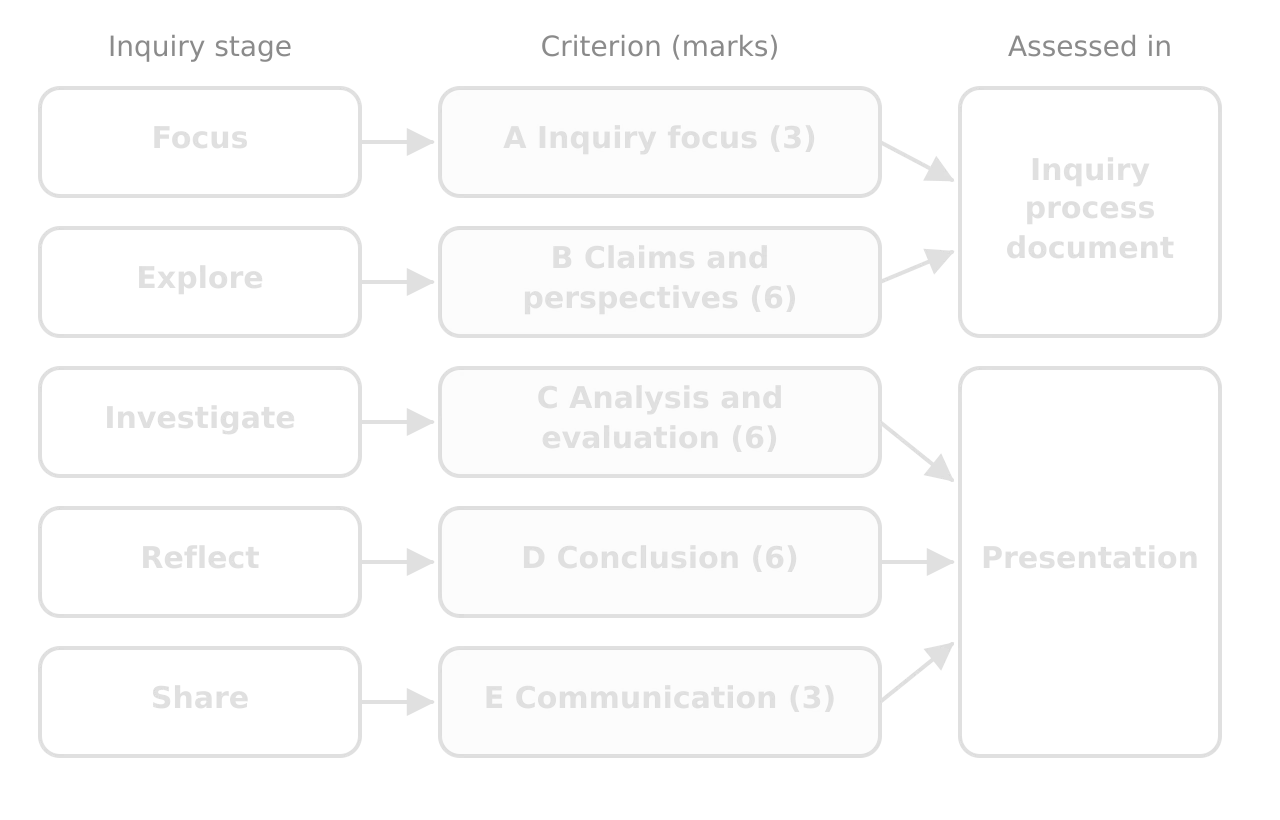
Criterion | Element | Marks | In one sentence |
|---|---|---|---|
A Inquiry focus | IPD | 3 | How fully the focus explains the links between the question, a specific example and the three Cs |
B Claims and perspectives | IPD | 6 | How thoroughly three sources are discussed, with justification of their usefulness |
C Analysis and evaluation | Presentation | 6 | How effective, sustained and evidence-based the analysis of impacts and implications for people and communities is |
D Conclusion | Presentation | 6 | How well the conclusion offers further insight and discusses emerging trends and future developments |
E Communication | Presentation | 3 | How well organisation and media support understanding |
Total | 24 |
The summaries that follow paraphrase each criterion. The full level descriptors are published by the IB and available from teachers, and it is good practice to read them alongside any summary.
Criterion A: Inquiry focus (3 marks)
Criterion A is applied to the inquiry focus section of the IPD. It asks whether the focus includes an inquiry question and explains how that question connects to a specific, relevant real-world example and to course concepts, content and contexts.
Level | What distinguishes it |
|---|---|
1 | The focus is incomplete or limited: an element is missing, or the example is not specific or not relevant to the inquiry |
2 | All elements are present, but the explanation of how they connect is only partial |
3 | The focus is appropriate and targeted: the connections are explained thoroughly |
The step from 2 to 3 is usually the step from naming the three Cs to explaining why each matters for this question and this example.
Self-assessment for A:
- To do:
Is there one clearly stated inquiry question?
- To do:
Is the real-world example a named, existing system in a specific setting?
- To do:
Is it clear why the example is relevant to the question?
- To do:
Are concepts, content and contexts all addressed, with reasons rather than labels?
- To do:
Could the question be answered convincingly in ten minutes?
Criterion B: Claims and perspectives (6 marks)
Criterion B is applied to the claims and perspectives section of the IPD. It asks how far the discussion of three sources' claims and perspectives goes, and whether each source's usefulness to the inquiry is justified.
Band | What distinguishes it |
|---|---|
1–2 | The discussion is limited and mostly descriptive; fewer than three sources are discussed, or their use is not justified |
3–4 | Each source is discussed, but only partly; some justification is given but it is underdeveloped |
5–6 | Each source is discussed thoroughly, and its usefulness is clearly justified |
In practice, a thorough discussion addresses origin and purpose, meaning and methods, and corroboration and use for every source, not only for the first.
Self-assessment for B:
- To do:
Are exactly three sources discussed?
- To do:
Do they represent different perspectives?
- To do:
For each, are origin and purpose, meaning and methods, and corroboration and use all addressed?
- To do:
Is each source's claim stated accurately and distinguished from its perspective?
- To do:
Does each justification explain specifically how the source shaped the inquiry?
Criterion C: Analysis and evaluation (6 marks)
Criterion C is applied to the analysis and evaluation section of the presentation. It asks for the student's own analysis and evaluation of impacts and implications of the digital system for people and communities.
Band | What distinguishes it |
|---|---|
1–2 | Analysis and evaluation are limited: mostly description, or only loosely related to the inquiry focus |
3–4 | Analysis and evaluation of impacts and implications for people and communities are adequate, but not sustained throughout or not consistently supported by evidence |
5–6 | Analysis and evaluation are effective, sustained across the section and well supported by evidence |
Three words carry most of the weight at the top: effective (the analysis answers the question), sustained (the quality lasts across the whole section, not one strong point among several weak ones), and well-supported (claims rest on evidence that is cited). The criterion names impacts and implications for people and communities, so naming specific groups, rather than "society" or "users", matters.
Self-assessment for C:
- To do:
Does the section analyse and evaluate rather than describe?
- To do:
Are specific people and communities named, and are differences between them explained?
- To do:
Are both positive and negative impacts, and intended and unintended ones, considered where relevant?
- To do:
Is every main claim supported by cited evidence?
- To do:
Are counter-claims or other perspectives weighed, leading to judgements with conditions?
- To do:
Does every part of the section relate back to the inquiry question?
Criterion D: Conclusion (6 marks)
Criterion D is applied to the conclusion of the presentation. It asks for further insight into the inquiry focus that reflects new understanding after the analysis, and a discussion of emerging trends and future developments.
Band | What distinguishes it |
|---|---|
1–2 | Little further insight; trends and future developments are mentioned with little or no discussion |
3–4 | Adequate further insight, with a partial discussion of trends and future developments |
5–6 | Effective, well-supported insight, with a thorough and substantiated discussion of trends and future developments |
The conclusion is weighted as heavily as the analysis, yet it is often the most rushed part. As a planning suggestion, leaving at least ninety seconds to two minutes for it is sensible.
Self-assessment for D:
- To do:
Does the conclusion state a new understanding, not only a summary?
- To do:
Is that insight clearly supported by the preceding analysis?
- To do:
Are emerging trends and future developments discussed, not just named?
- To do:
Are the trends real and supported by evidence (new laws, adoption data, product changes)?
- To do:
Are the trends connected back to the people and communities in the inquiry?
Criterion E: Communication (3 marks)
Criterion E is applied to the presentation as a whole. It asks how well the organisation of ideas and evidence, and the coherent use of media, support understanding.
Level | What distinguishes it |
|---|---|
1 | Organisation and use of media are limited and do not help the viewer understand |
2 | The presentation is adequately organised; media are coherent at times but not throughout, or only partly effective |
3 | The presentation is well organised and uses media coherently to support understanding |
Self-assessment for E:
- To do:
Are the three sections labelled and in the right order?
- To do:
Is the argument signposted so a viewer always knows where it is going?
- To do:
Does each visual support what is being said at that moment?
- To do:
Is the narration in my own voice and audible throughout, with other audio lowered?
- To do:
Is all on-screen text legible?
- To do:
Are sources cited on screen or aloud at the point of use?
Final checks before submission
Work that does not meet the format rules can prevent accurate marking, and resetting a submission is not guaranteed, so the final files deserve careful checking.
Area | Check |
|---|---|
Inquiry focus | The introduction restates the same inquiry focus as the IPD (keeping the question word for word the same avoids any doubt) |
IPD | Two labelled sections in order; word count for each; total no more than 1,500 words; no appendices |
Presentation | Three labelled sections in order; length 10:00 or less; one file; plays correctly from start to finish |
Voice | Student's own commentary (or text-to-speech of the student's own script) audible throughout |
References | Every source cited at the point of use and listed with author or creator, title, date, format, page or time codes, URL and access date |
Integrity | All media not created by the student are acknowledged; no material reused from the extended essay or another assessment |
Files | The correct, final versions are uploaded and open properly |
Checklist
- To do:
I can outline the three labelled sections of the presentation and what each must contain.
- To do:
My presentation is no longer than ten minutes, in one file, with my own voice audible throughout.
- To do:
The introduction restates the same inquiry focus as the IPD and outlines its significance.
- To do:
The analysis and evaluation section is the longest part and analyses impacts and implications for named people and communities with cited evidence.
- To do:
The conclusion offers further insight and a substantiated discussion of emerging trends and future developments.
- To do:
My media support the narration, on-screen text is legible and sources are cited at the point of use.
- To do:
I can explain what distinguishes the lower, middle and upper levels of each criterion A to E.
- To do:
I have used the self-assessment questions for each criterion on my draft.
- To do:
I have completed the final checks on both files and the list of references.
Carry on with Digital Society in Augment
With a free account, Augment remembers where you stopped in the notes and which questions you have marked.