Planning the inquiry project
Plan an inquiry project that works, from choosing a specific digital system and writing a focused inquiry question to keeping a research journal and carrying out ethical primary research.
- IB Digital Society
- Internal assessment
- SL and HL
Introduction
The inquiry project is an individual investigation into the impacts and implications of a digital system for people and communities. It is the one part of the course where the student chooses the topic, finds the evidence and decides how to present it, so the quality of the planning shapes almost everything that follows.
Planning means more than picking a subject. A strong project starts from a specific, existing digital system, asks an open question that can be answered in ten minutes, and connects that question to the course's concepts, content and contexts. It also means organising time, recording research as it happens and gathering evidence safely and ethically.
What the project is
The project follows an inquiry of the student's own design. The teacher gives feedback and advice, but the student leads each stage: setting the focus, choosing sources, analysing impacts and implications, and presenting the conclusions. This is called an open inquiry, the last point on a range that runs from directed inquiries (the teacher sets the focus and models each stage) through guided inquiries (teacher and student share the work) to open ones.
The three parts of the submission
Every project is submitted as three separate items.
Item | Form | Limit | Criteria it is assessed against |
|---|---|---|---|
Inquiry process document (IPD) | One written document with two labelled sections: Inquiry focus, then Claims and perspectives | 1,500 words in total | A Inquiry focus (3 marks), B Claims and perspectives (6 marks) |
Presentation | One recorded multimedia file with three labelled sections: Introduction, Analysis and evaluation, Conclusion | 10 minutes | C Analysis and evaluation (6), D Conclusion (6), E Communication (3) |
List of references | Every source used in the IPD and in making the presentation | No limit | Not marked separately; intentionally failing to cite and reference sources may be treated as an academic integrity violation |
Source: IB Digital Society guide (first assessment 2024), internal assessment details.
The project is worth 24 marks. It counts for 30% of the final grade at SL and 20% at HL, and the task, limits and criteria are identical at both levels. Teachers mark the work against the criteria, and the IB then checks a sample of the school's marking externally (moderation). The IB recommends about 30 hours of teaching and learning time for the project, covering the explanation of requirements, planning, research, analysis, building the presentation and acting on feedback.
Rules that shape planning from day one
Several rules affect decisions long before any writing starts.
Limits are firm. Words beyond 1,500 in the IPD and anything after the tenth minute of the presentation are not assessed. A plan that needs twenty minutes to answer its question loses its conclusion to the time limit.
No appendices. Submitted work must not include appendices, because they are not read. Interview transcripts, survey tables and extra notes stay in the research journal; only what fits within the limits counts.
One full draft. The teacher gives feedback at each stage, and comments on one complete draft of the IPD and presentation, giving oral or written advice without editing. The next version handed in is the final one, so the draft should be genuinely complete.
No double use. Work submitted for the inquiry project cannot also be used for the extended essay or any other Diploma assessment.
Own work. The project must be entirely the student's own work, and every idea, image, clip or statistic from someone else must be cited where it is used and listed in the references.
The inquiry stages
Each inquiry in the course, including the assessed project, moves through four stages: focus, explore, investigate, and reflect and share. The stages are iterative: they overlap and do not always follow a straight line. Reading sources often shows that a question is too broad, which sends the student back to refine the focus; analysis may expose a gap that calls for one more source. The inquiry cycle diagram shows the stages as a loop with feedback at the centre.
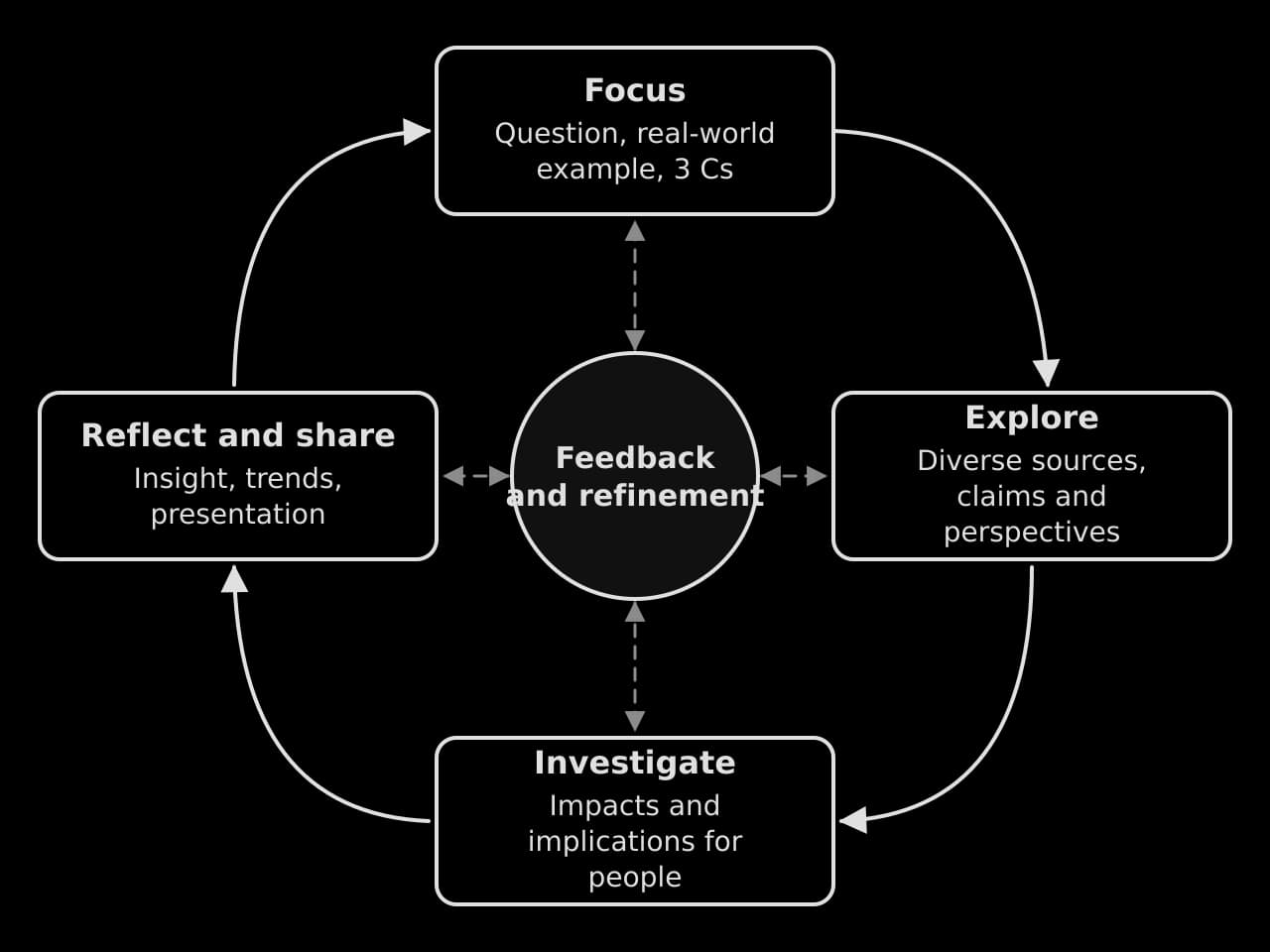
Each stage corresponds closely to one part of the submission and one assessment criterion:
Stage | Main questions | Where it shows in the project |
|---|---|---|
Focus | What exactly is being asked? Which digital system, which real-world example, which concepts, content and contexts? | Inquiry focus section of the IPD (criterion A) |
Explore | Which sources are relevant and balanced? What do they claim, from which perspectives, and how far can they be trusted? | Claims and perspectives section of the IPD (criterion B) |
Investigate | What are the impacts and implications, for whom, and how significant are they? | Analysis and evaluation in the presentation (criterion C) |
Reflect and share | What new understanding has emerged? Which trends and future developments matter? How can the findings be communicated clearly? | Conclusion and the presentation as a whole (criteria D and E) |
Choosing a digital system and a real-world example
What counts as a digital system
A digital system is a combination of technologies, data and people that creates, stores, processes or distributes data. Apps, platforms, smart devices, algorithms, robots and networks all qualify. The project's real-world example must involve a specific and existing digital system: one that is actually in use, with a name, a place and people who are affected by it. It may be local (a city's transport app) or global (a platform used in many countries), and a useful approach is to combine the two by studying a global system in one local setting.
The following examples show the difference between a general area and a usable example.
Too general | Specific and existing |
|---|---|
Social media and teenagers | Instagram's teen account settings introduced in 2024, as experienced by students at one school |
AI in education | Google Classroom and its automated feedback tools in a named school |
Smart cities | Citi Bike, New York City's bike-sharing system, operated by Lyft |
The gig economy | Riders on a named food-delivery platform, such as Foodpanda, in one city |
Surveillance | ShotSpotter gunshot detection in Chicago, which the city stopped using in 2024 |
Contact tracing | TraceTogether in Singapore |
A project about "social media" cannot be finished in ten minutes and has no clear group of people to analyse. A project about one platform feature in one setting has identifiable stakeholders, available evidence and room for depth.
Criteria for a workable example
Before committing to an example, it helps to test it against four practical questions. They are advice for choosing well, not formal requirements.
Is there enough evidence? The IPD discusses three sources, ideally with different perspectives, and the analysis needs further evidence beyond them. A system launched last month may not yet have any.
Are people affected in different ways? Analysis depends on comparing groups: users and non-users, workers and customers, a city government and residents.
Is it debated? If everyone agrees the system is simply good or bad, there is little to evaluate. A system with competing claims supports richer evaluation.
Is it personally accessible? Projects are often strongest when the student can observe the system directly or speak to people who use it, within the limits of research ethics.
Identifying people and communities
People and communities are the individuals and groups affected by a digital system. They include those who use it, those who build and run it, those affected without choosing to be, and those excluded from it. They often make different claims about the same system. Mapping them early keeps the inquiry focused on human impacts rather than technical features.
For Citi Bike in New York, for instance, the groups include annual members who commute by bike, occasional tourist users, residents of neighbourhoods with few docking stations, the city's transport department, Lyft as operator, and bike couriers who share the same streets. Each group experiences the system differently, and each would describe its impacts differently. Distinguishing between groups directly affected (members, the operator) and those indirectly affected (pedestrians, local shops near docking stations) adds depth to the later analysis.
Writing an inquiry question
The inquiry question turns a topic into an investigation. A strong question is open-ended, worth considering from more than one perspective, and impossible to answer by description alone. It also needs to be narrow enough to answer convincingly in a ten-minute presentation.
Features of a strong question
A useful inquiry question usually:
names, or clearly points to, the specific real-world example
asks about impacts or implications for identifiable people and communities
uses an evaluative framing ("to what extent", "how far", "how effectively", "who benefits") that invites judgement
can be answered with available evidence
suggests one or two concepts as a lens (power, identity, change, values and ethics, and so on).
A weak question, by contrast, is closed (answered yes or no), descriptive ("How does X work?"), far too broad ("Is AI good for society?"), or depends on predicting the future without evidence.
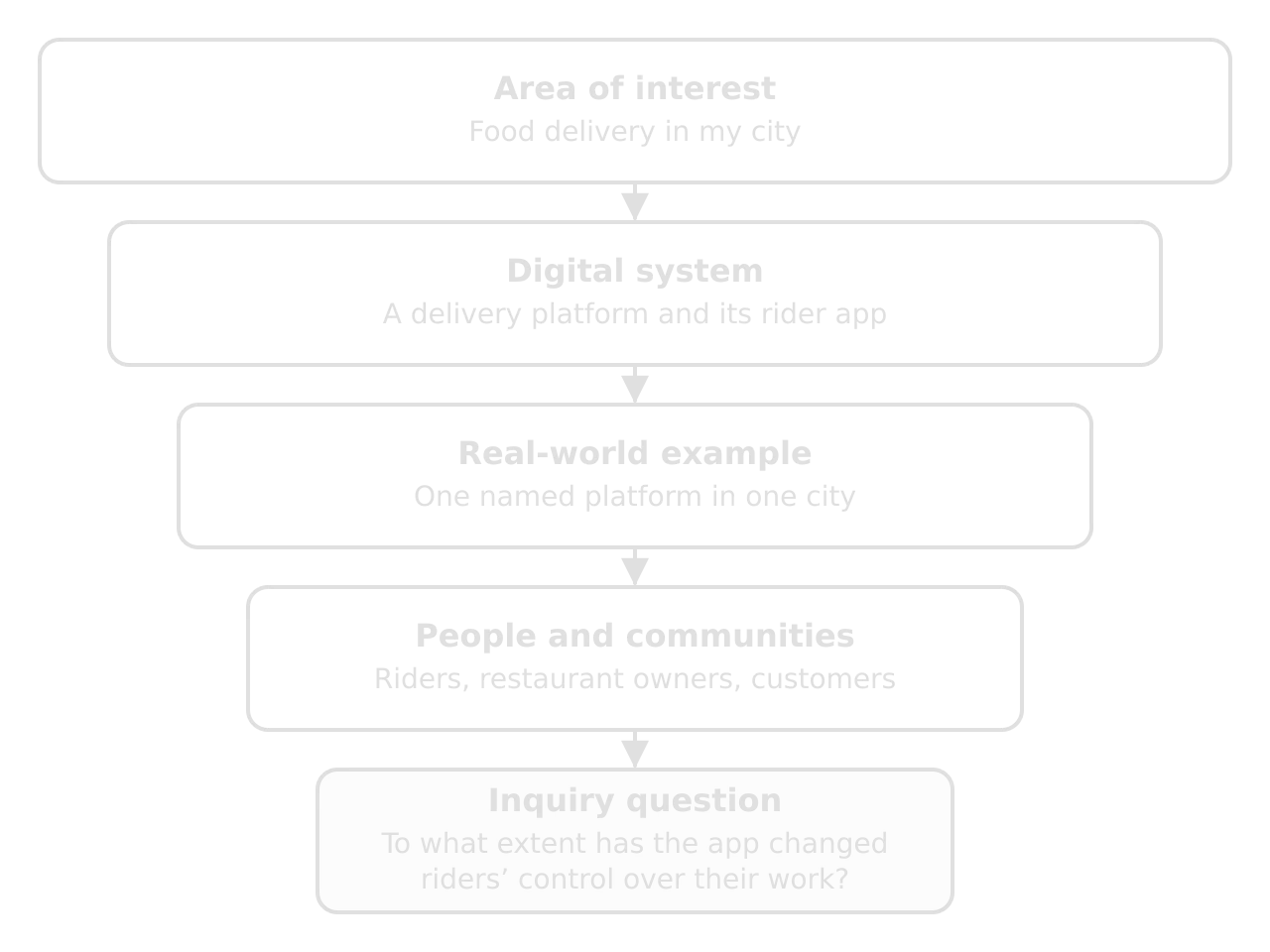
Weak and strong questions compared
Weak question | Problem | Stronger version |
|---|---|---|
How does TikTok's algorithm work? | Descriptive; no people, no judgement | To what extent does TikTok's For You feed shape the career ambitions of teenage users in one city? |
Is surveillance bad? | Too broad; no system; yes/no | How far did ShotSpotter in Chicago benefit the communities in which its sensors were placed? |
Do people like Citi Bike? | Closed; opinion poll rather than inquiry | To what extent has Citi Bike's expansion changed access to transport for residents of lower-income neighbourhoods in New York? |
What will AI do to schools in the future? | Speculative; no specific example | How has the introduction of AI writing tools on our school's learning platform affected the way teachers assess homework? |
Should delivery apps exist? | Normative and general | To what extent has algorithmic management on a named delivery platform changed riders' control over their working time? |
The same refinement process applies to any topic. One more short illustration shows a refinement from a local system:
"How do food-delivery apps affect workers?" (broad, no example)
"How does Foodpanda affect riders in Hong Kong?" (specific, but descriptive)
"To what extent does Foodpanda's app-based allocation of orders give riders in Hong Kong control over their hours and income?" (specific, evaluative, centred on one group and one feature)
Connecting to concepts, content and contexts
The inquiry focus explains how the question links to the course's three Cs. All three must be addressed, although they need not receive equal weight.
Content is the digital system itself: which type of technology is involved (data, algorithms, computers, networks, media, artificial intelligence, robots and autonomous technologies) and the relevant details of how it works.
Concepts (change, expression, identity, power, space, systems, values and ethics) are the lenses that give the inquiry insight. A concept turns a description into an argument: through the concept of power, a bike-sharing scheme becomes a question of who decides where docking stations go.
Contexts (cultural, economic, environmental, health, human knowledge, political, social) situate the inquiry in an area of life.
Real-world example | Content | Concept(s) | Context(s) |
|---|---|---|---|
Citi Bike in New York | Data (trip data), networks (docking system), algorithms (rebalancing) | Space, power | Environmental, social |
TraceTogether in Singapore | Data, networks (Bluetooth tokens) | Power, values and ethics | Political, health |
Google Classroom in one school | Data, algorithms, media | Change, identity | Human knowledge, social |
ShotSpotter in Chicago | Algorithms, AI (sound classification), networks (sensors) | Power, systems | Political, social |
Delivery platform riders | Algorithms (order allocation), data | Power, change | Economic, social |
The connections should explain, not just list. "Concept: power" earns little; "the concept of power frames the inquiry because the platform's algorithm, not the riders, decides which orders they see" shows why that lens matters for this question.
Planning and documentation
Making a timeline
The project spans many weeks alongside other subjects, so a written plan helps. The course toolkit describes planning as identifying the resources needed (time, people, materials), breaking a long process into smaller tasks, and setting deadlines. Schools set their own internal dates, and the teacher's calendar always takes priority over any generic plan.
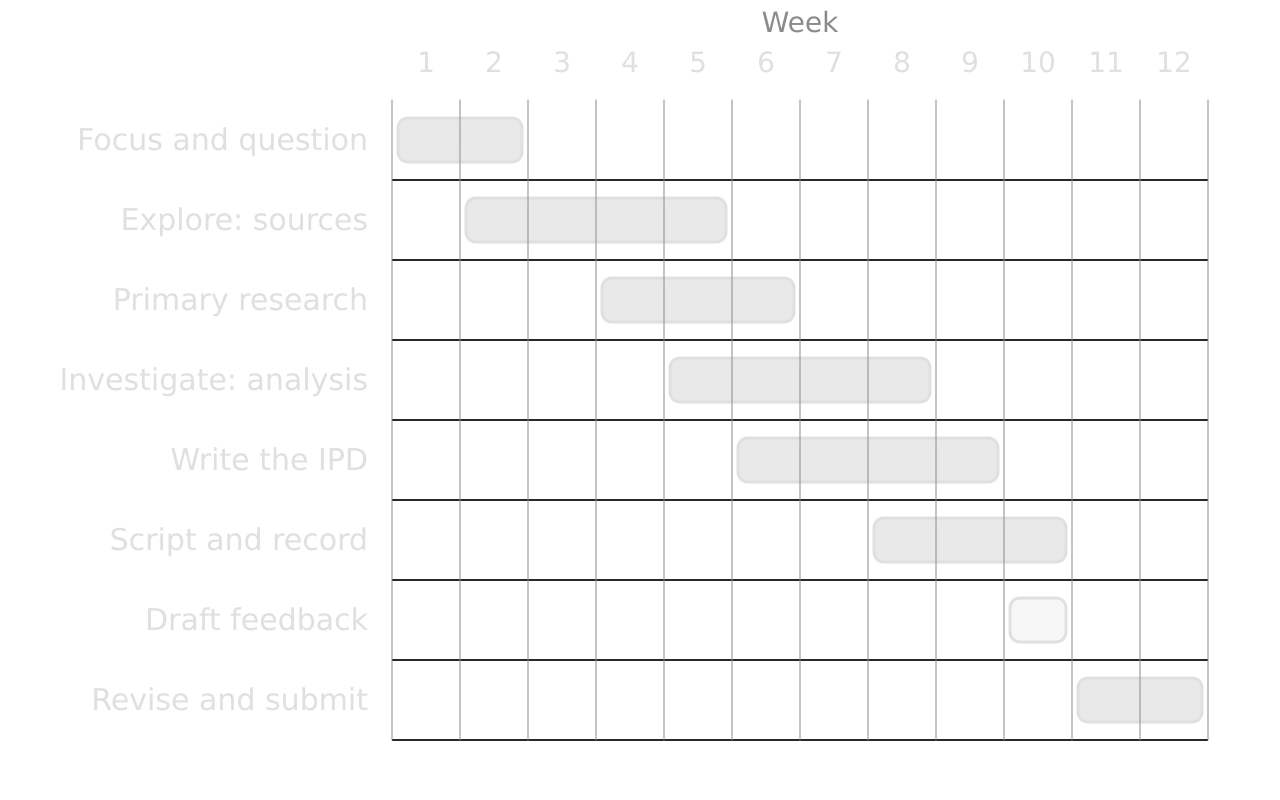
As a matter of good practice, a plan works best when it is concrete. "Research" is not a task; "find and annotate one academic or official source on Citi Bike station locations" is. Each task should have an estimated time and a date, and the plan should leave a buffer of a week or more before the internal deadline, because recording and editing a presentation usually takes longer than expected.
Phase | Typical tasks | Output |
|---|---|---|
Focus | Brainstorm topics; test three possible examples; draft and refine the question; discuss with the teacher | A refined question and a 3 Cs map |
Explore | Search for sources from different perspectives; annotate each; shortlist three for the IPD | Annotated source list |
Primary research (optional) | Plan an interview or survey; get approval; collect and store data securely | Notes, anonymised responses |
Investigate | Identify impacts and implications for each group; collect evidence for and against | An argument plan |
Write and build | Draft the IPD; script, record and edit the presentation | A complete draft |
Feedback and finish | Act on teacher feedback; check limits, citations and files | Final submission |
Keeping a research journal
A research journal (sometimes called a portfolio or inquiry log) is a running record of the project. It may be a notebook, a shared document or a note-taking app. It has three practical uses: it stops sources and ideas being lost, it makes writing the IPD faster because the source evaluations already exist, and it shows that the work is authentic. Teachers may check planning documents and records of work in progress when they confirm that a project is the student's own.
Useful journal entries include:
each version of the inquiry question, with the reason it changed
news articles and sources, with full reference details recorded at the time of reading
notes on each source's claims, perspective, value and limitations
mind maps or diagrams connecting stakeholders, impacts and concepts
notes from teacher and peer feedback, and what was done in response
records of any interviews or surveys (stored securely, with personal details removed).
Using feedback
Feedback can come from the teacher at each stage, from peers and from self-assessment against the criteria. Its purpose is to identify strengths and weaknesses, refine the approach and decide on next steps. Feedback on a focus is particularly valuable because a small change early (narrowing the example, rewording the question) saves a great deal of work later. The teacher may advise on how to improve but must not edit the draft.
Research ethics
Research ethics are the principles that keep research safe, honest and respectful. Three principles apply throughout the project:
Safe and appropriate research. Research should suit the school setting and the student's age. A student should not investigate in ways that create risk, such as contacting strangers online, visiting unsafe places or joining harmful online communities to observe them.
Acknowledging others. All ideas, words, data, images and media taken or adapted from others must be cited and referenced. This is both an ethical duty and an academic integrity rule.
Handling sensitive topics responsibly. Digital society often involves sensitive subjects: surveillance, discrimination, mental health, violence, extremism. These can be studied, but carefully: with respect for the people involved, without sharing harmful material, and with the teacher's guidance.
Finding diverse sources
A source is any material that provides information or evidence for the inquiry. The explore stage asks for sources that are grounded in the inquiry's concepts, content and contexts, that balance different claims and perspectives, and that support in-depth understanding rather than a quick overview.
Types of source
Sources come in many forms, and a well-researched project usually draws on several:
news reports from outlets with different perspectives and agendas
books, academic articles, reports from governments and international organisations
databases, social media posts, blogs and forum discussions
images, videos, podcasts and other media
live experiences such as lectures, workshops and interviews with experts or users.
A primary source is first-hand evidence created at the time or by those directly involved: a company's terms of service, a government's published data, an interview the student carries out, a user's social media post. A secondary source interprets or analyses primary material: a news analysis, an academic study, a documentary. Both are valuable, and a balance of the two often works best.
Balancing perspectives
Balance does not mean equal numbers of "for" and "against" sources. It means including the main groups that make claims about the system. For a project on ShotSpotter in Chicago, a balanced set might include the city's Office of Inspector General report of 2021, which found that about 9% of alerts led to documented evidence of a gun-related offence; material from the company that makes the system, which disputed such findings; and reporting that included the views of residents in the neighbourhoods where sensors were placed.
Searching efficiently
Search engines give the most popular results, not necessarily the most useful. More targeted searches combine the system's name with the type of source wanted ("Citi Bike equity study", "TraceTogether parliament statement"), use the school library's databases for academic articles, and check the websites of regulators, city governments and international organisations directly. Following the references in a good source often leads to two or three more.
Primary research
Primary data collected by the student, such as interviews or a short survey, can make a project distinctive, especially for a local example. It is optional, and a project can reach the top levels without it. When used, it must be done safely and ethically and should answer a clear need: evidence about a local group that no published source covers.
Choosing a method
Research methods fall into three groups. Qualitative methods explore experiences and behaviours in depth through interviews, observation or open questions, and produce themes and quotations (qualitative data). Quantitative methods measure facts across a larger number of people, through closed survey questions, polls or existing statistics, and produce patterns shown in tables and charts (quantitative data). Mixed methods combine the two.
Method | Good for | Limitations in a school project |
|---|---|---|
Interview (one person, in depth) | How a teacher, a delivery rider or a city official experiences a system | Small number; one person's view; time to transcribe |
Small survey | Patterns among, say, 60 students using the same learning platform | Sample is not representative of all users; question wording affects answers |
Observation | How people use a public system (for example, how often docking stations are full) | Records behaviour, not reasons; needs care around privacy |
Doing primary research ethically
Primary research involves real people, so the same ethical principles apply with extra force. The following steps are common good practice in school research rather than IB rules, and the school's own policy always comes first.
Get approval. Discuss the plan with the teacher before contacting anyone.
Ask for informed consent. Explain the purpose, how answers will be used and stored, and that participation is voluntary and can be withdrawn. Many schools also require parental consent for participants under 18.
Protect identities. Use anonymization: remove names and identifying details, and report "a Year 12 student" or "a delivery rider with two years' experience" rather than a name.
Collect only what is needed. Avoid questions about health, religion, political opinions or other sensitive personal data unless essential and approved.
Store data securely and delete it when the project is finished.
Stay safe. Interview adults in public or school settings, or by school-approved video call, never alone with strangers.
Common planning problems
Most difficulties later in the project trace back to choices made at the start. The table gathers the most frequent ones.
Problem | Effect later | Fix at the planning stage |
|---|---|---|
Topic instead of a specific system | Description rather than analysis; weak inquiry focus | Name the system, place and people |
Question too broad | Presentation runs over time or stays shallow | Narrow to one feature, one setting, one or two groups |
Descriptive or yes/no question | Little to evaluate | Reframe with "to what extent" or "how far" |
One-sided sources | Claims and perspectives section cannot compare views | Search deliberately for each stakeholder group |
No journal | Lost references; little to show the work is authentic | Record every source and decision as it happens |
Late start on the presentation | Rushed recording, poor media, over-length | Begin scripting while the IPD is still being drafted |
Checklist
- To do:
I can outline the three parts of the submission, their limits (1,500 words; 10 minutes) and the 24 marks across criteria A to E.
- To do:
I know that the project is identical at SL and HL and that appendices are not read.
- To do:
My real-world example names a specific, existing digital system, a setting and the people and communities affected.
- To do:
I have listed the groups directly and indirectly affected, including any who are excluded.
- To do:
My inquiry question is open-ended, evaluative and answerable in ten minutes.
- To do:
I can explain how my question connects to at least one concept, the relevant content and a context.
- To do:
I have a timeline with concrete tasks, deadlines and a buffer before the internal deadline.
- To do:
I keep a research journal with full reference details, source notes and feedback.
- To do:
My sources represent different perspectives, including independent ones.
- To do:
Any primary research has been approved, uses informed consent and anonymises participants.
- To do:
I can explain how the four inquiry stages connect to the criteria.
Carry on with Digital Society in Augment
With a free account, Augment remembers where you stopped in the notes and which questions you have marked.