"Paper 3: challenges and interventions"
Prepare from the Paper 3 pre-release with a research plan and a bank of evaluated interventions, then answer the four questions, evaluate an unseen intervention and write well-supported recommendations for future action.
- IB Digital Society
- Exam skills
- HL only
What Paper 3 is
Paper 3 is taken only at HL. It contains four compulsory questions about one intervention related to a challenge topic from the HL extension (global well-being, governance and human rights, or sustainable development). The questions move from understanding the intervention to analysing it, evaluating it and recommending steps for future action. The stimulus material, which can include text, visuals, data, diagrams or an infographic, is unseen: it appears for the first time in the exam. Knowledge of course concepts, content and contexts may be needed.
Paper 3 is different from the other papers in one important way. Four months before the exam, a pre-release statement introduces the challenge topic, so that students can carry out an extended inquiry into it and into relevant digital interventions. The exam then presents stimulus material about a specific intervention.
The pre-release statement
The pre-release is a short description, between 250 and 400 words, of the real-world nature of one challenge topic from the HL extension. It may also suggest resources, terms and approaches for an extended inquiry. The intervention that the questions address is presented in the exam's own stimulus.
Read the statement several times, marking five things:
The challenge. Which challenge and prescribed area it belongs to, and exactly which aspect it focuses on.
People and communities. Every group it names or implies, including those who are hard to reach or whose voices are rarely heard.
Digital systems. Any technologies, data, platforms or policies it mentions.
Terms. Specialist vocabulary to define and use accurately.
Tensions. Trade-offs it hints at, such as efficiency against fairness or innovation against privacy.
These five lists become the headings of the research plan.
Preparing from the pre-release
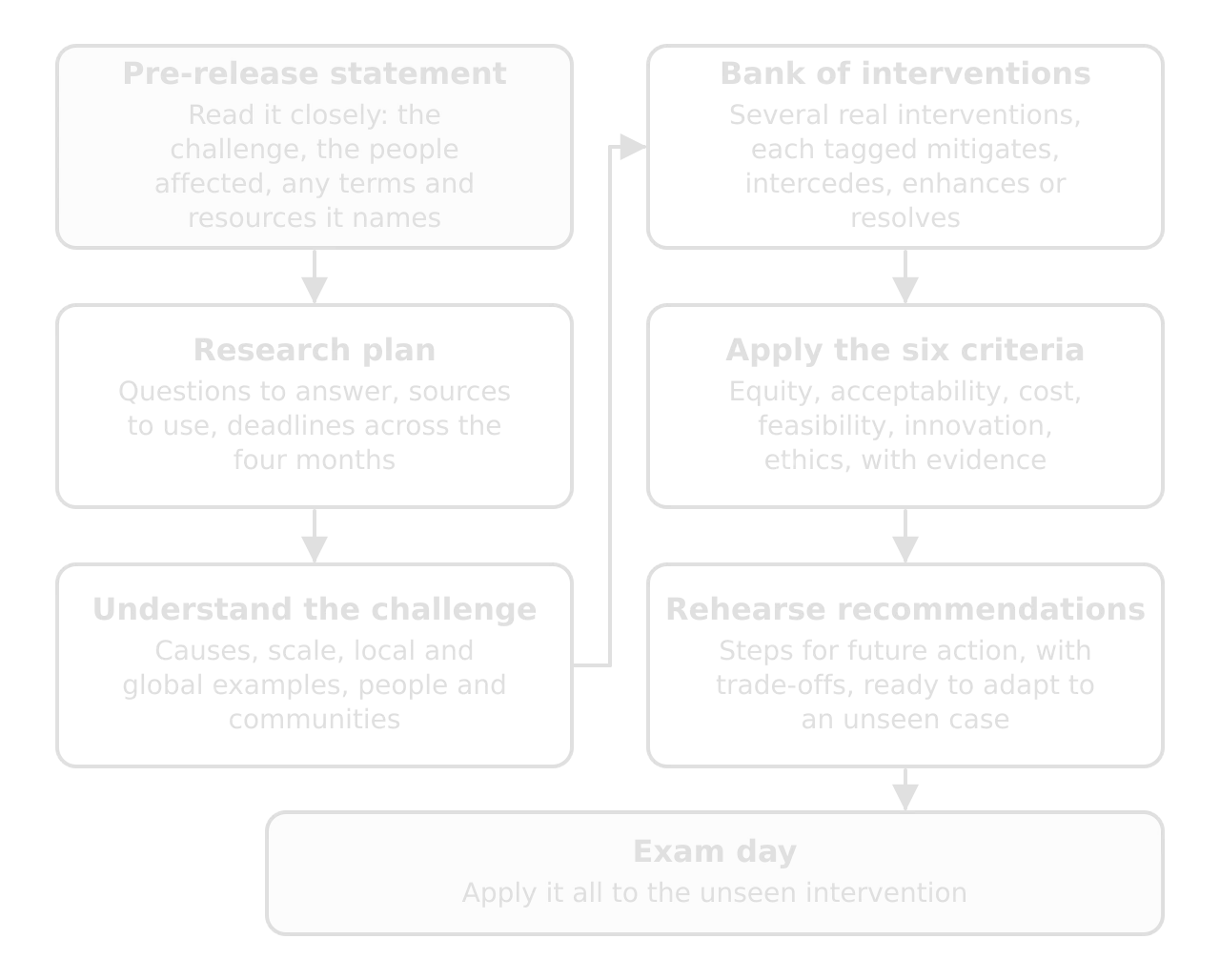
Four months is enough time for a thorough extended inquiry if it is planned. The preparation workflow moves from understanding the challenge to building and evaluating a bank of interventions, and finally to rehearsing recommendations.
A research plan
A simple plan divides the four months into stages, with a deadline for each.
Stage | About | What to produce |
|---|---|---|
Unpack the statement | Weeks 1–2 | The five lists; definitions of every term; a set of inquiry questions |
Understand the challenge | Weeks 3–6 | Notes on causes, scale and trends, with local and global real-world examples and data |
Build the bank of interventions | Weeks 7–10 | A profile of each of 5–8 real interventions of different types and scales |
Evaluate against the criteria | Weeks 11–13 | An evaluation of each intervention against the relevant criteria, with evidence |
Practise | Weeks 14–16 | Timed answers to practice questions on interventions you have not studied |
Understanding the challenge
Start with the challenge itself, because every evaluation depends on knowing what problem an intervention is trying to address. Useful inquiry questions include:
What is the relationship between digital systems and this challenge? Do digital systems cause it, worsen it, make it visible or help address it?
What is the nature and scope of the challenge: how many people, where, and how fast is it changing?
Which concepts, content topics and contexts help most in understanding it?
How does it appear at local and global levels?
Which specific people and communities are affected, and how do their claims differ?
What are the main impacts and implications?
Building a bank of interventions
An intervention is an action involving digital systems that aims to address a challenge. It can be an app, a platform or a device, but it can also be a policy or rule change that involves digital systems. The HL extension groups interventions into four overlapping categories.
Category | The intervention… |
|---|---|
reduces the negative aspects of the challenge | |
changes a process or trend that contributes to the negative aspects | |
strengthens the positive or effective aspects | |
removes the negative aspects |
Aim for variety in the bank: interventions from different regions, at different scales (a city app, a national law, a global platform), of different categories, and with different results, including some that failed. An intervention that failed is often the best source of recommendations, because the reasons for its failure suggest what to do differently. For each intervention, record the same facts: what it is, who runs it, where and since when, how the digital system works, who it affects, its category, evidence of its effects, and its evaluation against the criteria.
Applying the six criteria
The HL extension provides six criteria for evaluating interventions and recommending steps for future action. Not every criterion fits every intervention; choose the most relevant ones. Each criterion has a matching question for recommendations, which makes the evaluation the direct basis of question 4.
Criterion | Evaluation question | Matching question for recommendations |
|---|---|---|
Does it fairly address the needs, claims and interests of the people affected? (fairness, inclusion, reciprocity) | How could it be made more equitable for more people? | |
Do the affected people see it as acceptable? (accountability, transparency) | How could it be made more accountable and transparent? | |
What are its financial, social, cultural and environmental costs, and do they outweigh the benefits? | How could costs be reduced or balanced against benefits? | |
Is it technically, socially and politically feasible? What barriers exist or are emerging? | How could the barriers be addressed? | |
Is the approach new, or has it failed before? Is it incremental, sustaining or disruptive? | How could it be adapted or refined to avoid risks, failures or limitations? | |
Ethics | Is it ethically sound, and who decides? | How could it be developed or used ethically? |
The four questions
The four questions move from understanding to recommendation, and the marks rise with the demand.
Question | Marks | Level | What it demands |
|---|---|---|---|
1 | 4 | AO1 | Knowledge and understanding of the intervention and/or the challenge; often split, for example 2 + 2 |
2 | 6 | AO2 | Application and analysis of the intervention and/or the challenge; may be split, for example 3 + 3 |
3 | 8 | AO3 | Evaluation of the intervention, often against named criteria; marked with markbands |
4 | 12 | AO3 | Recommendations for future action related to the intervention and/or the challenge; marked with markbands |
Question 1 usually draws on the stimulus: identifying features of the intervention or describing how it works. Keep answers short and precise. Question 2 asks for explanation or analysis, for example why the intervention might reduce a problem or why some groups use it less. Use the point, reason and consequence pattern, tied to details in the stimulus. Question 3 asks for an evaluation, often naming two criteria. Question 4 asks for recommendations and may invite answers to draw on the student's own inquiry into other interventions.
Paper 3 allows about two and a half minutes per mark. A sensible split is about 5 minutes reading the stimulus, 8 minutes for question 1, 14 for question 2, 20 for question 3 and 28 for question 4.
Markbands for questions 3 and 4
Questions 3 and 4 are marked with markbands applied as a best fit to the whole response.
Marks (Q3) | Level descriptor for the evaluation |
|---|---|
1–2 | Limited understanding; limited relevance; descriptive, with mostly unsupported generalisations; limited organisation |
3–4 | Some understanding; mainly descriptive, with some evaluation that is not sustained or fully supported; partly organised |
5–6 | Adequate understanding; adequate evaluation that is relevant and supported; adequately organised |
7–8 | Focused, in-depth understanding; sustained evaluation, relevant and well supported throughout; well structured |
In question 3, the step to the top band is sustained evaluation. Every paragraph judges the intervention against a criterion, with evidence from the stimulus and from own knowledge, rather than describing it.
Marks (Q4) | Level descriptor for the recommendations |
|---|---|
1–3 | Limited understanding; mostly unsupported generalisations; no recommendations, or recommendations with only limited support; limited organisation |
4–6 | Some understanding; knowledge not always relevant or accurate; recommendations with some support that is not sustained; partly organised |
7–9 | Adequate understanding; relevant, accurate knowledge; recommendations presented and effectively supported; adequately organised |
10–12 | Focused, in-depth understanding; well supported throughout; recommendations well supported, with clear consideration of possible trade-offs and implications; well structured |
In question 4, the top band adds trade-offs and implications. A recommendation that is well supported but presented as cost-free is likely to stay at 7–9. The top band explains what each recommendation would cost, who might lose out, and what new risks it might create.
Writing recommendations for future action
A recommendation is a specific, advisable action, supported by evidence and reasoning, for a given situation. In Paper 3, recommendations respond to the weaknesses found in the evaluation, so the strongest answers to question 4 build directly on question 3.
A complete recommendation contains six elements:
The action: what should be done, stated precisely.
The actor: who should do it (the city council, the platform, a regulator, a community organisation).
The reason: which weakness or criterion it addresses.
The evidence: a real-world example where a similar step worked, or failed.
The trade-offs: what it costs, who might lose out, what might go wrong.
The implications: what it would mean for the people and communities affected, and for the challenge.
Two or three developed recommendations, ranked or connected, are better than a long list of brief ones. End with a short judgement about which recommendation matters most and why.
A practice set
The practice set follows the format of Paper 3 but is not based on any pre-release. The challenge is participation and representation (governance and human rights). The intervention, CityVoice, and its data are a scenario written for this exercise; the real-world examples in the model answers are real.
Stimulus. Scenario: Two years ago, a city of about 600,000 people launched CityVoice, an app and website for participatory budgeting. Each year, the city sets aside part of its investment budget for projects proposed by residents. Any resident aged 16 or over can submit a proposal, comment on other proposals and, after a technical check by city staff, vote for up to five projects. Voting is only possible through CityVoice and requires a verified account linked to the city's digital ID.
In the second year, 21,000 residents voted. Residents over 65 made up about 20% of the adult population but 5% of voters, and three wealthier districts out of twelve produced half of all proposals. A local disability organisation reported that the app did not work well with screen readers. The city council says CityVoice has "brought democracy into every pocket".
Question 1 rewards accurate, brief answers taken from or based on the stimulus. In part (b), the answer uses the HL extension's category correctly and explains which positive aspect is strengthened.
Each reason is a point, a cause and a consequence, tied to data in the stimulus. The second reason goes beyond access to technology, which shows analysis of the whole participation process rather than only the app.
The evaluation stays on the two named criteria throughout. Each paragraph weighs a strength against a limitation, uses specific data from the stimulus, adds a real-world comparison, and ends with a judgement. This is the sustained, well-supported evaluation the 7–8 band describes.
The response would reach the 10–12 band. Each recommendation names an action, an actor and a reason taken from the question 3 evaluation, is supported by a real intervention (Paris, vTaiwan), and states its trade-offs and implications separately. The final paragraph ranks the recommendations and links them back to the challenge, which shows synthesis rather than a list.
Checklist
- To do:
I know the structure of Paper 3: four compulsory questions worth 4, 6, 8 and 12 marks.
- To do:
I can unpack a pre-release statement into the challenge, people and communities, digital systems, terms and tensions.
- To do:
I have a four-month research plan with deadlines.
- To do:
I have a bank of 5–8 real interventions of different types, scales and outcomes, each classified by category.
- To do:
I can evaluate an intervention against each of the six criteria, with evidence.
- To do:
I keep question 3 to the criteria it names and make the evaluation sustained.
- To do:
I write recommendations with an action, actor, reason, evidence, trade-offs and implications.
- To do:
I apply my preparation to the unseen intervention in the paper rather than writing out prepared material.
Carry on with Digital Society in Augment
With a free account, Augment remembers where you stopped in the notes and which questions you have marked.