"Paper 2: source-based questions"
Read Paper 2 sources for origin, purpose, meaning, methods and corroboration, compare two sources point by point, and integrate all the sources with own knowledge in a 12-mark evaluation.
- IB Digital Society
- Exam skills
- SL and HL
How Paper 2 works
Paper 2 is the same paper at SL and HL. It presents a set of sources on one theme from the common course, usually four sources labelled A to D, and asks four compulsory questions. The sources can be text (news articles, blog posts, reports, social media posts), visuals (photographs, cartoons, advertisements), data (tables, charts) or diagrams and infographics. They are chosen to show different claims and perspectives on the theme.
Question | Marks | Level | What it demands |
|---|---|---|---|
1 | 2 | AO1 | Knowledge and understanding of one source: identifying a claim or perspective, or describing what an infographic, diagram or data set shows. May be split, for example 1 + 1 |
2 | 4 | AO2 | Application and analysis: explaining a claim or perspective, or analysing how a term or technique is used. May be split, for example 2 + 2 |
3 | 6 | AO3 | Comparing and/or contrasting two sources, often their claims and perspectives. May also ask for your own knowledge |
4 | 12 | AO3 | Evaluation and synthesis that integrates evidence from the sources with your own knowledge from the course. Marked with markbands |
The marks rise steeply. Question 4 is worth half the paper, and questions 3 and 4 together are worth three quarters. Time spent on questions 1 and 2 should match their small mark allocations.
Reading sources
The course toolkit gives three overlapping ways to examine a source. They apply to every question, and they are especially useful in questions 2 and 3.
Facet | Questions to ask | Why it matters |
|---|---|---|
Who made it, when and where? Is the author hidden? Why was it made: to inform, persuade, sell, campaign? | Shows potential bias and the source's value and limitations for different people and communities | |
Meaning and methods | What is the main message? What techniques support it: word choice, images, statistics, layout, design? | Shows how the source tries to convince, and whether its methods are sound |
Corroboration and use | Do other sources or your own knowledge support or contradict it? How has it been shared or used, and by whom? | Helps judge reliability and validity |
Each source can be annotated quickly with these three facets once writing begins (nothing may be written during the reading time at the start). A few words in the margin, such as "campaign group, persuasive", "US survey, teachers' views only" or "agrees with C on distraction", provide most of the material for questions 2 to 4.
Reading data and visual sources
Charts and infographics are sources too, with an origin, a purpose and methods. Read the title, the axis labels, the units, the date and the sample before the bars or lines. Ask what the data measures (behaviour, opinion, outcome), who was asked, and what it cannot show. A survey of opinions shows what people believe, not what is true; a correlation shows that two things occur together, not that one causes the other.
Questions 1 and 2
Question 1 tests reading. A request to identify two claims needs two short, distinct points taken from the source, in the student's own words or as brief quotations. A request to describe information in a chart needs specific values or trends with units. No explanation is needed.
Question 2 asks for application and analysis, often of one source. The key is to go one step beyond the source: explain why the author makes the claim, how a technique supports it, or what a term means in this context. For a two-plus-two split, write two short paragraphs, each with a point from the source and an explanation.
Question 3: comparing and contrasting two sources
Question 3 asks for a comparison and/or contrast of two named sources, usually their claims and perspectives. The command term requires the answer to refer to both sources throughout. Two separate summaries, one of each source, do not compare.
A point-by-point structure meets this demand:
Choose three or four themes on which both sources say something (their main claim, their evidence, their perspective, their methods or purpose).
Write one short paragraph per theme, covering both sources in each paragraph.
Use linking words that signal comparison: both, similarly, whereas, however, unlike, in contrast.
Include at least one similarity and one difference if the question says "compare and contrast". If it says only "compare" or only "contrast", focus on what it asks for.
Six marks suggest about three developed points, each supported by evidence from both sources. Sorting the points before writing, for example in a quick two-circle diagram, makes it easier to see which are shared and which belong to one source only.
Question 4: integrating sources with own knowledge
Question 4 asks for an evaluation of a claim or issue "using all the sources and your own knowledge". It is the longest answer in the paper and is marked with markbands.
Marks | Understanding and knowledge | Use of sources | Organisation |
|---|---|---|---|
1–3 | Limited understanding of the question; limited relevant knowledge | Evidence from the sources is not integrated | Limited |
4–6 | Some understanding; knowledge not always relevant or accurate | Partially integrated | Partially organised |
7–9 | Adequate understanding; relevant, accurate knowledge with some lapses | Adequately integrated, but not sustained | Adequately organised |
10–12 | Focused, in-depth understanding; relevant, accurate knowledge throughout that adds insight | Consistent and effective integration of source evidence | Well structured, effectively organised |
The markbands combine two demands. Answers that use only the sources, or only their own knowledge, cannot reach the top band. Integration means using sources and own knowledge together in the same argument: a source makes a claim, own knowledge supports or challenges it, and the answer judges what the combination shows.
A structure for question 4
Opening: state the judgement on the claim in one or two sentences.
Body (three or four paragraphs): each paragraph makes one argument, draws on at least one source by letter, adds a piece of own knowledge (a real-world example, a course concept, data), and comments on the strength of the evidence where useful.
Conclusion: weigh the arguments and give a judgement with conditions.
Use every source at least once. The sources often represent different stakeholders, so grouping them by perspective helps to build a balanced argument.
Timing
Paper 2 allows about three minutes per mark. A sensible plan:
about 10–12 minutes reading and annotating all four sources;
about 4 minutes for question 1;
about 8 minutes for question 2;
about 15 minutes for question 3;
about 35 minutes for question 4, including a short plan.
Time spent reading is not wasted. Careful annotation in the first ten minutes makes questions 3 and 4 quicker to plan.
A practice paper
The practice paper follows the format of Paper 2. Sources A, C and D were written for this exercise and describe no real school or organisation. Source B presents real survey data, and Source D refers to a real study; both are cited.
Theme: smartphones in schools
Source A. Letter to parents from the principal of a secondary school (written for this exercise).
From the start of next term, students will not be able to use their phones during the school day. Phones will be locked in a pouch at the school gate and unlocked at the end of the day. Teachers have told us that phones are the single biggest distraction in lessons, and our pastoral team has dealt with more cases of online bullying this year than ever before. We want break times to be about talking and playing, not scrolling. Parents who need to contact their child urgently can call the school office.
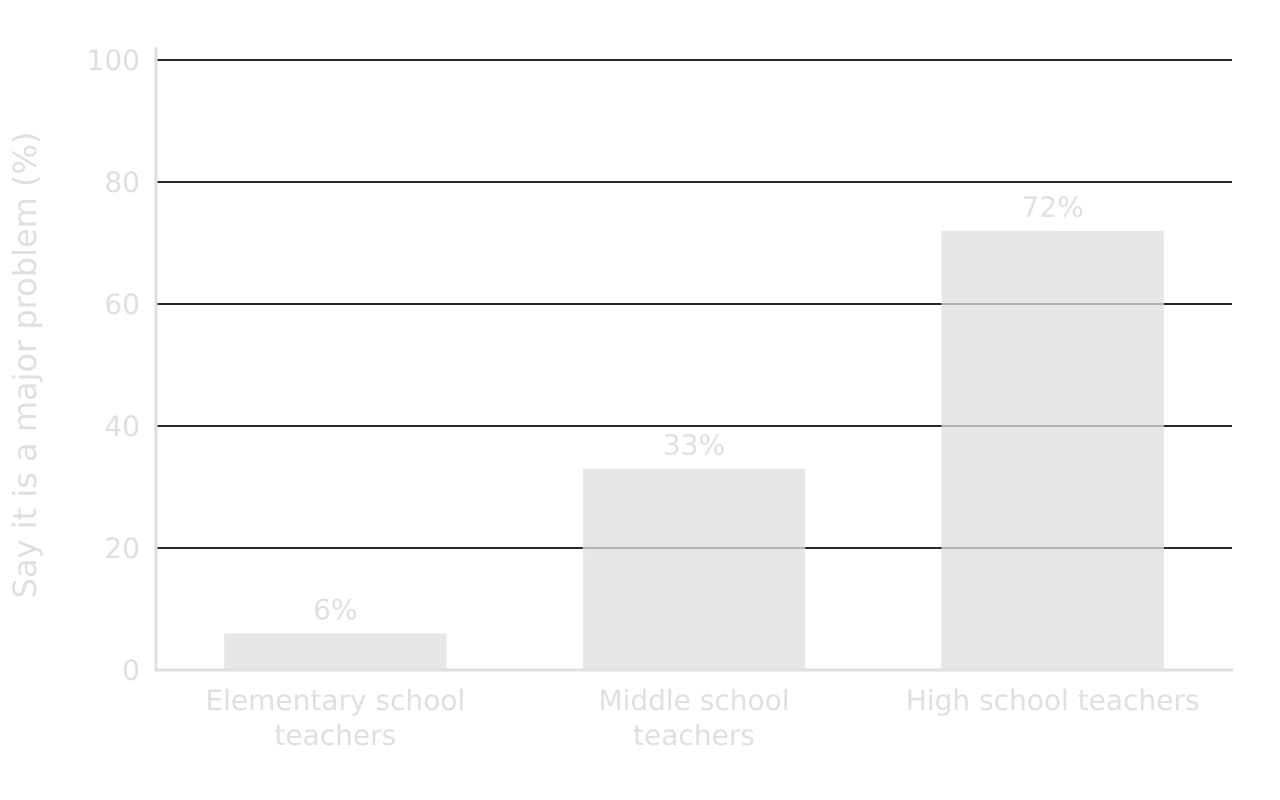
Source B. Survey of public school teachers in the United States (Pew Research Center, 2024).
Source C. Blog post by a parents' campaign group (written for this exercise).
Every parent in our group has a story. A daughter who stopped sleeping because of group chats at midnight. A son who was filmed in the changing room and saw the video shared before lunch. Teachers tell us they spend their lessons fighting for attention against apps designed to be addictive. A phone-free school day is the simplest way to give children their childhood back. Schools that have done it say the playground is noisy again, in the best way. We are asking every school in the region to follow.
Source D. Article on the website of a student-led digital rights group (written for this exercise).
No one denies that phones can distract in lessons. But a blanket ban treats every student as a problem and every phone as a toy. Many of us use our phones to manage medical conditions, to translate lessons, or to stay in touch with a parent working night shifts. The evidence for bans is also weaker than campaigners claim: a 2025 study of 1,227 students at 30 secondary schools in England found no evidence that those at schools with restrictive phone policies had better mental well-being. They used their phones less during school hours, but their total use on weekdays and at weekends was no lower. Schools should teach students to manage their phones, not lock them away.
Questions
Each reason is distinct, taken directly from the source and stated briefly. A third reason (wanting break times for talking and playing) would also have earned a mark; no explanation is needed.
Part (a) gives the trend with specific values and units. Part (b) names a limitation based on the source's methods (opinions, not outcomes) and origin (United States), and links it to Source A's decision, which is what explain asks for.
The answer refers to both sources in every paragraph and covers three themes: claims, evidence, and perspectives with origins. It includes similarities and differences, uses short quotations, and comments on the strength of each source's evidence, which is the level of development six marks require.
This response would reach the 10–12 band. It states a conditional judgement at the start and returns to it at the end. Every source is used, each by letter, and own knowledge (the UNESCO report, the Dutch guideline, the concept of power) is woven into the same paragraphs as the sources rather than added separately. It also evaluates the evidence itself, contrasting opinion data and personal stories with a systematic study, which is the insight the top band describes.
Checklist
- To do:
I know the demand and marks of each of the four questions.
- To do:
I annotate every source for origin and purpose, meaning and methods, and corroboration and use.
- To do:
I read data sources for what they measure, whom they cover and what they cannot show.
- To do:
I answer questions 1 and 2 briefly and precisely, with specific limitations rather than "it might be biased".
- To do:
I compare two sources point by point, with both letters in every paragraph.
- To do:
I use every source in question 4 and integrate them with my own knowledge in the same paragraphs.
- To do:
I comment on the strength of source evidence inside my evaluation.
- To do:
I spend about half my time on question 4.
Carry on with Digital Society in Augment
With a free account, Augment remembers where you stopped in the notes and which questions you have marked.