"Paper 1 Section B: the HL extended response"
Plan and write a 12-mark extended response on the HL extension that uses a concept as a lens, a specific real-world example and well-handled counter-claims to reach a supported judgement.
- IB Digital Society
- Exam skills
- HL only
What Section B asks
Section B appears only in the HL Paper 1, after Section A. It contains two questions, of which students answer one. Each is an extended response worth 12 marks, set entirely at AO3: it requires evaluation and synthesis, together with consideration of counter-claims. Additional stimulus material, such as a quotation or a short data set, may be provided.
The questions come from the HL extension: the three challenges and their prescribed areas for inquiry.
Challenge | Prescribed areas for inquiry |
|---|---|
Global well-being | Local and global inequalities; changing populations; the future of work |
Governance and human rights | Conflict, peace and security; participation and representation; diversity and discrimination |
Sustainable development | Climate change and action; use of resources; managing pollution and waste |
A typical question asks for a discussion or evaluation of a claim about one of these areas, with reference to a real-world example and sometimes to one concept chosen from a short list given in the question (for example, change, power or values and ethics). The question may also refer to interventions: digital systems, or policies that involve them, which aim to address a challenge.
The pre-release statement is issued for Paper 3, not for Section B, so any of the nine prescribed areas can appear, so preparation means having at least one well-understood real-world example and one intervention for each of the nine areas.
The markbands
Section B is marked with an analytic markscheme for the specific question and with four markbands, applied as a best fit to the whole response.
Marks | Understanding and knowledge | Counter-claims | Organisation |
|---|---|---|---|
1–3 | Limited understanding; descriptive, mostly unsupported generalisations | Not considered or addressed | Limited |
4–6 | Some understanding; knowledge not always accurate or well used; mainly descriptive, with some analysis that is not sustained | Partially addressed | Partially organised |
7–9 | Adequate understanding; adequate, effective analysis supported by relevant, accurate knowledge | Adequately addressed | Adequately organised |
10–12 | Focused, in-depth understanding; evaluation and synthesis effectively and consistently supported by relevant, accurate knowledge | Effectively addressed | Well structured and effectively organised |
Two steps separate the bands. The first is from description to analysis (4–6 to 7–9): the answer explains why and how, with accurate evidence. The second is from analysis to evaluation and synthesis (7–9 to 10–12): the answer weighs the arguments and brings them together into one judgement, and it deals with counter-claims effectively rather than only mentioning them.
What "effectively addressed" means
A counter-claim is effectively addressed when it is stated in its strongest form, supported with evidence, and then answered: the answer explains whether it changes the judgement, and how. There are three good ways to answer a counter-claim.
Response | What it does | Example phrase |
|---|---|---|
Rebut | Shows that the counter-claim is weaker than it looks, with evidence | "This risk is real, but the evidence suggests it has been managed by…" |
Concede and limit | Accepts the counter-claim for some people or situations, and limits the original claim | "This is true for…, so the claim holds only where…" |
Weigh | Accepts both, then argues that one matters more | "Both are supported, but the second affects more people, for longer…" |
The weakest response is dismissal: "some people disagree, but the benefits are greater". It mentions a counter-claim without engaging with it, which matches "partially addressed" at best.
Planning the response
Twelve marks in about 30–35 minutes allows five minutes of planning and 25–30 minutes of writing, which is usually 600–800 words. The plan matters more here than anywhere else in Paper 1, because the markbands reward a structured argument with a clear judgement.
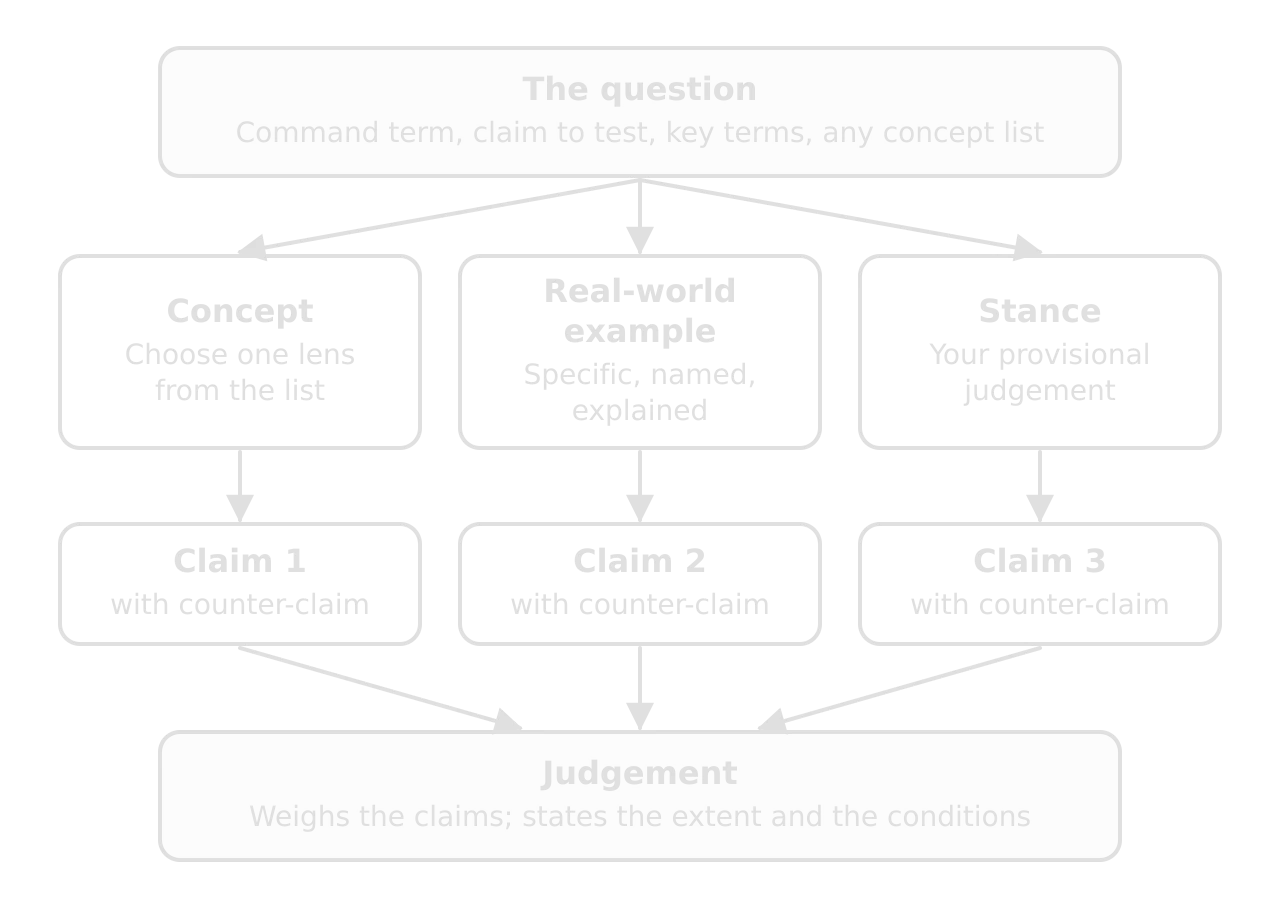
A five-minute plan answers five questions:
What exactly is the question asking? Underline the command term and the claim being tested. Circle key terms that need defining (for example "participation" or "intervention").
Which concept will I use? If the question gives a list, choose the concept that opens the most interesting argument about the example, not the one that is most familiar in general.
Which real-world example? One specific, named case, known well enough to give dates, places, people and outcomes.
What is my provisional stance? One sentence that answers the question, with a condition.
What are my three claims and their counter-claims? Write each pair in a few words.
Structure
A clear structure makes the evaluation easy to follow and is itself rewarded in the top band ("well structured and effectively organised").
Introduction (about 80–100 words). Define the key terms, introduce the real-world example in one or two sentences, name the concept that the answer will use, and state the judgement.
Three body sections (about 150–200 words each). Each section opens with a claim, supports it with evidence from the example, explains it through the concept, then states and answers a counter-claim.
Conclusion (about 80–100 words). Weigh the three sections against each other, and give a judgement of degree with its conditions. No new evidence.
Using the concept
The concept should run through the whole answer, not appear only in the introduction. Through the concept of power, for example, every section asks who gains control, who loses it, and who decides. Through the concept of change, the sections ask what is different, for whom, and whether the change is an evolution or a transformation. Through values and ethics, they ask whose values the intervention reflects and whether its effects are fair.
Using the HL extension framework
The HL extension gives useful tools for structuring an argument. An intervention can be classified as one that mitigates negative aspects of a challenge, intercedes to change a process, enhances positive aspects, or resolves the problem. It can then be judged against criteria such as equity, acceptability, cost, feasibility, innovation and ethics. Using two or three of these criteria as the basis of the body sections gives a ready-made, balanced structure.
Writing the introduction and conclusion
The introduction and conclusion carry the judgement, so they deserve more care than their length suggests. An introduction that only restates the question delays the argument. One that defines the terms, names the example and concept, and commits to a judgement tells the reader what every later paragraph is for.
Weak | Strong | |
|---|---|---|
Introduction | "Digital technology affects participation in many ways, and people have different opinions about it. This essay will discuss the advantages and disadvantages." | "Political participation means the ways citizens take part in decisions that affect them. Through the concept of power, Estonia's internet voting suggests that digital interventions increase participation for specific groups, such as citizens abroad, but not for the electorate as a whole." |
Conclusion | "In summary, there are good and bad sides, and it depends on the situation." | "The claim holds only to a limited extent: i-voting widened access for some groups without raising turnout, and its value depends on trust, independent audits and a paper alternative." |
The strong conclusion does more than summarise. It answers the command term with a degree ("only to a limited extent"), gives the main reason, and names the conditions under which the judgement would change. That final step, saying what the judgement depends on, is a clear sign of synthesis.
A model answer
The question is in the style of Section B. The model answer is a strong student response of about 750 words.
The answer matches the top markband for the reasons in the table.
Feature | Where it appears | Why it earns credit |
|---|---|---|
Focused understanding | Introduction defines participation and the intervention, and states a qualified judgement | Shows in-depth understanding of the demands of the question |
One concept used throughout | Power appears in every section: who is empowered, who controls the count, who is trusted | The concept drives the analysis rather than labelling it |
Specific real-world example | Dates (2007, 2014, 2017, 2023), figures (over half of votes online; about 750,000 cards; turnout 62–64%) and named mechanisms (ID card, re-voting) | Relevant, accurate knowledge consistently supports each point |
Counter-claims effectively addressed | One per section: rebutted with turnout evidence, conceded and limited on security, weighed on trust | Counter-claims change the judgement rather than sit beside it |
Synthesis | The conclusion combines the three sections into one conditional judgement | Evaluation and synthesis, not a summary |
Common problems
Most weak Section B answers share a small number of problems.
Problem | Effect on the mark | Fix |
|---|---|---|
Describing the technology at length | Stays descriptive (4–6 at best) | Limit description to what the argument needs; spend the words on why and how far |
No concept, or a concept named only once | Analysis is shallow | Ask the concept's question in every section |
A vague example ("social media", "AI in hospitals") | Knowledge is not specific enough to support claims | Name the system, place, date, people and outcome |
Counter-claims only at the end | Partially addressed | Put a counter-claim in each section and answer it |
A judgement of "yes" or "no" with no conditions | Evaluation looks one-sided | Give the extent and the conditions under which it holds |
Losing time on Section A | A short, unplanned Section B | Keep strictly to the time for each Section A question |
Checklist
- To do:
I know that Section B is one of two questions, 12 marks, AO3, on the HL extension, with counter-claims required.
- To do:
I know the four markbands and the two steps that separate them.
- To do:
I can rebut, concede and limit, or weigh a counter-claim, and I avoid dismissing it.
- To do:
I plan for about five minutes: command term, concept, example, stance, three claims with counter-claims.
- To do:
I use one concept throughout the answer, not only in the introduction.
- To do:
I have one specific real-world example and one intervention for each of the nine prescribed areas.
- To do:
I can use the intervention categories and evaluation criteria to structure an argument.
- To do:
I end with a judgement of degree that states its conditions.
Carry on with Digital Society in Augment
With a free account, Augment remembers where you stopped in the notes and which questions you have marked.