"Paper 1: structured questions"
Choose two Paper 1 questions well, answer parts (a), (b) and (c) to their command terms, plan an 8-mark evaluation that reaches the top markband, and manage your time.
- IB Digital Society
- Exam skills
- SL and HL
How Section A works
Paper 1 Section A is the same at SL and HL. It contains four structured questions, of which students answer two. Each question is worth 20 marks and opens with a short stimulus: usually a paragraph describing a scenario involving a digital system, sometimes with an image, a short data set or a quotation. The stimulus may describe a real case or a realistic invented one. The questions draw on the whole common course: any concept, content topic or context can appear.
Every question has the same three-part structure, and each part is set at one assessment objective level.
Part | Marks | Level | What it asks for | Typical command terms |
|---|---|---|---|---|
(a) | 6 | AO1 | Knowledge and understanding, often of the technology or ideas in the stimulus | Identify, state, define, outline, describe |
(b) | 6 | AO2 | Application and analysis, usually of the scenario in the stimulus | Explain, analyse, distinguish, suggest |
(c) | 8 | AO3 | Evaluation and synthesis of a wider issue raised by the stimulus | Discuss, evaluate, examine, to what extent, justify, recommend |
Parts (a) and (b) are often split into sub-parts, for example (a)(i) [2] and (a)(ii) [4], or (b)(i) [3] and (b)(ii) [3]. They are marked with an analytic markscheme: each valid point, developed as the command term requires, earns marks. Part (c) has its own markscheme too, but it is also marked with markbands, a set of level descriptors applied to the whole answer as a best fit, which reward the quality of the argument rather than the number of points.
Choosing two questions
The choice needs a method. The best approach is to read all four stimuli and all four (c) parts before deciding. A familiar stimulus matters less than a (c) question that can be answered with a well-known real-world example.
A quick test for each question:
Can I answer part (c) with a specific real-world example and a clear judgement?
Do I know the technical terms that part (a) is likely to need?
Can I see at least two distinct points for part (b) in the scenario?
Choose the two questions where all three answers are yes. If none fits perfectly, favour the question whose (c) offers the strongest argument, because the AO1 marks in (a) are fewer and easier to secure with partial knowledge.
Reading the stimulus
The stimulus is short, but almost every phrase in it is there for a reason. Read it twice: once for the situation, and once with a pen, marking three things.
The digital system. What technology is involved and what it does (an app that issues QR codes, a facial recognition camera, a recommendation algorithm). Part (a) usually asks about this.
The people and communities. Every group named or implied (passengers, staff, older people, the operator, a regulator). Part (b) usually asks about impacts on them.
The tension. Any objection, conflict or trade-off (savings against access, safety against privacy). Part (c) usually widens this tension into a general question.
Marking these before answering saves time later, because the material for each part is already identified.
Technique for part (a)
Part (a) tests knowledge of what things are and how they work. The marks are for accuracy and precision, not for length.
Match the marks. In an identify or state question, one mark is usually given for each correct item. In an outline or describe question, marks are typically split between points and their development: a four-mark describe might want two features, each with a sentence of detail.
Use course terminology. "The app collects geolocation data through the phone's GPS receiver" is better than "the app knows where you are".
Use the stimulus when the question does. "Identify two types of data the app collects" may be answered from the stimulus; check it first.
Do not explain unless asked. Reasons and judgements earn nothing in an AO1 part and use up time.
Technique for part (b)
Part (b) asks for knowledge to be applied to the scenario. The key word is why: the answer gives reasons and consequences, and it refers to the people and places in the stimulus.
A three-mark explain usually rewards one point developed in three steps: the point, the reason, and the consequence for a named group. A six-mark analyse rewards a broken-down answer that shows the parts of the issue and how they connect. For both, the strongest answers name the stakeholders in the scenario (older passengers, part-time staff, the operator) rather than "people".
Technique for part (c)
Part (c) usually moves out from the stimulus to a wider question: from one operator's ticketing app to digital public services in general, or from one school's AI policy to the role of AI in education. The question may ask for a real-world example studied during the course. That means a real, named case from outside the paper, not the stimulus scenario.
The markbands
The markbands for part (c) describe four levels. Each band adds a demand to the one before.
Marks | What the response does | What moves it up a band |
|---|---|---|
1–2 | Shows limited understanding of the question; mostly description and unsupported generalisations; little organisation, or a list | Answer the question that was asked, and support each point |
3–4 | Some understanding; some relevant knowledge, not always accurate or well used; some analysis, not sustained; partly organised | Explain why each point matters, with accurate, relevant evidence |
5–6 | Adequate understanding; adequate, effective analysis supported by relevant, accurate knowledge; adequately organised | Weigh the arguments and reach a judgement that pulls them together |
7–8 | Focused, in-depth understanding; evaluation and synthesis consistently supported by relevant, accurate knowledge; well structured | (Top band) |
The key boundary is between 5–6 and 7–8. A response that analyses well, with good evidence on both sides, can still stay at 5–6 if it never decides which side is stronger or under what conditions. The top band asks for evaluation (weighing strengths and limitations) and synthesis (bringing the points together into one supported judgement).
A structure that works
Eight marks in about 18 minutes means about 300–400 words: an opening, three body paragraphs and a short conclusion. The structure in the plan diagram keeps the judgement visible from start to finish.
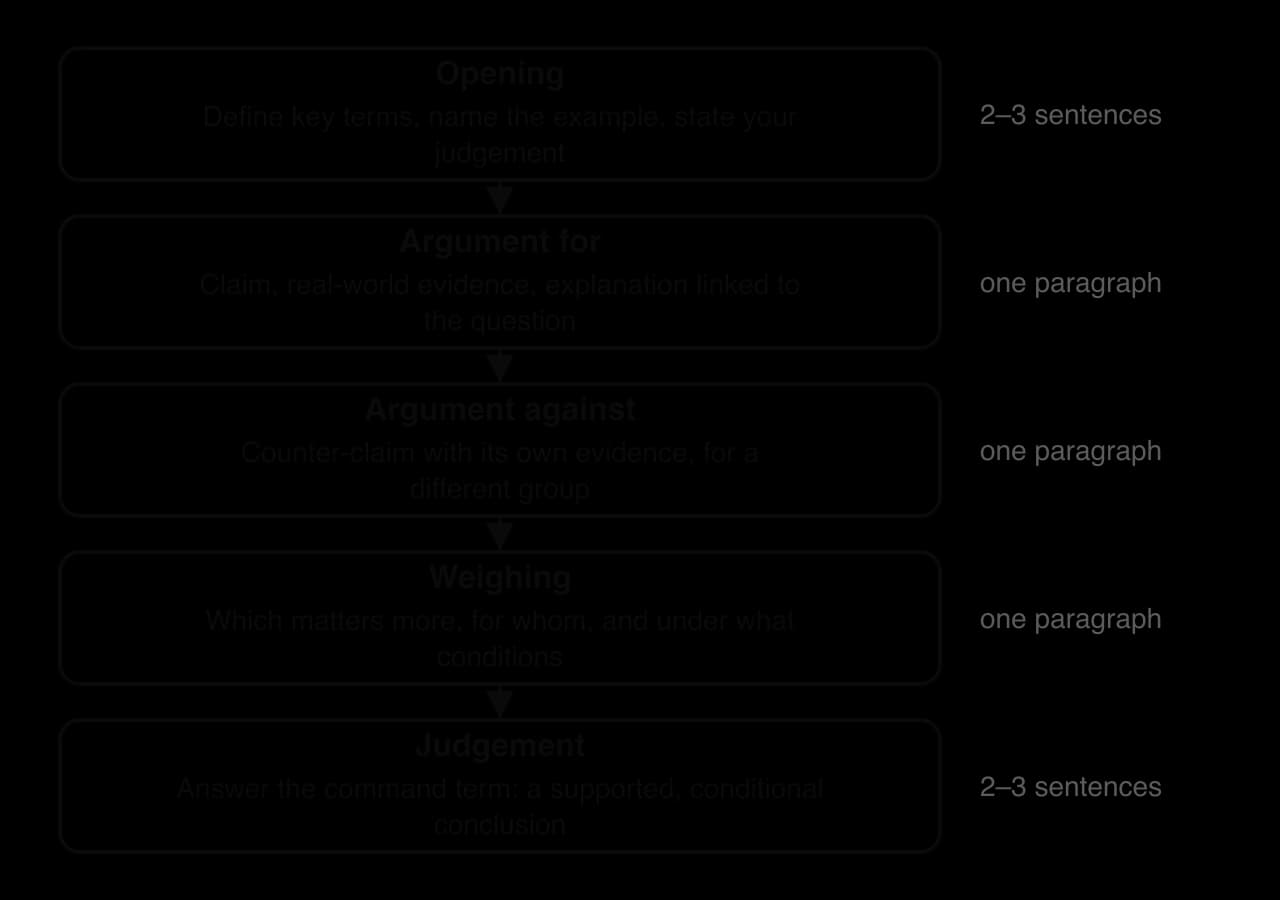
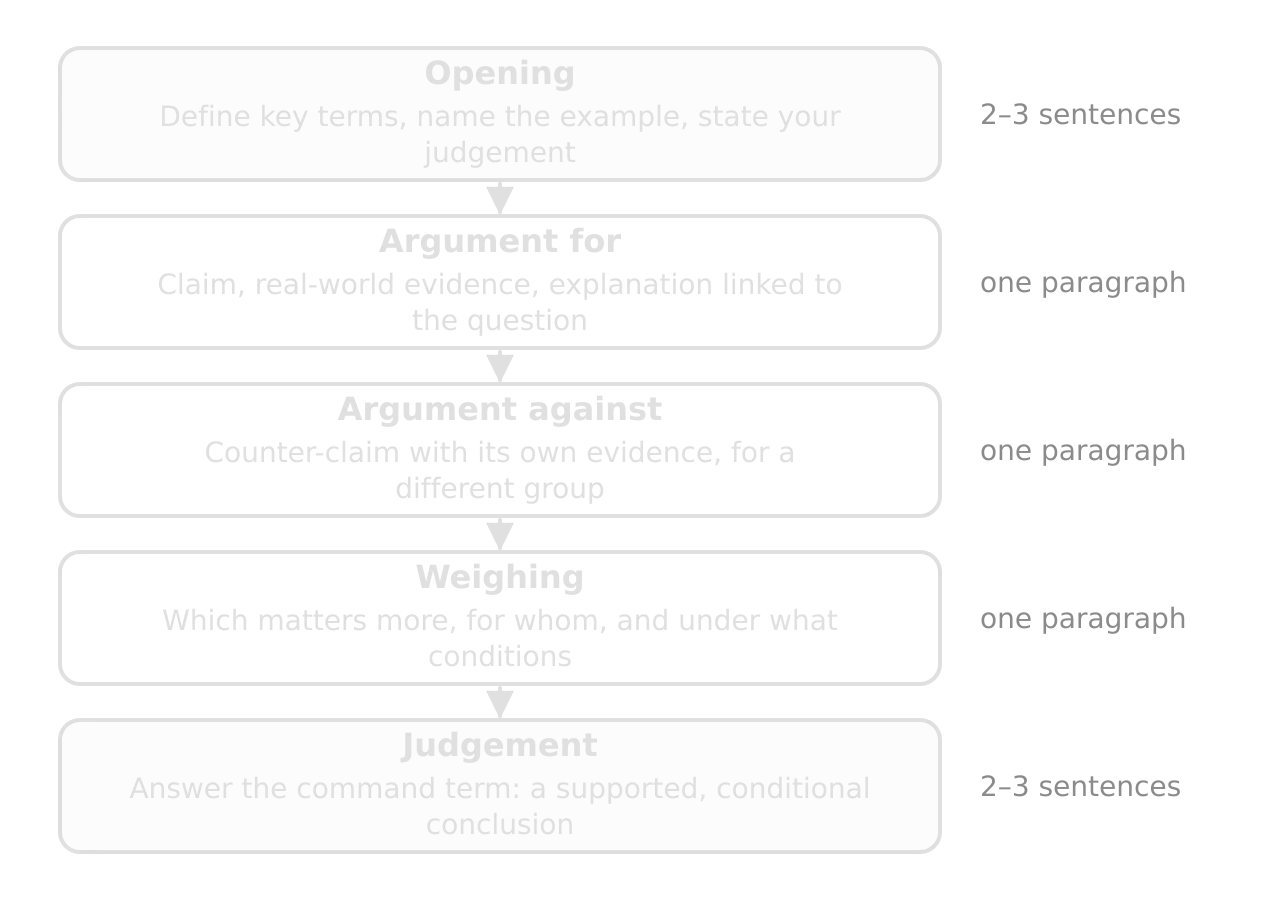
Opening. Define any key term in the question, name the real-world example, and state the judgement in one sentence.
Argument for. One clear claim, supported by the real-world example, with a sentence that explains what the example shows about the question.
Argument against. A counter-claim, ideally about a different group of people and communities, with its own evidence.
Weighing. Which argument matters more, for whom, and on what conditions.
Judgement. A short conclusion that answers the command term ("to a large extent, provided that…").
Timing
The paper gives roughly two and a quarter minutes per mark, so about 45 minutes per question. A sensible split within each question:
about 5 minutes reading the stimulus and planning part (c);
about 10 minutes for part (a);
about 12 minutes for part (b);
about 18 minutes for part (c).
Plan part (c) first, in a few lines, while the stimulus is fresh. Ideas for (c) often come while writing (a) and (b), and a plan gives them somewhere to go. If time runs short, finish the second question's part (c) in brief points rather than leaving it blank, since a short, focused judgement can still earn some of the marks.
At HL, Section A is the same, but the paper also contains Section B, a 12-mark extended response. Section A should take about 50 minutes per question, leaving about 30–35 minutes for Section B.
A worked question
This question is in the style of Section A. Its scenario is invented; the real-world example in the model answer to part (c) is real.
Each part of the model answer earns its marks for the reasons in the table.
Part | Why it earns its marks |
|---|---|
(a)(i) | Two clearly different categories (payment, journey), each with an example; no wasted explanation |
(a)(ii) | Four linked steps (code stores data; scanner reads it; system checks validity; ticket marked as used), matching four marks |
(b)(i) | Point (no smartphone or skills), reason (both remaining options are digital), consequence (cannot travel independently), tied to a named group in the scenario |
(b)(ii) | Point (journey records), use (find busiest trains), consequence (timetable and capacity changes), with benefits for two stakeholders |
(c) | States a conditional judgement in the opening; uses a real, specific example with place, date and outcome; explains what the example shows; weighs the arguments by how essential the service is; ends with a judgement of degree. This matches the 7–8 band: evaluation and synthesis consistently supported by relevant, accurate knowledge |
A weaker and a stronger part (c)
A top-band part (c) usually differs from a middle-band one in two ways: it reaches a judgement, and it uses evidence to support that judgement. The amount of knowledge is often similar.
Checklist
- To do:
I know the structure of a Section A question: (a) 6 marks AO1, (b) 6 marks AO2, (c) 8 marks AO3.
- To do:
I choose my two questions by checking part (c) first.
- To do:
In part (a), I give precise, distinct points matched to the marks and command term.
- To do:
In part (b), I explain with point, reason and consequence, using details from the stimulus.
- To do:
I know what separates each markband for part (c), especially 5–6 from 7–8.
- To do:
I plan part (c) with a judgement in the opening and the conclusion.
- To do:
I use a real-world example from outside the paper and explain what it shows.
- To do:
I include a counter-claim and weigh it, rather than listing advantages and disadvantages.
- To do:
I keep to about 45 minutes per question, with about 18 minutes for part (c).
Carry on with Digital Society in Augment
With a free account, Augment remembers where you stopped in the notes and which questions you have marked.