Command terms and real-world examples
Read every Digital Society command term correctly, choose and explain specific real-world examples, separate impacts from implications, use claims and counter-claims, and reach a supported judgement.
- IB Digital Society
- Exam skills
- SL and HL
What command terms do
Every question in Digital Society starts with a command term: a verb or phrase such as outline, explain or evaluate that sets the task. The command term decides what kind of thinking the answer must show, and so how much it can earn. Two questions on the same topic can ask for very different answers. "Outline how a food delivery app assigns orders to riders" wants a short, accurate account. "Evaluate the use of algorithms to manage delivery riders" wants strengths and limitations weighed against each other and a judgement.
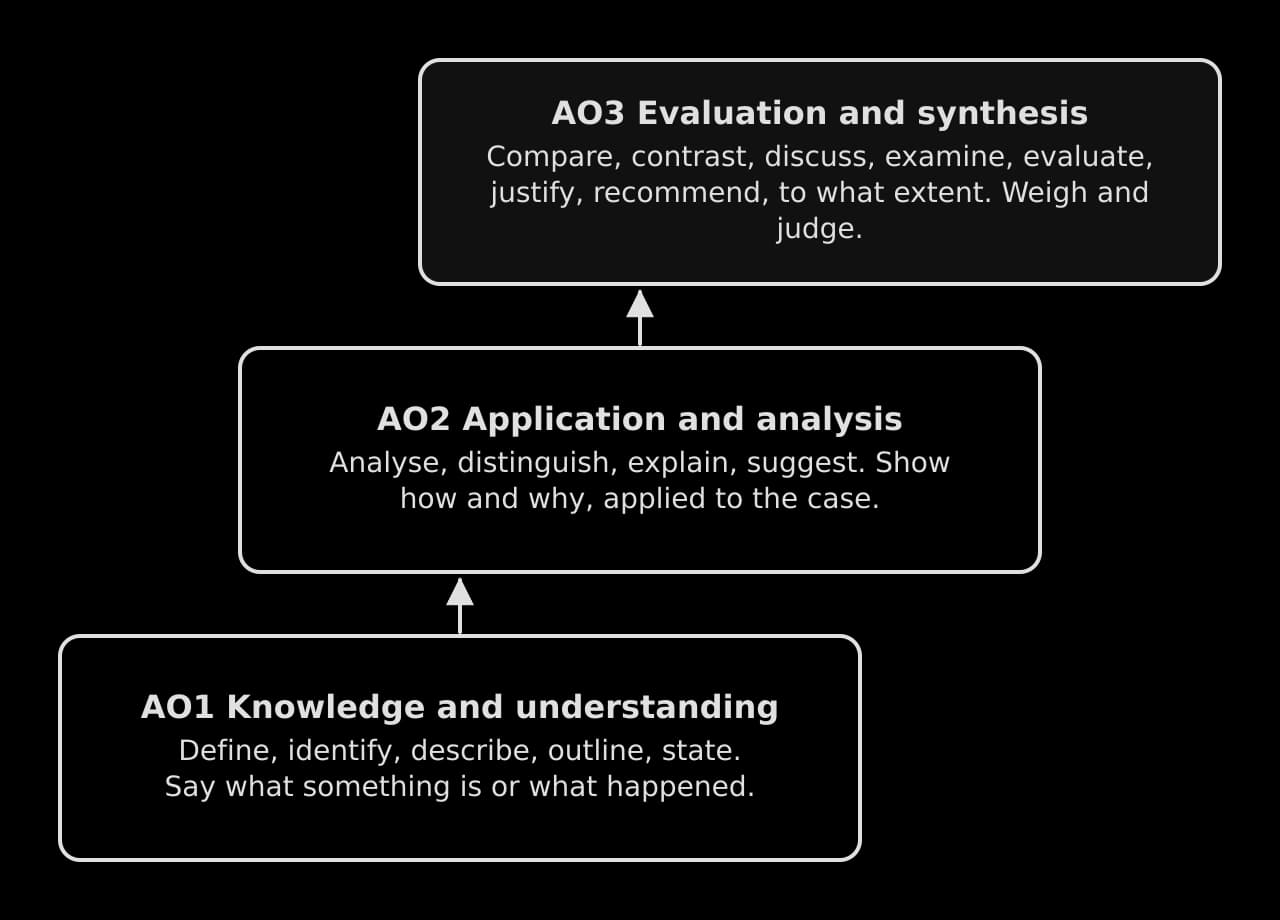
The course uses eighteen command terms, grouped into three assessment objective levels. AO1 terms test knowledge and understanding, AO2 terms test application and analysis, and AO3 terms test evaluation and synthesis. Each part of a question is set at one level, and any term from that level may appear. The level of a term shows the minimum that the answer must do.
The three levels build on each other, as the ladder diagram shows. An AO3 answer still needs the accurate knowledge of AO1 and the reasoning of AO2, and then adds weighing and judgement on top.
The worked examples on command terms all use one topic, so the differences between terms stand out: food delivery and ride-hailing platforms that manage workers through apps, part of the gig economy.
AO1: knowledge and understanding
AO1 terms ask what something is, what it does or what happened. They do not ask why, and they do not ask for opinions. The skill is precision: the right term, the right detail, and nothing that wastes time.
Command term | Meaning in plain words | What the response looks like |
|---|---|---|
State | Give a name, value or short answer, with no explanation | A word or a short phrase per mark |
Define | Give the exact meaning of a word, phrase or concept | One precise sentence that would fit a glossary |
Identify | Pick out an answer from a number of possibilities, often from a stimulus | A short phrase per point, taken from or matched to the material |
Outline | Give a brief account or summary | Two or three linked sentences for each point |
Describe | Give a detailed account | Several sentences with specific features, steps or characteristics |
The difference between outline and describe is one of detail, not of kind. Neither asks for reasons. The difference between state and identify is smaller still: identify usually means choosing from material provided, such as a stimulus or source.
AO2: application and analysis
AO2 terms ask for knowledge to be applied to a particular case, showing how or why something happens. The key word is because: every AO2 answer contains reasons, causes or consequences, linked to the situation in the question.
Command term | Meaning in plain words | What the response looks like |
|---|---|---|
Explain | Give a detailed account that includes reasons or causes | A point, the reason it happens, and the consequence, linked to the case |
Analyse | Break something down to show its essential parts or structure | The issue split into elements (causes, stakeholders, stages), with the links between them shown |
Distinguish | Make the differences between two or more things clear | Paired statements on the same feature: "X does…, whereas Y does…" |
Suggest | Propose a possible answer, solution or reason | A plausible idea, briefly justified, applied to the scenario |
Explain is the most common AO2 term. A reliable pattern is point, reason, consequence: say what happens, say why it happens, then say what it leads to for a named group. Analyse asks for more structure: the answer separates the issue into parts and shows how they interact. Suggest is used when there is no single correct answer, so any reasonable idea that fits the scenario and is supported by a reason can earn credit.
AO3: evaluation and synthesis
AO3 terms ask for judgement. The answer weighs evidence, considers more than one side and reaches a conclusion that follows from the argument. These terms appear in the higher-mark parts of each paper. Most of those parts are marked with markbands as well as a markscheme, so the quality of the whole argument counts, not only the number of points.
Command term | Meaning in plain words | What the response looks like |
|---|---|---|
Compare | Show the similarities between two or more items, referring to all of them throughout | Point-by-point similarities, never two separate summaries |
Contrast | Show the differences between two or more items, referring to all of them throughout | Point-by-point differences |
Compare and contrast | Show both similarities and differences, referring to all items throughout | Each paragraph covers one theme and both items, with a word such as "both" or "whereas" |
Discuss | Give a balanced review of a range of arguments or factors, with a clear, supported conclusion | Several arguments on different sides, each supported, then a stated conclusion |
Evaluate | Weigh up strengths and limitations | Strengths and limitations set against each other, leading to an appraisal |
Examine | Consider an argument or concept so that its assumptions and interrelationships become clear | Questions what the claim takes for granted and how its parts connect |
Justify | Give valid reasons or evidence for an answer or conclusion | A position, then the strongest reasons and evidence for it |
Recommend | Present an advisable course of action, with supporting evidence or reasons, for a given situation | A specific action, who should take it, why, and its likely trade-offs |
To what extent | Consider the merits or otherwise of an argument, with a clear conclusion backed by evidence and sound argument | A judgement of degree ("largely", "only when…"), argued from both sides |
Several of these terms look similar, but they reward different emphases. Discuss and to what extent both need a balanced review and a conclusion; to what extent also asks how far, so the conclusion should be a matter of degree rather than yes or no. Evaluate centres on strengths and limitations. Examine is the least familiar. It asks for the assumptions under a claim to be uncovered, for example by showing that "algorithms are neutral" assumes that the data they learn from is neutral.
Choosing and using real-world examples
A real-world example is a specific, existing case involving digital systems: a named app, platform, law, event, company or organisation, in a real place and time. Real-world examples are the main evidence in Digital Society answers. Some questions ask for one directly ("Refer to a real-world example you have studied"); in others, a good example is what turns a general claim into a supported one.
What makes an example specific
A specific example answers four questions: what digital system, who was involved, where and when, and what happened. "Social media spreads hate speech" answers none of them. "Facebook in Myanmar, where a UN fact-finding mission reported in 2018 that the platform had been used to spread hate speech against the Rohingya, and Facebook later accepted that it had not done enough to prevent this" answers all four.
Weak | Specific |
|---|---|
"Gig apps exploit workers." | "In Uber BV v Aslam (2021), the UK Supreme Court ruled that Uber drivers were workers entitled to the minimum wage and holiday pay, partly because the app set fares and could log drivers off." |
"Algorithms can be biased against workers." | "In December 2020 a court in Bologna, Italy, ruled that Deliveroo's system for ranking riders discriminated against them, because it penalised riders who cancelled booked shifts without considering why, for example illness or a strike." |
"Governments are starting to regulate platforms." | "The EU Platform Work Directive (2024) presumes that platform workers are employees when the platform controls their work, and requires human oversight of important automated decisions, such as deactivating an account." |
Explaining the example in relation to the question
Naming an example is not enough. The example must be explained in relation to the question, so the reader sees what it proves. A useful test is to ask "so what?" after the example. The answer to that question is the sentence that earns the credit.
Building an example bank
Examples are easier to recall under pressure if they are prepared in advance and organised. A bank of about 15–25 well-understood examples, spread across the content topics and contexts, gives enough choice for most questions. For each example, record the same set of facts.
Field | Example: Deliveroo ruling, Bologna |
|---|---|
Digital system | Deliveroo's rider-ranking algorithm and booking app |
People and communities | Food delivery riders in Italy; the trade unions that brought the case |
Where and when | Bologna, Italy; ruling in December 2020 |
What happened | The court found the ranking discriminatory because it treated every cancellation the same way, whatever the reason |
Concepts it shows | Power, values and ethics, systems |
Content and contexts | Algorithms, data; economic, political |
Best used for | Questions on algorithmic bias, fairness at work, accountability, regulation |
Impacts and implications
Impacts are the effects and outcomes of digital systems: what has happened or is happening to people and communities. Implications are the opportunities and risks that follow: what could happen, what it means for policy, law or ethics, and where things might go next. The two overlap and inform each other, but separating them makes an answer more precise.
Impact | Implication | |
|---|---|---|
Time | Present or past | Future or possible |
Typical wording | "has reduced", "led to", "resulted in" | "could", "risks", "creates an opportunity for", "raises the question of" |
Gig work example | Riders' incomes vary from week to week because orders are allocated by algorithm | Workers without stable income may be unable to obtain loans or tenancies; governments may lose tax and social insurance revenue |
A strong answer moves from impact to implication. It shows what has happened to a named group, then what that opens up or puts at risk. The Uber ruling is an impact for drivers in the UK (they gained minimum wage rights); its implication is that platforms in other countries face pressure to reclassify their workers, and that their business model may become more expensive.
Concepts, content and contexts in answers
Digital Society is organised around three lenses: concepts (change, expression, identity, power, space, systems, values and ethics), content (data, algorithms, computers, networks, media, artificial intelligence, robots) and contexts (cultural, economic, environmental, health, human knowledge, political, social). Questions are rarely labelled with these headings. Using them in an answer, however, adds analysis that a plain description lacks.
Content gives the technical accuracy: explaining that the platform uses GPS data and a ranking algorithm is more precise than "the app tracks riders".
A concept gives the angle of analysis. Through the concept of power, the question becomes who controls the data and who can challenge decisions. Through identity, it becomes whether riders see themselves as entrepreneurs or employees.
A context places the impacts. In the economic context, the issue is income security; in the political context, it is regulation and collective action.
Use concepts as tools, not labels. "This relates to the concept of power" earns little. "Through the concept of power, the ruling shows that control over pricing data, not ownership of a car, decided whether drivers counted as workers" uses the concept to make a point.
Claims, counter-claims and perspectives
A claim is a statement presented as true, which can be supported or challenged with evidence. A counter-claim is a claim that disagrees with or qualifies another claim. A perspective is the position from which a person or group sees an issue, shaped by their role, interests, values and experience. These three ideas are central to the longer answers in every paper.
Stakeholder | Perspective | Typical claim |
|---|---|---|
Platform company | Business offering a service to independent contractors | "Flexible app-based work lets people earn on their own terms." |
Rider | Worker whose income depends on the app | "The app controls my pay and can remove me without explanation." |
Customer | User wanting fast, cheap service | "Delivery apps give access to more restaurants at any hour." |
Regulator | Public body balancing innovation and protection | "Platform work needs rules on employment status and automated decisions." |
The stakeholders in the table see different parts of the same system, which is why their claims differ. A good answer treats counter-claims seriously. It states the strongest version of the opposing view, gives its evidence, and then explains why it does or does not change the judgement. A counter-claim that is mentioned and immediately dismissed ("Some people disagree, but this is wrong") adds nothing.
Structuring an evaluation and reaching a judgement
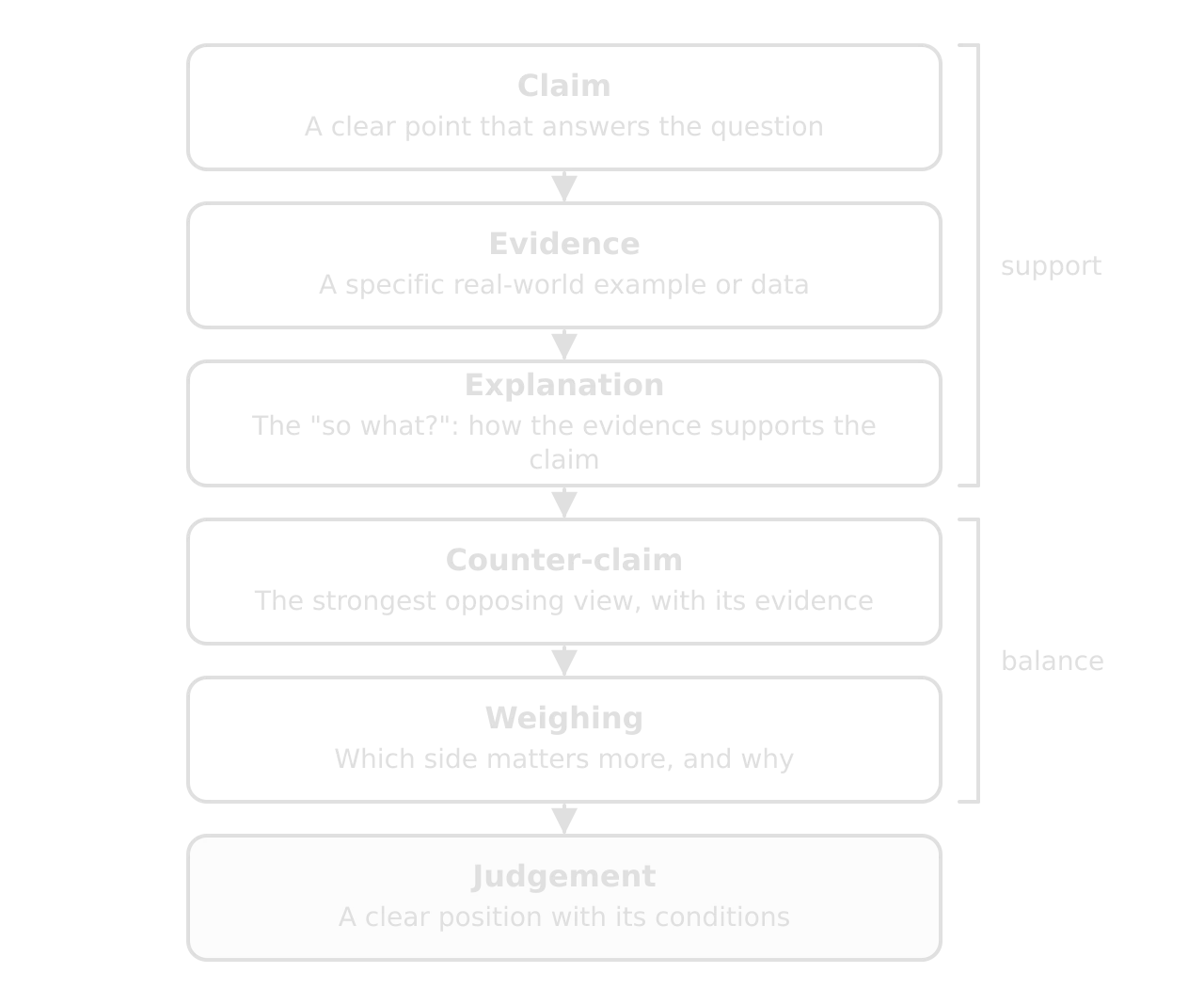
An evaluation is built from linked paragraphs, each of which advances the argument. The chain in the evaluation diagram works for one paragraph or for a whole answer: a claim, evidence from a real-world example, an explanation that links the evidence to the question, a counter-claim, and then weighing that leads to a judgement.
Weighing
Weighing means deciding which argument is stronger and saying why. Useful criteria for weighing include:
Scale: how many people are affected, and how seriously.
Who is affected: whether the benefits and harms fall on the same group, or whether one group gains while another loses.
Time: whether an effect is short-term or long-lasting.
Evidence: how strong and reliable the evidence for each side is.
Reversibility: whether a harm can be corrected, such as through an appeal.
A supported, conditional judgement
The best judgements are clear but conditional. They state a position and the conditions under which it holds. "Algorithmic management is acceptable" is a position with no limits. "Algorithmic management is acceptable for allocating orders, but not for deactivating accounts unless a human reviews the decision" is a judgement that shows the weighing behind it. Phrases such as "to a large extent", "only where", "provided that" and "in the short term, but" signal a judgement of degree.
Checklist
- To do:
I know all eighteen command terms and which assessment objective level each belongs to.
- To do:
I can tell the difference between outline and describe, describe and explain, and discuss, evaluate and to what extent.
- To do:
I can write an AO2 answer as point, reason and consequence, linked to a named group.
- To do:
I can give a real-world example that names the digital system, the people involved, the place and time, and what happened.
- To do:
I can explain an example in relation to the question with a "so what?" sentence.
- To do:
I have an organised bank of real-world examples from several regions and contexts.
- To do:
I can distinguish impacts from implications and move from one to the other.
- To do:
I can use a concept as a lens rather than a label.
- To do:
I can state a counter-claim fairly and explain whether it changes my judgement.
- To do:
I can reach a clear, conditional judgement that follows from my argument.
Carry on with Digital Society in Augment
With a free account, Augment remembers where you stopped in the notes and which questions you have marked.