Research design
What the Research design criterion rewards: setting the question in context, explaining techniques, range, repeats and controls, piloting, writing a reproducible method and addressing safety and the environment.
- IB Chemistry
- Internal assessment
- SL and HL
The Research design criterion assesses how well the report communicates the methodology, both its purpose and its practice: why the investigation was carried out the way it was, and exactly what was done. A moderator reading a top-level design understands the chemistry behind the question, sees why each technique, range and control was chosen, and could repeat the investigation from the method alone.
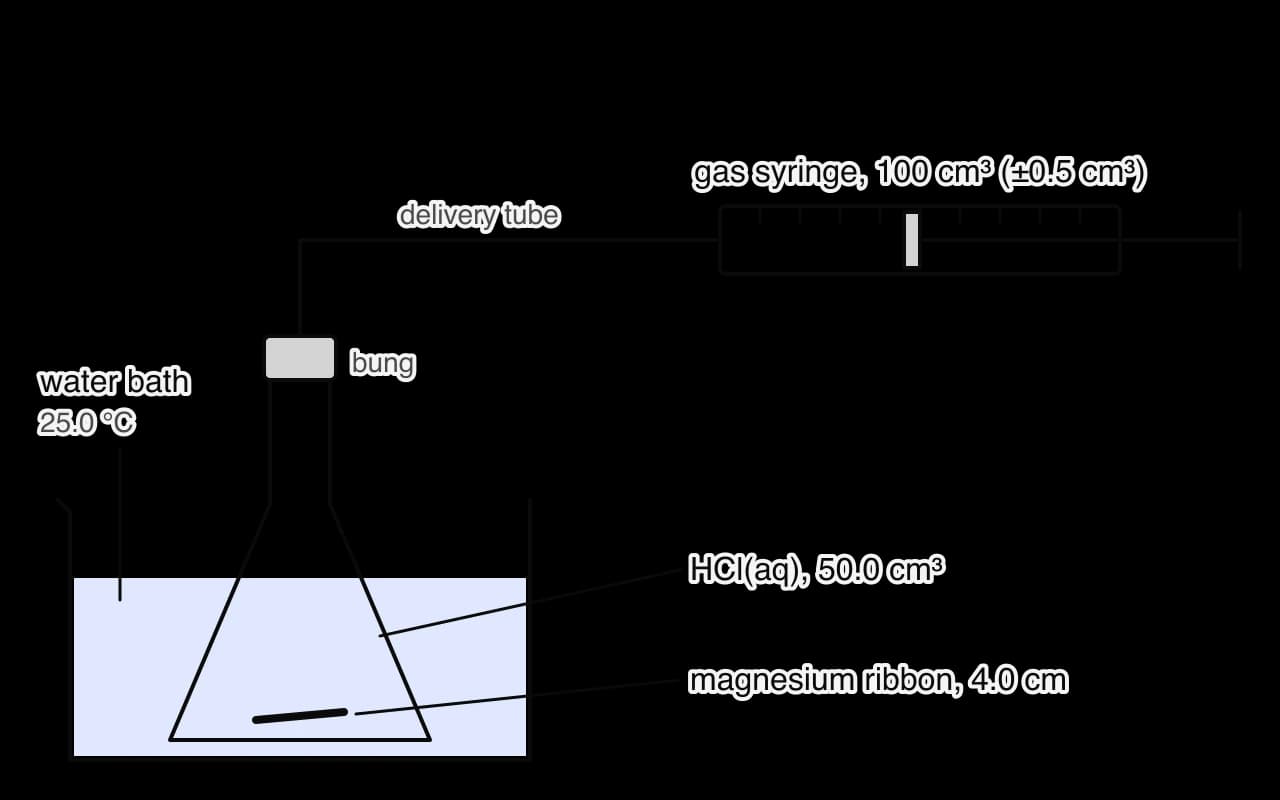
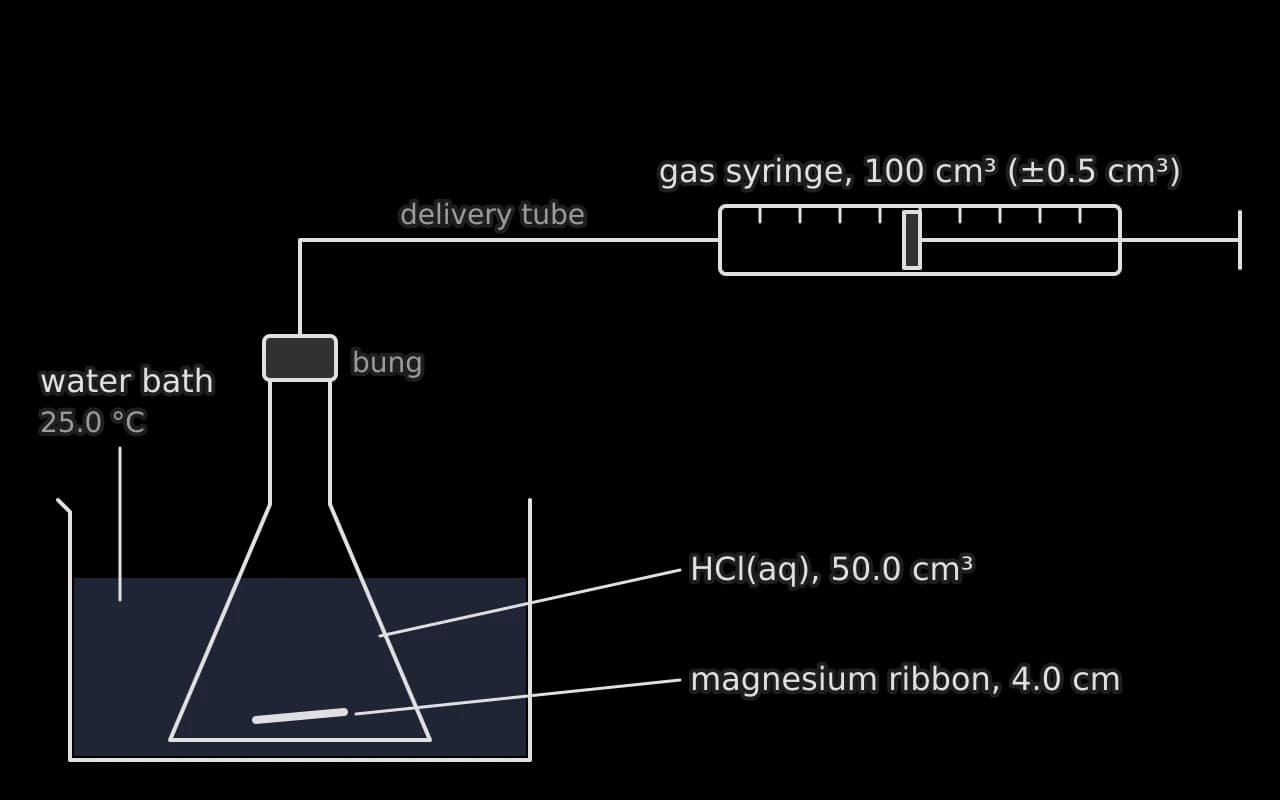
Design decisions run through the whole report. A good choice of technique gives precise data for the analysis; a well-chosen range gives a graph that can support a conclusion; controls that were explained can be evaluated. A rate investigation illustrates each decision: "How does the concentration of hydrochloric acid (0.25 to ) affect the initial rate of hydrogen production when 4.0 cm of magnesium ribbon reacts with of acid at 25.0 °C, measured with a gas syringe?"
What the criterion rewards
The criterion has three strands, and each steps up through the command terms from one level to the next.
Strand | 1–2 | 3–4 | 5–6 |
|---|---|---|---|
The research question | Stated without context | Outlined within a broad context | Described within a specific and appropriate context |
Methodological considerations for collecting relevant and sufficient data | Stated | Described | Explained |
Description of the method | Lacks the detail needed to reproduce the investigation | Allows it to be reproduced with few ambiguities or omissions | Allows it to be reproduced |
The "methodological considerations" are the decisions behind the method. They include the choice of methods for measuring the independent and dependent variables; the choice of database or model and how data are sampled from it; decisions about the range, interval, number of repeats and precision of the measurements; the identification of control variables and how they are controlled; and the safety, ethical and environmental issues that had to be addressed. At the top level each decision is explained: the report says what was chosen and why.
Context: placing the question in chemistry
A research question described "within a specific and appropriate context" sits inside a short account of the chemistry it tests. For the magnesium investigation, the context includes the balanced equation with state symbols, the collision-theory explanation of why rate depends on concentration, and the reason the initial rate is measured.
The rate depends on the frequency of collisions between hydrogen ions and the magnesium surface, which increases with the concentration of the acid. As the reaction proceeds both the acid and the magnesium are used up, so the rate falls; measuring the gradient at the start, when the concentration is known exactly, removes that complication. The context also states a prediction, for example that the initial rate will increase with concentration, and explains how the shape of the graph of initial rate against concentration would be interpreted.
The context is specific. It explains the chemistry of this reaction and this measurement, not the whole of kinetics. Paragraphs on the Maxwell–Boltzmann distribution or catalysts add words but no context, because the question does not vary temperature or use a catalyst.
Explaining the methodology
Choosing a measurement technique
Most dependent variables in chemistry can be measured in more than one way, and the choice is a methodological consideration to explain. For a reaction that produces a gas, the main options differ in precision, cost and the range of rates they can follow.
Technique | What is measured | Strengths | Weaknesses |
|---|---|---|---|
Gas syringe | Volume of gas against time | Direct reading to about ; follows the whole reaction | Plunger can stick; reading by eye limits the time resolution; maximum 100 cm³ |
Mass loss on a balance | Mass of the open flask against time | Simple; readings can be logged automatically | Hydrogen is so light that g of Mg loses only about g, below useful precision; works for |
Inverted burette or measuring cylinder over water | Volume of gas displaced | Cheap and widely available | Soluble gases such as dissolve partly; lower precision |
Pressure sensor | Pressure in a sealed flask against time | Fast, automatic logging; good for fast reactions | Needs a data logger; the flask must be airtight |
Colorimeter | Absorbance of a coloured species against time | Continuous and precise; no gas needed | Only works when a reactant or product is coloured |
For the magnesium investigation the gas syringe is the best of these. The hydrogen produced (about ) fits the syringe, hydrogen is almost insoluble in water, and the mass of hydrogen is far too small for the balance method. The explanation in the report would say exactly that.
A colorimeter offers a different route whenever a reactant or product is coloured, for example following the disappearance of iodine, manganate(VII) or a dye. It measures the absorbance of the solution, which is proportional to the concentration of the coloured species over a useful range, so a calibration curve converts each reading into a concentration.


Choosing apparatus for its precision
Every instrument has a limit to how finely it can be read, and the choice of glassware sets the precision of the whole investigation. A measuring cylinder is quick but imprecise; a burette or a volumetric pipette is slower but measures volumes about ten times more precisely. The right choice depends on how much each measurement affects the result: the volume of acid in the magnesium investigation must be the same each time, but a 1 % error in it changes the concentration of acid not at all, so a measuring cylinder is adequate there, whereas the dilutions that set the concentration need a burette or pipette.
Apparatus | Typical uncertainty of one reading or delivery |
|---|---|
Top-pan balance to two decimal places | g |
Burette, (graduated every ) | per reading, so for a titre (two readings) |
Volumetric pipette, | to , depending on its class |
Volumetric flask, | to , depending on its class |
Measuring cylinder, | to |
Gas syringe, | |
Digital thermometer or temperature probe | °C |
Glass thermometer graduated every 1 °C | °C |
Stopwatch operated by hand | resolution s, but reaction time makes it about to s |
pH meter (after calibration) | to |
Tolerances for volumetric glassware are printed on the glass itself (class A glassware has about half the tolerance of class B), and those printed values are the ones to quote. Where a reading is judged by eye between graduations, the uncertainty is usually taken as half the smallest division for an analogue scale and one unit of the last digit for a digital display.
Range, interval and repeats
The range of the independent variable should be as wide as the chemistry and the apparatus allow, because a wide range shows a trend clearly and makes the gradient of a graph more precise. The interval between values should be even, unless there is a reason to concentrate points where the graph is expected to change shape (near the change of gradient in the zinc–copper(II) sulfate investigation, for example). Five values are the minimum for a graph; six to eight are better.
Repeats serve two purposes. They reduce the effect of random error on the mean, and their spread gives an estimate of the random uncertainty. Three repeats at each value is a common minimum; if two of the three disagree, a fourth helps decide which is anomalous. In titrations, repeats continue until two or three concordant titres agree within .
A pilot run at each end of the planned range is the quickest way to set the range. In the magnesium investigation, the pilot curves for the two extreme concentrations showed that the highest planned concentration was too fast to follow by eye.
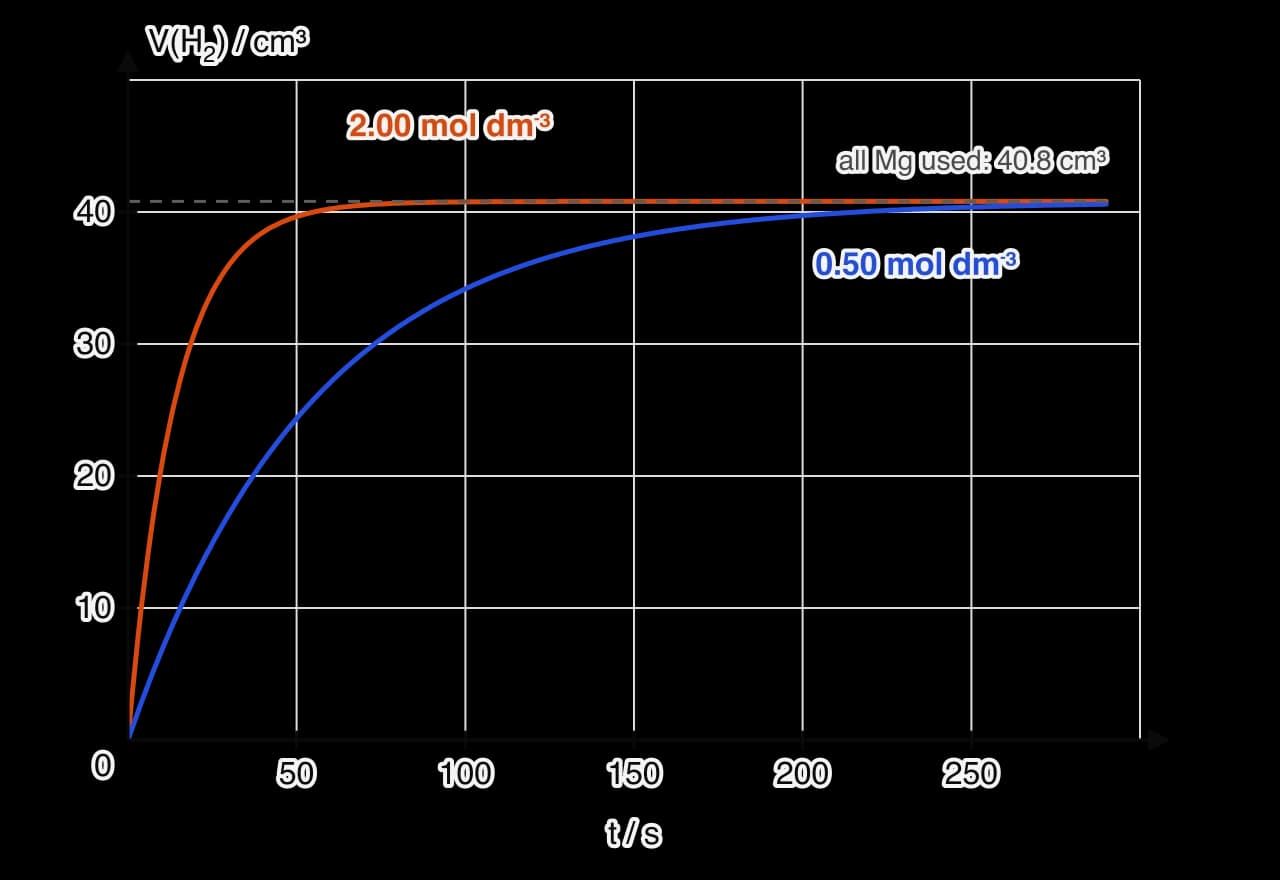
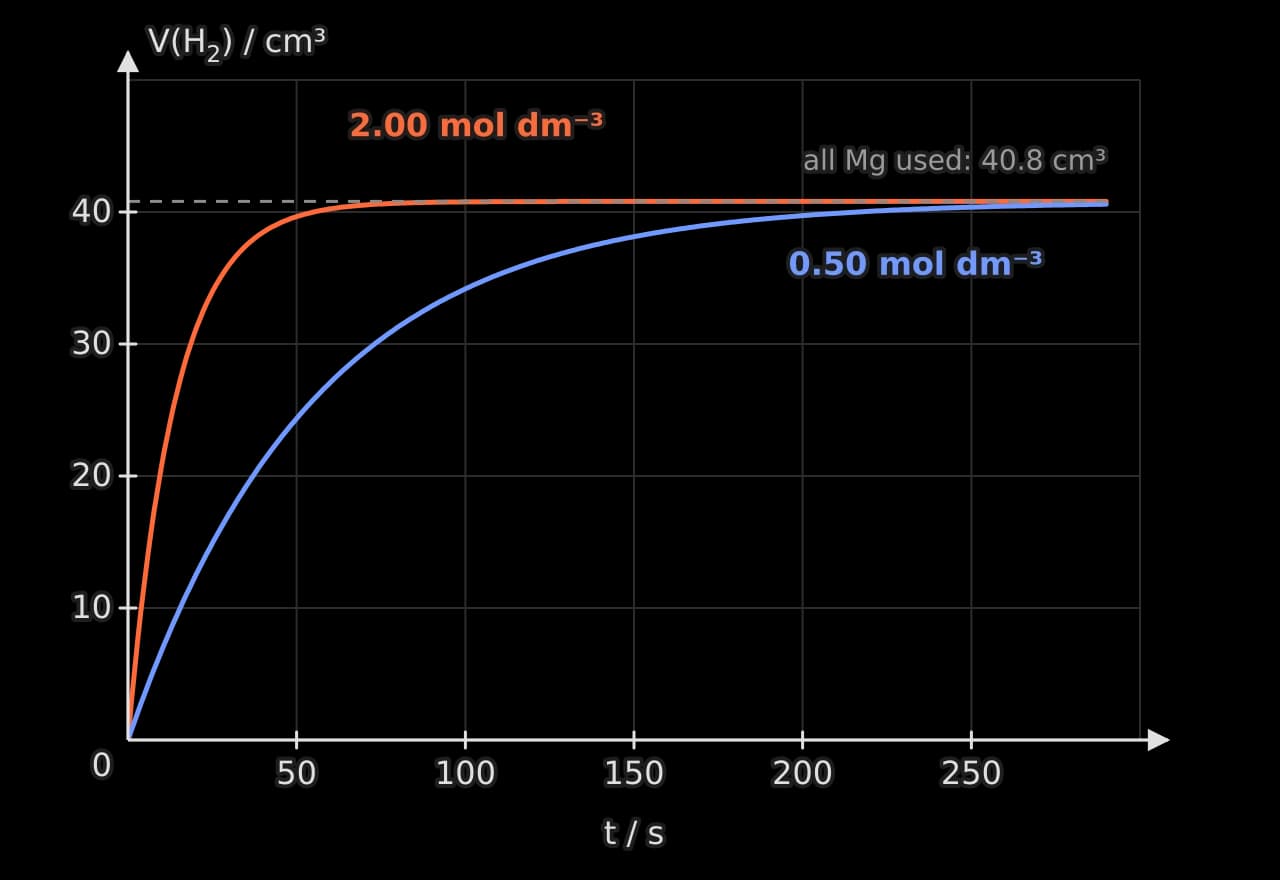
The pilot led to a range of to in steps of : five values, with three repeats each, so fifteen runs of about four minutes, which fit comfortably into two lessons. The acid is in excess at every concentration ( mol of at the lowest, against mol needed for g of magnesium), so magnesium is always the limiting reactant and the total volume of gas is the same in every run.
Controlling variables
A control variable is any variable, other than the independent variable, that could change the dependent variable. Identifying the controls is not enough at the top level: the report explains why each one affects the dependent variable and how it was kept constant or monitored. A table is the clearest way to do this.
Control variable | Why it affects the initial rate | How it was controlled |
|---|---|---|
Temperature | Rate increases steeply with temperature | Flask clamped in a water bath at °C; acid left in the bath for 10 min before each run |
Surface area of magnesium | The reaction happens at the metal surface | Ribbon from one roll, cut to cm, so width and thickness are the same |
Oxide layer on the magnesium | A coating of delays the start of the reaction | Each piece cleaned with emery paper immediately before use |
Volume of acid | Sets the amount of and the depth of liquid over the metal | measured with a measuring cylinder |
Mixing | Stirring brings fresh acid to the surface | The flask was swirled at the same gentle rate throughout |
Acid stock | Different stocks could differ slightly in concentration | All dilutions made from one stock with a burette and volumetric flask |
Some variables cannot be held fixed but can be monitored. Room temperature, for example, can be recorded for each run; if it changed during the investigation, the evaluation can judge whether that mattered. Recording a variable that could not be controlled is much better than ignoring it.
Piloting
A pilot study is a short trial of the method before the main data collection. It tests whether the planned range is measurable, whether the instruments are precise enough, how long each run takes and whether anything unexpected happens. A pilot that changes nothing is still useful evidence, because it confirms the choices; a pilot that changes the method is better evidence still.
Typical findings from a chemistry pilot include a reaction too fast or too slow at the ends of the range, a colour too faint for the colorimeter at low concentrations, a temperature probe that takes 20 s to respond, a gas syringe whose plunger sticks, or a precipitate that coats the electrode. Each change made because of the pilot belongs in the report, with the reason, because it shows the methodological considerations being worked out in practice.
Writing a method that can be repeated
The method describes what was actually done in enough detail that another student could repeat the investigation and get comparable results, without unnecessary or repeated information. It lists the apparatus with sizes and uncertainties, the chemicals with concentrations and quantities, and a numbered sequence of steps. A labelled diagram of the apparatus often replaces a paragraph.
Reproducibility depends on specifics: how the solutions were made, the order in which things were added, how the timing started, when each reading was taken and how many repeats were done. Phrases such as "some acid", "a few minutes" or "until it looked finished" make a method impossible to repeat.
Weak step | Reproducible step |
|---|---|
Add acid to the flask. | Measure of the acid with a measuring cylinder and pour it into a conical flask clamped in the water bath at 25.0 °C. Leave for 10 min. |
Add the magnesium and time it. | Clean a cm strip of magnesium ribbon with emery paper, drop it into the flask, immediately insert the bung connected to the gas syringe and start the stopwatch. |
Record the volume. | Record the volume in the syringe every 10 s for the first 60 s, then every 30 s until the volume has been constant for 60 s. |
Repeat for other concentrations. | Repeat with the other four concentrations, in a random order, carrying out three runs at each concentration. |
Running the concentrations in a random order, rather than from lowest to highest, prevents a slow drift (such as the water bath warming during the lesson) from being mistaken for an effect of concentration. Small choices like this are worth one sentence of explanation each.
Safety, ethics and the environment
The research design recognizes any safety, ethical or environmental issues and shows how they were addressed. In chemistry this usually means a short risk assessment: each hazardous substance or procedure, the hazard, the precaution, and how the waste was disposed of.
Substance or procedure | Hazard | Precaution | Disposal |
|---|---|---|---|
Hydrochloric acid, up to | Irritant to skin and eyes | Safety glasses; wash spills with plenty of water | Neutralize with sodium hydrogencarbonate, then dilute down the sink |
Magnesium ribbon | Flammable solid | Keep away from flames | Unreacted pieces returned to the teacher |
Hydrogen gas | Extremely flammable; explosive mixtures with air | No flames in the laboratory; small volumes only | Vented in a well-ventilated room |
Copper(II) sulfate solution (in a calorimetry investigation) | Harmful if swallowed; toxic to aquatic life | Gloves; avoid skin contact | Collected in a labelled heavy-metal waste container, never poured down the sink |
Ethical issues are less common in chemistry than in biology, but they arise when an investigation involves people (taste tests, testing products on skin), animals or plants, or sampling from private land. Environmental issues are common: the use of heavy metals, organic solvents and large volumes of reagents. Microscale methods, which use a few cubic centimetres instead of fifty, reduce hazard, cost and waste together, and choosing one can be explained as a methodological consideration in its own right.
Databases and simulations as approaches
Database investigations
In a database investigation the methodological considerations shift from apparatus to selection. The report explains which database was used and why it is reliable (a curated source such as the NIST Chemistry WebBook, the data booklet or a peer-reviewed compilation rather than an uncited website), which data were selected, the criteria for including or excluding entries, and how many were sampled. If values for the same substance differ between sources, the report explains how one was chosen.
For a question on how the boiling points of straight-chain alkanes depend on chain length, the selection criteria might be: straight-chain alkanes only (branching lowers boiling points and would add a second variable); to ; boiling points at 101.3 kPa; all from one source. Each criterion is a decision with a reason, which is exactly what the criterion asks to be explained.
Simulation investigations
A simulation investigation describes the model: what it calculates, the assumptions it makes and the settings used. The independent variable is set in the simulation, the dependent variable read from it, and the controls are the other settings. The report explains why the simulation is a valid way to answer the question, for example because the real system is too hazardous or slow, and how its assumptions limit the conclusion. Where possible, a few real measurements are compared with the simulation to test it.
Applying the ideas
Explaining a control variable
Choosing glassware
Improving reproducibility
A database design
Self-check
- To do:
I can describe what each strand of the Research design criterion rewards at each level.
- To do:
I can set a research question in a specific context with only directly relevant theory and a balanced equation.
- To do:
I can choose a measurement technique and explain why it suits the dependent variable.
- To do:
I can choose apparatus for its precision and quote the uncertainty of each instrument.
- To do:
I can justify the range, interval and number of repeats, using pilot results.
- To do:
I can explain why each control variable matters and how it was controlled or monitored.
- To do:
I can write a method detailed enough for someone else to reproduce the investigation.
- To do:
I can write a risk assessment that covers hazards, precautions and disposal.
- To do:
I can explain the selection of data in a database investigation and the assumptions of a simulation.
Carry on with Chemistry in Augment
With a free account, Augment remembers where you stopped in the notes and which questions you have marked.