Paper 2: short and extended responses
How Paper 2 questions are built and marked: setting out calculations, writing equations, explanations that earn every mark, and three fully worked questions with markschemes.
- IB Chemistry
- Exam skills
- SL and HL
Paper 2 consists of structured questions, each built around one substance or one context: a fuel, an industrial process, an element and its compounds, a drug molecule. A question opens with a short stem and moves through parts labelled (a), (b), (c) and sub-parts (i), (ii), each with its mark allocation in square brackets. Several shorter questions are followed by one or two longer ones that range widely across the course.
The parts are small. About half are worth 1 mark and most of the rest 2 marks, so a typical part is one fact, one link in a chain of reasoning, or one step of a calculation. The skill being tested is the ability to give exactly what each part asks for, quickly and precisely, and then move on.
How a Paper 2 question is built
The stem names a substance or a situation in one or two lines, often with a structure, a table of data, a graph or a diagram of apparatus. The parts then visit different areas of chemistry that all involve that substance. A question about ethanol might ask for its Lewis formula, why it mixes with water, its combustion equation, the energy released by a given mass, the assumptions behind that calculation, the product of its oxidation and the atom economy of making it from ethene: six subtopics in one question.
New information between parts. Lines such as "The enthalpy of combustion of methanol is …" or "The equilibrium constant at 450 °C is …" appear between parts, unlabelled. They are there because a later part needs them.
Easy parts after each new lead-in. Within a question, parts often restart at simple recall (write, state) after new information arrives, then rise to calculation and explanation. A hard part does not mean the rest of the question is hard.
Follow-on parts. Phrases such as "using your answer to (b)(i)" mean the method is marked even if the earlier answer was wrong. Use your own earlier value, even if you doubt it.
Labelled answer lines. Some parts print labels for a two-part answer ("Oxidized: … Reduced: …", "Similarity: … Difference: …", "Number of signals: … Ratio: …"). Write one answer on each line.
Answers on figures. "Sketch on the axes", "complete the diagram" and "draw an arrow, labelled X" mean the answer goes on the printed figure.
Setting out a calculation
Calculation parts are marked one step at a time. A typical 3-mark calculation gives one mark for the amount in moles, one for applying the mole ratio, and one for the final quantity. The markscheme usually adds "Award [3] for correct final answer", so a correct answer alone earns full marks, but a wrong answer earns only the marks for steps that are visible.
Write what each line calculates. " =" or "mass of water =" before the number lets the examiner follow the method and award marks for it.
Substitute, then calculate. Write the equation with the numbers in it, then the result. If the arithmetic slips, the substitution can still earn the mark.
Keep unrounded values in the calculator. Round only the answers you write down, and use the stored value in the next step, so rounding errors do not build up.
Give the final answer with a unit and a sensible number of significant figures, usually the same as the least precise data (often three).
Check the size and the sign. An enthalpy change of combustion is negative; a pH is usually between 0 and 14; a percentage yield above 100 % means an error.
Writing equations
"Write an equation" or "formulate an equation" always means a balanced symbol equation. A word equation scores zero, and so does an unbalanced one, even if every formula is right. Where an equation is worth 2 marks, one mark is usually for the correct species and one for the balancing, or one for the equation and one for its state symbols.
State symbols are ignored unless the question asks for them. When it does, use the state at the conditions given: water is under standard conditions, ionic compounds in solution are , precipitates are .
Integer coefficients. "Using integer coefficients" or "using only whole numbers" rules out . Multiply the whole equation through instead. Equations that define a standard enthalpy change (of formation or combustion) may need fractions, because they refer to one mole of one substance.
Ionic equations leave out the spectator ions: . Charges must balance as well as atoms.
Half-equations show electrons, and the electrons go on the left for a reduction and on the right for an oxidation. Balance atoms other than O and H first, then O with , then H with , then charge with electrons.
Organic equations may use condensed structural formulas () so that the product is unambiguous; molecular formulas such as do not show which isomer is meant.
Explanations that earn every mark
An explain part is marked as a chain of cause and effect, and each link is usually one mark. The examiner checks the answer against a list of mark points; a point that is implied but not written does not score. Most chemistry explanations have a standard skeleton, and learning the skeletons for the common ones means the right links appear in the right order under exam pressure.
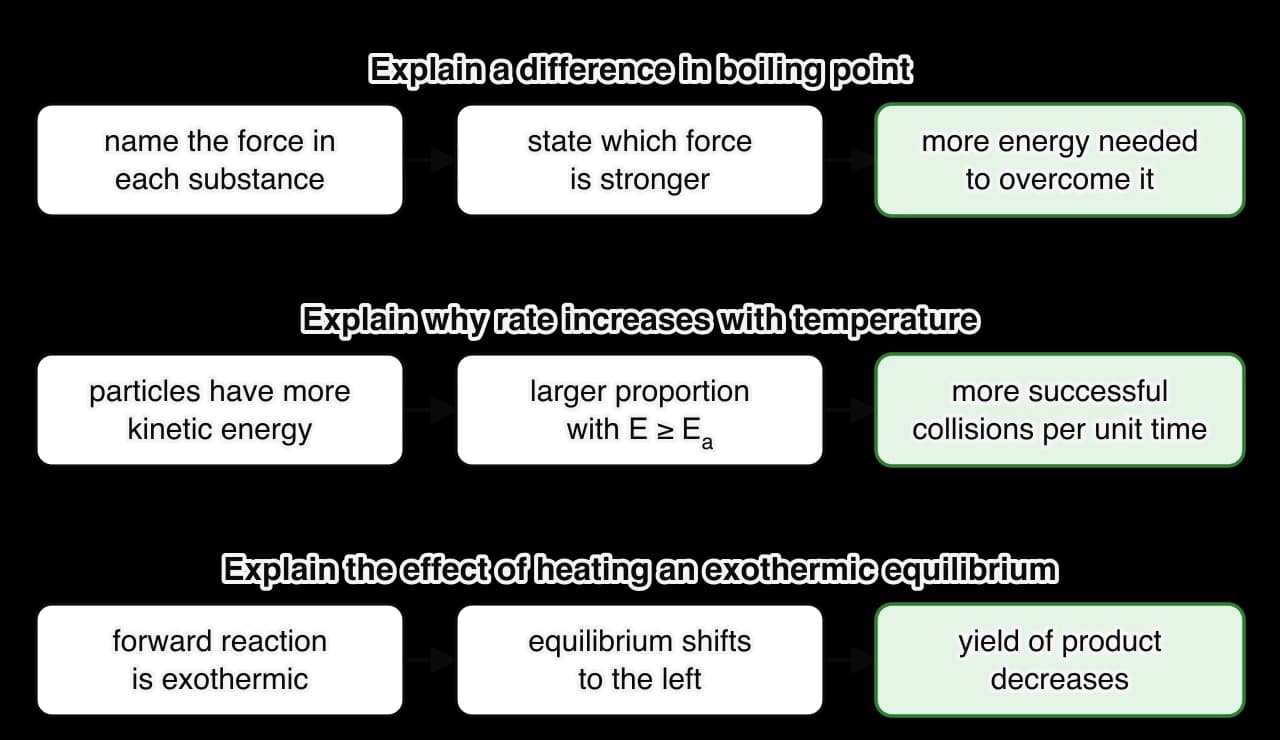
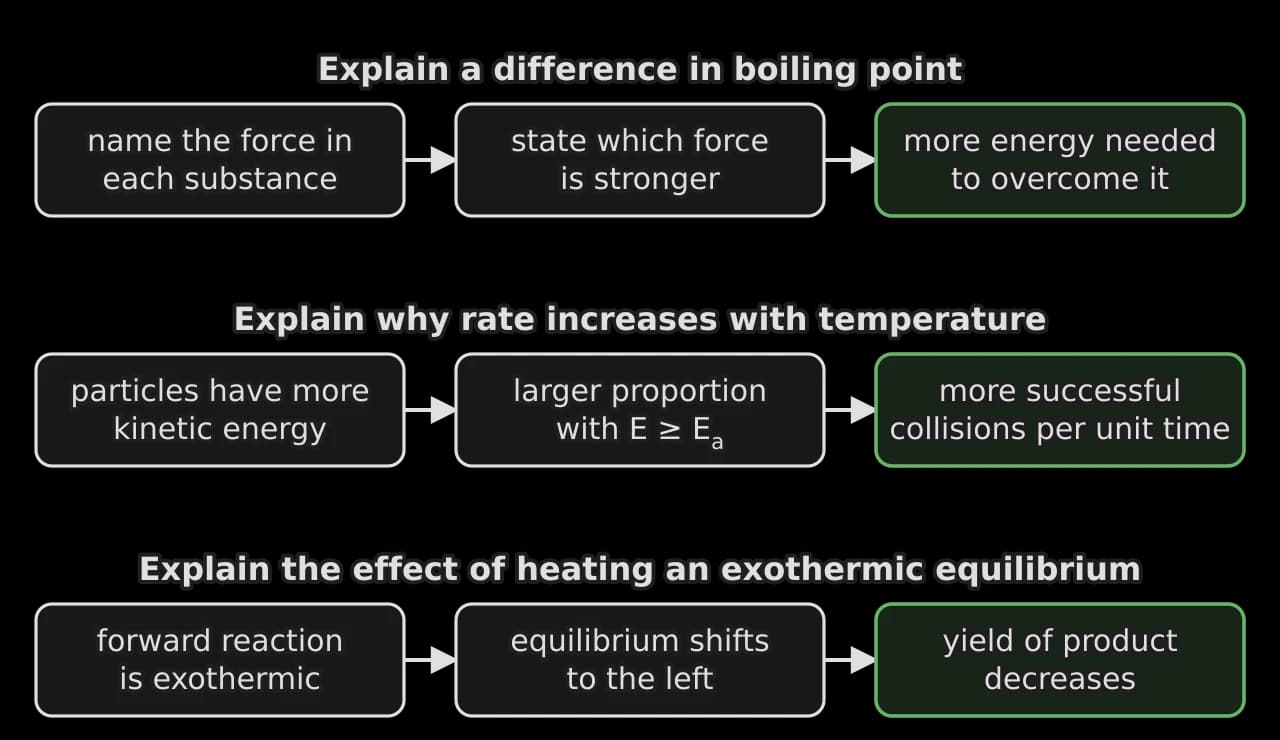
The same habit works for unfamiliar questions. Before writing, decide how many separate points the marks require, then make sure each one appears as its own sentence or clause. A part worth 2 marks that gets one long, accurate sentence containing a single idea scores 1.
Explanation asked for | The points the markscheme looks for |
|---|---|
Why first ionization energy increases across a period | greater nuclear charge (more protons); electrons added to the same main energy level, so similar shielding; outer electron held more strongly / smaller radius |
Why an ionic solid conducts when molten but not when solid | in the solid the ions are held in fixed positions in the lattice; when molten (or in solution) the ions are free to move and carry charge |
Why a catalyst increases the rate | provides an alternative pathway (mechanism); with a lower activation energy; so a larger proportion of collisions have energy ≥ Ea |
Why a weak acid has a higher pH than a strong acid of the same concentration | the weak acid only partially dissociates; so the concentration of H⁺ ions is lower |
Why the boiling points of the alkanes increase with chain length | more electrons / larger surface area of contact; stronger London forces; more energy needed to separate the molecules |
Why a substance with a giant covalent structure has a high melting point | many strong covalent bonds throughout the structure; all must be broken to melt it; this needs a lot of energy |
Questions in unfamiliar contexts
Some parts deliberately use a compound or a situation that the course never mentions: a drug molecule, an unusual salt, a new battery. The chemistry needed is always within the course. The approach is to find the familiar feature: a functional group in the structure, a type of bonding, an equilibrium, a redox change. Then apply the ordinary rule to it, and say in the answer which feature you used.
Worked question 1: hydrogen peroxide
A short question of the kind that opens a paper. It moves from structure to stoichiometry, kinetics, intermolecular forces and energetics around one substance. Try each part before opening the markscheme.
Worked question 2: methanol as a fuel
A longer synoptic question. It visits combustion, calorimetry, experimental error, specific energy, incomplete combustion, equilibrium and intermolecular forces, all through one compound. The new information between parts is needed for the parts after it.
Worked question 3: an equilibrium mixture (HL)
An HL question on equilibrium calculations, the reaction quotient and the link between the equilibrium constant and Gibbs energy. HL papers mix parts like these into questions that also contain SL parts.
Common ways marks are lost
What happens | How to avoid it |
|---|---|
The answer addresses a different quantity: molecular for empirical formula, lengths for strengths, observation for conclusion | Underline the quantity and the qualifier before writing |
A name is given when a formula was asked for, or the reverse | Give exactly what is asked; if both are given and one is wrong, the mark may be lost |
Equations are unbalanced or written in words | Always count atoms and charges |
The sign of an enthalpy change is missing or wrong | Exothermic means negative; write the sign every time |
A 2-mark explanation contains one idea | Count the points against the marks before moving on |
A bare final answer is wrong, so no method marks are possible | Show each step, labelled |
Vague words: clear, more collisions, enough energy, human error, pollution | Use the precise term and name the substance or process |
An oxidation state is written as "2+" instead of "+2" | Sign first for oxidation states, sign after the number for ionic charges |
Self-check
- To do:
I can follow a Paper 2 question across several topics around one substance and use the new information given between parts.
- To do:
I can set out a calculation with labelled steps, unrounded intermediate values and a final answer with a unit.
- To do:
I can explain how error carried forward protects later marks.
- To do:
I can write balanced symbol, ionic and half-equations, with state symbols when asked.
- To do:
I can write explanations as chains of cause and effect, with one point per mark.
- To do:
I can use the precise vocabulary that markschemes accept.
- To do:
I can apply familiar principles to an unfamiliar compound or context and say which feature I used.
- To do:
I can budget time in a long question by marks rather than by parts.
Carry on with Chemistry in Augment
With a free account, Augment remembers where you stopped in the notes and which questions you have marked.