Calculations, units and the data booklet
Units, conversions, significant figures and the standard calculations of IB Chemistry, how to set them out and check them, and what the data booklet does and does not give.
- IB Chemistry
- Exam skills
- SL and HL
Calculations appear throughout Paper 1 and Paper 2: amounts in moles, concentrations, gas volumes, enthalpy changes, equilibrium constants, pH, yields and uncertainties. Almost all of them are short, and almost all lost marks come from a few recurring slips: a unit not converted, a mole ratio not applied, a sign left out, an answer rounded too early. Good habits remove most of them.
The data booklet available in every paper gives the equations, constants and data tables that calculations need. Knowing what is in it, and what is not, saves time and prevents errors from values remembered wrongly.
Quantities, symbols and units
Each quantity has a standard symbol and unit, used in the data booklet and in markschemes. Units are written with negative indices and a space between parts: , not mol/dm³ or M; , not kJ/mol. Relative atomic and formula masses are ratios and have no unit.
Quantity | Symbol | Usual unit |
|---|---|---|
Amount of substance | ||
Mass | (kg in some energy calculations) | |
Molar mass | ||
Relative atomic / formula mass | , | no unit |
Concentration | or | (or ) |
Volume | , ; in | |
Pressure | or ; Pa in | |
Temperature | in equations; °C for everyday readings | |
Heat energy | or | |
Enthalpy change | (or kJ for a reaction as written) | |
Specific heat capacity | ||
Rate of reaction | — |
Converting units
Most conversions in chemistry are powers of ten, and the prefixes are listed in the data booklet. Three are used constantly: , , and . Temperatures convert as ; a change in temperature has the same value in both units.
Significant figures, decimal places and standard form
Data in questions are usually given to three significant figures, or four for volumetric glassware (). A final answer should normally have the same number of significant figures as the least precise value used, which in practice is usually three. Markschemes do not usually penalize significant figures, but some questions ask for a stated precision ("give your answer to two decimal places"), and then the precision carries the mark.
Very large and very small numbers are written in scientific notation (standard form), as a number between 1 and 10 multiplied by a power of ten: , . Scientific notation also removes doubt about trailing zeros: clearly has three significant figures, while is ambiguous.
Relative atomic masses are used as given in the data booklet, to two decimal places ( 12.01, 16.00), not rounded to whole numbers.
pH values are logarithms: the number of decimal places in the pH equals the number of significant figures in . A concentration of gives pH 2.70.
Intermediate values are kept unrounded in the calculator. Rounding each step to three figures can shift the final answer in the third figure.
Uncertainties are given to one significant figure, and the value is rounded to the same decimal place: becomes .
Calculations through the mole
Every calculation about reacting quantities has the same structure: convert what is given into an amount in moles, use the mole ratio from the balanced equation, and convert the result into the quantity asked for. The mole map shows the routes in and out, all of which use equations from the data booklet.
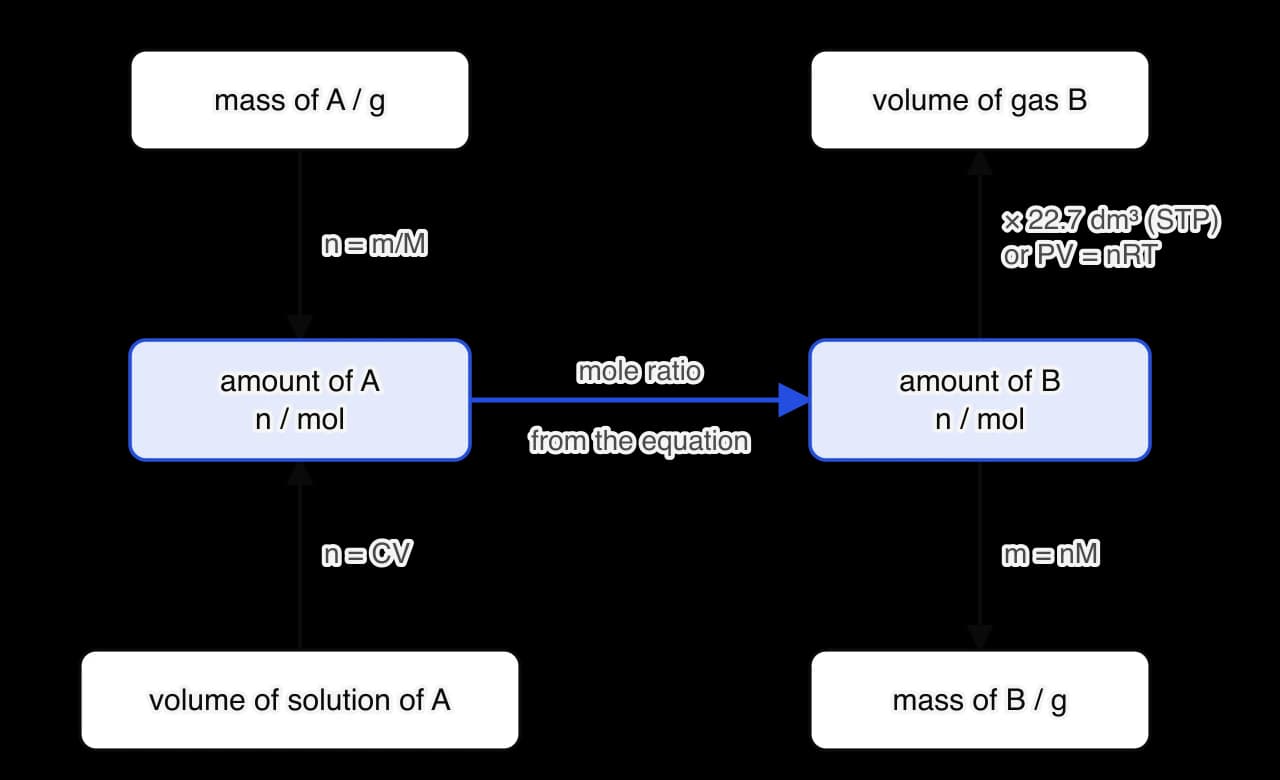
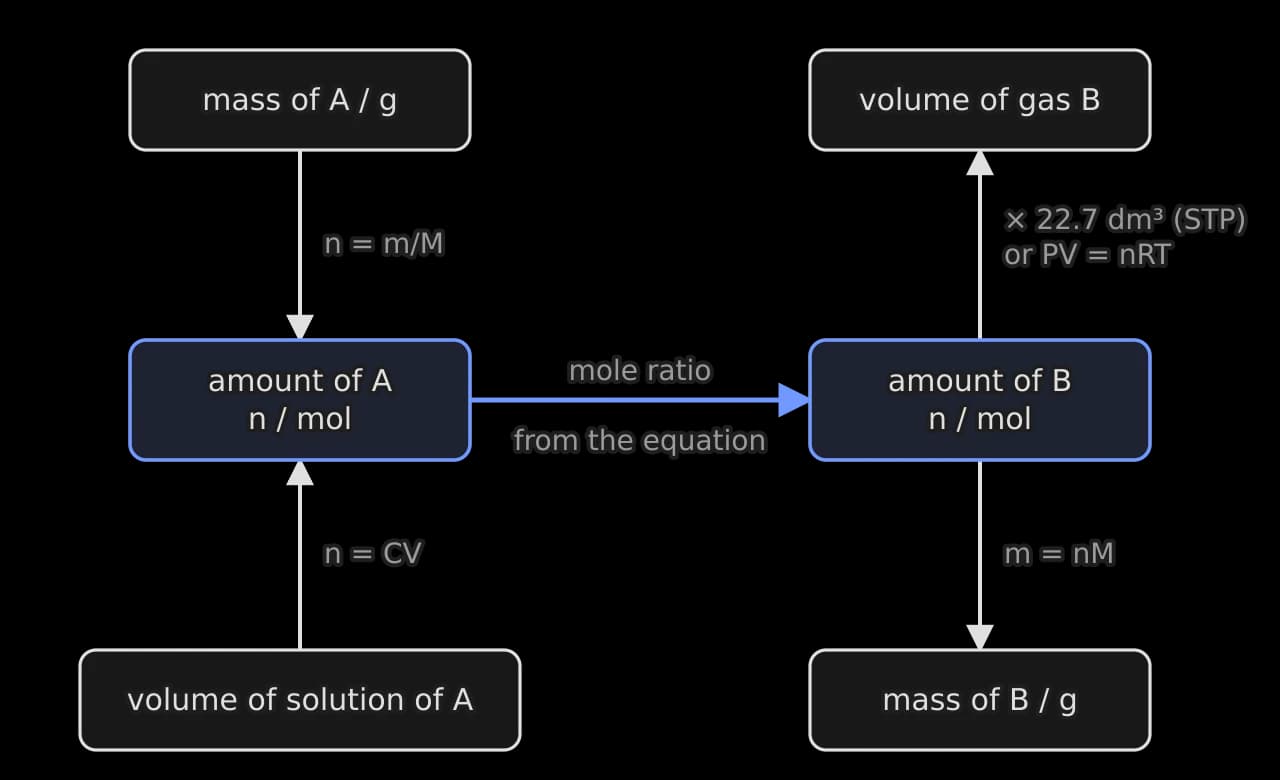
Two further steps appear often. With amounts of two reactants given, find the limiting reactant first by dividing each amount in moles by its coefficient: the smaller result belongs to the limiting reactant, and it sets the amount of product. With a product mass given, compare it with the theoretical mass to find the percentage yield.
Energy calculations
Three calculations recur. In calorimetry, gives the heat absorbed by the water or solution, where is the mass of the water or solution (not of the reactant), and for the limiting reactant, with the sign showing whether heat was released. From average bond enthalpies, , which applies to gases. At HL, enthalpy changes also come from enthalpies of formation, , and of combustion, ; both equations are in the data booklet.
Logarithms and pH
The data booklet gives and at 298 K. The reverse calculation, from pH to concentration, uses . Every change of one pH unit is a tenfold change in .
Percentages
Several percentages appear in chemistry questions. They look alike, so the formula and the reference value should be written out each time.
Percentage | Calculation |
|---|---|
Percentage by mass of an element | |
Percentage yield | |
Atom economy (data booklet) | |
Percentage error | |
Percentage uncertainty |
More standard calculations
Empirical formula from composition
Divide the mass (or percentage) of each element by its to get amounts in moles, divide every amount by the smallest, and round to a whole-number ratio. If a ratio ends in about .5, .33 or .25, multiply all the ratios by 2, 3 or 4 before rounding. Never round 1.5 to 2.
Dilution and concentration in g dm⁻³
Diluting a solution adds solvent but not solute, so the amount in moles is unchanged: , with both volumes in the same unit. To convert a concentration in into , multiply by the molar mass; to go back, divide by it.
Equilibrium constants (HL)
At SL, the equilibrium constant expression is deduced from the equation but not evaluated; calculations with values of are HL. To find from equilibrium concentrations, write the expression first, with products over reactants and each concentration raised to the power of its coefficient, then substitute. If only initial amounts and one equilibrium amount are given, use the mole ratio to find the others (an initial–change–equilibrium table helps). Concentrations, not amounts, go into the expression, so divide each amount by the volume of the container.
Cell potentials and rate constants (HL)
For a voltaic cell, , using the reduction potentials exactly as printed in the data booklet. The values are never multiplied when a half-equation is scaled to balance electrons, because a potential does not depend on the amount. For a rate equation, the units of the rate constant follow from rate : rearrange for and cancel the units. For an overall second-order reaction, .
Checking an answer
A minute spent checking a calculation is often worth more than a minute spent on the next part. Five quick checks catch most errors:
Size. Is the answer physically sensible? A gram of a common compound is a few hundredths of a mole; a titre is between about 10 and 50 cm³; the specific energy of a fuel is tens of kJ per gram; a percentage yield cannot exceed 100 %.
Sign. Exothermic changes are negative. A spontaneous change has a negative (HL). An for a working voltaic cell is positive.
Unit. Does the unit of the answer match the quantity asked for, including any prefix ("in kJ mol⁻¹", "in cm³")?
Ratio. Was the mole ratio from the equation applied, the right way round?
Reverse. Substitute the answer back into the equation, or estimate it with rounded numbers, to see whether it reproduces the data.
What the data booklet gives
A clean copy of the data booklet is provided for every paper. Its sections are not divided by level; SL students simply do not need some of them. Using it well means knowing which section holds what, so that looking up a value takes seconds.
Section | Contents | Used for |
|---|---|---|
1 | Equations: c = fλ, E = hf, n = m/M, n = CV, PV = nRT, Q = mcΔT, atom economy, Hess with ΔHf and ΔHc, Gibbs energy, Arrhenius, pH, Kw | Every calculation; the HL equations are included |
2–4 | Physical constants (NA, R, molar volume at STP, c of water, Kw, F), SI prefixes, unit conversions and standard conditions | Moles, gases, calorimetry |
5–7 | Electromagnetic spectrum, names of the elements, periodic table with Ar to two decimal places | Molar masses, configurations, spectra |
8–10 | Melting and boiling points; first ionization energy, electron affinity and electronegativity; atomic and ionic radii | Periodic trends, bond polarity |
11–14 | Bond lengths, bond enthalpies, thermodynamic data (ΔHf, ΔGf, S), enthalpies of combustion | Energetics |
15–17 | Colour wheel, lattice enthalpies, triangular bonding diagram | Colour of complexes (HL), ionic bonding, bonding type |
18–19 | Acid–base indicators, standard reduction potentials | Choosing an indicator and calculating cell potentials (HL) |
20–23 | Infrared and ¹H NMR data, mass spectral fragments, propagation of uncertainties | Spectroscopy (HL), data analysis |
The booklet gives the molar volume of an ideal gas only at STP ( at 273 K and 100 kPa). For any other conditions, use .
Several things are not in the booklet and must be learned: definitions of terms, the functional groups and their names, the formulas and charges of common polyatomic ions, solubility of common salts, the colours of common substances and test results, reaction conditions and reagents, the shapes and bond angles of molecules, and the products of electrolysis.
Self-check
- To do:
I can give the symbol and IB unit of each quantity used in chemistry calculations, written with negative indices.
- To do:
I can convert between cm³, dm³ and m³, between kPa and Pa, and between °C and K.
- To do:
I can use PV = nRT with SI units and convert the answer to the unit asked for.
- To do:
I can give answers to an appropriate number of significant figures, and pH values to the right number of decimal places.
- To do:
I can carry out reacting-quantity calculations through the amount in moles and the mole ratio, including limiting reactants and percentage yield.
- To do:
I can calculate enthalpy changes from calorimetry data and from bond enthalpies, with the correct sign and unit.
- To do:
I can determine empirical and molecular formulas, and carry out dilution and g dm⁻³ conversions.
- To do:
I can calculate an equilibrium constant from equilibrium amounts, converting them to concentrations first (HL).
- To do:
I can calculate a cell potential and the units of a rate constant (HL).
- To do:
I can calculate enthalpy changes from enthalpies of formation or combustion (HL).
- To do:
I can calculate pH from the concentration of a strong acid or base, using Kw where needed.
- To do:
I can check an answer for size, sign, unit and mole ratio.
- To do:
I can find any value I need in the data booklet quickly, and I know what it does not give.
Carry on with Chemistry in Augment
With a free account, Augment remembers where you stopped in the notes and which questions you have marked.