5.9 Management information systems questions for IB Business Management
42 questions on Management information systems, written by Augment in the style of IB exam papers. Six of them are below in full, to answer on paper.
- IB Business Management
- Part of 5 Operations management
- HL only
Questions by paper and level
| Paper | Questions |
|---|---|
| Paper 2 | 34 |
| Paper 3 | 8 |
| Every paper | 42 |
Counted on
Questions to try
Written by Augment in the style of IB exams, not past papers. Answer them on paper, then check each one against its markscheme with a free account.
Vantage Connect Inc. runs a customer-service centre in Manila, the Philippines, handling calls and chats for overseas banks. It employs 2 300 agents. It has introduced software that uses artificial intelligence to monitor every call, score each agent’s tone of voice and time every break to the second. Agents whose scores fall below a target lose part of their monthly bonus. At the same time, Vantage has moved from fixed shifts to rosters published only three days in advance. Agents have started to organize a union.
Explain two sources of conflict between Vantage Connect’s management and its agents.
4 marks
Read the resources and answer the questions that follow.
Rescata: food that would have been thrown away
Rescata is a social enterprise in Valencia, Spain, set up in 2021 by Inés Folch and Hamza Bennani. Its app lets bakeries, restaurants and greengrocers sell surplus food at the end of the day at 60–70 % off. A share of every portion sold funds free “solidarity bags” for families referred by local social services. Rescata keeps a fee of €1.20 for each portion sold.
Resource 1: Article in a regional newspaper, March 2026
“Rescata saves 400 tonnes of food, but can it save itself?” In five years Rescata has grown to 640 partner shops and 95 000 app users. Last year it rescued 400 tonnes of food and handed out 21 000 solidarity bags. However, Rescata has never made a surplus. Its 14 staff earn below the average for tech workers in Valencia, and two developers left in 2025 for higher-paid jobs.
Resource 2: Rescata’s finances (€)
2024 | 2025 | |
|---|---|---|
Fee income from portions sold | 312 000 | 384 000 |
Grants from the city council | 120 000 | 60 000 |
Total costs | 470 000 | 510 000 |
Deficit | (38 000) | (66 000) |
The city council grant ends in December 2026.
Resource 3: Email from Hamza (technology director) to Inés (CEO)
Inés, a national supermarket chain has offered us €150 000 a year for access to our app data: what users buy, when, and their postcode. It says the data would be “anonymised”, and it wants it to plan its own surplus food deals. It would solve our deficit, but I am uneasy. Our users never agreed to their data being sold, and the chain could use it to compete with our partner shops. Should we ask users for consent, or say no? — Hamza
Resource 4: Social media posts
@bakery_l_horta: Rescata has cut our waste by half. But the app crashed twice in February at closing time, and we lost sales. Please fix it! [1/2]
@ana_valencia_mum: The solidarity bags helped my family a lot last winter. I would happily pay €1 more a month to support Rescata if there were a membership option. [2/2]
Resource 5: Notes from a meeting with an impact investor
Willing to lend €200 000 at 4 % interest over five years.
Condition: Rescata must show how it will break even within three years.
Suggests expanding to Madrid and Barcelona, where no similar app exists.
- (1)
Using an appropriate business management theory, describe a human need that Rescata meets through its solidarity bags.
2 marks
- (2)
Explain two challenges facing Rescata.
6 marks
- (3)
Using all the resources provided and your knowledge of business management, recommend a plan of action to ensure the financial sustainability of Rescata over the next three years.
17 marks
Suki Mart is a chain of 85 convenience stores in Metro Manila, the Philippines. Until 2025 store managers ordered stock using their own estimates. Suki Mart has now introduced artificial intelligence (AI) software that forecasts daily sales of each product in each store, using data from its loyalty card scheme, weather forecasts, payday dates and local events.
- (a)
Explain two benefits for Suki Mart of using AI and big data to forecast sales.
4 marks
- (b)
Explain one limitation of Suki Mart’s new forecasting system.
2 marks
Nokoru House (NH)
Read the resources and answer the questions that follow.
Nokoru House (NH) is a social enterprise in a mountain town in Shimane Prefecture, Japan. It was founded in 2018 by Aoi Tanabe, who returned to her home town after ten years in Tokyo. NH buys or rents akiya (empty, abandoned houses), restores them and runs them as guesthouses. It now operates nine houses with 27 guest rooms and employs 26 local people, most of them retired residents who work part-time as hosts, cooks and cleaners. NH’s mission is “to keep our town alive by opening its doors”.
Image: an old wooden farmhouse with a thatched roof and paper sliding doors, restored and lit warmly at dusk. An elderly woman in an apron kneels at a low table serving dishes of mountain vegetables to two guests. Sign at the gate: “Nokoru House – stay, and the town stays too”.
Resource 1 – News article from the *Shimane Weekly News*
Empty houses find new life – but who will run them?
Rural Japan is shrinking. In NH’s town, more than half of residents will soon be over 65, and young people leave for the cities after school. NH has attracted foreign and domestic tourists and created jobs, but its founder admits that “our best hosts are in their seventies”.
Table 1: NH’s home town
2005 | 2015 | 2025 | |
|---|---|---|---|
Population | 6 800 | 5 400 | 4 100 |
Residents aged 65 and over | 31 % | 40 % | 49 % |
Empty houses (akiya) | 210 | 390 | 560 |
Resource 2 – Online review from a guest from Australia
The highlight of our whole trip to Japan. Mrs Hamada cooked eleven dishes from vegetables she had picked that morning, and told us (with hand signals and a lot of laughing) how the village celebrated harvest when she was a girl. ★★★★★ [1/2]
Only problem: nobody spoke English and we arrived after the office closed. It took us 40 minutes and three phone calls to find the key to our house. Fix that and this place is perfect. [2/2]
Resource 3 – Internal email from Aoi Tanabe to NH’s two other directors
From: Aoi Tanabe, Founder
To: Directors
Subject: Staffing for the next five years
Bookings rose again this year, but seven of our 26 staff plan to retire within three years, six of them hosts or cooks. We cannot grow – or even keep going – without a plan. The options I have looked at:
1. Apply for three young people from the national rural relocation programme, which pays urban young people to live and work in rural towns for up to three years. The government pays their salaries. About 60 % stay in the area after three years.
2. Recruit foreign workers on the Specified Skilled Worker visa for the accommodation sector. An agency would charge JPY 400 000 per worker and they must be paid the same as Japanese staff. They would need housing and Japanese lessons.
3. Install smart locks and tablet check-in with a multilingual guest app for JPY 6.5 million. This would save about 2 000 hours of front-desk work a year.
4. Raise our hourly wage from JPY 1 050 (just above the prefecture’s minimum wage) to JPY 1 300 to attract local parents and part-time workers. Hotels in Tokyo pay about JPY 1 450.
CONFIDENTIAL: this email and any attachments are intended only for the named recipients.
Resource 4 – NH’s staff profile, 2025
Age group | Number of staff | Main roles | Expected to retire by 2028 |
|---|---|---|---|
70 and over | 9 | Hosts, cooks | 6 |
60–69 | 8 | Cleaning, maintenance, gardens | 1 |
40–59 | 5 | Managers, bookings, accounts | 0 |
Under 40 | 4 | Front desk, marketing, social media | 0 |
NH’s hourly-paid staff work a total of about 31 000 hours a year.
Resource 5 – Interview with Hamada Setsuko, aged 78, an NH host
“I would like to keep working, but my knees cannot manage five days a week any more. Two or three mornings would suit me. The young people from the city don’t know how to cook mountain vegetables or how to talk to our old neighbours – but I could teach them, if someone gave me the time to do it. And guests come to hear our stories, not to talk to a tablet.”
Resource 6 – NH guest survey and booking data
Item | 2023 | 2025 |
|---|---|---|
Room nights sold | 3 745 | 5 125 |
Average price per room night | JPY 18 000 | JPY 18 000 |
Room occupancy | 38 % | 52 % |
What guests valued most (2025, 400 guests) | % | Main problems reported | % |
|---|---|---|---|
Hosts’ home cooking and stories | 64 | Language difficulties | 38 |
Quiet and nature | 21 | Check-in and finding the house | 22 |
Price | 9 | None | 40 |
Other | 6 |
- (1)
Using an appropriate business management theory, describe a human need that NH meets for older residents of its town.
2 marks
- (2)
Explain two challenges facing NH.
6 marks
- (3)
Using all the resources provided and your knowledge of business management, recommend a plan of action to ensure NH has the workforce it needs to operate and grow over the next five years.
17 marks
Salmones Aysén S.A. farms salmon in sea pens in the fjords of southern Chile. Feed is about half of its costs. Management proposes an AI-controlled feeding system that uses underwater cameras to detect when fish stop eating and adjusts feeding automatically. Figure 1 shows the force field analysis prepared by the operations team.
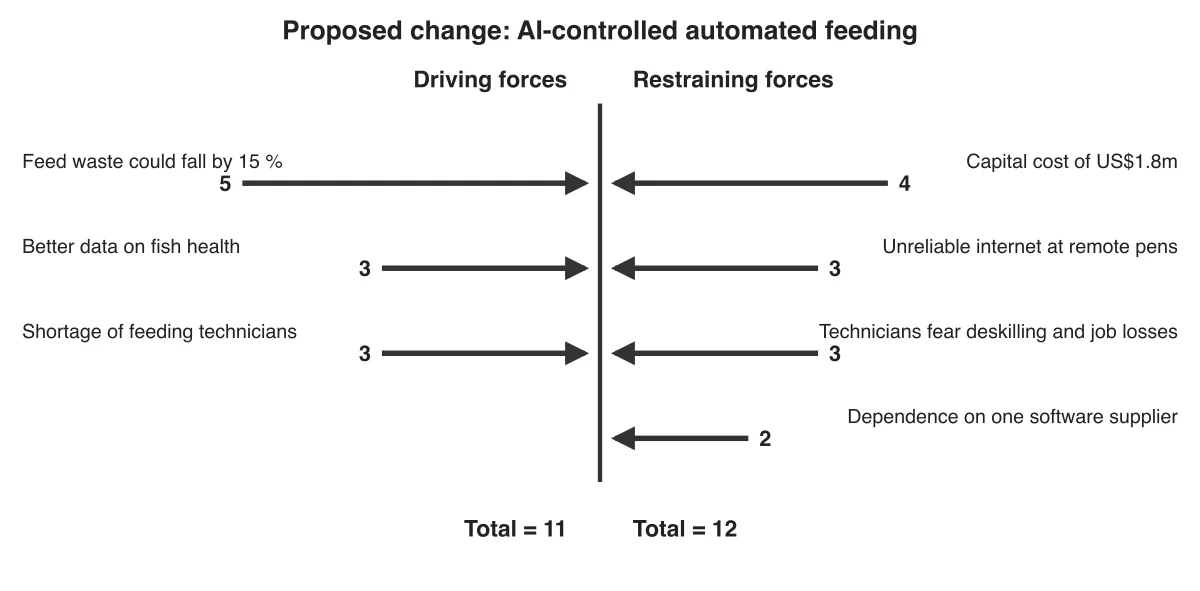
Using Figure 1, analyse the force field analysis for Salmones Aysén’s proposal.
6 marks
Nkabom Savings Ltd (NS)
Read the resources and answer the questions that follow.
Nkabom Savings Ltd (NS) is a for-profit social enterprise in Kumasi, Ghana, founded in 2016 by Akosua Boateng, a former bank manager. It modernizes susu, a traditional savings system in which a collector visits market traders every day to collect small deposits. NS’s 420 agents visit about 38 000 traders, most of them women, and record each deposit on the NS app. Traders can withdraw their savings at any time and, after six months of saving, can borrow small loans to buy stock. NS’s mission is “a safe place for every cedi”. The agents are self-employed and paid commission. Six regional supervisors manage them, reporting to an operations manager at head office.
Image: a smiling agent in a green NS waistcoat holding a phone up to a market trader seated behind piles of tomatoes and onions; the phone screen shows “Deposit received: GHS 20.00 – thank you, Auntie Ama”.
Resource 1 – News article from the *Ashanti Business Mirror*
Regulator to tighten rules on susu collectors after fraud cases
Ghana’s central bank has proposed new rules for microfinance companies that use susu agents. From 2027 every agent must be registered, trained every year and supervised by a team leader responsible for no more than 20 agents. The proposals follow several cases of collectors disappearing with traders’ money. NS, one of the fastest-growing digital susu companies, says it supports the rules but admits that its own fraud losses have risen.
Table 1: NS key figures
2023 | 2024 | 2025 | |
|---|---|---|---|
Customers | 21 000 | 30 000 | 38 000 |
Agents | 240 | 330 | 420 |
Fraud losses (GHS) | 48 000 | 112 000 | 236 000 |
Resource 2 – Social media posts from Ama, a trader at Kejetia market
My old susu man ran away with three months of my money in 2019. NS is different – every cedi I give shows on my phone. Last month I used my NS loan to buy two extra bags of rice. #NkabomNS [1/2]
But last week our agent did not come for nine days and his phone was off. NS paid us back after five weeks, but nobody at the office answers the phone. Who is checking these agents? [2/2]
Resource 3 – Internal email from Kwabena Yeboah, operations manager, to Akosua Boateng
From: Kwabena Yeboah, Operations Manager
To: Akosua Boateng, CEO
Subject: Restructuring our agent network
Each of our six supervisors is responsible for 70 agents. They cannot visit them, let alone check their records. We will not meet the regulator’s rule. I see three options:
Option A – employ all agents on contracts at GHS 1 400 a month (plus 13 % social security) instead of commission, organized in 30 teams under employed team leaders paid GHS 2 500 a month.
Option B – keep agents self-employed on commission, but add 30 employed team leaders (GHS 2 500 a month each), buy GPS-tracked tablets for all agents (GHS 150 000 in total) and rotate agents’ routes every six months.
Option C – move customers to depositing by mobile money themselves and reduce the network to 150 agents, who would then mainly sign up new customers and deal with loans.
CONFIDENTIAL: this email and any attachments are intended only for the named recipients.
Resource 4 – NS’s agent economics, 2025
Item | Amount |
|---|---|
Average deposits collected per agent per month | GHS 50 000 |
Fee charged to customers | 3 % of deposits |
Agent’s commission | 2 % of deposits (average GHS 1 000 a month) |
NS’s share of the fee | 1 % of deposits (average GHS 500 per agent a month) |
NS’s interest income from loans, 2025 | GHS 3.1 million |
Resource 5 – Survey of NS customers (600 replies)
Statement | % agree |
|---|---|
I trust my agent personally | 81 |
I would deposit by mobile money on my own instead of using an agent | 34 |
I can read the SMS receipts NS sends me | 46 |
A deposit of mine went missing in the past year | 7 |
Resource 6 – Interview with Yaw Owusu, an NS agent for nine years
“I know 95 traders by name and I know which ones are having a bad month. That is why they trust NS. But I am not an employee – no sick pay, no training since 2019, and I have met my supervisor twice. When an agent steals, everybody looks at all of us. If NS gave me a contract and a team leader I could talk to, I would stay for life. If NS replaces us with an app, the women at the market will go back to the old susu men.”
- (1)
Using an appropriate business management theory, describe a human need that NS meets for market traders.
2 marks
- (2)
Explain two challenges facing NS.
6 marks
- (3)
Using all the resources provided and your knowledge of business management, recommend a plan of action to reorganize NS so that it can grow safely over the next three years.
17 marks
Practice all 42 in Augment
Free with an account. Every question has its markscheme, and Augment keeps the ones you got wrong so you can come back to them.
More questions in Operations management
- 5.1Introduction to operations management
- 5.2Operations methods
- 5.3Lean production and quality management
- 5.4Location
- 5.5Break-even analysis
- 5.6Production planning
- 5.7Crisis management and contingency planning
- 5.8Research and development
- 5.9Management information systemsThis page
Check your answers in Augment
A free account opens all 42 questions on Management information systems with their markschemes, and keeps a record of what you have marked.