Supporting documents and research
Find, choose and prepare three to five supporting documents with a range of views, carry out useful primary research, and cite every source correctly in the project and bibliography.
- IB Business Management
- Internal assessment
- SL and HL
What supporting documents are for
The business research project is built on evidence. Most of the information in it comes from three to five supporting documents: sources you find yourself, attach at the end of the project, and refer to throughout the analysis. The project then analyses the evidence in them with the tools and theories of the course.
Documents matter for two criteria directly. Criterion B (4 marks) judges the documents themselves: whether there are three to five, whether they are relevant to the research question, whether they have enough depth, and whether together they give a range of ideas and views. Criterion D (5 marks) judges how well you select and use data from them in your analysis and evaluation. Indirectly they matter for almost every other criterion, because a project cannot analyse or conclude beyond the evidence it has.
The rules for supporting documents
Rule | What it means |
|---|---|
Three to five documents | Fewer than three or more than five limits criterion B to 1 mark out of 4, however good the documents are. |
Contemporary | Each document must have been published no more than three years before the project is submitted to the IB (in April or October of the final year, depending on the exam session). |
Chosen by you | Your teacher may guide you, but may not give you documents. Documents supplied by the teacher are not acceptable. |
At most one transcript | One document may be a written transcript of an audio or video file from a reliable organisation, with the original fully referenced. |
Short | Ideally no document is longer than the equivalent of five A4 pages. Use extracts from long reports. |
Highlighted | Highlight the parts of each document that relate directly to the project. |
Translated | Highlighted parts not in the language of your registration must be translated. |
Labelled | "Supporting document 1", "Supporting document 2" and so on, placed at the end of the project. |
Not textbooks or class notes | Textbooks, class notes and similar sources may be used and referenced, but they never count as supporting documents. |
Sources beyond the three to five documents are allowed: a textbook for a definition, a website for background on the organisation, a second article that confirms a figure. These additional sources must be cited and listed in the bibliography, but most of the information and data in the project should still come from the supporting documents.
Primary and secondary research
The documents may come from primary research, secondary research or both. Primary research collects new information first-hand for this project. Secondary research uses information that already exists, collected by someone else for another purpose.
Primary research for the project
Primary research can turn a generic topic into a specific one, because it gives you evidence no other student has. When primary research is used, its results become a supporting document, and that document must show both the questions asked and the findings.
Method | What the supporting document must include | Best used for |
|---|---|---|
Questionnaire or survey (face-to-face or online) | A blank copy of the questionnaire and a tally or summary of the responses. | Customer or employee opinions that can be counted: satisfaction, preferences, willingness to pay. |
Interview (face-to-face or online) | A copy of the interview questions and a summary of the answers. | The reasons behind a decision, from a manager or owner; detailed views of a supplier or expert. |
A copy of the questions put to the group and a summary of the findings. | How customers react to a product, a brand or a proposed change, and why. |
Each method has a different strength. A questionnaire gives quantitative research data that can be shown in a table or chart and analysed with descriptive statistics. Interviews and focus groups give qualitative research data that explain motives and feelings but cannot be generalised to all customers. Many strong projects combine one primary document with several secondary ones.
Doing primary research well
Ask questions that serve the research question. Every question should produce information you will use. Draft the questions after the research question is approved, not before.
Choose the right people. A sample of classmates is not a sample of a hotel's business guests. The people asked must be the stakeholders the issue affects.
Avoid leading questions. "Do you agree that the new prices are too high?" pushes respondents towards one answer and creates bias. "How do you rate the new prices?" with a scale is neutral.
Get enough responses. A survey of 12 people cannot support strong claims. State the sample size in the methodology and treat small samples with caution in the evaluation.
Record answers accurately. Take notes or record (with permission) and write the summary soon afterwards.
Act ethically. Ask for consent, explain the purpose, keep respondents anonymous unless they agree to be named, and never publish confidential company figures without permission.
Secondary sources for the project
Secondary documents are usually quicker to obtain and often contain data that primary research cannot, such as financial results, market share or national statistics. Typical secondary documents include:
articles from local, national or international newspapers and business magazines
the organisation's accounts, annual reports, financial results and investor presentations
business plans, mission statements and extracts from the organisation's website
press releases from the organisation or its competitors
market research reports and industry surveys
government statistics and reports by regulators
articles in academic or professional journals
a transcript of a relevant audio or video file (at most one).
Primary research | Secondary research | |
|---|---|---|
Strengths for the project | Specific to the organisation and the question; original; can fill gaps in published data. | Quick to find; often contains financial and market data; produced by organisations with expertise and large samples. |
Limitations | Time-consuming; small samples; access may be refused; the student's own design can introduce bias. | Written for another purpose; may be general; may present only the author's or the company's view. |
What to include as a document | The questions plus a tally or summary of responses. | The relevant extract, highlighted, with its full reference. |
Choosing documents with a range of views
The highest level of criterion B is reached only when the documents are relevant, sufficiently in-depth and together give a range of ideas and views. Three to five documents all published by the organisation itself, or three to five surveys of similar groups of people, do not give balance or objectivity. The aim is a set of documents that disagree, or at least look at the issue from different sides.
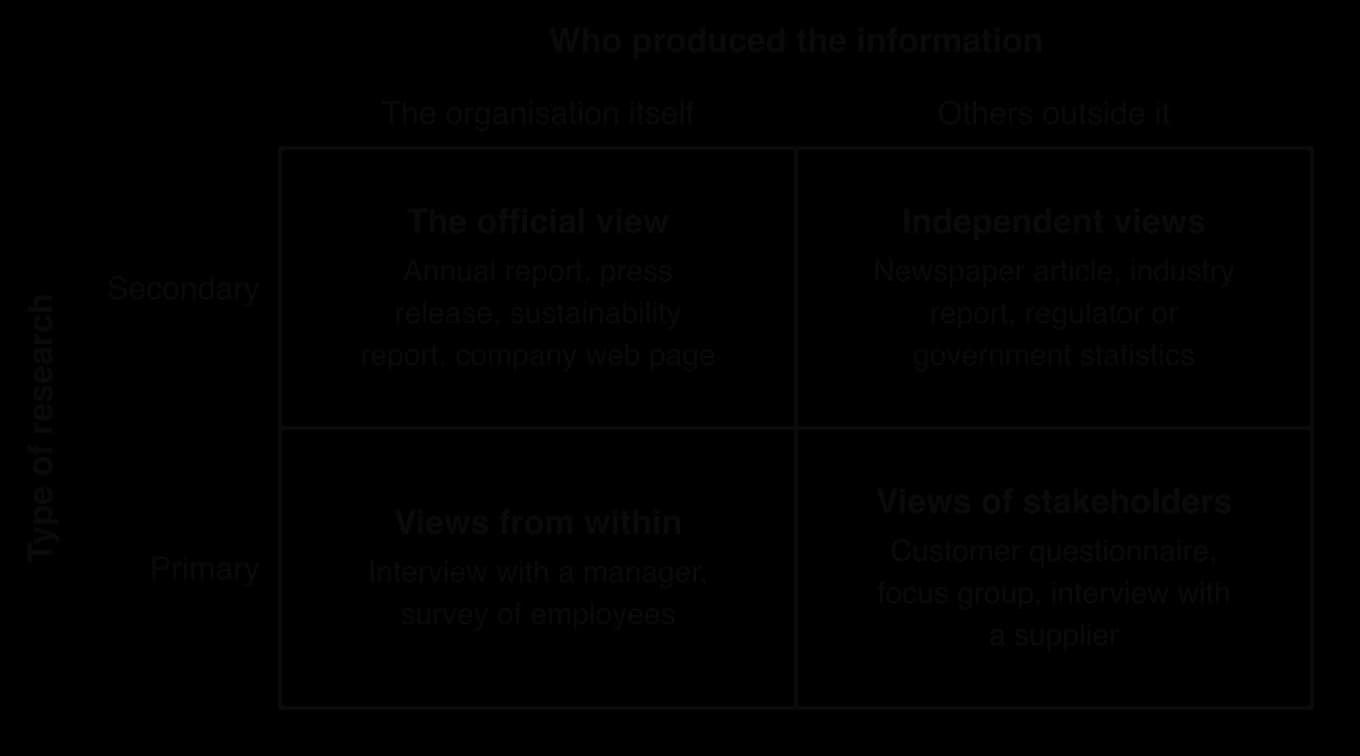
A practical way to build a range is to ask whose voice each document carries. The organisation's own reports give its official view and usually its best data. Independent journalists and analysts may be critical. Industry and government data place the organisation in its market. Customers, employees and suppliers, reached through primary research or through press coverage, show how the issue affects them. A set that combines three or four of these voices allows genuine evaluation.
Judging the reliability of a document
Every document has an author with a purpose. A company press release is written to present the company well; a campaign group's report is written to persuade; a newspaper article may simplify. None of this makes a document useless, but your analysis should recognise it. The questions in the table help to judge each document before choosing it.
Question | Why it matters |
|---|---|
Who wrote or published it? | An organisation with expertise and a reputation to protect is usually more reliable than an anonymous blog. |
Why was it written? | To inform, to sell, to persuade or to defend? The purpose shapes what is included and left out. |
When was it published? | It must be within three years before submission, and more recent data are usually more useful. |
What evidence does it contain? | Figures, sources and named data are more useful than opinion alone. |
How does it relate to the research question? | A document that is interesting but only loosely relevant weakens criterion B. |
Whose view does it represent? | Each document should add a view the others do not. |
Is it the right length? | Ideally no more than about five A4 pages; take an extract from a long report. |
Transcripts of audio and video
One of the supporting documents may be a transcript of a video or audio file, such as an interview with a chief executive, a company presentation, a podcast episode or a news report. The transcript must give the essential points of the recording used for the project; it need not be a word-for-word record of the whole file.
Use a reliable source. The recording should come from a reliable organisation: the business itself, an organisation it commissioned, a news organisation or an NGO, not an anonymous upload.
Reference the original fully so that it can be traced: the title, the organisation that published it, the date, the platform and the web address, plus the time stamps of the parts transcribed.
Transcribe the relevant parts accurately. Automatic captions are a starting point, but check them against the recording.
Highlight and translate the transcript like any other document.
Use at most one. Only one of the three to five supporting documents may be a transcript.
Preparing the documents
The documents are part of the submitted project, so their presentation matters. A moderator should be able to turn from any sentence in the project to the exact passage in the document that supports it.
Extract. If a source is long, keep only the relevant pages or sections, with the title, author, publisher and date visible. Aim for no more than about five A4 pages per document.
Highlight. Mark only the passages and figures that relate directly to the project. Highlighting whole pages defeats the purpose.
Translate. If a highlighted part is not in the language in which you are registered, add your own translation next to it or after it.
Label. Head each document "Supporting document 1", "Supporting document 2" and so on. Numbering them in the order in which they are first cited makes the project easier to follow.
Reference. Put the full reference at the top of each document and in the bibliography.
Place. Attach the documents together in their own section at the end of the project.
Citing sources and writing the bibliography
Every idea, figure or quotation taken from a source must be acknowledged where it is used and listed in full at the end. This is part of academic integrity: it shows which work is yours and which is someone else's. A citation is the short reference in the text; the bibliography is the full list of sources.
Citations in the text
The simplest system for supporting documents is to cite them by number, with a page where it helps: "Delivery costs per order fell by 18% during the trial (Supporting document 1)" or "(SD1, p. 2)". Additional sources, such as a textbook or a website used for background, are cited in the referencing style your school uses, for example the author and year in Harvard style: "(Ng 2025)". Whatever system you choose, use it consistently.
Citations do not count towards the 1,800-word limit, and neither does the bibliography. Footnotes and endnotes may be used only for references. Definitions of business terms and quotations must be in the body of the project, and they do count towards the word limit, so keep them short.
The bibliography
The bibliography lists every source used, the supporting documents and any additional sources, usually in alphabetical order of author or organisation. Each entry gives enough detail for a reader to find the source again. A typical layout for common source types is shown in the table (all entries invented).
Source type | Example entry |
|---|---|
Newspaper article (online) | Harbour Times (2025) "Green Basket riders split over switch to cargo bikes", 14 March. Available at: https://www.harbourtimes.example/business/green-basket (accessed 2 June 2026). |
Company report | Green Basket Ltd (2025) Annual Report 2024. Rotterdam: Green Basket Ltd. |
Government report | City of Rotterdam (2024) Low-Emission Zone Plan 2025–2030. Rotterdam: City of Rotterdam. |
Video (for a transcript) | Green Basket Ltd (2025) "Why we are trialling cargo bikes", interview with the chief executive, YouTube, 3 April. Available at: https://www.youtube.example/watch?v=… (accessed 5 June 2026). |
Primary research | Author's own survey of 85 Green Basket customers, conducted online, 10–24 May 2026. |
Textbook (additional source) | Author surname, initial. (year) Title of book. Edition. Place: Publisher. |
Using the documents in the analysis
Criterion D rewards the effective selection and use of data from the documents. Strong projects take numbers and evidence from the documents and do something with them: calculate a ratio, compare two figures, place them in a tool such as a SWOT analysis or a break-even chart, or set one document's claim against another's data. Weak projects quote or summarise each document in turn.
Weak use of a document | Strong use of the same document |
|---|---|
"Supporting document 1 says the cargo bike trial was a success." | "During the trial, delivery cost per order fell from €4.10 to €3.35 (SD1), a fall of 18%. However, the trial ran only in the flattest district in summer, so the saving may be smaller across the whole city." |
"The newspaper reports that riders are unhappy." | "Riders interviewed by the Harbour Times say pay per delivery is lower on bikes (SD3). If labour turnover rises, recruitment and training costs could offset part of the saving in SD1, which matters for the social side of sustainability." |
Copying a table of survey results into the text. | Presenting the key results in a chart (not counted in the word limit) and analysing what they show: 62% of customers would accept a 15-minute longer delivery window (SD7), but only 21% would pay a higher delivery charge. |
The strong versions use specific data, cite the document, connect two documents, and add a judgment about reliability or implications. Sustained analysis and evaluation follow this pattern of evidence, then analysis, then a qualification.
Why tables, charts and calculations help with the word limit
Tables of statistical data, diagrams, figures, equations, formulae and calculations are not included in the word count. Presenting survey results or financial data as a table or chart, and showing calculations such as ratios or payback set out as working, lets you include more evidence without using words.
Each table or chart must still be referred to and analysed in the text. A chart that is never discussed adds nothing to criterion D. Keep the text that interprets it concise and specific.
Common mistakes with documents
Too many or too few. Six documents, or two, limit criterion B to 1 mark.
Out of date. A document published more than three years before submission does not qualify. Check the date of each one.
One voice only. Five company publications give no balance.
Too long. A whole 120-page annual report is not a suitable document. Use the relevant extract.
Not used. A document listed at the end but rarely or never cited in the analysis weakens both B and D.
Supplied by the teacher. Documents must be found by the student.
Weak primary research. A survey of friends who are not customers, with leading questions and no tally attached.
Textbooks counted as documents. A textbook can be cited, but it is never a supporting document.
Document checklist
- To do:
I have three, four or five supporting documents: no more, no fewer.
- To do:
Every document was published within the three years before my submission date.
- To do:
I found every document myself; none was supplied by my teacher.
- To do:
The documents give a range of ideas and views, not just the organisation's own.
- To do:
Each document contains data or arguments I use in the analysis.
- To do:
At most one document is a transcript, from a reliable organisation, with the original fully referenced.
- To do:
Primary research documents include the blank questions and a tally or summary of responses.
- To do:
No document is much longer than about five A4 pages.
- To do:
The relevant parts are highlighted, and any highlighted parts in another language are translated.
- To do:
Each document is labelled "Supporting document 1", "2" and so on, and placed at the end of the project.
- To do:
Every source is cited in the text and listed in the bibliography in one consistent style.
Carry on with Business in Augment
With a free account, Augment remembers where you stopped in the notes and which questions you have marked.