Choosing an issue and a research question
Choose an organisation, a real issue and one key concept for the business research project, and turn them into a focused research question that your documents can answer.
- IB Business Management
- Internal assessment
- SL and HL
What the business research project is
The internal assessment in business management is a business research project: a written report of no more than 1,800 words on a real issue or problem facing one real organisation, analysed through one of the four key concepts. It is the same task at SL and HL, it is marked out of 25, and it counts for 30% of the final grade at SL and 20% at HL. Your teacher marks it first, and a sample from your school is then checked by an external moderator.
The project is a piece of research. Most of the information in it comes from three to five supporting documents that you find yourself and attach at the end: articles, company reports, survey results, interview summaries and similar sources. You then analyse that information with the tools and theories of the course, weigh up what it shows, and reach a conclusion that answers your research question.
Almost every later mark depends on decisions taken in the first few weeks. A well-chosen organisation gives you documents to work with; a real issue gives you something to analyse; a suitable key concept gives you a lens that fits naturally; and a focused research question makes it possible to reach a clear conclusion in 1,800 words. Good writing later in the project cannot make up for a weak choice at the start.
The requirements at a glance
Requirement | What it means in practice |
|---|---|
A real business issue or problem | A decision, problem, change or opportunity that the organisation actually faces or has faced, linked to any part of the course. |
One organisation | The project is about a single named organisation. Issues affecting its whole industry may be discussed when they affect that organisation. |
A research question | The title is written as a question. It may look forward (what should the organisation do?) or back (how successful was something it did?). |
One key concept as a lens | Change, creativity, ethics or sustainability: exactly one, named on the title page. It may also appear in the research question. |
Three to five supporting documents | The sources most of your information comes from, published no more than three years before submission and chosen by you. The highest marks need documents that give a range of views. |
Primary and/or secondary research | Documents may be secondary (articles, reports, statistics) or primary (your own survey, interview or focus group results). |
At most 1,800 words | The text of the introduction, main body and conclusion counts; tables of data, diagrams, calculations, citations, the bibliography and the documents do not. A moderator stops reading at 1,800 words. |
Full referencing | In-text citations for every source and a bibliography, with the supporting documents labelled and attached. |
The requirements that shape your choice of topic are the single organisation, the real issue, the key concept and the need for recent documents that show more than one point of view.
How your choices affect the marks
The project is marked against seven assessment criteria, A to G. The table connects each criterion to the choices made before any writing starts.
Criterion | Marks | How the choice of topic affects it |
|---|---|---|
A Integration of a key concept | 5 | A concept that fits the issue naturally can be analysed throughout; a concept added as a label gets stuck at the lower levels. |
B Supporting documents | 4 | An organisation with plenty of recent, varied coverage lets you choose documents with a range of views. A very obscure organisation may leave you with three similar sources. |
C Selection and application of tools and theories | 4 | A question about a decision or a problem invites tools such as SWOT, STEEPLE, ratios or break-even. A descriptive question leaves little to apply them to. |
D Analysis and evaluation | 5 | An issue with real data and more than one defensible answer allows thorough analysis and balanced evaluation. |
E Conclusions | 3 | A focused question can be answered explicitly. A vague question produces a vague conclusion. |
F Structure | 2 | Depends on how the project is organised, but a clear question makes a clear structure much easier. |
G Presentation | 2 | Depends on the title page, contents page, headings and page numbers, not on the topic. |
Criteria A to E, worth 21 of the 25 marks, depend directly on how good the organisation, issue, concept and question are. Time spent choosing carefully therefore pays off across most of the marks.
Choosing an organisation
Any real organisation can be the subject: a multinational company, a privately held company, a sole trader, a cooperative, a charity, a social enterprise, a school or a public sector body. What matters is that you can find enough recent, reliable information about the issue you want to study, from more than one point of view.
What makes an organisation a good choice
Access to information. Large publicly held companies publish annual reports, results and press releases and are covered by the news media. Small businesses publish little, but their owners may agree to an interview or allow a customer survey.
A recent, visible issue. The organisation should have faced a decision, problem or change in the last three years, so that documents about it are recent enough to use.
A manageable size. A huge multinational has so many activities that it is easy to drift into generalities. Focusing on one product, one market or one decision keeps the project specific.
Your own interest and knowledge. You will read about this organisation for several months. Knowing its products, market or local context helps you notice what matters in the documents.
Language. Documents in other languages may be used, but the highlighted parts must be translated, which takes time.
Type of organisation | Strengths for the project | Risks for the project |
|---|---|---|
Large publicly held company or multinational company | Plenty of published data (annual reports, results, press coverage); financial data for ratios. | Easy to become general or descriptive; many other students choose the same company; difficult to get primary research. |
Medium-sized privately held company | Some press coverage; managers may agree to an interview; a focused issue. | Limited financial data; may depend heavily on one interview. |
Small local business (for example a family restaurant) | Primary research is possible (owner interview, customer survey); a very specific decision. | Almost no secondary documents; the documents may all come from one viewpoint; the owner may not share figures. |
Social enterprise, cooperative or charity | Annual and impact reports; distinctive issues that suit ethics or sustainability. | Smaller organisations may publish only their own positive view. |
Public sector organisation | Official reports, budgets and audits; media coverage of decisions. | Political issues can pull the project away from business management. |
There is no best type of organisation. A small business works well if you can carry out good primary research and also find secondary sources, such as local news coverage, industry data or council planning documents, that give a wider view. A large company works well if you narrow the issue tightly, for example to one product launch or one market.
One organisation, but industry issues are allowed
The project must refer directly to a single organisation. You may still discuss issues that affect its whole industry, such as new regulation, rising raw material prices or a change in consumer tastes, as long as you analyse how they affect your organisation. An industry report or a government statistic can therefore be a good supporting document, provided the project uses it to explain the organisation's position.
Finding a real issue or problem
An issue is a situation in which the organisation has to make a choice, solve a problem, respond to a change or judge whether something it did has worked. A topic is not yet an issue: "Tesla's marketing" is a topic, while "whether a car maker should cut prices to protect its market share" is an issue, because there is something to decide and more than one possible answer.
Real issues usually take one of four forms.
Kind of issue | What the project does | Example (invented organisation) |
|---|---|---|
A decision still to be made | Weighs the options and recommends one. | Whether Lumen Cycles, a bicycle maker in the Netherlands, should start selling directly to consumers online. |
A problem to solve | Analyses the causes and evaluates possible solutions. | How a hotel group can reduce high labour turnover among its kitchen staff. |
A change that has already happened | Judges how successful the change has been and why. | How successful a café chain's move to a reusable-cup deposit scheme has been. |
An opportunity | Assesses whether and how the organisation should take it. | Whether a regional airline should open a route to a new holiday destination. |
Where to look for ideas
Good ideas come from noticing businesses around you and from the course itself. Local and national news, business sections of newspapers, company press releases, trade magazines and the businesses your family or friends work for are all sources of real issues. Each unit of the course also suggests typical issues.
Unit | Typical issues for a project |
|---|---|
Introduction to business management | Growth by acquisition or franchising; changing legal structure; a conflict between stakeholders; a move into a new country. |
Human resource management | High labour turnover; a change in organisational structure; introducing flexible or remote working; a new pay or reward system; outsourcing a function. |
Finance and accounts | Financing an expansion; whether an investment was worth it; a fall in profitability or liquidity; closing a loss-making branch. |
Marketing | Targeting a new segment; repositioning a brand; changing a pricing strategy; using social media marketing; entering a new market. |
Operations management | Relocating production; adopting new technology; reducing waste; moving to a circular business model; changing suppliers. |
Six tests for an issue
Is it real? It must be an issue the organisation actually faces or has faced, not one invented for the project.
Is it recent? Documents about it must have been published within the three years before submission.
Is it specific? It concerns one decision, problem or change, not the organisation's whole strategy.
Is it debatable? Reasonable people could disagree about it, so the project can weigh more than one view.
Is it analysable? Course tools and theories can be applied to it, and some data exist.
Is it the right size? It can be analysed in depth in 1,800 words.
Choosing the key concept lens
The project must use exactly one of the four key concepts, change, creativity, ethics or sustainability, as a lens, a particular angle from which the issue is analysed. The concept is named on the title page. It may also appear in the research question, but it does not have to.
A lens shapes which questions the project asks. The same issue looks different through different concepts. A supermarket's decision to replace staffed checkouts with self-service tills can be analysed through change (how the business manages the move and the resistance to it), ethics (its duty to employees whose jobs disappear and to older customers) or sustainability (whether the move keeps the business viable in the long run while affecting the local community). Each lens leads to different evidence and a different emphasis.
Key concept | The lens asks… | Issues where it fits naturally |
|---|---|---|
Change | What is changing, why, how the organisation manages it, and with what consequences for stakeholders? | Restructuring, new technology, relocation, entering a new market, responding to a new competitor or law. |
Creativity | How does the organisation generate or use new ideas in products, processes or marketing, and what value do they bring? | Product development, innovative promotion, new business models, problem-solving in operations. |
Ethics | Which moral principles are involved, which stakeholders gain and lose, and is the decision right as well as profitable? | Pay and working conditions, sourcing from suppliers, marketing to children, data use, closing a site. |
Sustainability | Can the organisation meet present needs without harming its future, economically, socially and environmentally? | Packaging and waste, circular business models, long-term financial survival, community impact. |
Choose the concept with the issue, not after it
The strongest projects choose the concept at the same time as the issue, because the concept and the issue fit each other. When the concept is chosen after the research is finished, it usually appears only in the introduction and the conclusion, and criterion A stays at the lower levels. A useful check is whether the concept could appear naturally in the research question: if it could, it will probably run naturally through the analysis too.
Writing the research question
The research question is the title of the project. It states precisely what the project investigates, names the organisation, and is phrased so that the conclusion can answer it directly. A good research question is the single most useful thing a project can have, because every later section is judged by how well it helps to answer it.
Forward-looking and backward-looking questions
A research question may look forward or back. A forward-looking research question asks what the organisation should do about a decision it still faces, so the project ends with a recommendation. A backward-looking research question asks how successful, effective or justified something the organisation has already done has been, so the project ends with a judgment.
Forward-looking | Backward-looking | |
|---|---|---|
What it asks | What should the organisation do? | How well did something the organisation did work? |
Typical wording | "Should…?", "How can…?", "To what extent should…?" | "How successful has…?", "To what extent has… improved…?", "How effective was…?" |
Conclusion | A justified recommendation, with conditions. | A justified judgment on success or failure. |
Strengths | Invites the evaluation of options; feels relevant to the organisation. | Results already exist, so the analysis rests on real outcomes. |
Risks | Can drift into speculation if the documents contain no data on the options. | Can become a description of what happened unless it judges success against clear measures. |
Neither type is better. Choose the one that suits the information available. If the decision is still open and documents discuss the options, a forward-looking question works well. If the change happened between one and three years ago and there are results to analyse, a backward-looking question is usually stronger.
Two examples in the official style
Two kinds of question are widely used as models of what is appropriate.
"Should company Y switch its manufacturing to outsourcing?" A forward-looking question about one decision. It leads into operations management and human resource management, and change is a natural lens, because outsourcing alters how work is organised and who does it.
"How can airline X target segment Y successfully?" A forward-looking question about a marketing problem. It leads into market segmentation, promotion and measures of financial success, and sustainability can serve as the lens, for example whether targeting that segment keeps the airline viable in the long term.
Both name one organisation, one issue and an outcome that the conclusion can state. Neither asks for a description, and neither can be answered with a simple fact.
Features of a good research question
Names one real organisation (and, where useful, one product, market or site).
Focuses on one issue, not a list of issues.
Invites analysis and judgment: "should", "how successful", "to what extent", "how can". It cannot be answered by looking up a fact.
Allows more than one answer, so that evidence can be weighed.
Is answerable from three to five documents, using data the documents contain.
Is limited in time or scope where that helps: "in the next two years", "in its UK stores", "since 2024".
Uses business language that points to the tools and theories involved: "market share", "profitability", "labour turnover", "repositioning".
Weak and improved research questions
The table shows common weaknesses and how to fix them. The organisations in the improved questions are invented, except where a widely known company is used to show the form of a question.
Weak question | Why it is weak | Improved question | Lens |
|---|---|---|---|
What is Sunrise Hotels' HR strategy? | Descriptive; no issue; far too broad. | How can Sunrise Hotels reduce labour turnover among kitchen staff at its Lisbon hotels? | Change |
Is Kopi Lane profitable? | Answered by one fact (yes or no); no analysis needed. | To what extent has opening three airport outlets improved the profitability of Kopi Lane, a Singapore café chain? | Change |
How do supermarkets reduce plastic? | An industry, not one organisation; no decision. | Should FreshMart replace plastic packaging on its own-brand fruit with compostable packaging by 2027? | Sustainability |
Should Apple and Samsung change their prices? | Two organisations; no specific decision. | How successful has a smartphone maker's move to a lower-priced model been in increasing its market share in India? | Change |
How can Lumen Cycles improve its business? | Vague: every area of the business; no specific issue. | Should Lumen Cycles start selling its bicycles directly to consumers online in Germany? | Creativity |
Is fast fashion unethical? | A general debate, not a business issue of one organisation. | To what extent is ThreadLine's decision to move production to a new supplier in Bangladesh ethically justifiable? | Ethics |
How will AI change the banking industry? | Industry-wide; speculative; documents will be opinion only. | Should Harbour Credit Union introduce an AI chatbot for customer enquiries in 2026? | Ethics |
Why did the bakery near my house close? | Almost no documents; backward-looking with nothing to evaluate. | How can Maison Lefèvre, a family bakery, compete with a new discount supermarket opening nearby? | Creativity |
Each improved question names one organisation, one issue and a measure of success or a decision to be made. The lens column shows a concept that fits each issue naturally. In several rows a different concept could also work, as long as it runs through the analysis.
Testing the question before approval
Your teacher approves the research question before the research starts, to make sure it is suitable and allows access to the highest levels of every criterion. Before you ask for approval, test the question yourself. The figure shows the path from an initial interest to an approved question, with the test that applies at each step.
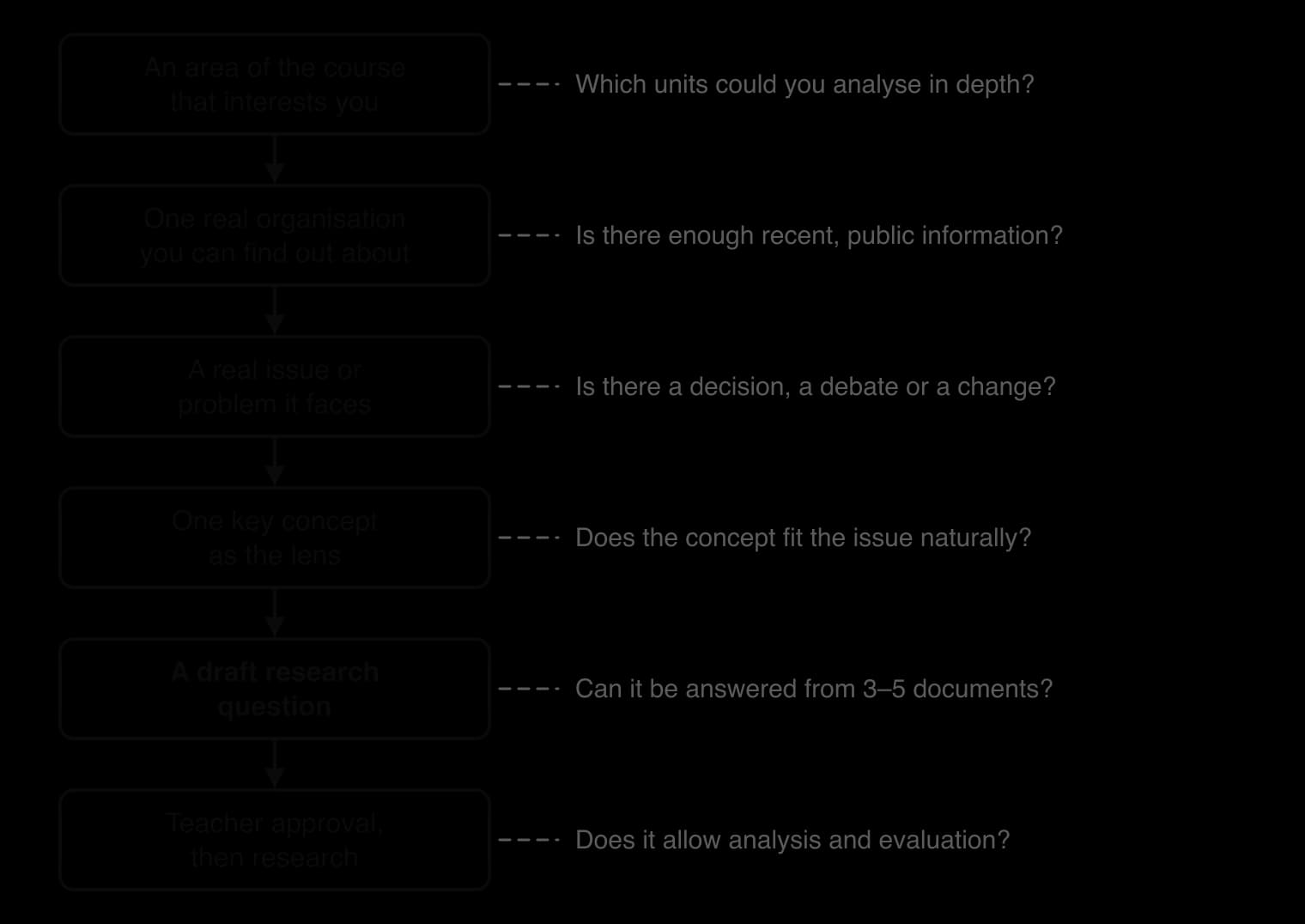
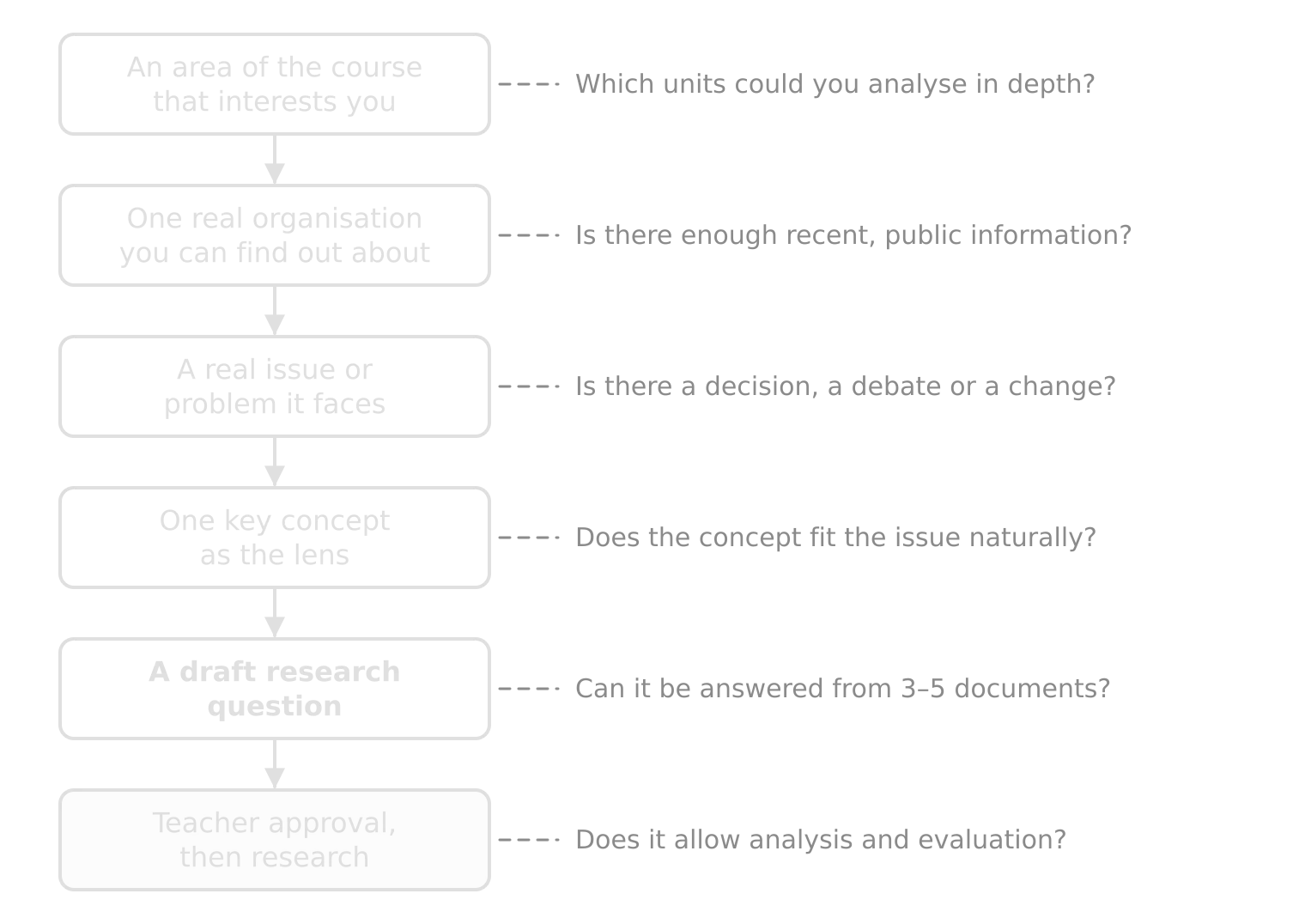
The document test
Try to name, before you start writing, three to five documents you expect to use, and say where each comes from and whose view it represents. If you can only think of the company's own website and one news article, the question is risky. If you can name a company report, an independent news analysis, an industry statistic and your own customer survey, the question is promising.
The tool test
Name two or three business management tools or theories that will help to answer the question, and say what each will show. For a question on entering a new market, a STEEPLE analysis of the new country, the Ansoff matrix and a short financial analysis might work together. If no tool clearly helps, the question may be too descriptive.
The answer test
Write two possible conclusions, one on each side ("Yes, Lumen Cycles should sell directly online, because…" and "No, because…"). If both are plausible, the question allows the balanced evaluation that criterion D rewards. If only one answer is possible, or the answer is obvious before any research, the question needs reworking.
Writing a short proposal
Many teachers ask for a short written proposal before approving a question. Even when it is not asked for, writing one clarifies your thinking and becomes the basis of your introduction. A good proposal covers six points in about 150 words.
Proposal heading | What to write |
|---|---|
Organisation | Name, type, size, location and what it does, in two sentences. |
Issue | The decision, problem or change, and why it matters now. |
Research question | The draft question, forward- or backward-looking. |
Key concept | The chosen concept and one sentence on why it fits. |
Likely documents | Three to five sources, with their origin and viewpoint. |
Tools and theories | Two or three, with what each is expected to show. |
Example research questions across the course
The table shows the form good research questions can take in every unit. The real organisations in it are used only to illustrate the wording of a question; they make no claim about decisions those organisations are actually facing. Before using any question like these, check that the issue is real and that recent documents exist.
Unit | Research question | Direction | Lens | Tools that might help |
|---|---|---|---|---|
Introduction to business management | Should Lumen Cycles grow by franchising its repair workshops in Belgium? | Forward | Change | SWOT, Ansoff matrix, stakeholder mapping |
Introduction to business management | How successful has a craft brewery's conversion to a cooperative been for its employees and its growth? | Backward | Ethics | Stakeholder analysis, ratio analysis |
Human resource management | How can Sunrise Hotels reduce labour turnover among kitchen staff at its Lisbon hotels? | Forward | Change | Motivation theories, labour turnover data, force field analysis (HL) |
Human resource management | To what extent has a four-day working week improved productivity at a software company? | Backward | Creativity | Motivation theories, productivity data, SWOT |
Finance and accounts | Should Kopi Lane finance its expansion into Malaysia with a bank loan or a share issue? | Forward | Sustainability | Sources of finance, ratio analysis, cash flow forecast |
Finance and accounts | To what extent has IKEA's investment in buy-back and resale schemes been financially worthwhile in one country? | Backward | Sustainability | Investment appraisal, circular business models |
Marketing | How can a regional airline successfully target business travellers on its new route? | Forward | Change | Market segmentation, position map, seven Ps |
Marketing | How effective has Maison Lefèvre's use of social media marketing been in attracting younger customers? | Backward | Creativity | Seven Ps, primary research data, descriptive statistics |
Operations management | Should Green Basket replace its petrol vans with electric cargo bikes by 2027? | Forward | Sustainability | Investment appraisal, break-even analysis, STEEPLE |
Operations management | To what extent is ThreadLine's move to a new supplier in Bangladesh ethically justifiable? | Backward | Ethics | Stakeholder analysis, STEEPLE, decision tree |
The questions use a wide range of tools because each issue calls for different ones. A project does not need many tools. Two to four, applied in depth to the organisation's data, are usually far more effective than six or seven applied briefly.
Planning the project
Most schools spread the project over several months, with deadlines set by the teacher. Work usually proceeds in the order shown in the timeline. The dark bars mark fixed points: approval of the research question, the first draft, the teacher's comments on it and the final submission. Everything else can overlap.
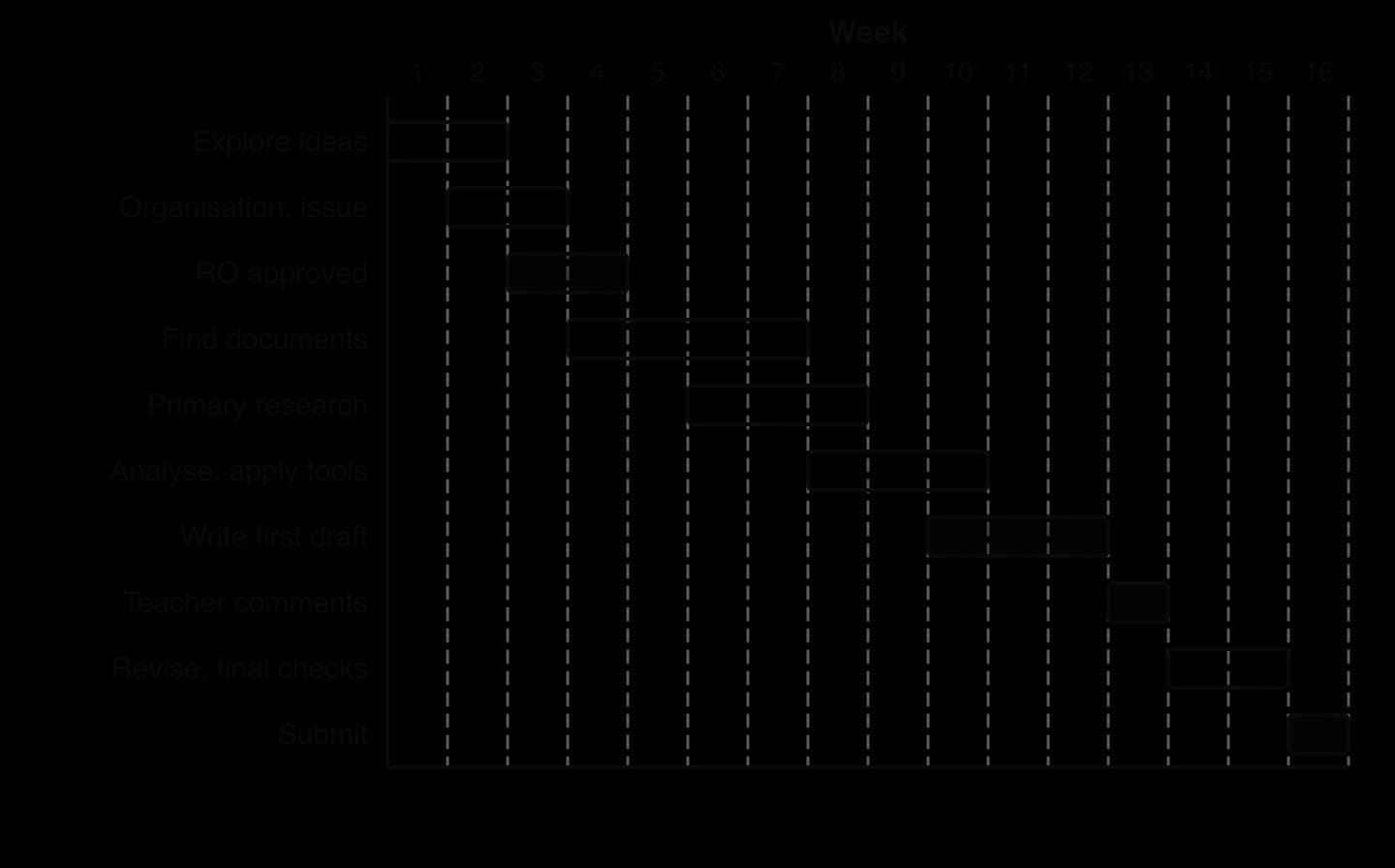
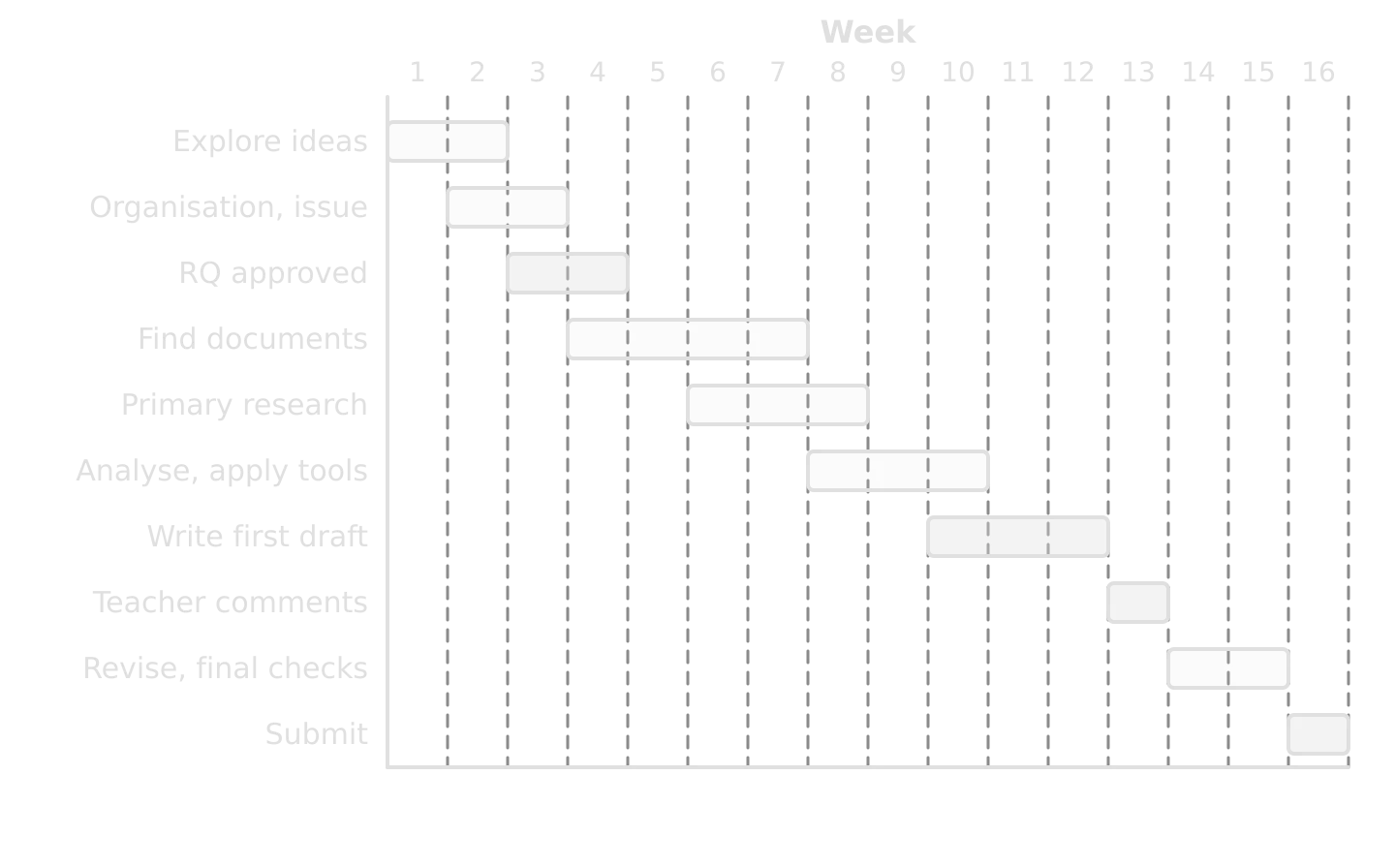
Three features of the timeline matter most. The research question is fixed early, because all later work depends on it. Finding documents takes longer than most students expect, so it starts as soon as the question is approved. And the first draft is a complete draft, because the teacher comments on one draft only; the next version you hand in is the final one.
Common traps when choosing
A topic instead of an issue. "Coca-Cola's advertising" is a topic. Find the decision, problem or change inside it.
A question that is too broad. Narrow it by product, market, site, stakeholder group or time period.
A question that needs secret data. Check that the figures you need are published or that the organisation will share them.
Only one point of view available. If every document comes from the organisation itself, the project cannot weigh different views.
An issue that is too old. Documents must be from the last three years before submission. An issue from five years ago will be hard to support.
A concept added at the end. Choose the lens with the issue, so that it shapes the research from the start.
Copying a question from an online example. The project must be your own. Example questions show a form, not a topic to reuse.
What if my research question needs to change later?
Small changes to the wording are normal as you learn more about the issue: narrowing the market, adding a time period or making the measure of success clearer. A completely different question means repeating the approval with your teacher, and usually finding new documents, so it is far better to test the question thoroughly at the start.
Whatever changes, the final research question must match the title page and be the question the conclusion answers. A conclusion that answers a slightly different question from the title loses marks under criterion E.
Before you ask for approval
- To do:
I have chosen one real organisation and can find recent information about it.
- To do:
I have identified a real issue: a decision, problem, change or opportunity it faces or has faced.
- To do:
The issue is recent enough for documents published in the last three years.
- To do:
The issue is debatable, with more than one reasonable answer.
- To do:
I have chosen one key concept that fits the issue naturally, and can say why in one sentence.
- To do:
My research question names the organisation, focuses on one issue and asks for a judgment or recommendation.
- To do:
I know whether my question is forward-looking or backward-looking.
- To do:
I can name three to five likely supporting documents, from different sources and viewpoints.
- To do:
I can name two to four tools or theories and what each will show.
- To do:
I have written two plausible answers to my question, one on each side.
- To do:
The organisation is different from the one in any extended essay I am writing.
Carry on with Business in Augment
With a free account, Augment remembers where you stopped in the notes and which questions you have marked.