Writing the project and the assessment criteria
Structure and write a business research project of at most 1,800 words that applies tools and theories, integrates one key concept and meets the top level of each of the criteria A to G.
- IB Business Management
- Internal assessment
- SL and HL
The shape of a business research project
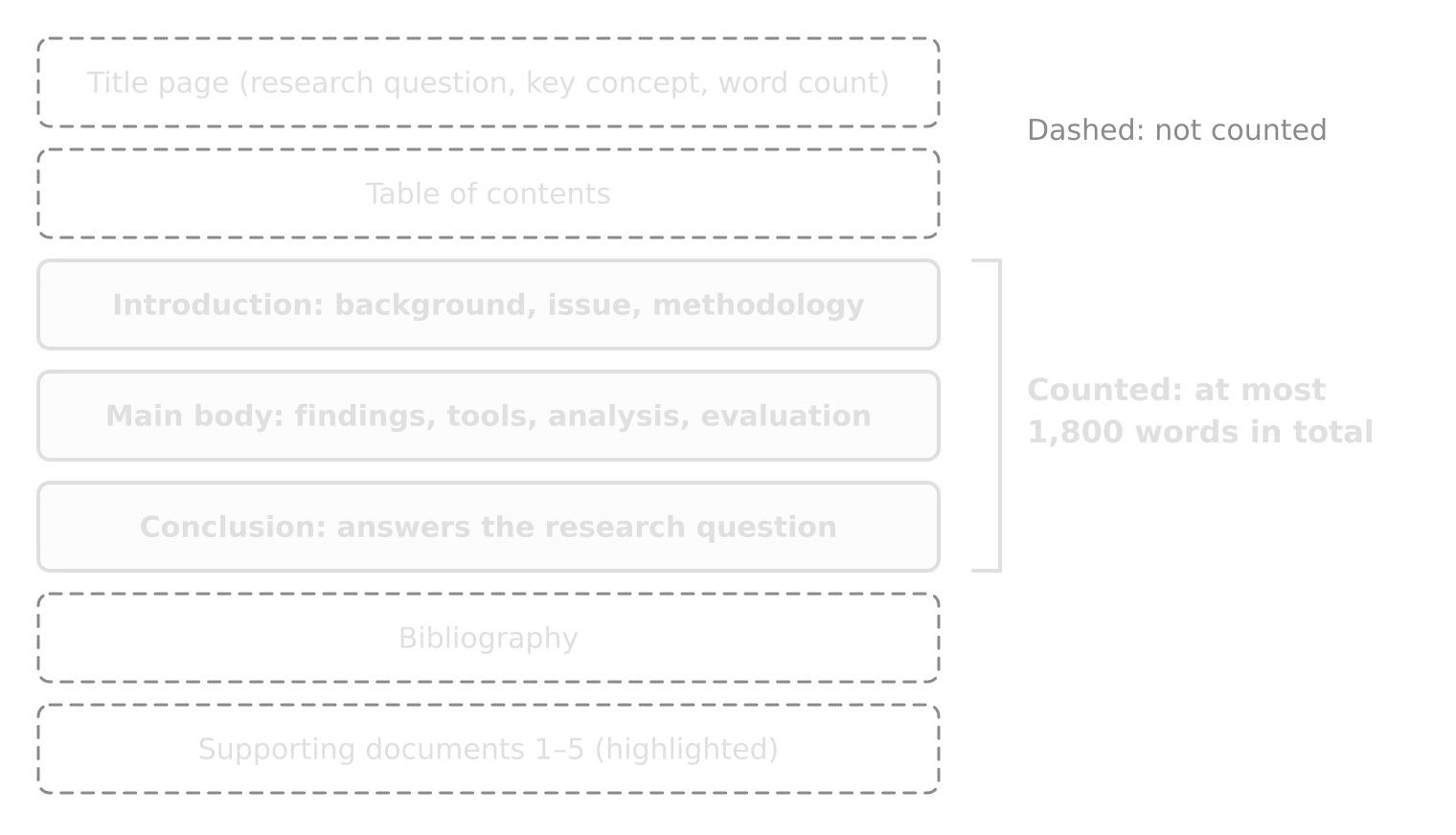
A business research project is a structured report. It answers one research question about one organisation, using evidence from three to five supporting documents, within a word limit of 1,800 words. The parts follow a fixed order, and only three of them count towards the limit.
What counts towards the 1,800 words
Counted in the 1,800 words | Not counted |
|---|---|
|
|
The word count must appear on the title page. Any words beyond 1,800 are ignored, so a project that runs long usually loses its conclusion, which is the part that answers the question and earns criterion E. Footnotes may contain references only: an explanation moved into a footnote to save words still counts, and is against the rules.
A sensible allocation of words
There is no fixed allocation, but most strong projects divide the words roughly as the table shows. The main body takes most of the space, because that is where criteria A, C and D are earned.
Part | Approximate words | What it does |
|---|---|---|
Introduction | 200–300 | Background on the organisation, the issue and why it matters, the methodology. |
Main body | 1,200–1,400 | Findings from the documents analysed with tools and theories, the key concept integrated, evaluation of the evidence and options. |
Conclusion | 200–250 | Answers the research question explicitly, with its conditions and the limitations of the research. |
Presentation and structure
Two criteria, F and G, judge the form of the project. They are worth only 4 marks together, but they are the easiest marks to secure, and a clear structure also makes the analysis easier to follow.
Title page and contents
Title page: the research question as the title, the key concept used as the lens, and the word count, plus any identifying details your school asks for.
Table of contents: every heading and sub-heading with its page number. It must be accurate, so update it after the final edit.
Headings and sub-headings: clear, specific headings ("Cost comparison of vans and cargo bikes", not "Analysis 2") that show the logic of the argument.
Numbered pages throughout, including the pages of the documents if possible.
Writing the introduction
The introduction sets the context in about 250 words. It gives brief background on the organisation, states the issue or problem clearly, and explains the methodology: how the research was done.
Background (2–3 sentences). What the organisation is, its size and market, and only the facts needed to understand the issue.
The issue (2–3 sentences). What decision, problem or change the organisation faces, and why it matters now.
The research question and the lens (1–2 sentences). State the question and why the key concept is a useful lens for it.
Methodology (3–4 sentences). Which documents were used, whose views they represent, any primary research and its sample, which tools will be applied, and the main limitation of the evidence.
The extract is the introduction of a project on an invented company. Research question: "Should Green Basket replace its petrol delivery vans with electric cargo bikes in its city-centre areas by 2027?" Lens: sustainability.
Green Basket is a privately held company that delivers organic groceries to about 30,000 customers in Rotterdam, Utrecht and The Hague, using a fleet of 48 petrol vans. In 2025 it trialled electric cargo bikes in central Rotterdam (Supporting document 1). The city plans to charge petrol vans entering a new low-emission zone from 2027 (SD4), so the company must decide whether to switch its city-centre deliveries. Sustainability is the lens for this project, because the decision affects Green Basket's long-term costs, its delivery riders and its environmental impact. The project uses five supporting documents: the company's press release on the trial, a newspaper article quoting riders, the city's low-emission zone report, a trade magazine comparison of delivery costs, and my own survey of 85 customers. These are analysed with a STEEPLE analysis, investment appraisal and stakeholder mapping. The trial data cover only one district in summer, which limits how far the results can be generalised.
Writing the main body
The main body presents the findings from the documents and analyses them with business management tools and theories, through the chosen key concept, to reach an evaluation of the issue. It is usually organised under three to five headings.
Organising the main body
Two structures work well. In a structure by theme, each section answers one part of the question (for example costs, customers, employees, the external environment), using whichever tools fit that theme. In a structure by option, each section evaluates one possible course of action, followed by a comparison. Avoid a structure by document ("Supporting document 1 says…", "Supporting document 2 says…"), which leads to description rather than analysis.
Selecting and applying tools and theories
Criterion C rewards tools and theories that are effectively selected and applied, with clear relevance to the research question. Selection means choosing the tools that actually help to answer this question; application means using the organisation's own data in them and drawing a conclusion from each one. Two to four tools used well are worth more than a long list used briefly.
If the question is about… | Tools and theories that often help |
|---|---|
Strategy, growth or a new market | SWOT analysis, STEEPLE analysis, Ansoff matrix, stakeholder mapping |
A financial decision or performance | Ratio analysis, investment appraisal, cash flow forecast, break-even analysis, sources of finance |
People, structure or motivation | Motivation theories, leadership styles, organisational structure, labour turnover data |
Marketing | Market segmentation, position map, seven Ps, product life cycle, BCG matrix, descriptive statistics of survey data |
Operations | Break-even analysis, location factors, circular business models, decision trees, productivity data |
Choosing between options | Decision trees, investment appraisal, SWOT of each option; at HL also force field analysis |
Use real data in each tool. A SWOT analysis whose points are generic ("strong brand", "competition") applies nothing. Each point should come from a document and be cited.
Draw a conclusion from each tool. After a STEEPLE analysis, say which factor matters most for the question and why.
Link tools together. A cost saving found by investment appraisal can become a strength in the SWOT, and a rider concern from the stakeholder map a weakness.
Show calculations as working. Ratios, payback periods and break-even quantities set out as calculations do not count towards the word limit.
Recognise the limits of each tool. A SWOT analysis is only as good as its evidence; a payback period ignores later cash flows. Saying so is evaluation.
Integrating the key concept throughout
Criterion A rewards a project that integrates the analysis of the connection between the key concept and the organisation throughout. In practice that means the concept appears in the introduction, shapes the analysis in each section of the main body, and is part of the answer in the conclusion. It is not a separate section.
Weak integration | Strong integration |
|---|---|
A paragraph headed "Sustainability" at the end of the main body. | Each section asks what its findings mean for the economic, social and environmental sustainability of the organisation. |
The concept is defined in the introduction and not mentioned again until the conclusion. | The concept shapes the choice of documents (riders' views for social sustainability) and of tools (investment appraisal for economic sustainability). |
The concept is described in general terms ("ethics is about right and wrong"). | The concept is analysed for this organisation ("paying riders per delivery shifts the risk of slower bike deliveries onto them, which raises an ethical question about fairness"). |
Analysis and evaluation
Criterion D shares the highest maximum, 5 marks, with criterion A. At the top level, data from the documents are used effectively, the analysis and evaluation are thorough, ideas are integrated (documents and tools are connected, not treated one at a time), and the project considers the assumptions behind the arguments and their implications.
Use specific data: figures, percentages, results, named views, each cited.
Connect sources: set one document's claim against another's data, and explain any disagreement.
Weigh both sides: the strengths and weaknesses of each option or position.
Question assumptions: what must be true for an argument to hold? Will the trial results apply to the whole city? Are the cost forecasts reliable?
Consider implications: what follows for different stakeholders, in the short term and the long term?
Judge reliability: who produced each piece of evidence, and might it be biased or incomplete?
The next extract comes from the main body of the same project (all organisation details invented).
The trial suggests the switch is economically sustainable. Delivery cost per order fell from €4.10 to €3.35 (SD1), and the bikes, costing €9,500 each, would pay back in about 2 years 4 months at 15 orders per bike per day (calculation in Appendix table 2). From 2027 the city's charge of €12 per van per day (SD4) would widen this gap. However, these figures assume trial conditions continue. The trial ran in summer in the flattest district, and the trade magazine reports that bike delivery rates fall by up to a quarter in winter (SD5), which could lengthen the payback period. The social side is less positive. Riders are paid per delivery, and those interviewed by the Harbour Times say they earn less on bikes because each trip carries fewer orders (SD3). If this raises labour turnover, the cost of recruiting and training riders would offset part of the saving, and the company's image as a responsible employer could suffer. The customer survey offers a possible solution: 62% would accept a longer delivery window (SD7), which would allow fuller bike loads and higher earnings per trip.
Writing the conclusion
The conclusion answers the research question explicitly, in its own words, at the start of the section. It summarises the main evidence that supports the answer, states any conditions on which the answer depends, and notes the limitations of the research or questions that need further investigation. It introduces no new facts or arguments: everything in it must already have been discussed in the main body.
Research question type | An explicit answer begins like this |
|---|---|
Forward-looking ("Should…?") | "Green Basket should replace its petrol vans with cargo bikes in central Rotterdam by 2027, but only if it changes rider pay so that earnings do not fall." |
Forward-looking ("How can…?") | "Sunrise Hotels can best reduce kitchen staff turnover by…, because…" |
Backward-looking ("How successful…?") | "The move to direct online sales has been partly successful: it raised the gross profit margin, but…" |
The assessment criteria explained
The project is marked against seven assessment criteria worth 25 marks in total. Each criterion has level descriptors, and the teacher (and later the moderator) chooses the level that best fits the work. The table summarises them; each is then explained in turn.
Criterion | Marks | Question it asks |
|---|---|---|
A Integration of a key concept | 5 | How well is the connection between the concept and the organisation analysed throughout? |
B Supporting documents | 4 | Are there three to five relevant, in-depth documents with a range of views? |
C Selection and application of tools and theories | 4 | Are relevant tools and theories chosen and applied effectively to the question? |
D Analysis and evaluation | 5 | How effectively are data from the documents used to analyse and evaluate the question? |
E Conclusions | 3 | Are the conclusions consistent with the evidence, and do they explicitly answer the question? |
F Structure | 2 | Is the project organised with an appropriate structure? |
G Presentation | 2 | Are the title page, accurate contents page, headings and page numbers all present? |
Criterion A: integration of a key concept (5 marks)
The levels rise in steps. The lowest level shows knowledge of the concept. The next describes how it connects to the organisation, then analyses that connection, then partly integrates the analysis into the project, and the top level integrates it effectively throughout. A concept that is not one of the four (for example "innovation" or "globalisation" instead of creativity or change) scores zero.
Top-level work: names one concept on the title page; explains in the introduction why it suits the issue; analyses its connection with the organisation in every main section; uses it in the answer to the question.
Typical weakness: the concept is defined and then appears only once or twice, so the work stays at the "describes" or "analyses" level.
Criterion B: supporting documents (4 marks)
One or two documents, more than five, or documents of marginal relevance score 1. Three to five generally relevant documents, some lacking depth, reach the second level. Relevant and sufficiently in-depth documents reach the third. The top level adds a range of ideas and views.
Top-level work: documents from different voices (the organisation, independent analysts, government or industry, stakeholders) that each contain substantial evidence on the issue.
Typical weakness: all the documents come from the organisation, or several are short news items that repeat one another.
Criterion C: selection and application of tools and theories (4 marks)
The levels move from a limited or irrelevant selection, through tools applied with only superficial relevance, then adequate application whose relevance is not always clear, to tools effectively selected and applied with clear relevance to the research question.
Top-level work: two to four tools chosen because they answer the question, each built from the organisation's data and each leading to a conclusion.
Typical weakness: a generic SWOT analysis and a STEEPLE analysis with points that could apply to any business, never linked back to the question.
Criterion D: analysis and evaluation (5 marks)
The levels move from limited use of data with no analysis, through superficial and then adequate use with some analysis, to sufficient use giving mostly effective analysis with some integration of ideas. The top level needs effective use of data, thorough analysis and evaluation, sustained integration of ideas, and consideration of the assumptions behind the arguments and their implications.
Top-level work: specific, cited data throughout; documents and tools connected; strengths and weaknesses of each position weighed; assumptions questioned; implications for stakeholders drawn.
Typical weakness: each document summarised in turn, with evaluation limited to "on the other hand" sentences that add no evidence.
Criterion E: conclusions (3 marks)
Inconsistent or superficial conclusions score 1. Some conclusions consistent with the evidence score 2. The top level needs conclusions that are consistent with the evidence presented and explicitly answer the research question.
Top-level work: a direct answer in the first sentence, supported by the main evidence, with conditions and limitations, and nothing new.
Typical weakness: a summary of the main body with no answer, or an answer that goes beyond what the evidence showed.
Criteria F and G: structure and presentation (2 marks each)
Criterion F distinguishes a limited structure from an appropriate one: an introduction that sets the context, a main body organised logically under headings, and a conclusion. Criterion G gives two marks when all the required elements are present (title page, accurate contents page, appropriate headings and sub-headings, numbered pages) and one when any is missing.
How the marks are decided: best fit and moderation
Teachers mark with a best-fit approach. For each criterion they find the level descriptor that most accurately describes the work, even if not every part of that descriptor is met. Where a level has two marks, the higher mark goes to work that shows the qualities strongly and the lower mark to work that only just reaches the level. The top level does not demand perfection; it describes work a strong student can achieve.
After marking, the school sends a sample of projects to the IB for moderation. A moderator re-marks the sample against the same criteria. If the teacher's marks are too generous or too harsh, the marks of every student in that teacher's group can be adjusted. Moderators see only the project and its documents, so everything that supports a mark must be on the page.
Academic integrity and the teacher's role
The project must be entirely your own work. Academic integrity means that every idea, figure and quotation from another person is acknowledged, and that the analysis and writing are yours. Your teacher supports you throughout, but within clear limits.
Your teacher can | Your teacher cannot |
|---|---|
Explain the requirements and the criteria. | Write your research question or any part of the project for you. |
Approve your research question before work starts. | Supply your supporting documents. |
Advise on how to find suitable documents. | Edit or correct your draft. |
Comment, orally or in writing, on one complete draft, saying how it could be improved. | Read and comment on a second draft: the next version you hand in is the final one. |
Discuss your work with you at any stage. | Accept a project they cannot confirm is your own work. |
Teachers check authenticity by talking to you about the content, and by comparing the final project with your proposal, your first draft, the references you cite and your usual style of writing. Schools may also use plagiarism detection software. Once you have submitted the final version and confirmed it is your own, it cannot be withdrawn.
Collaboration and collusion. Discussing ideas with classmates is normal; sharing analysis, paragraphs or documents is collusion. If several students study the same organisation, each project must show its own research, documents and analysis.
Online examples. Sample projects online may show a format, but copying their questions, analysis or wording is malpractice.
AI tools. Follow your school's policy. Any use of an AI tool must be acknowledged like any other source, and the analysis and writing must be your own.
The extended essay. The same work can never count for both the project and the extended essay. If you write an extended essay in business management, use a different organisation and a different research approach.
From first draft to submission
The final weeks turn a complete draft into a finished project. The plan in the table assumes the first draft is handed in about four weeks before the final deadline; adjust it to your school's dates.
When | Task |
|---|---|
Week 1 | Hand in the complete first draft. While waiting, check every citation against its document and every date in the bibliography. |
Week 2 | Read the teacher's comments carefully. List each one and decide how you will act on it. Ask about anything unclear. |
Week 2–3 | Revise the analysis and evaluation first (criteria C and D), then the concept integration (A), then the conclusion (E). |
Week 3 | Cut to 1,800 words or fewer. Move data into tables and calculations into working, and remove repetition and long definitions. |
Week 4 | Final presentation checks: title page, contents page, headings, page numbers, labels and highlighting on documents, bibliography. Submit. |
Final checklist before submission
- To do:
The title page shows the research question, the one key concept used as the lens and the word count.
- To do:
The table of contents is accurate, the headings are specific and every page is numbered.
- To do:
The introduction, main body and conclusion together are no more than 1,800 words.
- To do:
Footnotes or endnotes contain references only.
- To do:
The introduction gives background, the issue and the methodology.
- To do:
Two to four tools or theories are applied to the organisation's own data, each leading to a conclusion.
- To do:
The key concept is analysed in relation to the organisation in every main section.
- To do:
Data from every supporting document are used and cited in the analysis.
- To do:
The evaluation weighs both sides, questions assumptions and considers implications.
- To do:
The conclusion answers the research question explicitly, ideally in its first sentence, and introduces nothing new.
- To do:
Three to five supporting documents are attached, labelled, highlighted, translated where needed and all from the last three years.
- To do:
Every source is cited in the text and listed in the bibliography.
- To do:
I have acted on the teacher's comments on my one draft, and the project is entirely my own work.
Carry on with Business in Augment
With a free account, Augment remembers where you stopped in the notes and which questions you have marked.