Paper 3: the social enterprise
Describe the human need, explain a social enterprise’s challenges, and write a sequenced, evaluated plan of action that uses every resource and the right tools, with a full invented stimulus and model answers.
- IB Business Management
- Exam skills
- HL only
What Paper 3 is
Paper 3 is taken by HL students only. It is based on unseen stimulus material about a social enterprise: an organisation that trades in order to meet a social or environmental aim. The stimulus describes a human need that the enterprise is trying to meet, the product or service it offers, and the difficulties it faces. The questions then move from describing the need, to explaining the challenges, to recommending what the enterprise should do next.
Unlike Paper 1, there is no pre-released material and no choice of questions. Every student answers the same three compulsory questions, worth 25 marks in total. Content can come from the whole course, units 1 to 5, including all HL material and the HL toolkit, so force field analysis, Gantt charts, critical path analysis, labour turnover, contribution costing and the rest are all available and often useful.
The paper rewards a particular way of thinking. A social entrepreneur must keep the enterprise financially alive while staying true to its mission, and every decision has effects on people with little power, such as the users of the service. Paper 3 asks you to think as an adviser to that entrepreneur: to understand the need with empathy, to see the organisational problems clearly, and to propose a realistic, ethical plan that improves the lives of the people it serves.
Question | What it asks | Marks | Assessment objectives | How it is marked |
|---|---|---|---|---|
1 | Describe the human need in the stimulus. | 2 | AO1 | Analytic markscheme |
2 | Explain the challenges facing the social entrepreneur or enterprise in meeting that need. | 6 | AO1, AO2 | Analytic markscheme |
3 | Recommend a plan of action for the enterprise, using all the resources and relevant tools and theories. | 17 | AO1, AO2, AO3, AO4 | Four assessment criteria, A to D |
Question 3 carries more than two-thirds of the marks, so time must be planned around it. A workable split of the 75 minutes, after the five minutes of reading time, is about 12 minutes to read and annotate the stimulus, 3 minutes for question 1, 10 minutes for question 2, 8 to 10 minutes to plan question 3 and about 40 minutes to write it, with a minute or two left to check.
Social enterprises and human needs
Social enterprises combine trading with a purpose. For-profit social enterprises may be private sector companies, public sector companies or cooperatives; non-governmental organisations (NGOs) are the main non-profit form. Whatever the legal form, the enterprise must earn or raise enough money to survive, but its success is measured by the good it does. A social entrepreneur is the person who starts such an organisation, taking a personal and financial risk to solve a social problem.
A human need, in Paper 3, is the basic lack or problem in people’s lives that the enterprise exists to address: access to clean water, affordable health care, safe housing, education, a fair income, dignity or inclusion. It is not the same as a want for a product. People need to hear well enough to work, learn and take part in family life; a hearing aid is one way of meeting that need. Keeping this distinction clear helps in all three questions.
Several ideas from the course run through every Paper 3 answer, because they are what make social enterprises different from commercial businesses.
The triple bottom line: success is judged on people, planet and profit, so a plan must be evaluated on all three.
Mission drift: growth, new investors or financial pressure can pull the enterprise away from its purpose. A good plan protects the mission.
Limited finance: many social enterprises cannot sell shares to investors seeking high returns, depend partly on grants and donations, and have customers who can pay little.
Stakeholders with little power: the people the enterprise serves often have high interest but low power, so their voice must be deliberately included.
Ethics and sustainability: every recommendation should be ethical towards users, staff and the community, and sustainable over time, not just in the first year.
An invented Paper 3 stimulus: Listenwell
The stimulus in Paper 3 has a short introduction to the organisation, a visual representation of its product, and five or six short excerpts from different kinds of document: emails, social media posts, news articles, reports or data. The excerpts are chosen to give different perspectives and pieces of evidence, often in tension with each other. The invented stimulus that follows has an introduction, a product visual and five excerpts. It is entirely fictional, including the country, and it is used for every model answer.
Introduction
Listenwell is a social enterprise in the Eastern Highlands, a rural province of the fictional country of Ondara. It was founded three years ago by Amara Dede, a nurse who saw how many older patients could not follow conversations with doctors or their own families. In the Eastern Highlands, about one in five people over 60 has hearing loss that affects daily life, but fewer than one in ten of them has a hearing aid. The province’s three hearing specialists all work in the city of Benra, four hours by bus from most villages, many of which have no reliable electricity supply, and the cheapest imported hearing aid costs US$600, about two months of an average household’s income.
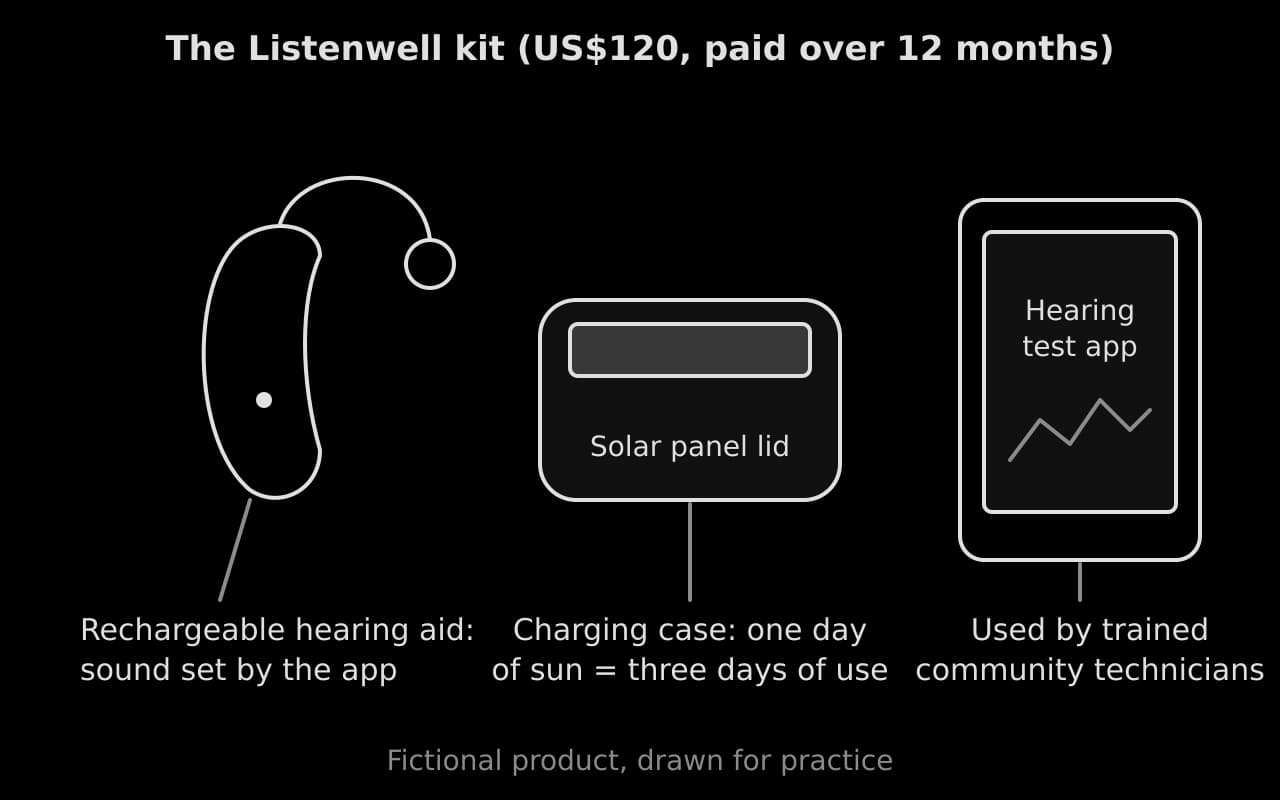
Listenwell trains young local people, most of them women, as community hearing technicians. Using a tablet app, a technician tests a person’s hearing in their home or village hall and fits a low-cost rechargeable hearing aid, which Listenwell buys from an overseas manufacturer. Customers pay US$120 for the kit in twelve monthly instalments of US$10, using mobile money. Listenwell is registered as a private company limited by guarantee, so it has no shareholders and reinvests any surplus in its mission. It also receives an annual grant from an international health charity.
Excerpt 1: email from Amara Dede to the Listenwell board
“We now have 18 technicians and have fitted 7,700 kits since we started, but our waiting list has reached 2,100 people and grows every month. I see three ways forward. (A) BrightPath Impact Fund will lend us US$400,000 at 5% a year over five years to expand into two more districts, if we reach 20,000 users within three years and report to them every month. (B) We could bid for the Ministry of Health’s new school hearing screening programme (Excerpt 3). (C) We could open our own repair workshop in the province: repairs now go to Benra and take six weeks. The workshop would cost about US$35,000. We cannot do everything at once.
“Five technicians left us last year, mostly for better-paid jobs in Benra, and the ones who stay are tired.”
Excerpt 2: social media post
“My grandmother got her Listenwell aid last year. For the first time in years she laughs at our jokes at dinner. The technician, Esi, was patient and kind. BUT her aid broke in March and it took SEVEN weeks to come back. She stopped going to church because she could not hear the service. Please fix this, Listenwell! #Listenwell #EasternHighlands” (posted by a customer’s grandson, 1,240 likes, 310 shares)
Excerpt 3: news article, The Ondara Herald
“The Ministry of Health will launch a national programme next year to test the hearing of every primary school child. Officials say undiagnosed hearing loss is a major cause of children falling behind at school. The ministry will pay approved partners US$2 for each child screened, with payment made 90 days after the end of each school term. Contracts will last three years. Partners must show that they can screen at least 60,000 children a year in their province. Applications close in four months.”
Excerpt 4: email from BrightPath Impact Fund
“We admire Listenwell’s model and want to help you grow. Our loan of US$400,000 is conditional on: reaching 20,000 users within three years; monthly reporting of users, repayment rates and costs; and a BrightPath representative attending board meetings as an observer. We would also like you to consider raising the kit price to US$150 to improve financial sustainability. Our board meets in two months to approve new loans.”
Excerpt 5: Listenwell key data (internal report)
Year 1 | Year 2 | Year 3 | |
|---|---|---|---|
Kits fitted | 1,200 | 2,600 | 3,900 |
Price per kit (US$) | 120 | 120 | 120 |
Variable cost per kit (US$): device, case, fitting | 85 | 85 | 85 |
Fixed costs (US$): salaries, transport, office | 70,000 | 115,000 | 160,000 |
Grant from health charity (US$) | 40,000 | 40,000 | 40,000 |
Technicians at year end | 8 | 14 | 18 |
Technicians who left during the year | 0 | 2 | 5 |
Customers more than one month behind with payments | 9% | 15% | 22% |
Kits returned for repair during the year | 4% | 9% | 14% |
Users who wear their aid every day (survey) | 84% | 82% | 81% |
Question 1: describing the human need [2]
Question 1 asks for a description of the human need that the enterprise is addressing. It is AO1 and worth 2 marks, so two linked points are enough: what the need is, and who has it or why it is not being met, with evidence from the stimulus. The answer is about the people, not the enterprise or its product.
Question 2: explaining the challenges [6]
Question 2 asks you to explain the challenges facing the social entrepreneur or the enterprise in meeting the need. It is AO2: the marks are for identifying each challenge, explaining its cause and effect, and using the stimulus as evidence. Six marks usually allow two well-developed challenges or three shorter ones; follow the wording, which may say “two”. Each challenge should be an organisational problem that affects the enterprise’s ability to meet the need.
Good challenges come from different areas of the business, because the analysis is stronger and the overlap smaller. For Listenwell, human resources (technician turnover), operations (repair delays), finance (late payments, a deficit before the grant) and marketing or reputation (the social media post) all offer candidates. Choosing two or three from different areas also prepares question 3, where the plan must respond to them.
Question 3: the recommended plan of action [17]
Question 3 asks for a plan of action: a decision-making document recommending what the enterprise should do. It usually asks you to use all the resources provided and your knowledge of business management tools and theories, and it often frames the plan around meeting the need over a stated period. The command term is normally recommend, which means presenting an advisable course of action supported by evidence and reasons.
A plan is more than an essay that ends in a choice. It sets out what to do, in what order, when, with what resources and with what expected effects on the different parts of the enterprise. It also shows what could go wrong and how the enterprise would respond. The four criteria reflect this, and together they reward a document that a real social entrepreneur could act on.
Criterion | Marks | What it rewards (in summary) | What a top answer does |
|---|---|---|---|
A: Use of resource materials | 4 | Using the stimulus to support the recommended plan. | Refers to every item, including the product visual and the data, and uses each one as evidence for a decision. |
B: Business management tools and theories | 4 | Applying appropriate tools and theories effectively. | Applies several suitable tools to Listenwell’s situation and uses their results to shape the plan. |
C: Evaluation | 6 | Evaluating the plan’s expected impact on the relevant areas of the business, including the trade-offs between them. | Weighs effects on HR, finance, marketing and operations, and on the mission, and explains what is gained and given up. |
D: Sequencing of ideas and plan of action | 3 | Ideas and plan set out in a clear, coherent order. | A logical document with phases, timings and dependencies, in which each step prepares the next. |
Criterion A: using every resource
The top level of criterion A needs reference to all the resource materials, used effectively to support the plan. “All” is demanding: it includes the introduction, the product visual and every excerpt. The most commonly ignored items are the product visual and the data table, which are easy to mention in passing but harder to use. The best answers make every item do work: the visual explains why the model suits off-grid villages; the data shows which problems are growing fastest.
A resource tracker, drawn in the planning time, makes sure nothing is missed. List each item, the key evidence in it, and the part of the plan it supports.
Item | Key evidence | Use in the plan |
|---|---|---|
Introduction | One in five over 60 affected; fewer than one in ten have aids; specialists four hours away; US$600 imported aids. | The scale of the need justifies growth; the price gap explains the low-cost model. |
Item 1: product visual | Solar charging case; app-based fitting by technicians. | The model works off-grid and without specialists, so it can be copied in new districts. |
Excerpt 1: Amara’s email | Three options; waiting list of 2,100; five technicians left; tired staff. | Sets out the choices; turnover and workload must be fixed first. |
Excerpt 2: social media post | Seven-week repair; user isolated again; 310 shares. | Repairs are a priority for impact and reputation. |
Excerpt 3: news article | US$2 per child; 60,000 children a year; three years; paid 90 days after term; four months to apply. | A new revenue stream and a new group in need; a cash flow risk; a deadline for sequencing. |
Excerpt 4: BrightPath email | US$400,000 at 5%; 20,000 users in three years; monthly reporting; observer; price rise to US$150. | Finance for growth, but conditions risk mission drift; a two-month deadline. |
Excerpt 5: data | Contribution, fixed costs, grant, turnover, late payments and repairs rising. | Calculations: break-even, deficit, turnover; trends show which problems are worsening. |
Criterion B: tools and theories
Criterion B rewards appropriate tools and theories, applied effectively. Appropriate means suited to the problem: a force field analysis suits a decision about change, a decision tree suits a choice between risky options with estimated outcomes, and stakeholder mapping suits a situation with powerful outsiders and less powerful users. Effective means the tool produces a result that changes or justifies the plan, not a decorative diagram.
Three or four tools, well chosen and used, are better than seven named in passing. They can be drawn quickly in the answer or summarised in a sentence with the key figures, as long as the result is clear. SWOT and STEEPLE, stakeholder mapping, force field analysis, decision trees, sources of finance and break-even analysis suit social enterprises particularly well, and each is applied to Listenwell in “Tools and theories that suit social enterprises”.
Criterion C: evaluation and trade-offs
Criterion C asks for an evaluation of the plan’s expected impact on the relevant areas of the business: human resources, finance, marketing and operations, and for a social enterprise the mission itself. The top level needs the trade-offs between those areas. A trade-off exists whenever a gain in one area or objective is paid for by a loss in another.
Social enterprises face a characteristic set of trade-offs, because they pursue social and financial objectives at the same time. Naming them explicitly, with evidence, is the clearest way to show evaluation.
Decision for Listenwell | Gain | Cost or risk elsewhere |
|---|---|---|
Raise the kit price to US$150 (BrightPath) | Finance: contribution per kit rises from US$35 to US$65, so break-even falls sharply. | Mission and marketing: fewer poor households can afford a kit; late payments may rise above 22%. |
Raise technicians’ pay | HR: lower labour turnover, more experienced staff, better service. | Finance: higher fixed costs, a larger deficit before the grant. |
Win the school screening contract | Mission and finance: reaches children, a new group in need; US$120,000 a year of revenue. | Operations and HR: many more technicians needed to screen 60,000 children a year; cash flow strained by payment 90 days after each term. |
Expand to two districts with the loan | Mission: shortens the waiting list and reaches more people. | Operations: repair delays and turnover would spread; finance: US$20,000 a year in interest and repayment pressure; governance: investor influence. |
Open a repair workshop | Operations and marketing: repairs in about a week, higher daily use, better reputation. | Finance: US$35,000 now, when cash is limited; delays growth. |
Evaluation also means considering time and uncertainty. Short-run costs can bring long-run benefits, and the reverse. Every plan rests on assumptions, such as the chance of winning the contract or the take-up in new districts, and naming them shows judgment about how reliable the plan is.
Criterion D: sequencing the plan
Criterion D rewards a plan whose ideas and actions are in a clear, coherent order. In practice, that means two kinds of sequencing. The document itself must be well organised, from the aim to the conclusion. The plan of action must also be sequenced in time: what happens first, what depends on what, and when decisions are reviewed.
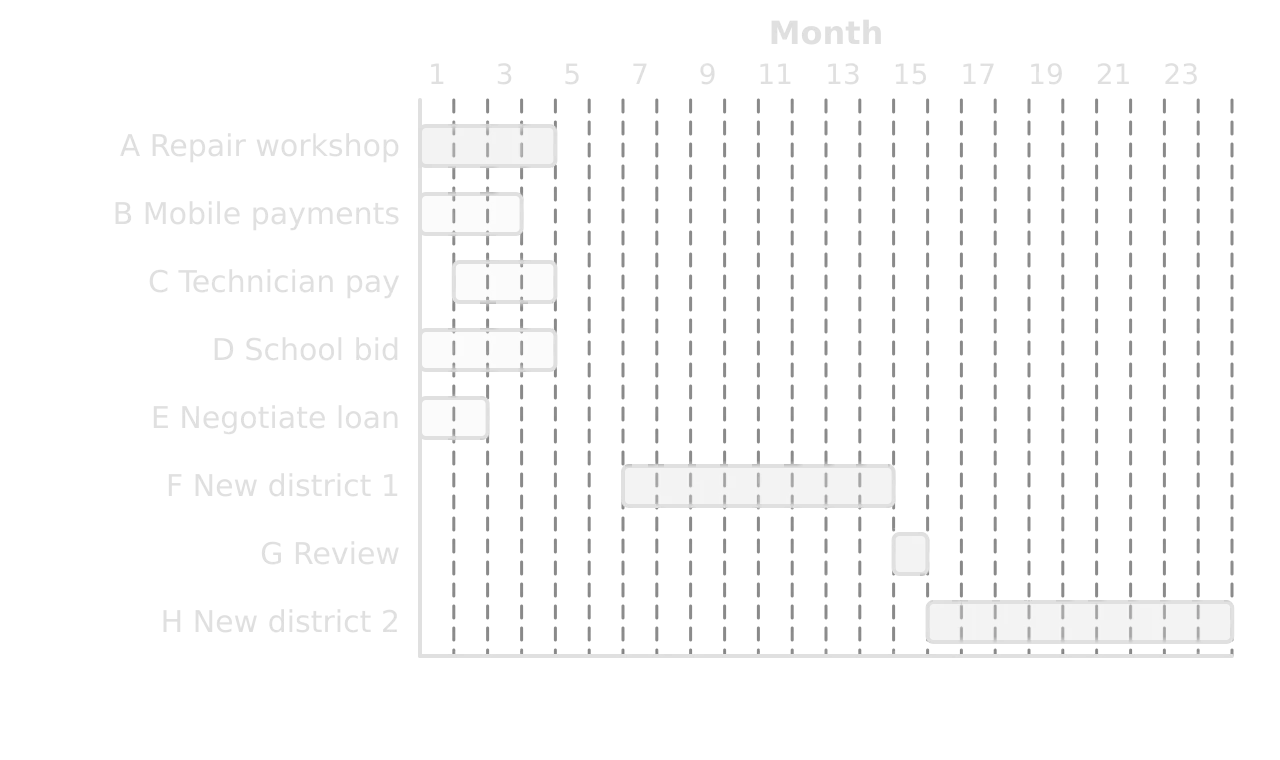
The logic of sequencing for a social enterprise is usually to fix the foundations before growing. Problems that would be multiplied by growth (high labour turnover, slow repairs, weak cash collection) come first, along with any action with an external deadline. Growth follows once the foundations are secure, with a review point before each major commitment. A Gantt chart is a natural way to show this, and it is itself an HL tool that counts towards criterion B.
A structure for the decision-making document
A clear structure earns criterion D directly and makes criteria A to C easier to show. The headings that follow suit almost any Paper 3 plan. Use them as actual headings in the answer: examiners read many scripts, and visible structure helps them find what they are looking for.
Aim: one or two sentences on what the plan is for, linked to the human need.
Situation analysis: the key challenges and opportunities, using two tools (for example SWOT and stakeholder mapping) and the data.
Options considered: the main options in the stimulus, briefly appraised with a tool such as a decision tree or force field analysis.
Recommendation: the chosen course of action, in one paragraph, with the main reason.
Plan of action in phases: what happens, when, who is responsible, what it costs and how it is financed.
Expected impact and trade-offs: effects on HR, finance, marketing, operations and the mission, with what is gained and what is given up.
Risks and contingencies: what could go wrong and how the enterprise would respond; review points.
Conclusion: the recommendation restated, with the conditions on which it depends.
Planning question 3 in ten minutes
- To do:
Write the aim in one sentence, linked to the human need.
- To do:
Fill in the resource tracker: every item, its evidence, its use.
- To do:
Do the key calculations (break-even, deficit, turnover, expected values).
- To do:
Choose three or four tools and note the finding each will give.
- To do:
Decide the recommendation and the order of actions, with timings and dependencies.
- To do:
List two or three trade-offs between areas and one risk with a contingency.
Tools and theories that suit social enterprises
Any tool or theory from the course can appear in a Paper 3 answer, but some fit social enterprises especially well, because they handle uncertainty, change, many stakeholders and limited finance. Each is applied to Listenwell in the form it could take in an answer.
SWOT and STEEPLE
A SWOT analysis summarises the enterprise’s position. For Listenwell, strengths include a low-cost, off-grid product and trusted local technicians; weaknesses include repair delays, labour turnover of 31.25% and a deficit before the grant; opportunities include the school programme and BrightPath’s finance; threats include investor conditions and the risk of damage to its reputation. A STEEPLE analysis widens the view of the external factors.
STEEPLE factor | Listenwell |
|---|---|
Social | Ageing rural population; stigma around hearing aids; families’ influence on older relatives. |
Technological | App-based testing lets non-specialists fit aids; solar charging overcomes weak electricity supply. |
Economic | Low household incomes; mobile money makes instalments possible. |
Environmental | Rechargeable aids avoid disposable batteries; repairs extend product life. |
Political | The Ministry of Health is now funding child hearing screening. |
Legal | Contracts with the ministry and BrightPath bring reporting obligations. |
Ethical | Pricing that the poorest can afford; fair pay for technicians; honest reporting to funders. |
Stakeholder mapping
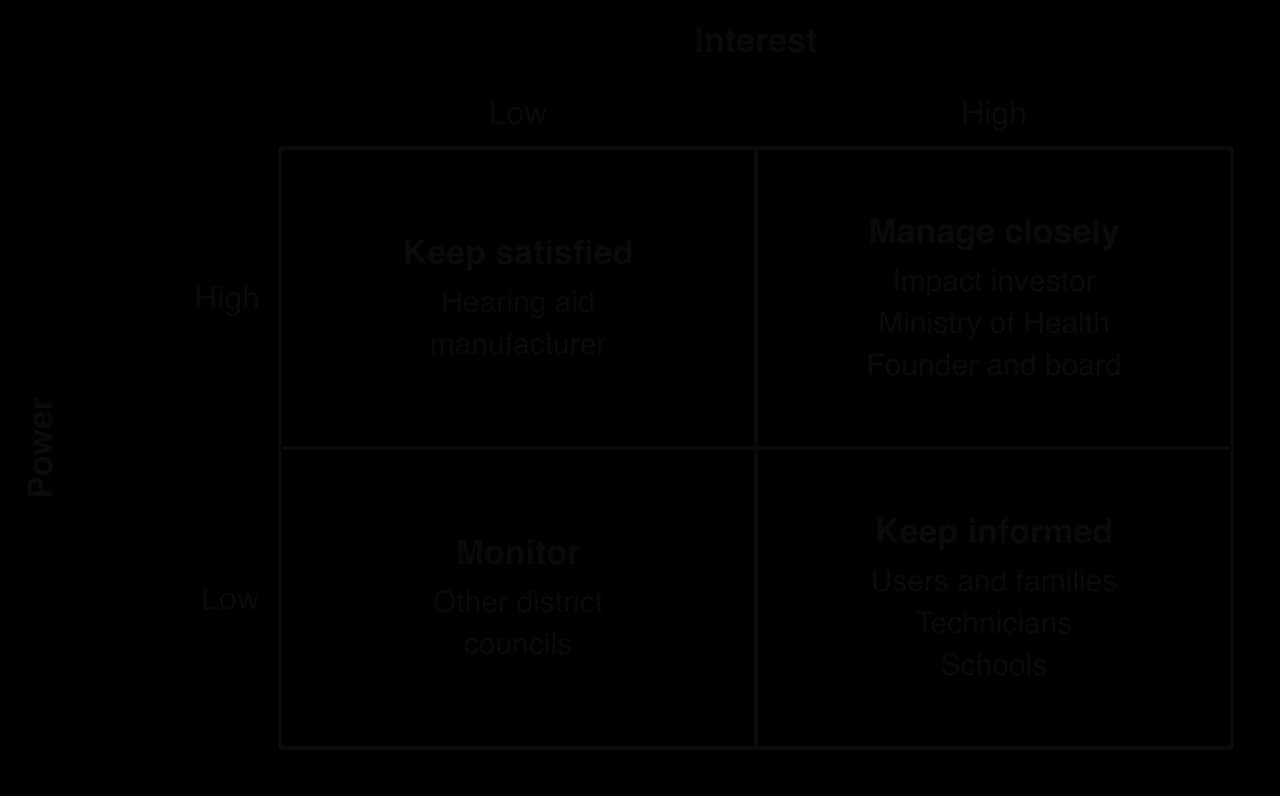
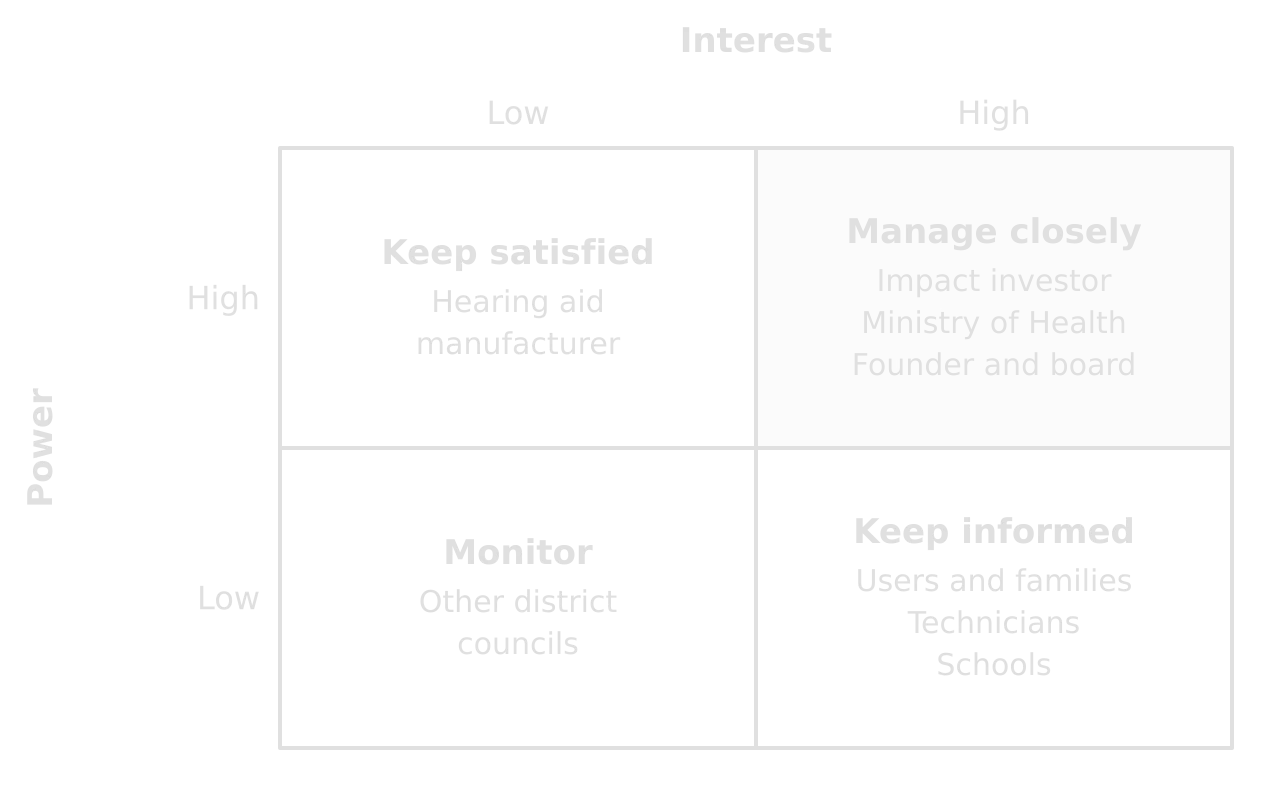
Stakeholder mapping places each group by its power over the enterprise and its interest in it. For Listenwell, BrightPath and the Ministry of Health have high power, and the users, the reason Listenwell exists, have high interest but very little power. The map shows why a plan must manage the funders closely while deliberately protecting the users’ interests, for example by refusing a price rise that would exclude them.
Force field analysis
Force field analysis weighs the driving forces for a change against the restraining forces, each scored for strength. Applied to expanding into two new districts, the driving forces (waiting list 5, investor finance 4, government policy 3, proven model 3) total 15, and the restraining forces (technician turnover 4, repair delays 4, late payments 3, investor conditions 3) total 14. The forces are nearly balanced, which suggests that expansion now would be fragile.
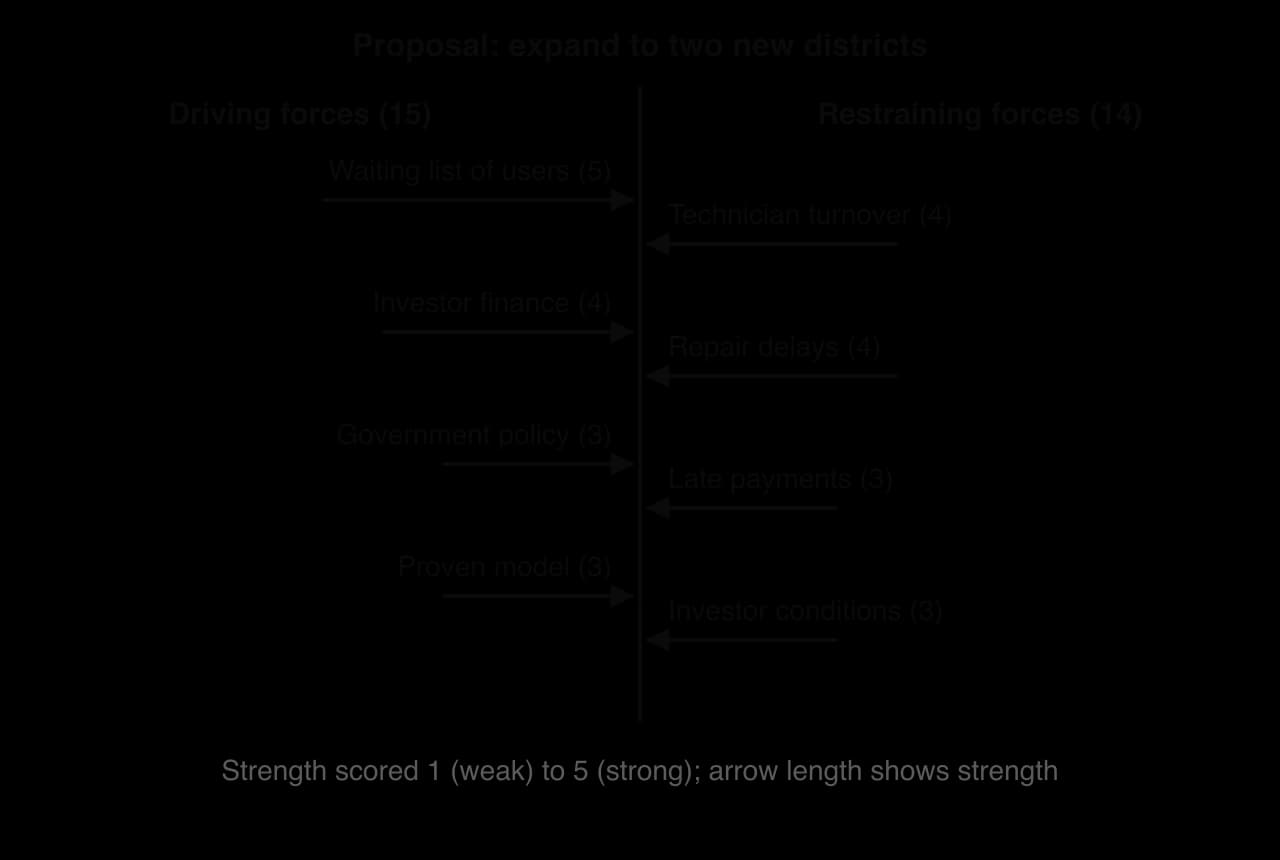
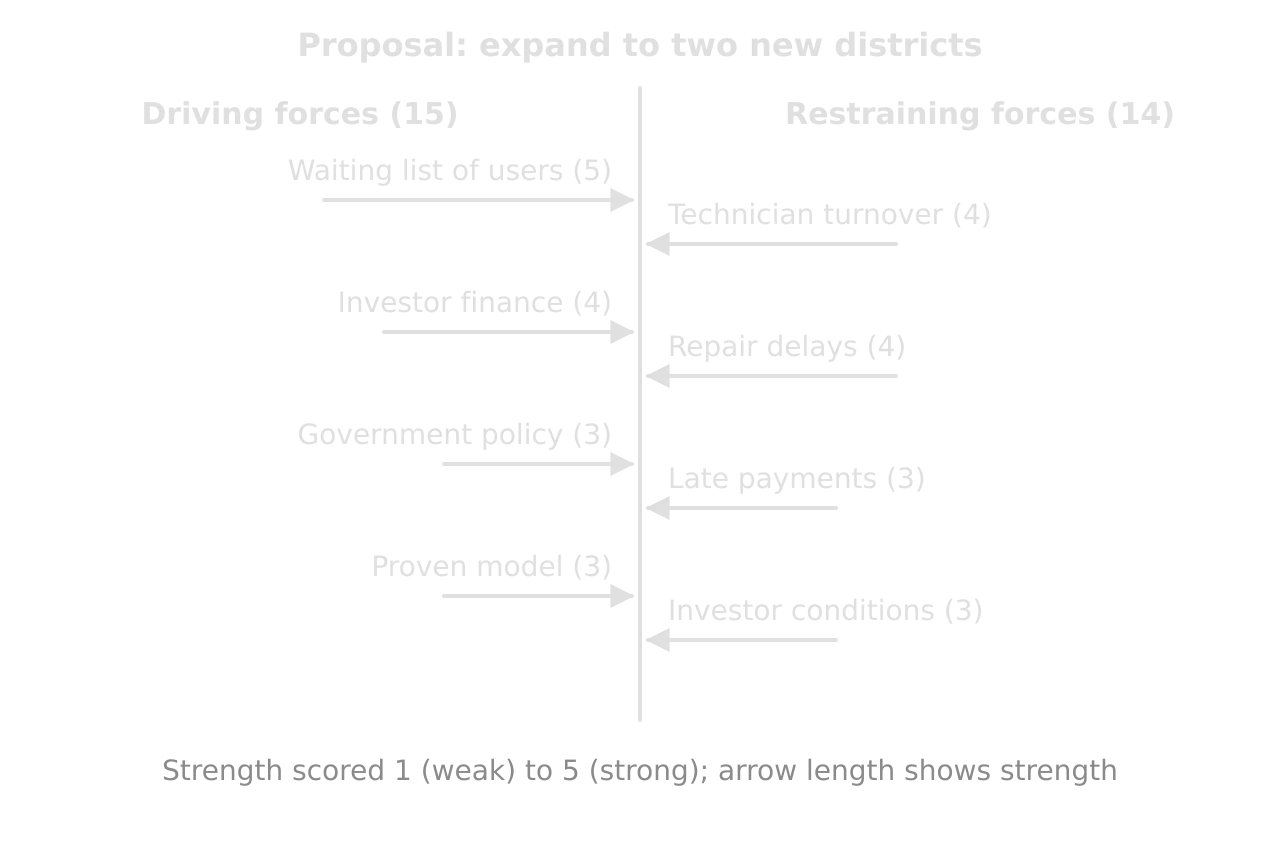
The value of the tool is in the strategy it suggests. Listenwell can weaken three of the four restraining forces itself: better pay and support reduce turnover, a workshop shortens repairs, and mobile money reminders reduce late payments. Doing so before expansion turns a marginal case into a strong one, which is a clear justification for the sequence of the plan.
Decision trees
A decision tree compares options whose outcomes are uncertain by calculating each option’s expected value. The probabilities and payoffs in Paper 3 are usually your own estimates, so state them as assumptions and justify them from the stimulus.
Sources of finance
Finance is a constraint in almost every Paper 3 stimulus. A social enterprise must match the source to the purpose and to its mission: the cheapest source may come with conditions that pull it away from its purpose, and the most mission-friendly may be too small. Comparing sources of finance in a short table is an efficient way to show this.
Source | Suitability for Listenwell | Risk to the mission |
|---|---|---|
Impact investor loan (BrightPath) | Large enough for expansion; 5% is cheap for an enterprise with no collateral. | Targets and an observer could push growth too fast; pressure to raise prices. |
Government grant or contract income | A reliable income stream for three years if the bid is won. | Paid 90 days late; dependence on one public customer. |
Charity grant | Already received (US$40,000 a year); no repayment. | May not be renewed; small. |
Donation-based crowdfunding could pay for the US$35,000 workshop; the social media following is engaged. | Uncertain amount; takes time and effort. | |
Microfinance for customers | A partner could lend to households, reducing Listenwell’s late payments. | Interest charged to poor customers raises ethical questions. |
Retained surplus | Cheapest and keeps control. | Too small: Year 3 shows a surplus of only US$16,500 after the grant. |
Break-even and financial data
Simple calculations show whether the enterprise can survive without grants and how the plan changes this. In Year 3, contribution per kit was US$120 − US$85 = US$35, so the break-even quantity was 160,000 ÷ 35 = 4,571.4, or 4,572 kits. Listenwell fitted 3,900, so it covered its costs only because of the US$40,000 grant.
This figure supports several decisions. Growth in kits fitted is needed to reach break-even without the grant; a price rise to US$150 would raise contribution to US$65 and cut break-even to 2,462 kits, but at a cost to the poorest users; and new fixed costs, such as the workshop or higher pay, push break-even up and must be justified by their effect on sales and impact.
Motivation and HR theories
Where the challenges involve people, motivation theories explain them and point to solutions. Technicians leaving for better pay suggests a hygiene factor in Herzberg’s two-factor theory; tired staff and a meaningful mission suggest that Deci and Ryan’s self-determination theory (autonomy, competence and relatedness) could guide non-financial rewards such as career paths, peer support and recognition. Theory adds to criterion B only when it leads to a specific action in the plan.
A model answer to question 3
The answer that follows is written at the length a strong student can manage in about 40 minutes. It uses the structure from the decision-making document, refers to every item in the stimulus, and applies several tools. The commentary after it explains how it meets each criterion.
Examiner-style commentary: how the answer meets each criterion
Criterion A (4/4): every item is used as evidence for a decision: the introduction for the scale of the need, Item 1 for why the model can spread, Excerpt 1 for the options and staff problems, Excerpt 2 for repairs and the crowdfunding idea, Excerpt 3 for the deadline and cash flow, Excerpt 4 for negotiating the loan, Excerpt 5 for the calculations.
Criterion B (4/4): SWOT ideas, stakeholder mapping, force field analysis, a decision tree, break-even analysis, labour turnover, Herzberg and sources of finance are applied, and each produces a finding that shapes the plan.
Criterion C (6/6): effects on HR, finance, operations, marketing and the mission are evaluated, and the trade-offs between them are explicit (pay versus fixed costs, workshop versus speed of growth, loan versus mission, price versus access, speed versus reliability). Assumptions and limitations are stated.
Criterion D (3/3): the document has a clear structure, and the plan is sequenced in phases with timings, dependencies, conditions for moving on and a review point.
A real answer under time pressure need not be this polished. It reaches the top levels by applying the four criteria throughout: every decision is tied to an item in the stimulus, every tool produces a finding, every action is weighed against its cost elsewhere, and the actions are placed in a logical order.
Common mistakes in Paper 3
Mistake | Effect on marks | What to do instead |
|---|---|---|
Treating the enterprise like a profit-maximising firm | Recommendations such as “raise prices to maximise profit” ignore the mission, weakening criterion C. | Judge every decision on people, planet and profit. |
Leaving out one or two items | Criterion A’s top level needs all the resources. | Use a resource tracker and tick off each item. |
Naming tools without findings | Criterion B stays “superficial”. | Follow every tool with what it shows and what the plan should do. |
Benefits only | Criterion C needs trade-offs between areas. | For each action, state what it costs another area or objective. |
An essay with no timeline | Criterion D rewards a sequenced plan. | Use phases with months, dependencies and review points. |
Choosing one option and ignoring the others | Misses the chance to combine and sequence options. | Check whether the options can be done in order. |
Spending too long on question 2 | Leaves too little time for 17 marks. | Keep question 2 to two or three developed challenges. |
A subtler weakness is a plan with no conditions. Real plans change as information arrives, and a recommendation that depends on an estimate should say what would make it change. In the Listenwell answer, the second new district goes ahead only if labour turnover and repair times reach stated targets at the month-15 review.
Checklists for Paper 3
Preparing
- To do:
I can explain the features of social enterprises, cooperatives and NGOs and the idea of mission drift.
- To do:
I can draw and use SWOT, STEEPLE, stakeholder mapping, force field analysis, decision trees and a Gantt chart quickly.
- To do:
I can calculate break-even, labour turnover, expected values and simple cash flow effects from a data table.
- To do:
I know criteria A to D and what the top level of each needs.
- To do:
I have written at least two timed plans of action on invented social enterprise stimuli.
In the exam
In reading time, read the three questions, then the introduction and product visual.
Read every excerpt, numbering them and annotating needs, challenges, options, numbers and deadlines.
Answer question 1 in two or three sentences about the people and their need.
Answer question 2 with two or three challenges from different areas, each explained with evidence.
Plan question 3 for about ten minutes: aim, resource tracker, calculations, tools, sequence, trade-offs.
Write the plan under clear headings, using every resource and stating trade-offs and contingencies.
Check that every item has been used and that the plan ends with a clear, conditional recommendation.
Carry on with Business in Augment
With a free account, Augment remembers where you stopped in the notes and which questions you have marked.