Paper 1: the pre-released case study
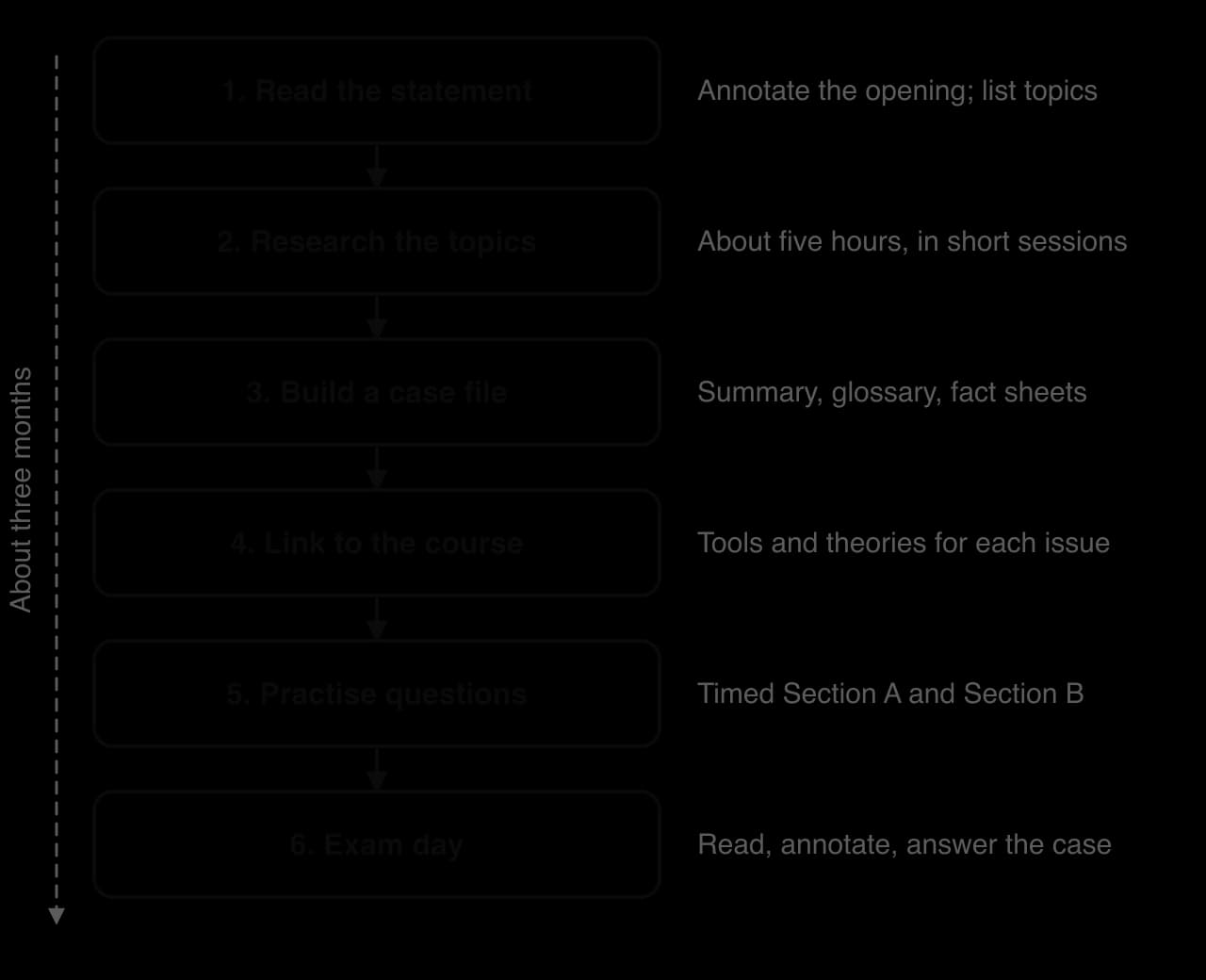
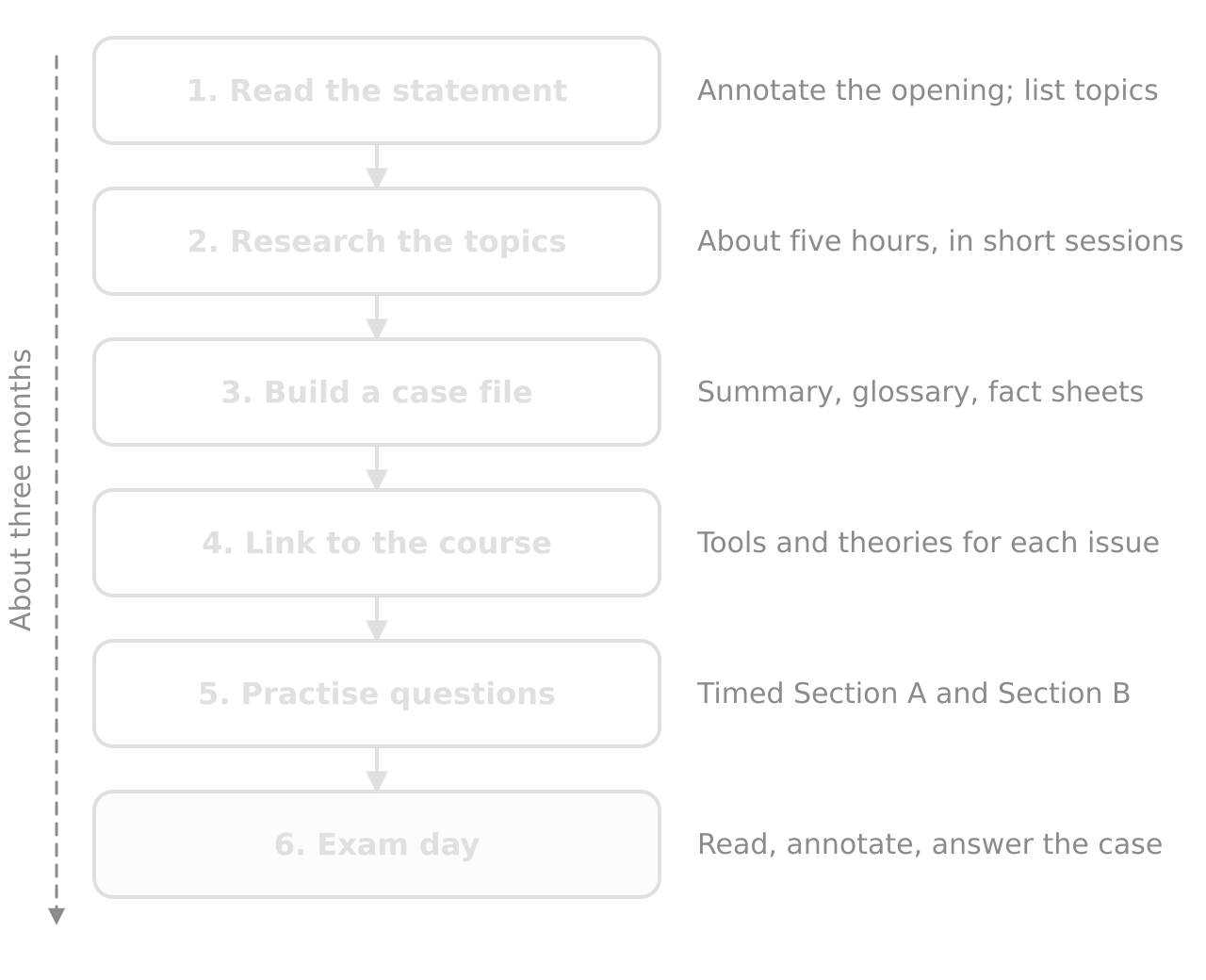
Research the pre-released topics in about five hours, build a case file, read and annotate the unseen case, and answer Section A and Section B questions with the case at the centre of every answer.
- IB Business Management
- Exam skills
- SL and HL
What Paper 1 is
Paper 1 is built around one case study about a fictional organisation. It is the same paper for SL and HL students. About three months before the exam, the IB releases a pre-released statement that sets the scene: it names a few contextual topics to research and gives the opening of the case, roughly 200 words. In the exam you receive the full case, about 800 to 1,000 words, and answer questions on it.
The paper has two sections. Section A has structured questions worth 20 marks in total, and every question must be answered. Section B offers a choice of two extended-response questions, each worth 10 marks, and you answer one. Most questions are qualitative: definitions, explanations, analysis and evaluation in words. A small calculation can appear, such as a break-even quantity, a percentage change or a market share, but the heavy number work belongs to Paper 2.
The case is fictional, but it is written to feel real. It describes an organisation with a history, owners, staff, customers, competitors and a decision to make. The questions test whether you can use business management to understand that organisation, not whether you can recall facts about real companies. Real examples still help in Section B, where they show breadth, but the case always comes first.
Part | What you do | Marks | Command terms you can expect |
|---|---|---|---|
Section A | Answer every structured question on the case. | 20 | Define, describe, outline, state, identify (AO1); explain, analyse, distinguish, suggest, comment (AO2); calculate, construct, prepare (AO4) |
Section B | Choose one of two questions and write an extended response. | 10 | Discuss, evaluate, examine, recommend, to what extent, justify (AO3) |
The command term at the start of each question decides the depth of the answer. A Section A question never asks for evaluation, because Section A assesses AO1, AO2 and AO4 only; Section B adds AO3. Knowing this keeps short answers short and saves the judgment for the question that rewards it.
What the pre-released statement contains
The pre-released statement has two elements. The first is a short list of contextual topics, usually two to four, that are linked to the case but are not part of the course itself. They might be a technology, an industry trend, a change in regulation or a social issue that the organisation in the case faces. The IB asks students to research them for about five hours. The point is to bring contemporary business issues into the exam that could not have been foreseen when the course was written.
Its second element is the opening of the case study itself. It introduces the organisation, its owners and its situation, and it saves you reading time in the exam. Every detail in it may matter later: the legal form of the business, the founders’ backgrounds, the location, the products, the numbers and the first signs of a problem. The rest of the case, which you see only in the exam, builds on this opening and usually adds the decision or crisis that the Section B questions are about.
The example is an invented pre-released statement in the style of the real thing. The research plan, the case file, the annotations and every model answer for Paper 1 use the same fictional business, so the preparation can be followed from start to finish.
Researching the topics in about five hours
Five hours is not long, so the research needs a plan. The aim is to understand each topic well enough to recognise it in the unseen case, to use its vocabulary correctly, and to see how it connects to business management: who gains, who loses, what it costs, what it changes. Expert knowledge of seaweed or plastics law is not needed. Research that ends in a few pages of clear notes is worth more than research that ends in a folder of downloaded articles.
A five-hour research plan
Spread the five hours over several weeks rather than one long session. Short sessions with a clear output each time are easier to fit around other subjects and leave time for ideas to settle. The plan that follows suits a statement with three topics.
Session | Time | Task | Output |
|---|---|---|---|
1 | 45 min | Read the whole statement twice. Annotate the opening. Write down what you already know about each topic and what you need to find out. | An annotated opening and a list of research questions per topic. |
2 | 60 min | Topic 1: what it is, how it works, its costs and benefits, its main players. | A one-page fact sheet with five to eight key terms. |
3 | 60 min | Topic 2, as for topic 1. | A one-page fact sheet. |
4 | 60 min | Topic 3, as for topic 1. Look for links between the three topics. | A one-page fact sheet and a list of links. |
5 | 45 min | Find two or three short real examples of businesses dealing with the same issues. Note one fact about each. | An examples list with sources. |
6 | 30 min | Map each topic to the course: which units, tools and theories fit. Draft a SWOT and a STEEPLE for the organisation. | A course-links table and draft tools. |
Good sources are those that explain rather than sell: national statistics offices, government and regulator websites, international organisations, reputable newspapers and industry associations. Company websites are useful for examples but present their own products favourably, so their claims need checking against an independent source. Note where each fact comes from, so that it can be checked and used with confidence later.
Building a case file
A case file is a short, organised set of notes about the case and its topics. It is the only thing worth revising from in the last week, so it should fit on a few pages. A useful case file has the same sections every time, which makes it quick to build and easy to revise from.
- To do:
A summary of the opening in five or six bullet points: legal form, owners, products, markets, size, the first signs of a problem.
- To do:
A one-page fact sheet for each contextual topic, in your own words.
- To do:
A glossary of the industry’s vocabulary, ten to twenty terms.
- To do:
A list of the organisation’s stakeholders with each group’s interests and possible conflicts.
- To do:
A draft SWOT analysis and a draft STEEPLE analysis of the organisation.
- To do:
A table linking each topic to units, tools and theories in the course.
- To do:
Two or three short real examples of businesses facing similar issues.
- To do:
A list of likely questions, with a plan for each Section B-style question.
The draft SWOT and STEEPLE are drafts because the unseen case will add information. Their value is that you arrive in the exam already thinking about the organisation’s position, so you can adjust the analysis in minutes rather than build it from nothing.
Linking the topics to the course
The contextual topics are not course topics, but every question is a business management question, so the marks come from linking the two. For each topic, ask what it means for each business function and which tools could analyse it. A table makes the links visible and shows which parts of the course to revise most.
Contextual topic | Likely links to the course | Tools that fit |
|---|---|---|
Seaweed farming | Primary and secondary sectors; operations methods (batch production, seasonal output); location; economies of scale; sustainability; stakeholders such as fishermen and coastal residents. | SWOT, STEEPLE, break-even analysis, decision trees |
Compostable food packaging | New product development; the product life cycle; pricing a new product (premium or penetration pricing); market research; segmentation and positioning; B2B marketing; differentiation and the USP. | Ansoff matrix, BCG matrix, position map |
Rules on single-use plastics | External change; opportunities and threats; ethics and CSR; greenwashing; the triple bottom line; market growth. | STEEPLE, SWOT |
A glossary of the case’s industry
Every industry has its own vocabulary, and the unseen case will use it without explanation. A short glossary means that no word in the case slows you down, and it lets you write about the industry precisely. Keep the definitions short and in plain words. The terms for the invented kelp case might look like this:
Term | Meaning (short) |
|---|---|
Aquaculture | The farming of fish, shellfish or plants such as seaweed in water, under controlled conditions. |
Harvest window | The weeks in the year when a crop is ready and can be collected. |
Compostable | Able to break down into natural materials in composting conditions within a set time, leaving no harmful residue. |
Bio-based | Made wholly or partly from plant or other biological material rather than from oil; not always compostable. |
Single-use plastic | A plastic item designed to be used once and then thrown away, such as cling film or a straw. |
Certification | Approval by an independent body that a product meets a stated standard, such as a compostability standard. |
A related trap is preparing complete answers in advance. The unseen part of the case changes the situation, and the questions are written around it. A memorised answer about why HK should grow, written in March, will not fit a case in which HK has just lost its biggest customer. Prepare ideas, tools and vocabulary, not paragraphs.
Reading the unseen case in the exam
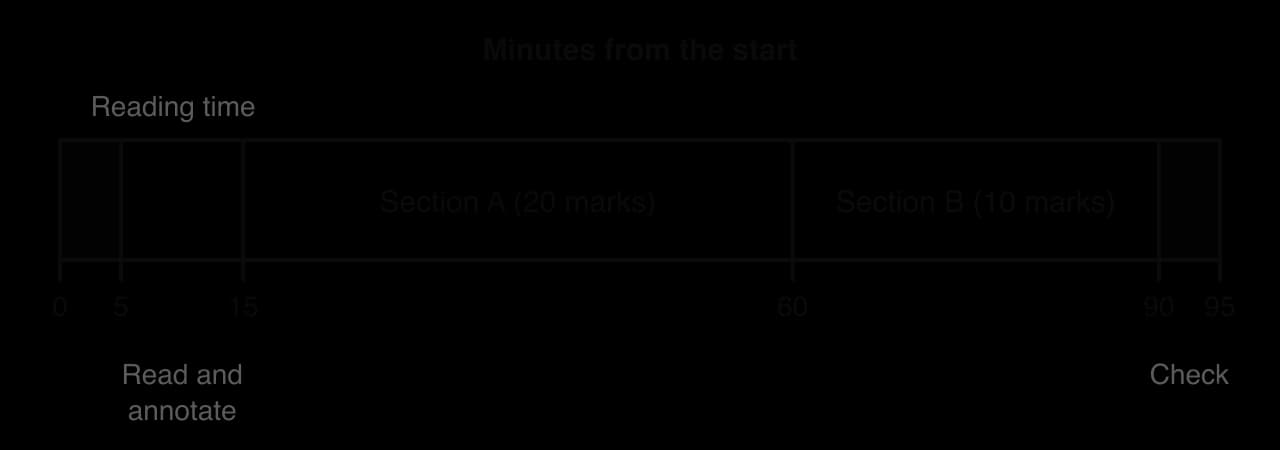
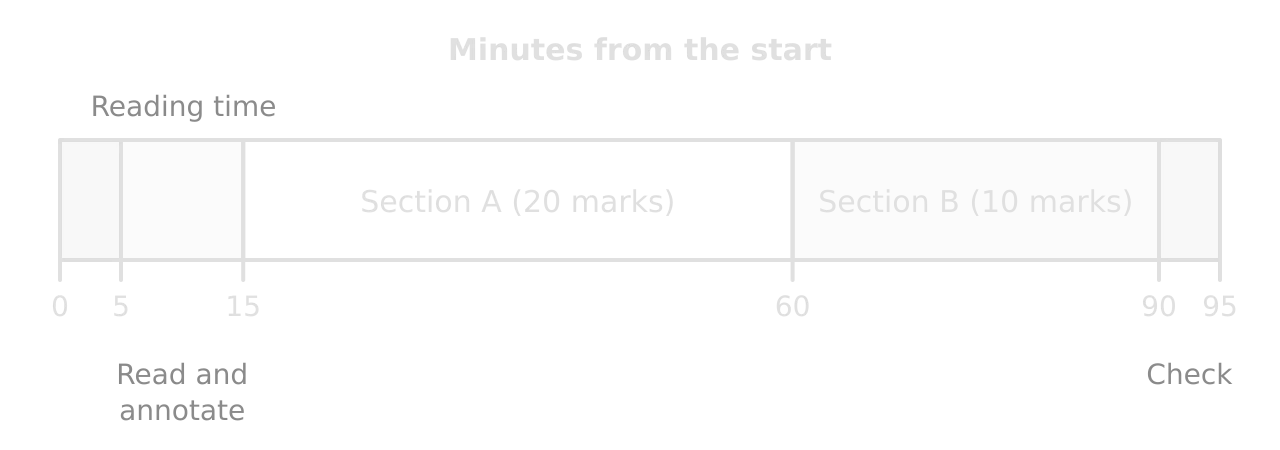
The paper begins with five minutes of reading time, during which you may read but not write. Use it to read the questions first and then start the case. Knowing the questions tells you what to look for, so the first reading is already purposeful. The case is long enough that reading it carefully takes about ten minutes; this is time well spent, because almost every mark depends on using it.
Annotating the case
Once writing is allowed, annotate the case as you read it a second time. Annotation is fast when it uses a fixed set of marks that you have practised. The aim is to find, in seconds, the evidence each answer needs.
Numbers: circle every figure (prices, costs, percentages, dates, staff numbers). Calculations and evidence come from these.
Stakeholders: underline every person or group and note their interest in the margin (“Velmora: price and reliability”).
Problems and changes: mark with a symbol such as “!” anything that has gone wrong or is changing.
Objectives and decisions: box what the owners want and what they must choose between.
Course links: write the concept in the margin where it appears (“economies of scale”, “Herzberg: hygiene factor”, “PLC: growth”).
Question numbers: write “Q2b” beside the lines that answer question 2(b).
Using line references
The lines of the case are numbered, and questions often point to a line: “Define the term privately held company (line 2).” Use the line numbers in your answers too. A brief reference such as “(line 31)” shows the examiner exactly which evidence you are using and keeps quotations short. Quote a few words rather than whole sentences, because the marks are for what you do with the evidence.
The extract that follows continues the invented case. In the real paper the lines run continuously from the opening; here, line numbers are given for each part.
Lines | Unseen case (continued, invented) |
|---|---|
21–26 | In 2025 HK’s sales revenue was €1.2 million. Dried kelp brought in 79% of it; the rest came from KelpWrap, which sold 42,000 rolls at €6 each. Each roll has variable costs of €3.50, and the fixed costs of the KelpWrap line, mainly the drying and rolling machine and a sales assistant, are €75,000 a year. |
27–33 | In January 2026 Velmora, a national supermarket chain, offered HK a three-year contract to supply 150,000 rolls of KelpWrap a year, sold under Velmora’s own label at €5.20 a roll. To meet the order, HK would need to triple its growing area, build a new drying hall and buy a second rolling machine. Tomas estimates the total cost at €900,000. |
34–39 | HK has €120,000 in the bank. A venture capital firm, BlueTide Partners, has offered €900,000 for 45% of the shares and a seat on the board. The local bank would lend €600,000 at 7% interest a year if the owners use the barn and boats as collateral. |
40–46 | Seasonal workers are hired each February through an agency. Most are students or retired fishermen, and about half return each year. Training a new worker to seed and harvest lines takes two weeks. In 2025 a winter storm destroyed 15% of the lines, and harvest output fell by the same amount. |
47–52 | Some local fishermen say the kelp ropes block their boats and reduce their catch, and they plan to object to HK’s application for more sea area. A marine charity has praised HK, saying kelp farms can improve water quality. Ines wants HK to grow, but not “at the cost of the bay or the people who live around it”. |
Section A: the structured questions
Section A tests whether you know the course precisely and can apply it to the case. The questions are short, so each mark depends on one or two exact points. The marks in square brackets are the best guide to length: as a rough rule, one developed point per two marks, and about two minutes per mark once the case has been read. A markscheme for Section A lists the points that earn credit, so answers that are precise, applied and in the right order of depth score well.
Question type | Usual marks | What earns the marks |
|---|---|---|
Define | [2] | A precise, complete meaning in your own words. Two marks for a full definition; one for a partly correct one. No example needed. |
Describe / outline | [2] | Two linked points about the feature, applied to the case where possible. |
Explain (often “explain two…”) | [4] | For each point: identify it (1 mark) and develop it with a reason or effect applied to the case (1 mark). |
Calculate | [2] | The correct answer with units, and the working shown (formula, substitution). |
Construct | [4] | A complete, correctly labelled tool (a SWOT, a decision tree, an organisation chart) using the case’s information. |
Analyse / distinguish / suggest | [2]–[4] | Clear differences, causes, effects or a reasoned proposal, linked to the case. |
The invented Section A for Harbourline Kelp that follows is worth 20 marks, like a real Section A. Each question has a model answer and a short note on why it scores.
Definitions [2]
A definition question checks that you know a term exactly. The best definitions say what category the term belongs to and what makes it different from similar terms. They are written in your own words, but they must be as precise as a textbook’s.
Describe and outline [2]
Describe and outline questions ask for an account without reasons. Two marks usually means two linked points, or one point with a detail from the case. Keep it to two or three sentences.
“Explain two…” [4]
The most common Section A question asks for two advantages, disadvantages, reasons or effects. Each of the two points earns two marks: one for identifying it and one for developing it with a reason that is applied to the case. Two separate short paragraphs, one per point, make the structure clear to the examiner.
Calculations [2]
Paper 1 includes only minor calculations, but they are quick marks if the working is shown. Write the formula, substitute the numbers from the case, and state the answer with its unit. Break-even, margin of safety, market share, percentage changes, profit and simple ratios are the most likely.
Construct a tool [4]
Construct questions ask for a business management tool built from the case. A SWOT analysis is the most common in Paper 1, but a decision tree, an organisation chart or an Ansoff matrix can also appear. The marks are for a complete, correctly classified tool with specific points from the case, so “good products” earns little while “KelpWrap, a compostable replacement for cling film (line 10)” earns credit.
Analyse, distinguish and suggest
These AO2 command terms ask for more than description but less than judgment. To analyse is to break an issue into parts and show how they are linked; to distinguish is to make differences clear, referring to both items each time; to suggest is to propose a reasonable answer with a reason. None of them needs a conclusion.
Stakeholder questions are a favourite in Paper 1, because a case always has people with different interests. A conflict has two sides: name both groups, say what each wants, and show why one group’s gain is the other’s loss in this case.
The six questions in this invented Section A total 20 marks: 2 + 2 + 4 for question 1, 2 + 4 for question 2 and 2 + 4 for question 3. A real paper may divide them differently, but the mix of short knowledge questions, applied explanations, one small calculation and one construction is typical.
Section B: the extended response
Section B is one extended response question, chosen from two, worth 10 marks. It is marked with a markband scale that rewards the whole answer rather than individual points. It is the only place in Paper 1 that asks for evaluation, and at a third of the marks it needs about 30 minutes of the time.
Choosing between the two questions
Spend one or two minutes choosing, because a wrong choice is hard to recover from. Both questions are about the case, and often one names a key concept (change, creativity, ethics or sustainability) while the other names a tool or a decision. Choose the question for which you can write the strongest argument with the most evidence from the case, not the one whose topic you like best in general. A quick test is whether you can find at least four pieces of evidence in the case, on more than one side of the argument, and two tools that fit; the full checks are in “The 10-mark extended response”.
What the markbands reward
The markbands for Paper 1 and Paper 2 are the same and are explained in full with the 10-mark extended response. In short, an answer climbs the bands as it does five things better: it answers the question set; it uses relevant, accurate tools and theories; it uses the case to support its argument rather than naming the company; it gives balanced, substantiated arguments; and, for the top band, it explains the limitations of the case itself. A justified conclusion that follows from the analysis holds the answer together.
Planning and writing in 30 minutes
A plan of two or three minutes makes the next 25 minutes faster and the argument clearer. Write it as a few lines: the judgment you expect to reach, the tools you will use, the arguments on each side with their line references, and the limitations. The full method for planning and structuring the answer (introduction, analysis on both sides, limitations of the case and a justified conclusion) is set out in “The 10-mark extended response”. In Paper 1 the difference is the line references, which let every argument point to its evidence in the case.
A model Section B answer
The model answer that follows is written at the length and depth a strong student can manage in 25 minutes. The commentary after it explains why it reaches the top markband.
Examiner-style commentary: why this answer reaches 9–10
Focus: every paragraph addresses the question (whether to accept) through the named concept (sustainability), using its three dimensions as a structure.
Tools and theories: contribution and break-even reasoning, economies of scale, the product life cycle, SWOT, sources of finance and stakeholder conflict are all used accurately and applied to HK.
Use of the case: figures and facts are used as evidence, with line references, and the student calculates a new figure (€255,000 of contribution) to support the argument.
Balance and limitations: arguments for and against are developed with equal care; the evaluation separates short and long run and names what the decision depends on; the limitations of the case are explained, not just listed.
Conclusion: a clear, conditional recommendation that follows from the analysis and returns to sustainability.
The second Section B question in this invented paper might be: “Using two or more business management tools, recommend which source of finance HK should use to fund its expansion.” A strong plan would apply a SWOT (strengths: founders’ expertise; weaknesses: cash of €120,000) and a decision tree or a simple comparison of the two offers, weigh cost against control, consider whether the contract is secure enough to justify debt, and recommend, for example, the bank loan topped up by a smaller share issue, explaining that the choice depends on the contract’s terms and HK’s future profits.
Using real examples and your research
Real-world examples show the examiner that you understand how a concept works beyond the case, and they can strengthen a Section B argument. They should be short (one or two sentences), accurate and clearly relevant, and they must never replace the case as the main evidence. Your research on the contextual topics is a good source of such examples, as long as they are used to support a point about the organisation in the case.
Research also helps in quieter ways. Knowing how the industry works lets you spot what the case implies but does not say: that a seasonal crop creates cash flow gaps, that a supermarket contract usually comes with strict delivery terms, or that certification of a compostable product costs time and money. These insights make analysis sharper and are a natural source of the limitations the top band asks for.
Common mistakes in Paper 1
Mistake | Why it costs marks | What to do instead |
|---|---|---|
Generic answers | Points that would fit any business show knowledge but not application, so they are capped. | Use a fact, number or quote from the case in every developed point. |
Over-writing Section A | Long answers to 2-mark questions leave too little time for the 10-mark question. | Write to the marks: one developed point per two marks. |
Evaluating when not asked | Section A has no marks for judgment. | Match the depth of the command term exactly. |
Using HL-only tools | Paper 1 never requires them, and time spent on them is time lost. | Use SL tools: SWOT, STEEPLE, Ansoff, BCG, decision trees, break-even. |
No limitations in Section B | The top markband asks for the limitations of the case. | Write one paragraph on what the case does not say and why it matters. |
Checklists for preparation and the exam
In the three months before
- To do:
I have read and annotated the opening of the case.
- To do:
I have researched each contextual topic for about five hours in total, with a one-page fact sheet per topic.
- To do:
I have built a case file with a summary, glossary, stakeholders, SWOT, STEEPLE and course links.
- To do:
I have revised the SL course topics most likely to appear, especially those taught to AO3 depth.
- To do:
I have written at least two timed Section A sets and two timed Section B answers on invented questions about the case.
In the exam
During reading time, read every question, then begin reading the case.
Read the full case and annotate numbers, stakeholders, problems, decisions and course links.
Write a three-line summary of the organisation, its aims and its decision.
Answer Section A in order, writing to the marks and using the case in every answer.
Choose the Section B question with the strongest evidence; plan for two or three minutes.
Write the extended response with balance, limitations and a justified conclusion.
Use the last few minutes to check units, line references and that every part has been answered.
Carry on with Business in Augment
With a free account, Augment remembers where you stopped in the notes and which questions you have marked.