A Unity and diversity
How theme A fits together: what all life shares, how diversity arises, the nine subtopics across four levels of organisation, and what HL adds.
- IB Biology
- SL and HL
9 subtopics in Unity and diversity
Each one has its own page once something is published for it.
- A1.1Water39 questions · notes · 2 quick fire
- A1.2Nucleic acids42 questions · notes · 2 quick fire
- A2.1Origins of cellsHL only38 questions · notes
- A2.2Cell structure39 questions · notes
- A2.3VirusesHL only36 questions · notes · 1 quick fire
- A3.1Diversity of organisms40 questions · notes
- A3.2Classification and cladisticsHL only36 questions · notes
- A4.1Evolution and speciation43 questions · notes
- A4.2Conservation of biodiversity37 questions · notes
Key terms introduced here
Each is in the Biology glossary, with every other term in the subject.
- Level of organisation
One of the four scales at which biology is studied: molecules, cells, organisms and ecosystems; each level is built from the one before it.
An overview of A Unity and diversity
Unity and diversity is the theme of what all living things share and of how they came to differ. Every organism uses the same genetic code, builds its cells from the same kinds of molecules and depends on water, yet the living world holds millions of species of very different form.
The theme explains both sides of that observation. Shared features are evidence of common ancestry; differences arise as populations evolve along separate lines.
Subtopics in Unity and diversity
Biology is organised into four themes, each studied at four levels of organisation: molecules, cells, organisms and ecosystems. The grid of themes and levels places each subtopic of Unity and diversity in the first row.
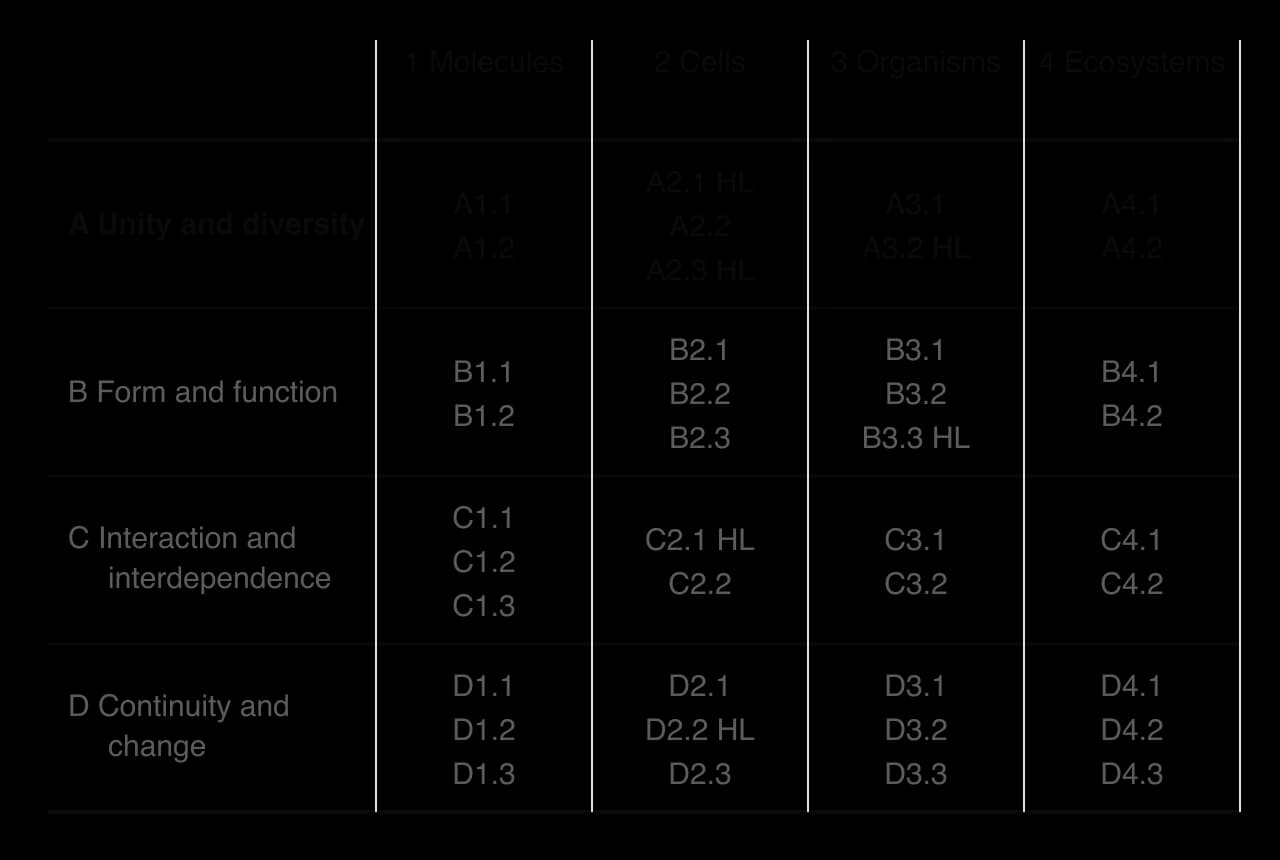
Subtopic | Level of organisation | SL or HL | Central question |
|---|---|---|---|
A1.1 Water | Molecules | SL and HL | Why does a small polar molecule make life possible, and what is water like as a habitat? |
A1.2 Nucleic acids | Molecules | SL and HL | How does the structure of DNA and RNA store hereditary information and allow it to be copied? |
A2.1 Origins of cells | Cells | HL only | How could non-living chemistry have given rise to the first cells and to LUCA? |
A2.2 Cell structure | Cells | SL and HL | Which features are shared by all cells, which differ, and how does microscopy show them? |
A2.3 Viruses | Cells | HL only | How can viruses exist with so few genes, and why do they evolve so fast? |
A3.1 Diversity of organisms | Organisms | SL and HL | What is a species, and how do genomes vary within and between species? |
A3.2 Classification and cladistics | Organisms | HL only | How can classification reflect evolutionary relationships? |
A4.1 Evolution and speciation | Ecosystems | SL and HL | What is the evidence for evolution, and how does one species split into two? |
A4.2 Conservation of biodiversity | Ecosystems | SL and HL | What is causing the current loss of biodiversity, and how can it be slowed? |
How unity and diversity connect across the levels
At the level of molecules, water and nucleic acids are common to every living thing. The properties of water (A1.1) make it the medium in which life began and in which metabolism still takes place. DNA and RNA (A1.2) carry information in a code that is almost identical in every organism, which is strong evidence that all life shares an ancestor.
At the level of cells, every cell has a plasma membrane, cytoplasm, ribosomes and DNA, while prokaryotes and eukaryotes differ in size and internal compartments (A2.2). At HL, A2.1 asks how the first cells formed and A2.3 deals with viruses, which depend on cells but are not cells.
At the level of organisms, genetic variation within a species and differences in genomes between species (A3.1) give the raw material for diversity; classification and cladistics (A3.2) arrange that diversity by ancestry. At the level of ecosystems, evolution and speciation (A4.1) explain how populations diverge and new species arise, and conservation (A4.2) deals with the present loss of biodiversity and how to slow it.
Links to the other themes
Form and function (B). The diversity of cell types and organs in A2.2 and A3.1 is explained by how structure suits function, from proteins (B1.2) to gas exchange surfaces (B3.1).
Interaction and interdependence (C). Species identified and classified in theme A interact in communities (C4.1), and the loss of biodiversity in A4.2 disrupts those interactions.
Continuity and change (D). The DNA structure of A1.2 is copied in DNA replication (D1.1), and the evidence for evolution in A4.1 is explained by the mechanism of natural selection (D4.1).
How HL differs in this theme
HL students study everything that SL students study, plus three HL-only subtopics and the sections marked HL only inside the SL subtopics. The HL-only subtopics are A2.1 Origins of cells, A2.3 Viruses and A3.2 Classification and cladistics.
Five SL subtopics carry additional HL sections:
A1.1 Water: where Earth's water came from and why it was retained, and why the search for life beyond Earth follows liquid water.
A1.2 Nucleic acids: the 5′ to 3′ directionality of strands, purine–pyrimidine pairing, nucleosome structure, the Hershey–Chase experiment and Chargaff's data.
A2.2 Cell structure: the origin of eukaryotic cells by endosymbiosis, cell differentiation and the evolution of multicellularity.
A3.1 Diversity of organisms: limits of the biological species concept, chromosome number as a species trait, designing a dichotomous key and identifying species from environmental DNA.
A4.1 Evolution and speciation: the similarities and differences between allopatric and sympatric speciation, adaptive radiation, barriers to hybridisation and abrupt speciation by polyploidy.
A4.2 Conservation of biodiversity has no HL extension: SL and HL students study the same content.
Carry on with A in Augment
With a free account, Augment remembers where you stopped and what you have practiced.