 YouTube
Explain evolution and the evidence for it, distinguish homologous from analogous structures, and explain how new species form, including (HL) isolation types, adaptive radiation and polyploidy.
Each is in the Biology glossary, with every other term in the subject.
A change in an organism's body or behaviour that develops during its lifetime through the environment or use, and is not inherited because it does not alter the genes in its gametes.
The rapid diversification of one ancestral species into many new species, each adapted to a different niche, often after colonising a new habitat or after other species became extinct.
The formation of new species from populations that are separated geographically, so that gene flow between them is prevented by a physical barrier.
Polyploidy in which the chromosome sets come from two different species after hybridisation; doubling of the chromosome number makes the otherwise sterile hybrid fertile.
A structure that performs a similar function in different species but has a different evolutionary origin and basic structure, because it evolved independently.
Polyploidy in which all the sets of chromosomes come from a single species, usually after unreduced gametes form or the chromosome number doubles.
Reproductive isolation caused by differences in courtship behaviour, songs, signals or mate preferences, so that members of two populations do not mate with each other.
Evolution is the change in the heritable characteristics of populations over many generations. It explains both the unity of life, the features that all organisms share because they descend from common ancestors, and its diversity, the millions of species that have arisen as lineages split and changed.
The evidence for evolution comes from many independent sources: the base sequences of genes, the results of selective breeding, the structure of organs and the fossil record. New species form when one species splits into two populations that stop interbreeding and then change in different ways. In plants a new species can arise within one or two generations.
43 exam-style questions on this subtopic, written in the style of the IB papers. The first has its markscheme open. Counted on
Which is an example of evolution?
Evolution is a change in the heritable characteristics of a population, and the proportion of a heritable wing colour changing over generations fits this. A is Lamarckian: muscle built by training is an acquired characteristic and is not inherited. B is a non-heritable response of individual plants to their environment, and D is a change within one individual, not a population.
The answer is C.
Cytochrome c is a protein found in the mitochondria of all eukaryotes. The table shows the number of amino acid differences between human cytochrome c and the cytochrome c of other organisms.
The official deck for this part of the syllabus.
Explain how evolution accounts for both the unity and the diversity of life.
State four independent sources of evidence for evolution.
With a free account, Augment remembers where you stopped and what you have practiced.
The independent evolution of similar characteristics in unrelated lineages exposed to similar selection pressures, producing analogous structures.
Natural selection acting in different directions on two populations because they experience different selection pressures, so that they diverge.
The process by which species descended from a common ancestor become increasingly different as they adapt to different environments, producing homologous structures with different functions.
Change in the heritable characteristics of a population over many generations.
The rejection of a hypothesis or theory when evidence contradicts a prediction made from it; a scientific idea must be testable in a way that could show it to be false.
The transfer of alleles from one population to another when individuals or their gametes move between the populations and interbreed.
Reproductive isolation of populations caused by a physical barrier, such as a mountain range, river or sea, that prevents individuals from meeting and interbreeding.
Describes a characteristic that is passed from parents to offspring through the genes in their gametes.
A structure that is similar in basic arrangement in different species because it was inherited from a common ancestor, even if it now has a different function.
The inability of a hybrid between two species to produce viable gametes, usually because its chromosomes from the two parent species cannot pair in meiosis.
The hypothesis, proposed by Lamarck, that characteristics acquired by an organism during its lifetime through use or disuse are inherited by its offspring.
A fundamental change in the accepted framework of ideas in a field of science, when evidence accumulates that the existing framework cannot explain.
A limb with one upper bone, two lower bones, a group of wrist or ankle bones and up to five digits, found in amphibians, reptiles, birds and mammals and inherited from a common ancestor.
The condition of having more than two complete sets of chromosomes in each cell, such as three sets (triploid) or four sets (tetraploid).
A mechanism acting after a hybrid zygote has formed, such as hybrid inviability, hybrid sterility or hybrid breakdown, so that alleles do not pass between species.
A mechanism that prevents mating or fertilisation between individuals of different species, so that no hybrid zygote is formed.
The separation of two populations so that they no longer interbreed and no gene flow occurs between them.
Deliberate choice by humans of individuals with desired heritable characteristics as parents, so those characteristics become more common in a domesticated population over generations; also called artificial selection.
The formation of new species by the splitting of an existing species into two or more populations that become reproductively isolated from each other.
The formation of new species from populations living in the same area, through reproductive isolation caused by behavioural or temporal differences or by polyploidy.
Reproductive isolation caused by populations breeding or flowering at different times of day, season or year, so that they do not interbreed.
Evolution is defined in terms of populations, not individuals. A single organism cannot evolve, because its genes are fixed when it is conceived. What changes over generations is the proportion of individuals in a population that have particular heritable characteristics.
A characteristic is heritable when it is passed from parents to offspring in their genes. Eye colour in humans, flower colour in peas and resistance to an antibiotic in bacteria are heritable. Characteristics that an organism gains during its lifetime, such as larger muscles from exercise, a scar or a language it has learned, are acquired characteristics. They result from the environment acting on the body, not from a change in the DNA of the gametes, so they are not passed on.
In 1809 the French biologist Jean-Baptiste Lamarck proposed one of the first theories of evolution. He suggested that organisms change during their lives in response to their needs: parts that are used a lot become larger, parts that are not used shrink, and these changes are passed to the offspring. In his best-known example, giraffes stretching to reach leaves high in trees lengthened their necks slightly, and their offspring were born with slightly longer necks. This idea, the inheritance of acquired characteristics, is called Lamarckism.
In 1859 Charles Darwin set out a different mechanism in On the Origin of Species. Individuals in a population vary, and much of the variation is heritable. More offspring are produced than can survive, so there is competition. Individuals with heritable characteristics that suit the environment are more likely to survive and reproduce, and they pass those characteristics on. Over many generations the characteristics become more common in the population. This is natural selection, studied in detail in D4.1 Natural selection.
Lamarckism | Darwinism (natural selection) | |
|---|---|---|
Source of new characteristics | Use or disuse of organs by the individual, in response to need | Heritable variation that already exists in the population (from mutation and sexual reproduction) |
What is passed on | Characteristics acquired during the lifetime | Only heritable characteristics, in the genes of gametes |
Who changes | Each individual changes during its life | The population changes, because some individuals survive and reproduce more than others |
Giraffe neck example | Stretching lengthened each giraffe's neck, and the longer neck was inherited | Giraffes with heritably longer necks reached more food, survived and reproduced more, so the allele combinations for long necks became more common |
Status today | Rejected: no mechanism allows acquired changes to alter the genes in gametes | Accepted: supported by evidence from genetics, fossils, sequences and observed change |
Lamarckism was tested and rejected. In the 1880s August Weismann cut off the tails of mice for several generations and found that their offspring were always born with normal tails. Later work in genetics showed why: the genes in the gametes are not altered by changes to the rest of the body. Lamarck's hypothesis made a prediction that could be tested, the prediction failed, and the hypothesis was rejected, an example of falsification.
Darwin's theory of evolution by natural selection, by contrast, has passed every test made of it for more than 160 years. It predicts and explains observations from all areas of biology: the order of fossils in rock layers, the distribution of species on islands, the nested pattern of similarities in DNA sequences, and the evolution of antibiotic resistance. A theory that explains such a wide range of observations, and that has survived so many opportunities to be falsified, is very unlikely to be overturned. Its acceptance replaced the earlier view that species were fixed and separately created, an example of a paradigm shift in science.
YouTubeAll living organisms use DNA as their genetic material and the same genetic code to make proteins. When a species splits into two, each lineage starts to accumulate mutations independently. Over time the base sequences of the same gene in the two lineages become more and more different, and so do the amino acid sequences of the proteins they code for.
This leads to a clear prediction. If species share common ancestors, then species that diverged recently should have very similar sequences, and species that diverged long ago should have more differences. Comparisons of sequences confirm the prediction for every gene studied, and the pattern of similarities matches the pattern of relationships shown independently by anatomy and fossils.
Cytochrome c is a small protein in the electron transport chain of mitochondria, so it is found in almost all eukaryotes. Its amino acid sequence has been determined for hundreds of species. The table compares the cytochrome c of several vertebrates with human cytochrome c.
Species | Group | Amino acid differences from human cytochrome c (out of 104) |
|---|---|---|
Chimpanzee (Pan troglodytes) | Primate | 0 |
Rhesus macaque (Macaca mulatta) | Primate | 1 |
House mouse (Mus musculus) | Mammal (rodent) | 9 |
Horse (Equus caballus) | Mammal (hoofed) | 12 |
Chicken (Gallus gallus) | Bird | 13 |
Skipjack tuna (Katsuwonus pelamis) | Bony fish | 21 |
Source: cytochrome c sequences from UniProt (entries P99999, P99998, P00002, P62897, P00004, P67881, P00025), aligned and compared position by position; the horse, chicken and tuna values agree with the classic comparison in Dickerson, Scientific American, 1972. The tuna count includes one position missing from its shorter sequence.
The number of differences rises in the same order as the time since each group shared a common ancestor with humans. Chimpanzees, together with bonobos, are the closest living relatives of humans, and their cytochrome c is identical to the human protein; birds and fish have more differences because their lineages separated from the lineage leading to humans much earlier. The sequence data show the same nested pattern as classification based on anatomy, from two completely independent kinds of evidence.
Sequence data also show evolution happening within a species. The genome of the virus SARS-CoV-2 has been sequenced millions of times since late 2019. The sequences show new mutations accumulating month by month and new lineages, such as Delta and Omicron, spreading and replacing earlier ones in the population.
Humans have bred domesticated animals and crop plants for thousands of years. In each generation, the breeder chooses the individuals with the most desirable characteristics, such as the largest seeds or the calmest temperament, and allows only those to reproduce. This is selective breeding, also called artificial selection.
Selective breeding is evidence for evolution because it shows that the heritable characteristics of a population can change a great deal over a relatively short time. The differences between modern breeds or varieties and their wild ancestors are often larger than the differences between separate wild species. The mechanism is similar to natural selection: variation exists, some individuals reproduce more than others, and the characteristics of the population change. The difference is that humans, not the environment, decide which individuals reproduce.
Maize (Zea mays) was domesticated from a wild grass, teosinte, in the Balsas River valley of southern Mexico. Genetic studies show that it was domesticated once, about 9,000 years ago. Teosinte produces small ears of only about 10 to 12 kernels, each enclosed in a hard, stony case, and the ears break apart when ripe so that the seeds are scattered. Modern maize has large cobs with hundreds of exposed kernels that stay attached to the cob, so they can be harvested but cannot disperse without humans.
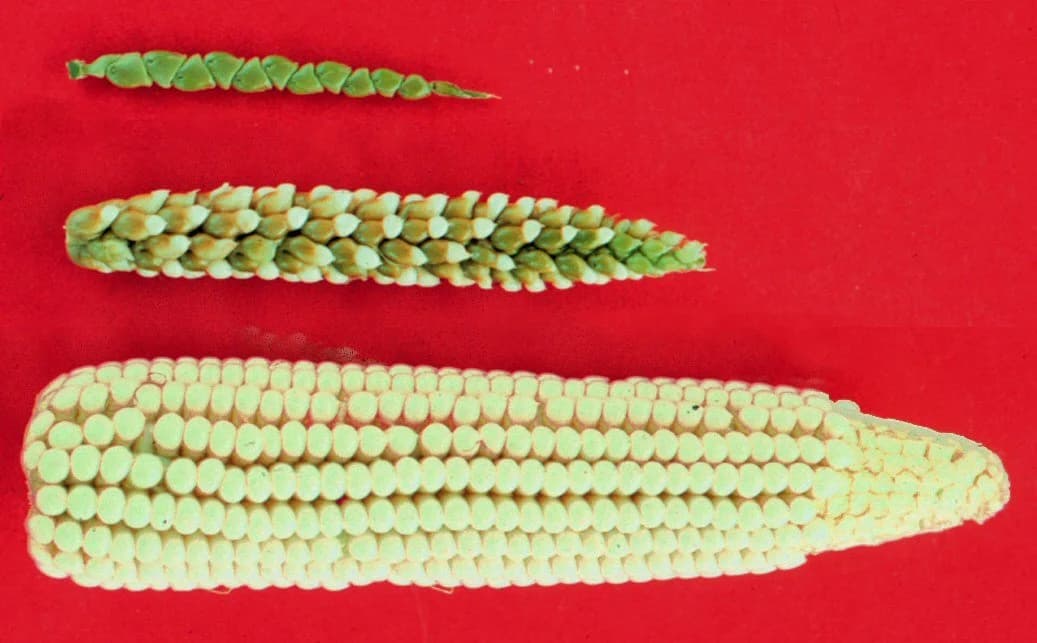
The differences are controlled by a small number of genes with large effects. One gene, teosinte glume architecture1 (tga1), controls the hard case around each kernel; a change in a single amino acid of its protein helps produce exposed kernels. Another gene, teosinte branched1 (tb1), controls branching: maize grows as a single stalk with a few large ears instead of the many branches of teosinte. Early farmers did not know about genes, but by saving seed from the plants they preferred, they increased the frequency of the alleles that produced these characteristics.
All domestic dogs (Canis familiaris) descend from populations of grey wolves (Canis lupus) that were domesticated more than 15,000 years ago. Dogs were selected first for tameness and later for many different tasks: herding, guarding, hunting, pulling sledges and companionship. Most of the several hundred modern breeds were produced in the last 200 years, when breeders began to keep pedigree records and to select strictly for appearance.
The result is a range of body forms wider than in any wild species of the dog family. Adult chihuahuas weigh under 3 kg, while large breeds such as the Great Dane can weigh more than 50 kg. Breeds differ in skull shape, leg length, coat type and behaviour, and the differences are heritable, because pups resemble their parents' breed. All breeds can still interbreed and are one species.
Organisms that share a common ancestor often have structures with the same basic arrangement of parts, even when the structures are used for very different functions. These are homologous structures. The similarity of structure is explained by inheritance from the common ancestor; the differences are explained by adaptation of each lineage to a different way of life.
The best-known example is the pentadactyl limb of tetrapods (amphibians, reptiles, birds and mammals). "Pentadactyl" means "five-fingered". Each limb has the same sequence of bones from the body outwards: a single bone in the upper limb (the humerus in the forelimb), two bones in the lower limb (radius and ulna), a group of wrist bones (carpals), a set of palm bones (metacarpals) and up to five digits made of finger bones (phalanges). The hindlimb follows the same pattern.
The diagram of five vertebrate forelimbs shows the same arrangement of bones in every case, with each region shaded the same way. What differs is the relative length, thickness and number of the bones, and these differences match the function of the limb.
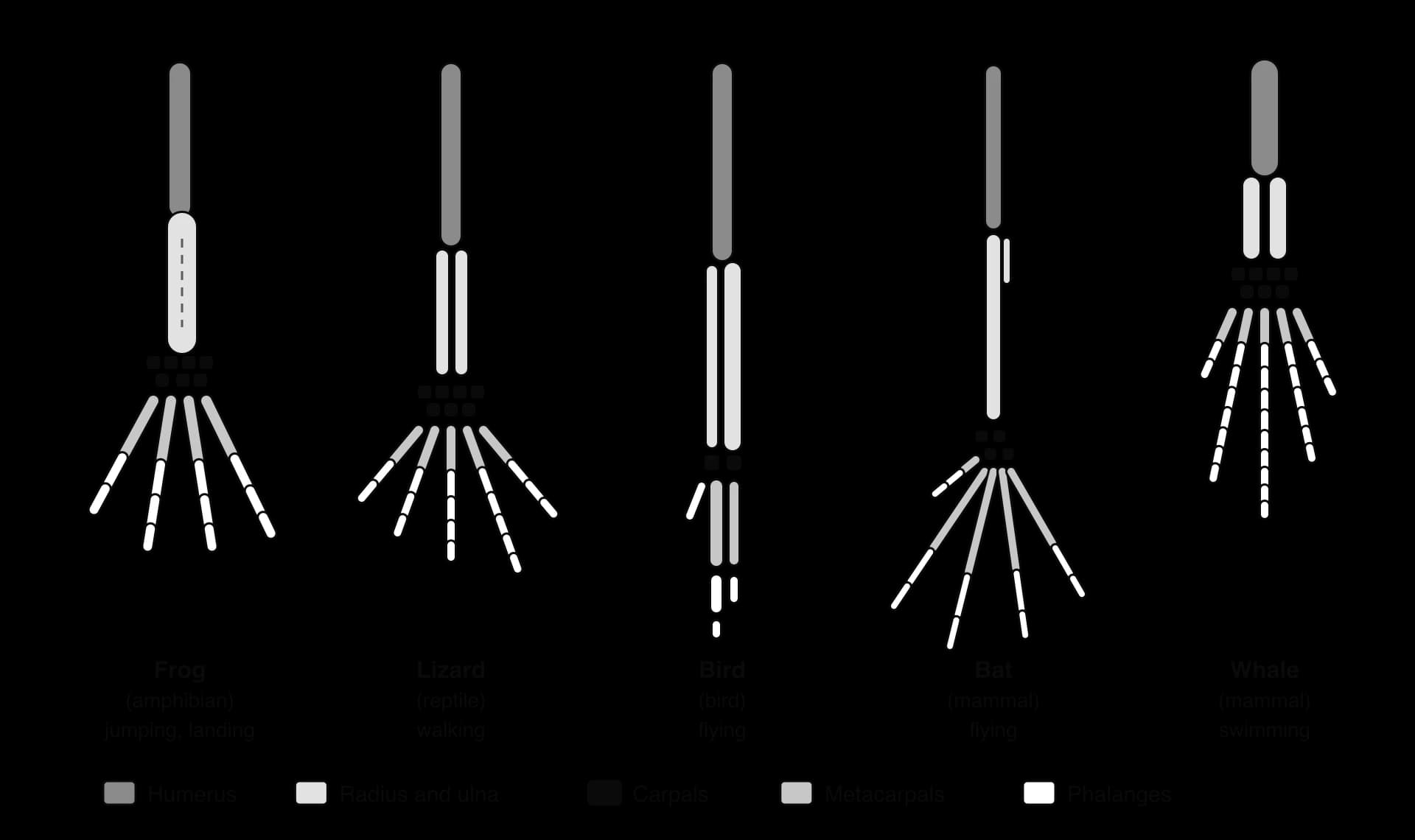
Organism | Class | Function of forelimb | How the pentadactyl pattern is modified |
|---|---|---|---|
Frog | Amphibian | Absorbing the impact of landing after a jump; pushing off | Short, strong bones; radius and ulna fused into one bone; four digits |
Lizard | Reptile | Walking and climbing | Short limb held out to the side; five spread digits with claws for grip |
Bird | Bird | Flying | Long humerus, radius and ulna; carpals and metacarpals fused; three reduced digits to support feathers |
Bat | Mammal | Flying | Very long metacarpals and phalanges in four digits support the skin of the wing; short thumb with a claw for climbing |
Whale | Mammal | Steering while swimming | Short, flattened humerus, radius and ulna; many extra phalanges form a stiff paddle inside the flipper |
There is no functional reason why a wing, a flipper and a walking leg should have the same bones in the same order. If each type of limb had originated separately for its function, there would be no reason to expect the same arrangement in all of them. The shared pattern is explained by divergent evolution: the limb was inherited from an ancestral tetrapod, and in each lineage natural selection modified it for a different function.
Homology is found at every level of organisation, not only in organs. Genes are homologous when they descend from the same ancestral gene, such as the cytochrome c gene in humans and tuna. Proteins made from homologous genes have similar amino acid sequences and three-dimensional shapes. Even developmental genes are homologous: the PAX6 gene, which controls eye development, is so similar in mice and fruit flies that the mouse gene can trigger eye development in a fly.
Vestigial structures are a special case of homology. They are reduced structures with little or no function, inherited from ancestors in which they were functional. Whales and pythons have small pelvic bones and remnants of hind-limb bones, and humans have a reduced tail (the coccyx). Their presence is explained by common ancestry.
Structures can also be similar because they perform the same function, without being inherited from a common ancestor. These are analogous structures. They arise by convergent evolution: unrelated lineages face similar selection pressures and evolve similar solutions independently.
The selection pressures that cause convergence come from the physical demands of a way of life. Flying in air, swimming fast in water or forming an image from light set similar engineering problems, whatever the ancestry of the organism.
Wings of insects, birds and bats. All three are used for flight. Insect wings are thin plates of chitin exoskeleton with no bones at all. Bird wings are forelimbs with feathers. Bat wings are forelimbs with skin stretched between long digits. The wings of insects and vertebrates have no common origin.
Eyes of vertebrates and octopuses. Both are camera-type eyes with a lens, an iris and a retina. In vertebrates the nerve fibres run across the front of the retina and leave through it, creating a blind spot. In the octopus the nerve fibres run behind the retina, so there is no blind spot. The difference in construction shows that the two eyes evolved independently.
Body shape of sharks and dolphins. Sharks (fish) and dolphins (mammals) both have a streamlined body, a dorsal fin and flippers, because these reduce drag in water.
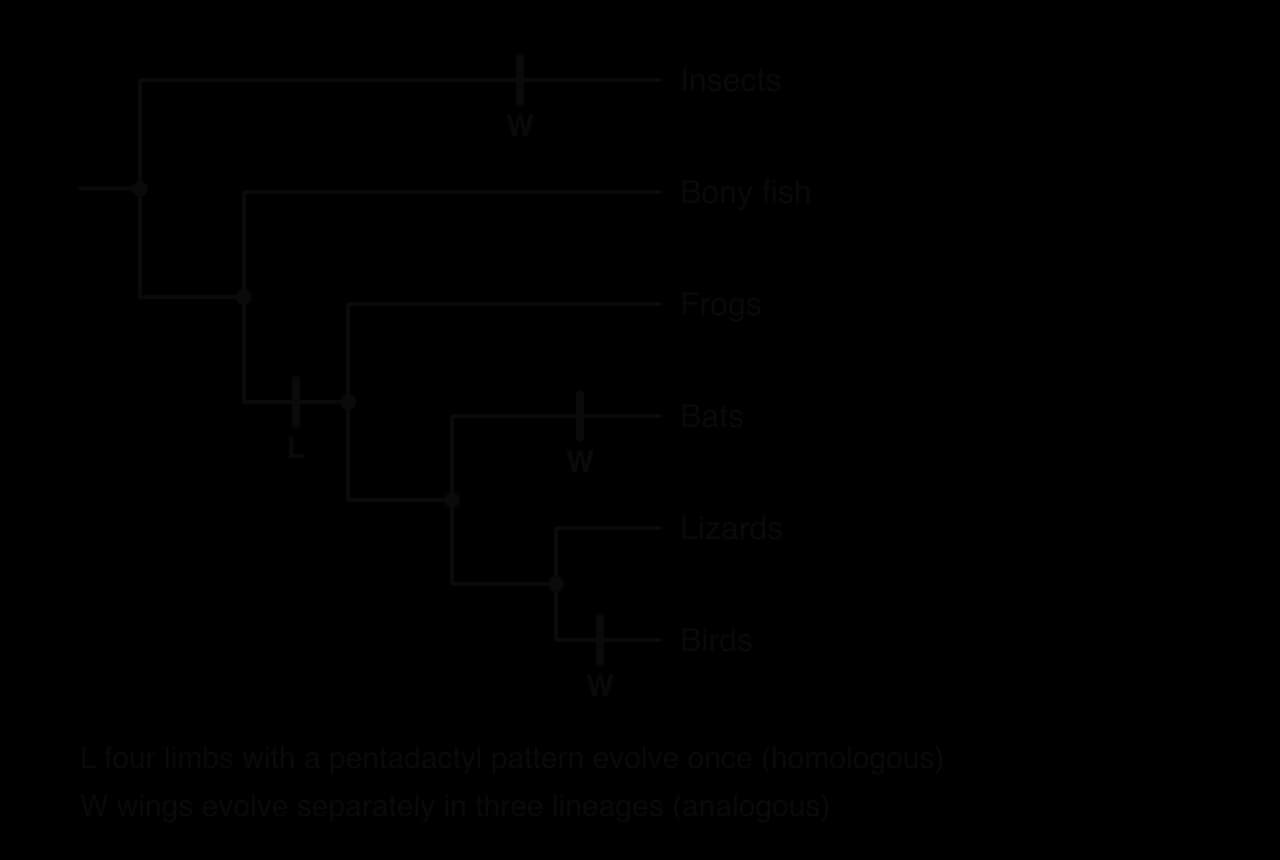
Bird and bat wings show that one structure can be homologous in one sense and analogous in another. As forelimbs, they are homologous, because both are pentadactyl limbs inherited from a tetrapod ancestor. As wings, they are analogous, because the ancestor of birds and bats did not have wings; flight evolved separately in each lineage.
A cladogram shows which groups share a common ancestor. To decide whether a shared structure is homologous or analogous, map it onto the cladogram. If the structure is present in all the descendants of one node (or was lost later in a few), it most probably evolved once in the ancestor at that node and is homologous. If it appears in separate branches, with groups in between that lack it, it most probably evolved more than once and is analogous.
A species is usually defined, using the biological species concept, as a group of organisms that can interbreed to produce fertile offspring. New species arise by speciation.
Speciation means splitting. A species can also change gradually over a long time without splitting, so that its later members look very different from its earlier ones. This change within a lineage is evolution, but it does not increase the number of species: at any one time there is still one species. The diagram of the two patterns compares them.
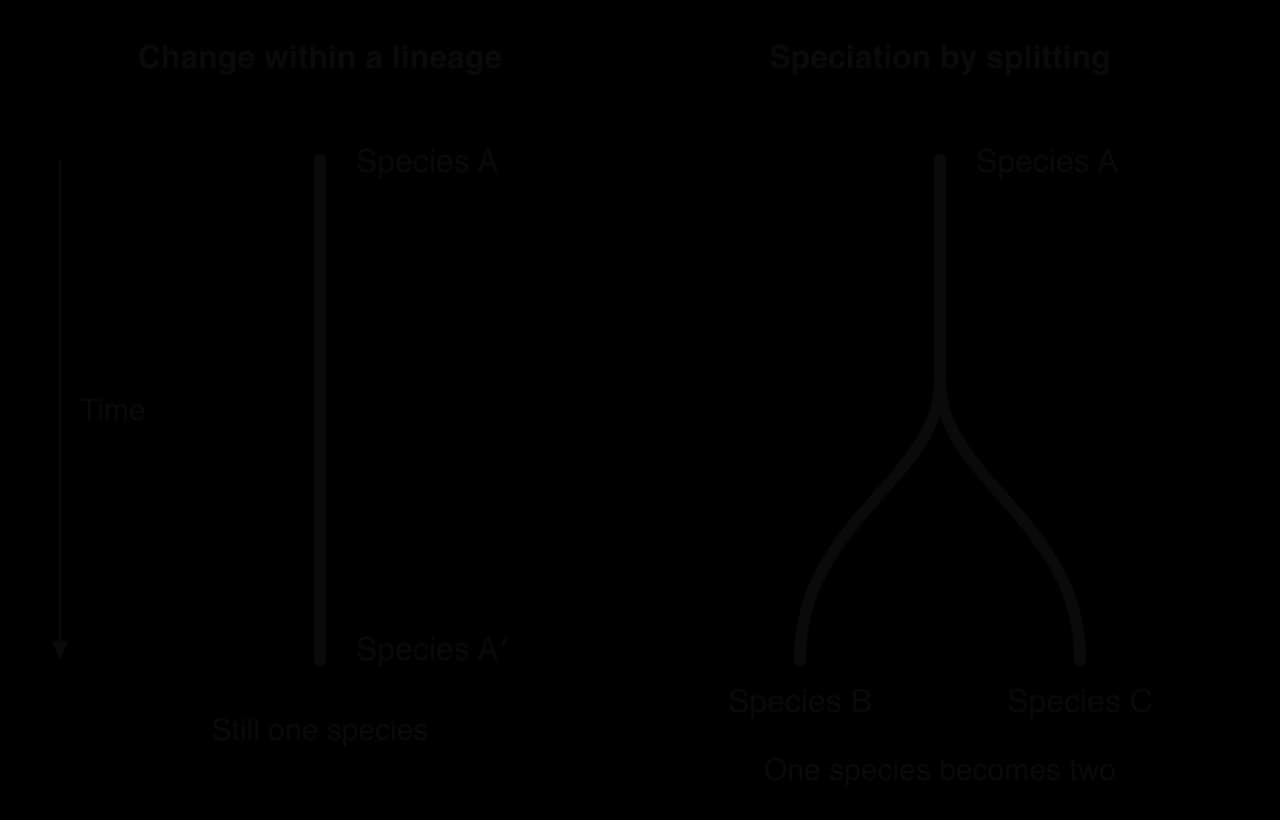
The total number of species on Earth therefore depends on two processes. Speciation by splitting increases it, and extinction, the death of the last members of a species, decreases it. The great diversity of life today is the result of speciation exceeding extinction over most of the history of life (A4.2 Conservation of biodiversity).
Two conditions are needed for one species to split into two:
Reproductive isolation. The populations must stop interbreeding, so that there is no gene flow between them. As long as genes flow between them, any differences that arise in one population are mixed into the other, and the populations stay alike.
Differential selection. The isolated populations must then experience different selection pressures, so that natural selection changes their heritable characteristics in different directions. Different mutations also arise in each population, and chance effects in small populations add to the divergence.
Gene flow happens whenever individuals move between populations and breed, or when pollen or gametes are carried from one population to another.
Over many generations the two populations accumulate so many differences in their genes, behaviour and anatomy that they could no longer interbreed successfully even if they came back together. At that point they are separate species. Isolation allows the populations to diverge, and differential selection drives the divergence, so isolation is necessary for speciation but is not enough on its own.
Bonobos (Pan paniscus) and chimpanzees (Pan troglodytes) are the two living species of the genus Pan and the closest living relatives of humans. They descend from a common ancestor population that lived in central Africa. Between about 1 and 2 million years ago the Congo River separated part of that population. Neither species swims, so the river became a barrier to interbreeding: chimpanzees live to the north and east of the river, and bonobos only to the south.
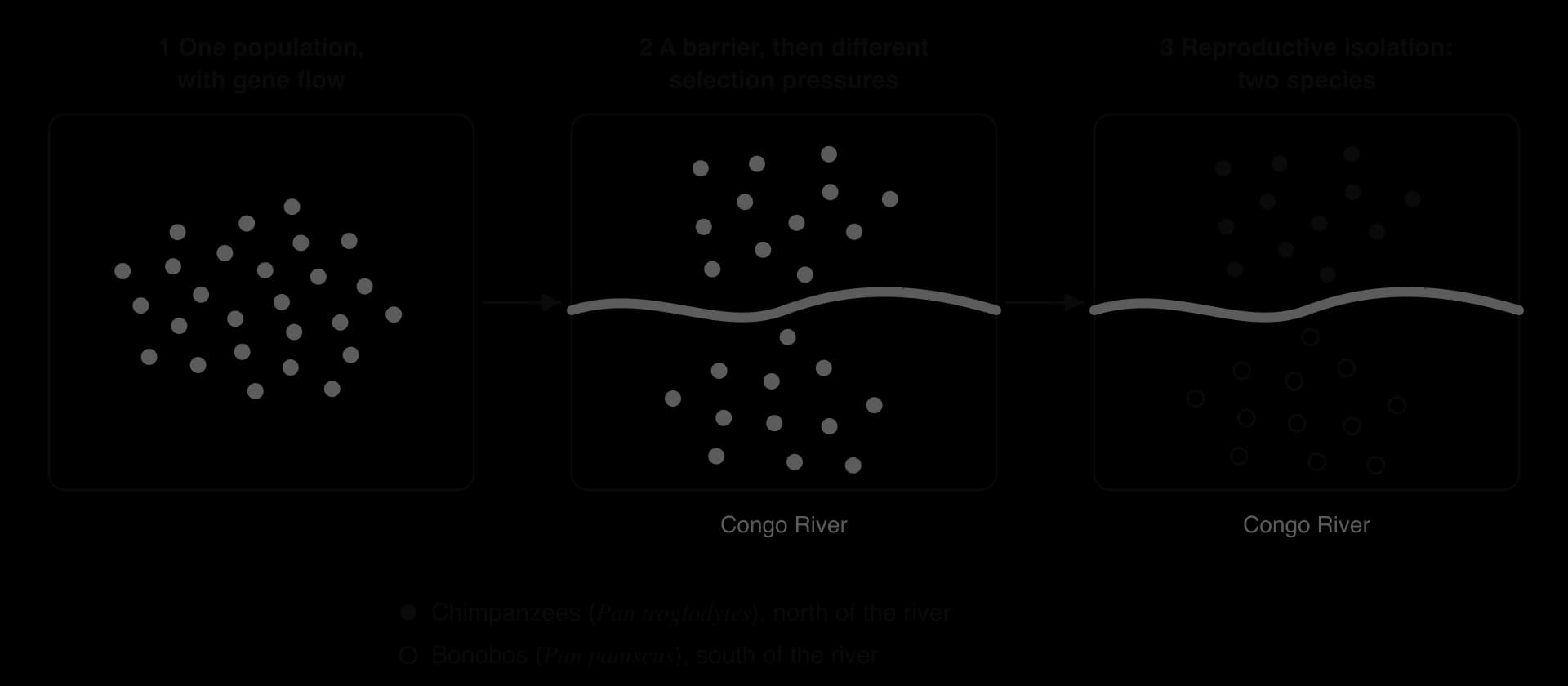
The two populations then experienced different conditions. Chimpanzees share much of their range with gorillas, which compete with them for food, while bonobos live in forests with no gorillas, where food plants are more evenly available. The populations diverged in body form and especially in behaviour. Bonobos are more slender, live in groups in which females are dominant, and use sexual behaviour to reduce conflict; chimpanzees live in male-dominated groups with more aggression between groups. The species can produce hybrids in captivity, but in the wild they never meet, and their genomes show that they have been isolated for most of the time since the split.
Speciation usually takes thousands of generations, so it is normally inferred from its results. On the small Galápagos island of Daphne Major, Peter and Rosemary Grant observed the start of a new lineage directly, as part of a study of Darwin's finches that began in 1973 and recorded every bird on the island.
In 1981 an unusual immigrant male arrived on Daphne Major. He was a large cactus finch (Geospiza conirostris) from the island of Española, more than 100 km away. He bred with a local female medium ground finch (Geospiza fortis), and they produced offspring. Their descendants, which the Grants called the "Big Bird" lineage, had a beak larger than any of the resident species and sang the immigrant father's unusual song.
Time | Event |
|---|---|
1981 | An immigrant male G. conirostris from Española, more than 100 km away, arrives on Daphne Major |
1981 onwards | He breeds with a resident female G. fortis; the offspring inherit a large beak and learn the father's song |
About three generations later | Members of the lineage breed only with each other: reproductive isolation is established |
2003–2005 | A severe drought; only one brother–sister pair of the third generation survives, and every later Big Bird descends from them |
About 30 years | The lineage has been followed for six generations and remains reproductively isolated from the resident species |
Source: Lamichhaney et al., Science 359:224, 2018.
Two features of the case match the two conditions for speciation. Reproductive isolation arose through song. Male Darwin's finches learn their song from their father, and females choose mates by song and beak. The Big Bird song was different from the songs of the resident species, so resident females did not choose Big Bird males, and the lineage mated only within itself. Differential selection came from food. The large beak allowed the lineage to feed on seeds and other foods that the resident finches use less, so it occupied a different niche.
Genome sequencing confirmed the history: all Big Birds carry genes from both G. conirostris and G. fortis, and the lineage is genetically distinct from every resident species. Whether it will persist as a separate species is not yet certain, because a small population can be lost to drought or inbreeding. The Big Bird lineage shows that the first steps of speciation can happen within a few generations, and it is an example of continuity and change in a population recorded as it happened.
 YouTube
Speciation is classified by whether the diverging populations live in different places or in the same place.
Allopatric speciation ("other homeland") happens when populations are separated by a geographical barrier such as a mountain range, a river, a stretch of sea or a desert.
Sympatric speciation ("same homeland") happens when populations diverge while living in the same area, with no geographical barrier. Reproductive isolation then arises from differences in behaviour, in the timing of reproduction, or from polyploidy.
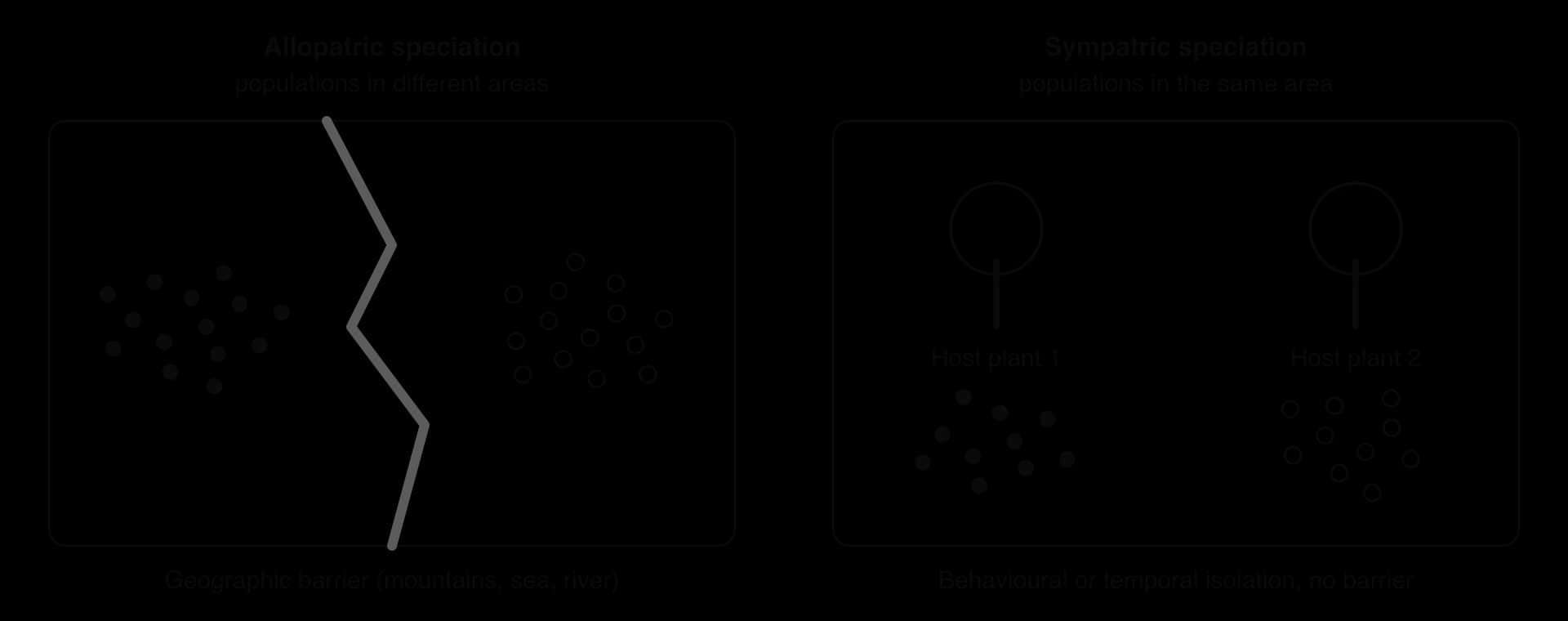
Geographic isolation is separation by a physical barrier and leads to allopatric speciation. The bonobos and chimpanzees divided by the Congo River are one example. Another comes from snapping shrimps of the genus Alpheus. When the Isthmus of Panama closed about 3 million years ago, it divided populations into those in the Caribbean Sea and those in the Pacific Ocean. Each Caribbean species now has a closely related "twin" species on the Pacific side, and when twins from opposite sides are put together in an aquarium, they rarely mate.
Behavioural isolation occurs when populations differ in courtship behaviour, songs, calls or mate choice, so that individuals of one population do not recognise or accept individuals of the other as mates. The Big Bird lineage on Daphne Major is isolated in this way, by song. The apple maggot fly (Rhagoletis pomonella) shows how behavioural isolation can produce sympatric speciation. Its larvae originally developed only in the fruit of native hawthorns in North America. Apples were introduced by European settlers, and in the 1860s flies were first recorded laying eggs in apples. The flies mate on the fruit of the host plant on which they developed, so flies that prefer apples mostly mate with other apple flies, even where hawthorns and apples grow side by side. The two host races now differ in allele frequencies and are partly reproductively isolated.
Temporal isolation occurs when populations breed at different times of day or year, or flower at different times, so that they do not meet as mates. Periodical cicadas (Magicicada) in eastern North America spend most of their lives underground as nymphs and emerge as adults to breed only once every 13 or 17 years, depending on the species. A 13-year brood and a 17-year brood in the same area emerge together only once every 221 years (13 × 17), so they rarely have the chance to interbreed. Apple and hawthorn races of Rhagoletis are also partly temporally isolated, because apples ripen several weeks before hawthorn fruit, and each race emerges as adults at the time its fruit ripens.
Feature | Allopatric speciation | Sympatric speciation |
|---|---|---|
Location of the populations | Different areas | The same area |
Cause of reproductive isolation | A geographical barrier (geographic isolation) | Behavioural or temporal isolation, or polyploidy |
How common | The most common way new species form in animals | Less common in animals; common in plants through polyploidy |
Example | Bonobos and chimpanzees; Caribbean and Pacific snapping shrimps | Rhagoletis host races; polyploid plants such as Persicaria |
Shared features | Both need gene flow to stop and the populations to diverge by differential selection and mutation | Both end with populations that cannot interbreed to produce fertile offspring |
Adaptive radiation is the rapid evolution of many species from a single ancestral species, each adapted to a different ecological niche. It usually happens when an ancestral species reaches an environment with many unoccupied niches and few competitors: a new island or lake, or a world in which a mass extinction has removed many other species.
Adaptive radiation repeats the two steps of speciation many times. The descendants of the colonists spread into different habitats or begin to use different foods. Populations that use different resources face different selection pressures (differential selection), and if they also become reproductively isolated, they become separate species. Each new species may then split again. The result is a group of closely related species that share many features from their common ancestor but differ in the structures linked to their niche, such as mouthparts, beaks or limbs.
Lake Victoria in East Africa contains more than 500 species of cichlid fishes found nowhere else. Geological evidence shows that the lake was largely or entirely dry until about 15,000 years ago, so most of these species evolved after it refilled, one of the fastest adaptive radiations known. The species differ mainly in their jaws and teeth, which suit different diets, and in the colours of breeding males, which females use to choose mates.
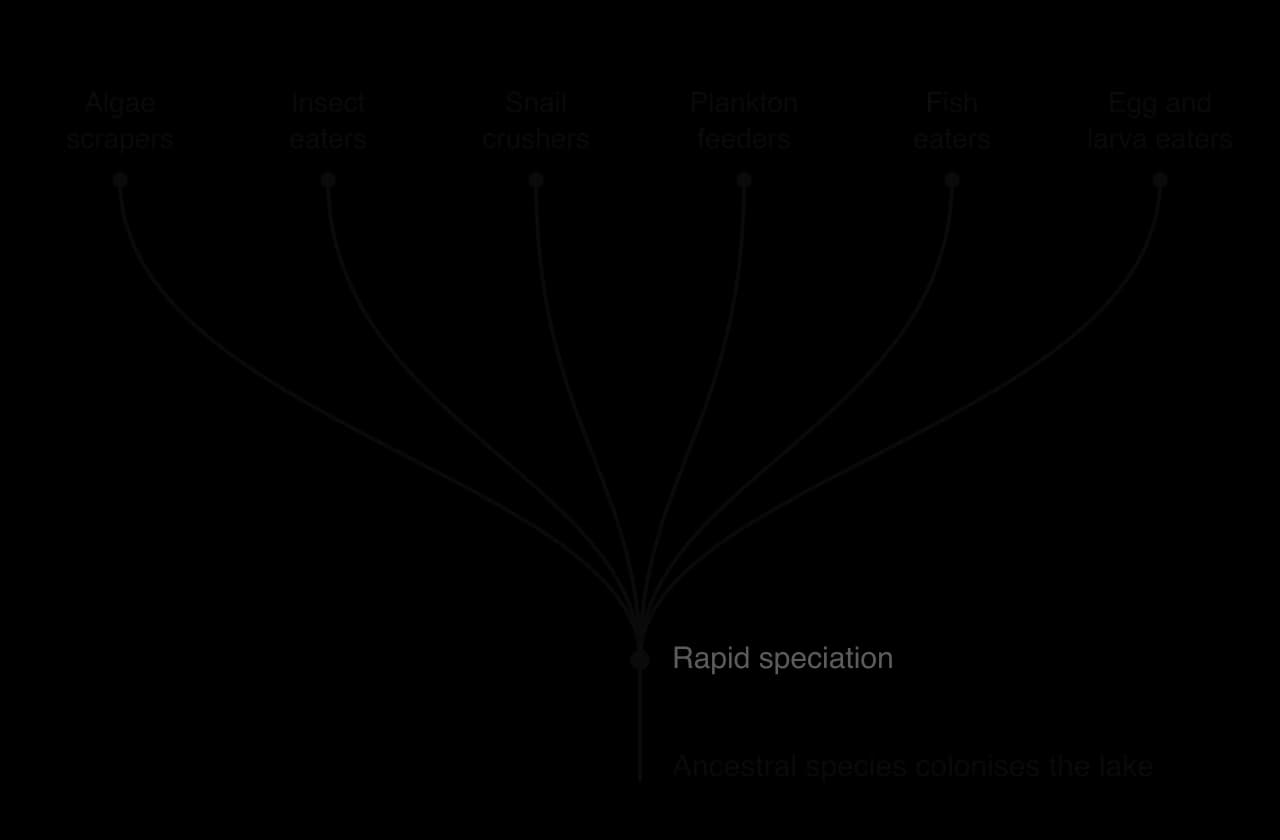
Among the Lake Victoria cichlids there are species that scrape algae from rocks, species that crush snails with strong pharyngeal jaws, species that eat insects, plankton or other fish, and even species that feed on the eggs and young of other cichlids. Female choice of male colour gives behavioural isolation between species that live together in the lake. Darwin's finches on the Galápagos Islands and the Hawaiian honeycreepers are other well-studied adaptive radiations, in which one colonising bird species gave rise to many species with beaks adapted to different foods.
Adaptive radiation is a major source of biodiversity, because it produces many species in a short time. It also explains why closely related species often share homologous structures that have been modified in different ways, for example the jaws of cichlids or the beaks of finches.
When two closely related species live in the same area, mating between them could mix their alleles and undo the differences between them. A range of barriers prevents this. They are divided into pre-zygotic barriers, which prevent a zygote from forming, and post-zygotic barriers, which act after fertilisation.
Barrier | Type | How it prevents mixing of alleles | Example |
|---|---|---|---|
Habitat isolation | Pre-zygotic | The species live in different habitats in the same area and rarely meet | Apple and hawthorn races of Rhagoletis on different host trees |
Temporal isolation | Pre-zygotic | The species breed or flower at different times | 13-year and 17-year periodical cicadas |
Behavioural isolation | Pre-zygotic | Courtship signals or mate choice differ | Song in the Big Bird lineage; male colour in Lake Victoria cichlids |
Mechanical isolation | Pre-zygotic | Reproductive organs or flowers do not fit together | Flowers shaped so that only one species of pollinator can transfer pollen |
Gametic isolation | Pre-zygotic | Sperm cannot fertilise eggs of the other species, often because surface proteins do not match | Sea urchins that release gametes into the same water |
Hybrid inviability | Post-zygotic | The hybrid zygote or embryo fails to develop or the hybrid dies young | Many sheep × goat hybrid embryos die before birth |
Hybrid sterility | Post-zygotic | The hybrid survives but cannot produce viable gametes | Mule (horse × donkey) |
Hybrid breakdown | Post-zygotic | First-generation hybrids are fertile, but their offspring are weak or sterile | Some crosses between varieties of rice and of cotton |
A mule is the offspring of a male donkey (Equus asinus) and a female horse (Equus caballus). Mules are strong and healthy and have been bred for thousands of years, but they are almost always sterile. This is hybrid sterility.
The cause lies in the chromosomes. A horse has a diploid number of 64 (32 pairs) and a donkey has 62 (31 pairs). A horse egg (32 chromosomes) fertilised by a donkey sperm (31 chromosomes) gives a mule with 63 chromosomes. Mitosis works normally, so the mule grows and develops. In meiosis, however, each chromosome must pair with its homologue. The horse and donkey chromosomes differ in number and arrangement, so many cannot pair, meiosis fails, and almost no viable gametes are produced. Because mules cannot breed, no alleles pass between horses and donkeys through them, and the two species stay separate.
Natural selection tends to strengthen pre-zygotic barriers between species that live in the same area. A hybrid that dies young or is sterile is a wasted reproductive effort for its parents. Individuals that avoid mating with the other species leave more fertile offspring, so alleles for stronger mate discrimination increase in frequency. This process, called reinforcement, explains why pre-zygotic barriers are often stronger where two related species live together than where they live apart.
Most speciation is gradual. In plants, a new species can arise abruptly, in one or two generations, through polyploidy. A polyploid organism has more than two complete sets of chromosomes. A diploid organism (2n) has two sets; a triploid has three (3n), a tetraploid four (4n) and a hexaploid six (6n).
Polyploidy arises when cell division fails to separate the chromosome sets. If all the chromosomes fail to separate in meiosis (non-disjunction of a whole set), a diploid gamete (2n) is produced instead of a haploid one (n). If two diploid gametes fuse, the zygote is tetraploid. The chromosome number can also double in a cell when mitosis copies the chromosomes but the cell does not divide; if that cell then produces a flowering shoot, its gametes are diploid. There are two types of polyploid, depending on where the extra chromosome sets come from.
Autopolyploidy is polyploidy in which all the chromosome sets come from one species, for example when a diploid plant produces diploid gametes that fuse to give a tetraploid of the same species.
Allopolyploidy is polyploidy in which the chromosome sets come from two different species, after hybridisation between them.
When two related plant species hybridise, the hybrid usually has one set of chromosomes from each parent. The two sets are not homologous, so in meiosis the chromosomes have no partners and cannot pair. The hybrid is sterile, like a mule, although plants can often survive and spread for many years by asexual reproduction. If the chromosome number of the hybrid then doubles, every chromosome has an identical partner. Meiosis can proceed normally, and the plant becomes fertile. The diagram of allopolyploidy follows the chromosome sets through the process.
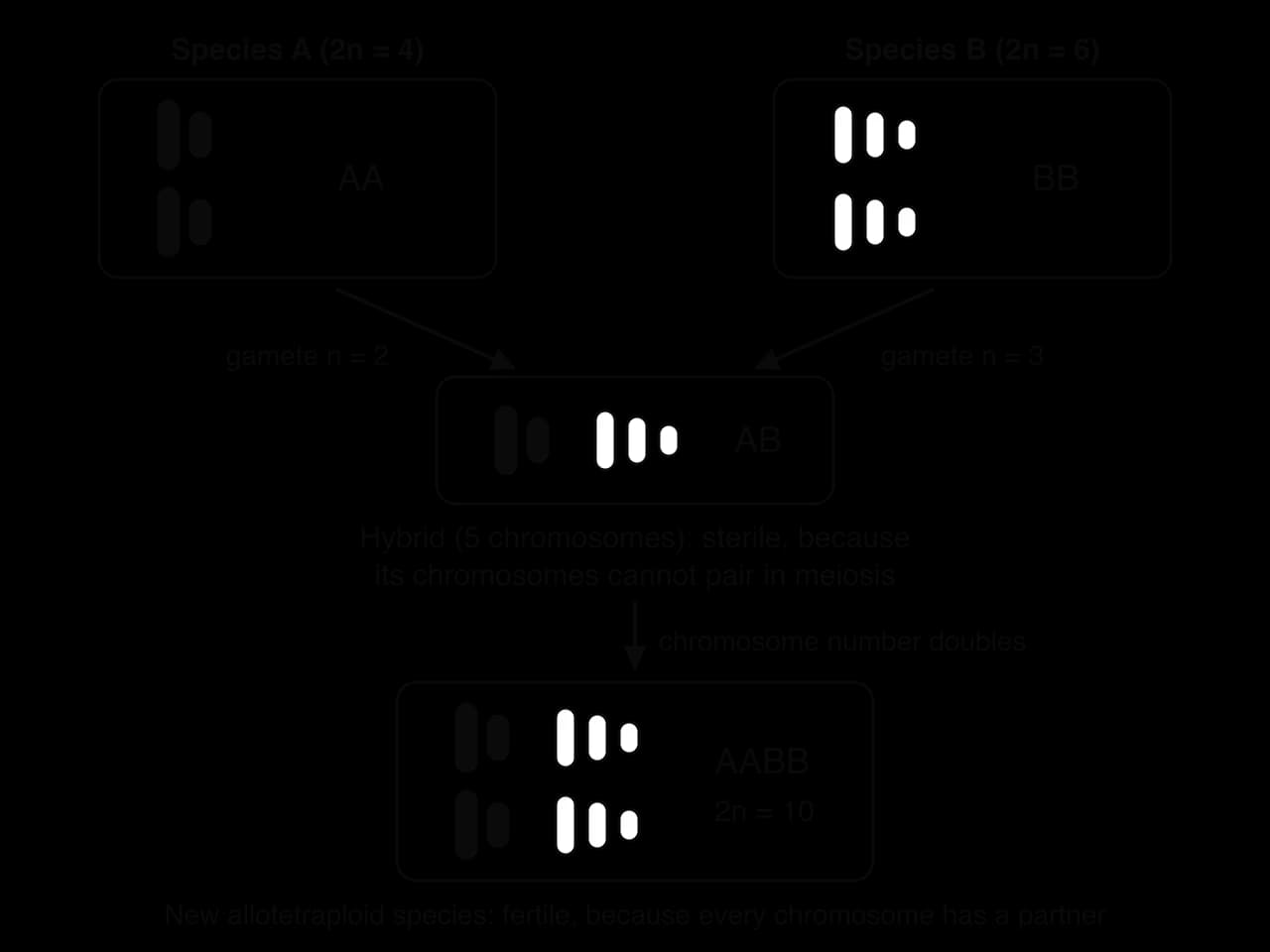
The new allopolyploid is instantly reproductively isolated from both parent species. If it is crossed with either parent, the offspring have an odd number of chromosome sets (for example three: AAB), and the unmatched set cannot pair in meiosis, so these offspring are sterile. The polyploid can reproduce only with other polyploids like itself, or by self-pollination, which many plants can do. A new species has therefore formed in about two generations, without geographic isolation, so allopolyploidy is a form of sympatric speciation.
The genus Persicaria (knotweeds and smartweeds, family Polygonaceae) contains diploid, tetraploid, hexaploid and octoploid species. Comparisons of the base sequences of chloroplast and nuclear genes show that many of the polyploid species are allopolyploids. A nuclear gene, LEAFY, has a separate copy inherited from each parent species, so sequencing both copies identifies the two parents of each polyploid.
About 15 species of Persicaria appear to have arisen by allopolyploidy.
Redshank (Persicaria maculosa), a common weed, is a tetraploid that arose from hybridisation between the diploids P. foliosa and P. lapathifolia.
The hexaploid P. puritanorum arose from a cross between the tetraploid P. hydropiperoides and the diploid P. lapathifolia.
One widespread diploid, pale persicaria (P. lapathifolia), has been a parent in at least six separate allopolyploid speciation events.
Source: Kim, Sultan and Donoghue, PNAS 105:12370, 2008.
Many of the allopolyploid species are widespread, adaptable weeds. Polyploids often have larger cells and organs and combine characteristics of both parents, which can help them colonise new habitats. A similar case has been observed directly in the cord-grass Spartina anglica. It arose in Southampton, England, in the late 1800s, after the introduced North American S. alterniflora hybridised with the native S. maritima, and the sterile hybrid then doubled its chromosome number. The fertile allopolyploid has since spread along coasts in many countries.
Autopolyploidy can also cause abrupt speciation. A tetraploid formed from a diploid species produces diploid gametes. If they fuse with haploid gametes of the parent species, the offspring are triploid and sterile, so the tetraploid is reproductively isolated from its parents even though all its chromosomes came from one species.
Evolution and speciation appear in Paper 1A as questions on homologous and analogous structures, the definition of evolution and types of isolation. Paper 1B and Paper 2 Section A use data such as tables of sequence differences, cladograms and chromosome numbers, with command terms such as deduce, identify and calculate. Paper 2 Section B often asks you to outline the evidence for evolution, explain how speciation occurs or distinguish between homologous and analogous structures.
Species P | Species Q | Species R | Species S | |
|---|---|---|---|---|
Species P | – | 3 | 14 | 15 |
Species Q | 3 | – | 13 | 14 |
Species R | 14 | 13 | – | 5 |
Species S | 15 | 14 | 5 | – |
The mechanism of natural selection, which links variation to speciation, is developed further in D4.1 Natural selection.
I can define evolution and explain why acquired characteristics are not inherited.
I can contrast Lamarckism with Darwinism and explain why Lamarckism was falsified.
I can explain how sequence data, such as cytochrome c, provide evidence for evolution.
I can describe selective breeding in maize and dogs as evidence for evolution.
I can identify the pentadactyl limb in an amphibian, reptile, bird and mammal and relate its differences to function.
I can distinguish homologous and analogous structures and use a cladogram to decide between them.
I can explain speciation as splitting, with the roles of reproductive isolation and differential selection.
I can describe the speciation of bonobos and chimpanzees and the Big Bird lineage.
I can compare allopatric and sympatric speciation and give examples of geographic, behavioural and temporal isolation. (HL)
I can explain adaptive radiation using Lake Victoria cichlids. (HL)
I can describe pre-zygotic and post-zygotic barriers and explain why mules are sterile. (HL)
I can explain abrupt speciation by allopolyploidy using Persicaria. (HL)
Number of amino acid differences from human cytochrome c |
|---|
Rhesus monkey | 1 |
Dog | 11 |
Horse | 12 |
Chicken | 13 |
Tuna | 21 |
Yeast | 44 |
Which conclusion is supported by the data?
Cabbage, kale, broccoli and cauliflower are all varieties of Brassica oleracea produced by selective breeding of a wild ancestor within the last few thousand years. What does this provide evidence for?