Research design
How to write the Research design of the IB Biology IA: a focused research question in context, explained variables and controls, sufficient data and a specific risk assessment.
- IB Biology
- Internal assessment
- SL and HL
Research design is the first of the four criteria of the scientific investigation. It assesses the research question and the scientific context it sits in, the decisions made in planning the method, and whether the method is written in enough detail for another person to repeat it.
A strong research design does most of the work for the other three criteria. If the variables are well chosen and well controlled, and enough data are collected, the analysis is straightforward, the conclusion is clear and the evaluation can focus on genuine limitations instead of avoidable mistakes.
What the criterion rewards
The descriptors look at three things: how the research question is set in context, how the methodological considerations are handled, and how complete the description of the method is. The command term changes from band to band, and the table paraphrases the difference.
Aspect | Band 1–2 | Band 3–4 | Band 5–6 |
|---|---|---|---|
Research question and context | The question is stated, with little or no context | The question is outlined within a broad context | The question is described within a specific and appropriate context |
Methodological considerations (variables, data sufficiency, safety, ethics, environment) | Stated: listed without reasons | Described: some detail on what was done | Explained: what was done, how, and why each decision matters to the results |
Description of the method | Lacks the detail needed to repeat it | Has some detail but with omissions | Detailed enough for the investigation to be reproduced |
Methodological considerations are every decision that affects the quality of the data: the choice of measuring method and instrument, the range and spacing of the independent variable, the number of repeats, the controlled variables, preliminary trials, and safety, ethical and environmental issues. The top band needs reasons for each of these, not only a list.
The research question and its context
Writing the research question
The research question is one sentence that names the independent variable with its range, the dependent variable with how it is measured, and the organism or system, with its scientific name. For a correlation study, it names the two variables and the population or site. Choosing and sharpening a question is covered in "The scientific investigation"; the Research design criterion then asks how well the question is placed in its context.
Background theory tied to the variables
The context is the biology that explains why the independent variable should affect the dependent variable in the system chosen, and it is specific to those two variables and that system. For an investigation of temperature and catalase, the context covers the reaction catalysed, how temperature affects the frequency of collisions between enzyme and substrate, why the rate falls above the optimum when the enzyme undergoes denaturation, and why catalase is found in potato tuber cells. It does not need a history of enzyme research or a description of every factor that affects enzymes.
Explain the mechanism that links the two variables, with the key terms of the course.
Give the biological relevance: why the process matters in the organism (catalase protects cells from hydrogen peroxide, a toxic by-product of metabolism).
Cite the sources of this information in the text.
Where published values exist (an optimum temperature, a water potential, a typical stomatal density), mention them, because the conclusion will be compared with them.
A hypothesis is not compulsory, but a prediction with a reason drawn from the theory shows that the context has been understood. "The rate of oxygen release will increase from 20 °C to an optimum near 40 °C, then decrease sharply, because catalase is denatured at higher temperatures" is a testable prediction based on theory.
 YouTube
Variables: what is changed, measured and kept constant
Every investigation has three kinds of variable. Each is named in the report together with how it is measured or controlled, its units and the uncertainty of the instrument used.
The independent variable is the one changed deliberately. State its values (the range and the increments) and how each value is set and checked, for example "water bath set to each temperature and checked with a thermometer (±0.5 °C)".
The dependent variable is the one measured. State exactly what is measured, with which instrument, over what time, and how it is turned into the quantity analysed (for example volume of oxygen in 60 s, used as the rate in cm³ min⁻¹).
The controlled variables are the other factors that could affect the dependent variable. For each, state the value used, how it was kept constant, and why it matters.
The "why" is where most marks are lost. A controlled variable matters because it would change the dependent variable if it varied, which would make it impossible to say whether a change in the results was caused by the independent variable. Explaining the mechanism for each one (more substrate means more collisions per second) turns a list into an explanation.
Controlled variable | Value | How it is controlled | Why it matters |
|---|---|---|---|
Concentration of hydrogen peroxide | 3% | Same stock solution used for every trial, stored in the dark | A higher substrate concentration increases the frequency of enzyme–substrate collisions and the rate |
Volume of hydrogen peroxide | 10.0 cm³ | Measured with a 10 cm³ pipette (±0.05 cm³) | Determines the total amount of substrate available |
Surface area of potato tissue | 5 discs, 10 mm diameter, 2 mm thick | Cut with a size 6 cork borer and a scalpel against a 2 mm template | Only catalase in cells at or near the cut surface reacts quickly; more surface area means more enzyme in contact with substrate |
Source of potato tissue | One tuber | All discs cut from the same tuber on the same day | Catalase content differs between tubers and changes with storage |
pH | pH 7.0 | 2.0 cm³ of phosphate buffer added to each flask | pH changes the shape of the active site and the rate |
Time of collection | 60 s | Stopwatch started when the bung is inserted | Volume collected depends on how long the reaction runs |
Time at the set temperature before mixing | 5 min | Discs and hydrogen peroxide equilibrated separately in the water bath | Ensures both are at the set temperature when the reaction starts |
Variables that cannot be controlled
In fieldwork and in studies of people, many variables cannot be held constant. Light intensity, soil moisture and temperature change during a field day; the age, fitness and diet of participants differ. These are monitored instead: measured and recorded, so that their possible effect can be discussed in the evaluation. Choosing sites, times or participants that are as similar as possible limits their influence. A variable that changes along with the independent variable and could explain the results is a confounding variable, and the design should try to remove or measure it.
Choosing and justifying the method
The method is the procedure used to set the independent variable and measure the dependent variable. Justifying it means explaining why that method and instrument were chosen over the alternatives, usually because they give more precise, more objective or more relevant data.
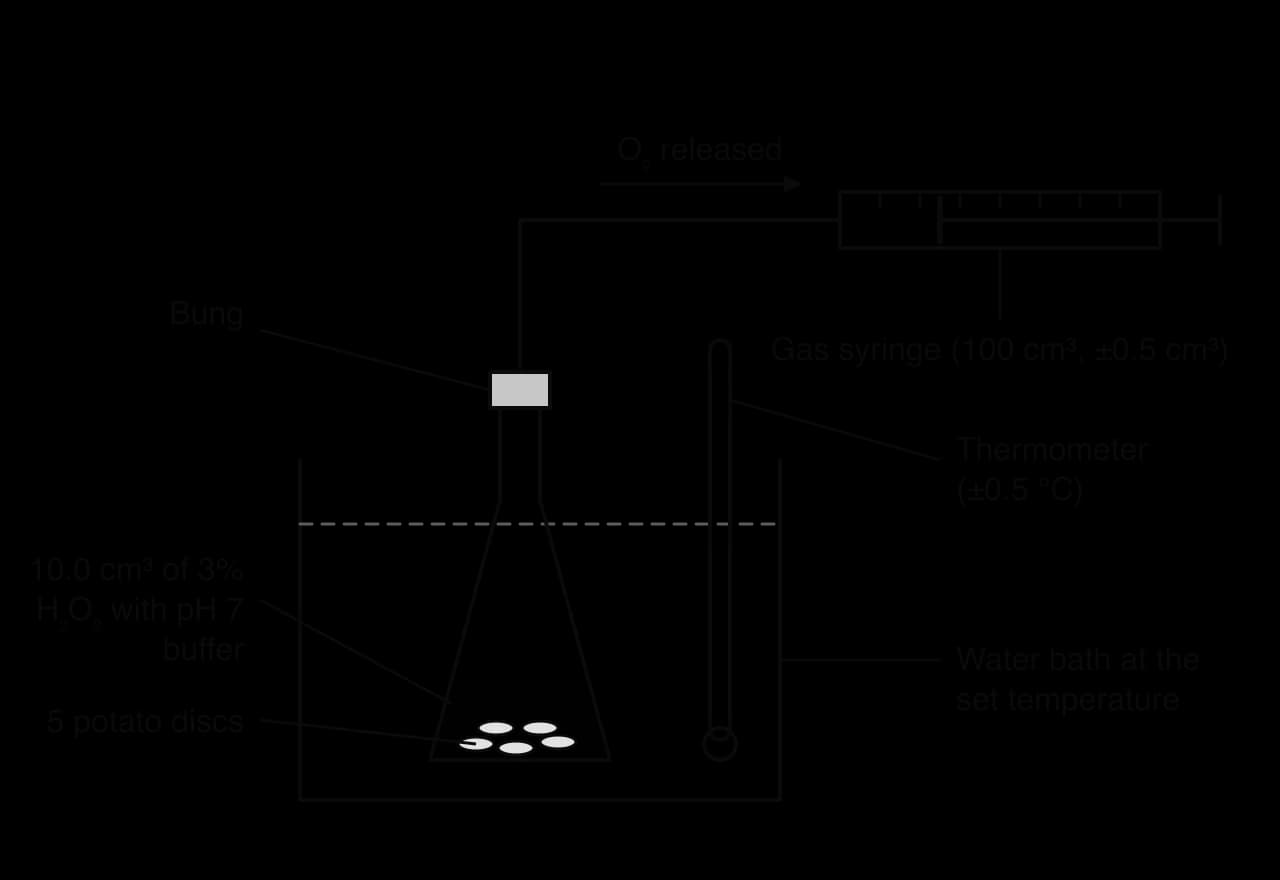
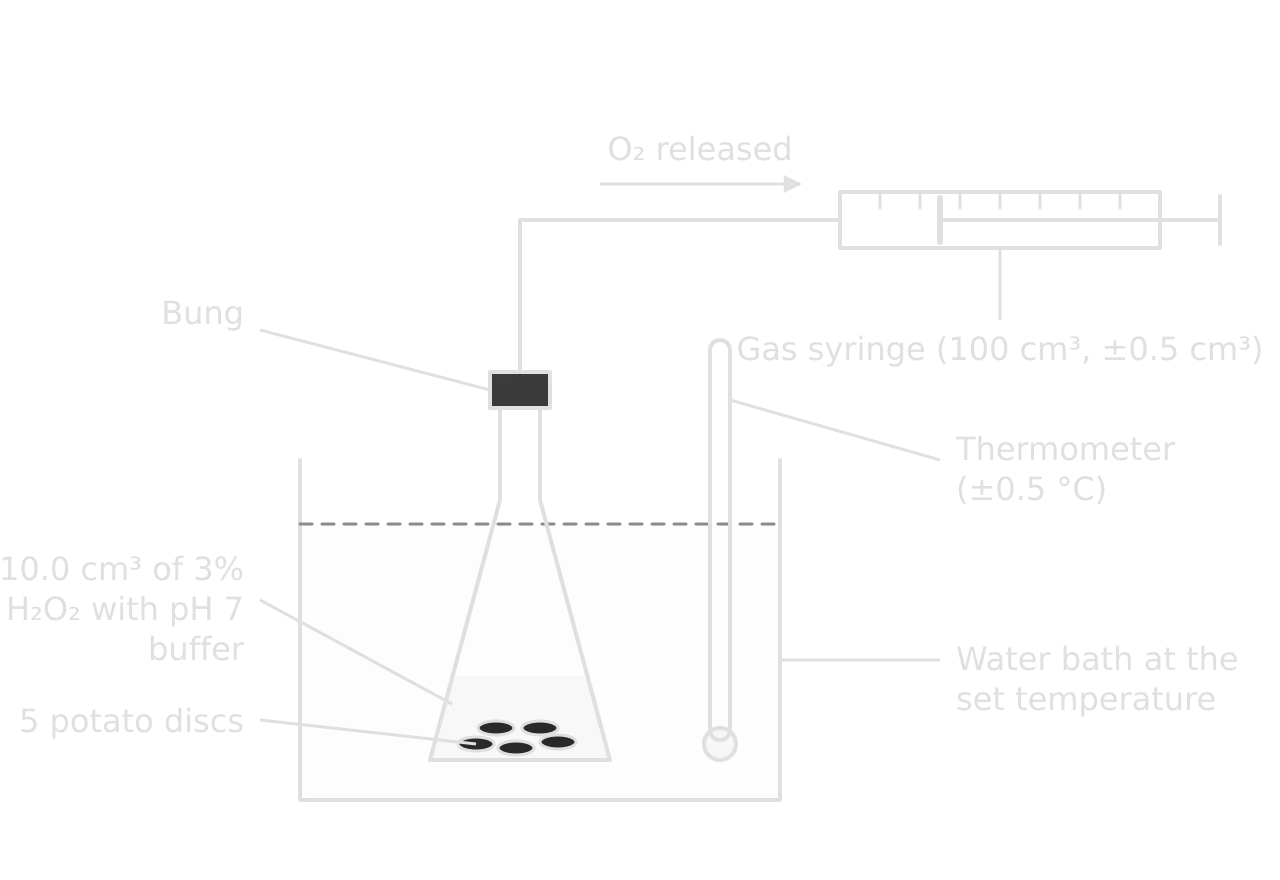
Catalase activity can be measured in several ways: by counting bubbles, by timing how long a filter-paper disc soaked in catalase takes to rise through hydrogen peroxide, by measuring the height of foam, or by collecting the oxygen in a gas syringe or an inverted measuring cylinder. Counting bubbles is quick but bubbles vary in size. A gas syringe measures the volume of oxygen directly, to ±0.5 cm³, and is the most precise of these methods for a school laboratory. The diagram of the apparatus shows the set-up chosen for the sample investigation.
Preliminary trials
Preliminary trials are small-scale runs of the method before the real data are collected. They show whether the method works and set values that would otherwise be guesses. In the catalase investigation, trials might show that at 40 °C about 19 cm³ of oxygen is collected in 60 s, a volume well within the 100 cm³ scale and large compared with the ±0.5 cm³ uncertainty, so 60 s is a suitable collection time; or that discs float and stick to the side of the flask unless the flask is swirled once. Reporting what the trials showed and what was changed as a result is strong evidence of explained methodological considerations.
Sufficiency of data
Sufficient data means enough levels of the independent variable, over a wide enough range, with enough repeats, to answer the research question with confidence. A useful rule is at least five levels and at least five repeats at each level, but the right numbers depend on the question.
Decision | What to consider | Catalase example |
|---|---|---|
Range | Wide enough to show the whole relationship, including any optimum, plateau or threshold | 20–60 °C covers the rise, the optimum and the fall from denaturation |
Increments | Evenly spaced, with closer spacing where the result changes fastest or an important point is expected | 10 °C steps, with extra levels at 35 and 45 °C around the expected optimum (7 levels) |
Repeats | Enough to calculate a mean and standard deviation and to identify anomalous results | 5 repeats at each temperature (35 trials in total) |
Sample size (field or human studies) | Enough quadrats, organisms or participants to represent the population and support a statistical test | Not applicable; in a transect study, for example, at least 10 quadrats per site |
Repeats allow the mean and the standard deviation to be calculated, so the variation in the data can be measured and a statistical test can be carried out. Three repeats are rarely enough for a meaningful standard deviation. The number of trials possible in the time available sets a limit, so there is usually a trade-off between more levels and more repeats. Explaining that trade-off is itself a methodological consideration.
A total of 35 trials at about 8 minutes each (setting up, equilibrating, collecting, cleaning) takes roughly 4.5 hours, which fits within two or three laboratory sessions. Collecting all the data with one batch of potato and one stock of hydrogen peroxide also keeps those variables constant.
Safety, ethics and the environment
A good risk assessment is specific to the method. It names each hazard, says what harm it could cause and gives the precaution. A table is the clearest way to present it and does not use up the word count.
Hazard | Risk | Precaution |
|---|---|---|
Hydrogen peroxide (3%) | Irritant to eyes and skin | Safety glasses and gloves worn; spills diluted and wiped up with water |
Water bath at up to 60 °C | Scalds | Flasks handled with tongs; bath not overfilled |
Scalpel and cork borer | Cuts | Tissue cut on a tile, cutting away from the body; blade sheathed when not in use |
Glassware | Cuts from breakage | Flasks checked for cracks; broken glass placed in the glass bin |
Disposal | Environmental impact | Dilute hydrogen peroxide poured down the sink with plenty of water; potato tissue composted |
Ethical considerations come under the same criterion. An investigation on potato tissue raises no ethical issues, and saying so in one sentence is enough. An investigation on animals or people must follow the IB animal experimentation policy and obtain informed consent, as described in "The scientific investigation". The environmental impact includes disposal of chemicals and, in fieldwork, trampling, removing organisms and leaving the site as it was found.
A worked example: a full research design
The sample investigation tests the effect of temperature on the rate of catalase activity in potato tuber. The write-up in the worked example shows the level of detail and explanation expected in the top band. It is shorter than a real report, which would also include the full background theory and citations, but every section is present.
The order of temperatures in step 5 is randomised for a specific reason: potato discs left waiting for an hour may lose activity as they dry or as cells are damaged. Running all the 20 °C trials first and all the 60 °C trials last would mix the effect of temperature with the effect of waiting time. Randomising spreads that effect across all temperatures.
Common mistakes and how to avoid them
Missing quantities. "Some hydrogen peroxide was added to potato" cannot be repeated. Give every concentration, volume, mass, size, time and temperature, with units.
Controlled variables listed but not explained. Give how and why for each, ideally in a table.
No instrument uncertainties. State the uncertainty of every measuring instrument in the method or the apparatus list.
Generic safety. Name the hazards specific to the method.
No scientific name. Name organisms and tissues precisely the first time they appear.
Method written as a story. Numbered steps in the order they are done are easier to follow and repeat.
Carry on with Biology in Augment
With a free account, Augment remembers where you stopped in the notes and which questions you have marked.