C Interaction and interdependence
How theme C fits together: interactions from enzymes to ecosystems, the nine subtopics across four levels of organisation, and what HL adds.
- IB Biology
- SL and HL
9 subtopics in Interaction and interdependence
Each one has its own page once something is published for it.
- C1.1Enzymes and metabolism43 questions · notes · 1 quick fire
- C1.2Cell respiration44 questions · notes · 2 quick fire
- C1.3Photosynthesis42 questions · notes · 1 quick fire
- C2.1Chemical signallingHL only39 questions · notes
- C2.2Neural signalling42 questions · notes
- C3.1Integration of body systems40 questions · notes
- C3.2Defence against disease44 questions · notes
- C4.1Populations and communities42 questions · notes
- C4.2Transfers of energy and matter43 questions · notes · 1 quick fire
Key terms introduced here
Each is in the Biology glossary, with every other term in the subject.
- Interdependence
The dependence of the parts of a biological system on one another, so that a change in one part, such as a molecule, cell, organ or species, affects the others.
An overview of C Interaction and interdependence
Interaction and interdependence is the theme of how the parts of living systems act on one another. Enzymes and their substrates, neurons and their target cells, organs within a body, and species within a community all depend on interactions with other parts of the same system.
A change in one part therefore affects the others. An inhibitor that blocks one enzyme can stop a whole metabolic pathway, and the removal of one predator can change the size of every population in a food web.
Subtopics in Interaction and interdependence
The grid of themes and levels of organisation places the nine subtopics of Interaction and interdependence in the third row.
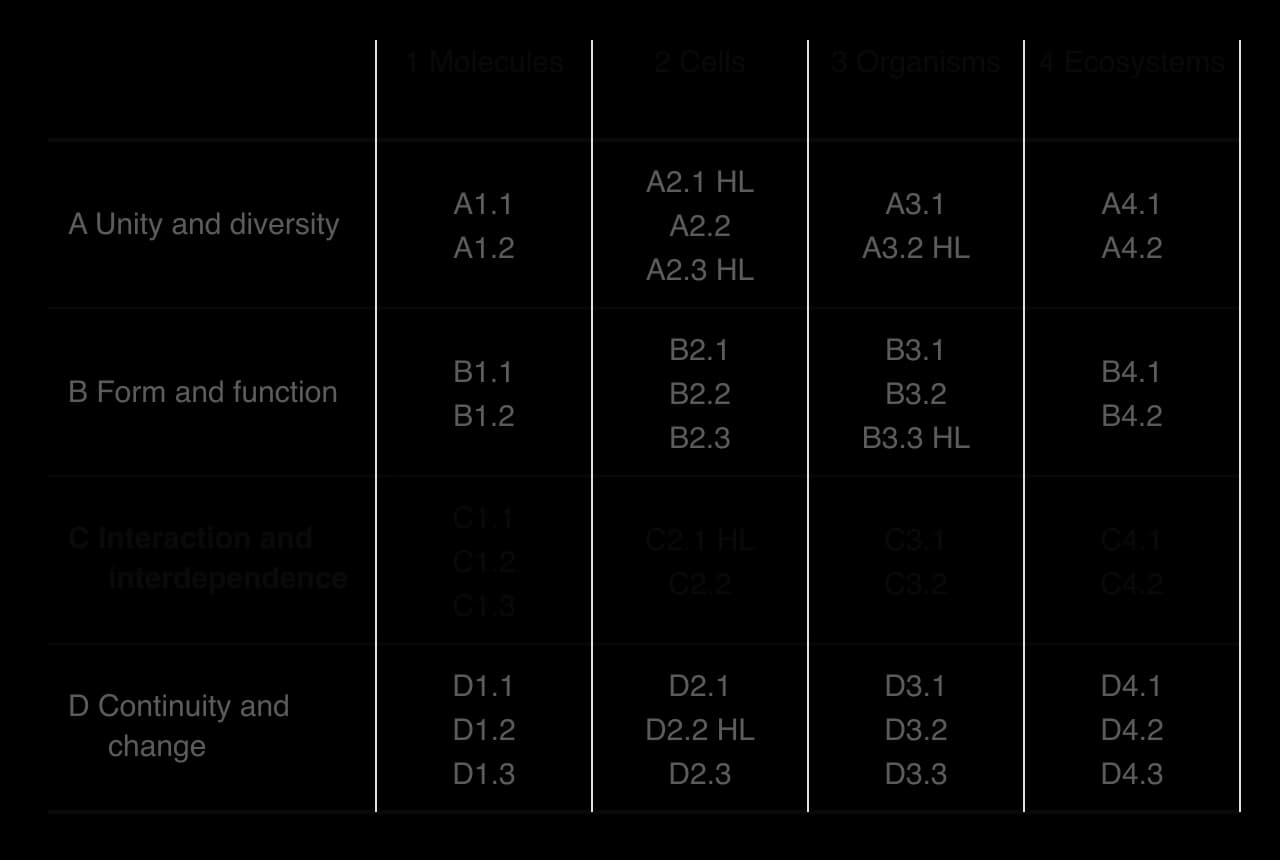
Subtopic | Level of organisation | SL or HL | Central question |
|---|---|---|---|
C1.1 Enzymes and metabolism | Molecules | SL and HL | How do enzymes speed up and control the reactions of metabolism? |
C1.2 Cell respiration | Molecules | SL and HL | How do cells release energy from carbon compounds to make ATP? |
C1.3 Photosynthesis | Molecules | SL and HL | How is light energy captured and used to make carbon compounds? |
C2.1 Chemical signalling | Cells | HL only | How do cells detect chemical signals and respond to them? |
C2.2 Neural signalling | Cells | SL and HL | How are electrical impulses generated and passed between neurons? |
C3.1 Integration of body systems | Organisms | SL and HL | How do nerves and hormones coordinate the body's organs? |
C3.2 Defence against disease | Organisms | SL and HL | How does the body recognise and fight pathogens, and how is disease controlled in populations? |
C4.1 Populations and communities | Ecosystems | SL and HL | How do interactions between organisms regulate population sizes? |
C4.2 Transfers of energy and matter | Ecosystems | SL and HL | Why is matter recycled in ecosystems while energy flows through and is lost? |
How interactions connect across the levels
The theme describes interdependence at every level of organisation, from molecules to ecosystems.
At the level of molecules, enzymes control the rate of every metabolic reaction (C1.1). Cell respiration (C1.2) and photosynthesis (C1.3) are linked pathways: the oxygen and carbon compounds made by photosynthesis are used in respiration, and the carbon dioxide released by respiration is fixed again by photosynthesis.
At the level of cells, cells communicate by chemical signals that bind to receptors (C2.1) and by electrical impulses passed across synapses (C2.2). At the level of organisms, the nervous and endocrine systems coordinate organs so that the body works as one unit (C3.1), and the immune system defends that body against pathogens (C3.2).
At the level of ecosystems, populations are regulated by competition, predation and other interactions between species (C4.1). Energy flows through food chains and is lost as heat, while carbon and other elements are recycled between organisms and the environment (C4.2).
Links to the other themes
Unity and diversity (A). The communities studied in C4.1 are made of the species identified and classified in A3.1, and their loss is the subject of A4.2.
Form and function (B). Enzymes depend on protein structure (B1.2), and respiration and photosynthesis take place in organelles adapted for them (B2.2).
Continuity and change (D). Hormonal control in C3.1 underlies homeostasis (D3.3), and interactions within ecosystems determine their stability (D4.2).
How HL differs in this theme
HL students study everything that SL students study, plus one HL-only subtopic, C2.1 Chemical signalling, and the sections marked HL only inside the SL subtopics. Five SL subtopics carry additional HL sections:
C1.1 Enzymes and metabolism: intracellular and extracellular reactions, heat from metabolism, cyclical and linear pathways, competitive, non-competitive and mechanism-based inhibition, and feedback inhibition.
C1.2 Cell respiration: the biochemistry of respiration, from NAD as a hydrogen carrier through glycolysis, the link reaction and the Krebs cycle to the electron transport chain, chemiosmosis and oxygen as the terminal electron acceptor; lactate and yeast fermentation as ways of regenerating NAD; and lipids compared with carbohydrates as respiratory substrates.
C1.3 Photosynthesis: photosystems as arrays of pigments, photolysis of water, chemiosmosis in thylakoids and the reduction of NADP, the Calvin cycle (carbon fixation by Rubisco, triose phosphate and regeneration of RuBP), the synthesis of other carbon compounds, and the interdependence of the light-dependent and light-independent reactions.
C2.2 Neural signalling: depolarisation and repolarisation, propagation and saltatory conduction, oscilloscope traces, the effects of exogenous chemicals on synapses, inhibitory neurotransmitters and summation, pain and consciousness.
C3.1 Integration of body systems: tropic responses and positive phototropism in seedlings, phytohormones, auxin efflux carriers and the promotion of cell growth by auxin, auxin–cytokinin interactions, and positive feedback in fruit ripening by ethylene.
C3.2 Defence against disease, C4.1 Populations and communities and C4.2 Transfers of energy and matter have no HL extension.
Carry on with C in Augment
With a free account, Augment remembers where you stopped and what you have practiced.