Explain how cells release energy from glucose and fats to make ATP, compare aerobic and anaerobic respiration, measure respiration rates and, at HL, follow every stage to chemiosmosis.
Each is in the Biology glossary, with every other term in the subject.
An acetyl group (2C) attached to coenzyme A, formed from pyruvate in the link reaction or from fatty acids, which delivers the acetyl group to the Krebs cycle.
Adenosine diphosphate: the nucleotide with two phosphate groups formed when ATP is hydrolysed; energy from respiration is used to add a phosphate to ADP to remake ATP.
Cell respiration that uses oxygen and releases a large amount of energy from glucose or other substrates, producing carbon dioxide and water; it takes place in the cytoplasm and mitochondria.
Cell respiration without oxygen, releasing a small amount of energy (2 ATP per glucose) in the cytoplasm; the product is lactate in humans and ethanol and carbon dioxide in yeast.
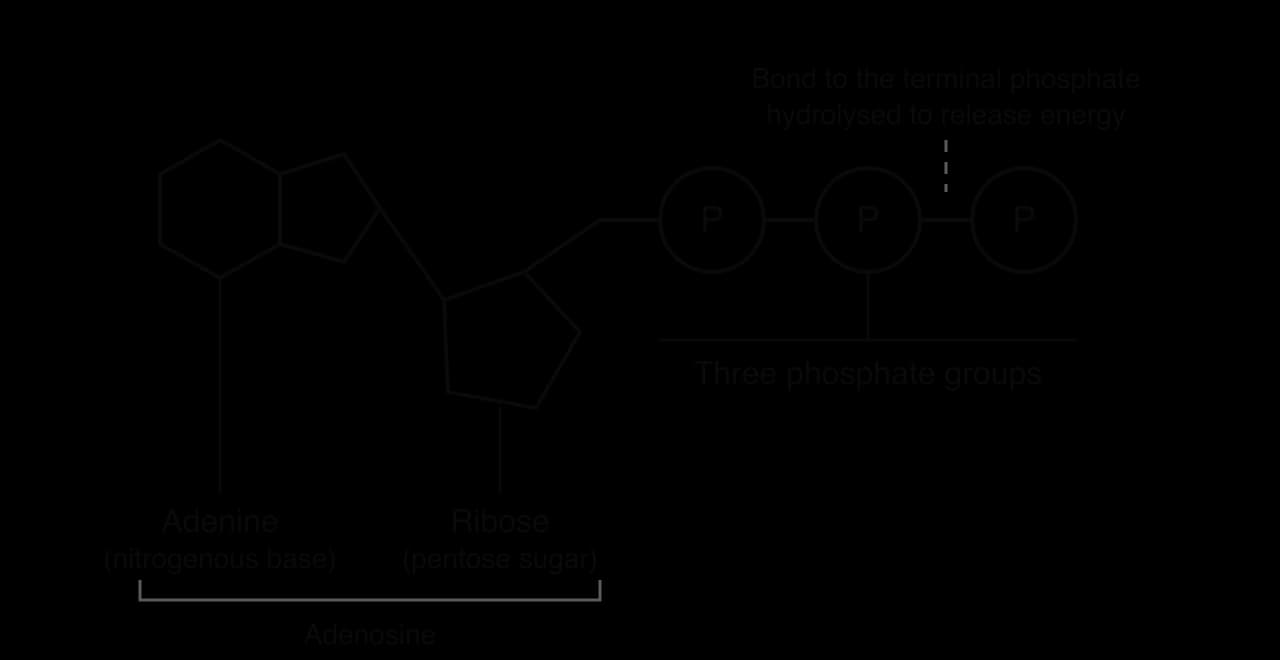
Adenosine triphosphate: a nucleotide made of adenine, ribose and three phosphate groups that distributes energy within cells; hydrolysis of the terminal phosphate releases energy.
An enzyme spanning the inner mitochondrial or thylakoid membrane that uses the energy of protons diffusing through it to phosphorylate ADP to ATP.
The controlled release of energy from organic compounds in cells to produce ATP, by a series of enzyme-catalysed reactions.
The movement of protons down their concentration gradient across a membrane through ATP synthase, which couples the energy released to the synthesis of ATP.
Every living cell needs a continuous supply of energy to stay alive, grow and reproduce. Cell respiration releases energy from carbon compounds such as glucose and transfers it to a single molecule, ATP, which then supplies energy to the processes that need it.
The same basic pathway runs in bacteria, fungi, plants and animals, which is strong evidence of the unity of life at the level of molecules. Cell respiration also links organisms to ecosystems: the carbon compounds it breaks down were made by photosynthesis, and the carbon dioxide it releases returns to the atmosphere.
44 exam-style questions on this subtopic, written in the style of the IB papers. The first has its markscheme open. Counted on
Living organisms release energy from food and use it in many ways.
Outline the role of ATP in cells.
4 marks
a. ATP distributes energy within cells / is the immediate source of energy for cell processes;
b. hydrolysis of ATP to ADP and phosphate releases energy;
c. energy used for active transport;
d. energy used for synthesis of macromolecules / anabolic reactions;
e. energy used for movement of the whole cell / of cell components such as chromosomes;
f. ATP is regenerated from ADP and phosphate using energy from cell respiration;
g. ATP is soluble so it moves easily within the cell;
h. ATP is continuously recycled rather than stored in large amounts;
[4 max]
Explain how heat is produced by metabolism and how it is used to maintain a constant body temperature in humans.
7 marks
a. energy transfers in metabolic reactions are not 100 % efficient;
b. so some energy is (inevitably) released as heat;
c. e.g. in cell respiration only part of the energy in glucose is transferred to ATP;
d. mammals / humans rely on this heat to keep body temperature constant / about 37 °C;
e. peripheral thermoreceptors (in the skin) detect a fall in temperature;
One of 2 short multiple-choice questions on C1.2. Pick an answer to see why it's right or wrong.
Where does the Krebs cycle take place?
The official deck for this part of the syllabus.
What does cell respiration release energy from, and to which molecule is that energy transferred?
What does the occurrence of the same basic respiration pathway in bacteria, fungi, plants and animals provide evidence for?
With a free account, Augment remembers where you stopped and what you have practiced.
The six-carbon compound formed in the Krebs cycle when an acetyl group combines with oxaloacetate.
A carrier molecule (CoA) that accepts the two-carbon acetyl group in the link reaction and from fatty acids, and delivers it to the Krebs cycle as acetyl-CoA.
The removal of a carboxyl group from a molecule, releasing carbon dioxide, as in the link reaction and the Krebs cycle.
A series of electron carrier proteins in the inner mitochondrial membrane (or thylakoid membrane) that pass electrons along, using the energy released to pump protons across the membrane.
Flavin adenine dinucleotide: a hydrogen carrier reduced in the Krebs cycle; reduced FAD passes its electrons to the electron transport chain at a later carrier than reduced NAD.
The first stage of cell respiration, in the cytoplasm: glucose is converted by phosphorylation, lysis, oxidation and ATP formation into two pyruvate, with a net yield of 2 ATP and 2 reduced NAD.
A cycle of reactions in the mitochondrial matrix in which acetyl groups are oxidised: each turn gives 2 CO₂, 3 reduced NAD, 1 reduced FAD and 1 ATP and regenerates oxaloacetate.
The three-carbon compound produced by anaerobic respiration of glucose in human cells such as muscle fibres; its formation releases no carbon dioxide, and at HL it is the step that regenerates NAD.
The oxidation and decarboxylation of pyruvate in the mitochondrial matrix, producing CO₂, reduced NAD and an acetyl group carried by coenzyme A as acetyl-CoA.
Nicotinamide adenine dinucleotide: a coenzyme that carries hydrogen in respiration; it is reduced when it accepts two electrons and a proton, and oxidised when it passes them to the electron transport chain.
The four-carbon compound of the Krebs cycle that accepts an acetyl group to form citrate and is regenerated at the end of each turn.
The loss of electrons from a substance, often by the removal of hydrogen (dehydrogenation) or the addition of oxygen; it releases energy from the substance oxidised.
The synthesis of ATP in mitochondria using energy released by the oxidation of reduced NAD and reduced FAD in the electron transport chain, through chemiosmosis.
The addition of a phosphate group to a molecule, which usually makes it less stable and more reactive, as when glucose is phosphorylated at the start of glycolysis.
A difference in proton (H⁺) concentration across a membrane, built up by electron transport, which stores potential energy used by ATP synthase.
The three-carbon end product of glycolysis; it enters the link reaction when oxygen is available or is converted to lactate or ethanol when it is not.
A reaction in which one substance is oxidised (loses electrons) and another is reduced (gains electrons) at the same time.
The gain of electrons by a substance, often by the addition of hydrogen or the removal of oxygen; it always occurs together with an oxidation.
An organic compound that is broken down in cell respiration to release energy for ATP production, such as glucose, fatty acids or amino acids.
An apparatus that measures the rate of cell respiration, usually as the volume of oxygen taken up by living organisms per unit time, with an alkali absorbing the carbon dioxide released.
The molecule that accepts electrons at the end of an electron transport chain; in aerobic respiration it is oxygen, which combines with electrons and protons to form water.
A three-carbon sugar phosphate; formed by the lysis of hexose bisphosphate in glycolysis, and the product of the Calvin cycle in photosynthesis.
Cells obtain energy from food or from light, but they cannot use that energy directly for most tasks. The energy first has to be transferred to a molecule that can carry it to wherever it is needed in the cell. In all known organisms that molecule is ATP.
ATP is a nucleotide, the same type of molecule as the monomers of RNA. It has three parts. The nitrogenous base adenine is linked to the pentose sugar ribose, and together these two form adenosine. A chain of three phosphate groups is attached to the ribose. The diagram of ATP shows these parts and the bond to the terminal phosphate group, which is the one broken when ATP releases energy.
The RNA nucleotide that carries adenine has only one phosphate group (adenosine monophosphate, AMP). ADP, adenosine diphosphate, has two. The names therefore count the phosphate groups: mono-, di- and tri-.
ATP is often called the energy currency of the cell. Money is useful because it can be earned in one place and spent in another, in convenient amounts. ATP is useful for the same reasons, and each of its properties explains part of this.
Soluble in water. ATP is a charged, polar molecule, so it dissolves in the cytoplasm and in the fluid inside organelles. It moves easily by diffusion from where it is made (mainly the mitochondria) to where it is used.
Stable at the pH of the cytoplasm. ATP does not break down on its own in neutral solution at a significant rate. Hydrolysis happens only when an enzyme catalyses it, so energy is released only where and when it is needed.
Cannot pass freely through membranes. The phosphate groups carry negative charges, so ATP cannot diffuse through the hydrophobic core of the phospholipid bilayer. ATP stays inside the cell (or the organelle) where it was made, unless a specific transport protein moves it.
The terminal phosphate is easily removed and reattached. One enzyme-catalysed reaction converts ATP to ADP and releases energy; another reaction converts ADP back to ATP. The same molecules are reused thousands of times a day.
A convenient amount of energy. The hydrolysis of one ATP molecule releases enough energy for many tasks in the cell, such as moving one ion across a membrane or adding one monomer to a polymer, without wasting a large surplus as heat.
ATP is not a long-term energy store. A cell holds only a small amount of ATP at any moment and remakes it continuously, so an active human cell recycles each ATP molecule many times per minute. Long-term stores of energy are lipids (triglycerides in adipose tissue) and polysaccharides (glycogen in animals, starch in plants).
Almost every energy-requiring process in a cell is powered, directly or indirectly, by the hydrolysis of ATP. Three groups of processes use most of it.
Active transport moves ions or molecules across a membrane against their concentration gradient, from a lower to a higher concentration. Pump proteins in the plasma membrane use the energy from ATP hydrolysis to change shape and carry the particle across. The sodium–potassium pump in nerve cells is an example: it uses one ATP to move three Na⁺ ions out of the cell and two K⁺ ions in. Root hair cells use ATP in the same way to absorb mineral ions from soil water, where they are much less concentrated than in the cell.
Anabolism is the building of larger molecules from smaller ones. Each step is usually a condensation reaction, which links two monomers and releases water. These reactions need energy, and ATP supplies it. Examples are the synthesis of proteins from amino acids at ribosomes, DNA replication, and the synthesis of glycogen from glucose in liver and muscle cells.
Movement needs force, and force in cells comes from protein motors powered by ATP. In muscle fibres, myosin heads use ATP to pull on actin filaments, so the whole muscle contracts. Inside dividing cells, ATP powers the microtubule motors that separate chromosomes during mitosis and meiosis. Cilia and flagella beat by the same kind of mechanism, so a sperm cell swimming towards an egg is powered by ATP made in the mitochondria of its midpiece.
Process | Where it happens | What ATP supplies energy for |
|---|---|---|
Active transport | Pump proteins in membranes, e.g. the sodium–potassium pump | Moving particles against their concentration gradient |
Anabolism | Ribosomes, nucleus, cytoplasm, e.g. protein and glycogen synthesis | Condensation reactions that build macromolecules |
Movement | Muscle fibres, cilia, flagella, spindle microtubules | Protein motors that produce force |
Other uses include the transmission of nerve impulses (indirectly, through the sodium–potassium pump that restores the resting potential) and the production of light by fireflies, in which ATP supplies energy to the enzyme luciferase.
ATP and ADP are converted into each other continuously. The two directions involve opposite energy transfers.
Hydrolysis of ATP releases energy. Water is used to break the bond to the terminal phosphate group: ATP + H₂O → ADP + Pi. (Pi stands for inorganic phosphate.) The energy released is transferred to the process the cell is carrying out, such as a pump changing shape.
Synthesis of ATP requires energy. ADP and Pi are joined in a condensation reaction that releases water: ADP + Pi → ATP + H₂O. The energy for this comes from cell respiration in all cells, and also from photosynthesis in chloroplasts.
The ATP–ADP cycle diagram shows the two halves of this loop. Energy enters the cycle from respiration when ATP is made, and leaves it when ATP is hydrolysed to power cell processes.
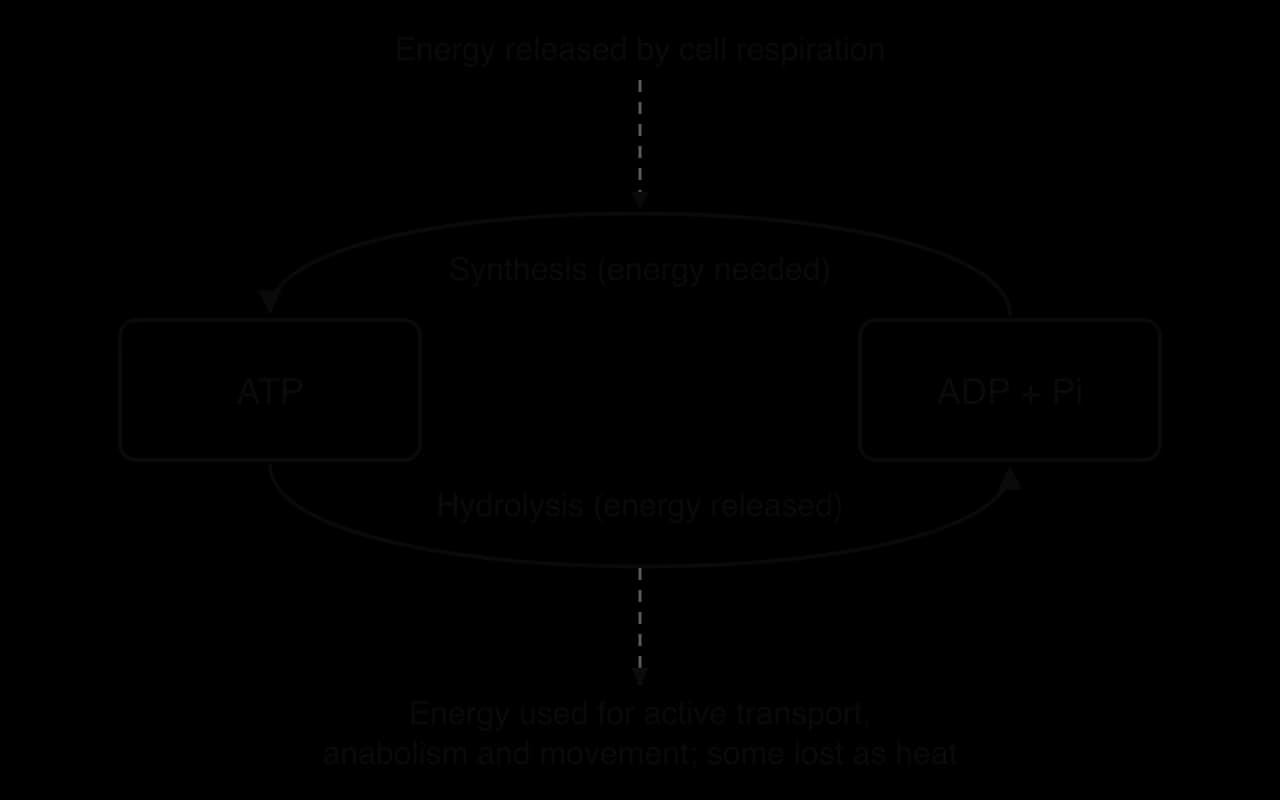
No energy transfer is 100% efficient. Some energy is lost as heat both when ATP is made and when it is used. In mammals and birds this heat helps to maintain a high, constant body temperature. All the energy released by respiration in an ecosystem is eventually lost as heat, which is why energy flows through ecosystems instead of cycling (C4.2 Transfers of energy and matter).
The turnover of ATP is very fast. An adult human contains only a few tens of grams of ATP at any moment, yet hydrolyses and remakes roughly their own body mass of ATP every day. If ATP synthesis stopped, the supply in a cell would run out within seconds, which is why poisons that block respiration act so quickly.
Cell respiration happens in every living cell, all the time, in plants as well as in animals. It is a catabolic pathway: large organic molecules are broken down into smaller ones, and the energy released is used to make ATP from ADP and phosphate. Because the energy is released in many small steps, each catalysed by a different enzyme, much of it can be captured in ATP instead of being lost as heat all at once, as it would be if the glucose were burned.
Any organic compound that is broken down in respiration to release energy is called a respiratory substrate. The principal substrates are glucose and fatty acids.
Glucose comes from the digestion of starch and other carbohydrates, or from the breakdown of glycogen stored in liver and muscle. Brain cells and red blood cells depend almost entirely on glucose.
Fatty acids come from triglycerides stored in adipose tissue. Heart muscle and resting skeletal muscle respire mainly fatty acids.
Amino acids can also be respired after the amino group has been removed (deamination in the liver). This happens when the diet has more protein than the body needs, or during starvation when muscle proteins are broken down.
Plants respire the sugars they make in photosynthesis, and many seeds store oils that are respired when the seed germinates. Other organic compounds, such as ethanol and lactate, can also be used by some cells.
In everyday language "respiration" often means breathing, so the two ideas are easily mixed up. Cell respiration is a chemical process inside cells that releases energy. Gas exchange is the diffusion of oxygen and carbon dioxide across a surface, such as the alveoli of the lungs or the spongy mesophyll of a leaf. Ventilation (breathing) moves air into and out of the lungs to keep the gas concentration gradients steep.
Feature | Cell respiration | Gas exchange |
|---|---|---|
What it is | A series of chemical reactions that release energy from organic compounds | Diffusion of O₂ and CO₂ between an organism and its environment |
Where it happens | Inside every living cell (cytoplasm and mitochondria) | At a gas exchange surface: alveoli, gills, leaf mesophyll |
Type of process | Chemical (enzyme-catalysed) | Physical (diffusion) |
Product of interest | ATP | A supply of O₂ to the blood or cells and removal of CO₂ |
The two processes are linked. Aerobic cell respiration uses oxygen and produces carbon dioxide, and gas exchange keeps supplying the oxygen and removing the carbon dioxide (B3.1 Gas exchange). A plant leaf carries out cell respiration all the time but in daylight exchanges gases mainly for photosynthesis.
Human cells can release energy from glucose in two ways, depending on whether oxygen is available.
In aerobic respiration glucose is broken down completely. The first stage takes place in the cytoplasm and the later stages in the mitochondria. Each glucose molecule yields a large amount of ATP, about 30 molecules.
The balanced chemical equation shows the numbers of molecules involved:
Anaerobic respiration breaks glucose down only partly, in the cytoplasm, and yields just 2 ATP per glucose. The product in humans is lactate, a three-carbon compound that still contains most of the chemical energy of the original glucose, and no carbon dioxide is produced.
Feature | Aerobic respiration | Anaerobic respiration (humans) |
|---|---|---|
Substrate | Glucose, fatty acids, amino acids | Glucose only |
Oxygen needed | Yes | No |
Yield of ATP per glucose | Large (about 30) | Small (2) |
Waste products | Carbon dioxide and water | Lactate |
Where in the cell | Cytoplasm, then mitochondria | Cytoplasm only |
Mitochondria needed | Yes | No |
Mitochondria are needed only for aerobic respiration. Red blood cells, which have no mitochondria, therefore respire anaerobically all the time, even though they carry oxygen.
Anaerobic respiration is useful when the demand for ATP is greater than aerobic respiration can supply. During a 400 m race the leg muscles need ATP faster than the heart and lungs can deliver oxygen to them, so part of the ATP comes from anaerobic respiration and lactate builds up in the muscles and blood. Anaerobic respiration can supply ATP quickly for a short time, but lactate accumulation contributes to fatigue, so it cannot be sustained.
After intense exercise, breathing rate and heart rate stay high for a while. The extra oxygen is used to respire some of the lactate aerobically and to convert the rest back to glucose in the liver. This extra oxygen used after exercise is sometimes called the oxygen debt.
The Amoeba Sisters animation gives an overview of both pathways and of where ATP is made in the cell.
 YouTube
The rate of cell respiration is the amount of substrate used, or product formed, per unit time. Because respiration is a series of enzyme-catalysed reactions, any factor that affects enzyme activity affects the rate. The demand for ATP also matters: an active cell respires faster than a resting one.
Temperature. Rate rises with temperature up to an optimum, because molecules collide more often and with more energy. Above the optimum the enzymes of respiration start to denature and the rate falls. In organisms that do not control their body temperature, such as invertebrates, germinating seeds and yeast, the rate depends strongly on the temperature of the surroundings.
Substrate availability. Yeast respires faster when more glucose is available, until the enzymes are working at their maximum rate. Different sugars give different rates: yeast respires glucose and sucrose quickly but cannot use lactose.
Oxygen concentration. Aerobic respiration slows when oxygen is scarce. Many cells then switch partly or completely to anaerobic respiration.
Activity and type of organism or tissue. Germinating seeds respire much faster than dry seeds; a flying insect respires faster than a resting one; small mammals respire faster per gram than large ones.
pH. Extreme pH changes enzyme shape and lowers the rate.
The temperature graph shows the typical shape for yeast or another organism that does not control its body temperature. The exact optimum differs between species: enzymes of organisms that live in hot springs have much higher optima than those of organisms from cold seas.
A simple respirometer contains small organisms, such as germinating seeds, woodlice or maggots, in a sealed tube. An alkali such as soda lime or potassium hydroxide solution absorbs the carbon dioxide they release. As the organisms use oxygen in aerobic respiration, the volume of gas in the tube falls, and a drop of coloured liquid in an attached capillary tube moves towards the organisms. The distance moved in a given time is proportional to the volume of oxygen used.
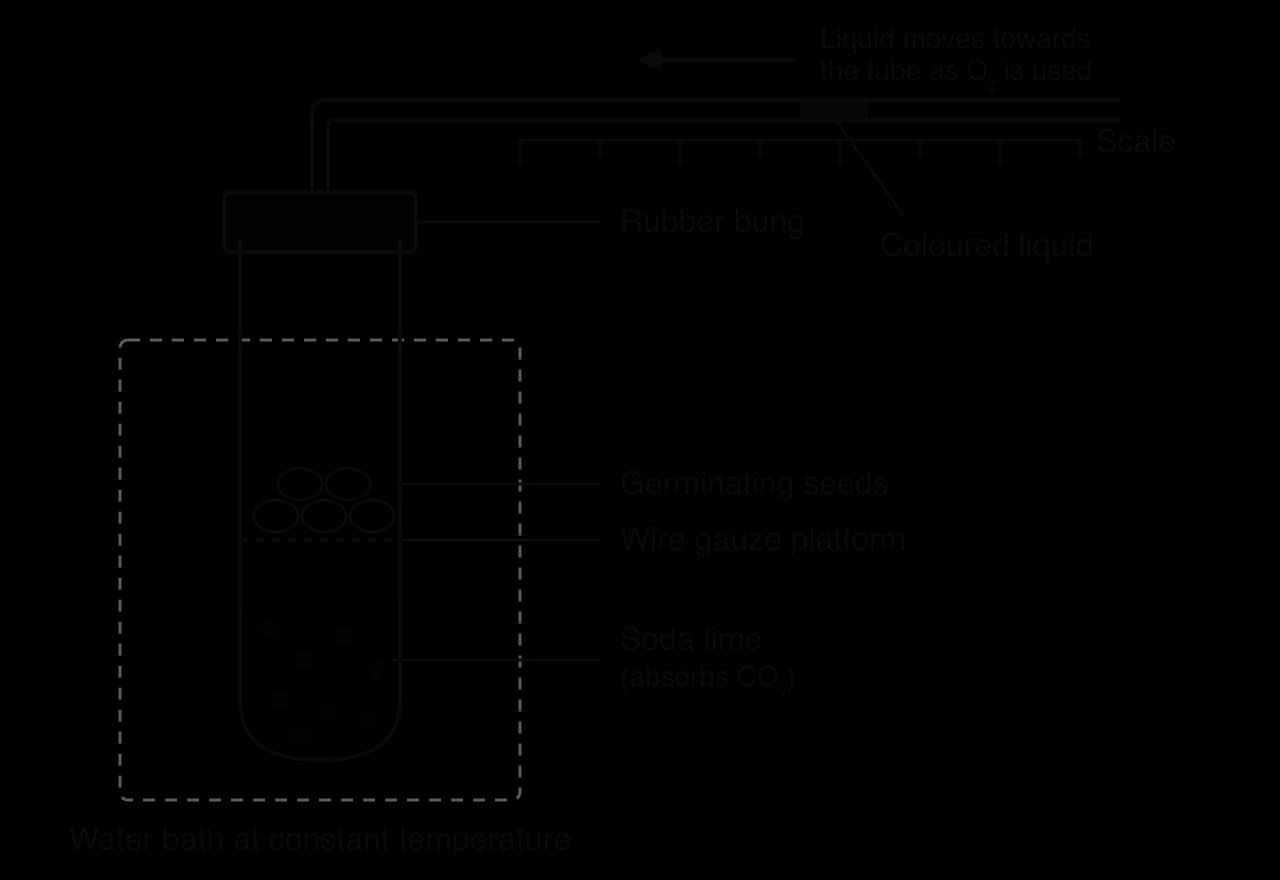
Several features of the apparatus control variables or improve the validity of the results:
Water bath. Gas volume changes with temperature, and temperature also affects the rate of respiration. The tube is kept in a water bath at constant temperature, and the apparatus is left to equilibrate for a few minutes before readings start.
Control tube. A second, identical tube contains glass beads of the same volume as the organisms, or boiled (dead) seeds. Any movement of the liquid in this tube is caused by changes in temperature or air pressure, and is subtracted from the reading of the experimental tube. A control used in this way is called a thermobarometer.
Gauze platform. The organisms must not touch the soda lime, which is caustic.
Same mass of organisms. The rate is expressed per gram of organism so that different tubes can be compared.
Respiration can also be measured with data loggers. A CO₂ sensor in a sealed chamber measures the rise in carbon dioxide concentration, and an O₂ sensor measures the fall in oxygen concentration. For yeast, the rate is often estimated by counting bubbles of CO₂ released from a fermenting sugar solution, or by measuring the volume of gas collected in a syringe or an inverted measuring cylinder.
An investigation into the effect of temperature on the respiration of germinating peas is a typical design. The independent variable is temperature, set with water baths at, for example, 10, 15, 20, 25 and 30 °C. The dependent variable is the rate of respiration, measured as the volume of oxygen taken up per minute per gram of peas. Controlled variables include the mass and species of peas, their stage of germination, the volume and type of alkali, the diameter of the capillary tube and the time allowed for equilibration. Repeating each temperature at least three times allows a mean to be calculated and anomalous results to be spotted.
The same calculation applies to secondary data. When a table gives the position of the liquid at regular times, the rate is the gradient of a graph of volume (or distance) against time. A straight line means a constant rate; a curve that levels off shows that the rate is falling, perhaps because the oxygen in the tube is running low.
Respiration releases energy from food in two forms: energy captured in ATP and energy lost as heat. Normally, as much as possible goes into ATP. The compound 2,4-dinitrophenol (DNP) shows what happens when this coupling is broken.
In the early 1930s researchers at Stanford University found that people taking small doses of DNP had a much higher metabolic rate and lost weight quickly. From 1933 DNP was promoted and sold as a slimming drug. Inside cells, DNP allows the energy released by the oxidation of food to escape as heat instead of being used to make ATP. Cells respond to the shortage of ATP by respiring more glucose and fat, so body fat is used up faster, and body temperature rises.
The effects were severe. Users developed cataracts, rashes and dangerously high body temperatures, and some died. The 1938 US Federal Food, Drug, and Cosmetic Act gave the authorities the power to act, and DNP was declared "extremely dangerous and not fit for human consumption". It is still sold illegally, often online as a bodybuilding or slimming product. The table of recorded deaths shows that DNP poisoning did not end with the 1930s.
Measure | Value |
|---|---|
Deaths attributed to DNP in the published medical literature, up to 2011 | 62 |
Of those, deaths in 2001–2010 | 12 |
Cases reported to the UK National Poisons Information Service, 2018 | 20 |
Deaths among those UK cases, 2018 | 6 |
Sources: Grundlingh et al., Journal of Medical Toxicology, 2011; UK National Poisons Information Service data for 2018, reported by Food Standards Scotland, 2019.
There is no safe dose of DNP, because the amount that causes harmful overheating differs greatly between people and the drug has no antidote. Deaths are usually caused by uncontrolled overheating (hyperthermia) and the failure of organs whose cells can no longer make enough ATP, even though they are respiring faster than normal.
A natural version of the same effect exists. In brown adipose tissue, found in newborn babies and hibernating mammals, mitochondria contain a protein that makes them release much of the energy from respiration as heat instead of using it to make ATP. This uncoupled respiration generates heat in a controlled way and helps to keep the body warm (D3.3 Homeostasis).
Energy is released from glucose by removing its hydrogen atoms, step by step, and eventually combining them with oxygen. Each removal of hydrogen is an oxidation, and the molecule that accepts the hydrogen is reduced.
Oxidation and reduction always happen together. Reduction is the gain of electrons, often by the addition of hydrogen or the removal of oxygen. When one substance loses electrons, another must gain them, so the two halves form a redox reaction. In respiration most oxidations are dehydrogenations: enzymes called dehydrogenases remove two hydrogen atoms (two protons and two electrons) from a substrate.
Oxidation | Reduction | |
|---|---|---|
Electrons | Lost | Gained |
Hydrogen | Lost | Gained |
Oxygen | Gained | Lost |
Energy of the molecule | Decreases (energy released) | Increases (energy stored) |
NAD (nicotinamide adenine dinucleotide) is a coenzyme made from two nucleotides. It accepts the hydrogen removed from substrates during glycolysis, the link reaction and the Krebs cycle, and carries it to the electron transport chain. When NAD accepts two electrons and one proton from a substrate, it becomes reduced NAD; the second proton from the pair of hydrogen atoms is released into solution.
In biology this is usually written more simply as NAD + 2H → reduced NAD. Reduced NAD carries both the electrons and the energy released by oxidising the substrate. When it later passes the electrons on, it is oxidised back to NAD and can be reused. A cell contains only a small amount of NAD, so it has to be regenerated continuously; this is the reason for the extra reactions of anaerobic respiration.
FAD (flavin adenine dinucleotide) is a second hydrogen carrier. It accepts two hydrogen atoms in one step of the Krebs cycle and becomes reduced FAD (FADH₂).
In glycolysis (from the Greek for "splitting sugar"), one molecule of glucose (6C) is converted into two molecules of pyruvate (3C). It takes place in the cytoplasm and does not need oxygen. Glycolysis is a metabolic pathway of ten small steps, each catalysed by a different enzyme. These are grouped into four stages, and most of the intermediates between them are left unnamed here.
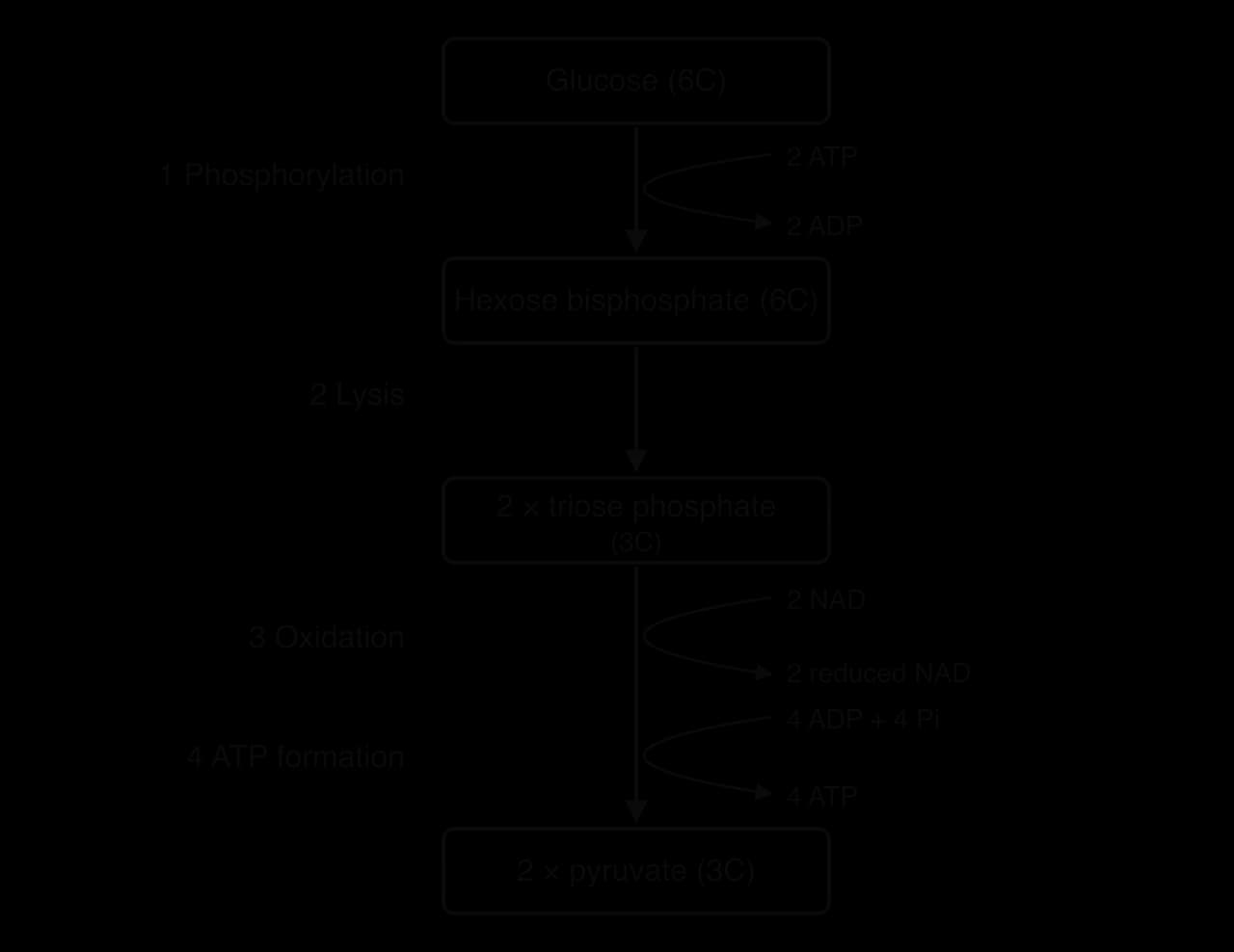
Phosphorylation. Two phosphate groups from two ATP molecules are added to glucose, forming hexose bisphosphate. Phosphorylation makes the sugar less stable and more reactive, so it can be split, and also traps it in the cell, because the charged phosphate groups cannot cross the plasma membrane.
Lysis. Hexose bisphosphate (6C) is split into two molecules of triose phosphate (3C), each carrying one phosphate group.
Oxidation. Hydrogen is removed from each triose phosphate. The hydrogen is accepted by NAD, so two NAD are reduced per glucose. Energy released by this oxidation is used to add a further inorganic phosphate to each 3C molecule.
ATP formation. The phosphate groups are transferred from the 3C intermediates to ADP, forming 4 ATP per glucose (2 per triose phosphate) and leaving pyruvate as the final product.
Glycolysis happens in almost every living organism, which suggests that it evolved very early, before the atmosphere contained much oxygen and before mitochondria existed. It is a clear example of unity at the molecular level: the same pathway, with very similar enzymes, runs in bacteria, yeast and human cells.
Glycolysis needs a constant supply of NAD to accept hydrogen in the oxidation step. When oxygen is not available, the electron transport chain cannot accept hydrogen from reduced NAD, so reduced NAD accumulates and NAD runs out. Glycolysis would then stop, and no more ATP could be made.
In human muscle, pyruvate solves this problem by accepting the hydrogen from reduced NAD. Pyruvate is reduced to lactate and NAD is regenerated, so glycolysis can continue. The conversion of pyruvate to lactate releases no ATP; its only purpose is to regenerate NAD. The net yield of anaerobic respiration is therefore the 2 ATP made in glycolysis.
The reaction is reversible. When oxygen becomes available again, lactate is converted back to pyruvate and respired aerobically, or carried to the liver and converted to glucose.
Yeast (Saccharomyces cerevisiae) is a single-celled fungus that respires aerobically when oxygen is available and anaerobically when it is not. The pathway is the same as in humans except for the step that regenerates NAD. Pyruvate is first decarboxylated (CO₂ is removed) to form ethanal, which is then reduced by reduced NAD to ethanol, regenerating NAD so that glycolysis continues.
The two pathways are compared in the diagram of anaerobic respiration. In both, the hydrogen removed in glycolysis is passed on to an organic molecule made from pyruvate, so NAD cycles between its two forms.
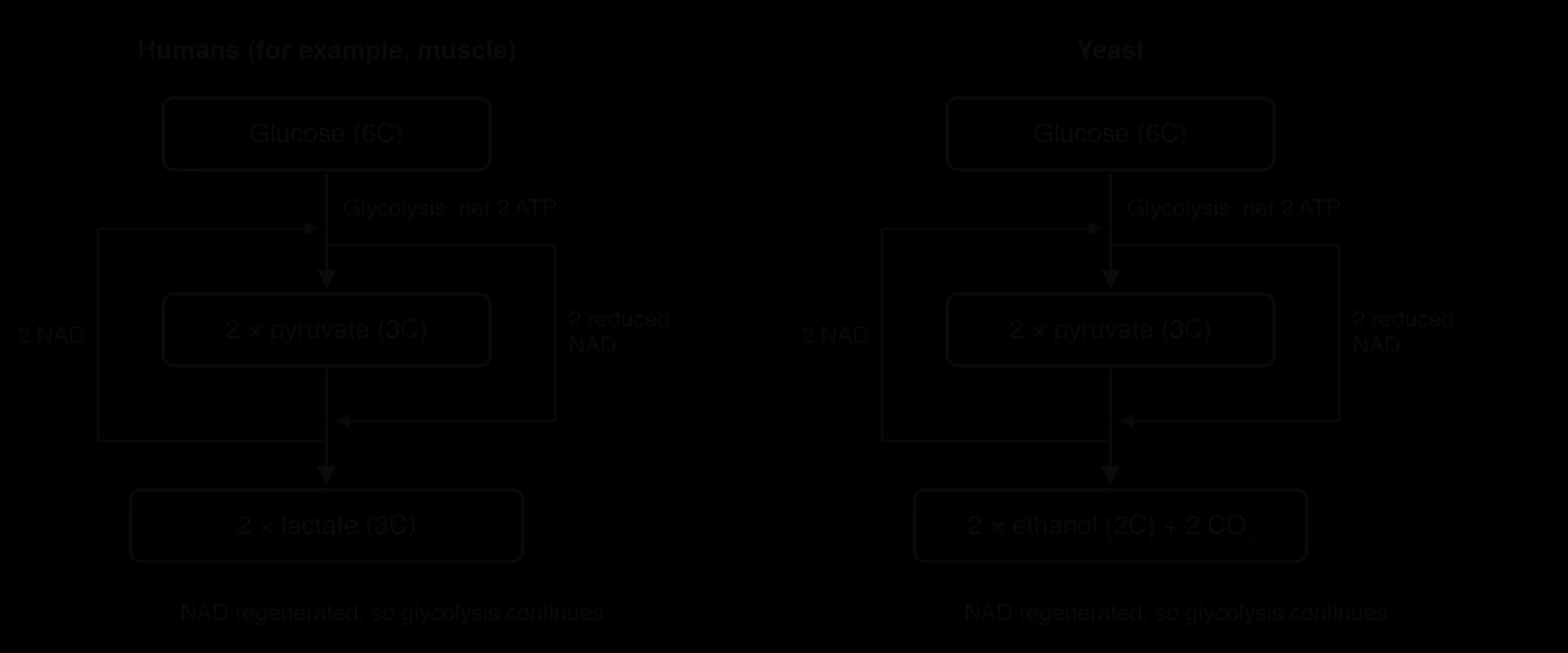
Humans have used anaerobic respiration in yeast for thousands of years. In each case one product is wanted and the other is a by-product.
Brewing. Yeast is added to a sugary liquid, such as malted barley for beer or grape juice for wine, in a container that excludes air. The yeast respires the sugars anaerobically, and the useful product is ethanol. The CO₂ escapes, or is kept in the bottle to make the drink sparkling. Ethanol is toxic to the yeast itself, so fermentation slows and stops once the ethanol concentration is high enough. This limits the strength of fermented drinks, and stronger drinks such as spirits are made by distillation.
Baking. Yeast is mixed into bread dough with flour, water and a little sugar. Enzymes in the flour digest starch to sugars, which the yeast respires. The useful product is CO₂: bubbles of gas trapped in the dough make it rise. In the oven the heat expands the bubbles further, kills the yeast and evaporates the ethanol.
When oxygen is available, pyruvate is transported from the cytoplasm into the mitochondrial matrix. The stages of aerobic respiration and their locations in the cell are summarised in the diagram of the stages of respiration.
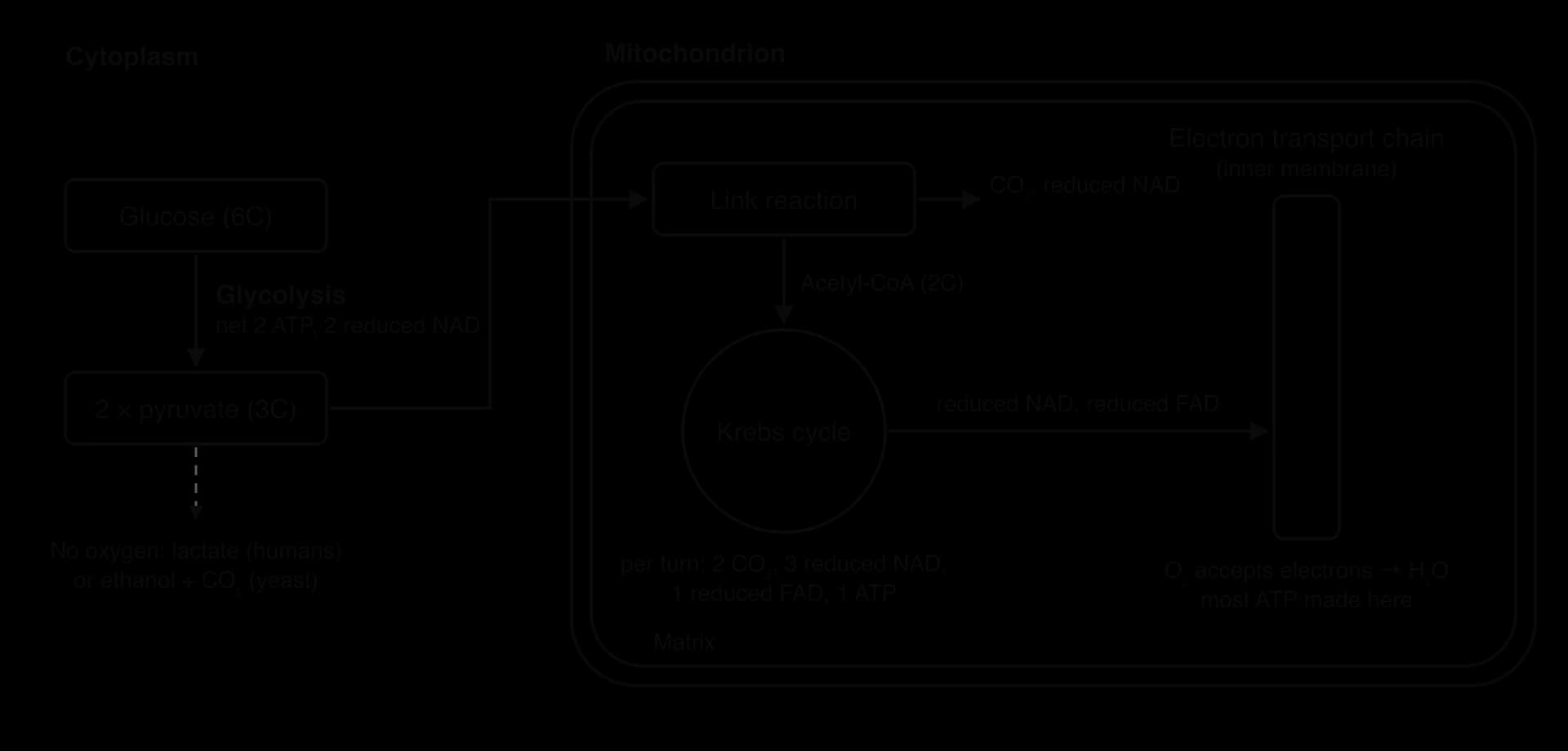
The link reaction connects glycolysis with the Krebs cycle. Each pyruvate (3C) undergoes two changes, catalysed by one large enzyme complex:
Decarboxylation: a carboxyl group is removed and released as CO₂, leaving a two-carbon acetyl group.
Oxidation: hydrogen is removed and accepted by NAD, which becomes reduced NAD.
The acetyl group is then attached to coenzyme A (CoA), a carrier molecule, forming acetyl-CoA. CoA carries the acetyl group into the Krebs cycle and is then released to be used again. Since each glucose gives two pyruvates, the link reaction happens twice per glucose, giving 2 CO₂ and 2 reduced NAD.
Acetyl-CoA is a meeting point of metabolism. Fatty acids from lipids are broken down in the matrix, two carbons at a time, into acetyl groups that are also carried by CoA. Carbohydrates and lipids therefore feed into the same Krebs cycle as acetyl-CoA, and so do some amino acids.
The Krebs cycle is a cyclical pathway in the matrix that completely oxidises the acetyl group. Of its many intermediates, two are named here: citrate (6C) and oxaloacetate (4C).
The acetyl group (2C) from acetyl-CoA combines with oxaloacetate (4C) to form citrate (6C). CoA is released.
Citrate is decarboxylated and oxidised to a 5C compound: one CO₂ is released and one NAD is reduced.
The 5C compound is decarboxylated and oxidised to a 4C compound: a second CO₂ is released and a second NAD is reduced.
The 4C compound is converted back to oxaloacetate in a series of reactions that make one ATP (by substrate-level phosphorylation), reduce one FAD and reduce a third NAD.
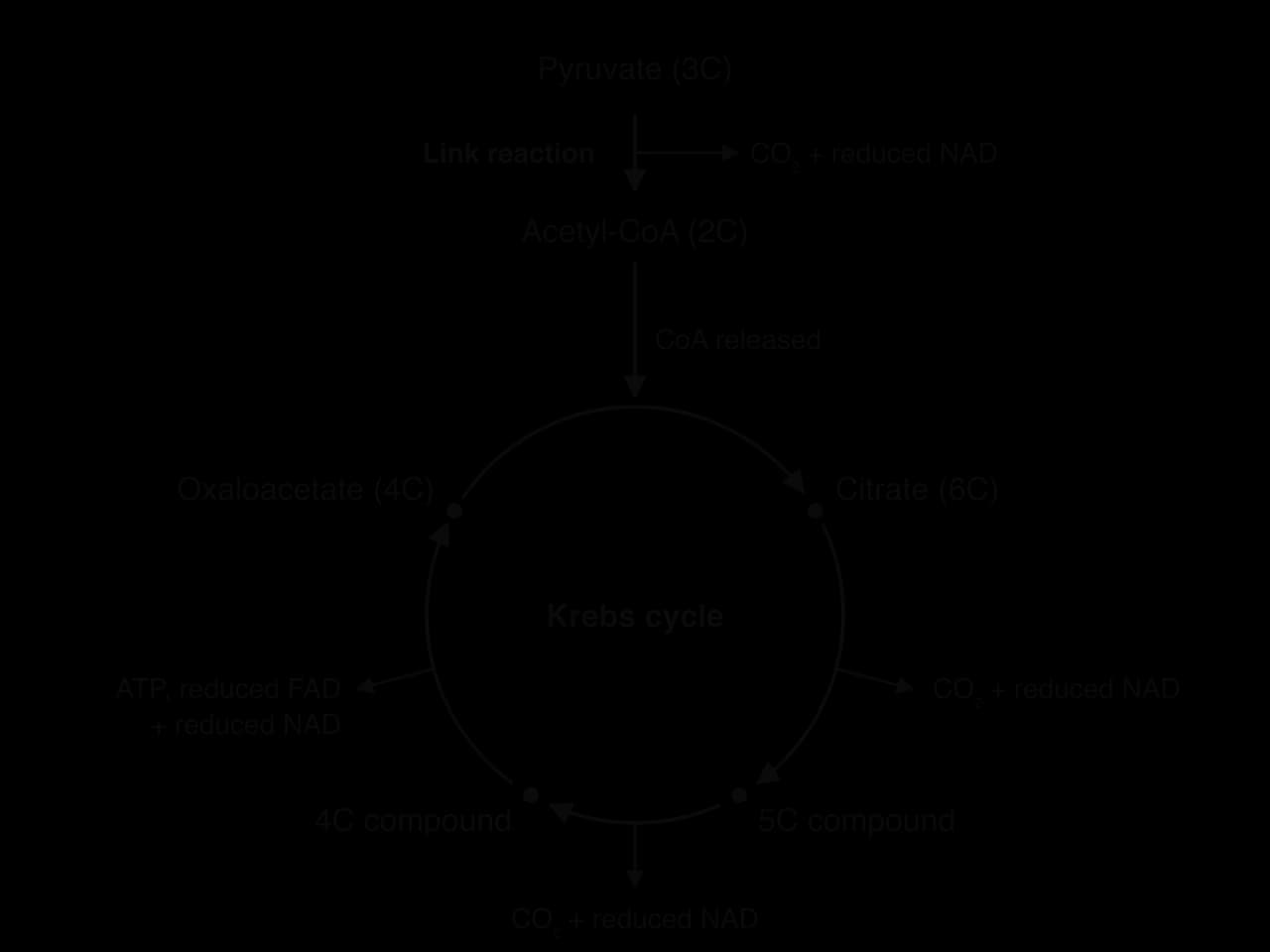
In each turn there are therefore two decarboxylations (2 CO₂) and four oxidations (3 reduced NAD and 1 reduced FAD), and one ATP is produced. Because one glucose gives two acetyl groups, the cycle turns twice per glucose. The two carbons that enter as an acetyl group leave as two CO₂, so all six carbon atoms of glucose are released as CO₂ in the link reaction and Krebs cycle combined.
Stage (per glucose) | Location | CO₂ | Reduced NAD | Reduced FAD | ATP made directly |
|---|---|---|---|---|---|
Glycolysis | Cytoplasm | 0 | 2 | 0 | 2 (net) |
Link reaction (×2) | Matrix | 2 | 2 | 0 | 0 |
Krebs cycle (×2) | Matrix | 4 | 6 | 2 | 2 |
Total | 6 | 10 | 2 | 4 |
Only four ATP are made directly by the end of the Krebs cycle. Most of the energy of the glucose is now held by the 10 reduced NAD and 2 reduced FAD, and is released in the final stage.
The electron transport chain is a series of electron carrier proteins embedded in the inner mitochondrial membrane. The inner membrane is folded into cristae (crista in the singular), which greatly increase the area available for these proteins. Reduced NAD from glycolysis, the link reaction and the Krebs cycle passes a pair of electrons (and their energy) to the first carrier in the chain. In doing so it is oxidised back to NAD, which returns to accept more hydrogen. Reduced FAD donates its electrons at a later point in the chain, so its electrons pass fewer carriers.
The electrons pass from one carrier to the next in a series of redox reactions. Each carrier is reduced when it accepts electrons and oxidised when it passes them on. At each transfer the electrons move to a lower energy level, and the energy released is used to do work.
Three of the carrier complexes use the energy released by electron flow to pump protons (H⁺) from the matrix across the inner membrane into the intermembrane space. The inner membrane is impermeable to protons except through specific channels, so protons accumulate in the narrow intermembrane space. This creates a proton gradient: a higher concentration of H⁺ (and a lower pH) in the intermembrane space than in the matrix. The gradient is a store of potential energy, in the same way that water behind a dam stores energy.

Protons can return to the matrix only through ATP synthase, a large enzyme that spans the inner membrane. As protons diffuse down their concentration gradient through a channel in ATP synthase, they cause part of the enzyme to rotate. The rotation changes the shape of the active sites in the head of the enzyme, which faces the matrix, and this drives the phosphorylation of ADP to ATP.
Chemiosmosis links the energy of electron transport to ATP synthesis. The overall process, in which ATP is made using energy released by the oxidation of reduced NAD and reduced FAD, is called oxidative phosphorylation. It produces most of the ATP made in aerobic respiration.
The HHMI animation shows ATP synthase turning as protons flow through it, and how each turn produces ATP.
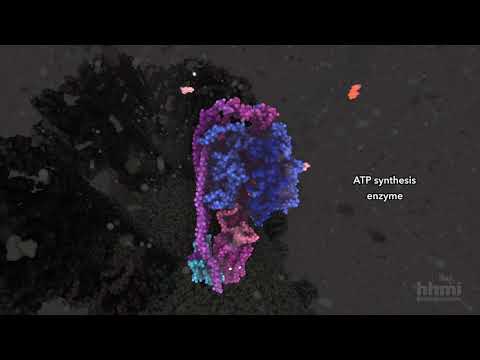 YouTube
At the end of the chain, the electrons are passed to oxygen. Oxygen is the terminal electron acceptor: it accepts electrons from the last carrier and combines with protons from the matrix to form water.
Oxygen has two roles, and the water it forms is called metabolic water. First, by removing electrons from the last carrier, it keeps electrons flowing along the chain, so the carriers can keep accepting electrons from reduced NAD. Second, by using protons from the matrix, it helps to maintain the proton gradient.
Without oxygen, the last carrier stays reduced and cannot accept more electrons, so the whole chain backs up and stops. Reduced NAD can no longer be oxidised, NAD is not regenerated, and the link reaction and Krebs cycle stop too, because both need NAD. Only glycolysis can continue, with anaerobic respiration regenerating its NAD. Cyanide has the same effect: it binds to cytochrome c oxidase, the final carrier that passes electrons to oxygen, so the chain stops even when oxygen is present. Cells that depend on aerobic respiration, such as heart muscle and neurones, fail within minutes.
Each reduced NAD that donates electrons to the chain causes enough protons to be pumped for about 2.5 ATP; each reduced FAD, which enters later, gives about 1.5 ATP. Adding these to the 4 ATP made directly gives a total of about 30–32 ATP per glucose. Older textbooks give 36–38, a figure calculated before measurements showed that some of the proton gradient is also used to transport ADP, phosphate and pyruvate into the matrix. Anaerobic respiration gives only 2 ATP per glucose, so aerobic respiration releases about 15 times as much usable energy from each glucose molecule.
Lipids and carbohydrates are both respired to release energy, but they differ in how much energy they yield and in which stages of respiration they use.
Feature | Carbohydrates (e.g. glucose) | Lipids (triglycerides) |
|---|---|---|
Energy released per gram | About 17 kJ g⁻¹ | About 37 kJ g⁻¹ |
Proportion of oxygen in the molecule | High (C₆H₁₂O₆: one O per C) | Low (fatty acids are mostly C and H) |
Entry into respiration | Glycolysis, then the link reaction | Fatty acids broken into 2C acetyl groups that enter the Krebs cycle as acetyl-CoA; glycerol enters glycolysis |
Can be respired anaerobically | Yes (glycolysis) | No (fatty acids do not pass through glycolysis) |
Speed of mobilisation | Fast | Slower |
Energy values are the standard figures used for food labelling.
Lipids yield more than twice as much energy per gram because their molecules contain less oxygen and relatively more hydrogen and carbon. Glucose is already partly oxidised; a fatty acid is almost completely reduced. More oxidation can therefore happen per gram of lipid, and more hydrogen is passed by NAD and FAD to the electron transport chain. This is why lipids are the main long-term energy store in animals: the same energy can be stored in less than half the mass.
Lipids cannot be respired anaerobically. Fatty acids are broken down only into acetyl groups, which can be oxidised only in the Krebs cycle and therefore only when oxygen is present. Glycolysis and anaerobic respiration happen only when carbohydrate (or glycerol) is the substrate. During a sprint, muscle depends on glucose and glycogen, while during a long, steady run it respires a higher proportion of fat.
Cell respiration is assessed in every part of the papers. Paper 1A multiple-choice questions test the products, locations and yields of each stage. Paper 1B data questions are often based on respirometer or CO₂-sensor experiments and ask for rates, variables and evaluation of the method. Paper 2 short-answer questions ask for comparisons of aerobic and anaerobic respiration, and at HL the extended-response questions often ask candidates to explain chemiosmosis or outline the stages of aerobic respiration. The command terms that appear most are state, outline, compare, calculate, explain and suggest.
Data questions on yeast often give results for different sugars or temperatures and ask candidates to suggest reasons for differences. Link each suggestion to enzymes (specificity for the sugar, kinetic energy, denaturation) or to the availability of oxygen.
I can describe the structure of ATP and explain why it is suitable as the energy currency of the cell.
I can outline three processes in cells that use energy from ATP, with examples.
I can describe the energy transfers when ATP is hydrolysed and when it is synthesised.
I can distinguish between cell respiration, gas exchange and ventilation.
I can compare aerobic and anaerobic respiration in humans and write their word equations.
I can describe how a respirometer works and calculate a rate of respiration from data.
I can explain oxidation, reduction and the role of NAD as a hydrogen carrier. (HL)
I can outline glycolysis, the link reaction and the Krebs cycle, giving their locations and yields. (HL)
I can explain why pyruvate is converted to lactate or to ethanol and CO₂, and how yeast is used in brewing and baking. (HL)
I can explain how the electron transport chain, the proton gradient and ATP synthase produce ATP by chemiosmosis. (HL)
I can explain the role of oxygen as the terminal electron acceptor. (HL)
I can compare lipids and carbohydrates as respiratory substrates. (HL)
[7 max]
For full marks answers must address both how heat is produced and how it is used.
Distinguish between linear and cyclical pathways in metabolism, using named examples.
4 marks
a. in a linear pathway the initial substrate is converted through a series of steps to an end product that differs from the starting molecule;
b. example of a linear pathway: glycolysis (glucose to pyruvate);
c. in a cyclical pathway the molecule that accepts the incoming substrate is regenerated by the pathway;
d. example: Krebs cycle, in which oxaloacetate is regenerated;
e. example: Calvin cycle, in which RuBP is regenerated;
f. cyclical pathways can turn repeatedly as long as substrate is supplied / need only a small amount of the regenerated intermediate;
[4 max]
Award [2] max if no named examples are given.
One additional mark is available for the construction of the answer.
Animals use energy released by cell respiration to move.
Explain how ATP is produced by chemiosmosis in mitochondria.
7 marks
Describe how antagonistic muscles move the ribcage during ventilation of the lungs.
4 marks
Suggest reasons why some animals undertake long-distance migrations despite the large amounts of energy used.
4 marks
Organisms are adapted to the ecological niches that they occupy.
Explain how natural selection could lead to adaptations in prey species that help them to resist predation.
7 marks
Outline the differences between obligate anaerobes, facultative anaerobes and obligate aerobes, with reference to cell respiration.
4 marks
Outline photosynthesis as a mode of nutrition, including the groups of organisms that use it.
4 marks