Explain how energy flows through ecosystems and is lost as heat, construct food webs and energy pyramids, and draw the carbon cycle and analyse the Keeling Curve.
Each is in the Biology glossary, with every other term in the subject.
An organism that uses an external energy source to synthesise its carbon compounds from simple inorganic substances such as carbon dioxide and water.
The total mass of organic matter in organisms, usually given as dry mass (or mass of carbon) per unit area.
The continuous movement of carbon atoms between the atmosphere, oceans, living organisms, dead organic matter and fossil stores by photosynthesis, feeding, respiration, decomposition, diffusion and combustion.
The rate of transfer of carbon from one carbon pool to another, such as by photosynthesis or respiration, measured as mass of carbon per unit time.
A reservoir in which carbon is held, such as the atmosphere, the oceans, living organisms, soils, peat or fossil fuels.
A pool or ecosystem that absorbs more carbon dioxide than it releases, so that carbon accumulates in it, because photosynthesis exceeds respiration (and combustion).
A pool or ecosystem that releases more carbon dioxide than it absorbs, because respiration and combustion exceed photosynthesis.
An autotroph that obtains the energy it needs to make carbon compounds from oxidation reactions involving inorganic substances, such as the oxidation of iron(II) ions or hydrogen sulfide.
Every ecosystem depends on two kinds of transfer: a one-way flow of energy, which enters as light and leaves as heat, and the cycling of matter, in which the same atoms are used again and again. Together they explain how many organisms an ecosystem can support, why food chains are short, and how human activity is changing the carbon dioxide content of the atmosphere.
Energy and carbon pass between organisms by feeding, and between organisms and the environment by photosynthesis, respiration, decomposition and combustion, linking every level of organisation from the molecules in a cell to the global atmosphere.
43 exam-style questions on this subtopic, written in the style of the IB papers. The first has its markscheme open. Counted on
Organisms obtain energy and carbon compounds in a wide variety of ways.
Describe mixotrophic nutrition in protists, with reference to Euglena.
4 marks
a. mixotrophs can feed both autotrophically and heterotrophically;
b. Euglena has chloroplasts and photosynthesizes in the light;
c. Euglena can also obtain carbon compounds from its surroundings / by absorbing dissolved organic matter / by ingesting food;
d. so Euglena can survive / grow in the dark if organic food is available;
e. Euglena is a freshwater example;
f. many mixotrophs are found in the plankton of the oceans;
g. obligate mixotrophs need both modes of nutrition to grow;
h. facultative mixotrophs can grow using either mode alone;
i. mixotrophy is an advantage when light or food is in short supply;
[4 max]
Outline the role of saprotrophs in ecosystems.
4 marks
a. saprotrophs are heterotrophs / obtain carbon compounds from other organisms;
b. they feed on dead organic matter / dead organisms / dead parts of organisms / faeces;
c. they secrete enzymes onto the food and digest it externally;
One of 1 short multiple-choice questions on C4.2. Pick an answer to see why it's right or wrong.
Roughly how much energy passes from one trophic level to the next?
The official deck for this part of the syllabus.
State the two kinds of transfer that every ecosystem depends on.
State the four processes by which energy and carbon pass between organisms and their environment (other than feeding).
With a free account, Augment remembers where you stopped and what you have practiced.
A system that exchanges energy but not matter with its surroundings, such as a sealed mesocosm; matter inside it must be recycled.
The burning of carbon compounds in oxygen, releasing energy as heat and light and releasing carbon dioxide and water.
A heterotroph that obtains its energy and carbon compounds by feeding on other living organisms.
Dead organic matter, including faeces, dead parts of organisms such as leaves and shed skin, and the remains of whole dead organisms.
A diagram in which each trophic level is drawn as a horizontal bar whose width is proportional to the energy flowing through that level per unit area per unit time, for example in kJ m⁻² yr⁻¹.
A sequence of organisms in which each feeds on the one before it, showing the direction of transfer of energy and biomass from producers to consumers.
A network of interconnected food chains showing all the feeding relationships in a community.
A fuel such as coal, oil or natural gas formed over millions of years from the buried remains of organisms in which decomposition was incomplete.
An organism that obtains carbon compounds from other organisms and uses them to synthesise the carbon compounds it needs.
An opening in the deep sea floor that releases hot, mineral-rich water; vent communities are based on chemoautotrophic bacteria rather than sunlight.
The graph of atmospheric carbon dioxide concentration measured at Mauna Loa, Hawaii, since 1958, showing an annual fluctuation and a long-term rise.
The continuous movement of a chemical element, such as carbon, nitrogen or phosphorus, between organisms and the abiotic environment, in which decomposers release it from dead matter in inorganic forms that producers reuse.
A system that exchanges both energy and matter with its surroundings; natural ecosystems are open systems.
Partly decomposed plant matter that accumulates in waterlogged, acidic, oxygen-poor conditions where decomposition is very slow; peatlands are long-term carbon sinks.
An autotroph that uses light as its external energy source to make carbon compounds by photosynthesis, such as plants, algae and cyanobacteria.
A consumer that feeds on producers; it occupies the second trophic level.
The accumulation of carbon compounds in biomass by autotrophs, measured as mass of carbon (or dry biomass) per unit area per unit time, usually g m⁻² yr⁻¹.
An autotroph that makes carbon compounds from inorganic substances using light or chemical energy; producers form the first trophic level.
A consumer that feeds on primary consumers; it occupies the third trophic level.
The accumulation of carbon compounds in biomass by heterotrophs; it is lower than primary production because carbon compounds are lost in cell respiration at each stage.
A consumer that feeds on secondary consumers; it occupies the fourth trophic level.
The position of an organism in a food chain, defined by the number of feeding steps between it and the producers.
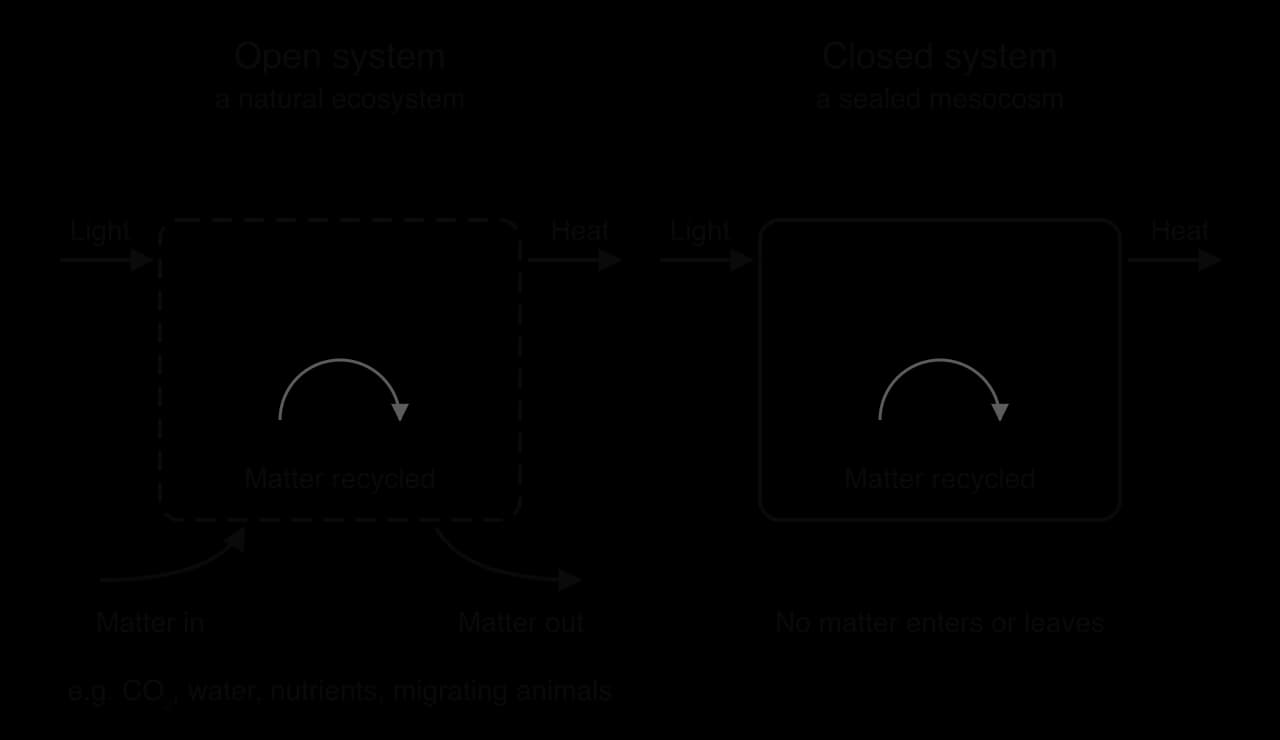
An ecosystem is a community of organisms together with its abiotic environment, interacting as a system. Like any system, an ecosystem has inputs and outputs. Energy enters most ecosystems as sunlight and leaves as heat. Matter, the atoms and molecules that organisms are built from, can also enter and leave: carbon dioxide and oxygen diffuse in and out, water flows through, mineral nutrients are washed in or leached out, and animals migrate between ecosystems.
An ecosystem is therefore an open system, in which both energy and matter can enter and exit. A closed system exchanges energy with its surroundings but not matter. Natural closed systems are almost unknown on Earth, but a sealed mesocosm, such as a sealed glass jar containing pond water, aquatic plants and small animals, comes close: light enters and heat leaves, but no matter crosses the glass.
A sealed mesocosm can survive for months or years only because the matter inside it is recycled. Plants and algae use light to make carbon compounds and release oxygen; animals and microorganisms use the carbon compounds and oxygen and release carbon dioxide and mineral nutrients, which the plants reuse. Energy, by contrast, cannot be recycled: it must keep arriving as light, because it leaves as heat.
Almost all ecosystems are sustained by energy from sunlight. Plants, algae and photosynthetic bacteria absorb light and use it in photosynthesis to make carbon compounds, and every other organism in the ecosystem depends on those compounds, directly or indirectly. Even ecosystems that receive little light, such as the floor of a dense forest or a deep lake, usually depend on organic matter made by photosynthesis elsewhere and carried in.
A few ecosystems do not depend on sunlight. In these, the producers are bacteria and archaea that obtain energy from chemical reactions instead of light.
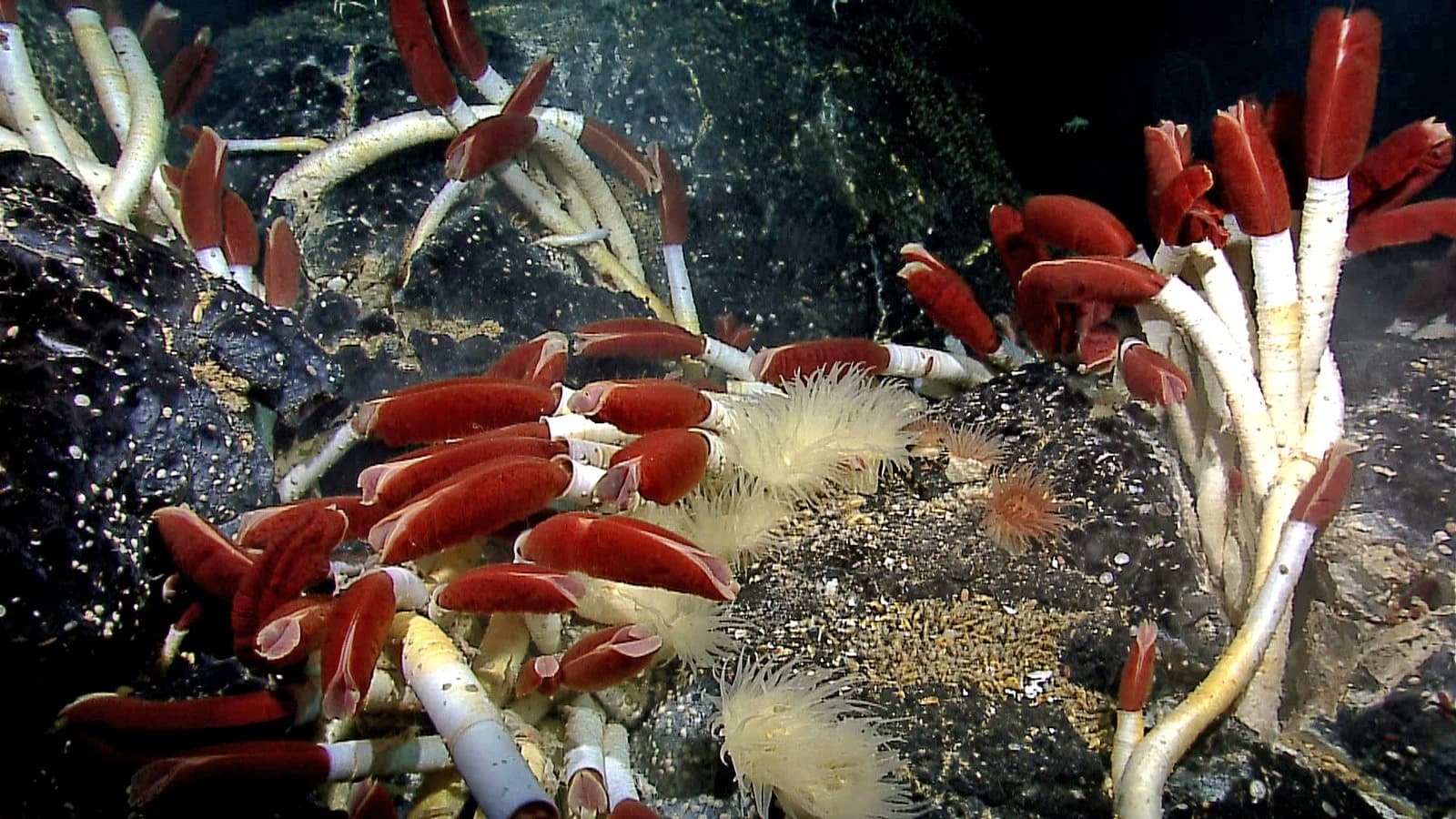
Deep-sea hydrothermal vents. Below about 1,000 m no sunlight reaches the ocean. In 1977 scientists in the submersible Alvin discovered dense communities of animals around hydrothermal vents, hot springs on the sea floor of the Galápagos Rift in the Pacific. The springs release water rich in hydrogen sulfide. Bacteria oxidise the sulfide to release energy and use it to fix carbon dioxide. The giant tubeworm (Riftia pachyptila) has no mouth or gut; it houses these bacteria inside its body and lives on the carbon compounds they make.
Caves. Movile Cave in Romania, discovered in 1986, has been sealed off from the surface for a very long time. Its air is poor in oxygen and rich in hydrogen sulfide and methane. Bacteria that oxidise these gases form the base of a food web that includes dozens of invertebrate species found nowhere else, all independent of sunlight.
The statement that "sunlight sustains ecosystems" is an example of a scientific law in the broad sense: a generalisation, or rule of thumb, that describes a pattern seen across many cases. Laws, like theories, can be used to make predictions; a biologist arriving at a new ecosystem can predict that its energy comes from photosynthesis and will almost always be right. Discoveries such as the hydrothermal vents show that laws in biology have exceptions, and that a generalisation must sometimes be qualified ("most ecosystems") when new evidence appears.
Energy enters an ecosystem when producers convert light energy into chemical energy, stored in the bonds of carbon compounds such as sugars, starch, lipids and proteins. When a consumer eats another organism, it takes in these carbon compounds and the chemical energy in them. Chemical energy therefore passes along a chain of organisms, each feeding on the one before it.
A food chain shows this sequence of feeding relationships. Each organism in the chain is food for the next. The arrows in a food chain point from the organism that is eaten to the organism that eats it, because they show the direction in which energy and biomass are transferred.
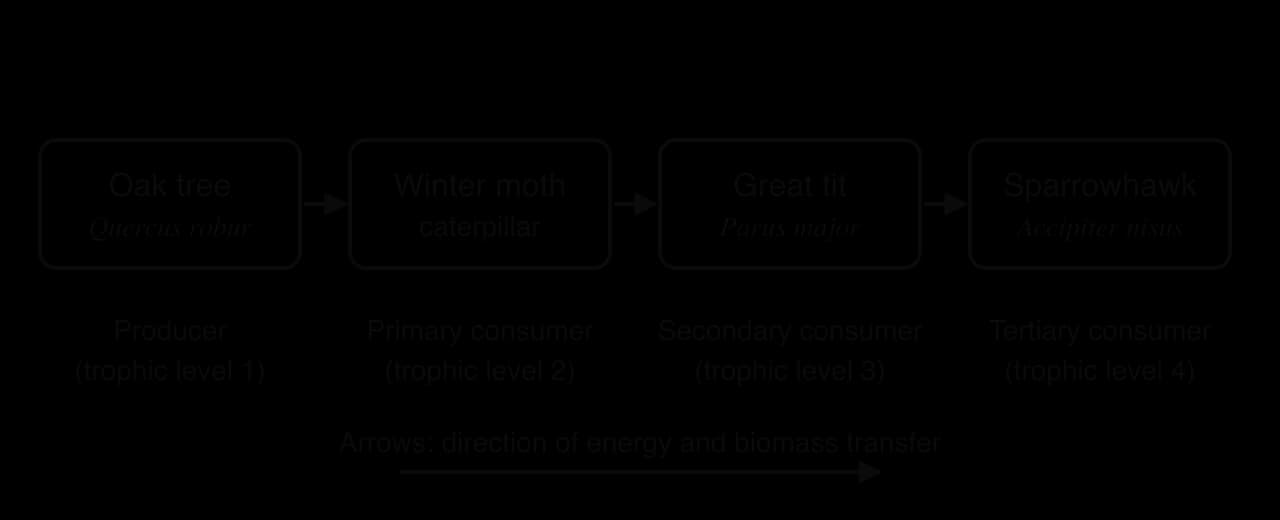
The woodland food chain in the diagram is a real one from English oak woodlands. In spring, winter moth caterpillars (Operophtera brumata) feed on newly opened oak leaves; great tits feed their nestlings mainly on these caterpillars; sparrowhawks hunt small birds, including great tits.
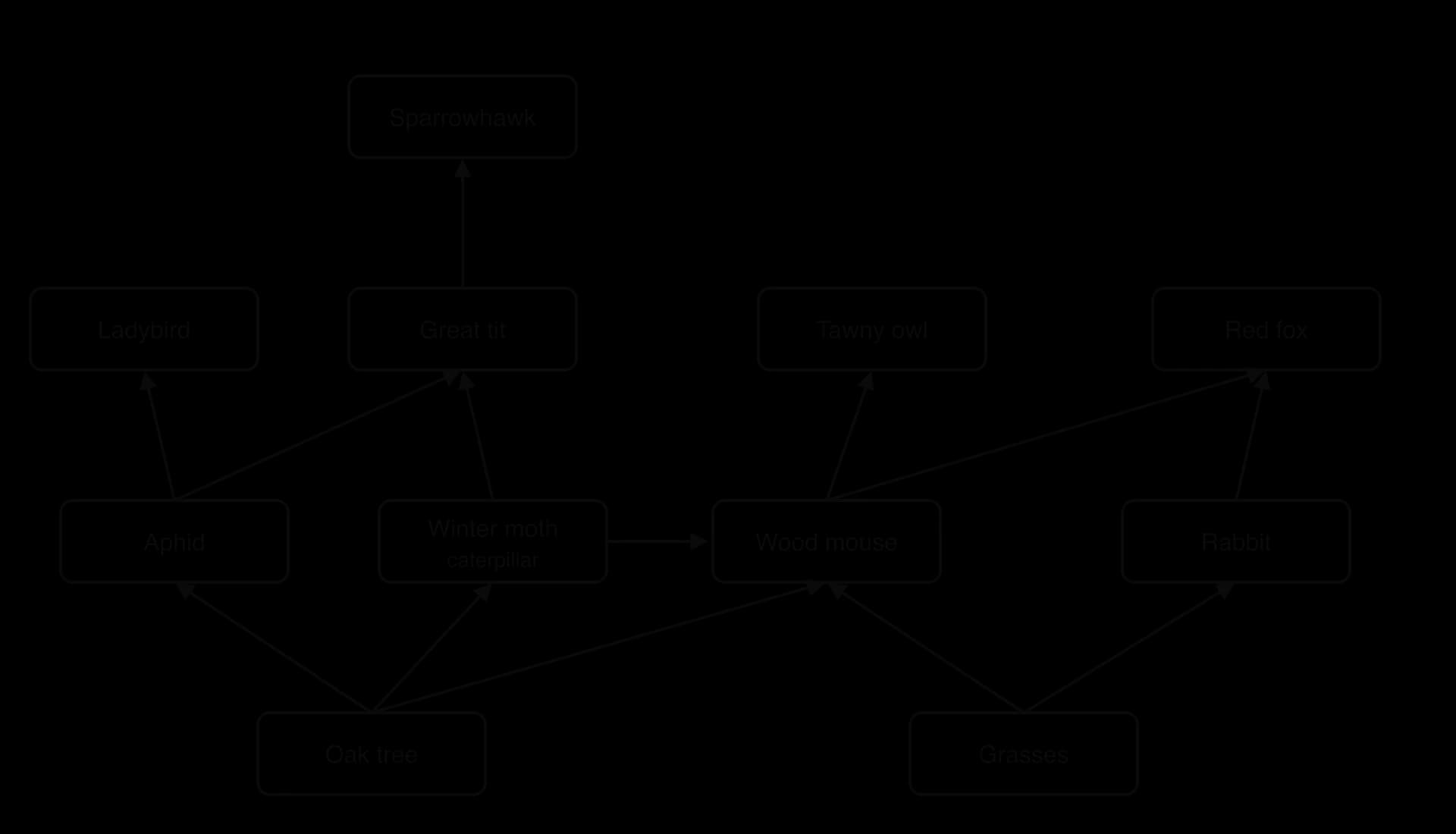
Most consumers eat more than one kind of food, and most organisms are eaten by more than one consumer. A food web shows all the feeding relationships in a community as a network of interconnected food chains. Food webs give a more realistic picture than single chains, and they show how a change in one population can affect many others.
Not all the chemical energy in an organism passes to a consumer. Much of it remains in dead organic matter: faeces, the dead parts of living organisms (fallen leaves, shed skin, hair, feathers, moulted exoskeletons) and whole dead organisms. This dead material is called detritus. It still contains carbon compounds and chemical energy, and it is the energy source of decomposers and detritivores.
Decomposers are bacteria and fungi that feed as saprotrophs: they secrete digestive enzymes onto dead matter and absorb the products. Detritivores are animals such as earthworms, woodlice and dung beetles that ingest detritus and digest it internally. Together they release the chemical energy in dead matter (most of which is eventually lost as heat in their respiration) and return mineral nutrients and carbon dioxide to the environment. In many ecosystems more energy flows through decomposers than through consumers: in a forest, most leaves are not eaten while alive but fall to the ground and decompose.
All organisms need carbon compounds, both as a source of energy and as building materials. Organisms obtain them in one of two ways. An autotroph makes its own carbon compounds from simple inorganic substances: carbon dioxide (or hydrogencarbonate ions in water), water, and mineral ions such as nitrate and phosphate. To do this it needs an external energy source.
Energy is needed at two stages. First, carbon fixation converts carbon dioxide into simple carbon compounds, a process that requires energy because the products have more chemical energy than the reactants. Second, the simple compounds are built up into macromolecules such as starch, cellulose, proteins and nucleic acids. Building larger molecules from smaller ones is anabolism, and it also requires energy, supplied by ATP.
Autotrophs are divided by their external energy source. A photoautotroph uses light as its energy source: plants, algae and cyanobacteria are photoautotrophs, and they carry out photosynthesis. A chemoautotroph uses energy released by oxidation reactions involving inorganic chemicals from its environment, so it can make carbon compounds in complete darkness.
Iron-oxidising bacteria are a well-studied example. Acidithiobacillus ferrooxidans, which lives in acidic water draining from mines, and Gallionella species, which live in iron-rich streams and springs, oxidise dissolved iron(II) ions to iron(III) ions:
The energy released by this oxidation is used to make ATP, which powers the fixation of carbon dioxide. The iron(III) forms insoluble iron hydroxide, which coats the stream bed with orange-brown deposits where these bacteria are active. Other chemoautotrophs oxidise hydrogen sulfide (the bacteria at hydrothermal vents), ammonium or methane.
A heterotroph obtains its carbon compounds from other organisms, living or dead. Animals, fungi, most bacteria and many protists are heterotrophs. They cannot use the large molecules in their food directly: proteins, starch and fats belonging to another organism must first be broken down. Heterotrophs therefore digest complex carbon compounds into small soluble molecules (amino acids, sugars, fatty acids), absorb them, and then assimilate them by building them into their own carbon compounds.
Feature | Photoautotroph | Chemoautotroph | Heterotroph |
|---|---|---|---|
Source of carbon | CO₂ (inorganic) | CO₂ (inorganic) | Carbon compounds from other organisms |
Source of energy for making carbon compounds | Light | Oxidation of inorganic chemicals | Chemical energy in food |
Examples | Plants, algae, cyanobacteria | Iron-oxidising bacteria, sulfide-oxidising bacteria at vents | Animals, fungi, most bacteria |
Trophic role | Producer | Producer | Consumer, decomposer or detritivore |
Autotrophs and heterotrophs both release energy from carbon compounds in the same way: by oxidising them in cell respiration. A plant uses the sugars it has made by photosynthesis as its respiratory substrate; an animal uses the sugars, fats and amino acids from its food. In both, the energy released is used to make ATP, which supplies energy for growth, movement, active transport and synthesis. The energy that photosynthesis stores in carbon compounds is therefore released again by respiration in every organism, at every trophic level.
A trophic level is the position an organism occupies in a food chain. The first trophic level is made up of producers, the autotrophs that make carbon compounds from inorganic substances. All the other levels are made up of consumers, heterotrophs that feed on other organisms.
Producers (trophic level 1): autotrophs, such as oak trees, grasses and phytoplankton.
Primary consumers (trophic level 2): heterotrophs that feed on producers; herbivores such as caterpillars, aphids and rabbits.
Secondary consumers (trophic level 3): feed on primary consumers, such as great tits eating caterpillars.
Tertiary consumers (trophic level 4): feed on secondary consumers, such as sparrowhawks eating great tits.
Many organisms have a varied diet and occupy different trophic levels in different food chains. Omnivores, such as the wood mouse, badgers and humans, eat both plants and animals, so they are primary consumers when they eat plants and secondary or higher consumers when they eat animals. A fox that eats blackberries, rabbits and also insect-eating birds feeds at three different trophic levels. Trophic levels are therefore assigned to an organism within a particular food chain, not to the species once and for all.
The amount of energy flowing through each trophic level can be measured and shown as an energy pyramid. Each trophic level is drawn as a horizontal bar, with producers at the bottom, and the width (or area) of each bar is proportional to the energy flowing through that level per unit area per unit time. The units are usually kilojoules per square metre per year (kJ m⁻² yr⁻¹).
Because energy is lost at every transfer, each bar is narrower than the one below it. An energy pyramid can never be inverted. Pyramids of numbers (counting individuals) and of biomass (mass of organisms present) can sometimes be inverted, for example when many insects feed on one tree, which is why ecologists prefer pyramids of energy for comparing trophic levels.
Find the energy value for each trophic level in the data, in the same units.
Choose a scale so that the largest value (the producers) fits the width available, for example 1 cm = 2,000 kJ m⁻² yr⁻¹.
Draw the producer bar at the bottom, then each higher level as a bar centred above it, with widths to scale.
Label each bar with its trophic level and its energy value, and give the units.
Silver Springs is a clear, spring-fed river in central Florida with a nearly constant temperature of about 22 °C all year. Its water is so clear and steady in flow that it became one of the first ecosystems in which the whole flow of energy was measured. In the early 1950s the ecologist Howard T. Odum measured the light reaching the river, the photosynthesis of the submerged plants and algae, and the feeding, respiration and growth of the animals at each trophic level, and combined the results into a single energy budget.
Trophic level | Main organisms | Gross production / kcal m⁻² yr⁻¹ | Equivalent / kJ m⁻² yr⁻¹ |
|---|---|---|---|
Producers | Strap-leaf arrowhead (Sagittaria) and attached algae | 20,810 | 87,070 |
Herbivores (primary consumers) | Snails, insect larvae, herbivorous fish, turtles | 3,368 | 14,090 |
Carnivores (secondary consumers) | Insects, small fish | 383 | 1,600 |
Top carnivores (tertiary consumers) | Largemouth bass, gar | 21 | 88 |
Decomposers | Bacteria and fungi | 5,060 | 21,170 |
Source: Odum, H. T., Ecological Monographs 27: 55–112, 1957. kJ values converted at 1 kcal = 4.184 kJ and rounded.
The values are gross production: the energy assimilated by each trophic level in a year. Odum also measured how much of each level's energy was released as heat in respiration. More than half of the 3,368 kcal m⁻² yr⁻¹ assimilated by the herbivores was used in their own respiration and lost as heat. Only the remainder could form new herbivore biomass, and only part of that was eaten by carnivores.
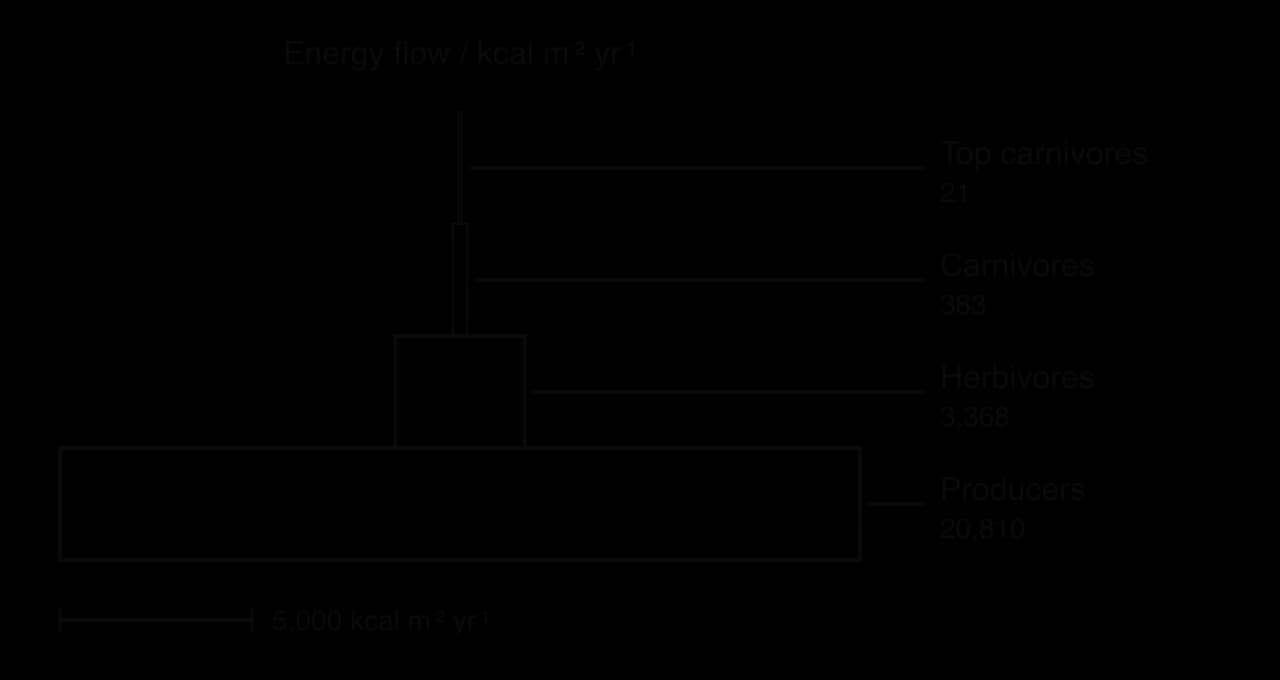
The pyramid drawn to scale shows how steeply energy falls at each step. The carnivore bar is so narrow it is barely visible, and the top-carnivore bar is little more than a line. The decomposers do not appear as a level of the pyramid because they feed on dead matter from every level, but a quarter of all the energy in the system (5,060 of 20,810 kcal m⁻² yr⁻¹) passed through them.
The efficiencies at Silver Springs, between about 5% and 16%, are typical of ecosystems in general. Ecologists often summarise this as a rough "10% rule": about a tenth of the energy at one trophic level is passed to the next. The real figure varies with the organisms involved; it is higher for carnivores, whose food is easily digested, and lower for birds and mammals, which use much of their energy to keep their body temperature high.
At each stage in a food chain, only a small fraction of the energy in one trophic level becomes energy in the next. The rest is lost in three main ways:
Incomplete consumption. Not all of an organism is eaten. Herbivores leave roots, woody stems and bark; carnivores leave bones, fur and feathers. Many organisms die without being eaten at all. The energy in these uneaten parts passes to decomposers and detritivores instead.
Incomplete digestion and absorption. Not all of the food eaten is digested and absorbed. Cellulose and lignin in plants, and hair, bone and chitin in animals, are hard to digest, so they pass out in the faeces. The energy in faeces also goes to decomposers. Herbivores lose much more energy this way than carnivores, because plant material is harder to digest.
Cell respiration. Of the food that is absorbed, much is oxidised in cell respiration to release energy for movement, active transport, keeping warm and other life processes. This energy is eventually converted to heat and lost to the environment. Only the energy that remains in new tissue (growth and reproduction) is available to the next trophic level.
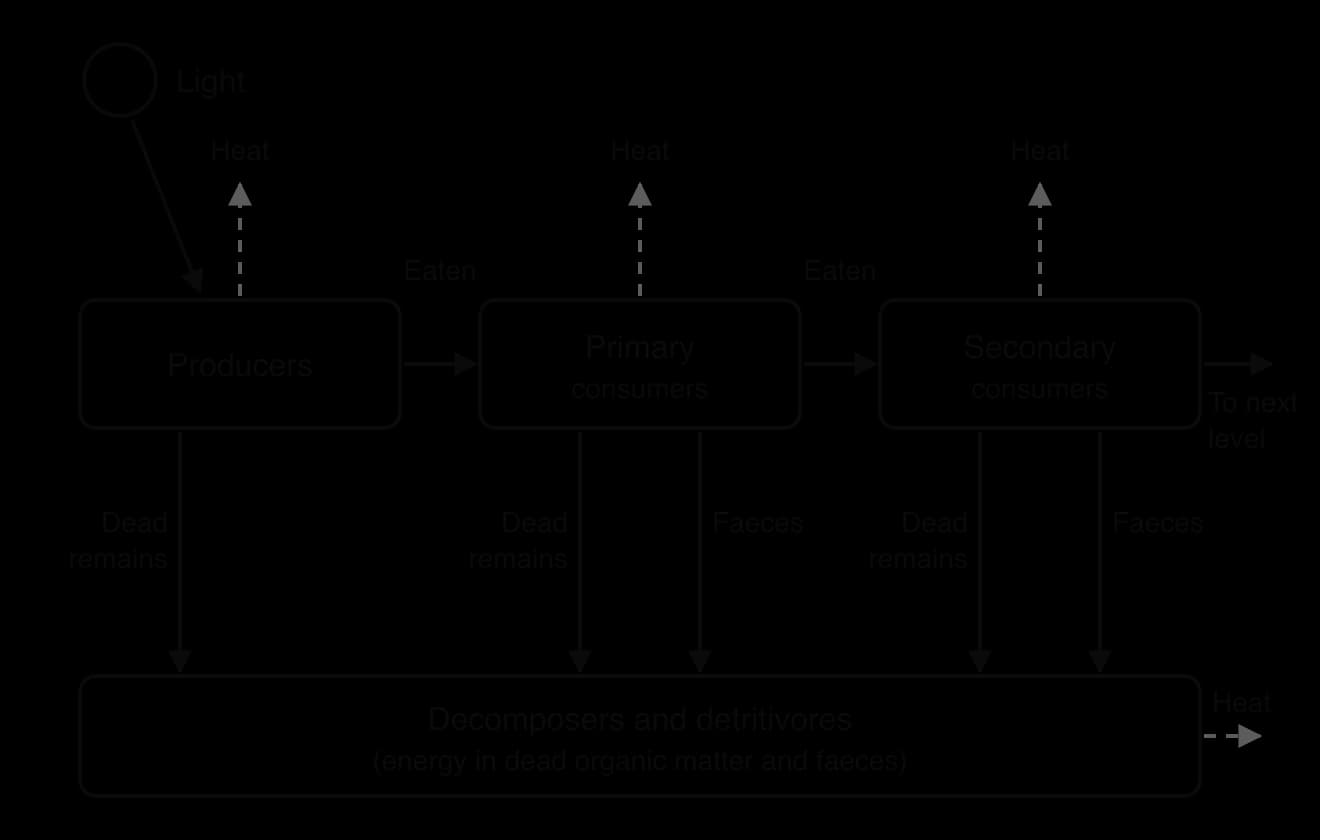
Decomposers and detritivores take in the energy that is lost from food chains as dead matter and faeces. They are an important part of the ecosystem's energy budget, but the energy they use is also lost, as heat from their own respiration. The detritivores themselves are eaten by other animals (earthworms by birds and moles, woodlice by shrews), so some of the energy in detritus re-enters food chains before it is all dissipated.
Every energy transformation in a living cell is less than 100% efficient: some energy is always converted to heat. This happens twice in respiration and its use. When glucose is oxidised in cell respiration, only part of the energy released is captured in ATP; the rest is released as heat. Then, when ATP is used to power muscle contraction, active transport or the synthesis of macromolecules, these processes are also not fully efficient, so more heat is released. Eventually almost all the energy captured by an organism ends up as heat.
Heat is useful to some organisms: birds and mammals use it to keep their body temperature high. But heat cannot be converted back into chemical energy by any organism. Producers can use light, and chemoautotrophs can use energy from chemical reactions, but none can use heat to make carbon compounds. Heat therefore radiates away from the ecosystem and is lost. This is why energy flows through ecosystems in one direction, from light to heat, and must be continually replaced by new light energy.
Matter behaves differently. When organisms respire or decompose, the carbon, hydrogen, oxygen, nitrogen and other atoms in them are released as carbon dioxide, water and mineral ions, which producers can absorb and use again. Matter is therefore recycled within ecosystems, while energy has to be supplied continuously.
Because so much energy is lost at each transfer, the energy available to each successive trophic level decreases rapidly. With efficiencies of about 10%, a producer level with 100,000 kJ m⁻² yr⁻¹ supports about 10,000 at level 2, 1,000 at level 3, 100 at level 4 and only 10 at level 5. Eventually there is too little energy to support a population of a further consumer. Food chains therefore rarely have more than four or five trophic levels.
Organisms at higher trophic levels are fewer, smaller, or both, and their total biomass is smaller. A hectare of grassland might support millions of insects but only a few kestrels. Top predators such as tigers, eagles and great white sharks need very large areas to find enough food, which is one reason they are often the first species to decline when habitats are reduced.
 YouTube
Primary production is the accumulation of carbon compounds in biomass by autotrophs. It is measured as the mass of carbon (or of dry organic matter) added per unit area per unit time, usually in grams per square metre per year (g m⁻² yr⁻¹). Gross primary production is the total amount of carbon fixed by photosynthesis; net primary production is what remains after the producers' own respiration, and it is this net production that is available as food for consumers.
Biomes differ greatly in their capacity to accumulate biomass. Primary production is highest where light, warmth, water and mineral nutrients are all plentiful throughout the year, and lowest where one or more of these is scarce.
Ecosystem or biome | Mean net primary production / g m⁻² yr⁻¹ (dry organic matter) | Main limiting factor where low |
|---|---|---|
Algal beds and coral reefs | 2,500 | — |
Tropical rainforest | 2,200 | — |
Temperate deciduous forest | 1,200 | Short growing season (winter cold) |
Savanna | 900 | Long dry season |
Boreal forest (taiga) | 800 | Low temperature, short summer |
Temperate grassland | 600 | Water in summer |
Tundra and alpine | 140 | Low temperature, short growing season |
Open ocean | 125 | Mineral nutrients |
Desert and semi-desert scrub | 90 | Water |
Source: Whittaker, R. H. and Likens, G. E., in Lieth, H. and Whittaker, R. H. (eds), Primary Productivity of the Biosphere, Springer, 1975. Dry organic matter is roughly 45–50% carbon.
Tropical rainforest produces about 25 times as much biomass per square metre per year as desert scrub and about 15 times as much as tundra. The open ocean has a low production per square metre because mineral nutrients are scarce in its surface waters, but it covers such a large area that its total production is comparable to that of all the land. Coral reefs and algal beds are among the most productive ecosystems of all, partly because of the efficient recycling of nutrients between corals and their zooxanthellae (see C4.1).
Secondary production is the accumulation of carbon compounds in biomass by heterotrophs: the growth of animals, fungi and other consumers. In any ecosystem, secondary production is much lower than primary production. Part of the producers' biomass is never eaten, part of what is eaten is not digested, and much of what is absorbed is oxidised in cell respiration to carbon dioxide and water. Only the carbon compounds that remain are built into new consumer biomass.
The same reasoning applies at each stage. Secondary production by carnivores is lower than secondary production by herbivores, because carbon compounds are again lost to respiration. Feeding at a lower trophic level is therefore more efficient: far more people can be fed from the crops grown on a hectare of land than from the meat of animals raised on the same crops.
Carbon atoms are recycled continuously between living organisms and their environment. The carbon cycle describes this movement. It can be described in terms of carbon pools and carbon fluxes. A carbon pool (or store) is a reservoir in which carbon is held: the atmosphere (as CO₂), the oceans (as dissolved CO₂ and hydrogencarbonate ions), living organisms (as carbon compounds), dead organic matter and soils, and fossil fuels and peat. A carbon flux is the rate at which carbon moves from one pool to another, measured as mass of carbon per year.
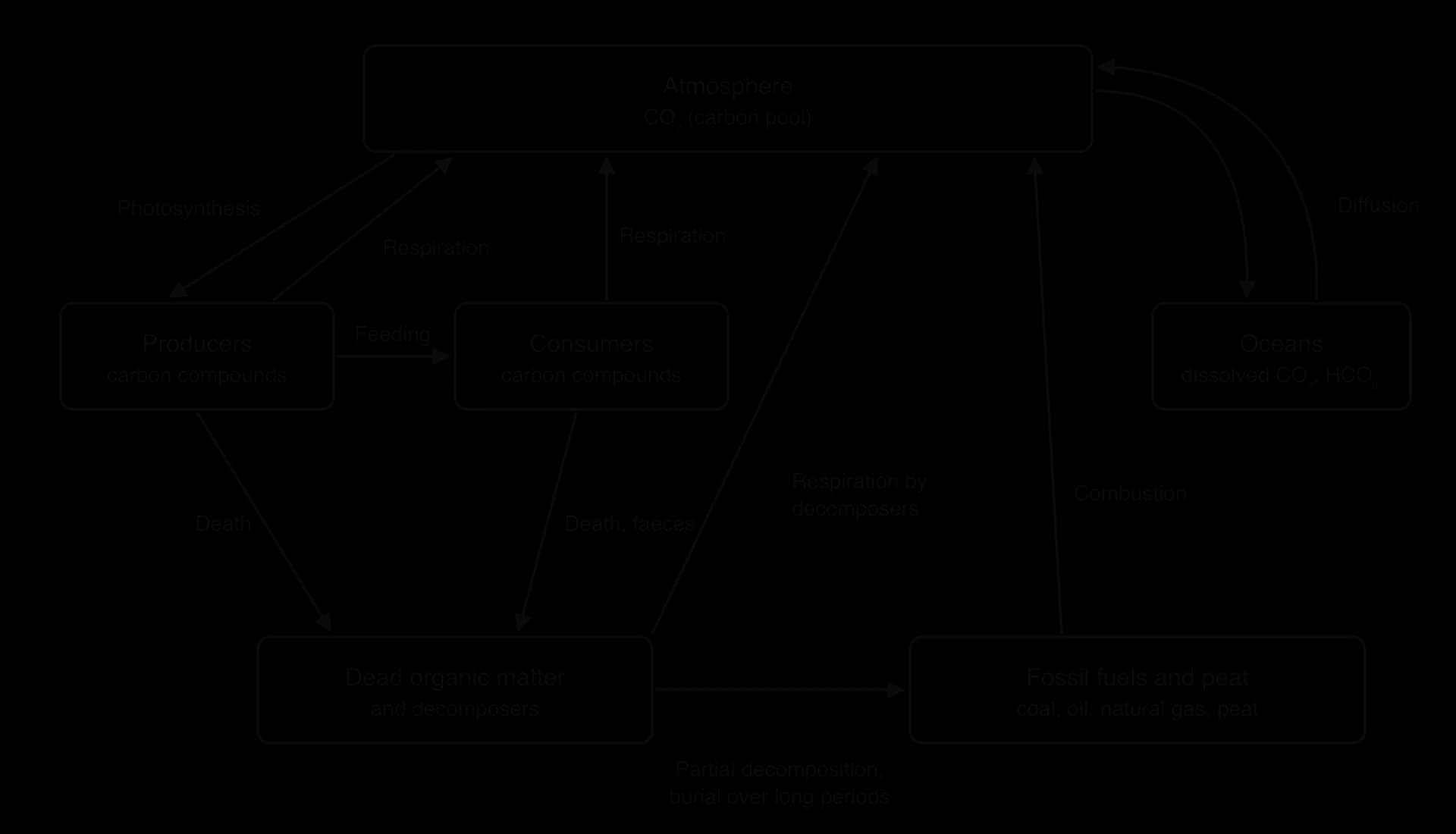
The processes that move carbon between pools are:
Photosynthesis. Producers absorb CO₂ from the atmosphere (on land) or dissolved CO₂ and hydrogencarbonate ions (in water) and fix it into carbon compounds.
Feeding. Carbon compounds pass from producers to consumers, and from consumers to other consumers, when they are eaten, digested and assimilated.
Cell respiration. Producers, consumers and decomposers oxidise carbon compounds and release CO₂ to the atmosphere or water.
Death and egestion. Carbon compounds in dead organisms and faeces pass into the pool of dead organic matter, where decomposers feed on them and respire, releasing CO₂.
Diffusion. CO₂ dissolves in seawater and diffuses between the atmosphere and the oceans in both directions; the oceans absorb more when the concentration in the air rises. In water, CO₂ forms hydrogencarbonate ions, which aquatic producers use in photosynthesis.
Formation of peat and fossil fuels. Where decomposition is incomplete, for example in waterlogged, acidic or oxygen-poor conditions, dead organic matter accumulates and, over long periods and under pressure, forms peat, coal, oil and natural gas.
Combustion. Burning biomass, peat and fossil fuels oxidises their carbon compounds and releases CO₂ to the atmosphere.
The balance between photosynthesis and respiration in an ecosystem determines whether it gains or loses carbon. If photosynthesis exceeds respiration (by producers, consumers and decomposers combined), there is a net uptake of CO₂ from the atmosphere, and carbon accumulates in biomass, soil and dead organic matter. The ecosystem is then a carbon sink. If respiration, together with any combustion, exceeds photosynthesis, there is a net release of CO₂ and the ecosystem is a carbon source.
Young, growing forests are usually carbon sinks, because the trees are adding wood every year. Mature forests are close to balance, since the carbon fixed by growth is roughly matched by the carbon released when old trees die and decompose. Peatlands are long-term sinks: in waterlogged, acidic bogs decomposition is very slow, so dead plant material accumulates as peat over thousands of years. Peatlands cover only about 3% of the land surface but store more carbon than all the world's forests together. Storage of carbon in this way is carbon sequestration.
An ecosystem can switch from sink to source when it is disturbed. When a peatland is drained, oxygen enters the peat, so decomposers respire the stored carbon; burning releases it far faster. In 2015, during a severe drought, fires burned through large areas of drained peatland in Indonesia, releasing huge quantities of CO₂ from carbon that had accumulated over thousands of years. In the Amazon rainforest, aircraft measurements of CO₂ made between 2010 and 2018 showed that the south-eastern part of the forest has become a net carbon source, mainly because of fires and deforestation, while the less-disturbed north-west remains closer to balance.
Combustion is the burning of carbon compounds in oxygen, releasing energy as heat and light and releasing carbon dioxide and water. Four kinds of carbon store are burned: biomass (wood, crop waste, vegetation in wildfires), peat, and the fossil fuels coal, oil and natural gas. They differ greatly in how long their carbon has been stored.
Carbon store burned | How it formed | Approximate age of the carbon |
|---|---|---|
Biomass (wood, vegetation) | Photosynthesis by living or recently dead plants | Years to centuries |
Peat | Partly decomposed plant matter in waterlogged bogs | Hundreds to thousands of years |
Coal | Plant remains of ancient swamp forests, buried and compressed | Tens to hundreds of millions of years; much of it about 300–360 million years (Carboniferous period) |
Oil and natural gas | Remains of marine plankton, buried and heated in sediments | Millions to hundreds of millions of years |
Combustion of biomass is a natural process: lightning strikes start wildfires in forests and grasslands, and many ecosystems are adapted to periodic fire. Human activities have greatly increased the rate of combustion. People burn forests to clear land for farming, and since the Industrial Revolution they have burned coal, oil and natural gas on a vast scale. Fossil fuels release carbon that had been locked away from the atmosphere for millions of years, so the extra CO₂ cannot be removed quickly by the natural cycle. In 2023, combustion of fossil fuels and cement production released about 10.1 billion tonnes (gigatonnes, Gt) of carbon, as about 37 Gt of CO₂.
In 1958 the American scientist Charles David Keeling began measuring the concentration of carbon dioxide in the air at an observatory on Mauna Loa in Hawaii, 3,400 m up on a volcano in the middle of the Pacific. The site is far from forests, cities and industry, so it records air that is well mixed and representative of the Northern Hemisphere. Measurements have continued ever since, and the graph of the results is called the Keeling Curve.
The curve shows two patterns: an annual fluctuation of a few parts per million (ppm) superimposed on a steady long-term increase.
The annual mean concentration rose from about 316 ppm in 1959 to about 421 ppm in 2023, an increase of about one-third. The rate of increase has itself risen: from below 1 ppm per year in the 1960s to more than 2 ppm per year since the early 2000s. The main cause is combustion of fossil fuels, with a smaller contribution from deforestation and burning of biomass. The rise is smaller than the total emissions would produce, because about half of the CO₂ released each year is absorbed by the oceans (by diffusion) and by increased photosynthesis on land.
Each year, the CO₂ concentration at Mauna Loa reaches a maximum in about May and falls to a minimum in about September or October. The 2023 monthly means illustrate this: 424.0 ppm in May and 418.5 ppm in September, a seasonal swing of about 5.5 ppm.
The fluctuation is caused by the seasons in the Northern Hemisphere, which contains most of the Earth's land and therefore most of its land plants. In the northern spring and summer, longer days and higher temperatures increase photosynthesis, especially in the vast temperate and boreal forests. Photosynthesis exceeds respiration, so there is a net uptake of CO₂ and the concentration falls from May until early autumn. In autumn and winter, deciduous trees lose their leaves and photosynthesis falls, but respiration by plants, animals and especially decomposers continues. Respiration exceeds photosynthesis, so CO₂ accumulates and the concentration rises until the following spring.
Photosynthesis and aerobic respiration are linked through the atmosphere. Photosynthesis uses CO₂ and releases O₂; aerobic respiration uses O₂ and releases CO₂. Almost all the oxygen in the atmosphere (about 21% by volume) has been produced by photosynthesis over billions of years, so every aerobic organism, including the producers themselves, depends on photosynthesis for the oxygen it uses. In turn, photosynthesis depends on the CO₂ released into the atmosphere by the respiration of all organisms.
The fluxes involved are enormous. Each year, land plants fix around 120 Gt of carbon by photosynthesis, and a similar amount is returned to the atmosphere by the respiration of plants, animals and decomposers. By comparison, fossil fuel combustion releases about 10 Gt of carbon a year. This exchange of gases through the atmosphere is one of the most important interactions between autotrophs and heterotrophs on Earth, linking every ecosystem into a single global system.
Flux of carbon | Approximate size / Gt C per year |
|---|---|
Photosynthesis on land (gross primary production) | about 120 |
Respiration on land (plants, animals and decomposers) | about 120 (slightly less than photosynthesis) |
Combustion of fossil fuels and cement production, 2023 | about 10 |
Sources: Beer, C. et al., Science 329: 834–838, 2010 (land photosynthesis, 123 ± 8 Gt C per year); Friedlingstein, P. et al., Global Carbon Budget 2024, Earth System Science Data, 2025.
An annual flux can also be estimated from the Keeling Curve. Each 1 ppm of CO₂ in the whole atmosphere contains about 2.1 Gt of carbon. If the seasonal fall of about 5.5 ppm seen at Mauna Loa applied to the whole atmosphere, it would correspond to about 12 Gt of carbon (5.5 × 2.1) taken up by photosynthesis in excess of respiration during the northern summer. This is an overestimate, because the seasonal swing is smaller in the Southern Hemisphere, and it is only the net change: the gross fluxes in each direction are many times larger.
Carbon is not the only element that is recycled. Living organisms need about 20 chemical elements, including nitrogen (in proteins and nucleic acids), phosphorus (in nucleic acids, ATP and phospholipids), sulfur (in some amino acids), and potassium, calcium, magnesium and iron. The Earth receives almost no new matter from space, so the supply of each element is essentially fixed. If these elements were not recycled, they would accumulate in dead organisms and living things would run out of them.
Decomposers play the central role in recycling. As bacteria and fungi break down dead organic matter, they release the elements in inorganic forms that producers can absorb: carbon as CO₂, nitrogen as ammonium ions (later converted by other bacteria to nitrate), and phosphorus as phosphate ions. Producers absorb these ions through their roots or cell surfaces and build them into new carbon compounds, which pass along food chains until death and decomposition release them again. Each element therefore follows its own nutrient cycle through producers, consumers, decomposers and the abiotic environment, and the cycling of matter, unlike the flow of energy, can continue indefinitely.
Some elements cycle mainly through the atmosphere, as carbon and nitrogen do; others, such as phosphorus, cycle mainly through rocks, soil and water and have no significant gas phase. In every case matter is recycled within the biosphere, while energy passes through it once and is lost as heat.
 YouTube
Questions on energy and matter in ecosystems appear in Paper 1A as multiple-choice items on trophic levels, autotrophs and the carbon cycle, and in Paper 1B and Paper 2 Section A as data questions: constructing an energy pyramid, calculating transfer efficiencies and analysing the Keeling Curve. Extended responses in Paper 2 Section B often ask you to explain why energy decreases along food chains, to draw the carbon cycle, or to distinguish between the flow of energy and the cycling of matter.
Strong answers to extended questions on energy and matter use a named ecosystem with data, draw arrows in the direction of energy or carbon movement, and give the cause of each loss or flux rather than listing processes.
I can explain why ecosystems are open systems and how a closed system differs.
I can state that sunlight sustains most ecosystems and describe the exceptions of hydrothermal vents and caves.
I can construct food chains and food webs with arrows in the direction of energy transfer.
I can explain how decomposers obtain energy from faeces, dead parts of organisms and whole dead organisms.
I can distinguish autotrophs from heterotrophs, and photoautotrophs from chemoautotrophs, using iron-oxidising bacteria as an example.
I can classify organisms into trophic levels, including omnivores that feed at more than one level.
I can construct an energy pyramid from data and calculate the efficiency of energy transfer.
I can explain the causes of energy loss between trophic levels and why heat cannot be reused.
I can explain why food chains rarely have more than four or five trophic levels.
I can define primary and secondary production, give their units and compare biomes.
I can draw the carbon cycle and explain when an ecosystem is a carbon sink or a carbon source.
I can analyse the Keeling Curve in terms of photosynthesis, respiration and combustion, and explain why all elements are recycled.
[4 max]
Explain the transfer of energy through a food chain, and why food chains rarely have more than four or five trophic levels.
7 marks
a. sunlight is the (principal) source of energy for most ecosystems;
b. producers / autotrophs convert light energy into chemical energy in carbon compounds by photosynthesis;
c. energy passes along the food chain as chemical energy in carbon compounds / food;
d. when consumers / heterotrophs eat organisms of the previous trophic level;
e. only a small proportion / about 10 % of the energy is passed to the next trophic level;
f. energy is lost as heat from cell respiration (in every trophic level);
g. not all of an organism is eaten / some parts are not digested;
h. energy remains in faeces / undigested material and passes to decomposers;
i. energy is also lost in organisms that die without being eaten (and pass to decomposers);
j. so the energy available decreases at each successive trophic level;
k. eventually there is too little energy to support a population of a further trophic level;
l. energy is not recycled / flows through the ecosystem, (unlike nutrients);
[7 max]
One additional mark is available for the construction of the answer.
Energy is transformed and transferred in ecosystems.
Outline how light energy is absorbed and transformed into chemical energy in photosynthesis.
4 marks
Explain how a hypothesis about the effect of a limiting factor on the rate of photosynthesis can be tested experimentally.
7 marks
Outline how both autotrophs and heterotrophs release energy from carbon compounds, and why this energy is eventually lost from ecosystems as heat.
4 marks
Living organisms need a continuous supply of energy.
Outline the properties of ATP that make it suitable as the energy currency of cells.
4 marks
Describe how energy flows through a food chain.
4 marks
Compare and contrast aerobic and anaerobic cell respiration in humans.
7 marks