B Form and function
How theme B fits together: structure suits function at every level, the ten subtopics from molecules to ecosystems, and what HL adds.
- IB Biology
- SL and HL
10 subtopics in Form and function
Each one has its own page once something is published for it.
- B1.1Carbohydrates and lipids43 questions · notes · 1 quick fire
- B1.2Proteins40 questions · notes · 1 quick fire
- B2.1Membranes and membrane transport52 questions · notes · 1 quick fire
- B2.2Organelles and compartmentalisation39 questions · notes
- B2.3Cell specialisation39 questions · notes
- B3.1Gas exchange44 questions · notes
- B3.2Transport45 questions · notes
- B3.3Muscle and motilityHL only36 questions · notes
- B4.1Adaptation to environment36 questions · notes
- B4.2Ecological niches38 questions · notes
Key terms introduced here
Each is in the Biology glossary, with every other term in the subject.
- Structure–function relationship
The link between the physical form of a biological structure and the role it performs, so that features of the structure can be explained by what they allow it to do.
An overview of B Form and function
Form and function is the theme of how the structure of a biological system suits it to its role. The same relationship holds at every scale, from the shape of an enzyme's active site to the folded lining of the small intestine and the roots of plants in a salt marsh.
Explaining a structure in this theme means linking each feature to what it does: thin walls for short diffusion distances, large surface areas for fast exchange, hydrophobic tails for a barrier to ions.
Subtopics in Form and function
The grid of themes and levels of organisation places the ten subtopics of Form and function in the second row.
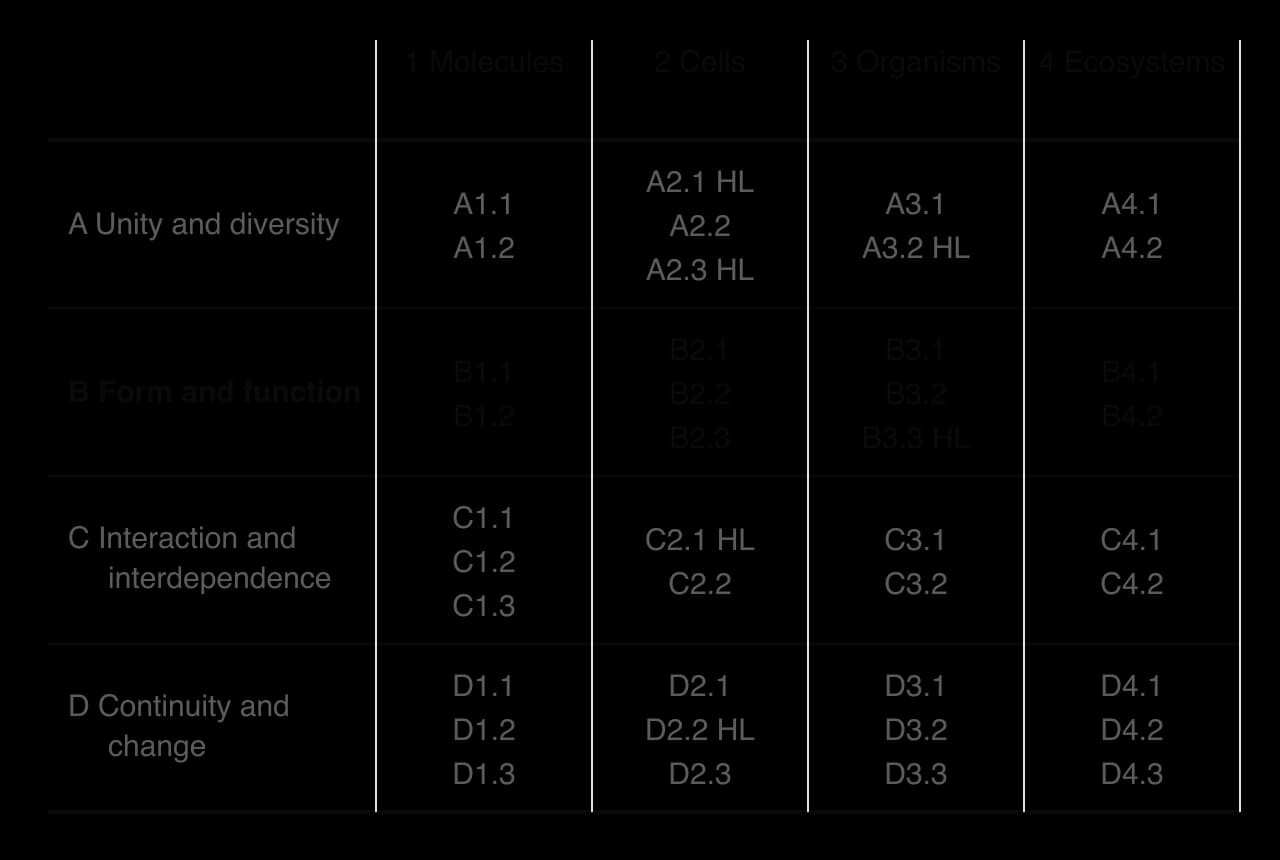
Subtopic | Level of organisation | SL or HL | Central question |
|---|---|---|---|
B1.1 Carbohydrates and lipids | Molecules | SL and HL | How does the structure of carbohydrates and lipids suit them to energy storage, structure and recognition? |
B1.2 Proteins | Molecules | SL and HL | How does the amino acid sequence determine a protein's shape and function? |
B2.1 Membranes and membrane transport | Cells | SL and HL | How does membrane structure control what enters and leaves a cell? |
B2.2 Organelles and compartmentalisation | Cells | SL and HL | What are the advantages of dividing a cell into compartments? |
B2.3 Cell specialisation | Cells | SL and HL | How do unspecialised cells become specialised, and what limits cell size? |
B3.1 Gas exchange | Organisms | SL and HL | How are large organisms adapted to exchange gases with their environment? |
B3.2 Transport | Organisms | SL and HL | How are fluids moved around the bodies of animals and plants? |
B3.3 Muscle and motility | Organisms | HL only | How do muscles contract and produce movement? |
B4.1 Adaptation to environment | Ecosystems | SL and HL | How do abiotic factors shape where species live and what biomes form? |
B4.2 Ecological niches | Ecosystems | SL and HL | How are the adaptations of a species related to its role in an ecosystem? |
How form and function connect across the levels
Each level is built from the one before, so a function at one level depends on structures at the level below. The structure–function relationship runs through all of them.
At the level of molecules, the bonds and shapes of carbohydrates, lipids and proteins (B1.1, B1.2) decide what each molecule can do. Phospholipids and proteins then form membranes (B2.1), and membranes divide eukaryotic cells into organelles with separate functions (B2.2). Cells become specialised for particular roles, and their size is limited by the surface area-to-volume ratio (B2.3).
At the level of organisms, large bodies solve the same surface-area problem with lungs, gills and leaves (B3.1) and with transport systems that move fluids over long distances (B3.2). At the level of ecosystems, the adaptations of whole organisms suit them to the abiotic conditions of a habitat (B4.1) and to a particular role, or ecological niche, within a community (B4.2).
Links to the other themes
Unity and diversity (A). The cell structures in A2.2 are the starting point for organelles and specialisation in B2.2 and B2.3, and adaptations in B4.1 are products of the evolution described in A4.1.
Interaction and interdependence (C). Enzyme function in C1.1 depends on the protein structure in B1.2, and membrane proteins from B2.1 carry the signals of C2.1 and C2.2.
Continuity and change (D). The amino acid sequence of a protein is set by the base sequence of a gene (D1.2), and water movement across membranes in B2.1 is explained at HL by water potential (D2.3).
How HL differs in this theme
HL students study everything that SL students study, plus one HL-only subtopic, B3.3 Muscle and motility, and the sections marked HL only inside the SL subtopics. Six SL subtopics carry additional HL sections:
B1.2 Proteins: the chemical diversity of R-groups and the levels of protein structure (the effect of primary structure on conformation, secondary, tertiary and quaternary structure, including conjugated proteins), and the form and function of globular and fibrous proteins.
B2.1 Membranes and membrane transport: membrane fluidity (fatty acid composition and cholesterol), vesicle fusion and formation in endocytosis and exocytosis, gated ion channels, sodium–potassium pumps, sodium-dependent glucose cotransport and cell-adhesion molecules.
B2.2 Organelles and compartmentalisation: how mitochondria and chloroplasts are adapted to their functions, the double nuclear membrane and nuclear pores, free ribosomes and the rough endoplasmic reticulum, the Golgi apparatus and vesicles.
B2.3 Cell specialisation: cell adaptations that increase surface area-to-volume ratio, and the adaptations of type I and type II pneumocytes, cardiac muscle cells and striated muscle fibres, and sperm and egg cells.
B3.1 Gas exchange: fetal and adult haemoglobin, oxygen dissociation curves and the Bohr shift.
B3.2 Transport: the formation and reuptake of tissue fluid and its drainage into lymph, single and double circulation, the adaptations of the mammalian heart and the cardiac cycle, root pressure, and phloem sieve tubes and companion cells for translocation.
B1.1 Carbohydrates and lipids, B4.1 Adaptation to environment and B4.2 Ecological niches have no HL extension.
Carry on with B in Augment
With a free account, Augment remembers where you stopped and what you have practiced.