1 Concepts
The six concepts (bias, causality, change, measurement, perspective and responsibility) are the lenses used to analyse and evaluate every theory, study and context in psychology.
- IB Psychology
- SL and HL
What 1 covers
From the subject guide: what you need to know and be able to do.
Six broad ideas used to frame every part of the course.
6 subtopics in Concepts
Each one has its own page once something is published for it.
- 1.1Biasnotes
- 1.2Causalitynotes
- 1.3Changenotes
- 1.4Measurementnotes
- 1.5Perspectivenotes
- 1.6Responsibilitynotes
Key terms introduced here
Each is in the Psychology glossary, with every other term in the subject.
- Behaviour
Any observable action of a person in response to biological, cognitive and environmental factors; in psychology the term also covers processes such as memory, emotion, motivation, learning and relationships that are inferred from what people do.
- Concept
A broad, general idea that applies across all areas of psychology and is used to analyse and evaluate content and research; the course uses six: bias, causality, change, measurement, perspective and responsibility.
- Context
A real-world area in which psychological content and concepts are applied; the course uses four: health and well-being, human development, human relationships, and learning and cognition.
- Critical thinking
The careful analysis and evaluation of claims, evidence and arguments, including their assumptions, alternative explanations and limitations, in order to reach a reasoned judgement.
- Cultural competence
The ability to understand, respect and work effectively with people from cultures other than one’s own, including awareness of how one’s own culture shapes one’s assumptions.
- Psychological literacy
The ability to apply psychological knowledge to personal, social and real-world problems in a critical, ethical and culturally aware way, including understanding how psychological research is carried out.
An overview of 1 Concepts
Psychology studies behaviour and the mental processes behind it, and the six concepts are the ideas used to think critically about that study. Bias, causality, change, measurement, perspective and responsibility apply to every theory, every research method and every real-world setting, so they are the tools for judging how far any claim about human behaviour can be trusted.
Questions the concepts help answer
Each concept turns into a question that can be asked of any study or theory. Together they make up a habit of critical thinking: the careful analysis of claims, evidence and their limits before reaching a judgement.
Bias: in what ways might knowledge of behaviour be distorted by researchers, participants, samples, culture or the way research is published?
Causality: how can anyone know what causes a behaviour, when most behaviours have several interacting causes?
Change: how can psychologists tell whether a change in behaviour comes from natural development or from a deliberate intervention, and what helps or blocks change?
Measurement: how can complex, unobservable processes such as memory, stress or love be turned into data that are reliable and valid?
Perspective: how do the biological, cognitive and sociocultural approaches each explain behaviour, and what does each leave out?
Responsibility: how should psychologists treat the people and animals they study, and how should research be used, communicated and applied?
The six concepts
Subtopic | The question it answers | Key ideas |
|---|---|---|
1.1 Bias | How might knowledge of behaviour be distorted, and how can bias be reduced? | Sampling, researcher, participant, confirmation and publication bias; cultural and gender bias; WEIRD samples; cognitive biases; reflexivity |
1.2 Causality | How can the causes of behaviour be established? | Correlation and causation; bidirectional ambiguity; third variables; internal and external validity; placebos, double-blind designs and wait-listing; statistical significance; interaction |
1.3 Change | How and why does behaviour change, and how can change be brought about? | Maturation and development; intervention, prevention and promotion; barriers to change; prevalence; longitudinal designs; free will and determinism |
1.4 Measurement | How can unobservable processes be measured reliably and validly? | Constructs and operationalisation; types of data; reliability and validity; triangulation; brain imaging; type I and type II errors |
1.5 Perspective | How do different approaches explain the same behaviour? | The three approaches; theories and models; reductionism and holism; deductive and inductive research; emic and etic; Indigenous psychologies |
1.6 Responsibility | What do psychologists owe to participants, animals and society? | Informed consent, deception, debriefing, right to withdraw, protection from harm; cost–benefit analysis; the 3Rs; socially sensitive research; stigma; advocacy |
How the concepts fit into the course
The course is built from three parts that are studied together. The concepts are the lenses. The content is the biological, cognitive and sociocultural approaches and research methodology, which supply the theories, models and methods. The four contexts (health and well-being, human development, human relationships, and learning and cognition) are the real-world settings in which the content is applied. Psychological literacy joins them: the ability to use psychological knowledge to understand and help solve real problems, critically, ethically and with cultural competence.
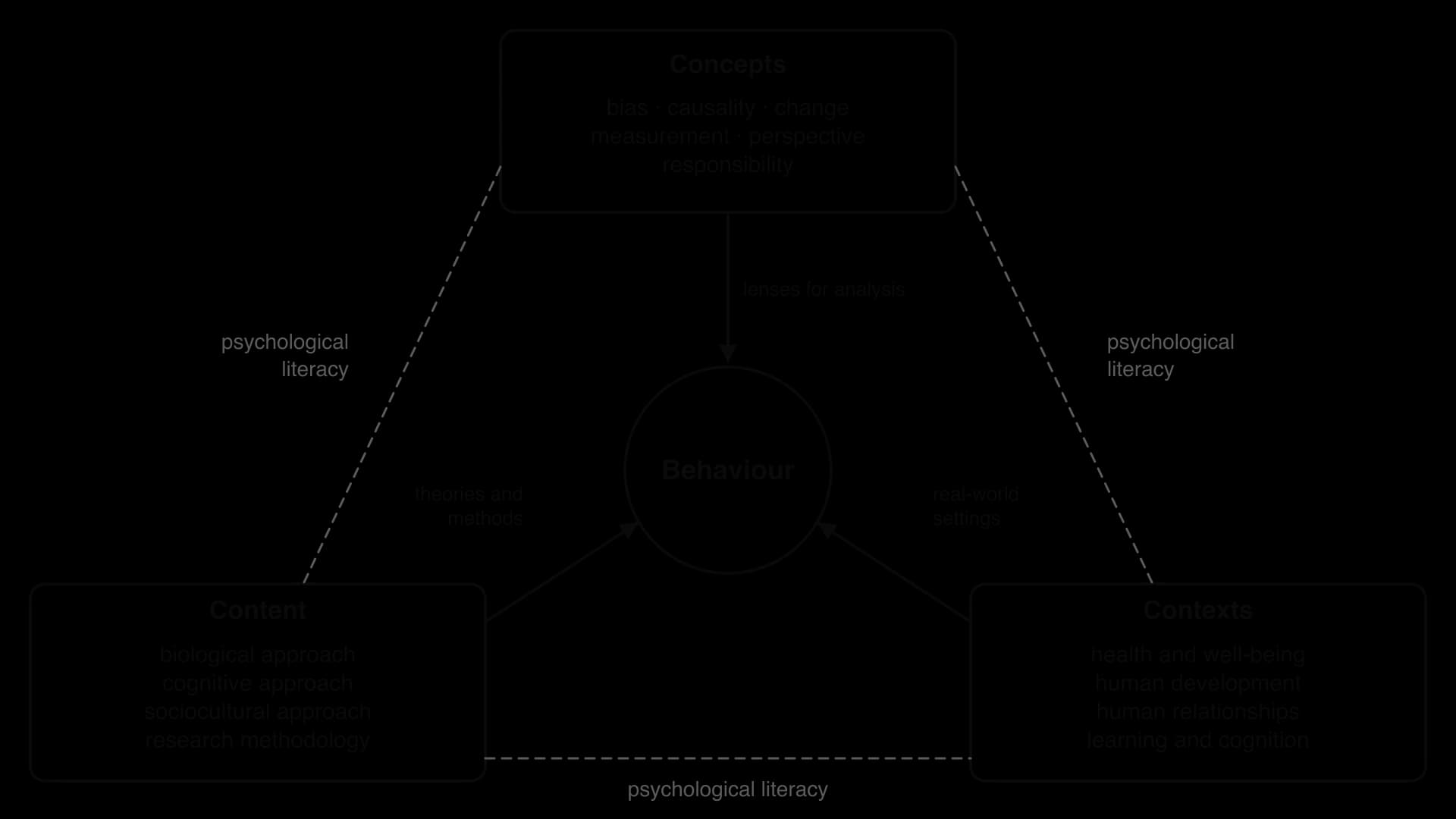
The concepts are used throughout the course rather than studied once as a separate unit. On an approach topic, such as the role of hormones or social identity theory, they are used to evaluate the theory and its research. In a context, such as treatments for depression or attachment in childhood, they are used to judge how well the content explains real behaviour. In research methodology, they are the standards by which a design is judged.
Links to the approaches
Each approach raises some concepts more sharply than others. Biological research raises questions of measurement (brain scans and hormone levels are indirect measures), causality (a brain difference may be an effect, not a cause) and perspective (the risk of reductionism). Cognitive research raises measurement, because mental processes are inferred from behaviour, and bias, because laboratory samples are often narrow. Sociocultural research raises bias and perspective, because concepts and measures developed in one culture may not fit another.
Links to the contexts
In the contexts, the concepts connect research to people’s lives. In health and well-being, causality and responsibility shape how disorders are explained and treated. In human development, change and measurement are central, because development unfolds over years and children cannot simply be asked about their minds. In human relationships, measurement and bias matter because so much evidence comes from self-report. In learning and cognition, causality and change matter because the aim is often to improve a cognitive process.
How the concepts connect
The concepts overlap and interact, and the same idea can sit under several of them. Reductionism is a form of theoretical bias and also a problem for causality. Statistical significance belongs to both causality and measurement. Deception reduces participant bias but limits informed consent, so a control for bias raises a question of responsibility. A longitudinal design measures change and also establishes the time order needed for a causal claim.
Showing these connections is a mark of developed critical thinking. A single study can usually be discussed through three or four concepts, and the most useful evaluation explains how a weakness under one concept affects the others: a biased sample (bias) limits whether a causal effect generalises (causality), and the use of a self-report questionnaire (measurement) may make social desirability bias more likely.
How SL and HL differ
SL and HL students study the same six concepts in full and use them in the same way, because they sit the same Papers 1 and 2, which assess the concepts directly. There is no additional concept content at HL.
HL students apply the concepts further in the HL extensions. The study of the role of culture, motivation and technology in behaviour draws heavily on perspective, causality, change and responsibility, and the data analysis and interpretation extension develops measurement and causality through work on statistics, graphs and qualitative analysis. Paper 3 asks HL students to judge sources through these concepts, for example how bias could be avoided in a qualitative study or how far findings can be transferred to other contexts.
Assessment
The concepts are assessed throughout the course rather than in one place.
Paper 1 Section C: a concept-based extended response. Each question combines an area of study from one of the contexts with one concept, for example evaluating research on attachment with reference to measurement. The concept must organise the whole answer.
Paper 2 Section A: one of the four questions on the class practicals asks students to explain a concept in relation to their own practical, so each of the six concepts needs to be applied to each method used.
Paper 2 Section B: an unseen study is discussed with reference to two or more concepts chosen from a list in the question. Answers are rewarded for using the details of the study.
Paper 3 (HL): the questions on interpreting data, on qualitative research (credibility, avoiding bias, transferability) and on evaluating a claim all draw on bias, causality and measurement.
Internal assessment: the research proposal asks students to justify methodological decisions, address ethical considerations (responsibility), design a data collection tool (measurement) and reflect on how their own background could bias the investigation.
Paper 1 Sections A and B focus on the approaches and their application to contexts, but using the concepts to explain why a theory or example is limited strengthens those answers too.
Carry on with 1 in Augment
With a free account, Augment remembers where you stopped and what you have practiced.