Explain change as a concept: how behaviour changes through maturation, experience and intervention, how psychologists detect change and its causes, what blocks it, and how to evaluate change across approaches and contexts.
Each is in the Psychology glossary, with every other term in the subject.
The loss of participants from a study over time, especially in longitudinal research; it biases results when those who leave differ systematically from those who stay.
Biological, psychological, social or structural factors that make it harder for a person or group to change behaviour, even when the change would benefit them.
A concept referring to alteration in behaviour, cognition, emotion or biology over time, through maturation, experience, intervention or chance, and to the use of psychological knowledge to bring about and evaluate such alteration.
The large rise in average scores on intelligence tests across the twentieth century in many countries, too fast to be genetic and so attributed to environmental change.
The capacity of a person to choose how to act, rather than having behaviour fully determined by biological or environmental causes; closely linked to agency, the ability to act intentionally and influence one’s own life.
A deliberate action designed to change behaviour, cognition, emotion or health, such as a therapy, a medication, a training programme, a campaign or a policy.
Biologically driven change in the body and brain that unfolds with age according to a genetic timetable, largely independent of specific experience, such as the development of the prefrontal cortex in adolescence.
The statistical tendency for an extreme score on one measurement to be followed by a score closer to the average on the next, because extreme scores partly reflect temporary chance factors.
The position that behaviour is strongly influenced by biological and environmental factors but that people still make real choices within the limits those factors set.
The improvement or disappearance of symptoms of a disorder without treatment, which has to be controlled for when judging whether a treatment caused change.
How well an intervention produces its intended change in real-world conditions, judged by the size, durability and reach of the change; often distinguished from efficacy, how well it works in controlled trials.
Describe the concept of change and the difference between gradual and sudden, deliberate and unplanned change.
Explain how maturation, natural recovery and regression to the mean make it hard to know whether an intervention caused a change.
Explain how longitudinal, repeated-measures and randomised controlled designs are used to detect change and its causes.
Discuss the free will and determinism debate and what it implies for changing behaviour.
Describe intervention, prevention and promotion strategies at individual, local and global levels, and evaluate their effectiveness.
Explain barriers and resistance to change, with examples from habits, biology and social context.
Apply the concept of change to research in the biological, cognitive and sociocultural approaches and in all four contexts.
Evaluate research on the Flynn effect with reference to change, measurement and causality.
Change is the concept that asks how and why behaviour alters over time, and how psychology can be used to alter it on purpose. People mature, learn, recover from illness, adapt to new countries and give up habits, and many of the most useful applications of psychology, from therapy to public health policy, are attempts to bring such changes about.
Change is one of the six concepts that run through the whole course, alongside bias, causality, measurement, perspective and responsibility. It is closely tied to causality, because a change only means something once its cause is known, and to measurement, because a change can only be seen if the same thing is measured in the same way at two or more points in time.
With a free account, Augment remembers where you stopped and what you have practiced.
In psychology, change has two sides. It is something psychologists study: how people develop from infancy to old age, how they recover from or relapse into illness, and how whole populations shift in their health or behaviour over decades. It is also something psychologists do: they apply theories and findings to promote healthier, happier or fairer behaviour, and they test whether those efforts work.
The central question for the concept is how psychologists can know whether a behaviour is the result of natural maturation or of a purposeful intervention. A teenager who becomes better at controlling impulses between 14 and 18 has had a great deal of experience, schooling and perhaps support, but has also gone through four years of brain development. Separating these influences is the main methodological problem in research on change.
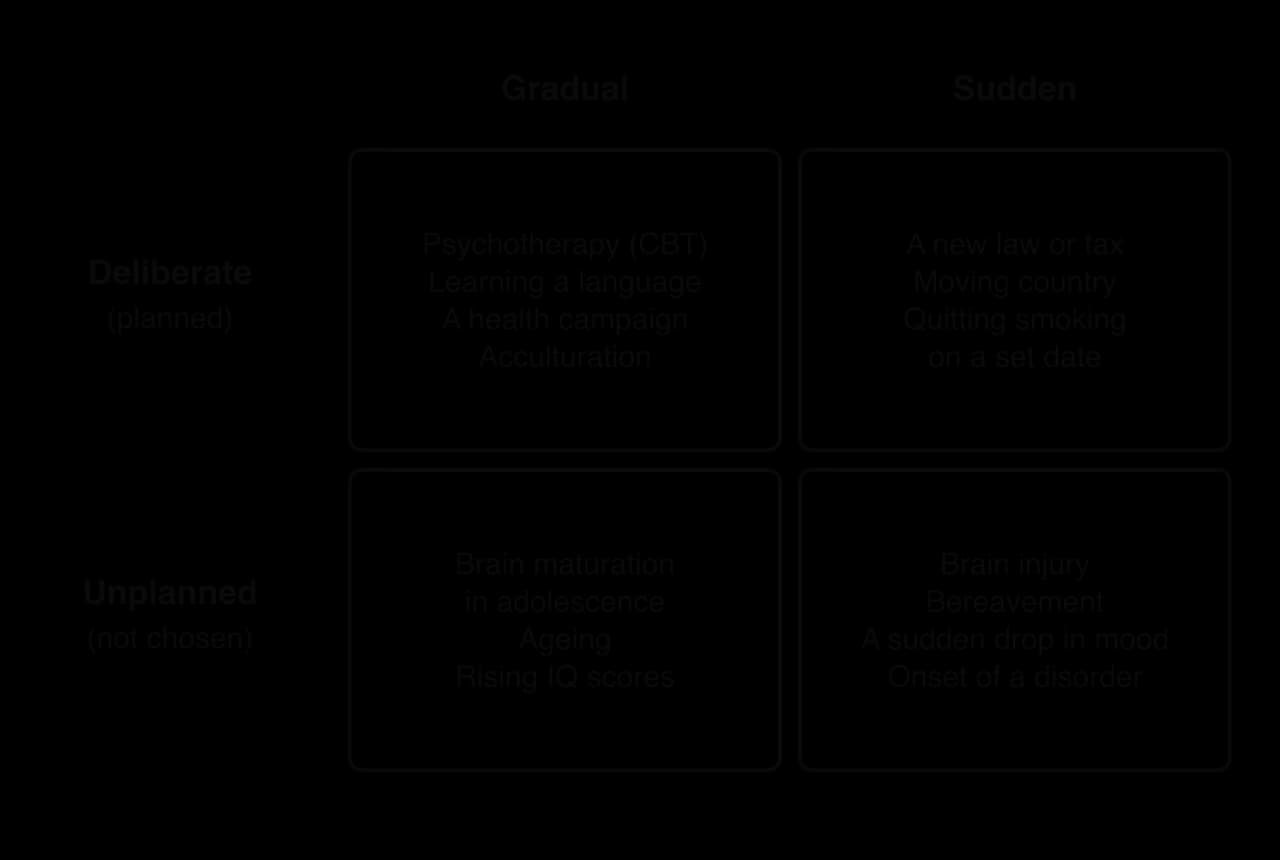
Changes can be classified along two dimensions. The first is speed. Development, ageing and most learning are gradual, unfolding over months or years. Other changes are sudden: a fall in mood after bad news, a brain injury, or a new law that changes what people can buy from one day to the next.
The second dimension is intention. Deliberate (planned) change is chosen or designed: a person decides to stop smoking, a school teaches a revision strategy, a therapist uses cognitive behavioural therapy, a government taxes sugary drinks. Unplanned change happens without anyone choosing it, as in maturation, an unexpected biological change such as the onset of a disorder, or the effects of a life event.
Planned change also includes adaptation to new environmental and technological circumstances. Migrants adapt to a new culture through acculturation, which can be chosen (learning the language) or forced by circumstances (displacement by war). People also adapt to new technology, for example by changing how they study when information is always available online. Adaptation shows that change is often a response to a changing environment rather than something that begins inside the person.
Much of the change that psychology studies is development: the gradual, largely predictable change in behaviour, thinking and the body from conception to old age. Development is driven partly by maturation, which unfolds according to a biological timetable, and partly by experience, which differs from person to person and from culture to culture.
Maturation sets limits on what can change and when. A one-year-old cannot be taught to read, however good the teaching, because the brain and the basic language skills reading depends on have not yet developed. Longitudinal brain imaging, such as the repeated scans of children and adolescents by Giedd et al. (1999), shows that grey and white matter continue to change well into the teenage years, so maturation is still under way during adolescence and has to be considered whenever adolescents’ behaviour changes.
Experience also produces measurable biological change, which is evidence that the relationship between biology and behaviour runs in both directions. Draganski et al. (2004) taught young adults with no juggling experience to juggle a three-ball routine, scanning their brains before training, after about three months of practice and again three months later; grey matter increased in areas that process visual motion, and the increase partly reversed after three months without practice, while a non-juggling control group showed no change. The finding is evidence of neuroplasticity in both directions, with grey matter increasing during practice and partly decreasing after practice stopped.
Change at the level of genes is also possible. Epigenetics describes chemical changes that switch genes on or off without altering the DNA sequence, and some are triggered by experiences such as stress or diet. Genetic inheritance is fixed at conception, but the expression of genes can change across a lifetime, so even the most biological explanations of behaviour leave room for change.
Change within people can only be seen by measuring the same people repeatedly, which is the purpose of a longitudinal design. The Harvard Study of Adult Development has followed two groups of men since 1938: 268 Harvard students and 456 young men from poor neighbourhoods of Boston. Participants have been assessed every two years or so through questionnaires, medical records and interviews, and the study’s best-known finding is that warm, close relationships predict health and happiness in later life better than wealth or social class.
 YouTube
A cross-sectional design compares different age groups at one time. It is quicker, but differences between, for example, 20-year-olds and 70-year-olds may reflect the different times they grew up in (a cohort effect) rather than ageing itself. Change over time and difference between groups are not the same thing, which is why longitudinal evidence carries more weight in research on development.
Whether people can choose to change is one of the oldest questions in psychology. Determinism is the view that behaviour is caused by forces outside a person’s control. Biological determinism places those forces in genes, hormones and brain structure; environmental determinism places them in conditioning, upbringing and culture. On a strongly deterministic view, change has to come from outside the person, through changes to brain chemistry, reinforcements or the environment.
The opposite position stresses free will and agency. It assumes that people can change through insight, choice and effort, which is the assumption behind most psychological therapies, self-help strategies and education. A therapist who teaches a client to challenge negative thoughts assumes that the client can choose to think differently, at least with practice.
Most psychologists take a middle position, sometimes called soft determinism. Biology and environment strongly influence behaviour and set limits on what can change, but within those limits people make real choices, and psychological knowledge can widen the limits. For example, a genetic vulnerability to depression raises risk, but the environment, coping skills and treatment all affect whether depression develops or lifts.
Deliberate change usually needs motivation. Psychologists distinguish motivation that comes from inside (doing something because it is interesting or meaningful) from motivation that comes from outside (doing it for a reward or to avoid a punishment). Rewards can produce change quickly, but the change may fade when the reward stops, and in some situations rewards reduce interest in an activity people already enjoyed, the overjustification effect. Change that a person values for its own sake tends to last longer.
The debate matters for how change is explained and evaluated. If smoking is explained only by nicotine addiction, the obvious intervention is medication; if it is explained only by social learning, the obvious intervention is changing peer norms. Treating people as agents adds a third route: helping them decide to change and supporting that decision. Interventions that combine all three are usually more successful than those built on one.
When people improve after a therapy, a course or a campaign, it is tempting to credit the programme. Several other processes produce change over the same period, and each has to be ruled out before the programme can take the credit. These rival explanations are the main reason research on change needs careful design.
Maturation and development. Children and adolescents change as their brains and skills develop, with or without an intervention. A reading programme for seven-year-olds will always be followed by better reading a year later.
Natural recovery (spontaneous remission). Many conditions improve without treatment. In a meta-analysis of wait-list and observational studies, Whiteford et al. (2013) estimated that among adults with untreated depression in primary care, about 23% recover within three months, 32% within six months and 53% within a year.
Regression to the mean. People often seek help, or are selected for a study, when a problem is at its worst. Their next measurement is likely to be closer to their usual level even if nothing is done.
Practice and testing effects. Taking the same test twice usually improves the score, because people learn the format.
History. Events outside the study, such as the end of the school year, a news story or a change of season, can change behaviour in everyone at once.
Expectation. Believing that one is being helped can itself reduce symptoms (the placebo effect), and participants who know what a study is testing may report the change they think is wanted.
Regression to the mean is easy to overlook because it looks exactly like improvement. A student who scores unusually badly on one test, perhaps because of poor sleep or a hard set of questions, will probably score better on the next one whatever happens in between. If such students are chosen for extra support because of their low scores, the support will seem to work even if it does nothing.
The effect of an intervention is measured as the difference between the change in the people who received it and the change in a comparable group who did not. If both groups improve, the improvement they share is due to maturation, natural recovery, regression, practice or history; only the extra improvement in the intervention group can be attributed to the intervention.
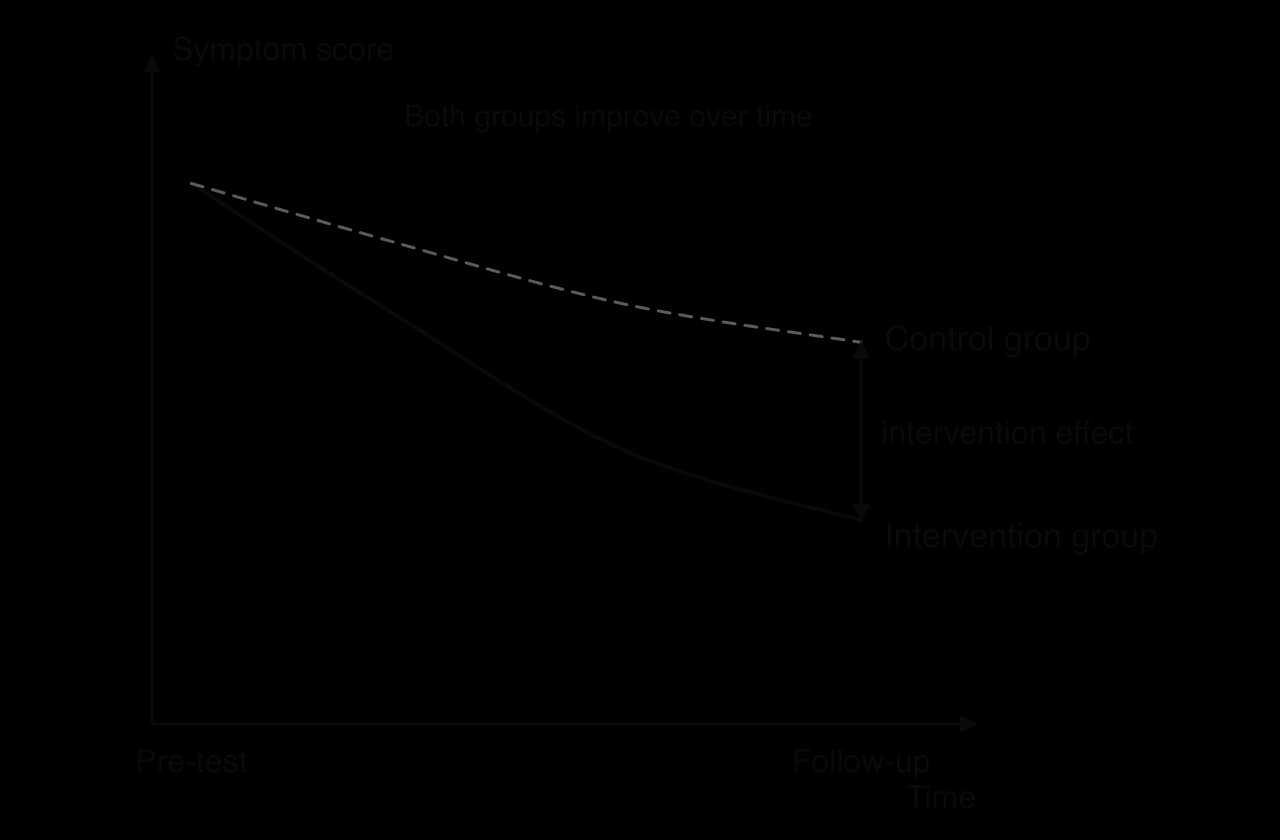
Researchers use several kinds of comparison group, and the choice affects the size of the effect they find. A no-treatment group shows the change that would happen anyway. A placebo group also controls for expectation. A wait-listing group, who receive the intervention later, allows a fair comparison while still giving everyone the treatment in the end, which addresses an ethical concern about withholding help. A “treatment as usual” group asks a different question: whether the new intervention is better than what people would normally receive.
Each design answers a different question about change. A repeated-measures design measures the same people more than once, for example before and after an intervention, and so detects change within individuals. Without a comparison group, however, it cannot separate the intervention from the rival explanations. A randomised controlled trial adds random allocation to an intervention or a control condition, which spreads the rival explanations evenly across groups and so supports a causal conclusion.
Design | What it shows about change | Main limitations |
|---|---|---|
Longitudinal | Real change within the same people over months or years; the order in which changes occur; different paths for different individuals | Slow and expensive; drop-out is rarely random; the measures and the world change during the study |
Cross-sectional | Differences between age groups or populations at one time | Differences may reflect generation (cohort) rather than development; no information on individual change |
Repeated measures (pre-test and post-test) | Change from before to after an event or intervention | Without a control group, cannot rule out maturation, natural recovery, regression to the mean or practice |
Randomised controlled trial | Change caused by the intervention, relative to a control group | Often short follow-up; strict selection of participants limits generalisation; blinding is hard for psychological interventions |
Natural experiment | Change after a real-world event that the researcher did not control, such as a new tax or law | No random allocation, so other changes at the same time may explain the result |
Time is a further issue. Many interventions produce change that is real but short-lived. People relapse after therapy, regain weight after a diet and start smoking again after quitting. A study that measures outcomes only at the end of an intervention can overestimate how much lasting change it produced, so follow-up measurements months or years later are central to judging change.
Applied psychology is largely about deliberate change. Researchers design ways to reduce stress, improve diet, stop unhealthy behaviour, treat disorders and improve learning, and then test whether they work. These strategies differ in when they act and in how many people they reach.
Prevention aims to stop a problem developing in the first place, for example teaching coping skills to all students before the most stressful weeks of the school year rather than treating anxiety once it has developed. Health promotion aims to help people take more control over their health, often through education, campaigns and changes to the environment rather than individual treatment. Treatment acts on a problem that already exists.
Change can be promoted at different levels, and the level shapes both what is possible and how success is measured. Individual interventions can be tailored to one person but reach few people. Local interventions act on a school, workplace or community. Global or population interventions, such as taxes, laws and international programmes, reach millions of people but are less precise and harder to evaluate.
Level | Typical strategies | Example of change |
|---|---|---|
Individual | Therapy, medication, coaching, personal goal-setting | Cognitive behavioural therapy aims to change the negative thoughts and behaviours that maintain depression |
Local (school, workplace, community) | Workplace incentive schemes, school programmes, community services | Volpp et al. (2009): financial incentives offered through an employer increased quitting smoking |
Global or population | Taxes, laws, mass-media campaigns, international health programmes | Colchero et al. (2016): purchases of taxed sugary drinks in Mexico fell after a 2014 tax |
Volpp et al. (2009) randomly allocated 878 employees of a large US company who smoked either to receive information about stop-smoking programmes or to receive the same information plus financial incentives of up to $750 for completing a programme and for staying abstinent. Quitting was confirmed by a biochemical test rather than self-report. The incentive group was almost three times as likely to have stopped smoking 9–12 months later, and the difference was still present after the payments had ended.
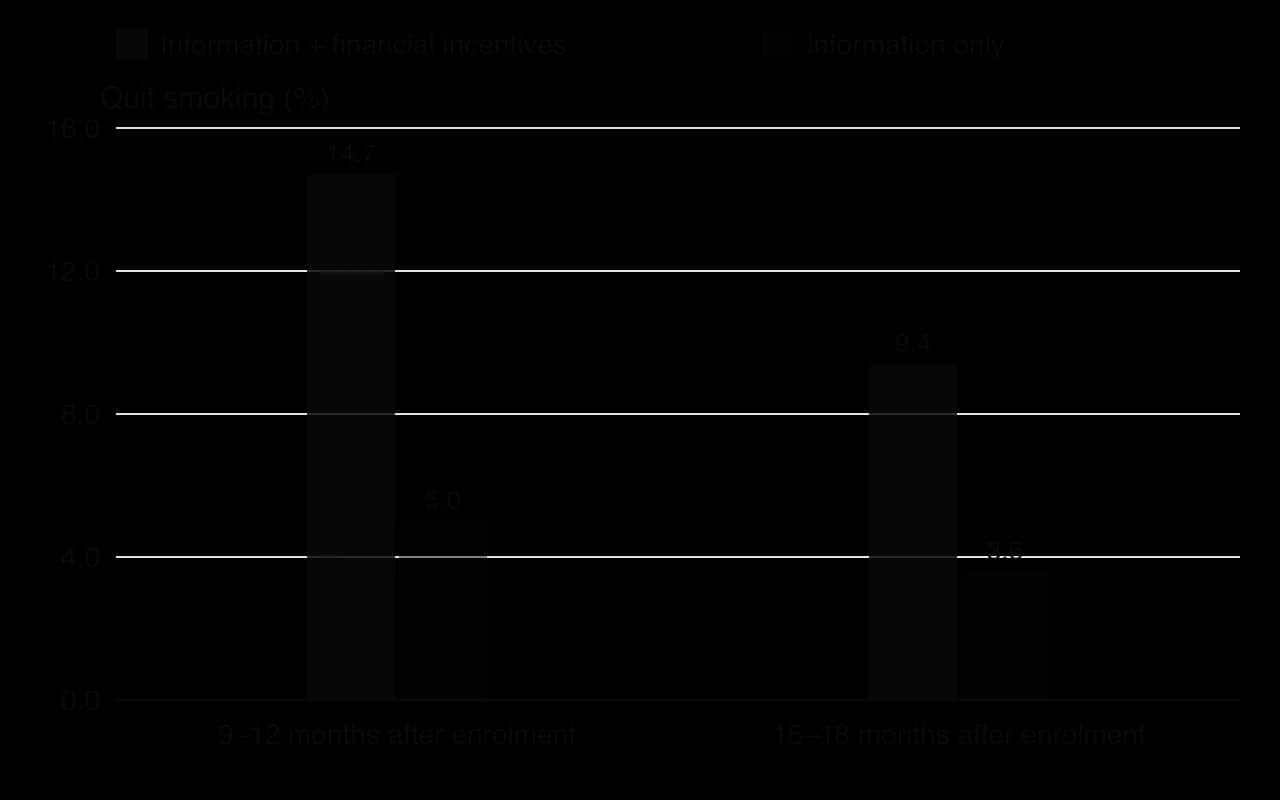
The results show three features of deliberate change. The change was real and caused by the intervention, because random allocation and a biochemical measure rule out the main rival explanations. Part of it faded once the extrinsic reward ended, which fits the idea that rewarded change is less durable. Most participants did not stop smoking at all, which points to strong barriers to change.
Population-level change works differently. Mexico introduced an excise tax of about 10% on sugar-sweetened drinks in January 2014. Using purchase records from 6,253 households, Colchero et al. (2016) compared actual purchases in 2014 with the purchases predicted from the trend before the tax. Purchases of taxed drinks were on average 6% lower than predicted, and 12% lower by December 2014; low-income households reduced their purchases most, by up to 17%. Because this was an observational study of a natural experiment, other events in 2014 could have contributed, and lower purchases do not by themselves show changes in weight or health.
A treatment can be efficacious but not effective. Trials often recruit motivated volunteers, exclude people with several problems at once, and use well-trained staff who follow a manual closely. In ordinary clinics, with patients who miss sessions and staff with less time, the same treatment may produce less change. A complete evaluation of treatment effectiveness therefore asks several questions: how large the change is, how long it lasts, for whom it works, what it costs, what side effects it has and how many people it can reach.
Size: is the change large enough to matter in people’s lives, or only statistically detectable?
Durability: is the change still present months or years later, or does relapse follow?
Reach and equity: who receives the intervention, and does it reduce or widen gaps between groups?
Mechanism: does the intervention change the thing it is supposed to change (for example, thoughts in cognitive therapy), or does it work in some other way?
People often fail to change even when they know what would help. Most people who smoke want to stop, and most people trying to lose weight know which foods to avoid, yet relatively few succeed in the long term. Research on change therefore studies the factors that block it as carefully as the factors that produce it.
Type of barrier | How it blocks change | Example |
|---|---|---|
Biological | Physiological processes resist the new behaviour | Nicotine withdrawal; increased hunger after weight loss, which makes regaining weight common |
Cognitive | Beliefs and thinking biases reduce the felt need or ability to change | Optimism bias (“it won’t happen to me”); low self-efficacy; discounting health warnings to reduce cognitive dissonance |
Emotional and motivational | Mixed feelings, or short-term rewards that outweigh long-term costs | Eating for comfort under stress; low energy and motivation as symptoms of depression itself |
Social and cultural | Norms, social networks and stigma | Friends who smoke; stigma that discourages seeking help for mental health problems |
Structural | Cost, access and environment | No affordable therapy nearby; cheap energy-dense food; long working hours |
Habits are one of the strongest barriers to deliberate change, because habitual behaviour is triggered automatically by familiar situations rather than by conscious decisions. Lally et al. (2010) asked volunteers to choose a new healthy behaviour and to perform it daily in the same situation while rating how automatic it felt. On average it took 66 days for the behaviour to reach its peak of automaticity, with a very wide range of 18 to 254 days. The finding helps explain why short interventions often produce change that does not last.
 YouTube
People also differ in how ready they are to change. Prochaska and DiClemente (1983), studying smokers who were trying to quit by themselves, proposed that change happens in stages: from not intending to change, through thinking about it and preparing, to action and then maintenance. This model, now known as the transtheoretical model, treats resistance and relapse as normal parts of change rather than failures, and suggests matching an intervention to a person’s stage.
Its critics argue that the boundaries between stages are arbitrary, that people sometimes move straight from no intention to action after a sudden event, and that interventions matched to stage have not consistently worked better than unmatched ones. The model is also measured by self-reported intentions, which do not always predict behaviour. It is better treated as a useful description of readiness than as an explanation of how change happens.
Change can be measured across whole populations as well as within individuals. Prevalence, the proportion of a population with a condition at a given time, can rise or fall over decades. The proportion of adults worldwide who are overweight rose from 25% in 1990 to 45% in 2024. A change this fast cannot be explained by genes, which change far more slowly across generations, so it points to changes in the environment, such as diet, work and transport.
Sources: WHO, Obesity and overweight fact sheet (2025).
A change in recorded prevalence is not always a change in the real rate. New diagnostic criteria, better screening, more awareness and less stigma can all increase the number of people who are diagnosed while the underlying rate stays the same. Before interpreting a population trend, psychologists ask whether the way the condition was measured changed over the same period, which links the concept of change directly to measurement.
Each approach explains change through its own causes, and so suggests its own way of bringing change about. Comparing them shows how the concept of change links to perspective: what a psychologist tries to change depends on what they believe causes behaviour.
Approach | What changes, and why | How change is brought about | Example |
|---|---|---|---|
Biological approach | Brain structure and chemistry change through maturation, experience (neuroplasticity), hormones and gene expression | Medication, brain stimulation, changes to sleep, diet and exercise | Draganski et al. (2004): grey matter grew with juggling practice and partly shrank back without it |
Cognitive approach | Thoughts, schemas and learned associations change through new experience, conditioning and practice | Therapy that challenges thoughts, new learning strategies, retraining associations | A conditioned fear weakens through extinction when the feared stimulus is met repeatedly without harm |
Sociocultural approach | Norms, identities and behaviour change through socialisation, contact with other cultures and group membership | Campaigns that change perceived norms, community programmes, intergroup contact | Acculturation after migration; prejudice falling after positive contact between groups |
The approaches also differ in what they treat as resistant to change. A biological account may see a genetic vulnerability as a fixed starting point, a cognitive account may point to belief perseverance, the tendency to keep a belief even after the evidence for it is removed, and a sociocultural account may point to norms that the group enforces. Because each approach captures part of the picture, interventions that combine them, such as medication plus therapy plus social support for depression, often produce more change than any one alone.
Research methodology supplies the tools for studying change: longitudinal and repeated-measures designs, randomised controlled trials with wait-list or placebo groups, and natural experiments. It also supplies the problems. In long studies, attrition (participants dropping out) is rarely random, because the people who leave are often those who changed least or whose lives became most difficult. If only the successful remain, the study will overestimate change.
In health and well-being, change is the purpose of most research: treatments for mental health disorders, prevention of health problems and promotion of well-being. A treatment for major depressive disorder is judged by how much symptoms fall compared with a control group, how many people recover, and how many relapse after treatment ends. Health problems such as obesity and smoking are studied through changes in prevalence and through interventions at individual and population levels, from therapy and incentives to taxes and campaigns.
The context also shows that change can be harmful. Stressful life events such as bereavement or job loss are sudden, unplanned changes that raise the risk of depression in vulnerable people, and acculturation can bring acculturative stress. Not all change is improvement, and research on change studies decline and relapse as well as recovery.
Human development is the study of change across the lifespan, so the concept is central to it. Its main question is how much change is due to maturation, and how much to experience and intervention. Stage theories such as Piaget’s describe change as a series of qualitative steps, while continuous models describe gradual, quantitative growth in skills. The type of change a theory assumes affects how researchers look for it.
Development research also asks whether there are times when change is easier. Children adopted from severely depriving institutions recover more fully when they are placed in families early, which suggests that the timing of a change in environment matters. This raises the question of whether early experiences can be fully reversed later, a question about the limits of change.
Relationships change over time: attraction can develop into commitment, and satisfaction can fall as couples face stress. Research in this context studies how relationships develop and break down, and tests strategies for improving them, such as couples therapy and relationship education. At the group level, intergroup contact under the right conditions (equal status, shared goals and support from authorities) is associated with reduced prejudice, which makes group attitudes another target for deliberate change.
Learning is itself a form of change, so this context studies how cognitive processes such as memory and attention change with practice, age and environment, and how they can be improved. Strategies such as retrieval practice and spaced practice are tested by comparing groups who learn in different ways, and the most useful studies test retention after days or weeks, not minutes, to see whether the change lasts. Ageing brings unplanned change in cognition, and research asks which declines are inevitable and which can be slowed by activity and education.
Change is rarely discussed alone. Any claim about change raises questions from the other five concepts, and the most convincing evaluation shows how they connect.
Concept | The link to change | Example question to ask |
|---|---|---|
Causality | Showing that an intervention caused change requires ruling out maturation, natural recovery, regression to the mean and history | Was there a comparison group, and were participants randomly allocated? |
Measurement | Change can only be seen if the same valid measure is repeated over time; a change in the measure can look like a change in behaviour | Was the same tool used each time, and did its meaning stay the same? |
Bias | Researchers who designed an intervention may expect it to work; studies showing change are more likely to be published than studies showing none | Were outcome assessors blind, and was the trial registered in advance? |
Perspective | Each approach suggests a different target for change, and single-approach interventions may miss important causes | What would an explanation from another approach add? |
Responsibility | Changing people’s behaviour raises questions of consent, autonomy and who decides what counts as improvement | Did people agree to be changed, and who benefits? |
Responsibility deserves particular attention. Some population-level strategies, such as taxes, defaults and “nudges” that make the healthy choice the easiest one, change behaviour without asking each individual. Supporters argue that they respect choice because nobody is forbidden anything; critics argue that they manipulate people without their awareness. Control groups raise a further issue, because a wait-list delays help to people who may need it, which is why ethics committees weigh the benefit of knowing whether an intervention works against the cost to those who wait.
The rise and recent fall of average IQ scores, known as the Flynn effect and its reversal, is one of the clearest examples of change at the level of whole populations. It shows how psychologists detect change over decades, and how the speed and pattern of a change can be used to work out its cause.
Flynn (1987) set out to test whether the rise in IQ scores that had been noticed in a few countries was a general phenomenon, and what it implied about what IQ tests measure. Three decades later, Bratsberg and Rogeberg (2018) aimed to find out whether the rise in Norwegian IQ scores, and the decline that followed it, were caused by environmental factors or by changes in which families were having children.
Flynn gathered existing data from 14 countries in which the same or equivalent intelligence tests had been given to comparable groups at different dates. The strongest data came from military conscription, where almost every young man in a country is tested at about 18. In the Netherlands, for example, conscripts took a test of abstract reasoning similar to Raven’s Progressive Matrices, so scores from 1952 could be compared directly with scores from 1982.
Bratsberg and Rogeberg used Norwegian government registers that link each man’s conscription test score to his family. Of the 817,611 men born between 1962 and 1991 who were in Norway at age 18, 736,808 (90.1%) had a valid score, converted to the familiar IQ scale. The key feature of the design was a within-family comparison: the researchers compared brothers born in different years. Brothers share the same parents, so any change in scores between older and younger brothers cannot be due to differences between families, such as changes in which kinds of parents have more children, or in their genes.
Flynn found substantial gains in every country with usable data. Dutch conscripts gained about 20 IQ points on the reasoning test between 1952 and 1982, and gains on other tests were often smaller, around three points per decade on the Wechsler tests in the USA. The gains were largest on tests of abstract reasoning and smaller on tests of vocabulary and general knowledge.
In Norway, the mean score rose from 99.5 for men born in 1962 to 102.3 for those born in 1975, then fell to 99.4 for those born in 1989. The same pattern appeared within families: in the rising period younger brothers tended to outscore their older brothers, and in the declining period they tended to score lower.
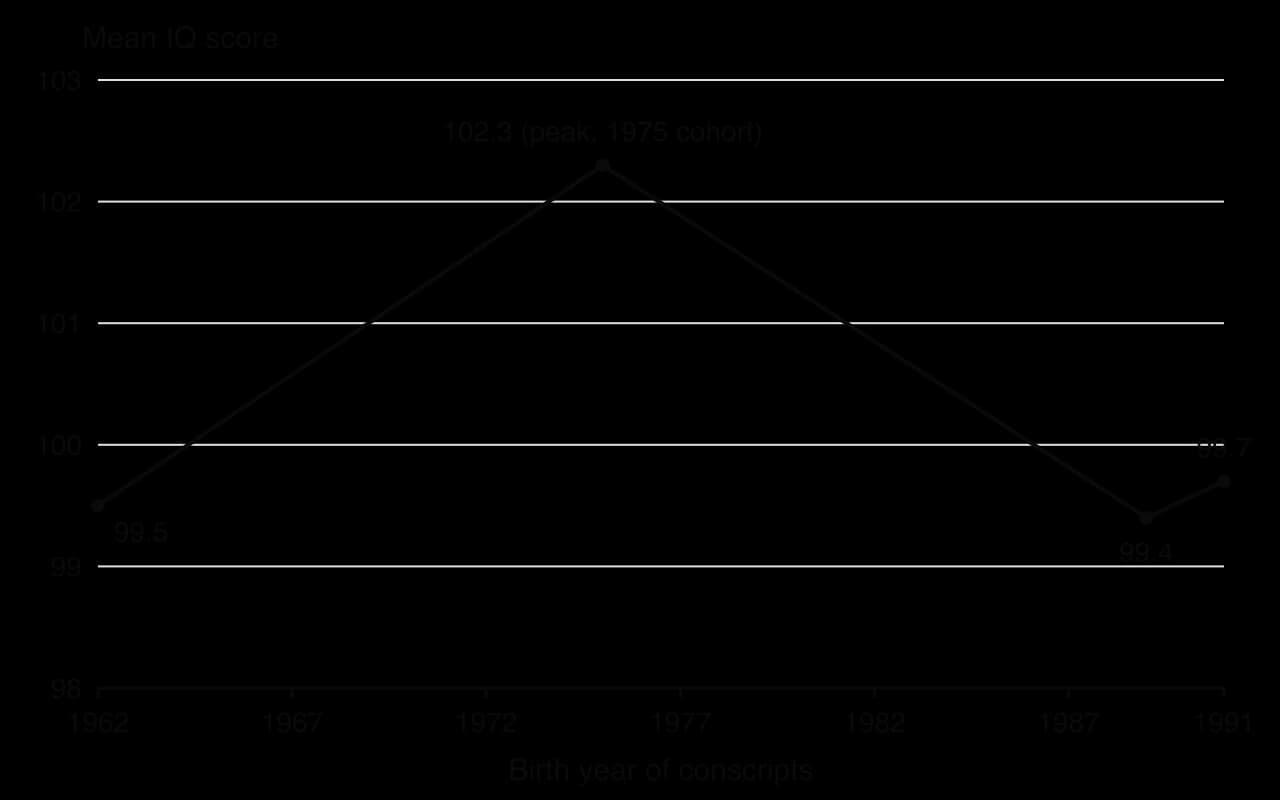
The gains Flynn documented were far too fast to be genetic: the gene pool of a country cannot change enough in 30 years to raise scores by 20 points. The cause had to lie in the environment, with explanations including longer and better schooling, improved nutrition and health, smaller families, and greater familiarity with tests and abstract thinking. Flynn later argued that the gains reflect real changes in how people think, especially a greater habit of abstract, hypothetical reasoning, rather than a simple rise in underlying intelligence.
The Norwegian results add that the reversal is environmental too. Explanations based on differences between families, such as lower-scoring parents having more children, cannot account for a decline that also appears between brothers. Something in the environment that changed for children born after the mid-1970s, such as changes in education, reading or media use, is a more likely cause, although the study does not show which factor.
IQ tests are regularly re-standardised so that the average score is set back to 100. The Flynn effect was only visible because researchers compared raw performance on the same test across years. A further problem is whether a test measures the same thing in different generations. Wicherts et al. (2004) found that the gains did not show measurement invariance, meaning that the test items did not relate to each other in the same way across cohorts. Part of the rise may therefore reflect skills specific to the tests, such as familiarity with abstract puzzles, rather than general intelligence.
Both studies are observational, so neither can identify a single cause. The within-family design is a strong control, because it rules out every explanation that works through differences between families. It cannot, however, separate the many environmental factors that changed at the same time, such as schooling, diet, family size and media, so the causes of both the rise and the decline remain uncertain.
Conscription data cover men only, so the findings may not apply to women. In Norway the share of men with a test score fell from 93% for those born in 1980 to 83% for those born in 1991, and missing scores were more common in families whose older sons had scored low; the authors corrected for this statistically, and the decline remained. The pattern is also not universal. Many countries, especially those still expanding education and improving nutrition, continue to show rising scores, so the reversal describes some wealthy countries rather than a global trend.
The Flynn effect has an ethical significance beyond IQ. If average scores in one country can change by 20 points in a generation for environmental reasons, then differences in average scores between groups cannot be assumed to be genetic. Researchers who report group differences in test scores have a responsibility to explain this, because such findings are easily misused to support prejudice.
Sources: Flynn, J. R. (1987). Massive IQ gains in 14 nations: What IQ tests really measure. _Psychological Bulletin, 101(2), 171–191. Bratsberg, B., & Rogeberg, O. (2018). Flynn effect and its reversal are both environmentally caused. PNAS, 115(26), 6674–6678._
Change can appear in a Paper 1 Section C question, which asks about an area of study from one context through the concept, and in Paper 2, where it can be one of the concepts listed for evaluating an unseen study or for explaining your class practical.
Change is alteration in behaviour, cognition, emotion or biology over time, and the use of psychology to bring it about and evaluate it.
Change can be gradual or sudden, and deliberate (therapy, education, policy) or unplanned (maturation, injury, life events).
A change after an intervention is not proof that the intervention caused it: maturation, natural recovery, regression to the mean, practice and history must be ruled out with a comparison group.
Longitudinal designs show change within people; cross-sectional designs show differences between groups; randomised controlled trials show change caused by an intervention.
Soft determinism holds that biology and environment limit change while people still make real choices; agency and motivation are causes of deliberate change.
Interventions act at individual, local and global levels, and are judged by the size, durability, reach and real-world effectiveness of the change they produce.
Barriers to change are biological, cognitive, emotional, social and structural; habits and relapse explain why much change does not last.
The Flynn effect and its Norwegian reversal show population-level change too fast and too consistent within families to be genetic, raising questions of measurement and causality.
I can describe the concept of change and classify a change as gradual or sudden, deliberate or unplanned.
I can explain why maturation, natural recovery and regression to the mean make it hard to know whether an intervention caused a change.
I can explain how longitudinal, repeated-measures and randomised controlled designs are used to detect change and its causes.
I can discuss free will, determinism and agency and what they imply for changing behaviour.
I can describe and evaluate interventions at individual, local and global levels, including their effectiveness.
I can explain barriers and resistance to change, with examples.
I can apply the concept of change to each approach and each context.
I can evaluate research on the Flynn effect with reference to change, measurement and causality.