Explain the ethical principles that protect research participants and animals, weigh costs against benefits, and evaluate how psychologists use, publish and apply research responsibly.
Each is in the Psychology glossary, with every other term in the subject.
Using psychological knowledge and research to argue publicly for changes in policy or practice that would benefit people or groups, especially those who are marginalised.
The principle that participants’ identities are not recorded or revealed, so that data cannot be linked to a particular person.
The duty to keep information about participants private and secure, sharing it only with their permission or when the law requires it.
Weighing the possible costs of a study to participants, such as distress or deception, against its possible benefits, such as new knowledge or better treatments, to judge whether it is justified.
A full explanation given to participants after a study about its true aims and any deception, with a check on their well-being and a chance to ask questions or withdraw their data.
Misleading participants about the aims or procedures of a study, by withholding information or giving false information; acceptable only when unavoidable and causing no lasting harm.
The principles researchers must take into account to protect the rights, dignity and well-being of participants and others affected by research, such as informed consent, protection from harm and confidentiality.
A group that reviews research proposals before they begin, judging whether risks to participants are acceptable and justified by the benefits and whether procedures meet ethical standards.
A participant’s voluntary agreement to take part in research after being told its purpose, procedures, risks and their rights; given by a parent or guardian for children.
The principle that participants should face no greater risk of physical or psychological harm than in everyday life, and that researchers must stop and support them if harm occurs.
The duty of psychologists to act ethically towards research participants, animals, clients and society, protecting their well-being and rights and considering how findings are communicated and used.
The right of participants to leave a study at any time, without giving a reason or losing any payment, and to have their data removed.
Research that may have consequences for the participants or for the group of people they represent, for example by affecting how that group is seen or treated in society.
Negative attitudes towards a person or group, and unfair treatment of them, because of a characteristic such as a mental health disorder, leading to shame, discrimination and reluctance to seek help.
The principles of replacement (avoiding animals where possible), reduction (using as few animals as possible) and refinement (minimising pain and distress) that guide animal research.
People whose age, health, circumstances or relationship with the researcher limit their ability to give informed consent or protect their own interests, such as children.
Explain what the concept of responsibility means for psychologists as researchers, therapists and advisers.
Describe the main ethical principles for research with human participants and explain why each exists.
Explain how ethical standards can affect the results of research.
Apply cost-benefit analysis to a proposed or published study.
Explain the 3Rs and evaluate the use of animals in psychological research.
Discuss responsibility in socially sensitive research, including stigma, the publication of findings and advocacy.
Evaluate Milgram’s obedience research and later replications with reference to responsibility.
Evaluate research in the four contexts with reference to the concept of responsibility.
Responsibility is the concept that psychologists must use their power over the people and animals they study, treat and advise in an ethical way. It covers how participants are treated during research, whether a study is worth what it costs them, and how findings are published and applied in society.
Responsibility connects with the other concepts at every stage. Ethical rules change what can be measured and how samples are formed, which can introduce bias; they limit the experiments that could show causality; and research that influences treatment or policy brings about change in people’s lives. Each of the approaches and contexts raises its own ethical questions, from animal research in the biological approach to research with children in human development.
With a free account, Augment remembers where you stopped and what you have practiced.
Scope: One of the six concepts that run through the whole course. It covers ethical principles for research with humans and animals, cost-benefit analysis, how ethics affects results, socially sensitive research, stigma, the publication of findings and advocacy, and it is used to evaluate research and its applications in every context.
Psychologists hold power in several roles. As researchers they design situations that participants enter without knowing everything that will happen. As therapists they work with people who are vulnerable, and as advisers to schools, governments and companies their findings can shape policies that affect millions. The relationship between psychologist and participant rests on mutual respect and trust, and responsibility means not abusing that trust.
Responsibility has two sides. Responsibility to participants concerns how individuals and animals are treated in a study: consent, honesty, protection from harm and privacy. Social responsibility concerns the effects of research beyond the study: which questions are asked, how results are reported, whether a group could be stigmatised, and whether psychologists should speak out on issues their research informs.
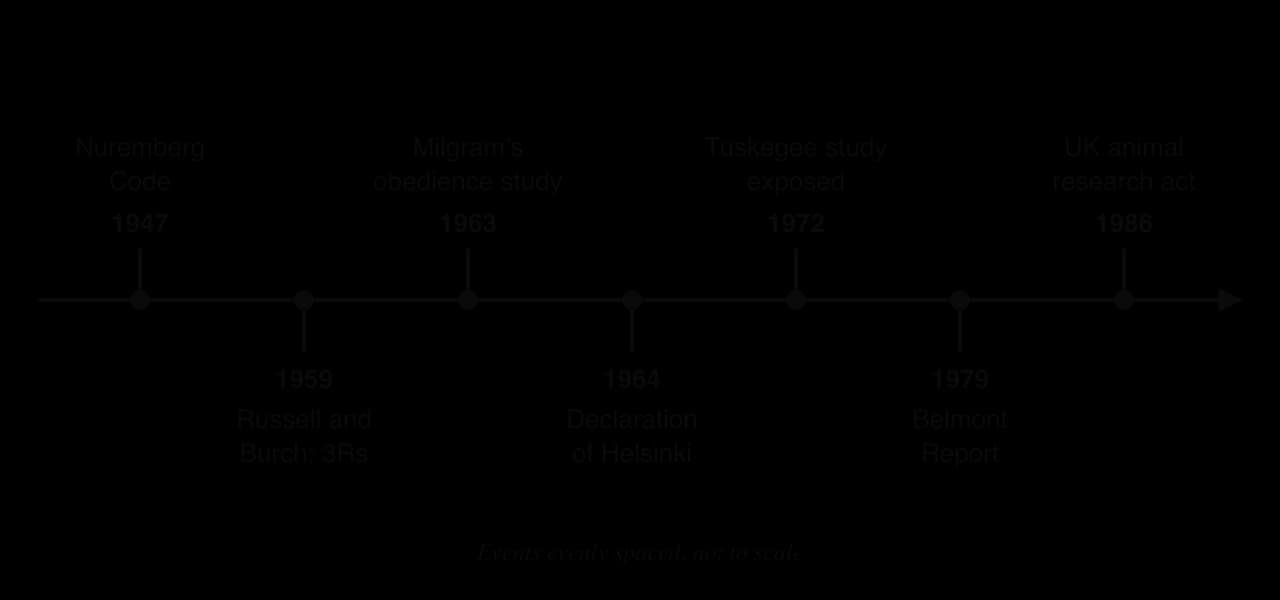
Formal research ethics developed in response to abuse. After the Second World War, the trial of Nazi doctors who had experimented on prisoners led to the Nuremberg Code (1947), whose first principle is that the voluntary consent of the person is essential. The World Medical Association’s Declaration of Helsinki (1964) extended these principles to medical research generally.
In the USA, the Tuskegee study (1932–1972) followed about 600 Black men, around 400 of them with syphilis, to observe the course of the untreated disease. The men were not told their diagnosis, and treatment was withheld even after penicillin became the standard cure in the 1940s. When the study was exposed in 1972, the public outcry led to new US law and the Belmont Report (1979), which set out three principles for research with humans: respect for persons, beneficence (doing good and avoiding harm) and justice.
 YouTube
Psychologists follow codes written by their professional bodies. The American Psychological Association’s Ethics Code is built on five general principles: beneficence and non-maleficence, fidelity and responsibility, integrity, justice, and respect for people’s rights and dignity. The British Psychological Society’s Code of Human Research Ethics is built on four: respect for the autonomy, privacy and dignity of individuals and communities; scientific integrity; social responsibility; and maximising benefit and minimising harm.
Codes give principles rather than rules for every case, so most research institutions require a proposal to be approved before it begins. An ethics committee (called an institutional review board in the USA) is a group of researchers and non-researchers who examine a proposed study, judge whether its risks are justified and acceptable, and may require changes. Approval is usually needed before any participant is recruited.
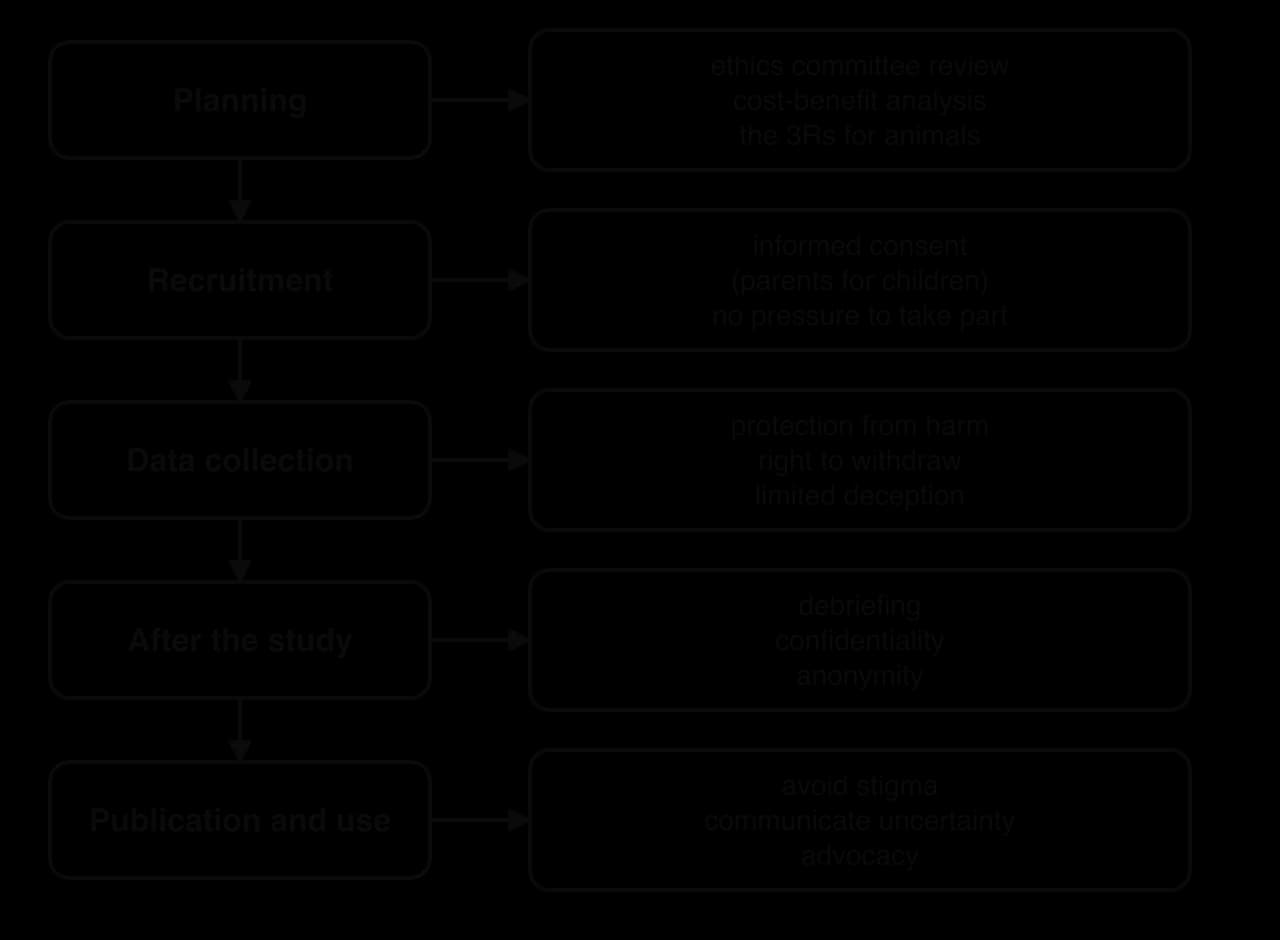
The following principles apply to all research with human participants, whichever approach or method is used. Each protects a different right, and each can conflict with the aim of collecting valid data. The figure shows at which stage of a study each principle mainly applies.
Participants should agree to take part only after they have been told what the study involves, what they will be asked to do, any risks, and their rights, including the right to withdraw. Consent must be voluntary: people must not be pressured, and incentives such as payment should not be so large that people feel they cannot refuse.
Informed consent becomes difficult when knowing the aim would change behaviour. If participants knew a study measured helping, they might help more. Researchers then use partial consent (telling participants the general nature of the study but not the hypothesis) or presumptive consent (asking a similar group whether they would agree to the procedure).
Online research raises new problems. In a study published by Kramer, Guillory and Hancock (2014), Facebook had altered the News Feeds of 689,003 users for a week in 2012 to test whether emotions spread through social networks, relying on the site’s general terms of use rather than specific consent. The journal that published the study later added an editorial expression of concern about consent.
 YouTube
Deception means misleading participants about the purpose or procedures of a study, either by withholding information or by giving false information. Some deception is very mild, such as not naming the hypothesis; some is extensive, such as using confederates who pretend to be participants. Many classic studies depended on it: Festinger and Carlsmith (1959) told participants that the study was about performance on tasks, and paid them to tell the next person that a boring task had been interesting.
Codes allow deception only when the research has significant value, there is no non-deceptive way to answer the question, the deception is not about anything that would cause distress or affect willingness to take part, and participants are told the truth as soon as possible. Deception undermines informed consent, which is why it is treated so cautiously, and repeated use of deception may make participants suspicious of all research, which itself threatens the validity of later studies.
At the end of a study participants should be given a full explanation of its aims, told about any deception and why it was needed, and checked for any distress. Debriefing gives participants the chance to ask questions and to withdraw their data. It should leave them in at least the same state as when they arrived.
Debriefing cannot undo every harm. A participant who has discovered something unpleasant about themselves, for example that they were willing to hurt someone, may still feel troubled after being told the truth. Debriefing therefore reduces the harm of a study but does not justify causing distress in the first place.
Participants must be told that they can leave a study at any time without giving a reason and without penalty, and that they can withdraw their data afterwards. The right to withdraw protects people who find a study more uncomfortable than they expected, and it reminds participants that the researcher’s authority is limited.
The right exists in practice only if participants feel able to use it. Children, patients, employees and students taking part in research run by their teacher may feel unable to refuse. For this reason, codes ask researchers to remind participants of their right during the study, especially when it becomes stressful.
Participants should not be exposed to risks greater than those of everyday life, whether physical (injury, exhaustion) or psychological (anxiety, embarrassment, loss of self-esteem). If harm occurs, the researcher must stop the procedure and support the participant. Protection from harm is the principle most often weighed against the value of a study.
Watson and Rayner (1920) taught an 11-month-old infant, “Little Albert”, to fear a white rat by striking a steel bar loudly behind him whenever he touched it; the fear spread to other furry objects. Albert left the hospital before the researchers attempted to remove the fear, so he was never protected from the harm they had created.
Haney, Banks and Zimbardo’s Stanford prison study (1973) was stopped after six of a planned fourteen days because of distress among the student “prisoners”. Zimbardo acted both as lead researcher and as prison “superintendent”, a dual role that made it harder for him to see when to stop; later archive work showed that the guards had also been guided by the research team.
Participants’ personal information should be kept private. Confidentiality means that information is stored securely and not shared without permission. Anonymity goes further: participants’ names and identifying details are never recorded or published, so no one, including readers of the research, can link the data to a person.
Case studies show why this matters. Henry Molaison, who lost the ability to form new long-term memories after brain surgery in 1953, was studied for more than 50 years and was known in hundreds of publications only as “H.M.” until his death in 2008. His case also raised a question of consent: because he could not remember agreeing to earlier sessions, his ongoing participation depended on others protecting his interests.
Some people are less able to protect their own interests: children, people with mental health disorders or learning disabilities, older people with dementia, prisoners, and people in a dependent relationship with the researcher. Research with these vulnerable participants needs extra safeguards, such as consent from a parent or guardian, the participant’s own agreement (assent) where possible, and close attention to signs of distress.
Bandura, Ross and Ross (1961) showed nursery-school children aged about three to six an adult attacking an inflatable doll before letting them play with it, which raises the question of whether children should be exposed to aggressive models for research. In the Bucharest Early Intervention Project, 136 young children living in Romanian institutions were randomly assigned either to foster care or to remain in institutional care. The design produced strong evidence that family care helps development, but critics asked whether it was right to leave half the children in institutions, a care known to be harmful, for the sake of a control group.
Observing people in public places, such as a park, a shopping centre or a social media site with public posts, does not usually require consent, because people expect to be seen by strangers there. Codes still ask researchers to respect privacy: people should not be observed where they would reasonably expect privacy, such as in toilets or private messages, and no individual should be identifiable in published results. Covert observation in semi-private settings, for example joining an online support group without telling its members, raises serious questions because members share personal information in the belief that only the group will see it.
Principle | What it protects | Common conflict with research aims |
|---|---|---|
Informed consent | Autonomy: the right to decide | Knowing the aim may change behaviour (demand characteristics) |
Deception | Trust and the validity of consent | Some behaviours can only be studied if participants are misled |
Debriefing | Understanding and well-being after the study | Cannot fully undo distress or self-knowledge |
Right to withdraw | Freedom to stop | Withdrawals can bias the final sample |
Protection from harm | Physical and psychological well-being | Stress, fear or conflict may be the very thing studied |
Confidentiality and anonymity | Privacy | Detailed case studies may make a person identifiable |
Ethical principles often conflict with one another and with the aims of research. A study of how people respond to stress cannot avoid causing some stress; a study of honesty may need to mislead participants. Researchers and ethics committees therefore weigh what a study costs the people involved against what it may achieve.
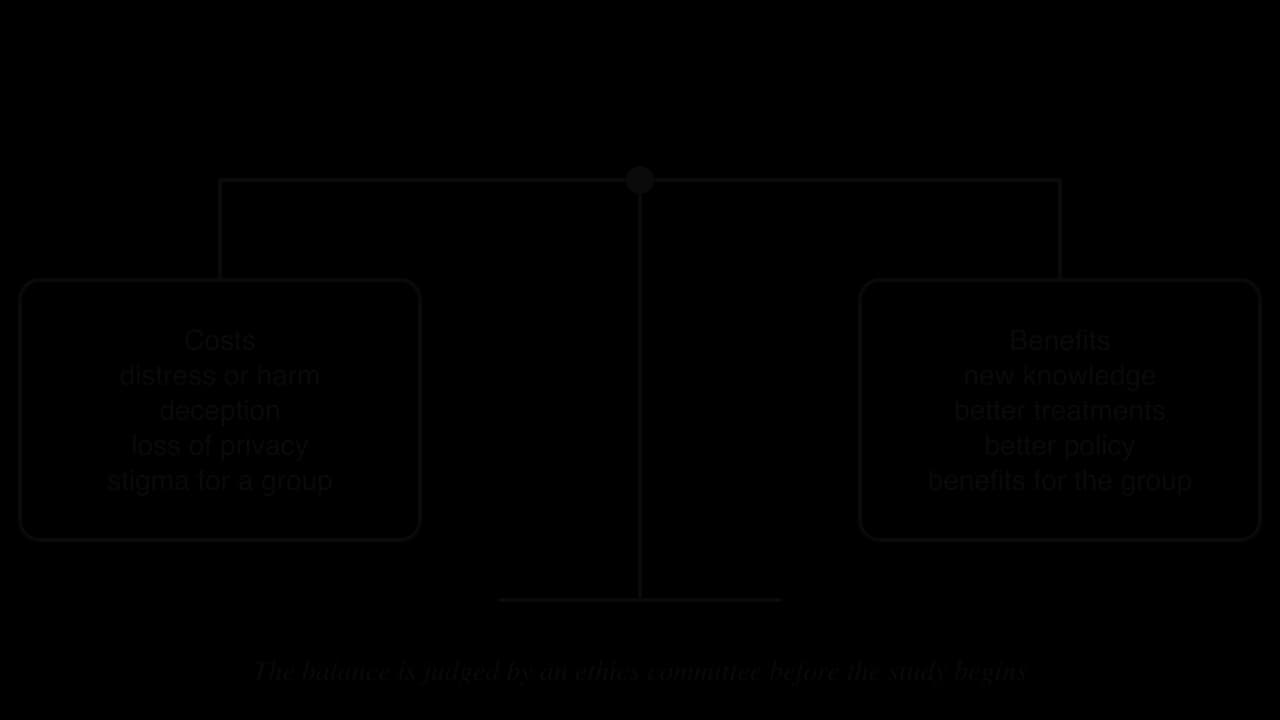
Cost-benefit analysis is the main way the concept asks its central question: can the potential benefits of research justify relaxing ethical standards? Supporters argue that some knowledge, such as how ordinary people come to obey harmful orders, can only be gained from studies that carry real costs, and that this knowledge protects society. Critics argue that individual rights should not be traded for possible benefits to others.
Costs and benefits are hard to predict. Milgram did not expect most participants to reach the maximum shock, so he could not anticipate how much stress the study would cause.
Costs and benefits fall on different people. Participants bear the costs; society, researchers and future patients receive the benefits.
The judges are not neutral. Researchers may overestimate the value of their own studies, and committees may be cautious or lenient depending on their members.
Some costs may be unacceptable whatever the benefits. Many ethicists argue that serious harm or the absence of consent cannot be justified by any expected gain.
Ethics and the quality of research are linked. Ethical principles protect participants, but they also change who takes part, what they know and how they behave, so they can affect the validity of results. Seeing this connection is part of evaluating any study through the concept of responsibility.
Ethical requirement | Possible effect on results | Example |
|---|---|---|
Informed consent | Knowing the aim may produce demand characteristics; only certain people agree to take part (volunteer bias) | Volunteers are often better educated and more interested in being approved of than non-volunteers |
Right to withdraw | Participants who find the study hardest may leave, so the final sample is biased | In a long therapy trial, people who drop out may be those for whom the therapy was not working |
Anonymity | Often improves validity: people report sensitive behaviour more honestly when they cannot be identified | People tend to report more sensitive behaviour, such as drug use, in anonymous questionnaires than in face-to-face interviews |
Ban on deception | Some behaviours, such as obedience or helping, can only be studied in artificial or self-report forms | Studies of obedience now stop at low levels or use virtual reality, so they can say less about extreme obedience |
Protection from harm | Only mild versions of stressors can be studied, so findings may not generalise to severe real-life stress | Laboratory stress tasks compared with real traumatic events |
Rosenthal and Rosnow’s research on volunteer participants in the 1970s found that people who volunteer for studies differ in systematic ways from those who do not, for example in education and in their need for social approval. Because consent is always needed, every sample is to some extent a volunteer sample, so findings may not apply to people who would never agree to be studied. This is an example of how the concept of responsibility interacts with bias and measurement.
Animal research is used most in the biological approach, for example to study the effects of brain damage, drugs, stress or early deprivation in ways that would be impossible with humans. It raises its own ethical questions, because animals cannot consent and many procedures cause pain or distress.
The main framework for animal research is the 3Rs, set out by William Russell and Rex Burch in The Principles of Humane Experimental Technique (1959). Replacement means using methods that avoid animals altogether, such as cell cultures, computer models or research with human volunteers. Reduction means using the smallest number of animals that will give reliable results, through good design and statistics. Refinement means changing procedures and housing to reduce pain, suffering and distress for the animals that are used.
The 3Rs were implicit in the UK’s Animals (Scientific Procedures) Act 1986, which requires licences for researchers, projects and institutions, and are made explicit in the European Union’s Directive 2010/63/EU. Before a licence is granted, the expected benefits must be weighed against the harm to the animals, which is cost-benefit analysis applied to animals.
Harlow’s research in the 1950s and 1960s is a classic example of the debate. Infant rhesus monkeys were separated from their mothers and raised with wire and cloth “surrogate” mothers; they preferred the cloth mother for comfort, and many later showed severe social and emotional problems. The research changed thinking about the importance of comfort and attachment in childcare, but the lasting harm to the monkeys would not be permitted under current rules.
Supporters point to benefits that would have been impossible otherwise, such as understanding how stress affects the brain or how drugs act on neurotransmitters, and to the strict controls now in place. Critics raise two kinds of objection. The ethical objection is that causing suffering to animals that cannot consent is wrong, or justified only for very serious human problems. The scientific objection is that results from rats or monkeys may not generalise to humans, whose behaviour depends so much on language, culture and thought, so the benefit side of the analysis is often smaller than claimed.
The principles that protect participants during a study are only part of responsibility. Research also affects people who never took part: the groups it describes, the people treated according to its findings, and the public who hear about it in the media. Psychologists are increasingly expected to consider these effects too.
Sieber and Stanley (1988) defined socially sensitive research as studies with potential social consequences or implications, either for the participants or for the wider group of people the research represents. Research on group differences in intelligence, on sexuality, on the causes of crime, or on mental health disorders in particular communities all fall into this category. The concern is not that such research should never be done, but that the questions asked, the way results are interpreted and the way they are reported can harm a whole group.
Sieber and Stanley identified concerns at every stage: the framing of the research question, how participants’ privacy is protected, how data are interpreted, and how findings may be used by others, including policymakers. A study that asks “Why do people from group X perform worse?” already assumes a deficit in the group, while a study asking “What helps students from group X succeed?” may answer a similar question with less risk of stigma.
Stigma is the negative judgement and unfair treatment of people because they belong to a group or have a characteristic, such as a mental health disorder. Research can reduce stigma, for example by showing that disorders are common and treatable, but it can also increase it. From the 1940s to the 1960s, some clinicians described autism as caused by cold, rejecting parenting (“refrigerator mothers”), an explanation with no good evidence that caused guilt and blame for many families before it was abandoned.
Explanations of mental health disorders carry this risk too. A purely biological explanation may reduce blame (“it is an illness, not a weakness”) but can increase the belief that people with the disorder are permanently different or dangerous. Responsible researchers think about how their explanations will be understood by the public and by the people they describe.
Responsibility includes reporting findings accurately and making their limits clear. Rauscher, Shaw and Ky (1993) found that 36 college students performed slightly better on a spatial reasoning task for about 15 minutes after listening to Mozart. Media reports turned this into the “Mozart effect”: the claim that classical music makes children more intelligent. In 1998 the governor of Georgia in the USA proposed spending $105,000 a year to give every newborn in the state a classical music recording.
Later meta-analyses found little support for the claim. Chabris (1999) concluded that any effect was small and did not reflect a change in IQ or general reasoning, and Pietschnig, Voracek and Formann (2010) found small effects overall and larger effects in studies by the original research group, together with signs of publication bias. The case shows how a small, cautious finding can be turned into a policy when uncertainty is not communicated, and why researchers share responsibility for how their findings are reported.
Psychologists sometimes go beyond reporting findings and use their research to argue for change, which is called advocacy. Kenneth and Mamie Clark’s research in the 1940s, in which many Black children in the USA preferred white dolls to Black dolls, was cited by the US Supreme Court in Brown v. Board of Education (1954), the decision that ended legal racial segregation in schools. Psychologists today advocate for policies on mental health services, children’s rights and the treatment of refugees.
Advocacy raises its own questions of responsibility. It can protect marginalised groups and make research useful, but researchers who campaign for a cause may be tempted to overstate their evidence, and the public may find it hard to separate research findings from the researcher’s values. Responsible advocacy therefore states clearly what the evidence does and does not show.
Every approach and context raises its own ethical issues, and the same principle can look different depending on the method. The table gives typical examples.
Area | Typical ethical issue | Example |
|---|---|---|
Biological approach | Animal welfare; invasive or risky procedures; genetic information that could cause anxiety or discrimination | Animal models of stress and deprivation; telling people about genetic risk for a disorder |
Cognitive approach | Deception about the aim of tasks; mild stress or failure feedback | False feedback studies; memory experiments with misleading information |
Sociocultural approach | Deception and confederates; research on groups that could be stigmatised; imposing one culture’s values | Conformity and obedience studies; cross-cultural comparisons that rank cultures |
Health and well-being | Vulnerable participants; withholding treatment from control groups; confidentiality of diagnoses | Wait-list control groups in therapy trials; interviews with people who have depression |
Human development | Consent from parents and assent from children; long-term effects of research on development | Bandura’s children watching aggression; the Bucharest Early Intervention Project |
Human relationships | Privacy in relationships; deception about partners; online data | Research on couples’ conflicts; the Facebook emotional contagion experiment |
Learning and cognition | Students and teachers as participants; pressure from authority; how findings are applied in schools | The Mozart effect; learning-styles programmes sold to schools |
In health and well-being, responsibility also applies to treatment. Therapists must obtain consent for treatment, keep sessions confidential, and use treatments with good evidence. The choice of control group in a therapy trial is an ethical decision: wait-listing means that some participants receive treatment later rather than never, which is fairer than a no-treatment group but still delays help for people who need it.
Milgram’s obedience research is one of the best-known studies in psychology and the most widely debated case in research ethics. It is treated as an ethics case: what was done to participants, how the costs and benefits have been judged, and how later researchers found more ethical ways to study the same question.
Milgram aimed to find out how far ordinary people would obey an authority figure who instructed them to harm another person. The question was prompted by the Holocaust and the defence of many of those involved that they had been following orders.
Forty men aged 20 to 50 from the New Haven area of the USA, with a range of jobs from postal clerks to engineers, were recruited through a newspaper advertisement and direct mail and paid $4.50. They were told the study was about the effect of punishment on learning. Each participant was assigned, through a rigged draw, to be the “teacher”, while a confederate, a likeable middle-aged man, became the “learner” and was strapped into a chair in the next room.
The teacher was told to give the learner an electric shock for each wrong answer on a word-pair task, increasing the voltage each time on a generator with 30 switches from 15 to 450 volts. The switches were labelled from “Slight shock” to “Danger: severe shock”, with the last two marked “XXX”. No real shocks were given.
At 300 volts the learner pounded on the wall, and after 315 volts he made no further response. If the teacher hesitated, the experimenter used four standard prods, starting with “Please continue” and ending with the instruction that the participant had no other choice but to go on. Obedience was operationalised as the highest shock given before refusing.
All 40 participants gave shocks up to at least 300 volts, and 26 of the 40 (65%) continued to the maximum of 450 volts. Before the study, students and colleagues asked by Milgram to predict the result had expected almost no one to go to the end.

The participants showed signs of extreme stress: sweating, trembling, stuttering, biting their lips and digging their fingernails into their hands. Fourteen showed nervous laughter, and Milgram reported full-blown, uncontrollable seizures in three. He described one businessman who arrived “smiling and confident” and within 20 minutes was reduced to “a twitching, stuttering wreck”.
Milgram concluded that ordinary people are far more likely to obey a legitimate authority than most people expect, even when obedience conflicts with their own conscience. Situational factors, such as the prestige of the setting and the experimenter taking responsibility, appeared to matter more than the personality of the participant.
Participants were deceived about the aim, the role draw and the shocks, so their consent was not fully informed. Their right to withdraw was undermined by prods telling them they had no choice but to continue, although 14 did withdraw. Most seriously, many experienced intense distress, which breaches protection from harm. Baumrind (1964) argued that the experimenter should have stopped when participants became distressed and that the stress was not justified by the knowledge gained.
Milgram replied (1964) that participants were debriefed after the session, including a friendly meeting with the unharmed learner, and that in a follow-up questionnaire 84% said they were glad or very glad to have taken part and only about 1% regretted it. He also argued that no one could have predicted the results, so the costs were not foreseeable. Archive research by Gina Perry (2012) complicated this defence: she found that many participants were not told the full truth until months later, when a written report was mailed to them, and that the experimenter often departed from the four standard prods.
Principle | Criticism | Milgram’s defence | Later evidence |
|---|---|---|---|
Informed consent and deception | Participants were misled about the aim, the draw and the shocks | Deception was necessary; the study could not be run otherwise | Burger (2009) still needed deception, but limited the harm it could cause |
Right to withdraw | Prods told participants they had no choice | 14 of 40 did withdraw, so leaving was possible | Perry (2012): the experimenter often went beyond the standard prods |
Protection from harm | Severe distress, including seizures | Distress was not foreseen and was short-lived | Follow-up found 84% glad to have taken part, but debriefing was often delayed |
Perry’s archive work also suggested that only about half of the participants fully believed the shocks were real, and that those who believed were more likely to disobey. If so, the 65% figure may overstate obedience to a genuinely harmful order. The sample of 40 self-selected men from one American town in the early 1960s also limits generalisability, although Milgram’s later variations included women and other settings.
Supporters argue that the study revealed something important and uncomfortable about human behaviour that could not have been found any other way, and that it is still used to teach people to recognise and resist destructive authority. Critics answer that individual participants paid the cost of this knowledge without agreeing to it, and that the distress was foreseeable once the first sessions had been run. The debate itself contributed to the stricter codes and ethics committees that now review research.
Burger (2009) designed a partial replication that an ethics committee could approve. He screened out anyone likely to react badly to stress, reminded participants repeatedly that they could withdraw, and had the learner tell them within seconds of the end of the session that no shocks had been given. Most importantly, he stopped the study at 150 volts, the point where the learner first protests. In Milgram’s research, 79% of participants who went past this point continued to the end, so willingness to continue past 150 volts is a good estimate of full obedience.
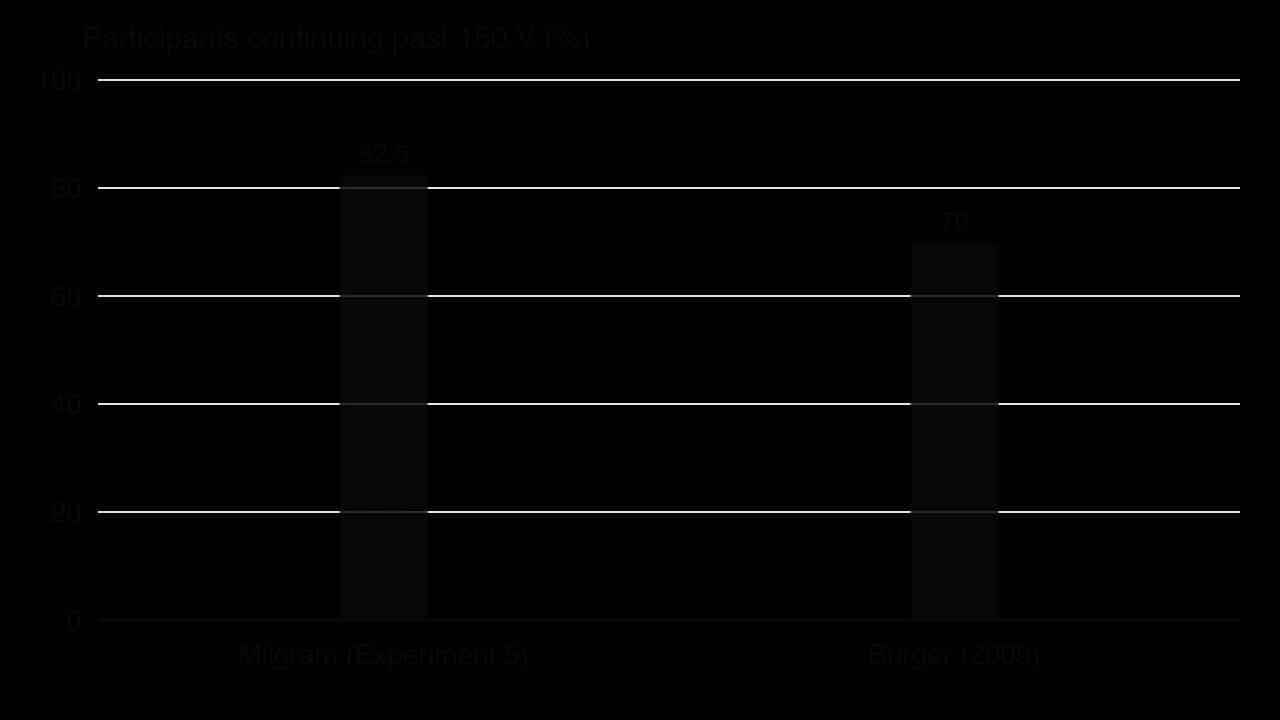
With 70 adults, Burger found that 70% were prepared to continue past 150 volts, compared with 82.5% in the comparable condition of Milgram’s research. The difference was not statistically significant. The study shows that some research questions can be answered under stricter ethics, though at a cost: it cannot show what people would do at much higher levels of harm. Slater and colleagues (2006) took another route, using a virtual-reality learner; participants knew the learner was not real but still showed stress responses, which suggests that even simulations raise ethical questions.
Sources: Milgram, S. (1963). Behavioral study of obedience. _Journal of Abnormal and Social Psychology, 67(4), 371–378. Burger, J. M. (2009). Replicating Milgram: would people still obey today? American Psychologist, 64(1), 1–11._
Responsibility is one of the six concepts that exam questions are built around. It can be the organising concept of a Paper 1 Section C essay on any area of study in the contexts, it is often one of the concepts named in a Paper 2 Section B question about an unseen study, and in Paper 2 Section A it can be the concept to explain in relation to a class practical. Ethical considerations are also part of the research proposal in the internal assessment.
Responsibility is the duty of psychologists to act ethically towards participants, animals, clients and society, including how research is used.
Ethical codes developed in response to harm (the Nuremberg Code, Tuskegee and the Belmont Report); ethics committees now review studies before they begin.
The main principles for human participants are informed consent, limited deception, debriefing, the right to withdraw, protection from harm, and confidentiality and anonymity, with extra safeguards for vulnerable participants.
Cost-benefit analysis weighs costs to participants against benefits to knowledge and society, but both are hard to predict and fall on different people.
Ethical standards affect results: consent creates volunteer samples and demand characteristics, withdrawal biases samples, and anonymity can make self-report more valid.
Animal research is guided by the 3Rs: replacement, reduction and refinement.
Social responsibility covers socially sensitive research, avoiding stigma, communicating uncertainty (as the Mozart effect shows) and advocacy.
Milgram (1963) found that 65% of participants obeyed to 450 V, under severe deception and stress; Burger (2009) found 70% continued past 150 V under a far more protective procedure.
I can explain what responsibility means for psychologists and why ethical codes were developed.
I can describe each ethical principle for human participants and explain why it exists.
I can explain how informed consent, the right to withdraw and anonymity can affect results.
I can apply cost-benefit analysis to a study and suggest safeguards.
I can explain the 3Rs and evaluate animal research ethically and scientifically.
I can discuss socially sensitive research, stigma, communicating uncertainty and advocacy with examples.
I can describe and evaluate Milgram (1963) and Burger (2009) with reference to responsibility.
I can evaluate research in each of the four contexts with reference to responsibility.