 YouTube
Explain how the biological, cognitive and sociocultural approaches act as perspectives on behaviour, evaluate reductionism and holism, compare deductive and inductive research, and discuss Indigenous psychologies.
Each is in the Psychology glossary, with every other term in the subject.
A theoretical framework for explaining behaviour, based on assumptions about what causes behaviour and how to study it, such as the biological, cognitive or sociocultural approach; also called a perspective.
A top-down research strategy that starts from an existing theory, derives a testable hypothesis and collects data to support or refute it.
Explaining behaviour as an integrated whole, on the view that a person in their relationships, culture and history is more than the sum of separate parts.
Approaches to psychology developed from within a culture, using its own concepts, values and ways of knowing to understand its people, rather than theories and methods imported from elsewhere.
A bottom-up research strategy that starts from data, often qualitative, identifies patterns and themes, and builds explanations or theory from them, as in grounded theory.
An approach that explains behaviour through the way biological, cognitive and sociocultural factors influence one another, rather than through any one factor alone.
A simplified representation of a complex process, usually showing its components and how they are linked, used to explain the process, test hypotheses and make predictions.
The standpoint from which behaviour is explained and studied, including the approach used, its assumptions, and whose viewpoint (researcher, participant or culture) shapes the questions and interpretation.
Explaining a complex behaviour by breaking it down into simpler, more basic components, such as one neurotransmitter, one gene or separate memory stores.
An organised set of principles that explains and predicts behaviour and can be tested by research.
Explain what the concept of perspective means in psychology and why no single perspective is sufficient to explain behaviour.
Describe the main assumptions of the biological, cognitive and sociocultural approaches about behaviour and about how it should be researched.
Apply the three approaches to one behaviour and explain how their explanations interact.
Evaluate reductionist and holistic explanations of behaviour, with examples of each.
Compare and contrast deductive and inductive research methodology.
Discuss the contribution of Indigenous psychologies to the study of behaviour.
Suggest alternative explanations and interpretations of research findings.
Evaluate research and theories in the four contexts with reference to the concept of perspective.
Perspective is the concept that human behaviour can be explained and studied from several standpoints, each with its own assumptions, questions and methods. Depression, for example, can be explained through brain chemistry, through patterns of negative thinking or through poverty and loss, and each explanation captures something the others miss.
Perspective is one of the six concepts of the course, together with bias, causality, change, measurement and responsibility. It applies to the three approaches themselves, to the methods psychologists choose, to whose viewpoint shapes a piece of research, and to how findings in each of the four contexts are interpreted.
With a free account, Augment remembers where you stopped and what you have practiced.
Scope: One of the six concepts that run through the whole course. It covers the approaches as perspectives, theories and models, reductionism and holism, deductive and inductive methodology, emic and etic research, the perspectives of Indigenous people, and alternative explanations; it is used to evaluate content and research in every context.
Humans have large frontal lobes, self-awareness, language and culture. Their behaviour is shaped at the same time by genes and hormones, by memories and beliefs, and by families, groups and societies. Because of this complexity, psychology has developed several ways of looking at behaviour rather than one. Each way of looking makes some causes visible and leaves others in the background.
In this course the three main perspectives are the biological approach, the cognitive approach and the sociocultural approach. In psychology the words “approach” and “perspective” are used interchangeably for these frameworks. To keep the two ideas apart, “approach” refers to the three frameworks, and “perspective” to the wider concept, which also includes the viewpoint of the researcher, the participants and their culture.
Each approach is built from theories and models. A theory states why something happens and allows predictions that research can test. Social identity theory, for example, predicts that people will favour their own group even when the groups are meaningless. A model is a simplified representation of a process, usually shown as a diagram of parts and the links between them, such as the multi-store model of memory or the diathesis-stress model of mental health disorders.
Theories and models are themselves perspectives. A model of memory as a set of stores directs researchers to measure how much information each store holds and for how long; it does not lead them to ask how culture shapes what people remember. Choosing a theory therefore decides which questions get asked and which data are collected.
The concept has two connected meanings, and both appear in evaluation. The first is the theoretical perspective: which approach, theory or model is used to explain behaviour. The second is the viewpoint perspective: whose understanding shapes the research, for example the researcher looking from outside a culture or the participants describing their own experience. A study of depression in rural Ghana can take a biological perspective (measuring stress hormones) and, separately, take the perspective of the outside researcher or of the community itself.
Meaning | Question it asks | Example |
|---|---|---|
Theoretical perspective | Which approach, theory or model explains this behaviour? | Explaining aggression through testosterone, through hostile attribution or through social learning |
Viewpoint perspective | Whose understanding frames the research and its conclusions? | Measuring parents’ “warmth” with a scale written in another country, or asking parents how they show care |
Each approach rests on assumptions: beliefs about what behaviour is and what causes it, and beliefs about how it can be studied. These assumptions are rarely tested directly. They decide which explanations an approach offers and which methods it prefers, so they are the starting point for evaluating any theory.
The biological approach assumes that behaviour has a physical basis in the brain, the nervous system, chemical messengers and genes. It assumes that biological processes can be measured objectively and that, because humans share their biology with other species, research on animals can say something about humans. Typical methods are brain imaging, twin and adoption studies, drug trials and animal research.
The biological approach has produced precise, testable explanations and many treatments, from medication for mental health disorders to an understanding of how brain injury affects language. Its main risk is biological reductionism: explaining a complex behaviour only through one physical cause, as if a feeling of love were nothing more than a rise in oxytocin.
The cognitive approach assumes that behaviour is guided by mental processes such as attention, memory, perception and decision-making, and that these processes can be studied scientifically even though they cannot be seen. It often treats the mind as an information processor, with input, processing, storage and output. Its typical methods are laboratory experiments with carefully controlled tasks, from which researchers infer what happens inside the mind, and cognitive models that are then tested.
The cognitive approach explains why two people react differently to the same event, because each person interprets the event in a different way. Schemas, for example, lead people to remember a story in a way that fits what they already know. Its main risk is to treat thinking as if it happened in a computer, separate from emotion, the body and culture.
The sociocultural approach assumes that behaviour is shaped by other people, by the groups people belong to and by culture. It assumes that behaviour must be studied in its social and cultural context, because the same act can mean different things in different places. Its methods include field experiments, surveys, interviews, observation and cross-cultural comparison, and it uses both quantitative and qualitative data.
The sociocultural approach is the most holistic of the three, because it looks at people within their relationships and communities. It is also the approach most likely to use both emic research, which studies a culture from within using its own meanings, and etic research, which compares cultures using shared categories. Its main risk is cultural determinism: treating individuals as if they simply carried out the norms of their group.
Biological | Cognitive | Sociocultural | |
|---|---|---|---|
Assumption about behaviour | Behaviour has a physical basis in the brain, chemical messengers and genes | Behaviour is guided by mental processes that can be studied scientifically | Behaviour is shaped by other people, groups and culture |
Assumption about research | Behaviour can be measured objectively; animal research can inform human research | Mental processes can be inferred from performance on controlled tasks | Behaviour must be studied in context; meanings differ between cultures |
Typical methods | Brain imaging, twin studies, drug trials, animal models | Laboratory experiments, cognitive tasks, models | Field studies, surveys, interviews, observation, cross-cultural comparison |
Typical data | Mostly quantitative | Mostly quantitative | Quantitative and qualitative |
Main risk | Biological reductionism and determinism | Treating the mind as a machine, ignoring emotion and culture | Cultural determinism; difficulty establishing cause and effect |
The table shows that each approach is strong where another is weak. Biological research is precise but often removed from everyday meaning; sociocultural research is close to real life but finds it harder to show cause and effect. For this reason the approaches are best treated as complementary rather than competing.
YouTubeA single perspective can describe one cause very precisely, but behaviour almost always has several causes that act together. A biological explanation of smoking (nicotine acting on the brain’s reward system) explains why stopping is hard, but not why smoking rates differ so much between countries, social classes and genders. A sociocultural explanation (peer modelling and advertising) explains who starts, but not why some people become dependent quickly and others do not.
The approaches also study behaviour at different scales: a neuron, a thought, a family, a society. Each scale has questions that only it can answer. For this reason, the strongest explanations in psychology combine evidence from more than one approach and show how the factors interact.
Major depressive disorder shows clearly why one perspective is not enough. Each approach offers a real explanation with evidence behind it, and treatments based on each approach help some people. The figure places the three explanations around the disorder.

The biological approach looks for causes in genes, brain structure and chemical messengers. Depression runs in families, twin studies suggest a moderate genetic contribution, and chronic stress raises cortisol. For decades the most popular explanation was a shortage of serotonin, which was used to explain why antidepressants that act on serotonin help some patients.
In 2022 an umbrella review by Moncrieff and colleagues brought together the main lines of evidence (serotonin levels in body fluids, receptor and transporter studies, tryptophan depletion and genetic studies) and found no consistent evidence that depression is caused by lowered serotonin. Critics replied that the drugs can still help even if low serotonin is not the cause. The debate shows how strongly a theoretical perspective can shape what researchers look for and how they read the same evidence.
The cognitive approach explains depression through the way people interpret events. Beck’s cognitive model proposes a cognitive triad of negative views about the self, the world and the future, maintained by negative self-schemas and by rumination, the habit of going over problems repeatedly. Two people may lose a job; the one who thinks “this proves I am worthless” is more likely to become depressed than the one who thinks “the company had bad luck”.
The sociocultural approach looks at the person’s social world. Stressful life events, poverty, isolation and the absence of social support all raise the risk of depression. Culture also shapes how distress is experienced and expressed: Kleinman’s research in China in the 1980s found that many patients described depression mainly through bodily symptoms such as fatigue and headaches, rather than sadness.
The three perspectives are not separate explanations to choose between. Negative thinking is learned in families and cultures, it affects stress hormones, and stress hormones in turn affect mood and thinking. The diathesis-stress model expresses one form of this interaction: a vulnerability (biological or cognitive) leads to disorder only when stress from the environment is high enough, as Caspi and colleagues argued for the serotonin transporter gene in 2003.
Perspectives differ in how much they simplify. Some explain a behaviour by breaking it into a few basic parts; others insist on seeing the person as a whole in a particular setting. This difference is described by two opposing terms.
Reductionism takes several forms. Biological reductionism reduces behaviour to genes, brain areas or chemical messengers. Machine reductionism reduces thinking to information-processing stages, as in cognitive models that treat memory like computer storage. Environmental reductionism reduces behaviour to learned links between stimuli and responses, as in classical conditioning and operant conditioning.
Reductionism and holism are best seen as ends of a continuum rather than two boxes. The figure places five kinds of explanation along it.
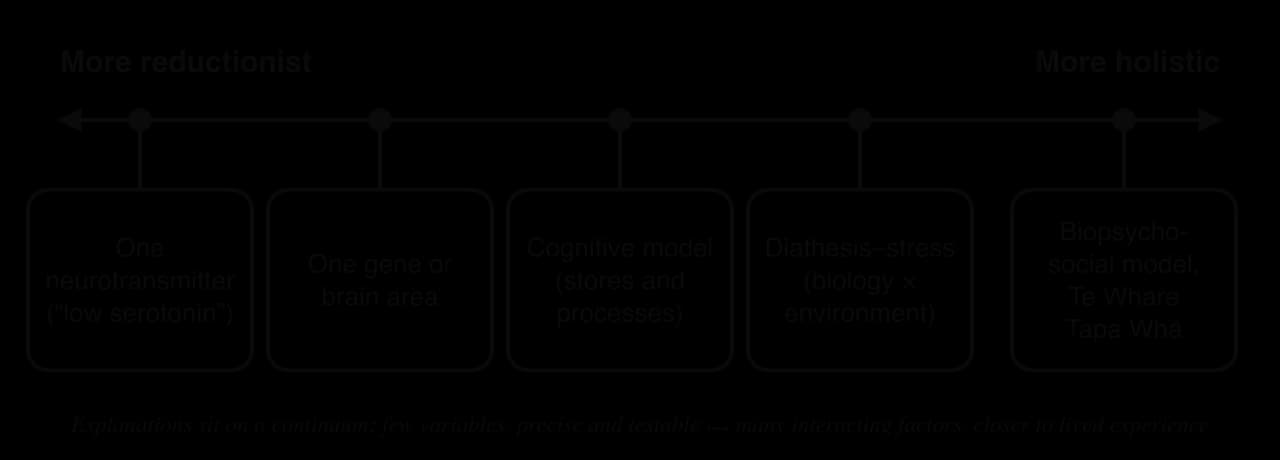
Reductionism is the basis of most scientific progress in psychology. By isolating one variable, researchers can form precise hypotheses, control other variables and test whether the variable has an effect. This is how researchers learned that damage to a small area of the left frontal lobe affects speech production, and how drugs that act on particular chemical messengers were developed.
The limitation is that complex behaviour rarely has one cause. A reductionist explanation may be correct about the part it measures and still be misleading about the whole. It can also encourage determinism, the view that behaviour is fixed by biology or environment, which may lead people to believe that they cannot change (“it is in my genes”).
Reductionist explanations | Holistic explanations | |
|---|---|---|
Strengths | Precise, testable hypotheses; variables can be isolated and controlled; can lead to targeted treatments | Capture complexity, meaning and context; closer to real experience; consider interactions between factors |
Limitations | Oversimplify; ignore interactions and context; can encourage determinism | Hard to test scientifically; can be vague; hard to say which factor matters most |
Example | Depression explained as a serotonin deficiency | The biopsychosocial model: biological, psychological and social factors together |
Between the two extremes lies interactionism, the view that behaviour is best explained by the way factors from several levels affect one another. An interactionist does not simply add up biological, cognitive and social causes: the effect of one factor depends on the level of another. The diathesis–stress model and research on gene–environment interaction are interactionist explanations.
The psychiatrist George Engel (1977) argued in the journal Science that medicine needed a new model. The “biomedical” model, he wrote, reduced illness to bodily processes and left out the patient as a person. He proposed the biopsychosocial model, in which biological, psychological and social factors are all considered in understanding and treating illness. The model is now standard in clinical psychology and health care, although critics argue that it is a general reminder to consider everything rather than a theory that makes testable predictions.
Perspective affects how research is done, not only how behaviour is explained. Before a study begins, the researcher has already chosen what counts as data, which method to use and which categories to measure. These choices follow from the approach and from the researcher’s own background, so two researchers studying the same behaviour can reach different conclusions without either making a mistake.
Each approach favours methods that fit its assumptions. A biological researcher studying stress will often measure cortisol in saliva; a cognitive researcher will measure how people appraise a stressful task; a sociocultural researcher may interview workers about the pressures of their jobs. Each method produces a different kind of quantitative or qualitative data, and each can only answer the questions its measures allow.
Much biological and cognitive research follows positivism, the view that behaviour can be studied objectively and measured like any other natural phenomenon. Much qualitative sociocultural research takes an interpretive view: behaviour is meaningful to the people involved, and the researcher’s task is to understand those meanings. Both views are accepted in psychology, and each represents a different position on what kind of knowledge research should produce.
Research choice | Positivist perspective | Interpretive perspective |
|---|---|---|
Aim | Test hypotheses and find general laws of behaviour | Understand the meaning of behaviour for the people involved |
Typical methods | Experiments, structured questionnaires, physiological measures | Semi-structured interviews, participant observation, focus groups |
Data | Quantitative | Qualitative |
Role of the researcher | A neutral observer whose influence is controlled | Part of the research, so must reflect on their own influence |
Main quality criteria | Reliability and validity | Credibility and transferability |
Research can move in two directions. In deductive research the researcher starts with a theory, derives a hypothesis from it and collects data to test the hypothesis. In inductive research the researcher starts with data, usually qualitative, looks for patterns in it and builds an explanation or theory from those patterns.
Glanzer and Cunitz (1966) give a clear deductive example. The multi-store model predicts that the last items in a list are recalled well because they are still in short-term memory. From this the researchers deduced that a 30-second distraction task should remove the advantage of the last items but leave the first items unaffected. With US Army enlisted men as participants, counting aloud for 30 seconds before recall removed the recency effect, while recall of early items was hardly changed, which supported the model.
Inductive research is used when little is known about a topic or a group, or when researchers want participants’ own meanings to lead. Grounded theory, set out by Glaser and Strauss in 1967, builds theory step by step from interview or observation data. Thematic analysis, described by Braun and Clarke (2006), can be carried out inductively, with themes coming from the data, or deductively, with the analysis guided by an existing theory.
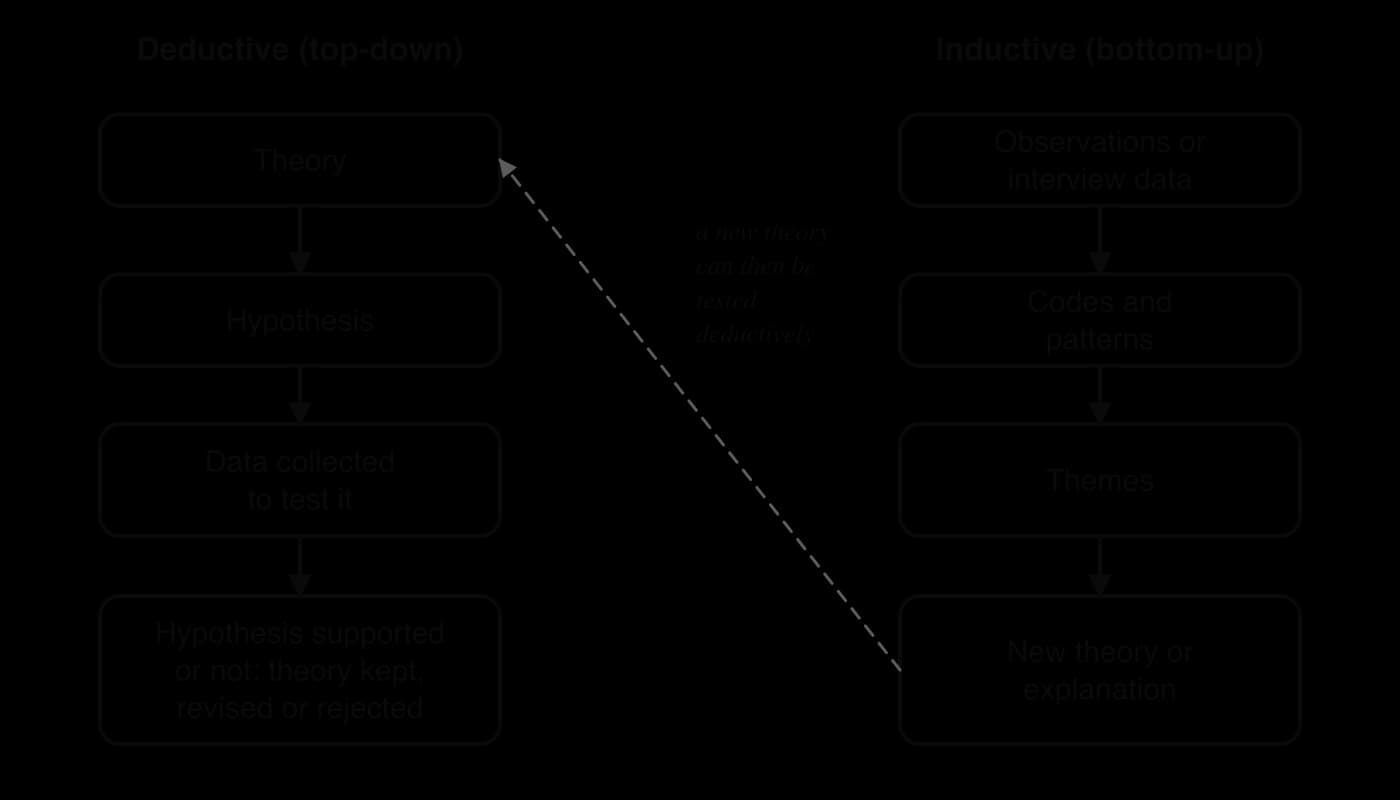
In health psychology, the sociologist Kathy Charmaz used grounded theory with people living with chronic illness and identified “loss of self” as a central form of their suffering, an idea that had not been part of the medical perspective. The finding was then available to be tested deductively in other groups. Research programmes often move in this cycle: inductive work proposes ideas from participants’ experience, and deductive work tests whether they hold more widely.
The choice between the two is a matter of perspective because it decides whose categories shape the findings. Deductive research can only find what the theory tells the researcher to look for. Inductive research lets participants’ meanings lead, which suits groups that have rarely been studied, but it depends more on the researcher’s interpretation, so it needs reflexivity.
Deductive | Inductive | |
|---|---|---|
Starting point | An existing theory or model | Data from participants or observations |
Direction | Theory → hypothesis → data | Data → codes → themes → theory |
Typical methods | Experiments, questionnaires, correlational studies | Semi-structured interviews, focus groups, observation, case studies |
Strength | Precise tests; results can be replicated and generalised | Can discover new ideas and capture participants’ own perspective |
Limitation | Can only find what the theory looks for; may impose the researcher’s categories | Findings depend on interpretation and may not transfer to other groups |
Cross-cultural research faces the viewpoint question directly. An emic approach studies behaviour from within a culture, using the culture’s own concepts and often qualitative methods. An etic approach studies behaviour from outside, using categories assumed to apply in all cultures so that cultures can be compared. Both are legitimate, but the risk of an etic approach is an imposed etic: a concept or measure developed in one culture is applied to another as if it were universal.
Researchers often combine the two, first exploring a culture emically to find what matters locally and then building a derived etic measure that is fair to every culture compared. The choice between them is a choice of perspective, because it decides whether the researcher’s categories or the participants’ categories frame the results.
For most of its history academic psychology has been developed by Western researchers studying Western participants. Arnett (2008) found that most samples in the leading journals of the American Psychological Association came from the United States, a country with less than 5% of the world’s population, and Henrich, Heine and Norenzayan (2010) described the typical participant as WEIRD: Western, educated, industrialised, rich and democratic. Theories built on such samples carry a Western perspective even when they claim to describe all humans.
Indigenous psychologies are one response. They are bodies of knowledge about behaviour developed within a particular people or culture, using its own concepts, values and ways of knowing, and designed to serve that people. The term covers both the psychological knowledge of Indigenous peoples, such as Māori in Aotearoa New Zealand, and “indigenous” psychologies built by researchers in non-Western countries, such as the Philippines or Taiwan, who question imported Western theory.
Te Whare Tapa Whā, developed by the Māori psychiatrist Mason Durie in the 1980s and set out in his book Whaiora (1994), is a model of health as a wharenui (meeting house) with four walls. The walls are taha tinana (physical well-being), taha hinengaro (mental and emotional well-being), taha whānau (family and social well-being) and taha wairua (spiritual well-being). All four walls are needed for the house to be strong and stable, so weakness in one area affects health as a whole. Some later versions add whenua, the land, as the foundation on which the house stands.
 YouTube
Compared with a biological or cognitive model of mental health, Te Whare Tapa Whā includes family and spiritual well-being as parts of health, not as background factors. It is used in New Zealand’s health services and schools. As a perspective it is holistic: problems in one area, such as loss of connection to family or land, are treated as health problems in their own right.
Sikolohiyang Pilipino (Filipino psychology) developed in the 1970s, led by the psychologist Virgilio Enriquez, who founded the Philippine Psychology Research House in 1971. Its aim was to decolonise psychology in the Philippines: to stop treating Western theories as universal and to build psychology on Filipino language and experience. Its central concept is kapwa, a shared identity in which the self is experienced as connected with others rather than separate from them.
Filipino psychology also developed its own research methods. In pakikipagkuwentuhan the researcher joins a group in informal storytelling, and in pagtatanong-tanong questions build on what participants have already said. These methods treat participants as partners in a conversation rather than as subjects answering a fixed list of questions.
Indigenous perspectives change how research is done, not only what it studies. In New Zealand, Kaupapa Māori research, described by Linda Tuhiwai Smith in Decolonizing Methodologies (1999), is research by, with and for Māori, guided by Māori values. The community helps decide the research question, collect the data and interpret the findings, and the research must benefit the community. This links perspective to responsibility: research that ignores a community’s own perspective can misrepresent it and add to stigma.
Indigenous psychology | Key idea | What it adds to a Western perspective |
|---|---|---|
Te Whare Tapa Whā (Māori) | Health as a house with physical, mental, family and spiritual walls on the land | Family, spirituality and land are part of health itself |
Sikolohiyang Pilipino (Filipino) | Kapwa: the self as shared with others | Questions the individual, bounded self assumed by much Western theory; relational research methods |
Kaupapa Māori research | Research by, with and for Māori | Communities as partners who set questions and interpret findings |
The main strength of Indigenous psychologies is validity for the people they describe. Concepts such as kapwa capture experiences that imported scales may miss, and services built on local models may be more acceptable to communities, which can improve help-seeking. They also widen the field: ideas first described in one culture can show that a “universal” Western finding is in fact local.
Several limitations follow from the same local focus. Knowledge built for one culture may not transfer to others, which makes comparison harder. Some Indigenous concepts are difficult to operationalise and test with quantitative methods, and evidence for the effectiveness of services based on them is still limited. A further issue is that cultures are not uniform, so an Indigenous model can itself overlook differences within a community, for example between generations or between urban and rural members.
Perspective also means asking what else could explain a finding. Every result is interpreted through a theory, and a different theory can often explain the same data. Looking for alternative explanations is one of the most reliable ways to evaluate research, because it tests whether the original interpretation is the only one the evidence supports.
A classic case is Clever Hans, a horse exhibited in Germany in the early 1900s who appeared to answer arithmetic questions by tapping his hoof. In 1907 the psychologist Oskar Pfungst showed that Hans could answer only when the questioner knew the answer and was visible to him: the horse was reacting to small, unintended changes in the questioner’s posture. The observers’ perspective (that Hans could count) had led them to ignore a simpler explanation.
Finding | Original interpretation | Alternative explanation |
|---|---|---|
Children who watch an adult hit a doll later hit the doll more themselves | Aggression is learned by observing models (social learning) | Demand characteristics: the doll is designed to be hit, so children may do what they think the adults expect |
People from lower-income groups score higher on depression questionnaires | Poverty causes depression (social causation) | Depression lowers income through job loss (reverse causation); or questionnaires measure distress differently across groups |
Some migrant groups receive more diagnoses of schizophrenia | Biological vulnerability in the group | Stress of discrimination and isolation; or diagnostic bias by clinicians from another culture |
East Asian participants describe more of the background in a scene | Culture shapes attention (holistic versus analytic thinking) | Differences in language or in familiarity with the images, rather than in perception |
An alternative explanation is not automatically better than the original. It becomes useful when it leads to a new test. Pfungst’s work with Clever Hans is an example: by testing the horse with the questioner out of sight, or with a questioner who did not know the answer, he could decide between the two explanations. Considering alternatives is therefore a link between perspective and causality.
The concept of perspective applies in every context of the course. In each one, the three approaches offer different explanations, the methods used reflect the researcher’s perspective, and cultural viewpoints shape what is studied and how results are read.
Explanations of mental health disorders differ by approach, as the example of depression shows, and so do treatments: antidepressants follow the biological perspective, cognitive behavioural therapy the cognitive perspective, and community support programmes the sociocultural perspective. Cultural perspectives also shape what counts as a disorder and where people look for help. A person who understands distress as a spiritual or family problem may turn to a religious leader or relatives before a doctor, which affects help-seeking and official prevalence figures.
Piaget’s theory of cognitive development describes the child mainly as an individual who builds knowledge by exploring the world, while Vygotsky’s sociocultural theory describes development as learning through interaction with more skilled people. The two theories rest on different assumptions about where development comes from. Research on parenting and attachment has also been criticised for treating middle-class Western families as the norm, so that other patterns of care can look like problems rather than differences.
Romantic attraction can be explained through activity in the brain’s reward system and hormones such as oxytocin (biological), through beliefs and expectations about partners (cognitive), or through cultural norms about who chooses a partner and why (sociocultural). In cultures where families arrange or help arrange marriages, research that measures relationship success only through romantic passion takes one cultural perspective as the standard.
Memory can be studied as activity in the hippocampus (biological), as a set of stores and processes (cognitive), or as shaped by culture (sociocultural). Bartlett (1932) asked English participants to recall a Native American folk tale, “The War of the Ghosts”, and found that over repeated recall they changed unfamiliar details to fit their own cultural expectations. A purely cognitive model of storage capacity does not capture this, while a sociocultural perspective explains it through cultural schemas.
Context | Biological perspective | Cognitive perspective | Sociocultural perspective |
|---|---|---|---|
Health and well-being | Genes and chemical messengers in depression | Negative schemas and the cognitive triad | Life events, poverty, cultural expression of distress |
Human development | Brain maturation in adolescence | Stage theories of thinking | Learning through interaction with others; cultural norms of parenting |
Human relationships | Reward system and oxytocin in attraction and bonding | Expectations and attributions about partners | Cultural norms about marriage and partner choice |
Learning and cognition | The hippocampus and memory | Models of memory as stores and processes | Cultural schemas shaping recall |
Using perspective to evaluate means asking three questions about any theory or study: which perspective does it take, what does that perspective allow it to explain, and what does it leave out? The answers usually connect perspective to the other five concepts.
Concept | How it connects with perspective | Example |
|---|---|---|
Bias | A bias towards one perspective produces reductionism; a Western perspective in measures and samples produces cultural bias | Theories built on WEIRD samples presented as universal |
Causality | Each perspective proposes different causes; complex behaviour usually has interacting causes | Biological and social causes of depression interacting in a diathesis–stress explanation |
Change | The perspective chosen decides the intervention | Medication, cognitive therapy or a community programme for the same disorder |
Measurement | Each perspective measures what it believes matters; the measure carries the perspective with it | A depression questionnaire that asks about sadness but not bodily symptoms |
Responsibility | Researchers are responsible for including participants’ and communities’ perspectives and for not stigmatising groups through one-sided explanations | Kaupapa Māori research as partnership |
Combining perspectives is not a solution in itself. A statement such as “depression has biological, cognitive and social causes” is true but does not say which factor matters most, for whom, or how the factors interact. Holistic models can become so broad that they cannot be tested. The perspectives also use different methods and kinds of data, which can be hard to bring together in one study.
The most useful multi-perspective research is therefore specific. It names the factors, predicts how they will interact and tests the prediction. Gene–environment studies that measure both a genetic variant and life stress in the same people are an example; they can fail to replicate, but they are testable in a way that a general appeal to “all three approaches” is not.
Luhrmann and colleagues compared how people with schizophrenia experience auditory hallucinations (“voices”) in the USA, India and Ghana. The study shows that even a symptom usually treated as purely biological is experienced through cultural meanings, so a biological perspective alone cannot describe the disorder.
The researchers aimed to find out whether, and how, the experience of hearing voices differs across three cultures among people with a serious psychotic disorder.
The study used semi-structured interviews with 60 adults who heard voices and met the research criteria for schizophrenia: 20 in or around San Mateo, California (USA), 20 in Chennai (India) and 20 in Accra (Ghana). In San Mateo participants were recruited through caseworkers at a county psychiatric hospital and lived mostly in supported housing; in Chennai they were outpatients or residents at the Schizophrenia Research Foundation; in Accra they were inpatients at the Accra General Psychiatric Hospital. Each site had roughly equal numbers of men and women, with average ages of 43, 41 and 34 years.
The anthropologist Tanya Luhrmann interviewed participants in San Mateo and Accra, mostly in English; two senior psychiatrists interviewed participants in Chennai, mainly in Tamil. The interview asked how many voices people heard, whether they knew who was speaking, whether they had conversations with the voices, what the voices said, what was most distressing, whether any experiences were positive, and what participants thought caused the voices. Interviews were recorded, transcribed and translated where necessary, and the researchers compared the accounts from the three sites.
In all three sites some participants reported both good and bad voices, conversations with voices, and voices of God. The differences lay in the quality of the experience and the relationship with the voices.
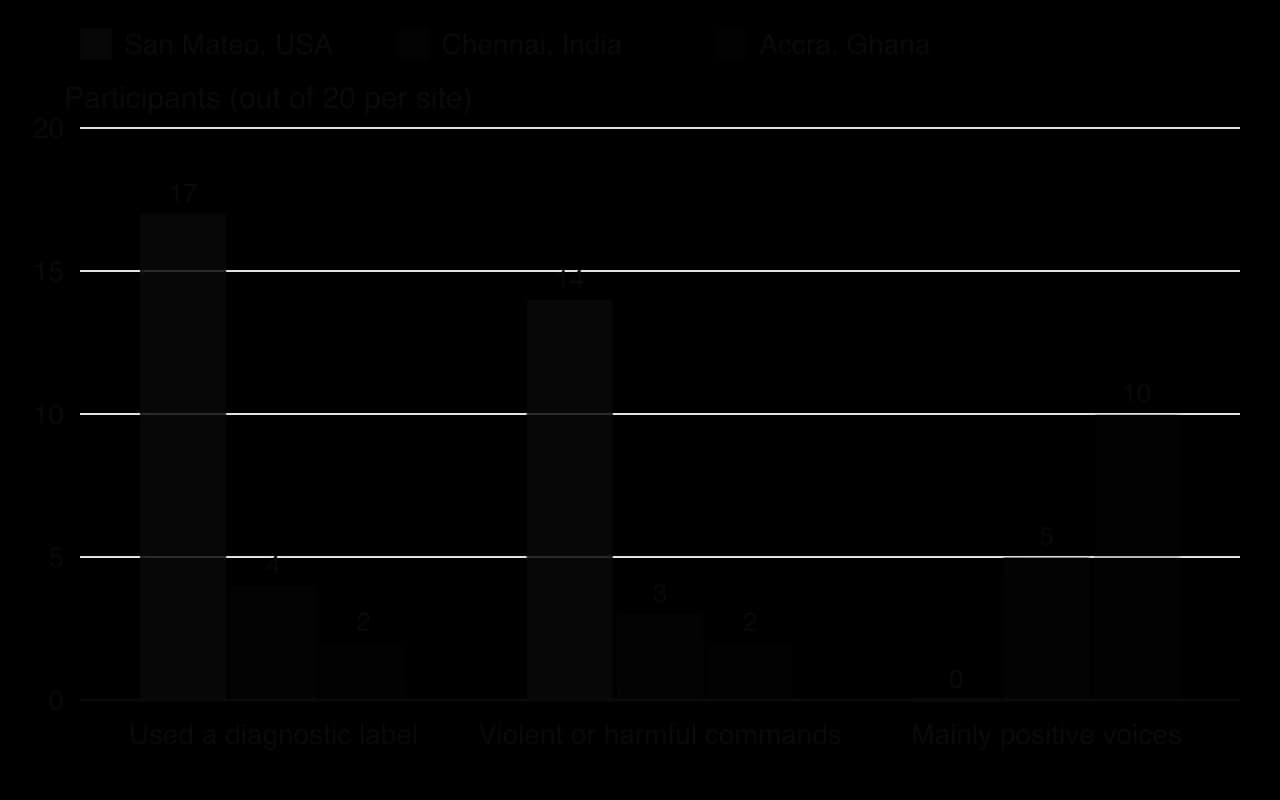
In San Mateo all but three participants described themselves with a diagnosis, 14 of 20 heard voices telling them to hurt themselves or others, and none described a mainly positive experience; many saw the voices as symptoms of a brain disease. In Chennai, 11 of 20 heard the voices of relatives, who gave advice and scolded like family members, and only 4 used the word “schizophrenia”. In Accra, 16 of 20 reported hearing God or another divine voice, and half described their voices as entirely or mainly positive.
Site (20 each) | Typical experience of voices | Example of how voices were described |
|---|---|---|
San Mateo, USA | Bombardment; a sign of a sick mind; often violent | Voices as unreal thoughts; “just the way my mind works” |
Chennai, India | Relationships with voices of relatives; guidance as well as scolding; sometimes playful | Voices like older relatives giving advice to younger ones |
Accra, Ghana | Voices of God or spirits; often mainly positive | A good voice (usually God) more powerful than the bad voices |
The researchers concluded that voice-hearing in serious psychotic disorder is shaped by local culture. They suggested that the American emphasis on the individual, bounded mind leads people to experience voices as an intrusion, while in Chennai and Accra, where the self is understood as more connected with others, voices are more often experienced as relationships. They proposed that more benign voices might contribute to the better long-term outcome of schizophrenia reported in some non-Western settings.
The study combines a biological category (a diagnosis of schizophrenia) with an emic, qualitative perspective on experience. It shows that a perspective focused only on the brain would miss differences in content and emotional tone that may affect distress and recovery. However, the research team still chose the diagnostic criteria and the interview questions, so the study is not fully emic: participants’ experiences were sorted into the researchers’ categories.
Semi-structured interviews give rich data on experience, which increases credibility. However, the counts in the chart come from the researchers’ reading of the transcripts rather than from a standardised scale, interviews were conducted in different languages by different interviewers, and not all participants completed the full interview. Translation can change meanings, although transcripts were checked by bilingual researchers.
The samples were small, a limitation the authors acknowledge, and were not randomly selected, so the findings cannot be generalised to everyone with schizophrenia in these countries. The groups also differed in ways other than culture: the Accra participants were younger, all inpatients and more seriously ill, while most San Mateo participants had lived with the illness for many years. The study is a comparison of existing groups, so it cannot show that culture caused the differences, although the authors argue that religiosity and urban living do not explain them.
Participants gave informed consent and the research was approved by ethics committees in the USA and India and by the hospital’s medical director in Ghana. Research with people experiencing psychosis raises questions about capacity to consent and about distress during interviews about their voices, so careful procedures are especially important with this group.
Sources: Luhrmann, T. M., Padmavati, R., Tharoor, H. and Osei, A. (2015). Differences in voice-hearing experiences of people with psychosis in the USA, India and Ghana: interview-based study. _British Journal of Psychiatry, 206(1), 41–44._
Perspective is one of the six concepts that exam questions are built around. It can be the organising concept of a Paper 1 Section C essay on any area of study in the four contexts, and it can be one of the concepts named in a Paper 2 Section B question about an unseen study. In Paper 2 Section A it can be the concept to explain in relation to a class practical, and the research proposal in the internal assessment draws on research from an approach and explores the perspective of its population of interest.
Perspective is the standpoint from which behaviour is explained and studied: the approach, theory or model used, and whose viewpoint shapes the research.
The biological, cognitive and sociocultural approaches each rest on assumptions about behaviour and research; each explains some causes and hides others.
No single perspective is sufficient: explanations of depression, smoking or memory are fullest when the approaches are combined and their interactions explained.
Reductionism breaks behaviour into simpler parts, making it testable but oversimplified; holism sees the whole person in context but is harder to test. Interactionism and the biopsychosocial model lie between them.
Deductive research tests a theory with data; inductive research builds theory from data. The direction decides whose categories shape the findings.
Emic research studies a culture from within; etic research compares cultures and risks an imposed etic.
Indigenous psychologies such as Te Whare Tapa Whā and Sikolohiyang Pilipino build knowledge from within a culture and challenge the WEIRD perspective of mainstream psychology.
Luhrmann et al. (2015) found that voice-hearing in schizophrenia was harsher and more often violent in the USA, and more relational and positive in India and Ghana, showing that culture shapes even a “biological” symptom.
Considering alternative explanations tests whether an interpretation is the only one the evidence supports.
I can explain what perspective means, in both its theoretical and its viewpoint sense.
I can describe the assumptions of the biological, cognitive and sociocultural approaches about behaviour and research.
I can apply all three approaches to one behaviour and explain how they interact.
I can evaluate reductionist and holistic explanations, with strengths on both sides.
I can compare and contrast deductive and inductive research, with an example of each.
I can discuss at least two Indigenous psychologies and what they add to mainstream psychology.
I can describe and evaluate Luhrmann et al. (2015) through perspective, measurement and bias.
I can suggest a specific alternative explanation for a research finding.
I can use perspective as the organising concept of an essay in any of the four contexts.