Explain what bias is, where it enters research and psychological knowledge, how researchers reduce it, and use the concept to evaluate studies and theories across the approaches and contexts.
Each is in the Psychology glossary, with every other term in the subject.
A form of gender bias that exaggerates or invents differences between men and women and presents them as fixed.
A form of gender bias that ignores or minimises real differences between men and women, often by studying one gender and assuming the findings apply to both.
A systematic tendency in thinking or research that distorts how information is collected, interpreted or reported, so that conclusions consistently lean in one direction rather than reflecting reality.
A systematic distortion that arises when behaviour is studied or judged by the standards of one culture, or when findings from one culture are assumed to apply to all cultures.
The view that behaviour is caused by factors outside a person’s control, such as genes and brain chemistry (biological determinism) or upbringing and culture (environmental determinism), leaving little room for free will.
A systematic distortion in how people of different genders are studied, described, diagnosed or treated, either by exaggerating differences between them or by ignoring real differences.
An attitude, expectation or association that influences judgement and behaviour without the person being aware of it, as opposed to explicit bias, which the person knows about and could report.
The aim of collecting and interpreting evidence in a way that does not depend on the researcher’s personal views or expectations, so that another researcher following the same procedure would reach the same result.
The view that knowledge should be based on observable and measurable evidence, collected and tested through the scientific method, with the aim of discovering general laws of behaviour.
Publicly recording a study’s hypotheses, procedure and planned analysis before the data are collected, so that confirmatory tests can be told apart from analyses chosen after seeing the results.
The tendency for studies with positive or statistically significant results to be published more often than studies with null or negative results, so that the published research overstates an effect.
Samples drawn from Western, educated, industrialised, rich and democratic societies, which make up most participants in published psychology research but only a small minority of the world’s population.
Explain the concept of bias and how a systematic error differs from a random one.
Describe the main types of bias in research: sampling, researcher, participant, confirmation and publication bias.
Explain how cultural and gender bias affect psychological knowledge, diagnosis, prevalence figures and treatment.
Explain how cognitive biases in everyday thinking relate to bias in research.
Describe the controls researchers use to reduce bias, and explain the limits of each.
Analyse the design of a study to show where bias may have entered and how it changes the conclusions.
Evaluate research and theories in the biological, cognitive and sociocultural approaches with reference to bias.
Discuss the role of bias in research in each of the four contexts.
Bias is a systematic distortion in the way information is collected, interpreted or reported, so that conclusions lean in one direction instead of reflecting what is really there. Psychological research is carried out by people studying other people, so researchers’ expectations, their culture and the way science is organised can all push research away from an accurate picture of behaviour.
Bias is one of the six concepts that run through the whole course, alongside causality, change, measurement, perspective and responsibility. It is the lens most often used to judge a study or a theory, and it links closely to the others: a biased sample limits what a study can show about causes, a biased measure is a problem of measurement, and publishing only positive results is a failure of responsibility. The question at the centre of the concept is how far knowledge of human behaviour may be biased, and what can be done about it.
With a free account, Augment remembers where you stopped and what you have practiced.
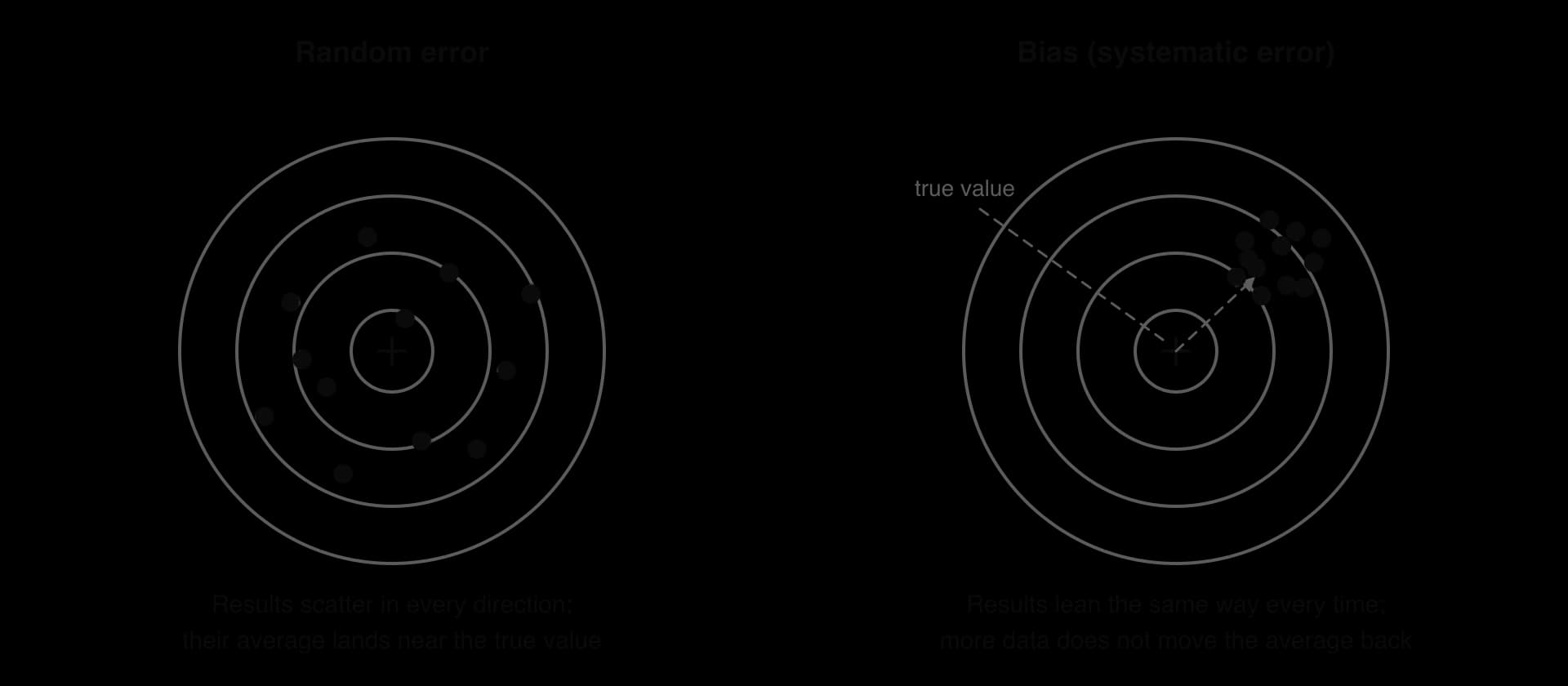
Every measurement contains some error. A participant may be tired, a room may be noisy or a question may be misread. Errors like these are random: they push some results up and others down, so across a large sample they tend to cancel out. Bias is different because it pushes results in the same direction every time.
The difference matters because the usual fix for random error does not work for bias. Collecting more data reduces random error, since the scattered results average out. A biased procedure produces the same distortion in every participant, so a larger sample gives a more precise estimate of the wrong value.
The scientific tradition in psychology aims for objectivity: findings that would be the same whoever carried out the study, because they depend on the evidence and not on the observer. This aim comes from positivism, the view that reliable knowledge comes from observable, measurable evidence gathered and tested by the scientific method. Laboratory experiments, standardised questionnaires and brain scans all reflect this ideal.
No study reaches full objectivity. Much psychological data is partly subjective: participants describe their own feelings in a questionnaire, an observer decides whether a push counts as aggression, and an interviewer chooses which part of a long answer is important. Researchers therefore accept that some subjectivity is unavoidable and build checks into their designs, such as agreement between two coders, instead of assuming that their own judgement is neutral.
Not all psychologists accept the positivist ideal. Researchers who use interviews and other qualitative methods argue that meaning is always interpreted, so the researcher is part of the instrument. Instead of claiming objectivity, they make their own position visible through reflexivity.
Bias can be explicit, when a person is aware of it, or implicit, when it operates without awareness. A drug company that chooses not to publish a failed trial shows explicit bias. A researcher who smiles slightly more at participants in the condition expected to do well shows implicit bias, because the behaviour is not deliberate.
Most bias in psychological research is implicit. Researchers usually believe they are being fair, so their intentions give little protection against it. The most effective controls work by design: they remove the chance for expectations to act at all, for example by keeping the person who collects the data unaware of which condition each participant is in.
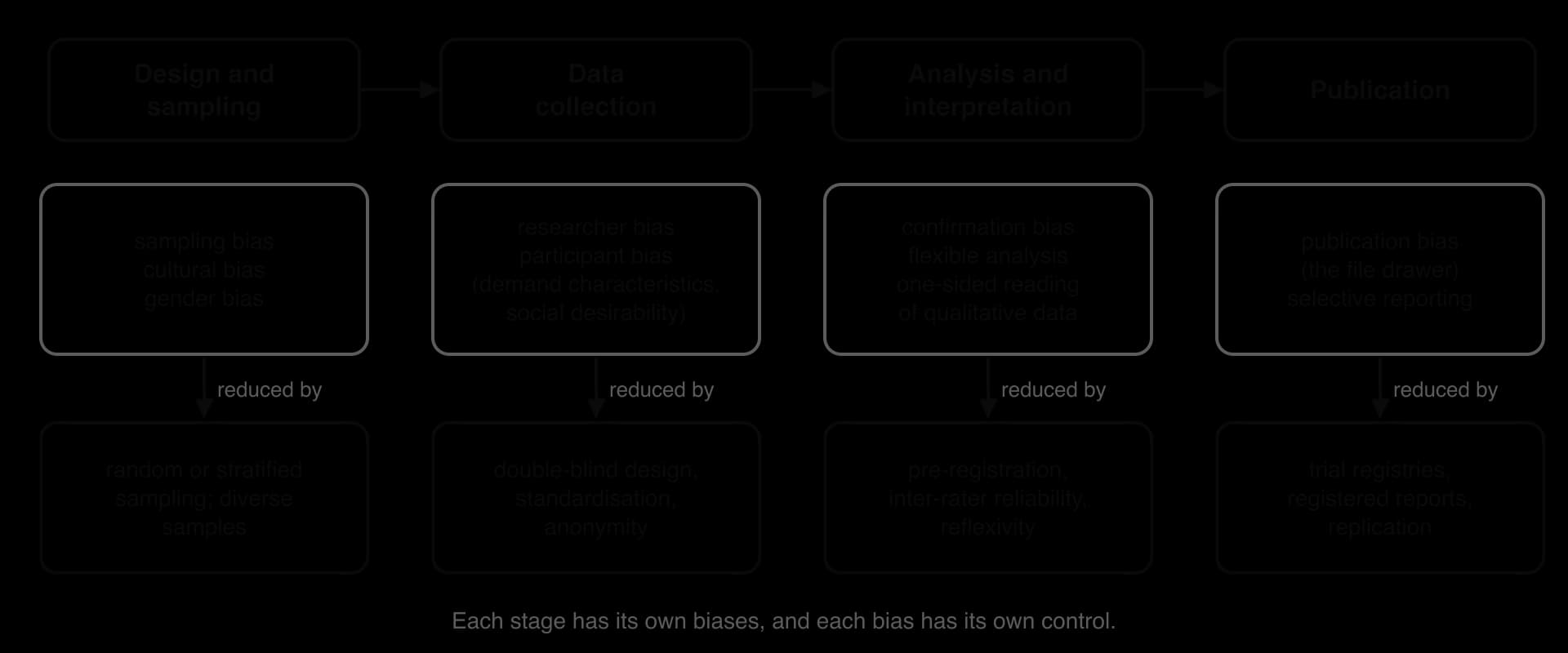
A study passes through several stages, from choosing participants to publishing the results, and bias can enter at each one. Following a study from start to finish is the clearest way to find where a distortion may have come from and which control could have prevented it.
Sampling bias occurs when the people in a sample differ systematically from the target population, so that some kinds of people are over-represented and others are missing. It concerns who takes part in a study; how participants are treated once they are in it is a separate source of bias. Opportunity samples of university students and volunteers who answer an advert are especially likely to be unrepresentative, because the people who are easy to reach or keen to take part are not typical. The techniques themselves are compared under sampling techniques.
The best-known sampling problem in psychology concerns the whole discipline. Arnett (2008) showed that most participants in leading American psychology journals were from the USA, a country with about 5% of the world’s population. Henrich, Heine and Norenzayan (2010) estimated that 96% of samples in leading journals came from countries with only 12% of the world’s population, and called these samples WEIRD: Western, educated, industrialised, rich and democratic.
The WEIRD problem matters because these samples are narrow and, on some measures, unusual. Henrich and colleagues reviewed evidence that people from different societies differ in visual perception (susceptibility to the Müller-Lyer illusion, in which two equal lines look different in length), fairness in economic games, moral reasoning and self-concept, with WEIRD participants often at one extreme. Rad, Martingano and Ginges (2018) found that, almost a decade later, nearly all research published in the journal Psychological Science still relied on Western samples.
 YouTube
Researcher bias occurs when the researcher’s expectations, beliefs or behaviour systematically influence how a study is run, how data are recorded or how results are interpreted. One form is the expectancy effect, in which a researcher who expects a particular result unintentionally behaves in ways that make it more likely.
Rosenthal and Fode (1963) gave psychology students ordinary laboratory rats to train in a maze. Half the students were told their rats had been bred to be “maze-bright” and half that theirs were “maze-dull”, although the rats had been allocated to the labels at random. The “maze-bright” rats learned faster and made more correct turns. Because the only systematic difference was the students’ expectation, the result shows that a researcher’s beliefs can change the data, through handling the animals differently, recording them differently, or both.
The same effect has been found in research on people. Doyen et al. (2012) failed to replicate a well-known finding that reading words about old age makes people walk more slowly, when walking speed was timed with infrared sensors. In a second experiment, participants walked more slowly only when the experimenters had been led to expect it, which suggests that the original effect partly depended on what the researchers expected.
The main control is a double-blind design, in which neither the participants nor the people collecting the data know which condition each participant is in. Other controls include standardisation of instructions and procedures, automatic recording of the dependent variable (as with the infrared timing gates), and checking inter-rater reliability when behaviour has to be judged by observers.
Participant bias occurs when participants’ awareness of being studied systematically changes how they behave or answer. People in a study try to make sense of it, and their guesses about its purpose can shape what they do.
Demand characteristics are cues in a study that suggest to participants what the researcher expects, so that they act to support (or occasionally to spoil) the hypothesis.
Social desirability bias is the tendency to give answers that present oneself in a good light: under-reporting alcohol use or prejudice, over-reporting exercise or helping.
The Hawthorne effect is a change in behaviour simply because people know they are being observed.
Controls include a single-blind design, in which participants do not know which condition they are in; anonymous questionnaires, which reduce the pressure to look good; covert observation where it is ethical; and measures that participants cannot easily control, such as reaction times or physiological recordings. Several of these controls raise questions of responsibility: concealing the aim of a study reduces demand characteristics but limits informed consent, so researchers must weigh the gain in validity against the ethical cost.
Researchers are subject to the same cognitive biases as anyone else. Confirmation bias is the tendency to search for, interpret and remember information in ways that support what one already believes. In research it can show up as stopping data collection when the result looks good, trying several analyses and reporting the one that “worked”, or explaining away results that do not fit the hypothesis.
Flexible analysis is dangerous because each extra analysis is another chance to find a result by luck. If a researcher can choose between several outcome measures, several ways of excluding participants and several statistical tests, at least one combination is likely to cross the usual threshold for statistical significance even when there is no real effect. This practice is sometimes called p-hacking. It need not be deliberate: a researcher who believes in an effect can sincerely see the analysis that supports it as the most sensible one.
Pre-registration controls confirmation bias by fixing the decisions in advance. A researcher can still explore the data afterwards, but the exploratory analyses are labelled as such and treated as ideas to test, not as confirmed findings.
In qualitative research, such as interviews and focus groups, the data are words and meanings, and the researcher decides what they mean. Two researchers can read the same interview transcript and notice different things, depending on their own experience, culture and theoretical views. In this kind of research the researcher is part of the instrument, so bias cannot be removed by blinding alone.
Qualitative researchers respond with reflexivity: an ongoing, critical awareness of how their own background and assumptions may shape the research. Personal reflexivity concerns the researcher’s own gender, culture, experiences and values; epistemological reflexivity concerns how the chosen method and questions limited what could be found. Other strategies include triangulation (comparing different methods, sources or researchers), member checking (asking participants whether the interpretation fits their experience) and having more than one researcher code the data. These strategies support the credibility of the findings, the qualitative counterpart of trustworthiness.
Publication bias is the tendency for studies with positive or statistically significant results to be published more often, and more quickly, than studies with null or negative results. Journals prefer striking findings, researchers are less likely to write up a study that “did not work”, and sponsors may prefer that a disappointing trial stays out of sight. The result is sometimes called the file-drawer problem, because unpublished studies stay in a drawer.
Publication bias is a bias of the whole research system rather than of one researcher. Every published study may be well run, and the literature can still be misleading, because the studies that would balance it are missing. A meta-analysis that combines only published studies inherits the distortion. Its effect on the evidence for antidepressants was measured directly by Turner et al. (2008).
The replication crisis made the problem visible across psychology. When the Open Science Collaboration (2015) repeated 100 studies published in three leading psychology journals, 97 of the originals had reported significant results, but only 36% of the replications did. High-profile findings such as “power posing” (adopting an expansive posture to change hormone levels) and the walking-speed priming effect have not held up in larger, more careful studies. Controls now include trial registries, in which trials must be recorded before they start, and registered reports, in which journals agree to publish a study on the strength of its design before the results are known.
Bias does not only affect single studies. When the same kinds of samples, measures and assumptions are used across a whole field, the resulting body of knowledge can be biased even if each study was carefully run. Two forms of bias in knowledge have been studied most closely: cultural bias and gender bias. Both have direct consequences in clinical psychology, where they shape who is diagnosed, how common disorders appear to be and which treatments are offered.
Cultural bias arises when behaviour is studied or judged by the standards of one culture, or when findings from one culture are assumed to apply everywhere. It is closely related to ethnocentrism, treating one’s own culture as the normal standard against which others are measured.
Cultural bias can enter at every stage of research. It shapes which questions are asked, which samples are used, how measures are built and how behaviour is labelled. A questionnaire developed in one culture and translated for use in another may carry assumptions that do not fit, a problem known as an imposed etic. A depression scale that focuses on sad mood, for example, may miss distress that is mainly expressed through tiredness, pain or other bodily symptoms, as is common in many cultures.
In clinical practice, cultural bias may affect diagnosis. Schwartz and Blankenship (2014) reviewed 24 years of research in the USA and found that African American patients were diagnosed with psychotic disorders three to four times as often as white patients, and Latino patients about three times as often. The authors discussed several explanations, including clinicians misreading cultural differences in how distress is expressed, but also differences in access to care and in the stress people face. A gap in diagnosis rates therefore suggests that bias may be operating, but it does not show that bias is the only cause.
One response to cultural bias is the emic approach, which studies a culture from within and uses the concepts that people in that culture use themselves. Another is the growth of Indigenous psychologies, built on the knowledge and values of Indigenous communities instead of on concepts imported from Western research.
Gender bias is a systematic distortion in how people of different genders are studied, described, diagnosed or treated. Hare-Mustin and Marecek (1988) distinguished two forms. Alpha bias exaggerates differences between men and women and presents them as fixed, as in claims that men and women think in fundamentally different ways. Beta bias ignores or minimises real differences, usually by studying one gender and assuming the results apply to both.
Beta bias has a long history in biological research. Beery and Zucker (2011) reviewed studies of mammals published in 2009 and found that in neuroscience, studies using only male animals outnumbered studies using only females by 5.5 to 1. Female animals were often left out because their hormone cycles were assumed to make them more variable, an assumption the review found to be unfounded. Findings about stress, pain or drug effects drawn mainly from males may not apply to females.
Gender bias also affects diagnosis. Ford and Widiger (1989) gave 354 psychologists case histories in which only the stated sex of the patient varied. The same case was diagnosed as histrionic personality disorder more often when the patient was described as female and as antisocial personality disorder more often when described as male. Ratings of the individual criteria did not show the same bias, which suggests that the bias entered when clinicians formed an overall judgement.
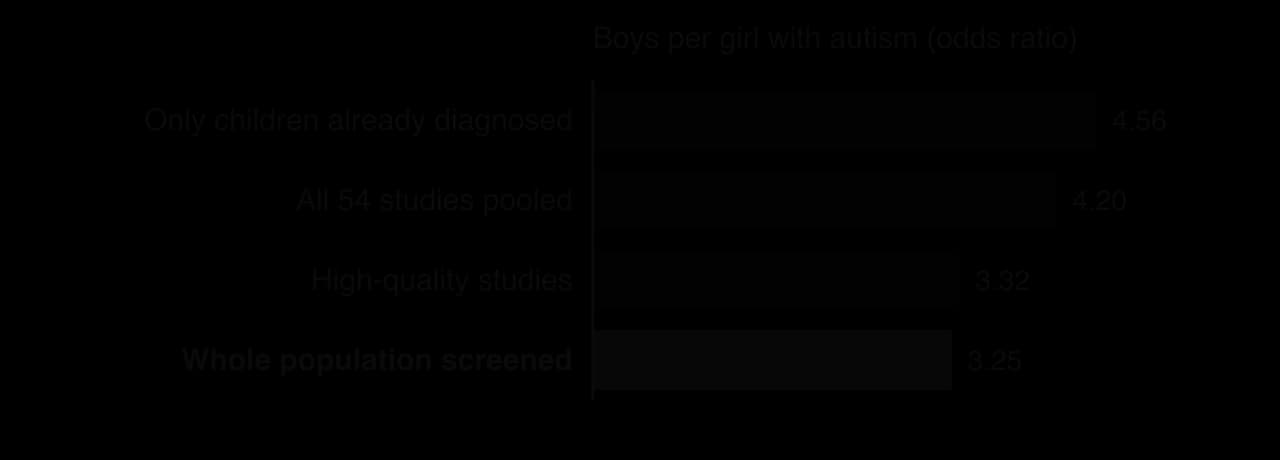
Prevalence figures can be biased in the same way. In a meta-analysis of 54 studies with more than 13 million participants, Loomes, Hull and Mandy (2017) found that the male-to-female ratio in autism depended on how cases were found. Studies of children who already had a diagnosis gave a higher ratio than studies that screened whole populations, including children who had never been assessed. The authors concluded that the true ratio is closer to 3:1 than the commonly cited 4:1, and that girls who meet the criteria are at greater risk of not being diagnosed.
Clinical psychology shows most clearly why bias matters, because each stage of care depends on the one before. If clinicians expect a disorder to look a certain way, people who express it differently are less likely to be diagnosed. If they are not diagnosed, they are missing from prevalence figures, which affect how services are planned and funded. If treatment trials then recruit mainly from diagnosed groups, the treatments are tested on people who are not fully representative of those who need them.
Diagnostic labels can also bias how behaviour is interpreted once they are given. Rosenhan’s (1973) report that healthy people admitted to psychiatric hospitals had their ordinary behaviour read as symptoms is a famous example, although the accuracy of his data is now disputed. Research on autism shows a related problem. Theories built by non-autistic researchers long described autistic people’s social difficulties as a deficit within the person. Milton (2012), an autistic researcher, proposed the double empathy problem: difficulties arise partly from a mutual mismatch between autistic and non-autistic people, so the earlier framing may reflect the researchers’ own perspective.
Favouring one perspective is itself a form of bias. A researcher who studies depression only through neurotransmitters will tend to find chemical explanations, while one who studies it only through thought patterns will find cognitive ones. Each may be accurate as far as it goes, but each leaves out what the other approach would notice. Explaining complex behaviour through a single level of simpler components is reductionism; the opposite position, holism, tries to understand behaviour as an integrated whole.
A related bias is determinism, the view that behaviour is fully caused by factors outside the person’s control. Biological determinism points to genes, hormones and brain structure; environmental determinism points to upbringing, conditioning and culture. A strongly deterministic theory can bias research by leaving no room for agency and choice, and it can have social effects: telling people that their behaviour is fixed by their genes may reduce their belief that they can change it.
The concept of bias also applies to ordinary thinking. A cognitive bias is a systematic deviation from rational judgement, and it usually comes from relying on a heuristic, a mental shortcut that gives a quick answer. Heuristics are often useful, but they produce predictable errors, especially when people are short of time, information or motivation to think carefully.
Cognitive bias | What happens | Everyday example |
|---|---|---|
Anchoring bias | A first number or piece of information pulls later estimates towards it, even when it is irrelevant. | A shop shows a high “original” price, and the sale price then seems cheap. |
Confirmation bias | People seek, interpret and remember information that supports what they already believe. | Someone convinced a diet works remembers the weeks they lost weight and forgets the weeks they did not. |
Availability heuristic | People judge how likely something is by how easily examples come to mind. | After news coverage of a plane crash, flying feels more dangerous than driving, although it is safer. |
Representativeness heuristic | People judge probability by how well something fits a typical example, ignoring how common it is. | Assuming a quiet, tidy person is a librarian rather than a salesperson, although salespeople are far more common. |
Cognitive biases connect to research bias in two ways. They are part of the content of psychology, studied in the cognitive approach and in the context of learning and cognition. They are also the mechanism behind much bias in research, because researchers are subject to the same shortcuts as everyone else. This is why the strongest controls are procedural, such as blinding and pre-registration, rather than relying on researchers to notice their own biases.
 YouTube
Each approach has typical sources of bias that follow from its methods and assumptions. Knowing them makes it possible to evaluate any theory or study within that approach.
Approach | Typical sources of bias | Example |
|---|---|---|
Biological | Male-only animal and human samples (beta bias); reductionism and biological determinism; interpreting brain activity as if it showed a single cause; publication of positive drug and gene findings only | Beery and Zucker (2011) found male-only neuroscience studies outnumbered female-only ones 5.5 to 1; Turner et al. (2008) found antidepressant efficacy overstated in journals |
Cognitive | WEIRD student samples; artificial laboratory tasks that participants try to “solve”; demand characteristics; experimenter expectancy | WEIRD participants are at one extreme in susceptibility to the Müller-Lyer illusion; priming effects on walking speed depended on what experimenters expected |
Sociocultural | Cultural bias and imposed etic measures; social desirability in self-reports of attitudes; researchers studying cultures other than their own | Questionnaires on prejudice or helping in which participants present themselves favourably; Western concepts of the self exported to collectivist cultures |
Research methodology | Sampling bias; researcher and participant bias; confirmation bias in analysis; publication bias | Only 36% of 100 replicated psychology studies reproduced a significant result |
The table shows that no approach is free of bias, but the kinds of bias differ. Biological research is especially open to reductionism and to unrepresentative animal samples, cognitive research to artificial tasks and WEIRD samples, and sociocultural research to cultural bias in its concepts and measures. Combining approaches, and using several methods to study the same behaviour, reduces the chance that one approach’s blind spot shapes the conclusion.
Research on mental health disorders is open to bias at every point, from diagnosis to treatment. Cultural and gender bias can change who receives a diagnosis, as in the higher rates of psychotic disorder diagnoses among African American patients and the under-diagnosis of autism in girls. Publication bias can then make treatments look more effective than they are, as Turner et al. (2008) showed for antidepressants. Because these decisions affect real patients, bias in this context is also a matter of responsibility.
Developmental research often relies on adults interpreting children’s behaviour, which gives room for researcher bias. Measures developed in one culture, such as observational tests of attachment designed in the USA, have been criticised as an imposed etic when used to classify children elsewhere. Research on autism and theory of mind has been criticised for framing differences as deficits, a bias the double empathy problem draws attention to.
Much research on relationships uses self-report questionnaires about attraction, love, jealousy or conflict, so social desirability bias is a constant risk: people may describe their relationships as happier, or their own behaviour as fairer, than it is. Samples are often university students in Western countries, in which relationships are freely chosen. Findings may not transfer to cultures in which families play a larger part in partner choice, which is a form of cultural and sampling bias.
Cognitive experiments are usually tightly controlled, but the samples are often WEIRD and the tasks artificial, so findings about perception, memory and reasoning may describe a narrow slice of humanity. Expectancy effects also matter in education. Rosenthal and Jacobson (1968) reported that pupils whom teachers had been told were about to “bloom” intellectually gained more in IQ over a school year, although later research found the effect on IQ to be small and inconsistent. Teachers’ expectations remain a recognised source of bias in how pupils are taught and assessed.
No study can be free of bias, but well-designed studies reduce it and make what remains visible. Each control targets a particular bias and has its own limits, so evaluation should explain both what a control achieves and what it leaves untouched.
Control | Bias it reduces | Limitation |
|---|---|---|
Random or stratified sampling; samples from several cultures | Sampling bias, cultural bias | Expensive and slow; people who refuse to take part can make a random sample unrepresentative again |
Double-blind design | Researcher bias (expectancy), participant bias | Not always possible: in therapy research the therapist knows which treatment is given |
Standardised instructions and procedures | Researcher bias, demand characteristics | Make the situation more artificial, which can reduce external validity |
Anonymous questionnaires | Social desirability bias | Do not remove it completely; people may still not admit some behaviours to themselves |
Inter-rater reliability checks | Observer and interpretation bias | Two raters can share the same bias, so high agreement does not prove accuracy |
Reflexivity, member checking, triangulation | Bias in qualitative interpretation | Depend on the researcher’s honesty and insight; harder to check from outside |
Pre-registration and registered reports | Confirmation bias, flexible analysis, publication bias | Only work if the plan is followed and the results are reported in full |
Replication by independent researchers | Every type of bias, by testing whether a finding holds up | Takes time; few journals have traditionally published replications |
An evaluation point about bias is useful only when it is specific. A general statement that a study “may be biased” could be written about any study and says nothing. A strong point names the type of bias, explains how it could have entered this particular study, states which way it would push the results, and judges how much it weakens the conclusion.
Bias also interacts with the other concepts. A biased sample limits the generalisability of a causal claim, which links bias to causality. A biased measure, such as a questionnaire that invites socially desirable answers, is a problem of measurement. Controls for bias often raise ethical questions, which link bias to responsibility: deception reduces demand characteristics, but it limits informed consent. Showing these links is a sign of developed critical thinking.
Turner and colleagues aimed to find out whether the published research on antidepressant drugs gave an accurate picture of all the clinical trials that had been carried out, and whether a trial’s result affected whether and how it was published.
The study compared two sets of documents rather than collecting new data from people. In the USA, a company seeking approval for a new drug must register its trials with the Food and Drug Administration (FDA) and submit the results, so the FDA holds a record of every trial in the licensing programme, whatever its outcome. The researchers obtained the FDA’s reviews of 74 trials of 12 antidepressants, involving 12,564 patients.
For each trial they recorded the FDA’s own verdict (positive, negative or questionable) and then searched the scientific literature for a matching journal article. Where an article existed, they compared the outcome it reported with the FDA’s verdict. Finally, they ran two separate meta-analyses, one on the FDA data and one on the published articles, and compared the average effect size of the drugs over placebo in each.
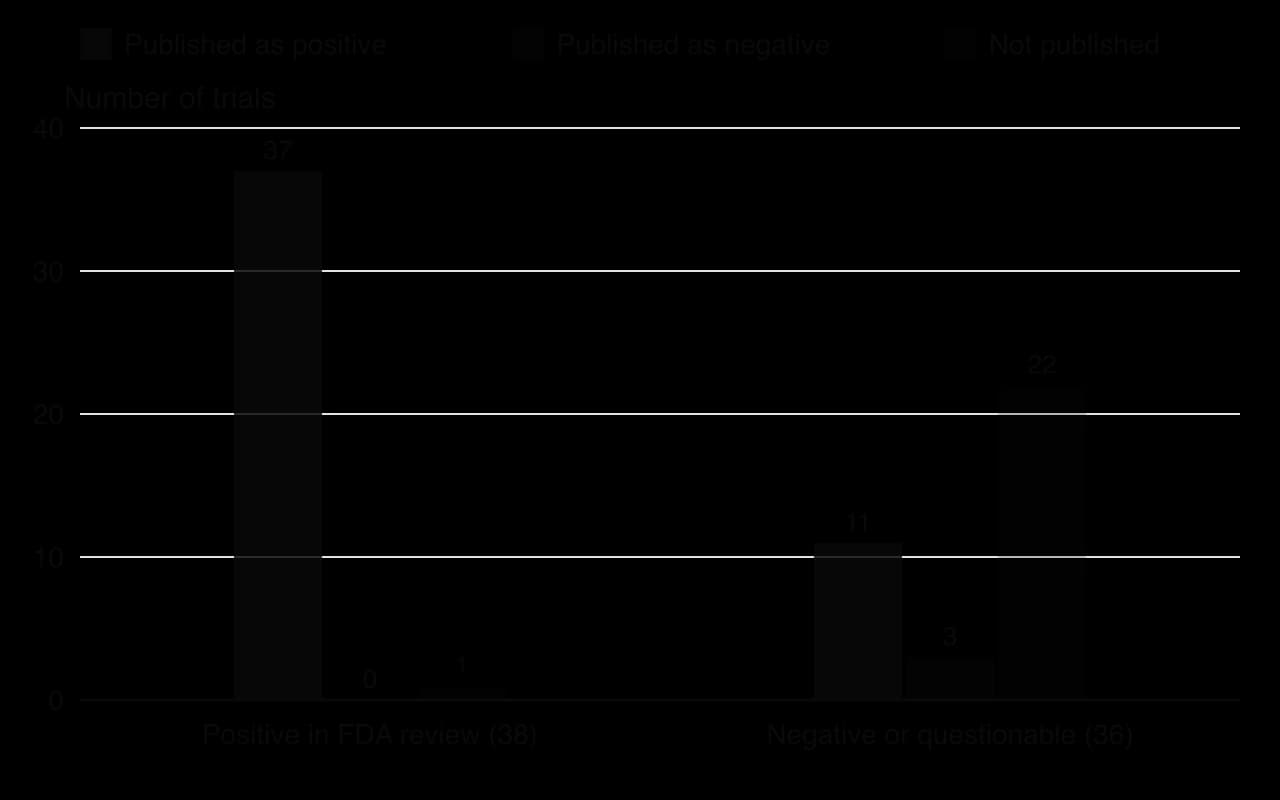
Whether and how a trial was published depended strongly on its result. Of the 38 trials the FDA judged positive, 37 were published. Of the 36 trials judged negative or questionable, 22 were never published and 11 were published in a way that, in the authors’ view, presented the outcome as positive; only 3 were published as negative. In total, 31% of the trials, with 3,449 participants, did not appear in the literature.
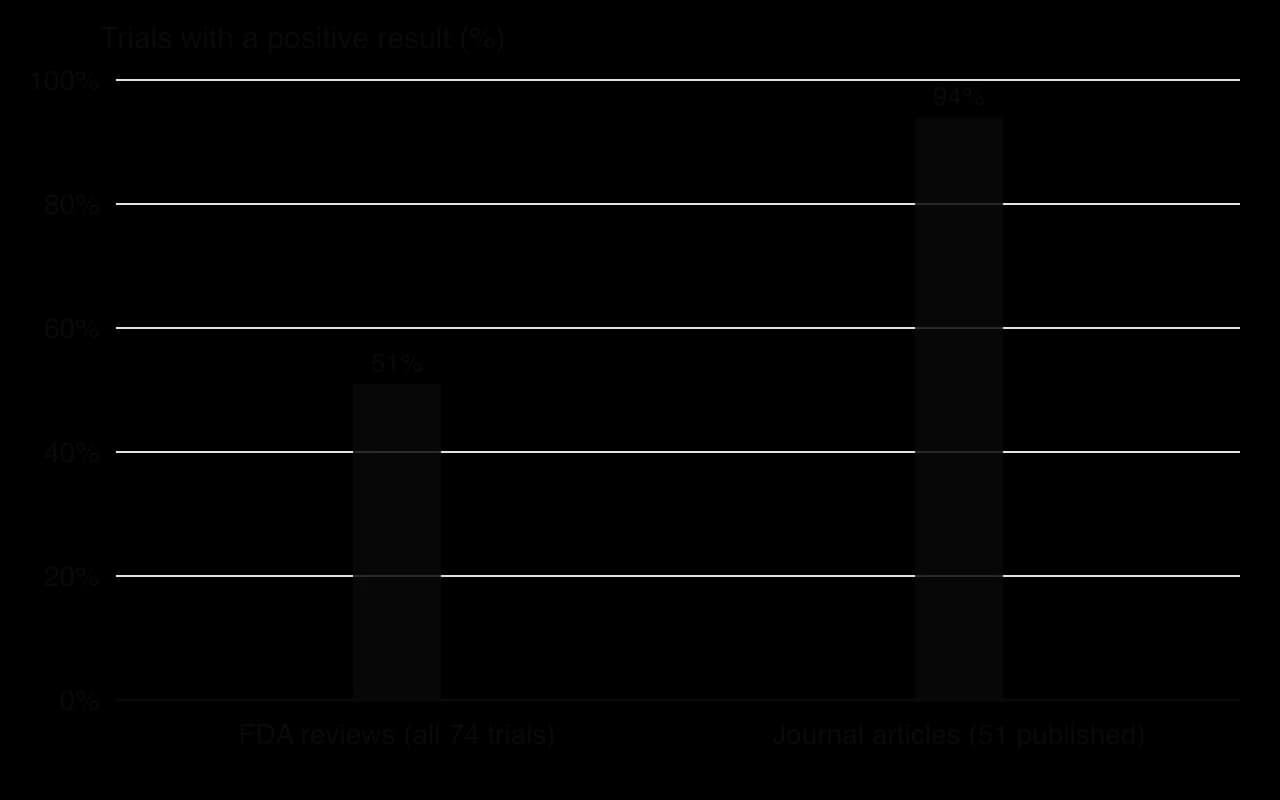
As a result, a reader of the journals would see a very different body of evidence from the one the FDA held. In the published literature 94% of trials appeared positive, against 51% in the FDA’s analysis. The effect size calculated from the journals was 32% larger overall than the effect size from the complete FDA data, with the increase ranging from 11% to 69% for individual drugs.
Selective publication made antidepressants appear more effective than the full evidence showed. Doctors, patients and researchers who relied on journals were given a biased picture, even though each published article may have been accurate about the trial it described. The authors could not tell whether the bias came from companies and authors not submitting negative trials, from journals rejecting them, or both. The drugs still performed better than placebo in the FDA data, but by less than the published research suggested.
Sources: Turner, E. H., Matthews, A. M., Linardatos, E., Tell, R. A. and Rosenthal, R. (2008). Selective publication of antidepressant trials and its influence on apparent efficacy. _New England Journal of Medicine, 358(3), 252–260._
The study shows publication bias operating across a whole field, which no single study could show. Its design is unusually strong because the FDA records provided a complete set of trials to compare against; in most areas of psychology unpublished studies are invisible, so the size of publication bias has to be estimated indirectly. The problem is not limited to drugs. Driessen et al. (2015) traced trials of psychological therapy for depression funded by the US National Institutes of Health and found that 13 of 55 were never published; adding their data reduced the estimated effect of therapy by 25%.
The FDA’s verdict was treated as the true result, but the FDA only receives trials that are part of a licensing application, so trials run later or by independent researchers are not included. The judgement that 11 published articles presented negative trials as positive also relied on the authors’ own reading of those articles, which another team might have classified differently. These limits make the exact figures less certain, but they are unlikely to explain a gap as large as 94% against 51%.
The findings raise questions of responsibility for sponsors, researchers and journals. Patients who took part in unpublished trials accepted risks to produce knowledge that was then hidden, and patients treated later received advice based on inflated evidence. The study is one of several that supported rules requiring trials to be registered before they begin and their results to be reported. It is sometimes misused to claim that antidepressants “do not work”, which the data do not support. The drugs still outperformed placebo in the complete FDA data, so the study shows that their benefit was overstated.
Bias can be examined in three main ways. In Paper 1 Section C it may be the concept named in an essay about an area of study in one of the contexts. In Paper 2 Section A, one question asks you to explain a concept in relation to your class practical, and bias is one of the six possibilities. In Paper 2 Section B it is often one of the concepts you can choose when discussing an unseen study.
Paper 2 Section A asks about the concept in relation to your own class practical. The answer must use the details of your practical: who took part, who collected the data, what participants knew, and how responses were recorded.
Bias is a systematic distortion in how evidence is collected, interpreted or reported; unlike random error, it pushes results the same way and is not removed by a larger sample.
Research aims at objectivity, a positivist ideal, but much psychological data is partly subjective, so bias is controlled by design rather than by trusting researchers to be neutral.
Bias enters at every stage of research: sampling bias (including WEIRD samples), researcher bias, participant bias, confirmation bias in analysis and publication bias.
Cultural and gender bias shape psychological knowledge and clinical practice, affecting who is diagnosed, prevalence figures and which treatments are tested.
Reductionism and determinism are theoretical biases when one level of explanation is presented as the whole explanation.
Cognitive biases such as anchoring and confirmation bias affect everyday thinking and are also the mechanism behind much research bias.
Controls include random sampling, double-blind designs, standardisation, anonymity, inter-rater reliability, reflexivity, pre-registration and replication; each has limits.
Turner et al. (2008) showed that publication bias made 94% of antidepressant trials look positive in journals, against 51% in the full FDA records.
A strong evaluation names the bias, explains how it entered the specific study and which way it pushes the results, and links it to other concepts.
I can explain what bias is and how a systematic error differs from a random one.
I can describe sampling, researcher, participant, confirmation and publication bias, with a research example of each.
I can explain how cultural and gender bias affect diagnosis, prevalence and treatment.
I can explain how cognitive biases relate to bias in research.
I can describe controls for bias and explain the limits of each.
I can describe and evaluate Turner et al. (2008) as evidence of publication bias.
I can analyse a study’s design to find where bias entered and which way it pushes the results.
I can use bias to evaluate research in each approach and each context.