Explain how psychologists try to establish cause and effect, why correlation is not causation, how controls, validity and statistical significance support causal claims, and use causality to evaluate research.
Each is in the Psychology glossary, with every other term in the subject.
The problem in correlational research that the direction of a relationship is unknown: variable A may cause B, or B may cause A.
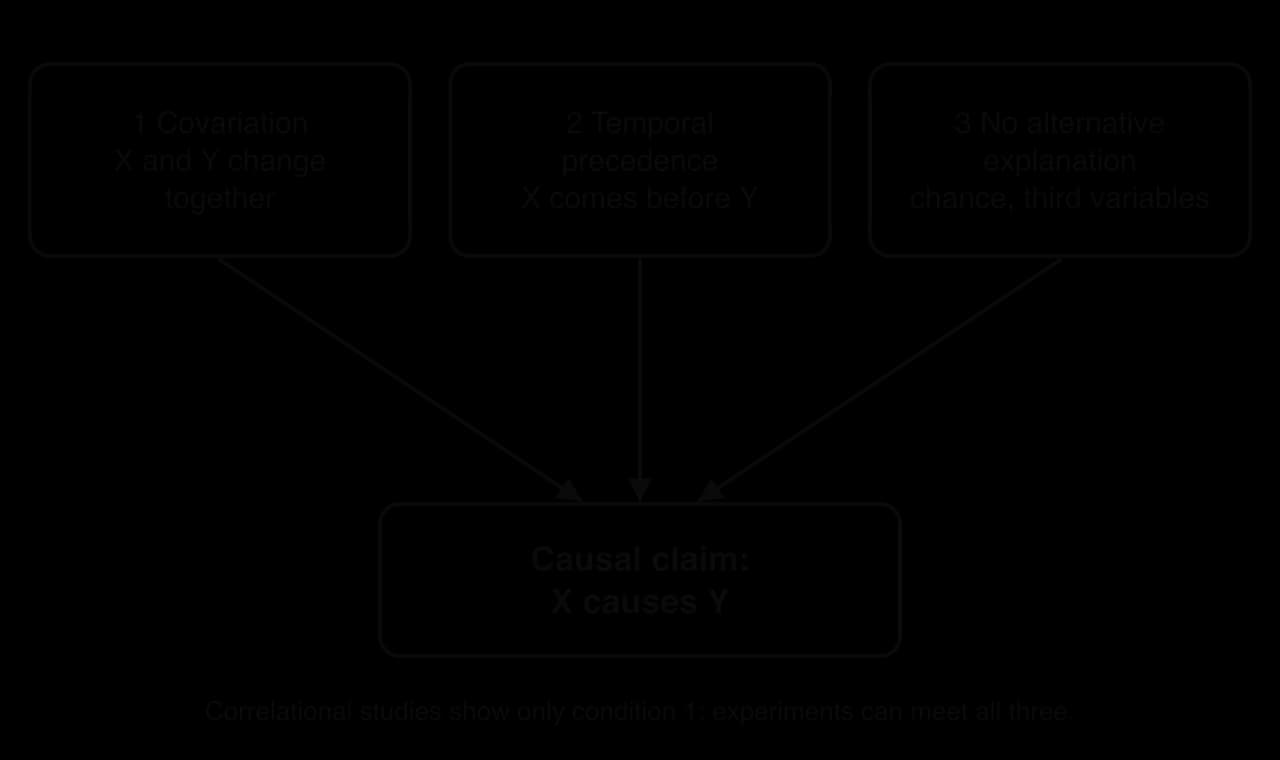
A relationship in which a change in one variable produces a change in another; establishing it requires that the two covary, that the cause comes first, and that alternative explanations are ruled out.
A relationship between two variables in which they change together, either in the same direction (positive correlation) or in opposite directions (negative correlation), without showing that one causes the other.
A relationship in which more exposure to a possible cause goes with a greater effect; it supports, but does not prove, a causal explanation.
A research design in which neither the participants nor the researchers who collect the data know which condition each participant is in, so that their expectations cannot affect the results; in a single-blind design only the participants are unaware.
The extent to which a study’s findings can be generalised beyond the study itself, to other people, settings and times.
The extent to which a study shows that the change in the dependent variable was caused by the independent variable and not by other variables, flaws in the procedure or chance.
The extent to which the tasks and setting of a study resemble situations that people meet in everyday life.
An inactive treatment, such as a sugar pill or a sham procedure, given to a control group so that the effect of a real treatment can be separated from the effect of expecting to be treated.
The judgement that a result is unlikely to have occurred by chance alone if there were no real effect, usually when the probability of such a result is less than 5% (p < 0.05).
The requirement for a causal claim that the cause comes before the effect in time, which longitudinal and prospective designs can show and one-off correlational studies cannot.
A variable that is not measured or controlled but influences both variables in a correlation, so that they appear related even when neither causes the other.
A control procedure in treatment research in which the control group receives the treatment after the study ends, so that no one is denied it while its effect is measured.
Explain the concept of causality and the three conditions a causal claim must meet.
Explain why a correlation does not show causation, with reference to bidirectional ambiguity and third variables.
Describe how experiments use manipulation, random allocation and controls such as placebos, double-blind designs and wait-listing to support causal claims.
Compare and contrast internal and external validity, including the role of mundane realism.
Explain what statistical significance shows about a result and what it does not show.
Explain how natural experiments, longitudinal designs and dose–response evidence approach causation when experiments are not possible.
Discuss why causes in psychology usually involve the interaction of several variables, and the role of agency and motivation.
Evaluate causal claims in research across the approaches and the four contexts.
Causality is the relationship between a cause and its effect: a change in one variable that produces a change in another. Psychologists study relationships between variables with the aim of explaining behaviour, and an explanation is usually a claim about causes, such as the claim that stress triggers depression, that rewards strengthen habits, or that group pressure changes opinions.
Causality is one of the six concepts. It asks how anyone can know what causes an observed behaviour. The answer depends on research design, which links causality closely to measurement and bias, and on how complex behaviour is: in most cases several biological, cognitive and sociocultural factors act together, so causation is rarely a single, direct effect.
With a free account, Augment remembers where you stopped and what you have practiced.
Scope: One of the six concepts, studied at SL and HL. It is used to analyse and evaluate content and research in every approach and every context. Correlation and causation, bidirectional ambiguity, internal and external validity, mundane realism, controls (placebos, double-blind designs, wait-listing) and statistical significance belong to this concept.
Everyday thinking finds causes easily. If a student sleeps badly before a test and then does poorly, it seems obvious that the poor sleep caused the poor result. Psychology needs stronger evidence, because the same pattern could have other explanations: the student may have slept badly because they were anxious about a test they had not prepared for, and the lack of preparation may explain the result.
Those three requirements are the core of causal reasoning. The first, covariation, means that when one variable changes, the other tends to change as well. The second, temporal precedence, means that the cause must come before the effect in time. The third, ruling out alternatives, means showing that the relationship is not produced by chance, by another variable or by the way the study was run.
Different research methods meet these conditions to different degrees. A one-off survey can show that two variables covary but usually cannot show which came first or rule out other explanations. A well-designed experiment can meet all three, because the researcher changes the cause, measures the effect afterwards and controls other variables. Correlation, experimental controls, validity and statistical significance can all be understood as ways of meeting, or failing to meet, these three conditions.
Correlational research measures two or more variables as they naturally occur and tests whether they are related, without the researcher changing anything. A correlation exists when two variables change together. In a positive correlation, higher values of one go with higher values of the other, as with hours of revision and test scores. In a negative correlation, higher values of one go with lower values of the other, as with hours of sleep and reported stress.
The strength and direction of a correlation are summarised by a correlation coefficient, usually written r, which ranges from −1 (a perfect negative correlation) through 0 (no relationship) to +1 (a perfect positive correlation). In psychology most correlations are modest. A coefficient of r = 0.30 is often treated as a moderate relationship, although it means that the two variables share only about 9% of their variation (0.30 × 0.30 = 0.09).
Correlational research is valuable. It can study variables that cannot ethically or practically be manipulated, such as childhood abuse, poverty, brain injury or culture. It can use very large samples and real-life data, and it can identify relationships worth testing with experiments. Its limitation is that, on its own, a correlation shows only the first of the three conditions for causality.
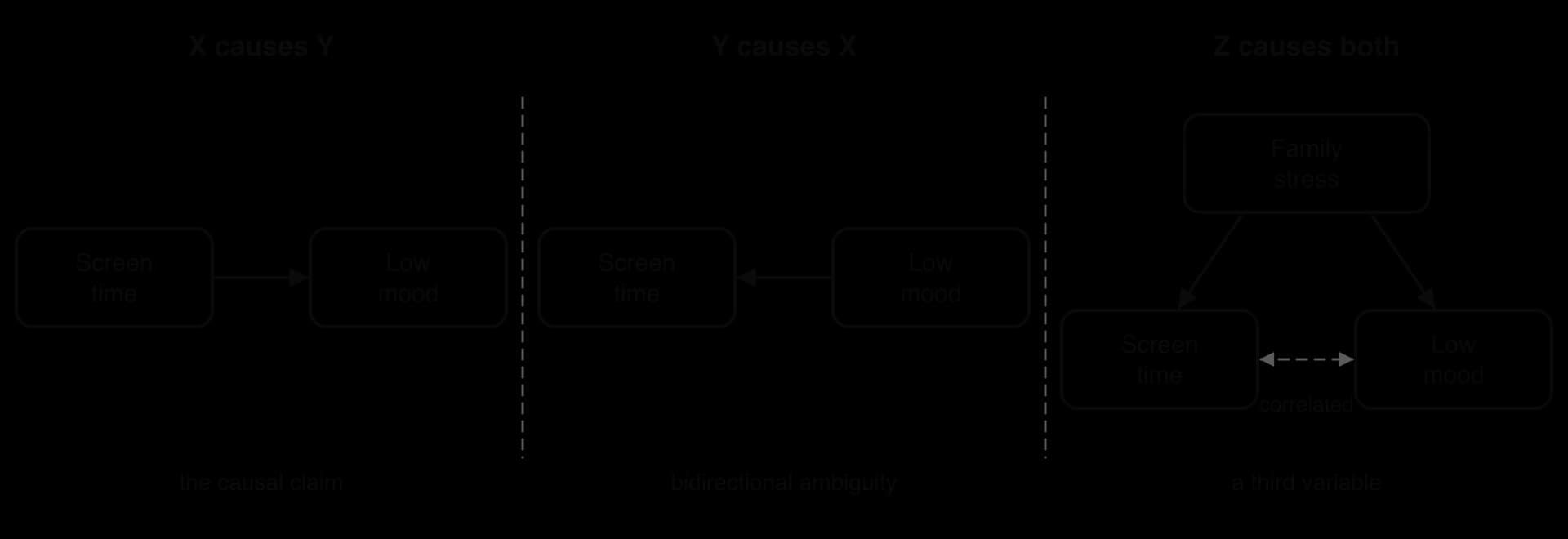
Bidirectional ambiguity is the problem that a correlation does not show the direction of a relationship. If adolescents who spend more time on social media report lower mood, social media may lower mood. It is equally possible that adolescents who already feel low spend more time online, perhaps to distract themselves or to seek support. Both directions produce the same correlation.
Research on London taxi drivers shows the problem and one way to solve it. Maguire et al. (2000) used MRI to show that licensed taxi drivers had larger posterior hippocampi than people who did not drive taxis, and that the volume correlated with the time spent as a driver. This suggested that learning the city enlarged the hippocampus.
It was also possible that people with larger hippocampi were better at navigation and more likely to become taxi drivers. Woollett and Maguire (2011) settled the direction by scanning trainees before and after their training: the grey matter increase appeared only in those who qualified, and not in those who failed or in controls.
A third variable is a variable that was not measured or controlled but influences both of the correlated variables, so that they appear to be related even if neither causes the other. Ice-cream sales and drowning both rise in summer, but the cause of both is hot weather. In psychology, family stress could lead to both more screen time and lower mood in adolescents, producing a correlation without any direct link between the two.
Research on social networks shows how hard third variables are to rule out. Christakis and Fowler (2007) analysed data on 12,067 people in the Framingham Heart Study in the USA, collected from 1971 to 2003, and reported that a person’s chance of becoming obese rose by 57% if a friend became obese, which they interpreted as obesity spreading through social networks.
Cohen-Cole and Fletcher (2008) used the same type of analysis on adolescent friendships and found apparent “spread” of acne, headaches and even height, which cannot be socially contagious. When they adjusted for shared environment, the effects became small and non-significant. Friends may resemble each other because they share neighbourhoods, schools and habits, or because people choose friends like themselves, not because one affects the other.
 YouTube
An experiment is designed to meet all three conditions for causality. The researcher manipulates the independent variable (IV), the presumed cause, and measures its effect on the dependent variable (DV). Because the researcher changes the IV first and measures the DV afterwards, temporal precedence is built into the design. Covariation is tested by comparing the DV across levels of the IV.
Ruling out alternatives is the hardest part. Participants differ in countless ways, and any of these differences could produce a difference in the DV. Random allocation deals with this by giving every participant an equal chance of being in each condition, so that individual differences are spread evenly across groups and are unlikely to differ systematically between them. An experiment with random allocation is a true experiment; one in which groups are formed by an existing characteristic, such as gender or culture, is a quasi-experiment and cannot by itself establish a cause.
Other variables can still interfere. An extraneous variable is any variable other than the IV that could affect the DV, such as the time of day or the room temperature. If it varies systematically with the IV, it becomes a confounding variable, and the result can no longer be attributed to the IV. Experimental controls are the procedures that keep extraneous variables constant or equal across conditions.
In research on treatments, one of the most important alternative explanations is expectation. People who believe they are receiving a treatment often improve, because of hope, attention, changes in behaviour, or natural recovery that would have happened anyway. A placebo is an inactive treatment that looks the same as the real one. Giving it to a control group allows researchers to separate the effect of the treatment itself from the effect of receiving any treatment.
Moseley et al. (2002) showed how much a placebo control can change a conclusion. They randomly allocated 180 patients with arthritis of the knee to one of two common arthroscopic operations or to placebo surgery, in which surgeons made skin incisions and simulated the operation without performing it. Patients and the people assessing their outcomes did not know which operation had been done. Over two years, patients in the real surgery groups reported no less pain and no better function than those in the placebo group.
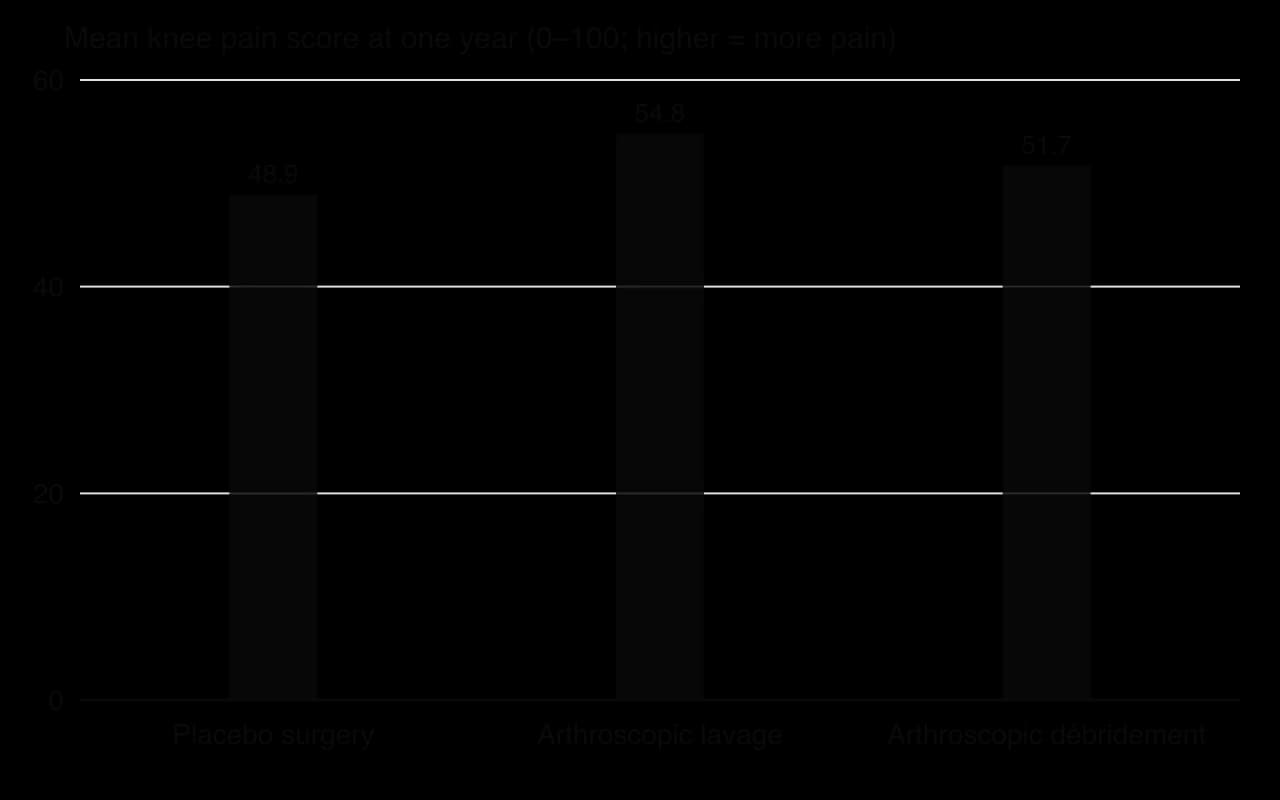
Without the placebo group, the improvement that many patients felt after surgery would have looked like evidence that the operations worked. The placebo control showed that the operations added nothing to the effect of expecting to be helped. In psychology, placebo pills are used in drug trials, and “psychological placebos”, such as supportive conversation without the active ingredients of a therapy, are used in therapy research.
 YouTube
Expectations affect researchers as well as participants. A researcher who knows which participants received the real treatment may, without intending it, rate their symptoms as better or treat them more warmly. In a single-blind design only the participants are unaware of their condition. In a double-blind design, neither the participants nor the researchers who collect the data know who is in which condition, so neither group’s expectations can produce the result.
Kosfeld et al. (2005) used a double-blind, placebo-controlled design to test whether the hormone oxytocin affects trust. Participants received a nasal spray of oxytocin or a placebo, and neither they nor the experimenters knew which. They then played a trust game in which they decided how much money to give a partner, who could return a profit or keep it.
Those given oxytocin trusted their partners with more money, but oxytocin did not increase willingness to take the same risk when the outcome was decided by a random mechanism rather than a person. The design allowed the researchers to claim that the hormone itself, and not expectations about it, changed trusting behaviour, although later research has found the effect hard to replicate.
Placebo controls are difficult in therapy research, because a convincing “fake therapy” is hard to design and both therapist and client know what is happening. A common alternative is wait-listing: the control group is placed on a waiting list and receives the treatment after the study ends. Everyone is eventually treated, which makes the design more acceptable ethically, while the comparison during the waiting period shows whether the treatment has an effect beyond the passage of time.
The choice of control group changes the causal estimate. Furukawa et al. (2014) combined 49 randomised trials of cognitive behavioural therapy for depression, with 2,730 participants, and compared different types of control group. Patients on a waiting list did worse than patients who received no treatment and were not told to wait, perhaps because being told to wait discourages people from seeking other help. Comparing a therapy with a wait-list may therefore make it look more effective than it is. The authors noted that the evidence was limited and partly affected by publication bias, so the size of the difference is uncertain.
Control | Alternative explanation it rules out | Limitation |
|---|---|---|
Random allocation | Pre-existing differences between participants in different conditions | Works reliably only with reasonably large samples; impossible when the IV is a fixed characteristic (gender, culture) |
Placebo | Expectation of improvement, attention, natural recovery | Hard to design convincing placebos for therapy, surgery or exercise; withholding an active treatment raises ethical issues |
Double-blind design | Expectations of participants and of researchers collecting data | Not possible when a treatment has obvious effects or when the therapist must know what they are delivering |
Wait-listing | Change that happens simply with time | May exaggerate treatment effects if waiting discourages people from seeking help; control group still knows it is not treated |
Standardisation | Differences in instructions, setting or procedure between conditions | Makes the study more artificial, which can reduce external validity |
Two questions decide how much a causal claim is worth. The first is whether the study really shows that the IV caused the change in the DV in this study. The second is whether that causal relationship holds beyond the study, for other people, settings and times. The first is internal validity; the second is external validity.
Internal validity is high when the three conditions for causality are met. Random allocation, placebos, blinding and standardised procedures all protect it, because each rules out an alternative explanation. It is threatened by confounding variables, demand characteristics, researcher expectations and participants dropping out more from one condition than another.
External validity has several parts. Population validity concerns whether the results apply to other people, which depends on the sample. Ecological validity concerns whether they apply to real-life settings. Generalisability is used for the same overall idea, and in qualitative research the related term is transferability. A causal effect found in one group of university students in one laboratory may not appear in older adults, in another culture, or outside the laboratory.
Mundane realism is the extent to which the tasks and setting of a study resemble situations that people meet in everyday life. Judging the length of lines, memorising lists of unrelated words or giving electric shocks to a stranger are low in mundane realism; observing how children play in their own nursery is high. Low mundane realism does not make a finding wrong, but it means extra evidence is needed before assuming the same cause operates in real situations.
There is often a trade-off between the two kinds of validity. The tight control that gives a laboratory experiment high internal validity usually makes it artificial, which lowers external validity. A field study in a real school has more mundane realism but less control, so other variables are more likely to interfere. Researchers deal with the trade-off by combining methods: a causal effect found in the laboratory and then confirmed in a field experiment or a natural setting is much more convincing than either alone.
Even in a well-controlled experiment, the groups will rarely have exactly the same scores, because people vary. The difference between conditions might therefore be due to chance, which is the last alternative explanation to rule out. Statistical significance is the judgement that a result is unlikely to have arisen by chance alone if there were no real effect.
Researchers start from a null hypothesis, which states that there is no effect or no relationship. A statistical test calculates a p-value: the probability of obtaining a result at least as extreme as the one found, if the null hypothesis were true. In psychology the usual threshold is p < 0.05. If the p-value is below it, the null hypothesis is rejected and the result is called statistically significant.
Statistical significance has clear limits. A threshold of 5% means that about one in twenty tests of a true null hypothesis will still produce a “significant” result by chance, a type I error. Significance also says nothing about the size or importance of an effect. With a very large sample, a tiny difference becomes significant; with a small sample, a real and important effect may fail to reach significance. This is why researchers also report an effect size, and why a single significant result needs replication before it is trusted.
Many of the most important causal questions in psychology cannot be answered by experiments. Researchers cannot randomly allocate children to poverty, expose people to trauma or give some adolescents more social media for years. In these cases, causation is approached through designs that meet more of the three conditions than a simple correlation, and through the convergence of several kinds of evidence.
A natural experiment uses a change in the IV that happens without the researcher’s control, such as a new policy, a disaster or an economic shock, and compares people affected by it with people who were not. If the change happens for reasons unrelated to the people involved, it can work almost like random allocation.
Costello et al. (2003) were following 1,420 children aged 9 to 13 in rural western North Carolina, a quarter of them from the Eastern Band of Cherokee Indians, with yearly psychiatric assessments, when a casino opened on the Cherokee reservation. Every Cherokee family began to receive a share of the casino’s profits, which moved some families out of poverty for reasons that had nothing to do with the parents’ characteristics. Before the casino opened, children in the families that would later leave poverty had as many symptoms as children who stayed poor (on average 4.28 and 4.38) and more than children who were never poor (2.75).
After the income rise, symptoms in the children whose families left poverty fell to the level of the never-poor children, while symptoms in the persistently poor stayed high. The effect appeared for conduct and oppositional symptoms but not for anxiety or depression. Because the income change came from outside the family, the study gives strong evidence that poverty itself contributes to children’s behavioural problems, rather than parents’ characteristics causing both poverty and children’s symptoms.
A longitudinal design measures the same people repeatedly over time, which allows researchers to see whether a possible cause comes before its supposed effect. Prospective research measures the possible cause first and then follows people forward to see who develops the outcome. This meets the condition of temporal precedence, which a cross-sectional design cannot.
Nolen-Hoeksema and Morrow (1991) had, by chance, measured depression, stress and ways of responding to low mood in 137 Stanford students 14 days before the 1989 Loma Prieta earthquake in California. They followed the students up 10 days and seven weeks after it. Students who already had a ruminative style, repeatedly focusing on their own distress, had more symptoms of depression and stress at both follow-ups. Because rumination was measured before the earthquake, it cannot have been caused by the symptoms that followed it, although a third variable, such as personality, could still influence both.
A dose–response relationship exists when more exposure to a possible cause goes with a greater effect. It strengthens a causal argument because a third variable would have to vary in exactly the same graded way to explain it. Felitti et al. (1998) asked 9,508 adults in the USA about seven types of adverse childhood experience, such as abuse and household dysfunction, and found a graded relationship between the number of types experienced and adult health. People who reported four or more types, compared with none, had a four- to twelvefold increase in the risk of alcoholism, drug abuse, depression and suicide attempts.
A dose–response relationship is still correlational. In the adverse childhood experiences study, the experiences were reported by adults looking back, so memory and current mood may have influenced what they recalled. Families with many adversities may also differ in poverty, neighbourhood and genetic risk, any of which could contribute to later health.
The epidemiologist Hill (1965) proposed a set of viewpoints for judging whether an association between an exposure and a disease is likely to be causal. They include the strength of the association, its consistency across studies and populations, temporal precedence, a dose–response gradient, a plausible mechanism, and agreement with experimental evidence. Hill stressed that none of them proves causation on its own. Their value is that causal conclusions become stronger as several independent lines of evidence point the same way.
Behaviour is complex, so causes in psychology usually involve several variables working together rather than one direct effect. A simple relationship, such as a loud noise causing a startle response, may be a direct cause. Most behaviours of interest, such as depression, aggression, attachment or academic success, depend on biological, cognitive and sociocultural factors at the same time.
It helps to distinguish influence from interaction. Two factors that each influence an outcome simply add up: poverty raises the risk of a disorder by a certain amount, and a family history raises it by another amount. In an interaction, the effect of one factor depends on the level of another. The diathesis-stress model describes this kind of cause: a vulnerability (diathesis) leads to a disorder only when stress is high enough, and stress has a large effect only in people who are vulnerable.
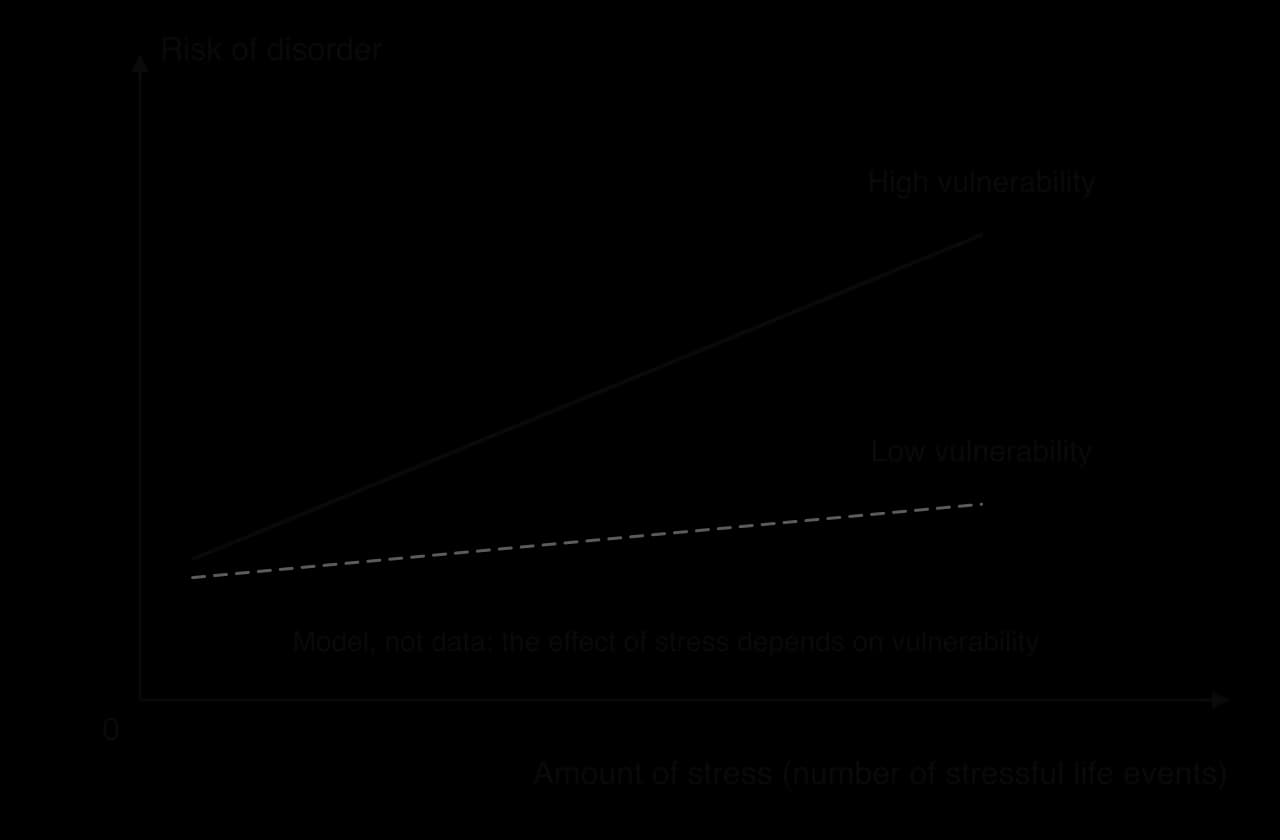
Caspi et al. (2003) reported a well-known example of a gene–environment interaction. In a birth cohort from Dunedin, New Zealand, stressful life events predicted depression more strongly in people who carried one or two short versions of the serotonin transporter gene than in people who did not. Later research shows why such findings need caution: Border et al. (2019) tested the same gene and similar environmental factors in samples far larger than earlier studies and found no evidence for the interaction. The general idea that causes interact remains well supported, but this particular interaction has not been confirmed.
Complexity also affects how causal claims should be judged. Explaining a complex behaviour through one cause is a form of reductionism, and it usually leaves out other causes that matter. Interactionism, explaining behaviour through the interaction of factors at several levels, is closer to how most behaviour is actually caused, although interactions are harder to test and need much larger samples.
People also act for reasons of their own. Agency is the capacity of people to make choices and act intentionally, and motivation is the set of processes that start, direct and maintain goal-directed behaviour. Both complicate causal explanation. Two students who receive the same low mark may react in opposite ways, one giving up and the other working harder, because of how each interprets the result and what each wants.
This links causality to the debate between determinism and free will. A strictly deterministic explanation treats behaviour as the product of genes, brain processes or the environment. Many psychologists take a middle position: biological and social factors shape and limit behaviour, but people’s beliefs, goals and choices are themselves causes that research can study. Research on the expectancy effect and on placebos shows that what people believe can change both what they do and how they feel, so beliefs belong inside causal explanations.
Agency also creates problems for research. Participants who guess the aim of a study may change their behaviour, which threatens internal validity. People choose their environments, so a correlation between, for example, sport and well-being may arise because happier people choose to play sport. Recognising agency is therefore part of identifying alternative explanations.
Each approach studies causes at a different level and meets different problems in establishing them.
Approach | Typical causal claims | Main causal problems | Example |
|---|---|---|---|
Biological | Genes, hormones, neurotransmitters and brain structures cause behaviour | Brain differences may be effects rather than causes (bidirectional ambiguity); drug effects do not show what causes a disorder; single-cause reductionism | Woollett and Maguire (2011): a longitudinal design showed that learning London’s streets changed the hippocampus, not the reverse |
Cognitive | Mental processes such as schemas, attention and thinking styles cause behaviour and emotion | Mental processes are inferred, not observed; thinking styles may be symptoms rather than causes of disorders | Nolen-Hoeksema and Morrow (1991): rumination measured before an earthquake predicted later depression |
Sociocultural | Groups, norms, culture and social conditions cause behaviour | Variables such as culture or poverty cannot be allocated at random; selection into groups (homophily) mimics influence | Costello et al. (2003): a casino income supplement as a natural experiment on poverty |
Research methodology | Designs differ in how far they meet the three conditions | Trade-off between internal and external validity; chance results; analytic flexibility | Moseley et al. (2002): placebo surgery showed that a common operation added nothing |
Research on mental health disorders depends heavily on correlational and longitudinal evidence, because most proposed causes, such as trauma, poverty, genes and stressful life events, cannot be manipulated. The strongest causal evidence comes from treatment trials with random allocation, placebos, double-blind procedures or wait-list controls. Even then, the fact that a treatment works does not show what caused the disorder: an antidepressant that reduces symptoms does not prove that depression was caused by the chemical the drug acts on.
Developmental psychologists study causes that unfold over years, so longitudinal designs are central. They separate maturation from experience by following the same children over time and by using natural experiments, such as changes in family income or in schooling. Bidirectional ambiguity is common: parenting style may shape a child’s behaviour, but a child’s temperament also shapes how parents respond.
Research on relationships often finds correlations between variables such as communication style and relationship satisfaction, which may run in both directions: satisfied couples communicate more positively, and positive communication makes couples more satisfied. Experiments are possible for short-term processes, as in research on hormones and trust, but long-term relationship outcomes rely mostly on longitudinal and correlational evidence. Social network research faces the problem of separating influence from the tendency to choose similar partners and friends.
Cognitive processes such as memory and attention are well suited to laboratory experiments, which give strong causal evidence about specific processes but often with low mundane realism. Applied questions, such as whether a teaching method improves learning in schools, need field experiments in which classes or schools are randomly allocated. Research on the brain and learning, such as the taxi driver studies, shows how longitudinal designs can establish that experience causes changes in the brain.
Causality is the concept to use whenever a study, a theory or a news report claims that one thing affects another. A useful evaluation identifies the causal claim, asks which of the three conditions the design meets, names the specific alternative explanations that remain, and judges how far the conclusion should be limited. It also asks whether the causal claim is stated at the right level of complexity, or whether a single cause is being given for a behaviour with many.
Causality connects closely with the other concepts. A biased sample limits the external validity of a causal claim. Poor measurement, such as a vague self-report of “screen time”, adds error that can hide or exaggerate a relationship. Controls such as placebos and wait-lists raise questions of responsibility, because some participants do not receive a treatment that may help them. Explaining these links shows that the concepts are being used together rather than as a checklist.
Since about 2010, rates of reported depression and anxiety among adolescents have risen in several countries, during the same years in which smartphones and social media spread. Twenge et al. (2018) analysed two nationally representative surveys of 506,820 US adolescents and found that depressive symptoms and suicide-related outcomes rose between 2010 and 2015, especially among girls, and that adolescents who spent more time on new media were more likely to report mental health problems. They suggested that the rise in screen time may account for the rise in depression. The claim was widely reported, and it raised a causal question that the correlational data could not answer on their own.
Orben and Przybylski aimed to test how strongly digital technology use is associated with adolescent well-being in large survey datasets, while taking account of the many different ways in which the same data can be analysed.
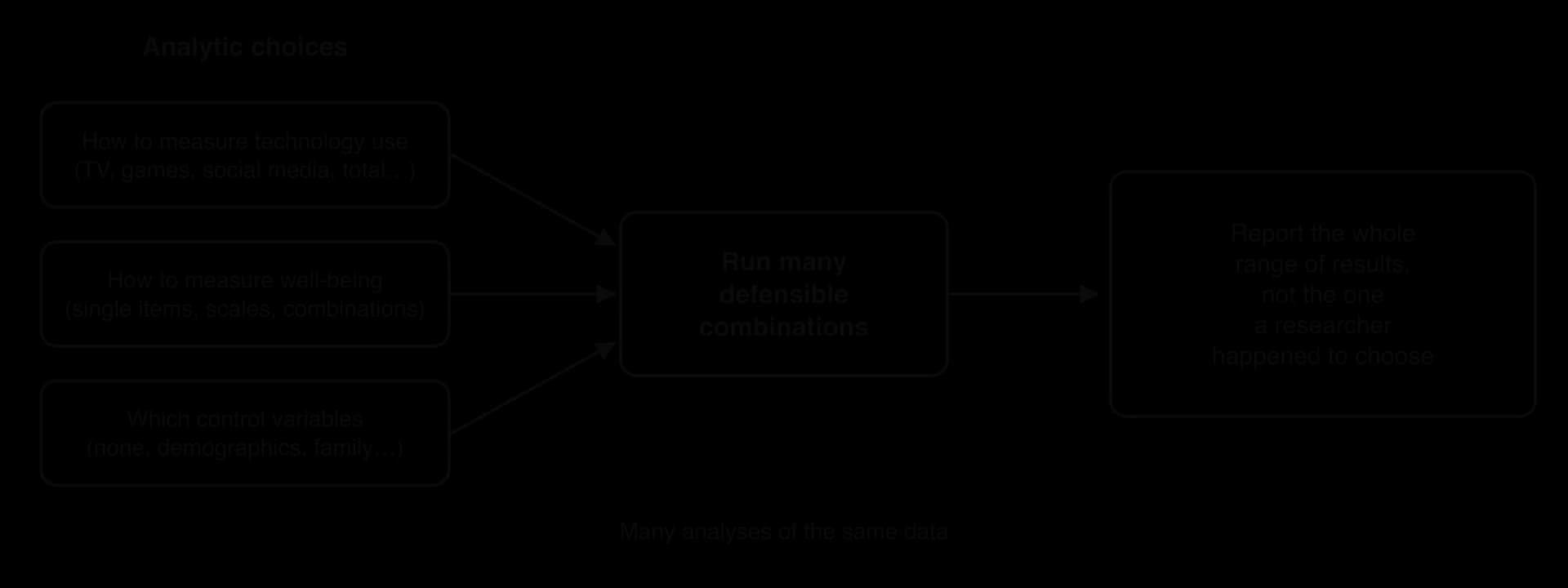
The study was a secondary analysis of three large-scale social datasets from the USA and the UK, with a total of 355,358 adolescents. In data sets this large, researchers must make many decisions: which questions to use as the measure of technology use (television, games, social media, total screen time), which items to combine into a measure of well-being, and which other variables to control for. Each combination of decisions is a “specification”, and different specifications can give different answers from the same data.
Instead of choosing one specification, the researchers used specification curve analysis. They identified the defensible options for each decision and reported the results of a very large number of the resulting analyses, rather than a selected one. The number of possible combinations ran into the hundreds of millions. To give the size of the associations a meaning, they compared them with the associations between well-being and other variables measured in the same surveys.
Across the specifications, the association between digital technology use and well-being was negative but small. At most, technology use explained 0.4% of the variation in adolescents’ well-being. Many specifications gave statistically significant results, because the samples were so large, but the size of the effects was tiny.
The comparisons put the figure in context. The association with technology use was similar in size to the association between well-being and eating potatoes, and smaller than the negative association with wearing glasses. Being bullied had a much larger negative association with well-being, and getting enough sleep a much larger positive one.
The researchers concluded that the association between technology use and adolescent well-being is too small to justify policy change, and that earlier studies reaching stronger conclusions from the same kinds of data may have depended on particular analytic choices. Because the data were correlational, even the small association does not show that technology use lowers well-being: unhappy adolescents may use technology more, or third variables may affect both.
Sources: Orben, A. and Przybylski, A. K. (2019). The association between adolescent well-being and digital technology use. _Nature Human Behaviour, 3(2), 173–182. Twenge, J. M., Joiner, T. E., Rogers, M. L. and Martin, G. N. (2018). Clinical Psychological Science, 6(1), 3–17._
The study shows clearly that a correlation in huge datasets can be statistically significant and still small, and that its size depends on analytic choices. It does not settle the causal question either way. Both the Twenge and the Orben analyses used survey data collected at one time point, so neither can establish temporal precedence or rule out bidirectional ambiguity. Experimental studies, in which adults were paid to stop using social media for several weeks, have since found small improvements in well-being, which is more direct evidence for a causal effect but also suggests that the effect is modest.
Technology use was measured by adolescents’ own estimates of time, which are known to be inaccurate. A single number for screen time also combines very different activities, such as messaging friends, watching videos and being bullied online, which may have different effects. Well-being was measured with different questionnaire items in each dataset. Weak measures add random error, which tends to make associations look smaller than they are, so the 0.4% figure may underestimate the real relationship.
Specification curve analysis is a control for confirmation bias, because it removes the researcher’s freedom to choose the analysis that best fits a hypothesis. It does not remove bias completely: the researchers still decide which options count as “defensible”. Critics also argued that an average effect across all adolescents can hide larger effects in vulnerable groups, such as girls or the heaviest users, so a small average does not mean that no one is harmed.
The research has direct policy implications for schools, parents and governments. Claims that screens cause a mental health crisis can lead to policies that may not help and can distract from better-supported causes, while dismissing the concern could leave real harms unaddressed. Researchers have a responsibility to report effect sizes, uncertainty and the limits of correlational evidence clearly, especially when findings are reported in the media.
Causality can be examined in three main ways. In Paper 1 Section C it may be the concept named in an essay about an area of study in one of the contexts. In Paper 2 Section A, one question asks you to explain a concept in relation to your class practical. In Paper 2 Section B it is usually one of the concepts you can choose for discussing an unseen study, and it is often the most productive one, because unseen studies frequently draw causal conclusions that their design cannot fully support.
Paper 2 Section A asks about causality in relation to your own class practical. For the experiment, the answer should show how your design did or did not meet the conditions for a causal conclusion, using its actual details.
Causality is a relationship in which a change in one variable produces a change in another; a causal claim needs covariation, temporal precedence and the elimination of alternative explanations.
A correlation shows only covariation: bidirectional ambiguity means the direction is unknown, and a third variable may produce the relationship.
Experiments establish causes by manipulating the IV, randomly allocating participants and using controls such as placebos, double-blind designs and wait-listing.
Internal validity is whether the IV caused the change in the study; external validity is whether the finding generalises. Mundane realism is how far the study resembles everyday life; there is often a trade-off.
Statistical significance (usually p < 0.05) means a result is unlikely to be due to chance; it does not show the size or importance of an effect.
When experiments are impossible, natural experiments, longitudinal and prospective designs, and dose–response evidence approach causation, and conclusions strengthen when several lines of evidence agree.
Most behaviour has several interacting causes, as in the diathesis-stress model; single-cause explanations are reductionist.
Agency and motivation mean that people’s beliefs and choices are themselves causes, and they create alternative explanations in research.
Orben and Przybylski (2019) found that technology use explained at most 0.4% of the variation in adolescent well-being, and that correlational conclusions depend on analytic choices.
I can explain causality and the three conditions a causal claim must meet.
I can explain why correlation does not show causation, using bidirectional ambiguity and third variables with examples.
I can describe how random allocation, placebos, double-blind designs and wait-listing support causal claims, and their limits.
I can compare and contrast internal and external validity and explain mundane realism.
I can explain what statistical significance shows and what it does not show.
I can explain how natural experiments, longitudinal designs and dose–response evidence approach causation.
I can discuss interaction, complexity, agency and motivation as features of causes in psychology.
I can describe and evaluate Orben and Przybylski (2019) with reference to causality, measurement, bias and responsibility.
I can evaluate causal claims in research across the approaches and the four contexts.