3 Cognitive approach
The cognitive approach explains behaviour through mental processes such as attention, memory, thinking and decision-making, studying the mind as a system that takes in, stores and uses information.
- IB Psychology
- SL and HL
What 3 covers
From the subject guide: what you need to know and be able to do.
How mental processes, learning and biases shape behaviour.
8 subtopics in Cognitive approach
Each one has its own page once something is published for it.
- 3.1Anchoring biasnotes
- 3.2Classical conditioningnotes
- 3.3Cognitive load theorynotes
- 3.4Cognitive modelsnotes
- 3.5Confirmation biasnotes
- 3.6Dual processing theorynotes
- 3.7Operant conditioningnotes
- 3.8Schema theorynotes
Key terms introduced here
Each is in the Psychology glossary, with every other term in the subject.
- Behaviourism
An approach that explains behaviour as learned through conditioning by the environment, and that studies only observable behaviour rather than unobservable mental processes.
- Cognitive approach
A perspective in psychology that explains behaviour through internal mental processes, such as perception, attention, memory and thinking, often treating the mind as an information-processing system.
- Cognitive process
Any mental function involved in acquiring, storing, interpreting, transforming or using information, such as attention, perception, memory, language, thinking and decision-making.
An overview of 3 Cognitive approach
The cognitive approach explains behaviour through the mental processes that come between what a person experiences and what they do. It studies how people take in information, store it, organise it and use it to reason and decide, and how these cognitive processes can go wrong in predictable ways.
Cognitive processes are the subject matter of the approach. They cannot be seen directly, but they can be studied through their effects on behaviour.
From behaviourism to the information-processing mind
The approach grew in the mid-20th century as a reaction to behaviourism, which had dominated psychology for decades. Behaviourists explained learning through links between stimuli and responses formed by classical conditioning and through the consequences of behaviour in operant conditioning, and they treated the mind as a “black box” that science could not open. Their theories remain useful: reward systems in schools and apps, and treatments for phobias, still rely on them.
Cognitive psychologists argued that the same stimulus produces different behaviour in different people because of how it is perceived, remembered and interpreted. Drawing on the development of computers, they described the mind as an information processor: input from the senses is encoded, stored and retrieved, and output is behaviour. The processes themselves cannot be observed, so they are inferred from behaviour that can be measured, such as recall, reaction times and choices, and increasingly from brain imaging.
Questions the cognitive approach tries to answer
How is information stored and organised in memory, and why is memory sometimes inaccurate?
Why does learning succeed or fail, and how can teaching be designed to fit the limits of the mind?
How do existing knowledge and expectations shape what people perceive and remember?
Why do people make decisions quickly and intuitively in some situations and slowly and deliberately in others?
Why do judgements depart from logic and probability in systematic ways, and can these biases be reduced?
How far can behaviour be learned without any mental processing at all?
The subtopics
Subtopic | Question it answers |
|---|---|
3.1 Anchoring bias | Why does an initial number, even an irrelevant one, pull later estimates towards it, and how does this affect real decisions such as criminal sentencing? |
3.2 Classical conditioning | How are associations between stimuli learned, why are some easier to learn than others, and how is conditioning used to treat phobias? |
3.3 Cognitive load theory | How do the limits of working memory affect learning, how can cognitive load be measured, and how should instruction be designed? |
3.4 Cognitive models | What is a cognitive model, and how are models such as the multi-store and working memory models built, tested and revised? |
3.5 Confirmation bias | Why do people seek, interpret and remember evidence in ways that support what they already believe? |
3.6 Dual processing theory | How do fast, intuitive thinking and slow, deliberate thinking together shape decisions? |
3.7 Operant conditioning | How do reinforcement and punishment shape behaviour, and how is this used to change it? |
3.8 Schema theory | How does organised prior knowledge shape perception, memory and behaviour, and how do schemas develop and differ between cultures? |
How the subtopics connect
The eight subtopics form three groups. Conditioning theories explain learning without reference to mental processes and provide the contrast against which the cognitive approach defined itself. Cognitive models, cognitive load theory and schema theory describe how the mind stores and organises information. Dual processing theory, anchoring bias and confirmation bias concern thinking and decision-making, and they explain why judgements that are usually adequate become systematically biased in some situations.
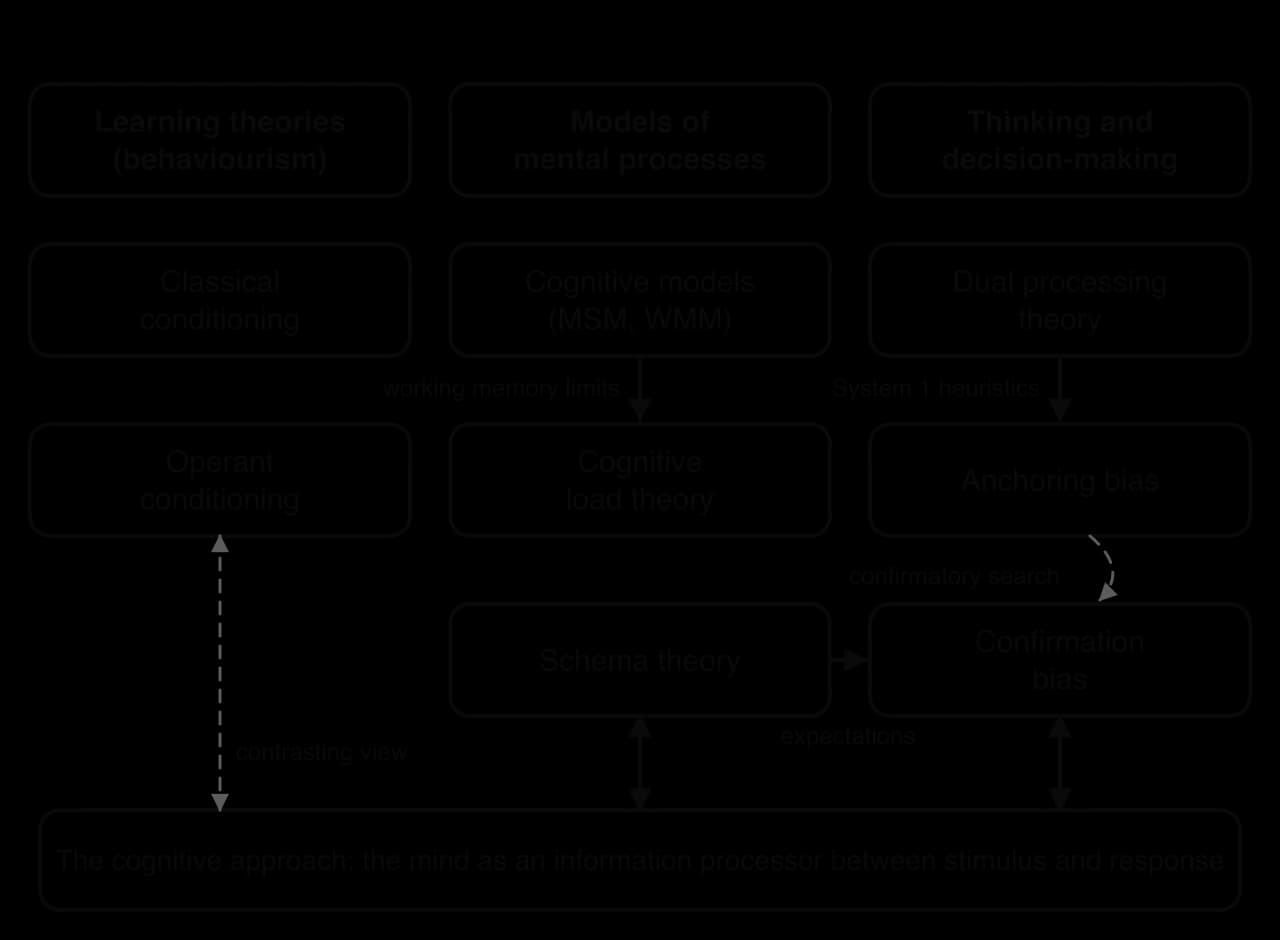
The links run across the groups as well. Cognitive load theory builds on the working memory model’s claim that working memory has a limited capacity. One explanation of anchoring, selective accessibility, is a confirmatory search, which connects anchoring to confirmation bias. Schemas provide the expectations that confirmation bias protects and the stereotypes on which intuitive judgements draw. Dual processing theory frames all of these: the fast, automatic system relies on schemas and heuristics, and the slow system has the limited capacity that cognitive load theory describes.
Links to the concepts and the rest of the course
The cognitive approach raises each of the six concepts in characteristic ways.
Concept | How it applies to the cognitive approach |
|---|---|
Measurement | Mental processes cannot be observed, so they are inferred from recall, reaction times, choices and brain activity; how a construct such as working memory or cognitive load is operationalised shapes every finding. |
Bias | Cognitive biases are a central topic, and the same biases affect researchers; much early research used WEIRD student samples. |
Causality | Laboratory experiments allow strong causal claims about variables such as anchors or presentation format, though less certainty about the mental mechanism. |
Perspective | The computer analogy is a powerful but partial view that can neglect emotion, culture and the body; biases can be seen as errors or as adaptive shortcuts. |
Change | Models and theories are used to design change: worked examples in teaching, debiasing strategies, reward systems and therapies. |
Responsibility | Research often uses mild deception; findings about biases and conditioning can be used to help or to manipulate. |
Cognitive terms are applied across all four contexts. In learning and cognition they are areas of study in their own right: cognitive biases, conditioning, dual processing, schema theory and cognitive models of processes such as memory and attention. In health and well-being, cognitive models of mental health disorders and negative self-schemas explain depression, and conditioning explains phobias and their treatment. In human development, schemas and models explain how thinking changes with age.
In human relationships, schemas, first impressions and biased judgements shape how people perceive one another. The approach also interacts with the other two: brain structures and chemical messengers underlie cognitive processes, and culture shapes the schemas and thinking styles people bring to every task.
How SL and HL differ
SL and HL students study exactly the same cognitive approach content and sit the same Papers 1 and 2. HL students build on it in the HL extensions on culture, motivation and technology. Motivation is linked closely to the cognitive approach, for example in how intrinsic and extrinsic rewards affect learning, and technology raises cognitive questions such as the effect of devices on attention and memory. HL students also apply their understanding of research to unseen data in Paper 3.
Assessment
Paper 1 Section A: short-answer questions name an approach term, such as anchoring bias or schema theory, and ask for an explanation or description with an example of behaviour. Questions come from two of the three approaches.
Paper 1 Section B: a scenario set in one of the four contexts asks how an approach term, such as confirmation bias or cognitive load theory, applies to it.
Paper 1 Section C: concept-based essays on areas of study in the learning and cognition context often draw on cognitive theories and research.
Paper 2: Section A asks about the class practicals by method; the experiment, the practical in the learning and cognition context, is often a cognitive study such as an anchoring or leading-question experiment, though the questions focus on the method. The unseen study in Section B may be a cognitive study.
Paper 3 (HL): the sources test a claim about culture, motivation or technology within one context; claims about motivation or technology in learning and cognition often involve cognitive processes such as attention, memory and learning.
Carry on with 3 in Augment
With a free account, Augment remembers where you stopped and what you have practiced.