Explain how classical conditioning creates learned associations, describe acquisition, extinction, generalisation and preparedness, and evaluate its role in fears, tastes, cravings and treatment.
Each is in the Psychology glossary, with every other term in the subject.
A behavioural treatment in which an unwanted behaviour or stimulus is repeatedly paired with an unpleasant stimulus, such as a nausea-producing drug, so that it comes to be avoided.
An inherited tendency to learn certain associations, such as taste with illness or snakes with fear, more quickly and lastingly than others because they aided survival in evolution.
A form of learning in which a neutral stimulus, repeatedly paired with a stimulus that already triggers a reflexive response, comes to trigger a similar response on its own.
An emotional reaction, such as fear, acquired through classical conditioning, so that a previously neutral stimulus now triggers it.
The learned response triggered by a conditioned stimulus, usually similar to but weaker than the unconditioned response.
A formerly neutral stimulus that, after being paired with an unconditioned stimulus, triggers a learned response on its own.
A learned avoidance of a food or drink after its taste has been followed by illness, which can form after one pairing even when illness is delayed by hours.
Describe the process of classical conditioning using the terms unconditioned stimulus, unconditioned response, neutral stimulus, conditioned stimulus and conditioned response.
Explain the conditions that make conditioning stronger or weaker, including timing, contingency and blocking.
Describe extinction, spontaneous recovery, stimulus generalisation and stimulus discrimination, with an example of each.
Explain biological preparedness and why some associations are learned far more easily than others.
Explain the role of classical conditioning in human behaviour in health, development, relationships and learning.
Describe and evaluate the Little Albert study of Watson and Rayner (1920).
Evaluate classical conditioning as an explanation of behaviour with reference to causality, measurement, perspective and responsibility.
Apply classical conditioning to an unfamiliar situation.
Classical conditioning is a form of learning in which an organism comes to link two stimuli, so that a signal which once meant nothing starts to produce a response on its own. It explains why the smell of a hospital can make a former patient feel sick, why a song can bring back the feelings of a past relationship, and why some people tense up at the sound of a dentist’s drill before any treatment starts.
The process was first studied in detail by the physiologist Ivan Pavlov and became the foundation of behaviourism, which tried to explain behaviour without reference to the mind. Later research showed that conditioning depends on what one event predicts about another, which is why it is now treated as part of the cognitive approach, in which the learner is seen as building an expectation about what will happen next. The topic raises questions of
With a free account, Augment remembers where you stopped and what you have practiced.
A technique that replaces an unwanted conditioned response with an incompatible one by pairing the conditioned stimulus with a stimulus that produces the new response, such as relaxation.
The gradual weakening and disappearance of a learned response when the conditioned stimulus appears without the unconditioned stimulus, or when a behaviour is no longer reinforced.
Conditioning in which a neutral stimulus is paired with an established conditioned stimulus, rather than an unconditioned stimulus, and comes to trigger a conditioned response itself.
A stimulus that, before conditioning, does not trigger the response being studied, apart from perhaps a brief orienting response.
The reappearance of an extinguished conditioned response after a rest period, when the conditioned stimulus is presented again.
Learning to respond to a conditioned stimulus but not to similar stimuli that have not been paired with the unconditioned stimulus.
The tendency for stimuli similar to a conditioned stimulus to trigger the conditioned response, with stronger responses to more similar stimuli.
The unlearned, reflexive response produced by an unconditioned stimulus, such as salivation to food or a startle to a sudden loud noise.
A stimulus that triggers a response naturally, without any learning, such as food producing salivation or a loud noise producing fear.
Many behaviours are reflexes: automatic, unlearned responses to particular stimuli. Food in the mouth produces saliva, a sudden loud noise produces a startle, and a puff of air on the eye produces a blink. Classical conditioning builds on these reflexes. When a new stimulus regularly comes just before the stimulus that triggers a reflex, the new stimulus begins to trigger a similar response by itself.
The learning is called “classical” because it was the first kind of conditioning to be studied systematically. It is also called Pavlovian or respondent conditioning, because the behaviour involved is a response that the stimulus draws out of the organism, rather than an action the organism chooses to perform. In operant conditioning, by contrast, the organism learns from the consequences of its own actions.
Pavlov was a Russian physiologist who received the Nobel Prize in 1904 for his work on the digestive system. To measure saliva, he surgically attached a small tube to the salivary gland of each dog so that drops could be collected and counted. During this work he found that the dogs began to salivate before the food arrived: at the sight of the bowl, or at the footsteps of the assistant who usually fed them. He called these “psychic secretions” and spent the following decades studying how they were learned, in work collected in English as Conditioned Reflexes (1927).
In a typical experiment a dog stood in a harness in a quiet room. A neutral sound, such as a metronome or a buzzer, was presented, and a few seconds later food powder was given. After a number of such pairings, the sound alone produced saliva. Counting the drops of saliva gave Pavlov a precise, objective measure of learning, an early example of operationalisation.
Every example of classical conditioning can be described with five terms. Two of them, the unconditioned stimulus (UCS) and the unconditioned response (UCR), describe the reflex that exists before any learning takes place.
The response to the UCS is also unlearned. In Pavlov’s dogs it was salivation to food; in a person it might be fear and a racing heart at a sudden loud bang.
The other three terms describe the stimulus that is learned about and the response it comes to produce. Before learning, the stimulus is a neutral stimulus (NS): it causes no response of the kind being studied, apart from perhaps a brief orienting response, such as a dog turning its head towards a sound. After learning, the same stimulus is a conditioned stimulus (CS).
The learned response to the CS is the conditioned response (CR). It is usually similar to the UCR but weaker: Pavlov’s dogs produced fewer drops of saliva to the sound than to food. Sometimes the CR is quite different from the UCR, which turns out to matter for drug tolerance.
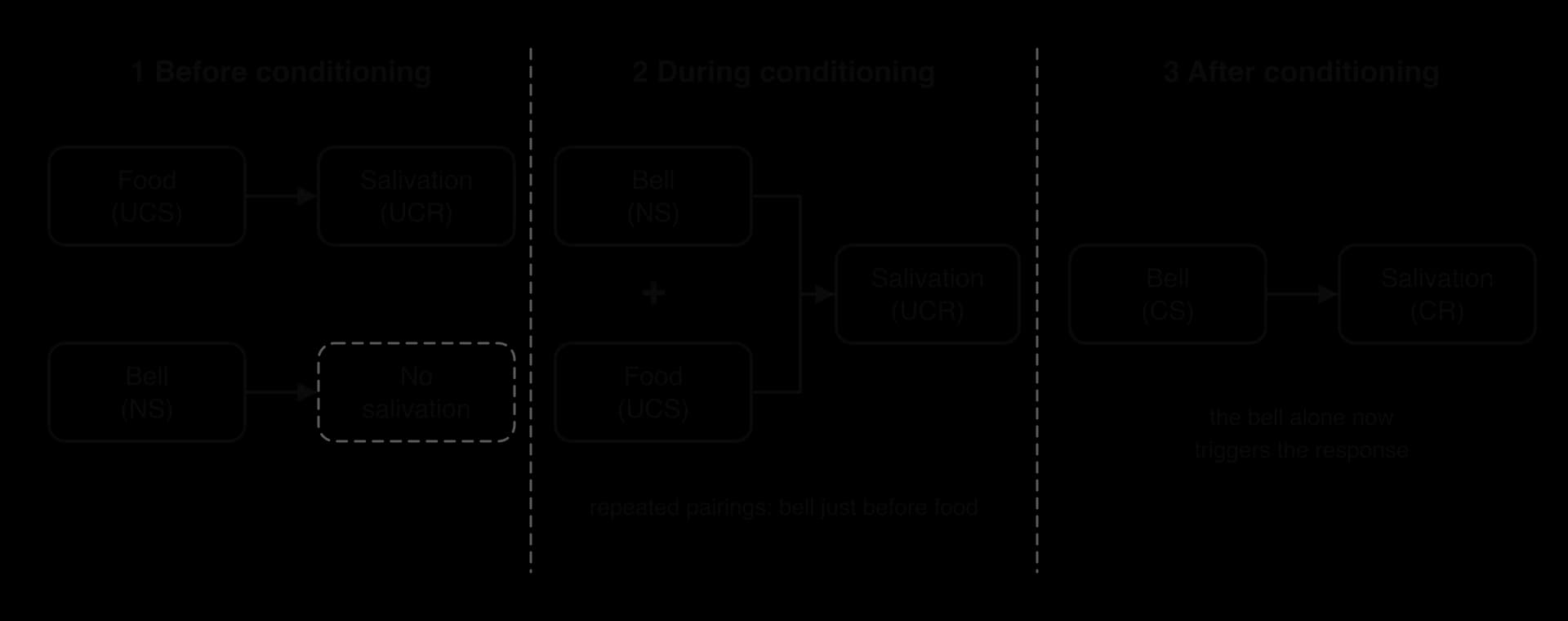
Conditioning is usually described in three phases. Before conditioning, the UCS produces the UCR and the NS produces no such response. During conditioning, the NS is presented just before the UCS, again and again; each pairing is called a trial. After conditioning, the former NS has become a CS and produces the CR when it is presented alone.
The figure follows a single sequence from left to right: food leads to salivation before learning, the bell and food are paired, and finally the bell alone leads to salivation. The middle phase, in which the association is formed and strengthened, is called acquisition.
 YouTube
Pairing a neutral stimulus with an unconditioned stimulus does not always produce learning. Pavlov and later researchers found that the strength of conditioning depends on when the two stimuli occur, how often they occur together, how intense the UCS is, and above all whether the CS gives the organism useful information about what is coming.
Conditioning is usually strongest when the CS starts shortly before the UCS and overlaps with it, which is called delay conditioning. In many laboratory procedures the best gap is around half a second, although it varies with the response being learned. When the CS ends before the UCS starts (trace conditioning), learning is weaker and becomes weaker still as the gap grows. When the CS comes after the UCS (backward conditioning), little or no conditioned response develops.
These timing effects show that the CS works as a signal. A sound that comes after the food tells the dog nothing about the food, so there is nothing useful to learn from it. The idea that stimuli must occur close together in time for an association to form is called contiguity. Taste aversions, where illness may come hours after eating, are the main exception and are explained by biological preparedness.
The conditioned response usually grows quickly over the first trials and then levels off, producing a curved acquisition graph. A more intense UCS, such as a louder noise or a more severe illness, produces faster and stronger conditioning. Very intense experiences can produce lasting learning after a single trial, which helps to explain why one frightening event, such as a car crash, can leave a person anxious about travelling by car.
Two findings from the 1960s changed how psychologists understand conditioning. Rescorla (1968) gave rats tones and electric shocks. For one group, shocks occurred only when the tone was on; for another, the shocks were just as likely when the tone was off. Both groups experienced the same number of tone–shock pairings, but only the first group learned to fear the tone. What mattered was not how often the two stimuli occurred together but whether the tone predicted the shock better than its absence did. This relationship is called contingency.
Kamin (1969) showed a related effect called blocking. Rats first learned that a noise predicted shock. Then a light was added, so that the noise and the light together came before the shock. When the light was later tested alone, the rats showed almost no fear of it. Because the noise already predicted the shock, the light added no new information and was barely learned, even though it had been paired with shock many times.
Contingency and blocking are the main reasons classical conditioning sits within the cognitive approach. A purely behaviourist account says that pairing alone creates learning. These results suggest that even a rat is forming an expectation about what will happen next, which is a mental representation of a relationship between events. Rescorla and Wagner (1972) turned this idea into a mathematical model in which learning on each trial depends on how surprising the UCS is.
Once a stimulus has become a CS, it can act like a UCS for another stimulus. Pavlov first conditioned dogs to salivate to a metronome, then paired a black square with the metronome without any food. After several pairings the black square alone produced some saliva. This is higher-order conditioning.
Higher-order conditioning helps to explain how humans develop emotional responses to things that were never paired with anything painful or pleasant in themselves. A word such as “test” may become anxiety-provoking because it is paired with situations that are already feared, and a brand name can become pleasant because it appears alongside images that already make people feel good. Second-order responses are usually weaker than first-order ones and extinguish more easily.
Once a conditioned response has been learned, it can change in four main ways. It can fade when the CS stops predicting the UCS, return after a delay, spread to similar stimuli, or become specific to one stimulus. Each of these processes matters for explaining real behaviour, and for treating unwanted conditioned responses such as phobias.
If the CS is presented again and again without the UCS, the CR gradually weakens and eventually stops. This process is called extinction. Pavlov rang the sound repeatedly without giving food, and the number of drops of saliva fell trial by trial until the dogs no longer salivated.
Extinction does not erase the original learning. The organism learns a second, competing association: in this situation, the CS no longer predicts the UCS. Bouton’s research on renewal shows that an extinguished fear often returns when the CS appears in a context different from the one where extinction took place, because the new “safe” learning is tied to that context. This has practical consequences: a fear reduced in a therapist’s office may return in the street.
After extinction, if there is a rest period and the CS is then presented again, the CR often returns, although it is weaker than before. Pavlov found that dogs whose salivation had been extinguished one day salivated again to the sound the next morning. Spontaneous recovery is further evidence that the original association survives extinction.
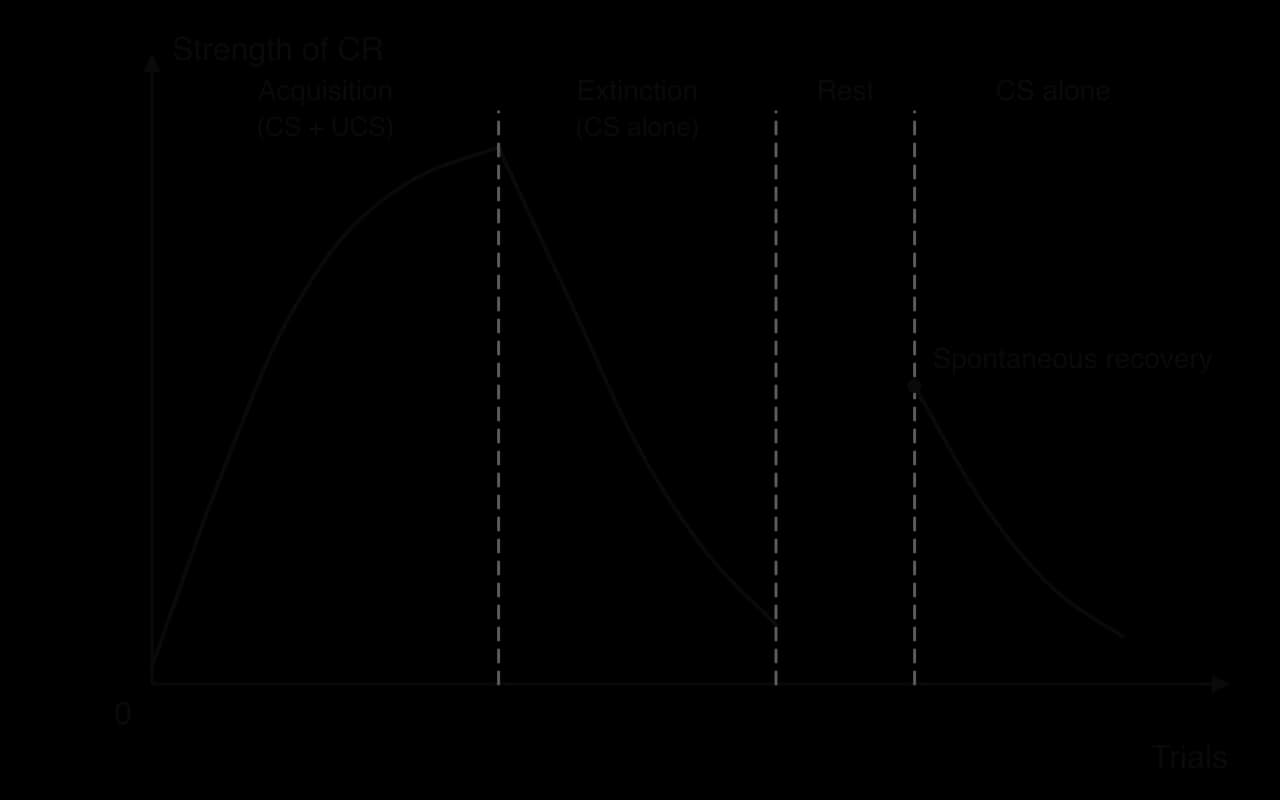
The graph summarises the sequence. During acquisition the strength of the CR rises steeply and then levels off. During extinction it falls towards zero. After the rest period, the first presentation of the CS produces a recovered response, which then extinguishes more quickly than the first time.
A conditioned response is often triggered by stimuli that are similar to the original CS. A dog conditioned to a tone of one pitch also salivates to tones of nearby pitches, and the closer the new tone is to the original, the stronger the response. This pattern, called stimulus generalisation, usually follows a gradient.
Generalisation is useful in everyday life: an animal that has learned that one rustle in the grass means a predator does well to react to similar rustles. It also helps to explain how a fear learned in one situation spreads. A person bitten by one dog may become afraid of all dogs, and in the Little Albert study a fear conditioned to a white rat spread to a rabbit, a dog and a fur coat.
The opposite of generalisation is stimulus discrimination: learning to respond to the CS but not to similar stimuli. Pavlov produced discrimination by pairing one tone with food and presenting a slightly different tone without food. Over many trials the dogs salivated to the first tone only.
Discrimination allows a learned response to become specific and accurate. A child who was frightened by one large, barking dog may at first fear all dogs (generalisation), but after many calm meetings with small, friendly dogs may come to fear only large dogs that bark (discrimination).
Process | What happens | Example |
|---|---|---|
Acquisition | NS and UCS are paired; the NS becomes a CS and produces a CR | A buzzer before food comes to produce salivation |
Extinction | CS presented repeatedly without the UCS; the CR fades | The buzzer is sounded many times without food; salivation stops |
Spontaneous recovery | After a rest, the extinguished CR returns in weaker form | The next day, the buzzer again produces some saliva |
Stimulus generalisation | Stimuli similar to the CS also produce the CR | A fear of one dog spreads to other dogs |
Stimulus discrimination | The CR occurs to the CS but not to similar stimuli | Fear of large barking dogs only, not of small quiet ones |
Higher-order conditioning | A CS acts like a UCS for a new stimulus | A black square paired with the metronome comes to produce saliva |
Early behaviourists assumed that any stimulus could be conditioned to any response equally well, an assumption sometimes called equipotentiality. If that were true, a tone, a light and a taste would all be equally easy to link with illness or with pain. Research from the 1960s onwards showed that this is not the case. Animals, including humans, learn some associations far more readily than others, and the easy associations tend to be the ones that helped their ancestors survive.
Seligman (1971) proposed the term preparedness to explain why human phobias are not spread evenly across all the things that can cause harm. Fears of snakes, spiders, heights, deep water and enclosed spaces are common, while fears of cars, electric sockets or guns are rare, although these modern objects cause far more injuries today. Seligman argued that humans are prepared to fear threats that were present throughout evolution, so that one frightening experience, or even none, is enough to create a lasting fear.
Garcia and Koelling (1966) let thirsty rats drink water that was both flavoured and “bright-noisy”: each lick at the spout produced a flash of light and a click. Some rats were then made ill with a toxin or X-rays, and others received an electric shock to the feet. Afterwards the rats were tested with flavoured water alone or with bright-noisy plain water alone. Rats that had been made ill avoided the flavour but not the light and click; rats that had been shocked avoided the light and click but not the flavour.
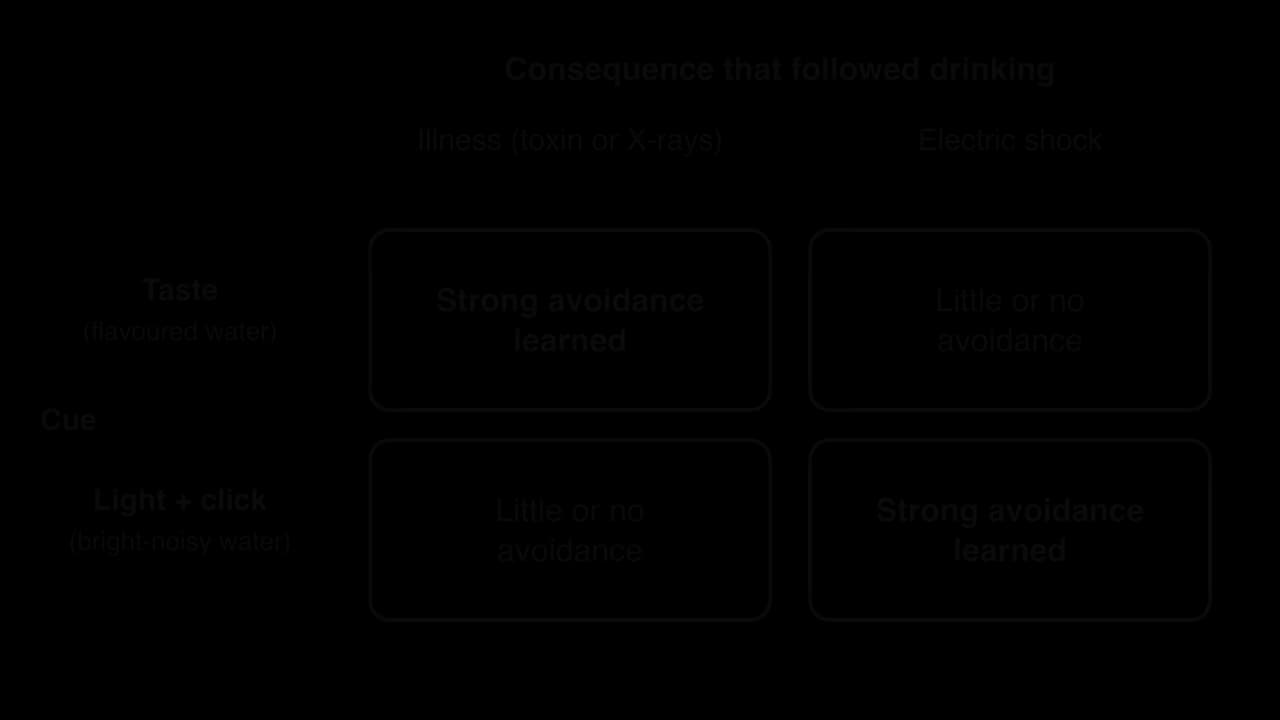
The grid shows that the rats were not simply learning whichever stimuli came before an unpleasant event. Taste is a reliable signal of food that may be poisonous, and sights and sounds are reliable signals of external dangers such as predators, so evolution appears to have prepared rats to make these particular links. The study also showed that a conditioned taste aversion can form even when illness comes long after eating, which breaks the usual rule of close timing.
Conditioned taste aversions are common in humans. Bernstein (1978) offered children who were receiving chemotherapy for cancer an unusual flavour of ice cream before a session of drug treatment. Children whose treatment made them sick were later less likely to choose that ice cream than children in a control group, although they knew that the drugs, not the ice cream, had caused the nausea. The finding helps to explain the loss of appetite that many cancer patients experience, and it led to practical advice such as giving patients an unfamiliar “scapegoat” food before treatment so that the aversion attaches to it instead of to everyday foods.
Preparedness also affects fear in primates. Cook and Mineka (1989) showed laboratory-reared rhesus monkeys, which had no fear of snakes, videos of other monkeys reacting fearfully. When the videos had been edited so that the fear seemed to be caused by a toy snake or toy crocodile, the observing monkeys acquired the fear; when the same fear reactions seemed to be caused by flowers or a toy rabbit, they did not. This study involved observational rather than direct conditioning, but it shows the same selective readiness to fear some objects and not others.
Classical conditioning is most important for emotional and physiological responses: fear, disgust, pleasure, nausea, sexual arousal, craving and the body’s preparation for food or drugs. These responses cannot be switched on by deciding to have them, which is why associations formed outside awareness can have such strong effects. Examples are found in each of the four contexts of the course.
The conditioning theory of phobias proposes that an intense fear begins when a neutral object or situation is paired with a frightening experience, and spreads through generalisation. Mowrer’s two-process theory adds that the fear is then kept going by avoidance: each time the person escapes the feared object, anxiety drops, which rewards the avoidance and prevents the person from discovering that the object is harmless. The first process is classical conditioning and the second is operant conditioning.
Conditioning also shapes responses to drugs. Siegel and colleagues argued that the places, objects and rituals that come before a drug become conditioned stimuli. They trigger a conditioned compensatory response, a set of bodily changes that oppose the drug’s effects and so contribute to tolerance.
Siegel, Hinson, Krank and McCully (1982) found that rats given a large dose of heroin were more likely to die when it was given in an environment different from the one in which they had received earlier doses. The model helps to explain why some human overdoses occur when a familiar dose is taken in an unfamiliar setting, and why drug cues can trigger craving and relapse long after withdrawal.
Anticipatory nausea is a further example. Some patients receiving chemotherapy begin to feel sick on the way to the hospital or on smelling the treatment room, before any drug has been given. The hospital setting has become a CS for the nausea originally caused by the drugs.
Infants form conditioned associations from the first weeks of life. Feeding routines are full of conditioned stimuli: the sight of a bottle or the parent’s voice before a feed can trigger sucking movements and calm a hungry baby. The Little Albert study by Watson and Rayner (1920) showed that an emotional response such as fear could be conditioned in an infant, and Watson used it to argue that much of a child’s emotional life is learned from experience rather than inherited.
Feelings towards people, objects and brands can be shaped by what they are paired with, a process often called evaluative conditioning. Gorn (1982) showed American students a slide of a coloured pen while music they liked or disliked was played; when later offered a pen, more students chose the colour that had been paired with the liked music. The study is often used to show conditioning in advertising, but later attempts to repeat it, such as Kellaris and Cox (1989), did not find the same effect, so the size and reliability of conditioning effects in advertising remain uncertain.
Similar processes may help to explain why people come to like places, songs and perfumes associated with a partner, and why a former partner’s name can produce a rush of emotion years later. In each case a neutral stimulus has been paired with strong emotional experiences.
Classrooms are full of potential conditioned stimuli. A student who has repeatedly felt humiliated when asked to solve problems at the board may come to feel anxious at the sight of a maths textbook, and the anxiety can then interfere with attention and memory. Equally, a calm, warm classroom can become a cue for feeling safe and ready to learn. The role of conditioning in learning, and how teachers use conditioning and reinforcement to change behaviour, is developed in the learning and cognition context.
Context | Behaviour | UCS → UCR | CS → CR |
|---|---|---|---|
Health and well-being | Anticipatory nausea in chemotherapy | Drugs → nausea | Hospital smell → nausea |
Health and well-being | Drug craving and tolerance | Drug → drug effects | Drug setting → compensatory response, craving |
Human development | An infant’s fear of a doctor’s white coat | Painful injection → distress | White coat → distress |
Human relationships | Liking for a song linked to a partner | Partner’s company → pleasure | The song → pleasant feelings |
Learning and cognition | Anxiety at the sight of a test paper | Public failure, criticism → anxiety | Test paper → anxiety |
If emotional responses can be learned through conditioning, they should also be changeable through conditioning. This idea led to some of the first psychological treatments based on experimental research. They belong in full to the psychological treatment of mental health disorders, so they are summarised briefly as applications of conditioning principles.
Jones (1924) worked with Peter, a boy of almost three who was afraid of rabbits, rats and furry objects. While Peter ate food he enjoyed, a rabbit in a cage was brought gradually closer over many sessions, until Peter could hold it and let it nibble his fingers. Pairing the feared object with a pleasant experience that is incompatible with fear is called counterconditioning.
Wolpe (1958) developed this into systematic desensitisation, in which a client learns relaxation and is then exposed, step by step, to a hierarchy of feared situations, from the least to the most frightening. Modern exposure therapy relies more directly on extinction: the person meets the feared stimulus without the feared outcome, for long enough and often enough for the fear to fade. Both are among the most effective treatments for specific phobias.
Aversion therapy works in the opposite direction. An unwanted behaviour is paired with an unpleasant stimulus so that the behaviour itself comes to produce discomfort. The drug disulfiram, for example, makes people who drink alcohol feel very sick, so that the taste of alcohol may become a CS for nausea. Aversion therapy raises serious ethical problems: it has been used in the past to try to change the sexual orientation of gay men, a practice now rejected as harmful and unethical, and its long-term effectiveness for addictions is weak because the CR tends to extinguish once the unpleasant stimulus is no longer given.
John B. Watson and Rosalie Rayner aimed to find out whether an emotional response, fear, could be conditioned in a human infant by pairing a neutral object with a frightening noise. They also wanted to know whether the fear would transfer to similar objects, and whether it would last over time. Watson believed that most adult fears are learned in this way rather than inherited.
The study was a single-participant experiment, sometimes described as a case study because it involved only one child. The participant, known as Albert B., was a healthy infant who had lived since birth in the Harriet Lane Home, a hospital for children in Baltimore, where his mother worked. Watson and Rayner described him as calm and unemotional. At about nine months old he was tested with a white rat, a rabbit, a dog, a monkey, masks with and without hair, cotton wool and burning newspaper. He showed no fear of any of them and usually reached out to handle them.
At 8 months and 26 days the researchers tested his response to a loud noise, made by striking a steel bar about four feet long with a hammer just behind his head. He started violently and, after the third strike, burst into tears. The noise was therefore an unconditioned stimulus for fear, and the white rat was a neutral stimulus.
Conditioning began at 11 months and 3 days. As Albert reached for the rat, the bar was struck behind him. He received two such pairings that day and five more a week later, seven in all. Fear was operationalised through observed behaviour: crying, whimpering, turning away, falling over and crawling away from the object, recorded in the researchers’ notes and on film. Later sessions tested his reactions to the rat alone, to similar objects and to wooden blocks as a control object, both in the original small room and in a large, well-lit lecture room.
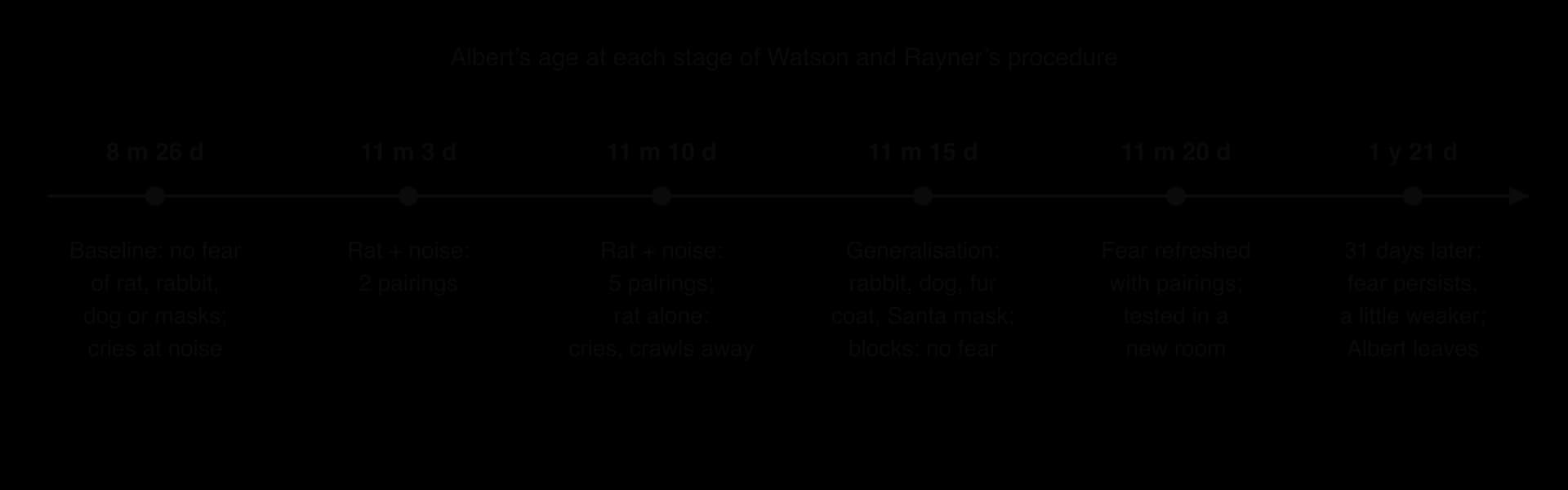
By the end of the second conditioning session, when the rat was presented alone, Albert began to cry, turned sharply away and crawled off so quickly that he had to be caught before he reached the edge of the table. Five days later the fear had generalised: he reacted negatively to a rabbit, a dog, a sealskin fur coat, cotton wool and a Santa Claus mask, but still played happily with his blocks. When the fears had weakened a few days later, they were refreshed with further pairings, and they then also appeared in a different, larger room.
Stimulus | Before conditioning (about 9 months) | After conditioning (11 months 15 days) | One month later (1 year 21 days) |
|---|---|---|---|
White rat (the CS) | Reached for it, no fear | Withdrew | Withdrew, fretted and covered his eyes |
Rabbit | No fear | Strong reaction: cried and crawled away | Withdrew, fretted, cried |
Dog | No fear | Cried when the dog came close | Cried when it came close |
Fur coat | Not tested | Withdrew, fretted, cried | Withdrew, fretted, cried |
Cotton wool | No fear | Avoided it, but no strong fear | Not reported |
Santa Claus mask | No fear of masks | Strongly negative | Cried at the sight of it |
Wooden blocks (control) | Played | Played normally | Played normally |
Sources: Watson, J. B. and Rayner, R. (1920). Conditioned emotional reactions. _Journal of Experimental Psychology, 3(1), 1–14, full text at psychclassics.yorku.ca._
Thirty-one days after the generalisation tests, with no emotional tests in between, Albert’s responses to the mask, the fur coat, the rat, the rabbit and the dog were still present, although somewhat less intense. Albert was taken from the hospital on the day of this final test, so the researchers never tried to remove the fears they had created. Their paper lists methods they would have tried, including pairing the feared objects with food and with soothing touch.
Watson and Rayner concluded that a fear response could be conditioned in a human infant through simple pairing, that it generalised to similar stimuli, and that it persisted for at least a month. In classical conditioning terms, the loud noise was the UCS, fear was the UCR, the rat became the CS and fear of the rat was the CR. They argued that many adult phobias are conditioned emotional reactions formed in the same way, which became the basis of the conditioning theory of phobias.
 YouTube
Fear was measured by the researchers’ own descriptions of crying, withdrawal and crawling, with no standardised scale, no observers unaware of the aims, and no measure of inter-rater reliability. The procedure also changed during the study: the noise was sometimes struck when Albert was reaching, sometimes not, and the rat was refreshed with extra pairings when the fear weakened. Harris (1979) re-read the original reports and film and argued that Albert’s reactions were less consistent and less dramatic than textbook accounts suggest.
With one participant and no control child, the study cannot rule out other explanations for Albert’s changing behaviour, such as tiredness or his frustration when his thumb was pulled out of his mouth, which happened during testing. A single, unusually calm infant raised in a hospital may not represent infants in general. Attempts by other researchers in the 1920s and 1930s to produce conditioned fears in infants had mixed results, so the study is better seen as a demonstration that conditioning of fear is possible than as proof that phobias arise this way.
Beck, Levinson and Irons (2009) proposed that Albert was Douglas Merritte, the son of a wet nurse at the hospital, who developed hydrocephalus and died aged six. Fridlund and colleagues (2012) then argued that this child was neurologically impaired, which would undermine Watson’s description of a healthy, normal infant. Powell and colleagues (2014) found a better match in William Albert Barger, a healthy child of another hospital worker, who lived to 87. The debate shows how much depends on trusting the original researchers’ account, and how the ethical problems of the study would be even greater if the child had been ill.
By current ethical standards the study would not be allowed. Albert was deliberately frightened, there is no evidence that his mother gave informed consent to the creation of fear, and the researchers made no attempt to remove the fear before he left the hospital. This failure of protection from harm is why Little Albert is often used as a textbook example of unethical research with vulnerable participants.
Classical conditioning is one of the best-supported principles in psychology. It has been demonstrated in a wide range of species, from sea slugs to humans, and in responses as different as salivation, eye blinks, fear, nausea and immune responses. Because the researcher controls exactly when the stimuli occur, laboratory studies can show causality: the pairing of CS and UCS causes the conditioned response, since the response does not appear in control groups given unpaired stimuli.
The theory has also been useful in practice. Exposure-based treatments built on extinction and counterconditioning are among the most effective psychological treatments for phobias, and an understanding of conditioned drug cues has shaped advice on relapse prevention. Taste aversion research has led to practical strategies for cancer patients and to non-lethal ways of discouraging predators from attacking livestock.
Conditioning explains how some fears begin, but not all of them. Many people with phobias cannot remember any frightening experience with the feared object, and many people who have such experiences, such as being bitten by a dog, do not develop a phobia. Other routes to fear, such as observing others’ fear or being told that something is dangerous, and individual differences in temperament and genetics also matter. A purely conditioning account is therefore reductionist.
Much of the evidence comes from animals in controlled laboratories. Extrapolation to humans is reasonable for simple reflexes, but human learning is shaped by language, beliefs and expectations. People can acquire a fear simply by being told that a stimulus will be followed by a shock, and conditioned responses in humans often weaken immediately when people are told that the UCS will no longer occur. These findings support the cognitive view that conditioning depends on expectations, not only on the pairing of stimuli.
Classical conditioning is also a deterministic account: it implies that emotional responses are fixed by past pairings. Yet humans can reappraise situations, choose to face their fears and change their emotional responses through therapy and effort, which suggests some degree of agency in what has been learned.
The mechanism of conditioning appears to be universal, but what is conditioned depends on culture. Which foods are eaten, which symbols are linked with danger or celebration, and how children are comforted or punished all vary between cultural groups, so the conditioned stimuli and responses in people’s lives vary too. Most experimental research has been conducted in Western laboratories with animals or university students, so less is known about how cultural experience interacts with conditioning in everyday life.
Concept | How it applies to classical conditioning |
|---|---|
Causality | Laboratory pairings show that a CS–UCS association causes a CR; in real phobias the original cause is usually unknown and other routes to fear exist. |
Measurement | Responses are operationalised as drops of saliva, freezing, heart rate or behaviour; emotions such as fear in an infant are hard to measure reliably. |
Perspective | Behaviourists saw conditioning as automatic; contingency and blocking support a cognitive view based on prediction; preparedness adds a biological view. |
Responsibility | Creating fear in participants, as in Little Albert, and causing pain or illness in animals raise serious ethical questions; aversion therapy has been misused. |
Change | Extinction and counterconditioning are the basis of treatments that change unwanted emotional responses, though fears can return through spontaneous recovery. |
Bias | Textbook accounts of Little Albert have often exaggerated its findings; samples are mostly animals and Western students. |
Classical conditioning is a cognitive approach term, so it can appear in Paper 1 Section A as a short-answer question with no context given, or in Section B, where it must be applied to a scenario from one of the four contexts. It is also an area of study in learning and cognition, so it can be the focus of a concept-based essay in Section C.
Classical conditioning is learning by association: a neutral stimulus paired with an unconditioned stimulus becomes a conditioned stimulus that triggers a conditioned response.
The UCS and UCR are unlearned; the CS and CR are learned. The same behaviour can be a UCR or a CR depending on what triggers it.
Conditioning is strongest when the CS comes just before the UCS and reliably predicts it; contingency and blocking show that organisms learn what predicts what, which places conditioning in the cognitive approach.
Extinction weakens a CR when the CS appears without the UCS, but spontaneous recovery and renewal show the original learning survives.
Generalisation spreads a CR to similar stimuli; discrimination restricts it to the CS.
Biological preparedness makes some links, such as taste with illness and snakes with fear, much easier to learn (Garcia and Koelling, 1966; Bernstein, 1978).
Conditioning helps to explain phobias, drug cravings and tolerance, anticipatory nausea, early emotional learning, liking and classroom anxiety, and underlies counterconditioning, exposure and aversion therapy.
Watson and Rayner (1920) conditioned fear of a rat in an infant, which generalised to similar objects, but the study used one child, informal measures and caused harm without removing the fear.
Conditioning explains some behaviour well but is reductionist on its own: genetic, cognitive and social factors also shape which responses are learned.
I can describe the process of classical conditioning using UCS, UCR, NS, CS and CR.
I can explain how timing, contingency and blocking affect conditioning.
I can describe extinction, spontaneous recovery, generalisation and discrimination, with an example of each.
I can explain biological preparedness using Garcia and Koelling (1966).
I can explain the role of classical conditioning in behaviour in each of the four contexts.
I can describe and evaluate the Little Albert study.
I can evaluate classical conditioning with reference to causality, measurement, perspective and responsibility.
I can apply classical conditioning to a new scenario, labelling each term.