 YouTube
Explain the two systems of dual processing theory and how they interact in decision-making, evaluate the evidence for them, including the Cognitive Reflection Test, and apply the theory to real decisions.
Each is in the Psychology glossary, with every other term in the subject.
The idea that people tend to minimise mental effort, relying on quick, intuitive System 1 judgements and engaging effortful System 2 thinking only when they must.
A three-item test devised by Frederick (2005) in which each question invites a fast, intuitive but wrong answer, used to measure the tendency to override intuition with reflection.
The cognitive process of choosing between two or more options, which involves judging the likelihood and value of possible outcomes.
A theory proposing that thinking and decision-making rely on two types of process: fast, automatic, intuitive System 1 processing and slow, effortful, deliberate System 2 processing that can check and override it.
A mental shortcut or rule of thumb that produces a quick judgement with little effort; heuristics are usually adequate but can lead to systematic errors called cognitive biases.
The fast, automatic, effortless and largely unconscious mode of thinking in dual processing theory, which produces intuitive judgements by association and heuristics without loading working memory.
The slow, deliberate, effortful and conscious mode of thinking in dual processing theory, which uses working memory to follow rules, reason hypothetically and check or override System 1.
Describe the characteristics of System 1 and System 2 thinking in dual processing theory.
Explain how the two systems interact in decision-making, including the role of heuristics and the idea of the cognitive miser.
Explain how research using cognitive load, individual differences and brain imaging supports the theory.
Describe the aim, method, results and conclusions of Frederick (2005) on the Cognitive Reflection Test.
Apply dual processing theory to decisions in health, relationships, learning and development.
Evaluate dual processing theory with reference to measurement, causality, bias and perspective, including failed replications.
Dual processing theory proposes that people think in two different ways: a fast, automatic, intuitive way that produces most everyday judgements, and a slow, effortful, deliberate way that can check and correct them. It explains why intelligent people make predictable errors, why decisions change under time pressure or distraction, and why the way a choice is presented can change what people choose.
The theory belongs to the cognitive approach and is one of its most influential accounts of decision-making. It links closely to research on cognitive biases, which it explains as by-products of fast thinking, and research on it raises questions of measurement, because the two systems cannot be observed directly, and of causality, because many findings are correlations between thinking style and outcomes.
With a free account, Augment remembers where you stopped and what you have practiced.
Scope: An approach term in the cognitive approach, with a focus on the role of dual processing theory in understanding decision-making. Questions can ask about it with any example of behaviour, and the dual processing model is applied in the learning and cognition context as an area of study in thinking and decision-making.
Most people can answer “2 + 2 = ?” instantly, without trying, and cannot stop the answer from coming to mind. Working out 17 × 24 in the head is different: it requires deliberate attention, the steps have to be held in mind, and it is easily disrupted. Kahneman (2011) used contrasts like this to introduce two modes of thinking, which Stanovich and West (2000) had called System 1 and System 2.
System 1 operates quickly and automatically, with little or no effort and no sense of voluntary control. It recognises faces and emotions, completes familiar phrases, reads simple words and produces immediate impressions of people and situations. It works by association: it links the present situation to similar situations in memory and generates a feeling of what is likely, right or dangerous.
Most of what people do competently every day, from understanding speech to driving a familiar route, depends on System 1. Its outputs are often good enough and arrive without loading working memory. Its main limitation is that, when a question is difficult, System 1 often substitutes an easier related question and answers that one instead.
System 2 is the mode of thinking that people experience as reasoning. It is slow, effortful and conscious, it follows rules, and it can consider hypothetical possibilities (“what would happen if…?”). It is needed for calculation, for comparing options on several features, for applying a rule that conflicts with habit and for checking whether an intuitive answer is correct.
System 2 depends on working memory and attention, so its capacity is limited. When people are tired, distracted, rushed or busy with another task, System 2 has fewer resources, and decisions rely more on System 1.
Feature | System 1 | System 2 |
|---|---|---|
Speed | Fast | Slow |
Effort | Effortless | Effortful |
Control | Automatic; cannot easily be switched off | Deliberate and voluntary |
Awareness | Mostly unconscious; only the result is experienced | Conscious; the steps are experienced |
Working memory | Little or no demand | Heavy demand |
How it works | Association, pattern recognition, heuristics | Rules, logic, calculation, hypothetical thinking |
Typical errors | Systematic biases | Fewer errors, but slow and easily overloaded |
Examples | Recognising a friend’s face; feeling that a stranger is untrustworthy | Filling in a tax form; comparing two phone contracts |
YouTubeDecisions are where the two kinds of thinking meet. Choosing what to buy, whom to trust or whether to take a risk usually begins with an immediate feeling about the options, and sometimes, but not always, continues with a deliberate comparison of them.
The most widely used version of the theory is the default-interventionist model. System 1 always responds first and supplies a default answer. System 2 monitors this answer and can intervene, but intervention costs effort, so it happens only under certain conditions.
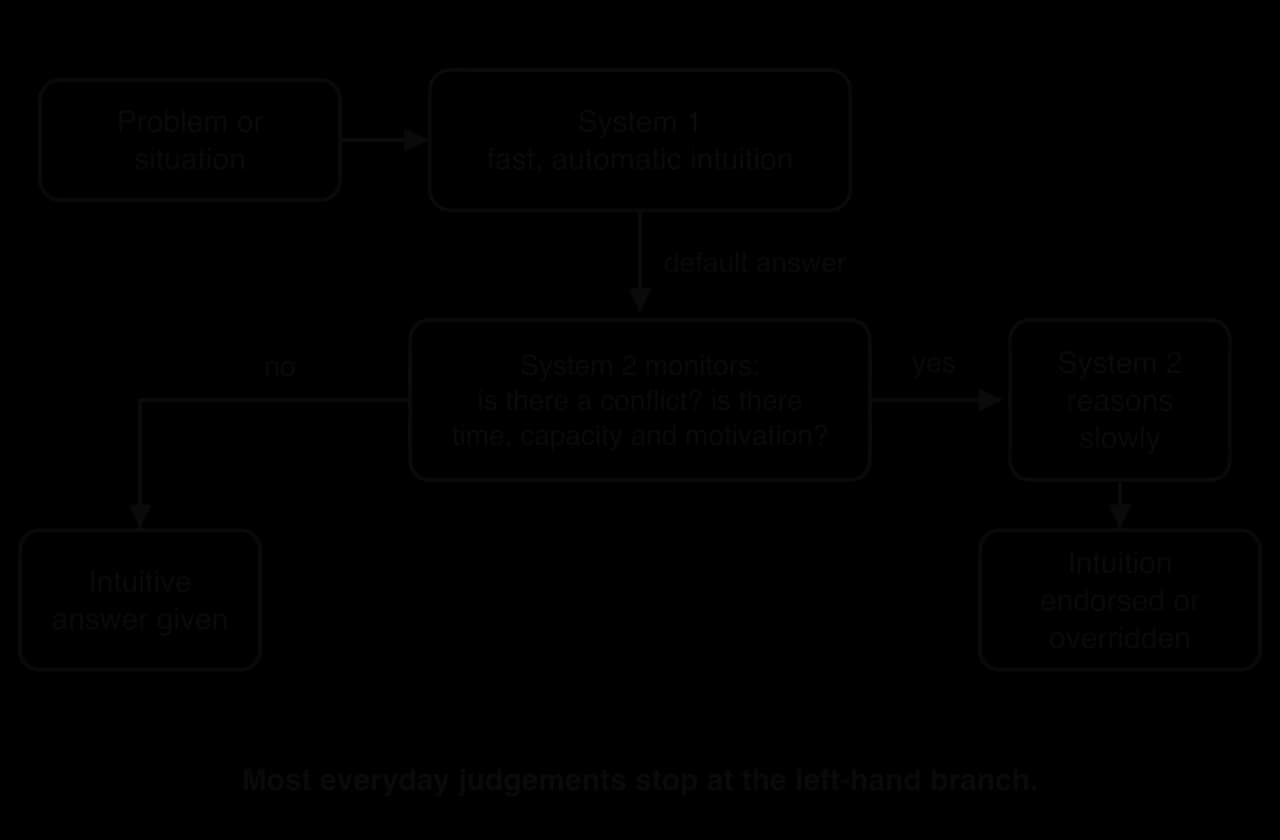
Three conditions must be met for System 2 to correct an intuition. First, the person must notice that something might be wrong, for example that the quick answer conflicts with a rule they know. Second, they need the working memory capacity to reason it out, which is reduced by distraction, fatigue or time pressure. Third, they must be motivated to make the effort, because a quick answer that feels right gives little reason to check.
Because System 2 is effortful, people tend to avoid using it when they can. Social psychologists describe people as cognitive misers: they economise on mental effort and accept a quick, plausible answer unless something forces them to think harder. With limited capacity and many decisions to make each day, relying on intuition for most of them is efficient.
 YouTube
Many of System 1’s answers come from heuristics: mental shortcuts that replace a difficult question with an easier one. Asked “How likely is a plane crash?”, System 1 may answer the easier question “How easily can I think of plane crashes?”. Tversky and Kahneman (1974) described three such shortcuts: anchoring on an initial value, judging probability by ease of recall (availability) and judging by resemblance to a typical case (representativeness).
Dual processing theory explains why heuristics persist even among people who know the correct rules. The heuristic answer arrives first and feels right. Unless System 2 notices a problem and has the capacity to work through the alternative, the heuristic answer becomes the decision, and the resulting error is a systematic cognitive bias rather than a random mistake.
If two kinds of processing exist, they should behave differently under different conditions. Researchers have tested this in three main ways: by loading working memory, by comparing people with different cognitive abilities and by looking at brain activity.
De Neys (2006) asked Belgian university students to judge whether the conclusions of logical arguments followed from their premises while they also performed a secondary task that loaded working memory. Some arguments had a believable conclusion that was also logically valid (no conflict), so intuition gave the right answer. Others set believability against logic (conflict), so the right answer required System 2 to override the intuitive one.
The memory load reduced accuracy on the conflict problems but not on the no-conflict problems. This is the pattern the theory predicts: only answers that depend on System 2 should suffer when working memory is busy. Participants with higher working memory capacity did better on conflict problems, but the load affected all participants to a similar extent, which suggests that everyone uses the same two kinds of processing rather than some people reasoning in a fundamentally different way.
Stanovich and West (2000) gave large samples of university students many of the classic reasoning and decision tasks used to show biases. Students with higher cognitive ability, measured by tests such as the SAT, were more likely to give the normatively correct answer on many tasks, especially those where the intuitive answer had to be overridden. The theory explains this as individual differences in System 2: people differ in their capacity to override intuitions and in their tendency to check them.
De Martino, Kumaran, Seymour and Dolan (2006) used fMRI while participants in London chose between a sure option and a gamble. The same choice was framed either as keeping money or as losing it. Participants were more likely to take the sure option when it was framed as a gain and the gamble when the sure option was framed as a loss, and this framing effect was associated with activity in the amygdala, a region involved in emotion. Participants whose choices were less affected by the frame showed more activity in the orbital and medial prefrontal cortex.
The results fit the idea of a fast, emotional response that biases choice and a more controlled process that can reduce the bias. They need careful interpretation, however. Activity in a region does not show that the region is “System 1” or “System 2”, and the amygdala and prefrontal cortex are involved in many other processes.
Because almost every decision involves a quick intuition that may or may not be checked, dual processing theory is used to explain behaviour in all four contexts. In each case the explanation has the same structure: what System 1 supplies by default, and what would be needed for System 2 to change it.
Johnson and Goldstein (2003) compared European countries in which people had to opt in to become organ donors with countries in which people were donors unless they opted out. Consent rates were far higher in the opt-out countries, and the same difference appeared in an online experiment in which the default was manipulated. Accepting the default requires no decision at all, so it is what a cognitive miser does when nothing prompts System 2 to consider the choice. Governments use this kind of nudge in health policy, for example by making healthy options the default in canteens.
Dual processing also helps explain impulsive health behaviour. Choosing a cigarette or a sugary snack in the moment draws on immediate, emotionally driven System 1 responses, while weighing long-term risks requires System 2. Health campaigns that rely only on information assume that people will engage System 2, which they often do not do when tired, stressed or rushed.
Willis and Todorov (2006) showed participants photographs of unfamiliar faces for 100 milliseconds, 500 milliseconds or one second and asked them to judge traits such as trustworthiness and competence. Judgements made after 100 milliseconds correlated highly with judgements made with no time limit, and more time mainly increased confidence. Impressions of other people therefore form almost instantly, a typical System 1 process, and later System 2 thinking tends to adjust them rather than build them from scratch.
Dual processing has also been used to ask whether cooperation is intuitive. Rand, Greene and Nowak (2012) reported that people forced to decide quickly contributed more money to a group in an economic game than people forced to wait, suggesting that cooperation is the intuitive response. A registered replication across 21 laboratories by Bouwmeester and colleagues (2017) found no effect of time pressure once all participants who had been randomly assigned were included. The original pattern appeared only when participants who failed to follow the time limits were excluded, which suggested a selection effect rather than a real effect of intuition.
Learning a complex skill often moves it from System 2 to System 1. A child learning to read sounds out each letter with effort; a fluent reader recognises whole words automatically. A learner driver thinks about every gear change; an experienced driver does not. This links dual processing to cognitive load theory: as practice builds and automates schemas, tasks that once needed effortful processing in working memory can be carried out by fast, automatic processes, freeing capacity for new learning.
The capacity for deliberate control develops slowly through childhood and adolescence, together with the maturation of the prefrontal cortex. The dual systems model of adolescent development uses a related idea to explain why teenagers take more risks with peers present: a reward-driven system matures earlier than the control system that regulates it. The two models are not identical, but both explain decisions through a fast, impulsive process and a slower controlling one.
Shane Frederick aimed to develop a short test of cognitive reflection, the ability or disposition to resist the first answer that comes to mind and check it, and to find out whether scores on the test predict decision-making, in particular patience (time preference) and willingness to take risks.
Frederick designed the three-item Cognitive Reflection Test (CRT). Each item has an intuitive answer that springs to mind but is wrong, and a correct answer that is easy to understand once it has been worked out.
Bat and ball: A bat and a ball cost $1.10 in total. The bat costs $1.00 more than the ball. How much does the ball cost? (Intuitive answer 10 cents; correct answer 5 cents.)
Machines and widgets: If it takes 5 machines 5 minutes to make 5 widgets, how long would it take 100 machines to make 100 widgets? (Intuitive answer 100 minutes; correct answer 5 minutes.)
Lily pads: A patch of lily pads doubles in size every day. If it takes 48 days to cover the whole lake, how long does it take to cover half the lake? (Intuitive answer 24 days; correct answer 47 days.)

The CRT was given to 3,428 respondents in 35 separate studies over 26 months from January 2003. Most were undergraduates at universities in the north-east and midwest of the United States, and the CRT was part of a longer questionnaire that also measured time and risk preferences. The test page said only that the problems varied in difficulty and asked respondents to answer as many as they could. Frederick compared the “low” group, who scored 0 out of 3, with the “high” group, who scored 3 out of 3.
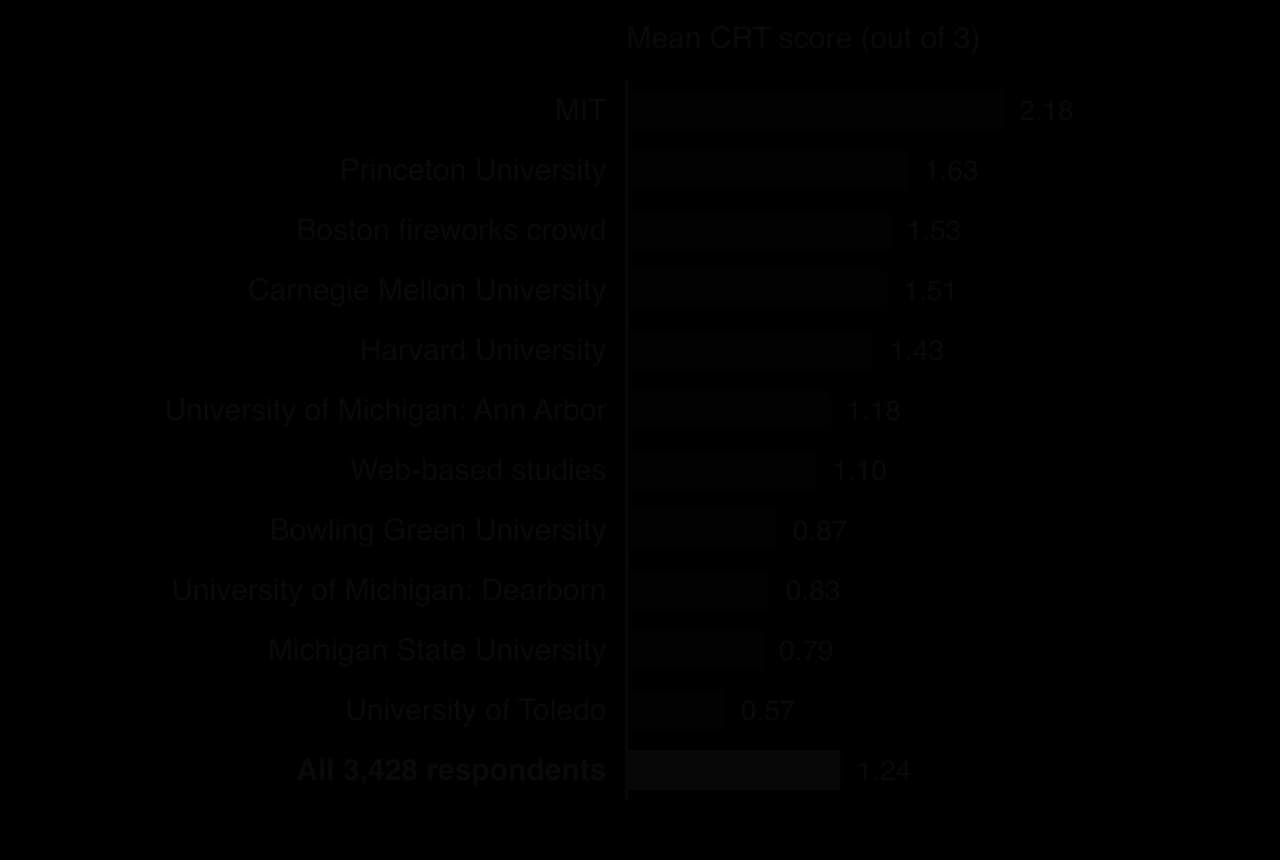
Across all respondents the mean score was 1.24 out of 3: 33% answered none of the three items correctly and only 17% answered all three. Several findings showed that the wrong answers were intuitive rather than random. Among all possible wrong answers, the intuitive ones (10, 100 and 24) were by far the most common. Respondents who gave the correct answer often wrote the intuitive answer first and crossed it out, but never the reverse. Respondents who answered “10 cents” estimated that 92% of other people would solve the problem, compared with 62% among those who answered “5 cents”.
CRT scores predicted choices. High scorers were more patient and, in the domain of gains, more willing to take risks with a higher expected value. Men scored significantly higher than women on the test.
Choice offered | Low CRT group (0/3) | High CRT group (3/3) |
|---|---|---|
$3,400 this month or $3,800 next month (% choosing to wait) | 35% | 60% |
$100 for sure or a 75% chance of $200 (% choosing the gamble) | 19% | 38% |
Lose $100 for sure or a 75% chance to lose $200 (% choosing the gamble) | 54% | 31% |
The last two rows show that the high-CRT group was more willing to gamble when the gamble offered gains and less willing when it involved losses. Low scorers showed the pattern described by prospect theory more strongly: cautious with gains and risk-seeking to avoid a certain loss.
Frederick concluded that many people, including students at highly selective universities, report the first answer that comes to mind without checking it, and that people differ reliably in cognitive reflection. In dual processing terms, System 1 produces a confident default, and only some people, some of the time, engage System 2 to test it. Because the test predicted real choices about time and money, cognitive reflection appears to be a general characteristic of decision-making rather than a skill specific to puzzles.
Measurement. The CRT is quick and easy to score, and it has been widely used and its scores linked to performance on many heuristics-and-biases tasks. However, all three items require numeracy, so a low score may reflect weak arithmetic as well as low reflection. The items have also become famous: many online participants have seen them before, which raises scores and changes what the test measures. With only three items, a person’s score is a coarse measure.
Causality. The links between CRT scores and choices are correlations between two measures taken at the same time. They do not show that reflection causes patience. A third variable, such as general intelligence or education, could explain both, and Frederick acknowledged that the CRT correlates with other cognitive tests.
Bias. The samples were mostly American undergraduates at selective universities, a narrow group, and they were not randomly selected. The samples at each site were also recruited in different ways, which matters because mean scores differed widely between sites and men scored higher than women. Conclusions about “people in general” should therefore be drawn with care.
Sources: Frederick, S. (2005). Cognitive reflection and decision making. _Journal of Economic Perspectives, 19(4), 25–42._
Dual processing theory is one of the most cited ideas in psychology and has shaped economics and public policy. It also has serious critics, and several findings once used to support it have not survived replication.
The theory brings together a large number of findings that would otherwise look unrelated: biases in judgement, the effects of time pressure and distraction, individual differences in reasoning and the power of defaults. It makes testable predictions, for example that loading working memory should harm answers that require System 2 but not those that intuition gets right, and research such as De Neys (2006) has confirmed them. It has also produced practical applications, from default options in pension and organ-donor schemes to checklists that make professionals pause before acting on a first impression.
Neither system can be observed directly. Researchers infer which system produced an answer from its speed, from whether it matches the intuitive or the normative answer, or from what happens under load. Each inference can be questioned. A fast answer is not necessarily intuitive, and a correct answer to a CRT item may come from having seen the item before. Because the same results can be described in several ways, it is difficult to design a study that could show the theory to be wrong.
Some of the most popular demonstrations of the theory came from experiments that manipulated one system and observed the effect on behaviour. Several have failed to replicate. The idea that System 2 depends on a limited store of willpower that is used up by effort, known as ego depletion, was tested by Hagger and colleagues (2016) in a registered replication across 23 laboratories with 2,141 participants, which found an effect close to zero. The time-pressure effect on cooperation reported by Rand and colleagues (2012) did not replicate across 21 laboratories, and a well-known claim that a hard-to-read font switches on System 2 also failed in large replications.
These failures leave the distinction between fast and slow processing intact, because it rests on many converging findings. They show that particular manipulations of the systems are less reliable than once thought, and that small original studies with surprising results need to be repeated before they are used as evidence about cause and effect.
Keren and Schul (2009) argued that the theory groups together features that do not always occur together. A process can be fast but controlled, or slow but unconscious, so dividing thinking into two systems with a fixed list of features oversimplifies it. Kruglanski and Gigerenzer (2011) went further and proposed that intuitive and deliberate judgements follow the same kind of rules and differ only in degree, so that a single process with a continuum of effort explains the data as well as two systems do.
Defenders of the theory, such as Evans and Stanovich (2013), responded that the essential difference is that deliberate processing loads working memory and allows hypothetical thinking, and that the long lists of features were never meant as a definition. The debate has made the theory more precise: most researchers now speak of two types of processing rather than two separate systems in the brain.
Most evidence comes from university students in North America and Western Europe, often solving abstract puzzles with one correct answer, such as syllogisms or the CRT. Which kind of thinking people prefer, and when they trust intuition, may depend on cultural norms about reasoning and on what counts as a good decision in a particular community. Tasks with a single “normative” answer also build in the researcher’s view of what is rational, which may not match the goals of the people making real decisions.
Concept | Strength of dual processing theory | Limitation |
|---|---|---|
Measurement | Converging methods (load, response time, individual differences, imaging) point to two types of processing | The systems are inferred, not observed; the CRT confounds reflection with numeracy |
Causality | Working memory load experiments show that some answers depend on System 2 | Several manipulations (ego depletion, time pressure, disfluent fonts) have not replicated |
Perspective | A clear framework that unites many biases and has practical uses | Critics argue for a continuum or a single process; the two-system label oversimplifies |
Bias | Explains why biases are systematic rather than random | Mainly WEIRD student samples and abstract puzzles with one “correct” answer |
Dual processing theory is an approach term, so it can be the focus of a Paper 1 Section A question with no context, or the theory to apply to an unseen scenario in Paper 1 Section B. The dual processing model also appears in the learning and cognition context, where Section C essays may ask about its value for understanding thinking and decision-making.
Section B questions give an unseen scenario. A strong answer uses details from the scenario in every paragraph and links each one to the theory, as in the following model answer.
Dual processing theory proposes two kinds of thinking: fast, automatic, intuitive System 1 and slow, effortful, deliberate System 2.
In the default-interventionist model, System 1 supplies a default answer and System 2 overrides it only when a conflict is detected and there is enough time, capacity and motivation.
People act as cognitive misers, relying on heuristics; the predictable errors this produces are cognitive biases.
A working memory load harms reasoning that requires System 2 but not reasoning that intuition gets right, as De Neys (2006) showed; Stanovich and West (2000) found that people with higher cognitive ability override intuitions more often.
Frederick (2005) found that 3,428 mostly student respondents averaged 1.24 out of 3 on the CRT, and that high scorers were more patient and made different risk choices.
The theory explains defaults in health, instant first impressions in relationships and the automation of skills in learning.
The systems are inferred rather than observed, the CRT confounds reflection with numeracy, and manipulations such as ego depletion and time pressure have failed to replicate.
Critics argue for a continuum or a single process, while defenders define Type 2 processing by its demand on working memory.
I can describe the characteristics of System 1 and System 2.
I can explain how the two systems interact in decision-making, including heuristics and the cognitive miser.
I can explain how load, individual-difference and brain-imaging research support the theory.
I can describe the aim, method, results and conclusions of Frederick (2005).
I can apply dual processing theory to decisions in health, relationships, learning and development.
I can evaluate the theory with reference to measurement, causality, bias and perspective, including failed replications.